

ASTM D7891-24
(Test Method)Standard Test Method for Shear Testing of Powders Using the Freeman Technology FT4 Powder Rheometer Shear Cell
General Information
- Abstract
SIGNIFICANCE AND USE
5.1 The test can be used to evaluate the following:
5.1.1 Classification or Comparison of Powders—There are several parameters that can be used to classify powders relative to each other, the most useful being the measured shear stresses, cohesion, flow function and angle of internal friction.
5.1.2 Sensitivity Analysis—The shear cell can be used to evaluate the relative effects of a range of powder properties or environmental parameters, or both, such as (but not limited to) humidity, particle size and size distribution, particle shape and shape distribution, water content and temperature.
5.2 Quality Control—The test can, in some circumstances, be used to assess the flow properties of a raw material, intermediate or product against pre-determined acceptance criteria.
5.3 Storage Vessel Design—Mathematical models exist for the determination of storage vessel design parameters which are based on the flow properties of powders as generated by shear cell testing, requiring shear testing at a range of consolidating stresses as well as the measurement of the wall friction angle with respect to the material of construction of the storage vessel. The methods are detailed in Refs. (1-3).3
Note 1: The quality of the result produced by this test method is dependent on the competence of the personnel performing it, and the suitability of the equipment and facilities used. Agencies that meet the criteria of Practice D3740 are generally considered capable of competent and objective testing/sampling/inspection/etc. Users of this test method are cautioned that compliance with Practice D3740 does not in itself assure reliable results. Reliable results depend on many factors; Practice D3740 provides a means of evaluating some of those factors (4).
Practice D3740 was developed for agencies engaged in the testing and/or inspection of soil and rock. As such it is not totally applicable to agencies performing this test method. However, users of this test method shoul...
SCOPE
1.1 This method covers the apparatus and procedures for quantifying the incipient failure properties of a powder as a function of the normal stress for a given level of consolidation. The method also allows the further determination of the unconfined yield strength, internal friction angles, cohesion, flow function, major principal stress and wall friction angle (with the appropriate wall coupon fitted to the correct accessory).
1.2 These parameters are most commonly used to assist with the design of storage hoppers and bins using industry standard calculations and procedures. They can also provide relative classification or comparison of the flow behavior of different powders or different batches of the same powder if similar stress and shear regimes are encountered within the processing equipment.
1.3 The apparatus is appropriate for measuring the properties of powders with a maximum particle size of 1 mm. It is practicable to test powders that have a small proportion of particles of 1 mm or greater, but it is recommended they represent no more than 5 % of the total mass in samples with a normal (Gaussian) size distribution.
1.4 All observed and calculated values shall conform to the guidelines for significant digits and rounding established in Practice D6026.
1.4.1 The procedures used to specify how data are collected/recorded or calculated, in this standard are regarded as the industry standard. In addition, they are representative of the significant digits that generally should be retained. The procedures used do not consider material variation, purpose for obtaining the data, special purpose studies, or any considerations for the user’s objectives; and it is common practice to increase or reduce significant digits of reported data to be commensurate with these considerations. It is beyond the scope of this standard to consider significant digits used in analysis methods for engineering design.
1.5 Un...
- Status
- Published
- Publication Date
- 14-Mar-2024
- Technical Committee
- D18 - Soil and Rock
- Drafting Committee
- D18.24 - Characterization and Handling of Powders and Bulk Solids
Buy Documents
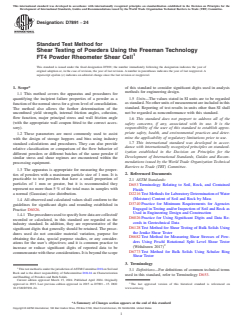
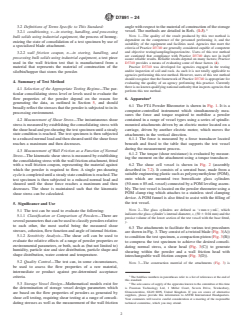
ASTM D7891-24 - Standard Test Method for Shear Testing of Powders Using the Freeman Technology FT4 Powder Rheometer Shear Cell
REDLINE ASTM D7891-24 - Standard Test Method for Shear Testing of Powders Using the Freeman Technology FT4 Powder Rheometer Shear Cell
Overview
ASTM D7891-24, titled Standard Test Method for Shear Testing of Powders Using the Freeman Technology FT4 Powder Rheometer Shear Cell, provides guidelines for measuring the flow properties of powders. Developed by ASTM International, this standard outlines apparatus specifications and procedures for quantifying key powder flow properties, such as shear stress, cohesion, internal friction angle, flow function, yield strength, principal stress, and wall friction angle. These properties are essential in the classification, comparison, quality control, and handling of powders and bulk solids across a range of industries.
Key Topics
Measurement Parameters: The method allows for the determination of vital powder properties including:
- Incipient failure properties as a function of normal stress
- Unconfined yield strength
- Internal friction angles
- Cohesion
- Flow function
- Major principal stress
- Wall friction angle (dependent on specific wall materials)
Apparatus: The test employs the FT4 Powder Rheometer fitted with various attachments such as shear heads, pistons, and wall friction coupons, in a controlled environment.
Sample Requirements: The test is designed for powders with a maximum particle size of 1 mm. Samples may include up to 5% particles at or above this size, provided they follow a normal (Gaussian) size distribution.
Calibration and Data Integrity: The standard emphasizes the importance of conformity with significant digits and rounding practices as set out in ASTM D6026, and periodic instrument calibration.
Applications
ASTM D7891-24 is widely used for:
Classifying and Comparing Powders: By measuring parameters like cohesion and shear stress, this method helps industries compare different powders or monitor consistency between batches.
Sensitivity Analysis: Evaluate how powder behavior changes due to factors such as humidity, particle size, shape, water content, and temperature. This aids in optimizing materials and environmental conditions for manufacturing and processing.
Quality Control: The method supports quality assurance by enabling the assessment of raw materials, intermediates, or finished products against predefined flow criteria, ensuring reliable handling and processing performance.
Design of Storage Vessels: Accurate flow property data are used to inform the design and engineering of hoppers, silos, and bins. Measurements like wall friction angle directly influence vessel geometry and material selection to minimize issues such as bridging, ratholing, and flow stoppages.
Related Standards
Professionals using ASTM D7891-24 may also reference:
- ASTM D653 - Terminology Relating to Soil, Rock, and Contained Fluids
- ASTM D2216 - Water Content Determination of Soil and Rock
- ASTM D3740 - Minimum Requirements for Testing and Inspection Agencies
- ASTM D6026 - Significant Digits and Data Records in Geotechnical Data
- ASTM D6128 - Shear Testing of Bulk Solids Using the Jenike Shear Tester
- ASTM D6773 - Shear Testing Using the Schulze Ring Shear Tester
Practical Value
Implementing ASTM D7891-24 enhances powder processing by:
- Facilitating reliable material classification and batch-to-batch consistency
- Supporting effective quality control measures for powders and granular materials
- Enabling informed equipment and vessel design, leading to safer and more predictable powder handling
- Providing a basis for troubleshooting processing issues related to flow behavior
Adhering to this standard ensures that powder flow properties are measured with consistency and accuracy, supporting optimal process control in industries such as pharmaceuticals, chemicals, food, and materials manufacturing.
Relations
- Effective Date
- 15-Mar-2024
- Effective Date
- 15-Mar-2024
Buy Documents
ASTM D7891-24 - Standard Test Method for Shear Testing of Powders Using the Freeman Technology FT4 Powder Rheometer Shear Cell
REDLINE ASTM D7891-24 - Standard Test Method for Shear Testing of Powders Using the Freeman Technology FT4 Powder Rheometer Shear Cell
Get Certified
Connect with accredited certification bodies for this standard

IMP NDT d.o.o.
Non-destructive testing services. Radiography, ultrasonic, magnetic particle, penetrant, visual inspection.
Inštitut za kovinske materiale in tehnologije
Institute of Metals and Technology. Materials testing, metallurgical analysis, NDT.
Q Techna d.o.o.
NDT and quality assurance specialist. 30+ years experience. NDT personnel certification per ISO 9712, nuclear and thermal power plant inspections, QA/
Sponsored listings
Frequently Asked Questions
ASTM D7891-24 is a standard published by ASTM International. Its full title is "Standard Test Method for Shear Testing of Powders Using the Freeman Technology FT4 Powder Rheometer Shear Cell". This standard covers: SIGNIFICANCE AND USE 5.1 The test can be used to evaluate the following: 5.1.1 Classification or Comparison of Powders—There are several parameters that can be used to classify powders relative to each other, the most useful being the measured shear stresses, cohesion, flow function and angle of internal friction. 5.1.2 Sensitivity Analysis—The shear cell can be used to evaluate the relative effects of a range of powder properties or environmental parameters, or both, such as (but not limited to) humidity, particle size and size distribution, particle shape and shape distribution, water content and temperature. 5.2 Quality Control—The test can, in some circumstances, be used to assess the flow properties of a raw material, intermediate or product against pre-determined acceptance criteria. 5.3 Storage Vessel Design—Mathematical models exist for the determination of storage vessel design parameters which are based on the flow properties of powders as generated by shear cell testing, requiring shear testing at a range of consolidating stresses as well as the measurement of the wall friction angle with respect to the material of construction of the storage vessel. The methods are detailed in Refs. (1-3).3 Note 1: The quality of the result produced by this test method is dependent on the competence of the personnel performing it, and the suitability of the equipment and facilities used. Agencies that meet the criteria of Practice D3740 are generally considered capable of competent and objective testing/sampling/inspection/etc. Users of this test method are cautioned that compliance with Practice D3740 does not in itself assure reliable results. Reliable results depend on many factors; Practice D3740 provides a means of evaluating some of those factors (4). Practice D3740 was developed for agencies engaged in the testing and/or inspection of soil and rock. As such it is not totally applicable to agencies performing this test method. However, users of this test method shoul... SCOPE 1.1 This method covers the apparatus and procedures for quantifying the incipient failure properties of a powder as a function of the normal stress for a given level of consolidation. The method also allows the further determination of the unconfined yield strength, internal friction angles, cohesion, flow function, major principal stress and wall friction angle (with the appropriate wall coupon fitted to the correct accessory). 1.2 These parameters are most commonly used to assist with the design of storage hoppers and bins using industry standard calculations and procedures. They can also provide relative classification or comparison of the flow behavior of different powders or different batches of the same powder if similar stress and shear regimes are encountered within the processing equipment. 1.3 The apparatus is appropriate for measuring the properties of powders with a maximum particle size of 1 mm. It is practicable to test powders that have a small proportion of particles of 1 mm or greater, but it is recommended they represent no more than 5 % of the total mass in samples with a normal (Gaussian) size distribution. 1.4 All observed and calculated values shall conform to the guidelines for significant digits and rounding established in Practice D6026. 1.4.1 The procedures used to specify how data are collected/recorded or calculated, in this standard are regarded as the industry standard. In addition, they are representative of the significant digits that generally should be retained. The procedures used do not consider material variation, purpose for obtaining the data, special purpose studies, or any considerations for the user’s objectives; and it is common practice to increase or reduce significant digits of reported data to be commensurate with these considerations. It is beyond the scope of this standard to consider significant digits used in analysis methods for engineering design. 1.5 Un...
SIGNIFICANCE AND USE 5.1 The test can be used to evaluate the following: 5.1.1 Classification or Comparison of Powders—There are several parameters that can be used to classify powders relative to each other, the most useful being the measured shear stresses, cohesion, flow function and angle of internal friction. 5.1.2 Sensitivity Analysis—The shear cell can be used to evaluate the relative effects of a range of powder properties or environmental parameters, or both, such as (but not limited to) humidity, particle size and size distribution, particle shape and shape distribution, water content and temperature. 5.2 Quality Control—The test can, in some circumstances, be used to assess the flow properties of a raw material, intermediate or product against pre-determined acceptance criteria. 5.3 Storage Vessel Design—Mathematical models exist for the determination of storage vessel design parameters which are based on the flow properties of powders as generated by shear cell testing, requiring shear testing at a range of consolidating stresses as well as the measurement of the wall friction angle with respect to the material of construction of the storage vessel. The methods are detailed in Refs. (1-3).3 Note 1: The quality of the result produced by this test method is dependent on the competence of the personnel performing it, and the suitability of the equipment and facilities used. Agencies that meet the criteria of Practice D3740 are generally considered capable of competent and objective testing/sampling/inspection/etc. Users of this test method are cautioned that compliance with Practice D3740 does not in itself assure reliable results. Reliable results depend on many factors; Practice D3740 provides a means of evaluating some of those factors (4). Practice D3740 was developed for agencies engaged in the testing and/or inspection of soil and rock. As such it is not totally applicable to agencies performing this test method. However, users of this test method shoul... SCOPE 1.1 This method covers the apparatus and procedures for quantifying the incipient failure properties of a powder as a function of the normal stress for a given level of consolidation. The method also allows the further determination of the unconfined yield strength, internal friction angles, cohesion, flow function, major principal stress and wall friction angle (with the appropriate wall coupon fitted to the correct accessory). 1.2 These parameters are most commonly used to assist with the design of storage hoppers and bins using industry standard calculations and procedures. They can also provide relative classification or comparison of the flow behavior of different powders or different batches of the same powder if similar stress and shear regimes are encountered within the processing equipment. 1.3 The apparatus is appropriate for measuring the properties of powders with a maximum particle size of 1 mm. It is practicable to test powders that have a small proportion of particles of 1 mm or greater, but it is recommended they represent no more than 5 % of the total mass in samples with a normal (Gaussian) size distribution. 1.4 All observed and calculated values shall conform to the guidelines for significant digits and rounding established in Practice D6026. 1.4.1 The procedures used to specify how data are collected/recorded or calculated, in this standard are regarded as the industry standard. In addition, they are representative of the significant digits that generally should be retained. The procedures used do not consider material variation, purpose for obtaining the data, special purpose studies, or any considerations for the user’s objectives; and it is common practice to increase or reduce significant digits of reported data to be commensurate with these considerations. It is beyond the scope of this standard to consider significant digits used in analysis methods for engineering design. 1.5 Un...
ASTM D7891-24 is classified under the following ICS (International Classification for Standards) categories: 19.120 - Particle size analysis. Sieving. The ICS classification helps identify the subject area and facilitates finding related standards.
ASTM D7891-24 has the following relationships with other standards: It is inter standard links to ASTM D7891-15, ASTM D8081-17(2021)e1. Understanding these relationships helps ensure you are using the most current and applicable version of the standard.
ASTM D7891-24 is available in PDF format for immediate download after purchase. The document can be added to your cart and obtained through the secure checkout process. Digital delivery ensures instant access to the complete standard document.
Standards Content (Sample)
This international standard was developed in accordance with internationally recognized principles on standardization established in the Decision on Principles for the
Development of International Standards, Guides and Recommendations issued by the World Trade Organization Technical Barriers to Trade (TBT) Committee.
Designation: D7891 − 24
Standard Test Method for
Shear Testing of Powders Using the Freeman Technology
FT4 Powder Rheometer Shear Cell
This standard is issued under the fixed designation D7891; the number immediately following the designation indicates the year of
original adoption or, in the case of revision, the year of last revision. A number in parentheses indicates the year of last reapproval. A
superscript epsilon (´) indicates an editorial change since the last revision or reapproval.
1. Scope* of this standard to consider significant digits used in analysis
methods for engineering design.
1.1 This method covers the apparatus and procedures for
1.5 Units—The values stated in SI units are to be regarded
quantifying the incipient failure properties of a powder as a
as standard. No other units of measurement are included in this
function of the normal stress for a given level of consolidation.
standard. Reporting of test results in units other than SI shall
The method also allows the further determination of the
not be regarded as nonconformance with this standard.
unconfined yield strength, internal friction angles, cohesion,
flow function, major principal stress and wall friction angle
1.6 This standard does not purport to address all of the
(with the appropriate wall coupon fitted to the correct acces-
safety concerns, if any, associated with its use. It is the
sory).
responsibility of the user of this standard to establish appro-
priate safety, health, and environmental practices and deter-
1.2 These parameters are most commonly used to assist
mine the applicability of regulatory limitations prior to use.
with the design of storage hoppers and bins using industry
1.7 This international standard was developed in accor-
standard calculations and procedures. They can also provide
dance with internationally recognized principles on standard-
relative classification or comparison of the flow behavior of
ization established in the Decision on Principles for the
different powders or different batches of the same powder if
Development of International Standards, Guides and Recom-
similar stress and shear regimes are encountered within the
mendations issued by the World Trade Organization Technical
processing equipment.
Barriers to Trade (TBT) Committee.
1.3 The apparatus is appropriate for measuring the proper-
2. Referenced Documents
ties of powders with a maximum particle size of 1 mm. It is
practicable to test powders that have a small proportion of
2.1 ASTM Standards:
particles of 1 mm or greater, but it is recommended they
D653 Terminology Relating to Soil, Rock, and Contained
represent no more than 5 % of the total mass in samples with
Fluids
a normal (Gaussian) size distribution.
D2216 Test Methods for Laboratory Determination of Water
(Moisture) Content of Soil and Rock by Mass
1.4 All observed and calculated values shall conform to the
D3740 Practice for Minimum Requirements for Agencies
guidelines for significant digits and rounding established in
Engaged in Testing and/or Inspection of Soil and Rock as
Practice D6026.
Used in Engineering Design and Construction
1.4.1 The procedures used to specify how data are collected/
D6026 Practice for Using Significant Digits and Data Re-
recorded or calculated, in this standard are regarded as the
cords in Geotechnical Data
industry standard. In addition, they are representative of the
D6128 Test Method for Shear Testing of Bulk Solids Using
significant digits that generally should be retained. The proce-
the Jenike Shear Tester
dures used do not consider material variation, purpose for
D6682 Test Method for Measuring Shear Stresses of Pow-
obtaining the data, special purpose studies, or any consider-
ders Using Peschl Rotational Split Level Shear Tester
ations for the user’s objectives; and it is common practice to
(Withdrawn 2017)
increase or reduce significant digits of reported data to be
D6773 Test Method for Bulk Solids Using Schulze Ring
commensurate with these considerations. It is beyond the scope
Shear Tester
3. Terminology
This test method is under the jurisdiction of ASTM Committee D18 on Soil and
3.1 Definitions—For definitions of common technical terms
Rock and is the direct responsibility of Subcommittee D18.24 on Characterization
used in this standard, refer to Terminology D653.
and Handling of Powders and Bulk Solids.
Current edition approved March 15, 2024. Published April 2024. Originally
approved in 2015. Last previous edition approved in 2015 as D7891 – 15. DOI: The last approved version of this historical standard is referenced on
10.1520/D7891-24. www.astm.org.
*A Summary of Changes section appears at the end of this standard
Copyright © ASTM International, 100 Barr Harbor Drive, PO Box C700, West Conshohocken, PA 19428-2959. United States
D7891 − 24
3.2 Definitions of Terms Specific to This Standard: angle with respect to the material of construction of the storage
vessel. The methods are detailed in Refs. (1-3).
3.2.1 conditioning, v—in storing, handling, and processing
NOTE 1—The quality of the result produced by this test method is
bulk solids using industrial equipment, the process of homog-
dependent on the competence of the personnel performing it, and the
enizing the state of consolidation of a test specimen by use of
suitability of the equipment and facilities used. Agencies that meet the
a specialized blade attachment.
criteria of Practice D3740 are generally considered capable of competent
and objective testing/sampling/inspection/etc. Users of this test method
3.2.2 wall friction coupon, n—in storing, handling, and
are cautioned that compliance with Practice D3740 does not in itself
processing bulk solids using industrial equipment, a test piece
assure reliable results. Reliable results depend on many factors; Practice
used in the wall friction test that is manufactured from a
D3740 provides a means of evaluating some of those factors (4).
material that represents the material of construction of the Practice D3740 was developed for agencies engaged in the testing
and/or inspection of soil and rock. As such it is not totally applicable to
silo/bin/hopper that stores the powder.
agencies performing this test method. However, users of this test method
should recognize that the framework of Practice D3740 is appropriate for
4. Summary of Test Method
evaluating the quality of an agency performing this practice. Currently
there is no known qualifying national authority that inspects agencies that
4.1 Selection of the Appropriate Testing Regime—The par-
perform this test method.
ticular consolidating stress level or levels used to evaluate the
flow properties of the powder depend on the reason for
6. Apparatus
generating the data, as outlined in Section 5, and should
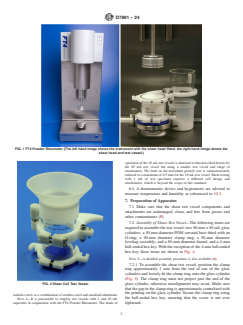
6.1 The FT4 Powder Rheometer is shown in Fig. 1. It is a
broadly reflect the stresses that the powder is subjected to in its
computer-controlled instrument which simultaneously mea-
processing environment.
sures the force and torque required to mobilize a powder
4.2 Measurement of Shear Stress—The instantaneous shear contained in a range of vessel types using a series of spindle-
stress is measured by establishing the consolidating stress with
mounted attachments driven by an electric motor located on a
the shear head and pre-shearing the test specimen until a steady carriage, driven by another electric motor, which moves the
state condition is reached. The test specimen is then subjected
attachments in the vertical direction.
to a reduced normal load and then sheared until the shear force 6.1.1 The force is measured by a force transducer located
reaches a maximum and then decreases.
beneath and fixed to the table that supports the test vessel
during the measurement process.
4.3 Measurement of Wall Friction as a Function of Normal
6.1.2 The torque (shear resistance) is evaluated by measur-
Stress—The kinematic shear stress is measured by establishing
ing the moment on the attachment using a torque transducer.
the consolidating stress with the wall friction attachment, fitted
6.2 The shear cell vessel is shown in Fig. 2 (assembly
with a wall friction coupon, representing the material against
described in 7.2). It consists of a serrated base, made from a
which the powder is required to flow. A single pre-shearing
suitable engineering plastic such as polyoxymethylene (POM),
cycle is completed until a steady state condition is reached. The
onto which are mounted two borosilicate glass cylinders
test specimen is then subjected to a reduced normal load and
(50-mm × 85-mL vessel) connected by a POM leveling assem-
sheared until the shear force reaches a maximum and then
bly. The test vessel is located on the powder rheometer using a
decreases. The shear is maintained such that the kinematic
POM clamp ring which attaches to a stainless steel clamping
shear stress can be calculated.
device. A POM funnel is also fitted to assist with the filling of
the test vessel.
5. Significance and Use
NOTE 2—The glass cylinders are defined as ‘x mm × y mL’, which
5.1 The test can be used to evaluate the following:
indicates the glass cylinder’s internal diameter, x, (50 6 0.04 mm) and the
5.1.1 Classification or Comparison of Powders—There are
precise volume of the lower section of the test vessel with the base fitted,
several parameters that can be used to classify powders relative
y.
to each other, the most useful being the measured shear
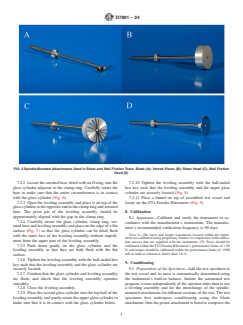
6.3 The attachments to facilitate the various test procedures
stresses, cohesion, flow function and angle of internal friction.
are shown in Fig. 3. They consist of a twisted blade (Fig. 3(A))
5.1.2 Sensitivity Analysis—The shear cell can be used to
to condition the test specimen, a compaction piston (Fig. 3(B))
evaluate the relative effects of a range of powder properties or
to compress the test specimen to achieve the desired consoli-
environmental parameters, or both, such as (but not limited to)
dating normal stress, a shear head (Fig. 3(C)) to generate
humidity, particle size and size distribution, particle shape and
shearing within the powder and a wall friction head with
shape distribution, water content and temperature.
interchangeable wall friction coupon (Fig. 3(D)).
5.2 Quality Control—The test can, in some circumstances,
NOTE 3—The construction material of the attachments (Fig. 3) is
be used to assess the flow properties of a raw material,
intermediate or product against pre-determined acceptance
criteria. The boldface numbers in parentheses refer to a list of references at the end of
this standard.
5.3 Storage Vessel Design—Mathematical models exist for
The sole source of supply of the apparatus known to the committee at this time
is Freeman Technology Ltd, 1 Miller Court, Severn Drive, Tewkesbury,
the determination of storage vessel design parameters which
Gloucestershire, GL20 8DN, United Kingdom. If you are aware of alternative
are based on the flow properties of powders as generated by
suppliers, please provide this information to ASTM International Headquarters.
shear cell testing, requiring shear testing at a range of consoli-
Your comments will receive careful consideration at a meeting of the responsible
dating stresses as well as the measurement of the wall friction technical committee, which you may attend.
D7891 − 24
FIG. 1 FT4 Powder Rheometer (The left hand image shows the instrument with the shear head fitted; the right hand image shows the
shear head and test vessel.)
operation of the 10 mL test vessels is identical to that described herein for
the 85 mL test vessel but using a smaller test vessel and range of
attachments. The limit on the maximum particle size is commensurately
reduced to a maximum of 0.5 mm for the 10 mL test vessel. Shear testing
with 1 mL of test specimen requires a different cell design and
attachments, which is beyond the scope of this standard.
6.4 A thermometric device and hygrometer are advised to
measure temperature and humidity as referenced in 10.3.
7. Preparation of Apparatus
7.1 Make sure that the shear test vessel components and
attachments are undamaged, clean, and free from grease and
other contaminants (5).
7.2 Assembly of Shear Test Vessel—The following items are
required to assemble the test vessel: two 50-mm × 85-mL glass
cylinders, a 50-mm diameter POM serrated base fitted with an
O-ring; a 50-mm diameter clamp ring; a 50-mm diameter
leveling assembly; and a 50-mm diameter funnel, and a 4-mm
ball-ended hex key. With the exception of the 4-mm ball-ended
hex key, these items are shown in Fig. 4.
NOTE 5—A detailed assembly procedure is also available (6).
7.2.1 To assemble the shear test vessel, position the clamp
ring approximately 1 mm from the end of one of the glass
cylinders and loosely fit the clamp ring onto the glass cylinder
(Fig. 5). The clamp ring must not project past the end of the
glass cylinder, otherwise misalignment may occur. Make sure
FIG. 2 Shear Cell Test Vessel
that the gap in the clamp ring is approximately centralized with
the printing on the glass cylinder. Secure the clamp ring using
stainless steel, or a combination of stainless steel and anodized aluminum.
the ball-ended hex key, ensuring that the screw is not over
NOTE 4—It is practicable to employ test vessels with 1 and 10 mL
capacities in conjunction with the FT4 Powder Rheometer. The mode of tightened.
D7891 − 24
FIG. 3 Spindle-Mounted Attachments Used in Shear and Wall Friction Tests: Blade (A); Vented Piston (B); Shear Head (C); Wall Friction
Head (D)
7.2.2 Locate the serrated base, fitted with an O-ring, into the 7.2.10 Tighten the leveling assembly with the ball-ended
glass cylinder adjacent to the clamp ring. Carefully rotate the hex key such that the leveling assembly and the upper glass
base to make sure that the entire circumference is in contact cylinder are securely located (Fig. 8).
with the glass cylinder (Fig. 6). 7.2.11 Place a funnel on top of assembled test vessel and
7.2.3 Open the leveling assembly and place it on top of the locate on the FT4 Powder Rheometer (Fig. 9).
glass cylinder at the opposite end to the clamp ring and serrated
8. Calibration
base. The pivot pin of the leveling assembly should be
approximately aligned with the gap in the clamp ring.
8.1 Apparatus—Calibrate and verify the instrument in ac-
7.2.4 Carefully invert the glass cylinder, clamp ring, ser-
cordance with the manufacturer’s instructions. The manufac-
rated base and leveling assembly and place on the edge of a flat
turer’s recommended verification frequency is 90 days.
surface (Fig. 7) so that the glass cylinder can be fitted flush
NOTE 6—The force and torque transducers located within the instru-
with the inner face of the leveling assembly without impedi-
ment are calibrated using proprietary fixtures in conjunction with calibra-
ment from the upper part of the leveling assembly.
tion masses that are supplied with the instrument. (7). Force should be
7.2.5 Push down gently on the glass cylinder and the
calibrated within the FT4 Powder Rheometer’s performance limits of 650
leveling assembly so that they are both flush with the flat N, and torque should be calibrated within the performance limits of 6900
mN·m both to tolerances better than 1.0 %.
surface.
7.2.6 Tighten the leveling assembly with the ball-ended hex
9. Conditioning
key such that the leveling assembly and the glass cylinder are
securely located. 9.1 Preparation of the Specimen—Add the test specimen to
7.2.7 Confirm that the glass cylinder and leveling assembly the test vessel and its mass is automatically determined using
are flush, and check that the leveling assembly operates the instrument’s built-in balance. Initiate the automated test
smoothly. program, it runs independently of the operator other than to use
7.2.8 Close the leveling assembly. a leveling assembly and for the interchange of the spindle-
7.2.9 Place the second glass cylinder into the top half of the mounted attachments for different sections of the test. The test
leveling assembly and gently rotate the upper glass cylinder to specimen first undergoes conditioning using the blade
make sure that it is in contact with the glass cylinder below. attachment, then the piston attachment is fitted to compress the
D7891 − 24
FIG. 4 Components to Assemble the Shear Cell Vessel (4-mm ball-ended hex key not shown)
powder with a level surface that is ready for shear testing. The
shear head must then be fitted to the instrument.
10. Procedure
10.1 Measurement of Shear Stress:
10.1.1 Select the appropriate test program from the program
library. There are four automated test programs which are
based on consolidating stresses of 3, 6, 9, and 15 kPa.
NOTE 7—The test method can be modified with respect to consolidating
stress, shear rate, and, the number and length of pre-shear cycles. These
options are detailed in Annex A1 and Ref. (8).
10.1.2 Securely fasten the assembled test vessel (7.2) to the
instrument table using the stainless steel clamping assembly
(Fig. 9).
10.1.3 Tare (zero) the mass of the empty test vessel using
the built-in balance prior to filling with the test specimen.
10.1.4 Once tared, fill the test vessel with powder such that,
following consolidation, the test specimen does not fall below
the split level of the leveling assembly.
NOTE 8—If the level of the powder is below the level of the leveling
assembly following the compression phase, the test is classified as a
failure and re-run with a greater starting volume.
10.1.5 Select the start button on the computer screen to
FIG. 5 Fitting the Clamp Ring to the Glass Cylinder Using the
commence the test.
Ball-ended Hex Key
NOTE 9—This automatically causes the blade to be slowly lowered into
the test vessel after which it performs conditioning by traversing through
powder to the target consolidating normal stress. Excess
the powder along a prescribed helical path. When the test program is
powder must then be removed from the test cell by means of a
initiated, the mass of the test specimen is registered withi
...
This document is not an ASTM standard and is intended only to provide the user of an ASTM standard an indication of what changes have been made to the previous version. Because
it may not be technically possible to adequately depict all changes accurately, ASTM recommends that users consult prior editions as appropriate. In all cases only the current version
of the standard as published by ASTM is to be considered the official document.
Designation: D7891 − 15 D7891 − 24
Standard Test Method for
Shear Testing of Powders Using the Freeman Technology
FT4 Powder Rheometer Shear Cell
This standard is issued under the fixed designation D7891; the number immediately following the designation indicates the year of
original adoption or, in the case of revision, the year of last revision. A number in parentheses indicates the year of last reapproval. A
superscript epsilon (´) indicates an editorial change since the last revision or reapproval.
1. Scope Scope*
1.1 This method covers the apparatus and procedures for measuringquantifying the incipient failure properties of a powder as a
function of the normal stress for a given level of consolidation. The method also allows the further determination of the unconfined
yield strength, internal friction angles, cohesion, flow function, major principal stress and wall friction angle (with the appropriate
wall coupon fitted to the correct accessory).
1.2 These parameters are most commonly used for to assist with the design of storage hoppers and bins using industry standard
calculations and procedures. They can also provide relative classification or comparison of the flow behavior of different powders
or different batches of the same powder if similar stress and shear regimes are encountered within the processing equipment.
1.3 The apparatus is suitableappropriate for measuring the properties of powders with a maximum particle size of 1 mm. It is
possiblepracticable to test powders whichthat have a small proportion of particles of 1 mm or greater, but they should be present
in the bulk sample as it is recommended they represent no more than 5 % of the total mass in samples with a normal (Gaussian)
size distribution.
1.4 All observed and calculated values shall conform to the guidelines for significant digits and rounding established in Practice
D6026.
1.4.1 The procedures used to specify how data are collected/recorded or calculated, in this standard are regarded as the industry
standard. In addition, they are representative of the significant digits that generally should be retained. The procedures used do not
consider material variation, purpose for obtaining the data, special purpose studies, or any considerations for the user’s objectives;
and it is common practice to increase or reduce significant digits of reported data to be commensurate with these considerations.
It is beyond the scope of this standard to consider significant digits used in analysis methods for engineering design.
1.5 Units—The values stated in SI units are to be regarded as standard. No other units of measurement are included in this
standard. Reporting of test results in units other than SI shall not be regarded as nonconformance with this standard.
1.6 This standard does not purport to address all of the safety concerns, if any, associated with its use. It is the responsibility
of the user of this standard to establish appropriate safety and healthsafety, health, and environmental practices and determine
the applicability of regulatory limitations prior to use.
1.7 This international standard was developed in accordance with internationally recognized principles on standardization
established in the Decision on Principles for the Development of International Standards, Guides and Recommendations issued
by the World Trade Organization Technical Barriers to Trade (TBT) Committee.
This test method is under the jurisdiction of ASTM Committee D18 on Soil and Rock and is the direct responsibility of Subcommittee D18.24 on Characterization and
Handling of Powders and Bulk Solids.
Current edition approved March 1, 2015March 15, 2024. Published March 2015April 2024. Originally approved in 2015. Last previous edition approved in 2015 as
D7891 – 15. DOI: 10.1520/D7891-15.10.1520/D7891-24.
*A Summary of Changes section appears at the end of this standard
Copyright © ASTM International, 100 Barr Harbor Drive, PO Box C700, West Conshohocken, PA 19428-2959. United States
D7891 − 24
2. Referenced Documents
2.1 ASTM Standards:
D653 Terminology Relating to Soil, Rock, and Contained Fluids
D2216 Test Methods for Laboratory Determination of Water (Moisture) Content of Soil and Rock by Mass
D3740 Practice for Minimum Requirements for Agencies Engaged in Testing and/or Inspection of Soil and Rock as Used in
Engineering Design and Construction
D6026 Practice for Using Significant Digits and Data Records in Geotechnical Data
D6128 Test Method for Shear Testing of Bulk Solids Using the Jenike Shear Tester
D6682 Test Method for Measuring Shear Stresses of Powders Using Peschl Rotational Split Level Shear Tester (Withdrawn
2017)
D6773 Test Method for Bulk Solids Using Schulze Ring Shear Tester
3. Terminology
3.1 Definitions—For definitions of common technical terms used in this standard, refer to Terminology D653.
3.2 Definitions of Terms Specific to This Standard:
3.2.1 conditioning, v—in powders, storing, handling, and processing bulk solids using industrial equipment, the process of
homogenizing the stress of a powderstate of consolidation of a test specimen by use of a specialized blade attachment.
3.2.2 wall friction coupon, n—in powders, storing, handling, and processing bulk solids using industrial equipment, a test piece
used in the wall friction test that is manufactured from a material that represents the material of construction of the silo/bin/hopper
that stores the powder.
4. Summary of Test Method
4.1 Selection of the Appropriate Testing Regime—The particular consolidating stress level or levels used to evaluate the flow
properties of the powder will depend on the reason for generating the data, as outlined in Section 5, and should broadly reflect the
stresses that the powder will be is subjected to in its processing environment.
4.2 Preparation of the specimen—The specimen is added to the test vessel and its mass determined using the instrument’s built-in
balance. The selected test program is then initiated and runs independently of the operator other than the interchange of the
spindle-mounted attachments for different sections of the test. The powder first undergoes a conditioning cycle using the blade
attachment which removes any variability introduced during filling or from the material’s previous history. The piston attachment
is then fitted and is used to compress the powder to the required consolidating stress as determined in the selected test program.
Excess powder is then removed from the test cell by means of a leveling assembly to leave a specimen of compressed powder with
a level surface that is ready for shear testing. The shear head is then fitted to the instrument.
4.2 Measurement of Shear Stress—The instantaneous shear stress is then measured by re-establishingestablishing the consolidating
stress with the shear head and then pre-shearing the test specimen until a steady state condition is reached. The powder test
specimen is then subjected to a reduced normal load and then sheared until the shear force reaches a maximum and then decreases.
4.3 Measurement of Wall Friction as a Function of Normal Stress—The same specimen preparation method is used for this test,
but a kinematic shear stress is measured by establishing the consolidating stress with the wall friction attachment, fitted with a
coupon wall friction coupon, representing the material against which the powder is required to flow, is used instead of a shear
head.flow. A single pre-shearing cycle is completed until a steady state condition is reached. The test specimen is then subjected
to a reduced normal load and sheared until the shear force reaches a maximum and then decreases. The shear is maintained such
that the kinematic shear stress can be calculated.
5. Significance and Use
5.1 The test can be used to evaluate the following:
The last approved version of this historical standard is referenced on www.astm.org.
D7891 − 24
5.1.1 Classification or Comparison of Powders—There are several parameters that can be used to classify powders relative to each
other, the most useful being the measured shear stresses, cohesion, flow function and angle of internal friction.
5.1.2 Sensitivity Analysis—The shear cell can be used to evaluate the relative effects of a range of powder properties and/or
environmental parameters or environmental parameters, or both, such as (but not limited to) humidity, particle size and size
distribution, particle shape and shape distribution, moisturewater content and temperature.
5.1.3 Quality Control—The test can, in some circumstances, be used to assess the flow properties of a raw material, intermediate
or product against pre-determined acceptance criteria.
5.1.4 Storage Vessel Design—Mathematical models exist for the determination of storage vessel design parameters which are
based on the flow properties of powders as generated by shear cell testing, requiring shear testing at a range of consolidating
stresses as well as the measurement of the wall friction angle with respect to the material of construction of the storage vessel. The
methods are detailed in Refs. (1-3).
NOTE 1—The quality of the result produced by this test method is dependent on the competence of the personnel performing it, and the suitability of the
equipment and facilities used. Agencies that meet the criteria of Practice D3740 are generally considered capable of competent and objective
testing/sampling/inspection/etc. Users of this test method are cautioned that compliance with Practice D3740 does not in itself assure reliable results.
Reliable results depend on many factors; Practice D3740 provides a means of evaluating some of those factors (4).
Practice D3740 was developed for agencies engaged in the testing and/or inspection of soil and rock. As such it is not totally applicable to agencies
performing this test method. However, users of this test method should recognize that the framework of Practice D3740 is appropriate for evaluating the
quality of an agency performing this practice. Currently there is no known qualifying national authority that inspects agencies that perform this test
method.
5.2 Quality Control—The test can, in some circumstances, be used to assess the flow properties of a raw material, intermediate
or product against pre-determined acceptance criteria.
5.3 Storage Vessel Design—Mathematical models exist for the determination of storage vessel design parameters which are based
on the flow properties of powders as generated by shear cell testing, requiring shear testing at a range of consolidating stresses as
well as the measurement of the wall friction angle with respect to the material of construction of the storage vessel. The methods
are detailed in Refs. (1-3).
NOTE 1—The quality of the result produced by this test method is dependent on the competence of the personnel performing it, and the suitability of the
equipment and facilities used. Agencies that meet the criteria of Practice D3740 are generally considered capable of competent and objective
testing/sampling/inspection/etc. Users of this test method are cautioned that compliance with Practice D3740 does not in itself assure reliable results.
Reliable results depend on many factors; Practice D3740 provides a means of evaluating some of those factors (4).
Practice D3740 was developed for agencies engaged in the testing and/or inspection of soil and rock. As such it is not totally applicable to agencies
performing this test method. However, users of this test method should recognize that the framework of Practice D3740 is appropriate for evaluating the
quality of an agency performing this practice. Currently there is no known qualifying national authority that inspects agencies that perform this test
method.
6. Apparatus
6.1 The FT4 Powder Rheometer is shown in Fig. 1. It is a computer-controlled instrument which simultaneously measures the
force and torque required to mobilize a powder contained in a range of vessel types using a series of spindle-mounted attachments
driven by an electric motor located on a carriage, driven by another electric motor, which moves the attachments in the vertical
direction.
6.1.1 The force is measured by a force transducer located beneath and fixed to the table that supports the test vessel during the
measurement process.
6.1.2 The torque (shear resistance) is evaluated by measuring the moment on the attachment using a torque transducer.
6.2 The shear cell vessel is shown in Fig. 2. (assembly described in 7.2). It consists of a serrated base, made from a suitable
The boldface numbers in parentheses refer to a list of references at the end of this standard.
The sole source of supply of the apparatus known to the committee at this time is Freeman Technology Ltd, 1 Miller Court, Severn Drive, Tewkesbury, Gloucestershire,
GL20 8DN, United Kingdom. If you are aware of alternative suppliers, please provide this information to ASTM International Headquarters. Your comments will receive
careful consideration at a meeting of the responsible technical committee, which you may attend.
D7891 − 24
FIG. 1 FT4 Powder Rheometer (The left hand image shows the instrument with the shear head fitted; the right hand image shows the
shear head and shear cell test vessel.)
FIG. 2 Shear Cell Test Vessel
engineering plastic such as polyoxymethylene (POM), onto which are mounted two borosilicate glass cylinders (50-mm × 85-mL
D7891 − 24
vessel) connected by a POM leveling assembly. The test vessel is located on the powder rheometer using a POM clamp ring which
attaches to a stainless steel clamping device. A POM funnel is also fitted to assist with the filling of the test vessel.
6.2.1 The shear cell vessel is located on the powder rheometer using a POM clamp ring.
NOTE 2—The glass cylinders are defined as ‘x mm × y mL’, which indicates the glass cylinder’s internal diameter, x, (50 6 0.04 mm) and the precise
volume of the lower section of the test vessel with the base fitted, y.
6.2.2 A POM funnel is also fitted to assist with the filling of the vessel.
6.3 Attachments are fitted The attachments to facilitate the various test procedures are shown in Fig. 3. They consist of a twisted
blade (Fig. 3(A)) to the powder rheometer condition the test specimen, a compaction piston (Fig. 3to facilitate various test
procedures.(B)) to compress the test specimen to achieve the desired consolidating normal stress, a shear head (Fig. 3(C)) to
generate shearing within the powder and a wall friction head with interchangeable wall friction coupon (Fig. 3(D)).
6.3.1 The first is a twisted blade (shown in Fig. 3(A)) that is used to condition the test specimen thus generating a repeatable stress
condition within the powder.
NOTE 2—This conditioning process eliminates the effects of the powder’s history and also any operator-induced effects generated during the filling
process.
NOTE 3—The construction material of the attachments (Fig. 3) is stainless steel, or a combination of stainless steel and anodized aluminum.
6.3.2 The second (Fig. 3(B)) is a compaction piston that compresses the specimen to achieve the desired consolidating normal
stress.
FIG. 3 Spindle-Mounted Attachments Used in Shear and Wall Friction Tests: Blade (A); Vented Piston (B); Shear Head (C); Wall Friction
Head (D)
D7891 − 24
NOTE 4—It is practicable to employ test vessels with 1 and 10 mL capacities in conjunction with the FT4 Powder Rheometer. The mode of operation of
the 10 mL test vessels is identical to that described herein for the 85 mL test vessel but using a smaller test vessel and range of attachments. The limit
on the maximum particle size is commensurately reduced to a maximum of 0.5 mm for the 10 mL test vessel. Shear testing with 1 mL of test specimen
requires a different cell design and attachments, which is beyond the scope of this standard.
6.3.3 The third (Fig. 3(C)) is a shear head consisting of 18 blades that are used to generate shearing within the powder.
6.3.4 The fourth (Fig. 3(D)) is a wall friction head and an interchangeable coupon representing the material of construction against
which the powder will be required to flow.
6.3.5 All of the attachments (Fig. 3) are made from stainless steel and stainless steel+anodized aluminum.
NOTE 3—The blades located in the shear head are thin and thus relatively sharp. Care must be taken when handling the shear head to prevent skin abrasions
and cuts.
6.4 Additionally, it is possible to employ shear cells with 10 mL and 1 mL capacityA thermometric device and hygrometer are
advised to measure temperature and humidity as referenced in 10.3conjunction with the FT4 Powder Rheometer if the quantity of
available test specimen is less than 85 mL (at the chosen consolidation stress). The mode of operation of the 10-mL shear cell is
identical to that described herein for the 85-mL shear cell but using a smaller shear cell and range of attachments. The limit on
the maximum particle size is commensurately reduced to a maximum particle size of 0.5 mm. The 1-mL shear cell uses a
significantly different cell design and attachments, which is beyond the scope of this standard.
7. Preparation of Apparatus
7.1 Since the integrity of the blades within the shear cell head is critical to generating accurate and reliable data, handle the shear
head with care, store it in the case provided and inspect it for damage at regular intervals.
7.1 Make sure that the shear celltest vessel components and the spindle-mounted attachments are clean undamaged, clean, and free
from grease and other contaminants (5).
7.3 The following items are required to assemble the shear cell vessel: two 50-mm × 85-mL glass cylinders, a 50-mm serrated
base; a 50-mm clamp ring; a 50-mm leveling assembly; and a 50-mm funnel. These items are shown in Fig. 4. A fully detailed
assembly procedure is also available (6).
7.2 Assembly of Shear Test Vessel—To assemble the shear cell vessel, position the clamp ring approximately 1 mm from the end
of one of the glass cylinders and loosely fit the clamp ring onto the glass cylinder (The following items are required to assemble
the test vessel: two 50-mm × 85-mL glass cylinders, a 50-mm diameter POM serrated base fitted with an O-ring; a 50-mm diameter
clamp ring; a 50-mm diameter leveling assembly;Fig. 5). The clamp ring must not project past the end of the glass cylinder,
otherwise misalignment may occur. Make sure that the gap in the clamp ring is approximately centralized with the printing on the
glass cylinder. Secure the clamp ring using the hex driver ensuring that the screw is and a 50-mm diameter funnel, and a 4-mm
ball-ended hex key. With the exception of the 4-mm ball-ended hex key, these items are shown in Fig. 4not over tightened.
NOTE 5—A detailed assembly procedure is also available (6).
7.2.1 To assemble the shear test vessel, position the clamp ring approximately 1 mm from the end of one of the glass cylinders
and loosely fit the clamp ring onto the glass cylinder (Fig. 5). The clamp ring must not project past the end of the glass cylinder,
otherwise misalignment may occur. Make sure that the gap in the clamp ring is approximately centralized with the printing on the
glass cylinder. Secure the clamp ring using the ball-ended hex key, ensuring that the screw is not over tightened.
7.2.2 Locate the serrated base, fitted with an O-ring, into the glass cylinder adjacent to the clamp ring. Carefully rotate the base
to make sure that the entire circumference is in contact with the glass cylinder (Fig. 6).
7.2.3 Open the leveling assembly and place it on top of the glass cylinder at the opposite end to the clamp ring and serrated base.
The pivot pin of the leveling assembly should be approximately aligned with the gap in the clamp ring.
D7891 − 24
FIG. 4 Components Required to Assemble the 50-mm × 85-mL Shear Cell Vessel (4-mm ball-ended hex key not shown)
FIG. 5 Fitting the Clamp Ring to the Glass Cylinder Using the Ball-ended Hex Key
7.2.4 Carefully invert the glass cylinder, clamp ring, serrated base and leveling assembly and place on the edge of a flat surface
(Fig. 7) so that the glass cylinder can be fitted flush with the inner face of the leveling assembly without impediment from the upper
part of the leveling assembly.
D7891 − 24
FIG. 7 Fitting the Leveling Assembly onto the Glass Cylinder with the Ball-ended Hex Key
7.2.5 Push down gently on the glass cylinder and the leveling assembly so that they are both flush with the flat surface.
7.2.6 Tighten the leveling assembly with the ball-ended hex key such that the leveling assembly and the glass cylinder are securely
located.
7.2.7 Confirm that the glass cylinder and leveling assembly are flush, and check that the leveling assembly operates smoothly.
7.2.8 Close the leveling assembly.
7.2.9 Place the second glass cylinder into the top half of the leveling assembly and gently rotate the upper glass cylinder to make
sure that it is in contact with the glass cylinder below.
7.2.10 Tighten the leveling assembly with the ball-ended hex key such that the leveling assembly and the upper glass cylinder are
securely located (Fig. 8).
7.2.11 Place a funnel on top of assembled test vessel and locate on the FT4 Powder Rheometer (Fig. 9).
7.5 Locate the serrated base into the glass cylinder adjacent to the clamp ring. Carefully rotate the serrated base to make sure that
the entire circumference is in contact with the glass cylinder (Fig. 6).
7.6 Open the leveling assembly and place it on top of the glass cylinder at the opposite end to the clamp ring and serrated base.
Make sure that the gap in leveling assembly is approximately in line with the gap in the clamp ring.
7.7 Carefully invert the glass cylinder, clamp ring, serrated base and leveling assembly and place on the edge of a flat surface (Fig.
7) so that the glass cylinder can be fitted flush with the inner face of the leveling assembly without impediment from the upper
part of the leveling assembly.
7.8 Push down gently on both the glass cylinder and the leveling assembly so that they are both flush with the flat surface.
7.9 Tighten the leveling assembly with the hex driver such that the leveling assembly and the glass cylinder are securely located.
7.10 Confirm that the glass cylinder and leveling assembly are flush, and check that the leveling assembly operates smoothly.
D7891 − 24
FIG. 6 Fitting the Serrated Base with O-ring to the Glass Cylinder
7.11 Close the leveling assembly.
7.12 Place the other 50-mm × 85-mL glass cylinder into the top half of the leveling assembly and gently rotate the upper glass
cylinder to make sure that it is in contact with the glass cylinder below.
7.13 Tighten the leveling assembly with the hex driver such that the leveling assembly and the upper glass cylinder are securely
located (Fig. 8).
7.14 Place the funnel on top of assembled shear cell vessel (Fig. 9) and locate on the FT4 Powder Rheometer.
NOTE 4—The assembled shear cell vessel is described as a 50-mm × 85-mL split vessel assembly, which indicates the glass cylinders’ internal diameter
and the precise volume of the lower section of vessel with the base fitted.
8. Calibration and Standardization
8.1 Apparatus—Calibrate and verify the instrument in accordance with the manufacturer’s instructions. The manufacturer’s
recommended verification frequency is 90 days.
NOTE 6—The force and torque transducers located within the instrument are calibrated using proprietary fixtures in conjunction with calibration masses
that are supplied with the instrument. (7)). Force should be calibrated within the FT4 Powder Rheometer’s performance limits of 650 N, and torque
should be calibrated within the performance limits of 6900 mN·m both to tolerances better than 1.0 %.
9. Conditioning
9.1 Preparation of the Specimen—Add the test specimen to the test vessel and its mass is automatically determined using the
instrument’s built-in balance. Initiate the automated test program, it runs independently of the operator other than to use a leveling
assembly and for the interchange of the spindle-mounted attachments for different sections of the test. The test specimen first
undergoes conditioning using the blade attachment, then the piston attachment is fitted to compress the powder to the target
consolidating normal stress. Excess powder must then be removed from the test cell by means of a leveling assembly to leave a
controlled volume of consolidated powder with a level surface that is ready for shear testing. The shear head must then be fitted
to the instrument.
D7891 − 24
FIG. 8 Fitting the Upper Glass Cylinder
FIG. 9 Shear CellTest Vessel Located on Instrument Table Prior to Taring (Zeroing) of the Empty Shear Cell Test Vessel Mass
D7891 − 24
10. Procedure
9.1 With the assembled shear cell vessel (Section 7) located on the instrument table, tare (zero) the mass of the empty shear cell
vessel using the built-in balance prior to filling with the test specimen.
9.2 Once tared, remove the shear cell vessel for filling.
9.3 Fill the tared shear cell vessel with sufficient powder such that, following the compression stage, the specimen is not
compressed below the split level of the leveling assembly.
NOTE 6—The amount of specimen required depends on the compressibility of the particular powder and the consolidating stress level chosen for the test.
If the powder’s compressibility with respect to the consolidating stress is known from a previously completed compressibility test (8), the required mass
of uncompressed powder can be determined based on the chosen consolidating stress of the shear test.
NOTE 7—If the level of the powder is below the level of the leveling assembly following the compression phase, the test should be classified as a failure
and re-run with a greater starting volume.
9.4 Return the filled shear cell vessel and securely fasten it to the instrument table using the clamping assembly. The mass of the
powder specimen is then registered within the data file associated with the test.
10.1 Measurement of Shear Stress:
10.1.1 Select the appropriate test program from the program library. There are four standardautomated test programs available
which are based on consolidating stresses of 3, 6, 9, and 15 kPa. These programs can be modified if other consolidating stresses
are required.
NOTE 7—For advanced users the The test method can be modified in detail with respect to consolidating stress, shear rate, and, the number and length
of pre-shear cycle
...