

ASTM D1140-17
(Test Method)Standard Test Methods for Determining the Amount of Material Finer than 75-μm (No. 200) Sieve in Soils by Washing
General Information
- Abstract
SIGNIFICANCE AND USE
5.1 Material finer than the 75-μm (No. 200) sieve can be separated from larger particles or soil aggregations can be broken down much more efficiently and completely by wet sieving than with dry sieving. Therefore, when accurate determinations of material finer than a 75-μm (No. 200) sieve are desired, these test methods are used on the test specimen prior to dry sieving, or as a determination of the percent of material that is finer than a 75-μm (No. 200) sieve. Usually the additional amount of material finer than a 75-μm (No. 200) sieve obtained in the dry sieving process is a small amount. If it is large, the efficiency of the washing operation should be checked, as it could be an indication of degradation of the soil (see Note 2).
5.2 Method A shall be used with non-cohesive soils containing fine material with little or no plasticity. The specimen is soaked in water to facilitate the separation of the fine and coarse fractions prior to washing through the 75-μm (No. 200) sieve.
5.3 Method B shall be used with soils, particularly clayey soils, where the fine material demonstrates plastic behavior and tends to adhere to the larger particles. To provide adequate fine grain dispersal, it is necessary to soak the specimen in a dispersing solution prior to washing through the 75-μm (No. 200) sieve.
5.4 To facilitate determination of which method to utilize, the sample may be classified as non-cohesive or having plastic characteristics based upon procedures outlined in Practice D2488 or other means of determining the soil properties.
Note 1: The quality of the result produced by this standard is dependent on the competence of the personnel performing it, and the suitability of the equipment and facilities used. Agencies that meet the criteria of Practice D3740 are generally considered capable of competent and objective testing/sampling/inspection/etc. Users of this standard are cautioned that compliance with Practice D3740 does not in itself ensure reliable ...
SCOPE
1.1 These test methods cover the determination of the amount of material finer than a 75-μm (No. 200) sieve by washing of material with a maximum particle size of 75 mm (3 in.).
1.2 The methods used in this standard rely on the use of water or a dispersant to separate and remove materials finer than a 75-μm (No. 200) sieve. During these processes soluble substances, such as salts and other minerals, may also be removed. It is not within the scope of this standard to differentiate between the removal of fine particles and soluble substances. It is recommended that materials containing significant amounts of soluble substances be tested using other methods of separation.
1.3 Two methods for determining the amount of material finer than the 75-μm (No. 200) sieve are provided. The method to be used shall be specified by the requesting authority. If no method is specified, the choice should be based upon the guidance given in 5.2, 5.3, and 5.4.
1.3.1 Method A—Test specimen is dispersed by soaking in water prior to wash sieving.
1.3.2 Method B—Test specimen is dispersed by soaking in a dispersing solution prior to wash sieving.
1.4 Units—The values stated in SI units are to be regarded as standard. Except the sieve designations are typically identified using the “alternative” system in accordance with Specification E11, such as 3 inch and No. 200, instead of the “standard” of 75-mm and 75-μm, respectively. Reporting of test results in units other than SI shall not be regarded as nonconformance with this test method. The use of balances or scales recording pounds of mass (lbm) shall not be regarded as nonconformance with this standard.
1.5 All observed and calculated values shall conform to the guidelines for significant digits and rounding established in Practice D6026, unless superseded by this test method.
1.5.1 The procedures used to specify how data are collected/recorded and calculated in this standa...
- Status
- Published
- Publication Date
- 31-Jan-2017
- Technical Committee
- D18 - Soil and Rock
- Drafting Committee
- D18.03 - Texture, Plasticity and Density Characteristics of Soils
Buy Documents
ASTM D1140-17 - Standard Test Methods for Determining the Amount of Material Finer than 75-μm (No. 200) Sieve in Soils by Washing
REDLINE ASTM D1140-17 - Standard Test Methods for Determining the Amount of Material Finer than 75-μm (No. 200) Sieve in Soils by Washing
Overview
ASTM D1140-17, "Standard Test Methods for Determining the Amount of Material Finer than 75-μm (No. 200) Sieve in Soils by Washing," provides standardized procedures for accurately identifying the quantity of fine particles in soil samples. This standard is essential for engineering, construction, geotechnical, and quality control laboratories analyzing soil composition. The test methods outlined are particularly valuable when precise measurement of soil fines is critical for material classification, performance assessment, or regulatory compliance.
Key Topics
Material Finer than 75-μm Determination
The standard specifies two reliable test methods for separating and quantifying material that passes the 75-μm (No. 200) sieve by wet sieving, which is more effective at breaking aggregates and separating fines compared to dry sieving.Test Methods
- Method A is used for non-cohesive soils, such as sands or mixtures with little to no plasticity. The specimen is soaked in water prior to wet sieving, promoting separation between fine and coarse fractions.
- Method B is intended for soils with plastic, cohesive fines (particularly clays) that may adhere to larger particles. The specimen is soaked in a dispersing solution (commonly sodium hexametaphosphate) to ensure complete dispersion before wash sieving.
Apparatus and Materials
Practitioners must use calibrated balances, compliant wash sieves (75-μm, No. 200), drying ovens, and suitable containers. Verification of sieve compliance and periodic equipment checks are essential for reliable, reproducible results.Sample Preparation and Handling
Detailed procedures are given for collecting representative soil samples, reducing sample size, and preparing test specimens. This includes guidance on minimum specimen mass and reduction techniques for ensuring sample integrity.Precision and Reporting
The standard describes expected repeatability and reproducibility of results, including required data points for reporting in technical documentation and quality control records.
Applications
ASTM D1140-17 is widely used in:
Geotechnical Engineering and Site Investigation
Determining the percentage of fines in soil samples for classification according to the Unified Soil Classification System (USCS), and evaluating soil behavior for foundation design, slope stability analysis, and earthworks.Construction Quality Control
Assessing aggregate and soil materials for compliance with project or regulatory specifications, particularly for road base, embankment fills, and structural backfill where fines content can impact compaction, drainage, and stability.Material Characterization
Analyzing soils for laboratory research, environmental site assessments, and material source evaluations where precise fines content measurement impacts project decisions.Supporting Other ASTM Soil Testing Standards
Acting as a preparatory or complementary step for other soil tests-such as particle size distribution or Atterberg limits-where accurate fines removal is necessary.
Related Standards
- ASTM D422 – Test Method for Particle-Size Analysis of Soils (withdrawn, replaced by ASTM D6913 and D1140 for fines analysis)
- ASTM D6913 – Test Methods for Particle-Size Distribution (Gradation) of Soils Using Sieve Analysis
- ASTM D2487 – Practice for Classification of Soils for Engineering Purposes (Unified Soil Classification System)
- ASTM D2488 – Practice for Description and Identification of Soils (Visual-Manual Procedure)
- ASTM D2216 – Test Methods for Laboratory Determination of Water Content of Soil and Rock by Mass
- ASTM E11 – Specification for Woven Wire Test Sieve Cloth and Test Sieves
Conclusion
ASTM D1140-17 sets the benchmark for precise, reliable determination of fines content in soil by washing. Its procedures are vital for geotechnical investigations, aggregate assessments, and construction quality assurance. By adhering to this standard, professionals ensure consistency, accuracy, and compliance across projects involving soil analysis and material classification.
Relations
- Effective Date
- 01-Feb-2024
- Effective Date
- 01-Nov-2023
- Effective Date
- 01-Oct-2019
- Effective Date
- 01-Mar-2019
- Effective Date
- 01-Mar-2019
- Effective Date
- 15-Dec-2017
- Effective Date
- 15-Dec-2017
- Effective Date
- 15-Jul-2017
- Effective Date
- 01-May-2015
- Effective Date
- 01-Aug-2014
- Effective Date
- 01-May-2014
- Effective Date
- 01-Oct-2013
- Effective Date
- 01-May-2013
- Effective Date
- 01-May-2013
- Effective Date
- 15-May-2012
Buy Documents
ASTM D1140-17 - Standard Test Methods for Determining the Amount of Material Finer than 75-μm (No. 200) Sieve in Soils by Washing
REDLINE ASTM D1140-17 - Standard Test Methods for Determining the Amount of Material Finer than 75-μm (No. 200) Sieve in Soils by Washing
Get Certified
Connect with accredited certification bodies for this standard

IMP NDT d.o.o.
Non-destructive testing services. Radiography, ultrasonic, magnetic particle, penetrant, visual inspection.
Inštitut za kovinske materiale in tehnologije
Institute of Metals and Technology. Materials testing, metallurgical analysis, NDT.
Q Techna d.o.o.
NDT and quality assurance specialist. 30+ years experience. NDT personnel certification per ISO 9712, nuclear and thermal power plant inspections, QA/
Sponsored listings
Frequently Asked Questions
ASTM D1140-17 is a standard published by ASTM International. Its full title is "Standard Test Methods for Determining the Amount of Material Finer than 75-μm (No. 200) Sieve in Soils by Washing". This standard covers: SIGNIFICANCE AND USE 5.1 Material finer than the 75-μm (No. 200) sieve can be separated from larger particles or soil aggregations can be broken down much more efficiently and completely by wet sieving than with dry sieving. Therefore, when accurate determinations of material finer than a 75-μm (No. 200) sieve are desired, these test methods are used on the test specimen prior to dry sieving, or as a determination of the percent of material that is finer than a 75-μm (No. 200) sieve. Usually the additional amount of material finer than a 75-μm (No. 200) sieve obtained in the dry sieving process is a small amount. If it is large, the efficiency of the washing operation should be checked, as it could be an indication of degradation of the soil (see Note 2). 5.2 Method A shall be used with non-cohesive soils containing fine material with little or no plasticity. The specimen is soaked in water to facilitate the separation of the fine and coarse fractions prior to washing through the 75-μm (No. 200) sieve. 5.3 Method B shall be used with soils, particularly clayey soils, where the fine material demonstrates plastic behavior and tends to adhere to the larger particles. To provide adequate fine grain dispersal, it is necessary to soak the specimen in a dispersing solution prior to washing through the 75-μm (No. 200) sieve. 5.4 To facilitate determination of which method to utilize, the sample may be classified as non-cohesive or having plastic characteristics based upon procedures outlined in Practice D2488 or other means of determining the soil properties. Note 1: The quality of the result produced by this standard is dependent on the competence of the personnel performing it, and the suitability of the equipment and facilities used. Agencies that meet the criteria of Practice D3740 are generally considered capable of competent and objective testing/sampling/inspection/etc. Users of this standard are cautioned that compliance with Practice D3740 does not in itself ensure reliable ... SCOPE 1.1 These test methods cover the determination of the amount of material finer than a 75-μm (No. 200) sieve by washing of material with a maximum particle size of 75 mm (3 in.). 1.2 The methods used in this standard rely on the use of water or a dispersant to separate and remove materials finer than a 75-μm (No. 200) sieve. During these processes soluble substances, such as salts and other minerals, may also be removed. It is not within the scope of this standard to differentiate between the removal of fine particles and soluble substances. It is recommended that materials containing significant amounts of soluble substances be tested using other methods of separation. 1.3 Two methods for determining the amount of material finer than the 75-μm (No. 200) sieve are provided. The method to be used shall be specified by the requesting authority. If no method is specified, the choice should be based upon the guidance given in 5.2, 5.3, and 5.4. 1.3.1 Method A—Test specimen is dispersed by soaking in water prior to wash sieving. 1.3.2 Method B—Test specimen is dispersed by soaking in a dispersing solution prior to wash sieving. 1.4 Units—The values stated in SI units are to be regarded as standard. Except the sieve designations are typically identified using the “alternative” system in accordance with Specification E11, such as 3 inch and No. 200, instead of the “standard” of 75-mm and 75-μm, respectively. Reporting of test results in units other than SI shall not be regarded as nonconformance with this test method. The use of balances or scales recording pounds of mass (lbm) shall not be regarded as nonconformance with this standard. 1.5 All observed and calculated values shall conform to the guidelines for significant digits and rounding established in Practice D6026, unless superseded by this test method. 1.5.1 The procedures used to specify how data are collected/recorded and calculated in this standa...
SIGNIFICANCE AND USE 5.1 Material finer than the 75-μm (No. 200) sieve can be separated from larger particles or soil aggregations can be broken down much more efficiently and completely by wet sieving than with dry sieving. Therefore, when accurate determinations of material finer than a 75-μm (No. 200) sieve are desired, these test methods are used on the test specimen prior to dry sieving, or as a determination of the percent of material that is finer than a 75-μm (No. 200) sieve. Usually the additional amount of material finer than a 75-μm (No. 200) sieve obtained in the dry sieving process is a small amount. If it is large, the efficiency of the washing operation should be checked, as it could be an indication of degradation of the soil (see Note 2). 5.2 Method A shall be used with non-cohesive soils containing fine material with little or no plasticity. The specimen is soaked in water to facilitate the separation of the fine and coarse fractions prior to washing through the 75-μm (No. 200) sieve. 5.3 Method B shall be used with soils, particularly clayey soils, where the fine material demonstrates plastic behavior and tends to adhere to the larger particles. To provide adequate fine grain dispersal, it is necessary to soak the specimen in a dispersing solution prior to washing through the 75-μm (No. 200) sieve. 5.4 To facilitate determination of which method to utilize, the sample may be classified as non-cohesive or having plastic characteristics based upon procedures outlined in Practice D2488 or other means of determining the soil properties. Note 1: The quality of the result produced by this standard is dependent on the competence of the personnel performing it, and the suitability of the equipment and facilities used. Agencies that meet the criteria of Practice D3740 are generally considered capable of competent and objective testing/sampling/inspection/etc. Users of this standard are cautioned that compliance with Practice D3740 does not in itself ensure reliable ... SCOPE 1.1 These test methods cover the determination of the amount of material finer than a 75-μm (No. 200) sieve by washing of material with a maximum particle size of 75 mm (3 in.). 1.2 The methods used in this standard rely on the use of water or a dispersant to separate and remove materials finer than a 75-μm (No. 200) sieve. During these processes soluble substances, such as salts and other minerals, may also be removed. It is not within the scope of this standard to differentiate between the removal of fine particles and soluble substances. It is recommended that materials containing significant amounts of soluble substances be tested using other methods of separation. 1.3 Two methods for determining the amount of material finer than the 75-μm (No. 200) sieve are provided. The method to be used shall be specified by the requesting authority. If no method is specified, the choice should be based upon the guidance given in 5.2, 5.3, and 5.4. 1.3.1 Method A—Test specimen is dispersed by soaking in water prior to wash sieving. 1.3.2 Method B—Test specimen is dispersed by soaking in a dispersing solution prior to wash sieving. 1.4 Units—The values stated in SI units are to be regarded as standard. Except the sieve designations are typically identified using the “alternative” system in accordance with Specification E11, such as 3 inch and No. 200, instead of the “standard” of 75-mm and 75-μm, respectively. Reporting of test results in units other than SI shall not be regarded as nonconformance with this test method. The use of balances or scales recording pounds of mass (lbm) shall not be regarded as nonconformance with this standard. 1.5 All observed and calculated values shall conform to the guidelines for significant digits and rounding established in Practice D6026, unless superseded by this test method. 1.5.1 The procedures used to specify how data are collected/recorded and calculated in this standa...
ASTM D1140-17 is classified under the following ICS (International Classification for Standards) categories: 19.120 - Particle size analysis. Sieving. The ICS classification helps identify the subject area and facilitates finding related standards.
ASTM D1140-17 has the following relationships with other standards: It is inter standard links to ASTM D4753-24, ASTM D3740-23, ASTM D3740-19, ASTM E145-19, ASTM D2216-19, ASTM D2487-17e1, ASTM D2487-17, ASTM D2488-17, ASTM D4753-15, ASTM D653-14, ASTM E177-14, ASTM E11-13, ASTM E691-13, ASTM E177-13, ASTM D1587-08(2012)e1. Understanding these relationships helps ensure you are using the most current and applicable version of the standard.
ASTM D1140-17 is available in PDF format for immediate download after purchase. The document can be added to your cart and obtained through the secure checkout process. Digital delivery ensures instant access to the complete standard document.
Standards Content (Sample)
This international standard was developed in accordance with internationally recognized principles on standardization established in the Decision on Principles for the
Development of International Standards, Guides and Recommendations issued by the World Trade Organization Technical Barriers to Trade (TBT) Committee.
Designation: D1140 − 17
Standard Test Methods for
Determining the Amount of Material Finer than 75-µm (No.
200) Sieve in Soils by Washing
This standard is issued under the fixed designation D1140; the number immediately following the designation indicates the year of
original adoption or, in the case of revision, the year of last revision.Anumber in parentheses indicates the year of last reapproval.A
superscript epsilon (´) indicates an editorial change since the last revision or reapproval.
This standard has been approved for use by agencies of the U.S. Department of Defense.
1. Scope* 1.5 All observed and calculated values shall conform to the
guidelines for significant digits and rounding established in
1.1 These test methods cover the determination of the
Practice D6026, unless superseded by this test method.
amount of material finer than a 75-µm (No. 200) sieve by
1.5.1 Theproceduresusedtospecifyhowdataarecollected/
washingofmaterialwithamaximumparticlesizeof75mm(3
recorded and calculated in this standard are regarded as the
in.).
industry standard. In addition, they are representative of the
1.2 The methods used in this standard rely on the use of significant digits that generally should be retained. The proce-
water or a dispersant to separate and remove materials finer dures used do not consider material variation, purpose for
than a 75-µm (No. 200) sieve. During these processes soluble obtaining the data, special purpose studies, or any consider-
substances, such as salts and other minerals, may also be ations for the user’s objectives; and it is common practice to
removed. It is not within the scope of this standard to increase or reduce significant digits of reported data to be
differentiate between the removal of fine particles and soluble commensuratewiththeseconsiderations.Itisbeyondthescope
substances. It is recommended that materials containing sig- of these test methods to consider significant digits used in
nificant amounts of soluble substances be tested using other analysis methods for engineering design.
methods of separation.
1.6 This standard does not purport to address all of the
safety concerns, if any, associated with its use. It is the
1.3 Two methods for determining the amount of material
responsibility of the user of this standard to establish appro-
finerthanthe75-µm(No.200)sieveareprovided.Themethod
priate safety and health practices and determine the applica-
to be used shall be specified by the requesting authority. If no
bility of regulatory limitations prior to use.
method is specified, the choice should be based upon the
guidance given in 5.2, 5.3, and 5.4.
2. Referenced Documents
1.3.1 Method A—Test specimen is dispersed by soaking in
2.1 ASTM Standards:
water prior to wash sieving.
C702PracticeforReducingSamplesofAggregatetoTesting
1.3.2 Method B—Testspecimenisdispersedbysoakingina
Size
dispersing solution prior to wash sieving.
D75Practice for Sampling Aggregates
D422Test Method for Particle-SizeAnalysis of Soils (With-
1.4 Units—The values stated in SI units are to be regarded
as standard. Except the sieve designations are typically iden- drawn 2016)
D653Terminology Relating to Soil, Rock, and Contained
tified using the “alternative” system in accordance with Speci-
fication E11, such as 3 inch and No. 200, instead of the Fluids
“standard” of 75-mm and 75-µm, respectively. Reporting of D1586Test Method for Penetration Test (SPT) and Split-
test results in units other than SI shall not be regarded as Barrel Sampling of Soils
nonconformance with this test method. The use of balances or D1587Practice for Thin-Walled Tube Sampling of Fine-
scales recording pounds of mass (lbm) shall not be regarded as Grained Soils for Geotechnical Purposes
nonconformance with this standard. D2216Test Methods for Laboratory Determination ofWater
(Moisture) Content of Soil and Rock by Mass
1 2
ThesetestmethodsareunderthejurisdictionofASTMCommitteeD18onSoil For referenced ASTM standards, visit the ASTM website, www.astm.org, or
and Rock and is the direct responsibility of Subcommittee D18.03 on Texture, contact ASTM Customer Service at service@astm.org. For Annual Book of ASTM
Plasticity and Density Characteristics of Soils. Standards volume information, refer to the standard’s Document Summary page on
Current edition approved Feb. 1, 2017. Published February 2017. Originally the ASTM website.
approved in 1950. Last previous edition approved in 2014 as D1140–14. DOI: The last approved version of this historical standard is referenced on
10.1520/D1140-17. www.astm.org.
*A Summary of Changes section appears at the end of this standard
Copyright © ASTM International, 100 Barr Harbor Drive, PO Box C700, West Conshohocken, PA 19428-2959. United States
D1140 − 17
D2487Practice for Classification of Soils for Engineering 5.2 Method A shall be used with non-cohesive soils con-
Purposes (Unified Soil Classification System) tainingfinematerialwithlittleornoplasticity.Thespecimenis
D2488Practice for Description and Identification of Soils soaked in water to facilitate the separation of the fine and
(Visual-Manual Procedure) coarse fractions prior to washing through the 75-µm (No. 200)
D3740Practice for Minimum Requirements for Agencies sieve.
Engaged in Testing and/or Inspection of Soil and Rock as
5.3 Method B shall be used with soils, particularly clayey
Used in Engineering Design and Construction
soils,wherethefinematerialdemonstratesplasticbehaviorand
D4753Guide for Evaluating, Selecting, and Specifying Bal-
tendstoadheretothelargerparticles.Toprovideadequatefine
ances and Standard Masses for Use in Soil, Rock, and
grain dispersal, it is necessary to soak the specimen in a
Construction Materials Testing
dispersing solution prior to washing through the 75-µm (No.
D6026Practice for Using Significant Digits in Geotechnical
200) sieve.
Data
5.4 To facilitate determination of which method to utilize,
D6913Test Methods for Particle-Size Distribution (Grada-
the sample may be classified as non-cohesive or having plastic
tion) of Soils Using Sieve Analysis
characteristics based upon procedures outlined in Practice
E11Specification forWovenWireTest Sieve Cloth andTest
D2488 or other means of determining the soil properties.
Sieves
NOTE 1—The quality of the result produced by this standard is
E145 Specification for Gravity-Convection and Forced-
dependent on the competence of the personnel performing it, and the
Ventilation Ovens
suitability of the equipment and facilities used. Agencies that meet the
E177Practice for Use of the Terms Precision and Bias in
criteria of Practice D3740 are generally considered capable of competent
and objective testing/sampling/inspection/etc. Users of this standard are
ASTM Test Methods
cautioned that compliance with Practice D3740 does not in itself ensure
E691Practice for Conducting an Interlaboratory Study to
reliable results. Reliable results depend on many factors; Practice D3740
Determine the Precision of a Test Method
provides a means of evaluating some of those factors.
NOTE 2—As outlined in 5.1, if the sample is dry sieved after washing,
3. Terminology
such as for Test Methods D422 or D6913, some material may pass the
3.1 Definitions: 75-µm (No. 200) sieve that did not pass during washing operations. The
material passing the 75-µm (No. 200) sieve may be a significant amount
3.1.1 For definitions of common technical terms in this
for samples with a high percentage of silt or clay.
standard, refer to Terminology D653.
6. Apparatus
3.2 Definitions of Terms Specific to This Standard:
3.2.1 guard sieve—a sieve or sieves that are placed over the
6.1 Balance—Abalance or scale conforming to the require-
actual wash sieve and are constructed of wire mesh instead of
ments of Specification D4753, having a readability with no
wire cloth.
estimation to four significant digits. The mass of the specimen
3.2.1.1 Discussion—The guard sieve(s) acts to prevent
may be determined in parts if necessary.
coarse particles from contacting the wire cloth of the wash
6.2 Wash Sieve—A 75-µm (No. 200) sieve with a diameter
sieveresultinginpunctures,tears,anddamagethatmayrequire
sufficient to handle the required size of specimen in 9.4.
the sieve to be replaced.
Usually 203-mm (8-in.) diameter sieves are adequate for the
4. Summary of Test Method
washing process. The 75-µm (No. 200) sieve shall have a
minimum height above the screen of 50 mm (2 in.) to prevent
4.1 A soil specimen is washed over a 75-µm (No. 200)
loss of retained material while washing. The sieve may be
sieve. Clay, silt, and other particles that are dispersed by the
reinforced with a larger mesh supporting the 75-µm (No. 200)
wash water, as well as water-soluble materials, are removed
mesh cloth. The reinforcing mesh shall be bonded to the sieve
from the soil during the test. The loss in mass resulting from
frame below the point where the 75-µm (No. 200) cloth is
thewashtreatmentiscalculatedasmasspercentoftheoriginal
attached. It is recommended that the sieve cloth be stainless
sample specimen and is reported as the percentage of material
steel to offer more resistance to wear and damage. The sieve
finer than a 75-µm (No. 200) sieve by washing.
shall conform to the requirements of Specification E11 for
5. Significance and Use
compliance sieves.
5.1 Material finer than the 75-µm (No. 200) sieve can be
6.3 Guard Sieves (optional)—A sieve or multiple sieves
separated from larger particles or soil aggregations can be
having a sieve opening of 425-µm (No. 40) or larger. The
broken down much more efficiently and completely by wet
diameter of the guard sieve(s) frame shall be equal to or less
sieving than with dry sieving. Therefore, when accurate deter-
than the 75-µm (No. 200) wash sieve when stacked. Guard
minations of material finer than a 75-µm (No. 200) sieve are
sieves do not need to conform to the requirements of Specifi-
desired, these test methods are used on the test specimen prior
cation E11.
to dry sieving, or as a determination of the percent of material
6.4 Drying Oven—An oven of sufficient size, thermostati-
that is finer than a 75-µm (No. 200) sieve. Usually the
callycontrolledandcapableofmaintainingauniformtempera-
additional amount of material finer than a 75-µm (No. 200)
tureof110 65°C(230 69°F).Theovenshallmeetthecriteria
sieve obtained in the dry sieving process is a small amount. If
of Specification E145 and preferably be a forced draft oven.
it is large, the efficiency of the washing operation should be
checked, as it could be an indication of degradation of the soil 6.5 Specimen Containers—The specimen containers shall
(see Note 2). be made of smooth walled, corrosion resistant material and of
D1140 − 17
sufficient size to accommodate the test specimen. The contain- dard methods of sample collection, providing that the collec-
ersshallbewithouttightcornersthatmayallowformaterialto tion process obtains a representative sampling of the soil (see
lodge or become trapped. Note 3).
9.1.1 The specimens may be obtained from bulk samples
6.6 Washing Sink with Water Delivery System—A sink
(bag or bucket samples), jar samples, tube (intact) samples or
havingamechanismtodeliverastreamofwaterdirectlytothe
from samples or specimens that have been tested for other
wash sieve.The delivery system may be a rigid or flexible line
properties, such as consolidation, compressive strength or
to facilitate the washing and transfer processes. The system
hydraulic conductivity.
preferably will include a spray nozzle capable of easily
adjusting the flow of water used in the washing process. The 9.2 Thoroughly mix the soil sample and reduce the quantity
water delivery system must have the ability to regulate the fortestingtoamassmeetingtherequirementslistedin9.4.The
temperature of the water. test specimen shall be the end result of the reduction.
6.6.1 Water used for the washing process shall be main-
9.3 The sample may be reduced to an acceptable size by
tained close to room temperature to avoid expansion or
using one of several methods.
contraction of the sieve mesh cloth.
9.3.1 For non-cohesive soils the sample can be placed on a
6.7 Splitter or Riffle Box (optional)—A device to obtain a solid surface, thoroughly mixed and quartered until the correct
representativesmallerportion(specimen)fromalargerportion specimen size is obtained.
(sample). This device has an even number of equal width 9.3.2 The use of a splitter may also be used to separate
chutes but not less than eight, which discharge alternately to non-cohesive soils, as described in Practice C702. If a splitter
each side of the splitter. For dry material having particles is used, it must be limited to only two passes per sample and
coarser than the 9.5 mm ( ⁄8 in.), the minimum width of the only on soils that have little or no fines. If during the splitting
chutes shall be approximately 1- ⁄2 times the largest particle in process dust is created, indicating the loss of fines, the spitting
the material being split, but not less than 12.5 mm ( ⁄2 in.). processshouldbestoppedandthequarteringmethodofsample
reduction should be used to complete the process.
6.8 Quartering Accessories—A hard, clean, level surface
9.3.3 For jar samples it may be necessary to use the entire
andadurablenonporousfabricorplasticsheethavingapproxi-
sample for the test.
matedimensionsof2to2.5m(6to8ft):astraightedgescoop,
9.3.4 Intact samples may be non-cohesive soils but will
shovel or trowel; a broom or brush.
normally demonstrate cohesive properties. A representative
6.9 Dispersion Shaker (optional)—A device to hold and
section of the sample should be selected. If additional sample
vibratethewashingsievenestwhilethewatersprayisdirected
reduction is necessary, the sample may be cut lengthwise into
onto the specimen contained in the sieve nest.
quarters.
6.10 Wash Bottle—Used for transferring washed material
9.4 Reduction to an exact predetermined mass is not per-
from the wash sieve into a drying container.
mitted.Thedrymassofthetestspecimen,shallconformtothe
values in Table 1 except as noted in 9.4.1.
7. Reagents
9.4.1 When sufficient material is not available to meet the
7.1 Dispersant—Sodium hexametaphosphate (may be re-
minimum mass requirement, a smaller mass specimen may be
ferred to as sodium metaphosphate) used in Method B to
used. The report shall record the mass used for the test and
facilitate separation of fine grained particles in soils during the
indicate that sufficient material was not available to meet the
soaking period.
minimum mass requirement.
7.1.1 Sodiumhexametaphosphateshallbemixedwithwater
NOTE3—SamplingfollowingTestMethodD1586maycrushorfracture
at a concentration sufficient to disperse fine grained soil
granular soil particles, possibly influencing the test results.
particles. Dispersant that has not fully dissolved shall not be
NOTE 4—The applicable minimum dry mass requirements listed above
washed through the wash sieve with the specimen.
also comply with the minimum dry mass requirements for Test Methods
D422 and D6913 should the same specimen be tested for sieve analysis.
8. Sieve Verification
10. Procedure
8.1 Priortoinitialuse,the75-µm(No.200)washsievemust
be examined for general condition and opening size of wire
10.1 After obtaining a representative specimen of sufficient
cloth for a compliance sieve as specified in Specification E11.
size in accordance with 9.2, transfer the test specimen into a
Prior to each use, a visual examination of the wash sieve shall
pre-weighed container. Dry the entire test specimen to a
be made to
...
This document is not an ASTM standard and is intended only to provide the user of an ASTM standard an indication of what changes have been made to the previous version. Because
it may not be technically possible to adequately depict all changes accurately, ASTM recommends that users consult prior editions as appropriate. In all cases only the current version
of the standard as published by ASTM is to be considered the official document.
Designation: D1140 − 14 D1140 − 17
Standard Test Methods for
Determining the Amount of Material Finer than 75-μm (No.
200) Sieve in Soils by Washing
This standard is issued under the fixed designation D1140; the number immediately following the designation indicates the year of
original adoption or, in the case of revision, the year of last revision. A number in parentheses indicates the year of last reapproval. A
superscript epsilon (´) indicates an editorial change since the last revision or reapproval.
This standard has been approved for use by agencies of the U.S. Department of Defense.
1. Scope*
1.1 These test methods cover the determination of the amount of material finer than a 75-μm (No. 200) sieve by washing of
material with a maximum particle size of 75 mm (3 in.).
1.2 The methods used in this standard rely on the use of water or a dispersant to separate and remove materials finer than a
75-μm (No. 200) sieve. During these processes soluble substances, such as salts and other minerals, may also be removed. It is
not within the scope of this standard to differentiate between the removal of fine particles and soluble substances. It is
recommended that materials containing significant amounts of soluble substances be tested using other methods of separation.
1.3 Two methods for determining the amount of material finer than the 75-μm (No. 200) sieve are provided. The method to be
used shall be specified by the requesting authority. If no method is specified, the choice should be based upon the guidance given
in 5.2, 5.3, and 5.4.
1.3.1 Method A—Test specimen is dispersed by soaking in water prior to wash sieving.
1.3.2 Method B—Test specimen is dispersed by soaking in a dispersing solution prior to wash sieving.
1.4 Units—The values stated in SI units are to be regarded as standard. Except the sieve designations are typically identified
using the “alternative” system in accordance with Specification E11, such as 3 inch and No. 200, instead of the “standard” of
75-mm and 75-μm, respectively. Reporting of test results in units other than SI shall not be regarded as nonconformance with this
test method. The use of balances or scales recording pounds of mass (lbm) shall not be regarded as nonconformance with this
standard.
1.5 All observed and calculated values shall conform to the guidelines for significant digits and rounding established in Practice
D6026, unless superseded by this test method.
1.5.1 The procedures used to specify how data are collected/recorded and calculated in this standard are regarded as the industry
standard. In addition, they are representative of the significant digits that generally should be retained. The procedures used do not
consider material variation, purpose for obtaining the data, special purpose studies, or any considerations for the user’s objectives;
and it is common practice to increase or reduce significant digits of reported data to be commensurate with these considerations.
It is beyond the scope of these test methods to consider significant digits used in analysis methods for engineering design.
1.6 This standard does not purport to address all of the safety concerns, if any, associated with its use. It is the responsibility
of the user of this standard to establish appropriate safety and health practices and determine the applicability of regulatory
limitations prior to use.
2. Referenced Documents
2.1 ASTM Standards:
C702 Practice for Reducing Samples of Aggregate to Testing Size
D75 Practice for Sampling Aggregates
D422 Test Method for Particle-Size Analysis of Soils (Withdrawn 2016)
These test methods are under the jurisdiction of ASTM Committee D18 on Soil and Rock and is the direct responsibility of Subcommittee D18.03 on Texture, Plasticity
and Density Characteristics of Soils.
Current edition approved Nov. 1, 2014Feb. 1, 2017. Published November 2014February 2017. Originally approved in 1950. Last previous edition approved in 20062014
as D1140 – 00 (2006).D1140 – 14. DOI: 10.1520/D1140-14.10.1520/D1140-17.
For referenced ASTM standards, visit the ASTM website, www.astm.org, or contact ASTM Customer Service at service@astm.org. For Annual Book of ASTM Standards
volume information, refer to the standard’s Document Summary page on the ASTM website.
The last approved version of this historical standard is referenced on www.astm.org.
*A Summary of Changes section appears at the end of this standard
Copyright © ASTM International, 100 Barr Harbor Drive, PO Box C700, West Conshohocken, PA 19428-2959. United States
D1140 − 17
D653 Terminology Relating to Soil, Rock, and Contained Fluids
D1586 Test Method for Penetration Test (SPT) and Split-Barrel Sampling of Soils
D1587 Practice for Thin-Walled Tube Sampling of Fine-Grained Soils for Geotechnical Purposes
D2216 Test Methods for Laboratory Determination of Water (Moisture) Content of Soil and Rock by Mass
D2487 Practice for Classification of Soils for Engineering Purposes (Unified Soil Classification System)
D2488 Practice for Description and Identification of Soils (Visual-Manual Procedure)
D3740 Practice for Minimum Requirements for Agencies Engaged in Testing and/or Inspection of Soil and Rock as Used in
Engineering Design and Construction
D4753 Guide for Evaluating, Selecting, and Specifying Balances and Standard Masses for Use in Soil, Rock, and Construction
Materials Testing
D6026 Practice for Using Significant Digits in Geotechnical Data
D6913 Test Methods for Particle-Size Distribution (Gradation) of Soils Using Sieve Analysis
E11 Specification for Woven Wire Test Sieve Cloth and Test Sieves
E145 Specification for Gravity-Convection and Forced-Ventilation Ovens
E177 Practice for Use of the Terms Precision and Bias in ASTM Test Methods
E691 Practice for Conducting an Interlaboratory Study to Determine the Precision of a Test Method
3. Terminology
3.1 Definitions:
3.1.1 For definitions of common technical terms in this standard, refer to Terminology D653.
3.2 Definitions of Terms Specific to This Standard:
3.2.1 guard sieve—a sieve or sieves that are placed over the actual wash sieve and are constructed of wire mesh instead of wire
cloth.
3.2.1.1 Discussion—
The guard sieve(s) acts to prevent coarse particles from contacting the wire cloth of the wash sieve resulting in punctures, tears,
and damage that may require the sieve to be replaced.
4. Summary of Test Method
4.1 A soil specimen is washed over a 75-μm (No. 200) sieve. Clay, silt, and other particles that are dispersed by the wash water,
as well as water-soluble materials, are removed from the soil during the test. The loss in mass resulting from the wash treatment
is calculated as mass percent of the original sample specimen and is reported as the percentage of material finer than a 75-μm (No.
200) sieve by washing.
5. Significance and Use
5.1 Material finer than the 75-μm (No. 200) sieve can be separated from larger particles or soil aggregations can be broken down
much more efficiently and completely by wet sieving than with dry sieving. Therefore, when accurate determinations of material
finer than a 75-μm (No. 200) sieve are desired, these test methods are used on the test specimen prior to dry sieving, or as a
determination of the percent of material that is finer than a 75-μm (No. 200) sieve. Usually the additional amount of material finer
than a 75-μm (No. 200) sieve obtained in the dry sieving process is a small amount. If it is large, the efficiency of the washing
operation should be checked, as it could be an indication of degradation of the soil (see Note 2).
5.2 Method A shall be used with non-cohesive soils containing fine material with little or no plasticity. The specimen is soaked
in water to facilitate the separation of the fine and coarse fractions prior to washing through the 75-μm (No. 200) sieve.
5.3 Method B shall be used with soils, particularly clayey soils, where the fine material demonstrates plastic behavior and tends
to adhere to the larger particles. To provide adequate fine grain dispersal, it is necessary to soak the specimen in a dispersing
solution prior to washing through the 75-μm (No. 200) sieve.
5.4 To facilitate determination of which method to utilize, the sample may be classified as non-cohesive or having plastic
characteristics based upon procedures outlined in Practice D2488 or other means of determining the soil properties.
NOTE 1—The quality of the result produced by this standard is dependent on the competence of the personnel performing it, and the suitability of the
equipment and facilities used. Agencies that meet the criteria of Practice D3740 are generally considered capable of competent and objective
testing/sampling/inspection/etc. Users of this standard are cautioned that compliance with Practice D3740 does not in itself ensure reliable results.
Reliable results depend on many factors; Practice D3740 provides a means of evaluating some of those factors.
NOTE 2—As outlined in 5.1, if the sample is dry sieved after washing, such as for Test Methods D422 or D6913, some material may pass the 75-μm
(No. 200) sieve that did not pass during washing operations. The material passing the 75-μm (No. 200) sieve may be a significant amount for samples
with a high percentage of silt or clay.
D1140 − 17
6. Apparatus
6.1 Balance—A balance or scale conforming to the requirements of Specification D4753, having a readability with no
estimation to four significant digits. The mass of the specimen may be determined in parts if necessary.
6.2 Wash Sieve—A 75-μm (No. 200) sieve with a diameter sufficient to handle the required size of specimen in 9.4. Usually
203-mm (8-in.) diameter sieves are adequate for the washing process. The 75-μm (No. 200) sieve shall have a minimum height
above the screen of 50 mm (2 in.) to prevent loss of retained material while washing. The sieve may be reinforced with a larger
mesh supporting the 75-μm (No. 200) mesh cloth. The reinforcing mesh shall be bonded to the sieve frame below the point where
the 75-μm (No. 200) cloth is attached. It is recommended that the sieve cloth be stainless steel to offer more resistance to wear
and damage. The sieve shall conform to the requirements of Specification E11 for compliance sieves.
6.3 Guard Sieves (optional)—A sieve or multiple sieves having a sieve opening of 425-μm (No. 40) or larger. The diameter of
the guard sieve(s) frame shall be equal to or less than the 75-μm (No. 200) wash sieve when stacked. Guard sieves do not need
to conform to the requirements of Specification E11.
6.4 Drying Oven—An oven of sufficient size, thermostatically controlled and capable of maintaining a uniform temperature of
110 6 5°C (230 6 9°F). The oven shall meet the criteria of Specification E145 and preferably be a forced draft oven.
6.5 Specimen Containers—The specimen containers shall be made of smooth walled, corrosion resistant material and of
sufficient size to accommodate the test specimen. The containers shall be without tight corners that may allow for material to lodge
or become trapped.
6.6 Washing Sink with Water Delivery System—A sink having a mechanism to deliver a stream of water directly to the wash
sieve. The delivery system may be a rigid or flexible line to facilitate the washing and transfer processes. The system preferably
will include a spray nozzle capable of easily adjusting the flow of water used in the washing process. The water delivery system
must have the ability to regulate the temperature of the water.
6.6.1 Water used for the washing process shall be maintained close to room temperature to avoid expansion or contraction of
the sieve mesh cloth.
6.7 Splitter or Riffle Box (optional)—A device to obtain a representative smaller portion (specimen) from a larger portion
(sample). This device has an even number of equal width chutes but not less than eight, which discharge alternately to each side
of the splitter. For dry material having particles coarser than the 9.5 mm ( ⁄8 in.), the minimum width of the chutes shall be
1 1
approximately 1- ⁄2 times the largest particle in the material being split, but not less than 12.5 mm ( ⁄2 in.).
6.8 Quartering Accessories—A hard, clean, level surface and a durable nonporous fabric or plastic sheet having approximate
dimensions of 2 to 2.5 m (6 to 8 ft): a straight edge scoop, shovel or trowel; a broom or brush.
6.9 Dispersion Shaker (optional)—A device to hold and vibrate the washing sieve nest while the water spray is directed onto
the specimen contained in the sieve nest.
6.10 Wash Bottle—Used for transferring washed material from the wash sieve into a drying container.
7. Reagents
7.1 Dispersant—Sodium hexametaphosphate (may be referred to as sodium metaphosphate) used in Method B to facilitate
separation of fine grained particles in soils during the soaking period.
7.1.1 Sodium hexametaphosphate shall be mixed with water at a concentration sufficient to disperse fine grained soil particles.
Dispersant that has not fully dissolved shall not be washed through the wash sieve with the specimen.
8. Sieve Verification
8.1 Prior to initial use, the 75-μm (No. 200) wash sieve must be examined for general condition and opening size of wire cloth
for a compliance sieve as specified in Specification E11. Prior to each use, a visual examination of the wash sieve shall be made
to check for tears, separations of the wire cloth from the rim or visible stretching of the wire cloth. If one of these conditions exists,
the sieve must be removed from service.
8.2 Verification of the 75-μm (No. 200) wash sieve outlined in Specification E11 shall be performed and documented on a
12-month interval.
9. Sampling
9.1 Procurement of the sample(s) shall be conducted in accordance with Practice D75, D1586, D1587, or other standard
methods of sample collection, providing that the collection process obtains a representative sampling of the soil (see Note 3).
9.1.1 The specimens may be obtained from bulk samples (bag or bucket samples), jar samples, tube (intact) samples or from
samples or specimens that have been tested for other properties, such as consolidation, compressive strength or hydraulic
conductivity.
9.2 Thoroughly mix the soil sample and reduce the quantity for testing to a mass meeting the requirements listed in 9.4. The
test specimen shall be the end result of the reduction.
D1140 − 17
9.3 The sample may be reduced to an acceptable size by using one of several methods.
9.3.1 For non-cohesive soils the sample can be placed on a solid surface, thoroughly mixed and quartered until the correct
specimen size is obtained.
9.3.2 The use of a riffle splitter may also be used to separate non-cohesive soils, as described in Practice C702. If a riffle splitter
is used, it must be limited to only two passes per sample and only on soils that have little or no fines. If during the splitting process
dust is created, indicating the loss of fines, the spitting process should be stopped and the quartering method of sample reduction
should be used to complete the process.
9.3.3 For jar samples it may be necessary to use the entire sample for the test.
9.3.4 Intact samples may be non-cohesive soils but will normally demonstrate cohesive properties. A representative section of
the sample should be selected. If additional sample reduction is necessary, the sample may be cut lengthwise into quarters.
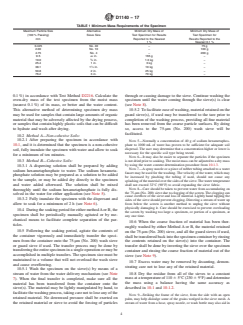
9.4 Reduction to an exact predetermined mass is not permitted. The dry mass of the test specimen, shall conform to the
following values in Table 1 except as noted in 9.4.1:.
Maximum Particle Standard Minimum Dry Mass of
Size (100 % Passing) Sieve Size Test Specimens
mm
0.425 No. 40 75 g
2.00 No. 10 100 g
4.75 No. 4 200 g
9.5 ⁄8 in. 165 g
19.0 ⁄4 in. 1.3 kg
25.4 1 in. 3 kg
38.1 1 ⁄2 in. 10 kg
50.8 2 in. 25 kg
76.2 3 in. 70 kg
9.4.1 When sufficient material is not available to meet the minimum mass requirement, a smaller mass specimen may be used.
The report shall record the mass used for the test and indicate that sufficient material was not available to meet the minimum mass
requirement.
NOTE 3—Sampling following Test Method D1586 may crush or fracture granular soil particles, possibly influencing the test results.
NOTE 4—The applicable minimum dry mass requirements listed above also comply with the minimum dry mass requirements for Test Methods D422
and D6913 should the same specimen be tested for sieve analysis.
10. Procedure
10.1 After obtaining a representative specimen of sufficient size in accordance with 9.2, transfer the test specimen into a
pre-weighed container. Dry the entire test specimen to a constant mass at a temperature of 110 6 5°C (230 6 9°F) and determine
the mass to four significant digits.
10.1.1 To determine the balance needed, multiply the mass by 0.001, check the resultant number with Table 1 of Specification
D4753 for the required balance.
10.1.2 For example: Minimum readability = 276 g (mass) × 0.001 = 0.3 g. A GP-2 with a readability of 0.1 g would be suitable.
A more sensitive balance could also be
...