


ASTM F1357-14(2019)
(Specification)Standard Specification for Articulating Total Wrist Implants
Standard Specification for Articulating Total Wrist Implants
ABSTRACT
This specification covers total wrist implants that provide articulation function through radial carpal components. However, this specification does not include implants with ceramic coated or porous coated surfaces, one-piece elastomeric implants, and those used for custom applications. Implants covered by this specification are of the constrained, partially constrained, or unconstrained joint prosthesis type. The implants shall be manufactured from biocompatible materials made of unalloyed titanium, cobalt-28chromium-6molybdenum alloy, wrought cobalt-20chromium-15tungsten-10nickel alloy, wrought titanium-6aluminum-4vanadium extra low interstitial alloy, wrought 35cobalt-35nickel-20chromium-10molybdenum alloy, wrought cobalt-20nickel-20chromium-3.5molybdenum-3.5tungsten-5iron alloy, cobalt-28chromium-6molybdenum alloy, titanium-6aluminum-4vanadium alloy, or wrought cobalt-28chromium-6molybdenum alloy with dimensions in conformity to the requirements specified. Tests for polymeric creep (cold flow), wear, and range of motion of the device as well as in vitro laboratory testing shall be performed and shall conform to the requirements specified. Per service requirement, metallic implants shall undergo fluorescent penetrant inspection, while cast metallic implants shall undergo radiography.
SCOPE
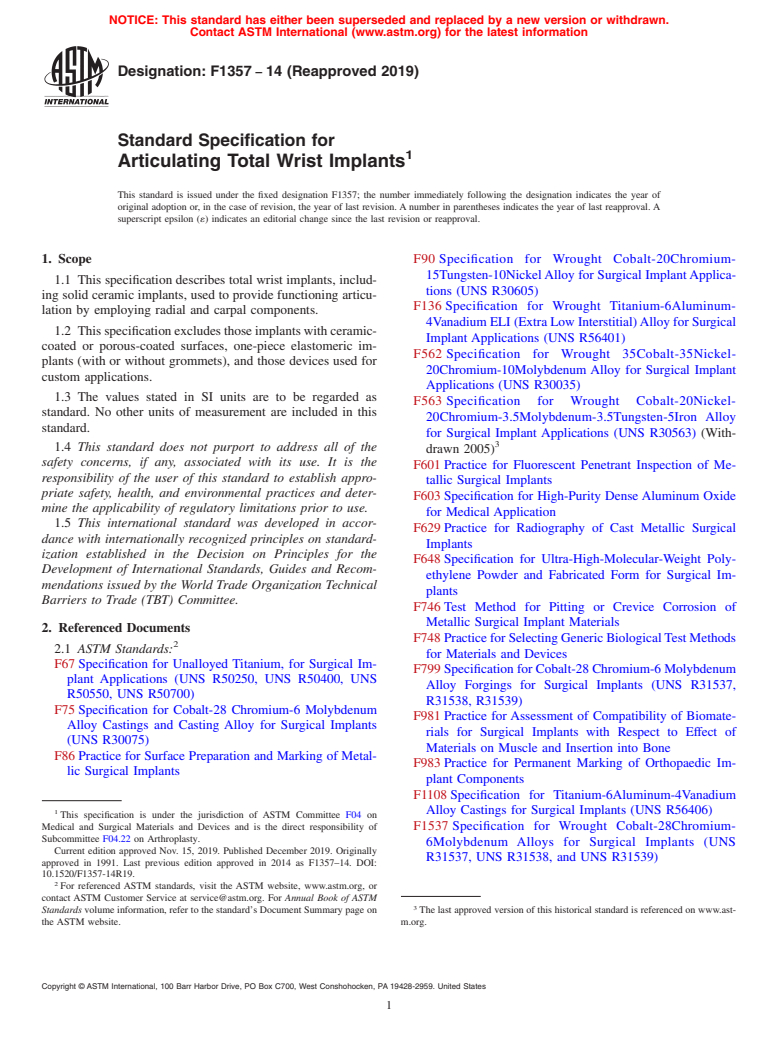
1.1 This specification describes total wrist implants, including solid ceramic implants, used to provide functioning articulation by employing radial and carpal components.
1.2 This specification excludes those implants with ceramic-coated or porous-coated surfaces, one-piece elastomeric implants (with or without grommets), and those devices used for custom applications.
1.3 The values stated in SI units are to be regarded as standard. No other units of measurement are included in this standard.
1.4 This standard does not purport to address all of the safety concerns, if any, associated with its use. It is the responsibility of the user of this standard to establish appropriate safety, health, and environmental practices and determine the applicability of regulatory limitations prior to use.
1.5 This international standard was developed in accordance with internationally recognized principles on standardization established in the Decision on Principles for the Development of International Standards, Guides and Recommendations issued by the World Trade Organization Technical Barriers to Trade (TBT) Committee.
General Information
Buy Standard
Standards Content (Sample)
NOTICE: This standard has either been superseded and replaced by a new version or withdrawn.
Contact ASTM International (www.astm.org) for the latest information
Designation: F1357 − 14 (Reapproved 2019)
Standard Specification for
Articulating Total Wrist Implants
This standard is issued under the fixed designation F1357; the number immediately following the designation indicates the year of
original adoption or, in the case of revision, the year of last revision. A number in parentheses indicates the year of last reapproval. A
superscript epsilon (´) indicates an editorial change since the last revision or reapproval.
1. Scope F90 Specification for Wrought Cobalt-20Chromium-
15Tungsten-10Nickel Alloy for Surgical Implant Applica-
1.1 This specification describes total wrist implants, includ-
tions (UNS R30605)
ing solid ceramic implants, used to provide functioning articu-
F136 Specification for Wrought Titanium-6Aluminum-
lation by employing radial and carpal components.
4Vanadium ELI (Extra Low Interstitial) Alloy for Surgical
1.2 This specification excludes those implants with ceramic-
Implant Applications (UNS R56401)
coated or porous-coated surfaces, one-piece elastomeric im-
F562 Specification for Wrought 35Cobalt-35Nickel-
plants (with or without grommets), and those devices used for
20Chromium-10Molybdenum Alloy for Surgical Implant
custom applications.
Applications (UNS R30035)
1.3 The values stated in SI units are to be regarded as
F563 Specification for Wrought Cobalt-20Nickel-
standard. No other units of measurement are included in this
20Chromium-3.5Molybdenum-3.5Tungsten-5Iron Alloy
standard.
for Surgical Implant Applications (UNS R30563) (With-
1.4 This standard does not purport to address all of the
drawn 2005)
safety concerns, if any, associated with its use. It is the
F601 Practice for Fluorescent Penetrant Inspection of Me-
responsibility of the user of this standard to establish appro-
tallic Surgical Implants
priate safety, health, and environmental practices and deter-
F603 Specification for High-Purity Dense Aluminum Oxide
mine the applicability of regulatory limitations prior to use.
for Medical Application
1.5 This international standard was developed in accor-
F629 Practice for Radiography of Cast Metallic Surgical
dance with internationally recognized principles on standard-
Implants
ization established in the Decision on Principles for the
F648 Specification for Ultra-High-Molecular-Weight Poly-
Development of International Standards, Guides and Recom-
ethylene Powder and Fabricated Form for Surgical Im-
mendations issued by the World Trade Organization Technical
plants
Barriers to Trade (TBT) Committee.
F746 Test Method for Pitting or Crevice Corrosion of
Metallic Surgical Implant Materials
2. Referenced Documents
F748 Practice for Selecting Generic Biological Test Methods
2.1 ASTM Standards:
for Materials and Devices
F67 Specification for Unalloyed Titanium, for Surgical Im-
F799 Specification for Cobalt-28 Chromium-6 Molybdenum
plant Applications (UNS R50250, UNS R50400, UNS
Alloy Forgings for Surgical Implants (UNS R31537,
R50550, UNS R50700)
R31538, R31539)
F75 Specification for Cobalt-28 Chromium-6 Molybdenum
F981 Practice for Assessment of Compatibility of Biomate-
Alloy Castings and Casting Alloy for Surgical Implants
rials for Surgical Implants with Respect to Effect of
(UNS R30075)
Materials on Muscle and Insertion into Bone
F86 Practice for Surface Preparation and Marking of Metal-
F983 Practice for Permanent Marking of Orthopaedic Im-
lic Surgical Implants
plant Components
F1108 Specification for Titanium-6Aluminum-4Vanadium
1 Alloy Castings for Surgical Implants (UNS R56406)
This specification is under the jurisdiction of ASTM Committee F04 on
Medical and Surgical Materials and Devices and is the direct responsibility of F1537 Specification for Wrought Cobalt-28Chromium-
Subcommittee F04.22 on Arthroplasty.
6Molybdenum Alloys for Surgical Implants (UNS
Current edition approved Nov. 15, 2019. Published December 2019. Originally
R31537, UNS R31538, and UNS R31539)
approved in 1991. Last previous edition approved in 2014 as F1357–14. DOI:
10.1520/F1357-14R19.
For referenced ASTM standards, visit the ASTM website, www.astm.org, or
contact ASTM Customer Service at service@astm.org. For Annual Book of ASTM
Standards volume information, refer to the standard’s Document Summary page on The last approved version of this historical standard is referenced on www.ast-
the ASTM website. m.org.
Copyright © ASTM International, 100 Barr Harbor Drive, PO Box C700, West Conshohocken, PA 19428-2959. United States
F1357 − 14 (2019)
2.2 ANSI/ASME Standard: shall be determined to exhibit corrosion resistance equal to or
ANSI/ASME B46.1 Surface Texture (Surface Roughness, better than one of the materials listed in 5.2 when tested in
Waviness, and Lay) accordance with Test Method F746.
3. Terminology 6. Performance Requirements
6.1 Polymeric Creep (Cold Flow)—Ultra-high-molecular-
3.1 Definitions:
weight-polyethylene in implant form shall conform to the
3.1.1 carpal component—articulating member inserted into
requirements detailed in Specification F648. When creep
or through the carpal bones.
occurs, it must not impair the function or stability of the
3.1.2 radial component—articulating member inserted into
interface.
the radius for articulation with the carpal component.
6.2 Wear of Alternative Materials—It is important to under-
3.1.3 total wrist replacement—prosthetic parts substituted
stand the wear performance for articulating surfaces. Any new
for the native opposing radial and carpal articulating surfaces.
or different material couple should not exceed the wear rates of
4. Classification
the following material couple when tested under physiological
conditions. The current wear couple is CoCrMo alloy (Speci-
4.1 Constrained—A constrained joint prosthesis is used for
fication F75) against ultra-high-molecular-weight-
joint replacement and prevents dislocation of the prosthesis in
polyethylene. This is an industry wide referenced wear couple
more than one anatomical plane and consists of either a single,
and is considered by some to be the minimum. It has been
flexible, across-the-joint component, or more than one compo-
proven to provide clinically acceptable results.
nent linked together or affined.
NOTE 1—In situations where the pin-on-flat test may not be considered
4.2 Partially Constrained—A semi-constrained joint pros-
appropriate, other test methods may be considered.
thesis is used for partial or total joint replacement and limits
6.3 Range of Motion of the Device Before Implantation—
translation and rotation of the prosthesis in one or more planes
The implant shall be evaluated to determine the maximum
via the geometry of its articulating surfaces. It has no across-
dorsiflexion, palmar flexion, radial deviation, and ulnar devia-
the-joint linkages.
tion possible before subluxation occurs or the motion is
4.3 Unconstrained—An unconstrained joint prosthesis is
arrested by the implant. These results shall be reported in the
used for partial or total joint replacement and restricts mini-
product labeling.
mally prosthesis movement in one or more planes. Its compo-
6.4 Guidelines for In-Vitro Laboratory Testing—No ASTM
nents have no across-the-joint linkages.
standards for testing articulating wrist implants have been
5. Materials and Manufacture
developed. Laboratory testing that simulates the conditions of
use is desirable to compare materials and designs and to
5.1 Proper material selection is necessary, but insufficient to
provide an indication of clinical performance. Implant testing
ensure suitable functioning of a device.
shall be done in keeping with the implant’s intended function,
5.2 All metal implant components shall conform to one of
that is, implants intended to partially stabilize or stabilize a
the following specifications for implant materials: ASTM
joint shall be subjected to the maximum destabilizing force
Specification F67, F75, F90, F136, F562, F563 (nonbearing
anticipated in clinical application during flexural testing.
use only), F799, F1108, or F1537.
7. Dimensions
5.3 All polymeric components shall conform to Specifica-
tion F648 for implant materials.
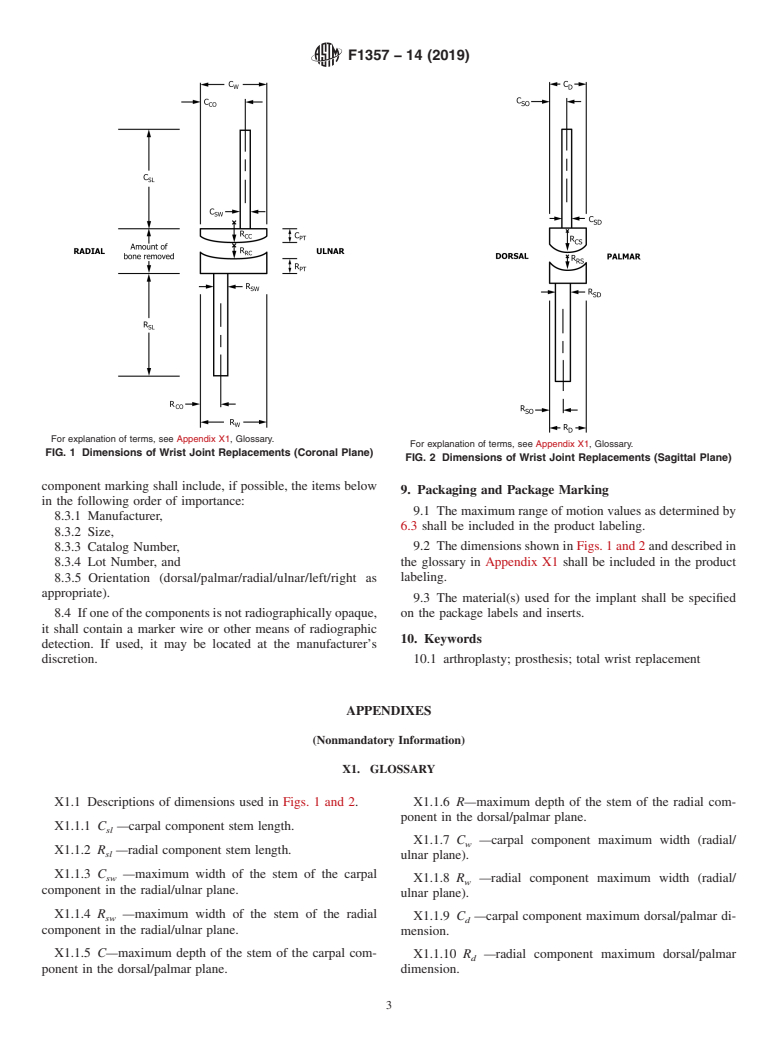
7.1 Dimensions of wrist joint replacement components
should be designated as in Figs. 1 and 2.
5.4 All solid ceramic components shall conform to Specifi-
cation F603 for implant materials.
8. Finish and Marking
5.5 Biocompatibility—Materials with limited or no history
8.1 Items conforming to this specification shall be finished
of successful use for orthopedic implant application shall be
and marked in accordance with Practice F86 where applicable.
determined to exhibit acceptable biological responses equal to
8.2 Articulating Surface Finishes:
or better than one of the materials listed in 5.2 when tested in
8.2.1 Metallic Bearing Surface—The main bearing surface
accordance with Practices F748 and F981.
shall have a surface finish no rougher than 0.10 µm roughness
5.6 When required for metallic implants, fluorescent pen-
average, Ra, with a cutoff length of 0.25 mm, when measured
etrant inspection shall be performed in accordance with Prac-
in accordance with the principles given in ANSI/ASME
tice F601.
B46.1–1995.
5.7 When required for cast metallic implants, radiography
8.2.2 Polymeric Bearing Surface (if used)—The main bear-
shall be performed in accordance with Practice F629.
ing surface shall have a surface finish no rougher than 2 µm
roughness, Ra, with a cut-off length of 0.8 mm, when measured
5.8 Corrosion Resistance—Materials with limited or no
in accordance with the principles
...
This document is not an ASTM standard and is intended only to provide the user of an ASTM standard an indication of what changes have been made to the previous version. Because
it may not be technically possible to adequately depict all changes accurately, ASTM recommends that users consult prior editions as appropriate. In all cases only the current version
of the standard as published by ASTM is to be considered the official document.
Designation: F1357 − 14 F1357 − 14 (Reapproved 2019)
Standard Specification for
Articulating Total Wrist Implants
This standard is issued under the fixed designation F1357; the number immediately following the designation indicates the year of
original adoption or, in the case of revision, the year of last revision. A number in parentheses indicates the year of last reapproval. A
superscript epsilon (´) indicates an editorial change since the last revision or reapproval.
1. Scope
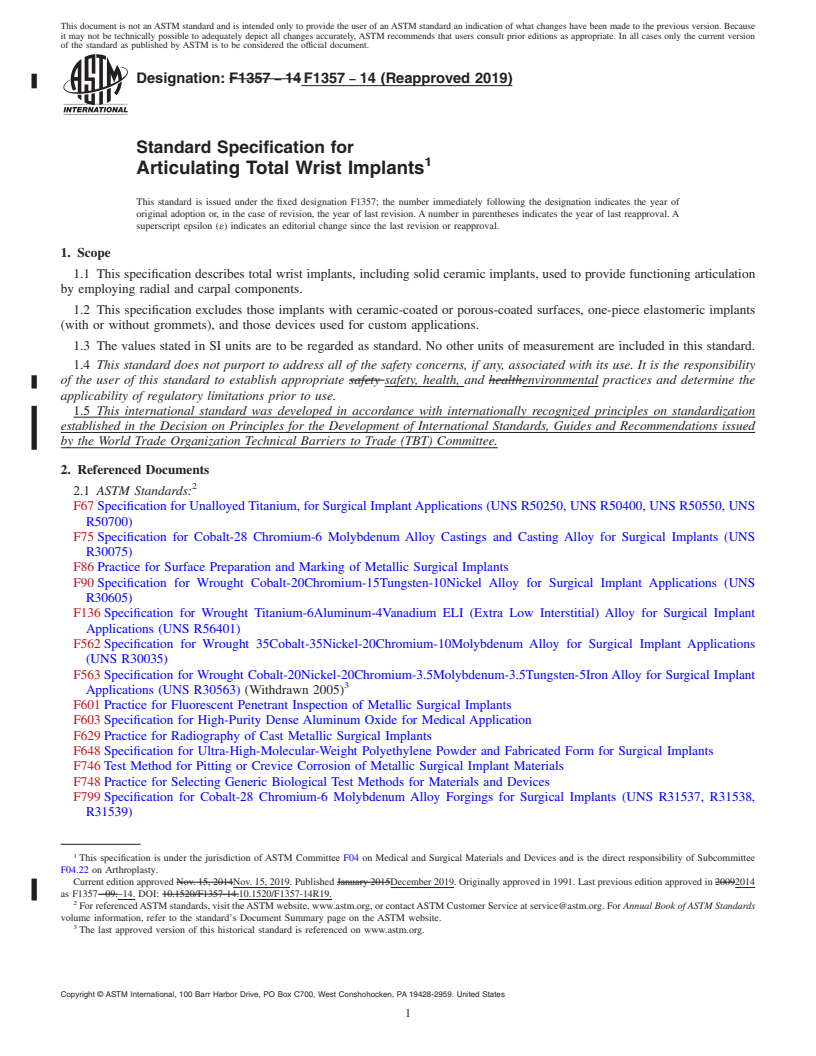
1.1 This specification describes total wrist implants, including solid ceramic implants, used to provide functioning articulation
by employing radial and carpal components.
1.2 This specification excludes those implants with ceramic-coated or porous-coated surfaces, one-piece elastomeric implants
(with or without grommets), and those devices used for custom applications.
1.3 The values stated in SI units are to be regarded as standard. No other units of measurement are included in this standard.
1.4 This standard does not purport to address all of the safety concerns, if any, associated with its use. It is the responsibility
of the user of this standard to establish appropriate safety safety, health, and healthenvironmental practices and determine the
applicability of regulatory limitations prior to use.
1.5 This international standard was developed in accordance with internationally recognized principles on standardization
established in the Decision on Principles for the Development of International Standards, Guides and Recommendations issued
by the World Trade Organization Technical Barriers to Trade (TBT) Committee.
2. Referenced Documents
2.1 ASTM Standards:
F67 Specification for Unalloyed Titanium, for Surgical Implant Applications (UNS R50250, UNS R50400, UNS R50550, UNS
R50700)
F75 Specification for Cobalt-28 Chromium-6 Molybdenum Alloy Castings and Casting Alloy for Surgical Implants (UNS
R30075)
F86 Practice for Surface Preparation and Marking of Metallic Surgical Implants
F90 Specification for Wrought Cobalt-20Chromium-15Tungsten-10Nickel Alloy for Surgical Implant Applications (UNS
R30605)
F136 Specification for Wrought Titanium-6Aluminum-4Vanadium ELI (Extra Low Interstitial) Alloy for Surgical Implant
Applications (UNS R56401)
F562 Specification for Wrought 35Cobalt-35Nickel-20Chromium-10Molybdenum Alloy for Surgical Implant Applications
(UNS R30035)
F563 Specification for Wrought Cobalt-20Nickel-20Chromium-3.5Molybdenum-3.5Tungsten-5Iron Alloy for Surgical Implant
Applications (UNS R30563) (Withdrawn 2005)
F601 Practice for Fluorescent Penetrant Inspection of Metallic Surgical Implants
F603 Specification for High-Purity Dense Aluminum Oxide for Medical Application
F629 Practice for Radiography of Cast Metallic Surgical Implants
F648 Specification for Ultra-High-Molecular-Weight Polyethylene Powder and Fabricated Form for Surgical Implants
F746 Test Method for Pitting or Crevice Corrosion of Metallic Surgical Implant Materials
F748 Practice for Selecting Generic Biological Test Methods for Materials and Devices
F799 Specification for Cobalt-28 Chromium-6 Molybdenum Alloy Forgings for Surgical Implants (UNS R31537, R31538,
R31539)
This specification is under the jurisdiction of ASTM Committee F04 on Medical and Surgical Materials and Devices and is the direct responsibility of Subcommittee
F04.22 on Arthroplasty.
Current edition approved Nov. 15, 2014Nov. 15, 2019. Published January 2015December 2019. Originally approved in 1991. Last previous edition approved in 20092014
as F1357 –09.–14. DOI: 10.1520/F1357-14.10.1520/F1357-14R19.
For referenced ASTM standards, visit the ASTM website, www.astm.org, or contact ASTM Customer Service at service@astm.org. For Annual Book of ASTM Standards
volume information, refer to the standard’s Document Summary page on the ASTM website.
The last approved version of this historical standard is referenced on www.astm.org.
Copyright © ASTM International, 100 Barr Harbor Drive, PO Box C700, West Conshohocken, PA 19428-2959. United States
F1357 − 14 (2019)
F981 Practice for Assessment of Compatibility of Biomaterials for Surgical Implants with Respect to Effect of Materials on
Muscle and Insertion into Bone
F983 Practice for Permanent Marking of Orthopaedic Implant Components
F1108 Specification for Titanium-6Aluminum-4Vanadium Alloy Castings for Surgical Implants (UNS R56406)
F1537 Specification for Wrought Cobalt-28Chromium-6Molybdenum Alloys for Surgical Implants (UNS R31537, UNS
R31538, and UNS R31539)
2.2 ANSI/ASME Standard:
ANSI/ASME B46.1 Surface Texture (Surface Roughness, Waviness, and Lay)
3. Terminology
3.1 Definitions:
3.1.1 carpal component—articulating member inserted into or through the carpal bones.
3.1.2 radial component—articulating member inserted into the radius for articulation with the carpal component.
3.1.3 total wrist replacement—prosthetic parts substituted for the native opposing radial and carpal articulating surfaces.
4. Classification
4.1 Constrained—A constrained joint prosthesis is used for joint replacement and prevents dislocation of the prosthesis in more
than one anatomical plane and consists of either a single, flexible, across-the-joint component, or more than one component linked
together or affined.
4.2 Partially Constrained—A semi-constrained joint prosthesis is used for partial or total joint replacement and limits
translation and rotation of the prosthesis in one or more planes via the geometry of its articulating surfaces. It has no
across-the-joint linkages.
4.3 Unconstrained—An unconstrained joint prosthesis is used for partial or total joint replacement and restricts minimally
prosthesis movement in one or more planes. Its components have no across-the-joint linkages.
5. Materials and Manufacture
5.1 Proper material selection is necessary, but insufficient to ensure suitable functioning of a device.
5.2 All metal implant components shall conform to one of the following specifications for implant materials: ASTM
Specification F67, F75, F90, F136, F562, F563 (nonbearing use only), F799, F1108, or F1537.
5.3 All polymeric components shall conform to Specification F648 for implant materials.
5.4 All solid ceramic components shall conform to Specification F603 for implant materials.
5.5 Biocompatibility—Materials with limited or no history of successful use for orthopedic implant application shall be
determined to exhibit acceptable biological responses equal to or better than one of the materials listed in 5.2 when tested in
accordance with Practices F748 and F981.
5.6 When required for metallic implants, fluorescent penetrant inspection shall be performed in accordance with Practice F601.
5.7 When required for cast metallic implants, radiography shall be performed in accordance with Practice F629.
5.8 Corrosion Resistance—Materials with limited or no history of successful use for orthopedic implant application shall be
determined to exhibit corrosion resistance equal to or better than one of the materials listed in 5.2 when tested in accordance with
Test Method F746.
6. Performance Requirements
6.1 Polymeric Creep (Cold Flow)—Ultra-high molecular weight polyethylene Ultra-high-molecular-weight-polyethylene in
implant form shall conform to the requirements detailed in Specification F648. When creep occurs, it must not impair the function
or stability of the interface.
6.2 Wear of Alternative Materials—It is important to understand the wear performance for articulating surfaces. Any new or
different material couple should not exceed the wear rates of the following material couple when tested under physiological
conditions. The current wear couple is CoCrMo alloy (Specification F75) against ultra high molecular weight polyethylene.
ultra-high-molecular-weight-polyethylene. This is an industry wide referenced wear couple and is considered by some to be the
minimum. It has been proven to provide clinically acceptable results.
NOTE 1—In situations where the pin-on-flat test may not be considered appropriate, other test methods may be considered.
Available from American National Standards Institute (ANSI), 25 W. 43rd St., 4th Floor, New York, NY 10036, http://www.ansi.org.
F1357 − 14 (2019)
6.3 Range of Motion of the Device Before Implantation—The implant shall be evaluated to determine the maximum
dorsiflexion, palmar flexion, radial deviation, and ulnar deviation possible before subluxation occurs or the motion is arrested by
the implant. These results shall be reported in the product labeling.
6.4 Guidelines for In-Vitro Laboratory Testing—No ASTM standards for testing articulating wrist implants have been
developed. Laboratory testing that simulates the conditions of use is desirable to compare materials and designs and to provide an
indication of clinical performance. Implant testing shall be done in keeping with the implant’s intended function, that is, implants
intended to partially stabilize or stabilize a joint shall be subjected to the maximum destabilizing force anticipated in clinical
application during flexural testing.
7. Dimensions
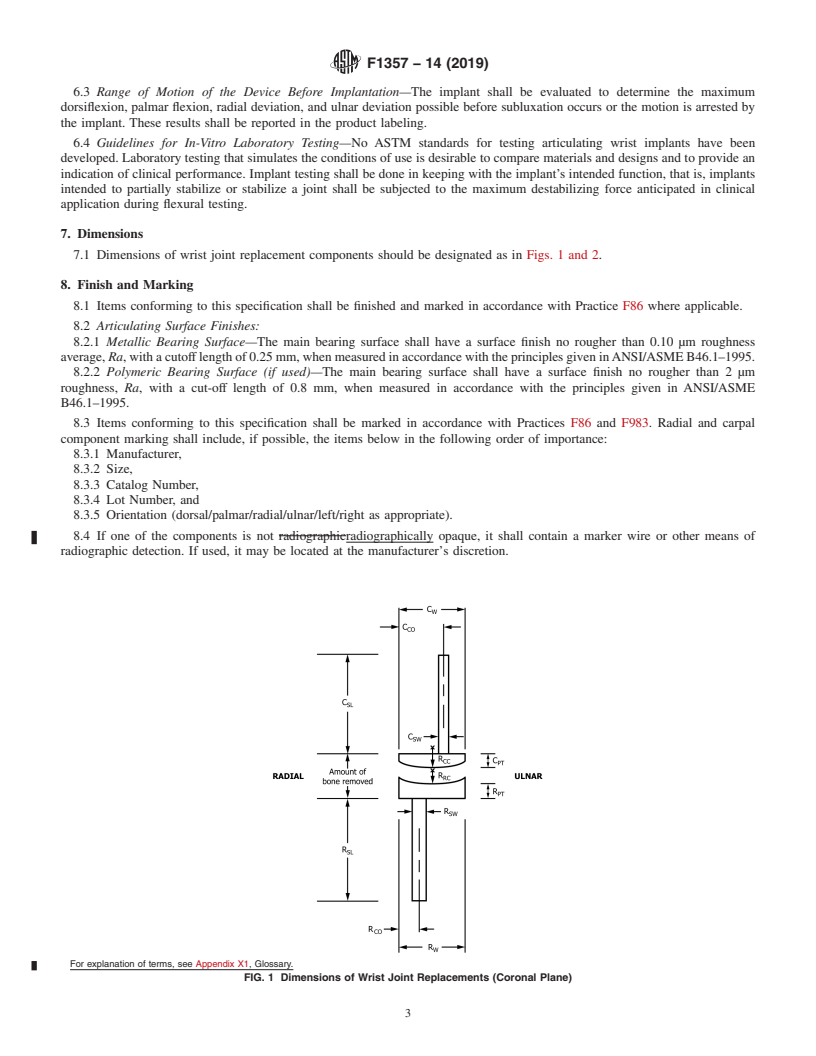
7.1 Dimensions of wrist joint replacement components should be designated as in Figs. 1 and 2.
8. Finish and Marking
8.1 Items conforming to this specification shall be finished and marked in accordance with Practice F86 where applicable.
8.2 Articulating Surface Finishes:
8.2.1 Metallic Bearing Surface—The main bearing surface shall have a surface fini
...
Questions, Comments and Discussion
Ask us and Technical Secretary will try to provide an answer. You can facilitate discussion about the standard in here.