

ASTM D5800-21
(Test Method)Standard Test Method for Evaporation Loss of Lubricating Oils by the Noack Method
General Information
- Abstract
SIGNIFICANCE AND USE
5.1 The evaporation loss is of particular importance in engine lubrication. Where high temperatures occur, portions of an oil can evaporate.
5.2 Evaporation may contribute to oil consumption in an engine and can lead to a change in the properties of an oil.
5.3 Many engine manufacturers specify a maximum allowable evaporation loss.
5.4 Some engine manufacturers, when specifying a maximum allowable evaporation loss, quote this test method along with the specifications.
5.5 The apparatuses used in Procedure C (see Annex A2) and Procedure D, also permit collection of the volatile oil vapors for determination of their physical and chemical properties. Elemental analysis of the collected volatiles may be helpful in identifying components such as phosphorous, which has been linked to premature degradation of the emission system catalyst.
SCOPE
1.1 This test method covers four procedures for determining the evaporation loss of lubricating oils (particularly engine oils). The evaporation measured is reported as percent total loss. The test method relates to one set of operating conditions but may be readily adapted to other conditions as required.
1.2 Procedure B and Procedure D that are in the main section of the test method provide equivalent results. Procedures A and C, which are in Annex A1 and Annex A2, have equivalent results. It has been determined that Procedures A and C show a slight bias when compared to Procedures B and D. Procedures B and D give slightly higher results versus Procedures A and C on formulated engine oils, while Procedures B and D give lower results versus Procedures A and C on basestocks. Thus, a correction factor is utilized to convert between the two sets of Procedures based on the fluid type.
1.3 The values stated in SI units are to be regarded as standard. No other units of measurement are included in this standard.
1.4 This standard does not purport to address all of the safety concerns, if any, associated with its use. It is the responsibility of the user of this standard to establish appropriate safety, health, and environmental practices and determine the applicability of regulatory limitations prior to use.
1.5 This international standard was developed in accordance with internationally recognized principles on standardization established in the Decision on Principles for the Development of International Standards, Guides and Recommendations issued by the World Trade Organization Technical Barriers to Trade (TBT) Committee.
- Status
- Published
- Publication Date
- 30-Sep-2021
- Technical Committee
- D02 - Petroleum Products, Liquid Fuels, and Lubricants
- Drafting Committee
- D02.06 - Analysis of Liquid Fuels and Lubricants
Buy Documents
ASTM D5800-21 - Standard Test Method for Evaporation Loss of Lubricating Oils by the Noack Method
REDLINE ASTM D5800-21 - Standard Test Method for Evaporation Loss of Lubricating Oils by the Noack Method
Overview
ASTM D5800-21 is the internationally recognized standard test method for determining the evaporation loss of lubricating oils, particularly engine oils, using the Noack Method. Established by ASTM International, this standard outlines four procedures to measure evaporation loss by simulating high-temperature conditions representative of those encountered in internal combustion engines. The method reports the oil's mass loss as a percentage of the original sample, providing valuable data for oil performance, volatility, and compliance with industry requirements.
Evaporation loss is a critical factor in engine lubrication. High evaporation rates can accelerate oil consumption, alter oil properties, and potentially result in higher emissions and faster catalyst degradation. Therefore, many engine manufacturers include maximum evaporation loss specifications in their oil requirements and frequently reference ASTM D5800-21 for compliance.
Key Topics
Evaporation Loss Measurement
The standard method quantifies evaporative loss as the percentage of lubricating oil mass that volatilizes when subjected to specific heating and airflow conditions for a set period (typically 1 hour at 250°C).Testing Procedures (A, B, C, D)
ASTM D5800-21 provides four procedures for testing: Procedures A and C (detailed in annexes), and Procedures B and D (main body). Procedures B and D are equivalent, as are A and C, though small biases exist between the groups. Correction factors are provided to reconcile differences based on oil type (basestock vs. formulated oil).Significance in Engine Performance and Emissions
Excessive evaporation leads to increased oil consumption and may alter vital oil characteristics such as viscosity and additive concentration, impacting engine wear protection, efficiency, and emissions system longevity.Volatile Component Analysis
This method allows for the collection and analysis of vaporized oil components, which can assist in identifying substances, including phosphorus, linked to emission system catalyst degradation.International Recognition
Developed in line with the WTO’s principles for international standards, ASTM D5800-21 is widely referenced in global markets for both lubricant formulation and regulatory compliance.
Applications
Automotive Engine Oils
The primary application is in the qualification and formulation of engine oils, where manufacturers require proven control of volatility to meet engine design and emissions requirements.Quality Assurance and Product Development
Oil manufacturers, formulators, and laboratories use ASTM D5800-21 to benchmark product performance, improve formulations, and ensure consistent quality by monitoring evaporation loss.API Licensing and Certification
Compliance with this standard, along with calibration protocols specified by the Lubricant Test Monitoring System (LTMS), is required for various API engine oil licensing programs.Regulatory and Compliance Testing
The standard is used to demonstrate conformity with engine manufacturer limits and governmental or environmental regulations on oil volatility.
Related Standards
- ASTM D4057 – Practice for Manual Sampling of Petroleum and Petroleum Products
- ASTM D4177 – Practice for Automatic Sampling of Petroleum and Petroleum Products
- ASTM D6299 – Practice for Statistical Quality Assurance and Control Charting
- ASTM D6300 – Practice for Determining Precision and Bias in Test Methods
- DIN 1725 – Specification for Aluminum Alloys
- DIN 12785 – Specifications for Glass Thermometers
Keywords: ASTM D5800-21, Noack volatility, evaporation loss, lubricating oils, engine oil volatility testing, oil consumption, oil volatility measurement, lubricant standard, API licensing, emission system catalyst, ASTM International, oil quality assurance.
Relations
- Effective Date
- 01-Mar-2024
- Effective Date
- 01-Dec-2023
- Effective Date
- 01-Dec-2023
- Effective Date
- 01-Dec-2019
- Effective Date
- 15-Dec-2017
- Effective Date
- 15-Nov-2017
- Effective Date
- 01-Jan-2017
- Effective Date
- 01-Apr-2016
- Effective Date
- 01-Jun-2015
- Effective Date
- 01-Jun-2014
- Effective Date
- 01-Jun-2014
- Effective Date
- 01-May-2014
- Effective Date
- 01-Dec-2013
- Effective Date
- 01-Oct-2013
- Effective Date
- 15-Jul-2013
Buy Documents
ASTM D5800-21 - Standard Test Method for Evaporation Loss of Lubricating Oils by the Noack Method
REDLINE ASTM D5800-21 - Standard Test Method for Evaporation Loss of Lubricating Oils by the Noack Method
Get Certified
Connect with accredited certification bodies for this standard

Element Materials Technology
Materials testing and product certification.

ABS Group Brazil
ABS Group certification services in Brazil.

ABS Quality Evaluations Inc.
American Bureau of Shipping quality certification.
Sponsored listings
Frequently Asked Questions
ASTM D5800-21 is a standard published by ASTM International. Its full title is "Standard Test Method for Evaporation Loss of Lubricating Oils by the Noack Method". This standard covers: SIGNIFICANCE AND USE 5.1 The evaporation loss is of particular importance in engine lubrication. Where high temperatures occur, portions of an oil can evaporate. 5.2 Evaporation may contribute to oil consumption in an engine and can lead to a change in the properties of an oil. 5.3 Many engine manufacturers specify a maximum allowable evaporation loss. 5.4 Some engine manufacturers, when specifying a maximum allowable evaporation loss, quote this test method along with the specifications. 5.5 The apparatuses used in Procedure C (see Annex A2) and Procedure D, also permit collection of the volatile oil vapors for determination of their physical and chemical properties. Elemental analysis of the collected volatiles may be helpful in identifying components such as phosphorous, which has been linked to premature degradation of the emission system catalyst. SCOPE 1.1 This test method covers four procedures for determining the evaporation loss of lubricating oils (particularly engine oils). The evaporation measured is reported as percent total loss. The test method relates to one set of operating conditions but may be readily adapted to other conditions as required. 1.2 Procedure B and Procedure D that are in the main section of the test method provide equivalent results. Procedures A and C, which are in Annex A1 and Annex A2, have equivalent results. It has been determined that Procedures A and C show a slight bias when compared to Procedures B and D. Procedures B and D give slightly higher results versus Procedures A and C on formulated engine oils, while Procedures B and D give lower results versus Procedures A and C on basestocks. Thus, a correction factor is utilized to convert between the two sets of Procedures based on the fluid type. 1.3 The values stated in SI units are to be regarded as standard. No other units of measurement are included in this standard. 1.4 This standard does not purport to address all of the safety concerns, if any, associated with its use. It is the responsibility of the user of this standard to establish appropriate safety, health, and environmental practices and determine the applicability of regulatory limitations prior to use. 1.5 This international standard was developed in accordance with internationally recognized principles on standardization established in the Decision on Principles for the Development of International Standards, Guides and Recommendations issued by the World Trade Organization Technical Barriers to Trade (TBT) Committee.
SIGNIFICANCE AND USE 5.1 The evaporation loss is of particular importance in engine lubrication. Where high temperatures occur, portions of an oil can evaporate. 5.2 Evaporation may contribute to oil consumption in an engine and can lead to a change in the properties of an oil. 5.3 Many engine manufacturers specify a maximum allowable evaporation loss. 5.4 Some engine manufacturers, when specifying a maximum allowable evaporation loss, quote this test method along with the specifications. 5.5 The apparatuses used in Procedure C (see Annex A2) and Procedure D, also permit collection of the volatile oil vapors for determination of their physical and chemical properties. Elemental analysis of the collected volatiles may be helpful in identifying components such as phosphorous, which has been linked to premature degradation of the emission system catalyst. SCOPE 1.1 This test method covers four procedures for determining the evaporation loss of lubricating oils (particularly engine oils). The evaporation measured is reported as percent total loss. The test method relates to one set of operating conditions but may be readily adapted to other conditions as required. 1.2 Procedure B and Procedure D that are in the main section of the test method provide equivalent results. Procedures A and C, which are in Annex A1 and Annex A2, have equivalent results. It has been determined that Procedures A and C show a slight bias when compared to Procedures B and D. Procedures B and D give slightly higher results versus Procedures A and C on formulated engine oils, while Procedures B and D give lower results versus Procedures A and C on basestocks. Thus, a correction factor is utilized to convert between the two sets of Procedures based on the fluid type. 1.3 The values stated in SI units are to be regarded as standard. No other units of measurement are included in this standard. 1.4 This standard does not purport to address all of the safety concerns, if any, associated with its use. It is the responsibility of the user of this standard to establish appropriate safety, health, and environmental practices and determine the applicability of regulatory limitations prior to use. 1.5 This international standard was developed in accordance with internationally recognized principles on standardization established in the Decision on Principles for the Development of International Standards, Guides and Recommendations issued by the World Trade Organization Technical Barriers to Trade (TBT) Committee.
ASTM D5800-21 is classified under the following ICS (International Classification for Standards) categories: 75.100 - Lubricants, industrial oils and related products. The ICS classification helps identify the subject area and facilitates finding related standards.
ASTM D5800-21 has the following relationships with other standards: It is inter standard links to ASTM D6300-24, ASTM D6299-23a, ASTM D6300-23a, ASTM D6300-19a, ASTM D6299-17b, ASTM D6299-17a, ASTM D6299-17, ASTM D6300-16, ASTM D6300-15, ASTM D6300-14ae1, ASTM D6300-14a, ASTM D6300-14, ASTM D6300-13a, ASTM D6299-13e1, ASTM D6300-13. Understanding these relationships helps ensure you are using the most current and applicable version of the standard.
ASTM D5800-21 is available in PDF format for immediate download after purchase. The document can be added to your cart and obtained through the secure checkout process. Digital delivery ensures instant access to the complete standard document.
Standards Content (Sample)
This international standard was developed in accordance with internationally recognized principles on standardization established in the Decision on Principles for the
Development of International Standards, Guides and Recommendations issued by the World Trade Organization Technical Barriers to Trade (TBT) Committee.
Designation: D5800 − 21
Standard Test Method for
Evaporation Loss of Lubricating Oils by the Noack Method
This standard is issued under the fixed designation D5800; the number immediately following the designation indicates the year of
original adoption or, in the case of revision, the year of last revision.Anumber in parentheses indicates the year of last reapproval.A
superscript epsilon (´) indicates an editorial change since the last revision or reapproval.
1. Scope* D4057Practice for Manual Sampling of Petroleum and
Petroleum Products
1.1 Thistestmethodcoversfourproceduresfordetermining
D4177Practice for Automatic Sampling of Petroleum and
the evaporation loss of lubricating oils (particularly engine
Petroleum Products
oils). The evaporation measured is reported as percent total
D6299Practice for Applying Statistical Quality Assurance
loss.The test method relates to one set of operating conditions
and Control Charting Techniques to Evaluate Analytical
but may be readily adapted to other conditions as required.
Measurement System Performance
1.2 Procedure B and Procedure D that are in the main
D6300Practice for Determination of Precision and Bias
section of the test method provide equivalent results. Proce-
Data for Use in Test Methods for Petroleum Products,
dures A and C, which are in Annex A1 and Annex A2, have
Liquid Fuels, and Lubricants
equivalent results. It has been determined that Procedures A
2.2 DIN Standards:
and C show a slight bias when compared to Procedures B and
DIN 1725Specification for Aluminum Alloys
D. Procedures B and D give slightly higher results versus
DIN 12785Specifications for Glass Thermometers
Procedures A and C on formulated engine oils, while Proce-
duresBandDgivelowerresultsversusProceduresAandCon
3. Terminology
basestocks. Thus, a correction factor is utilized to convert
3.1 Definitions of Terms Specific to This Standard:
between the two sets of Procedures based on the fluid type.
3.1.1 evaporation loss, n—of a lubricating oil by the Noack
1.3 The values stated in SI units are to be regarded as
method, that mass of volatile oil vapors lost when the oil is
standard. No other units of measurement are included in this
heatedinatestcruciblethroughwhichaconstantflowofairis
standard.
drawn.
1.4 This standard does not purport to address all of the
3.1.2 volatility, n—the tendency of a liquid to form a vapor.
safety concerns, if any, associated with its use. It is the
responsibility of the user of this standard to establish appro-
4. Summary of Test Method
priate safety, health, and environmental practices and deter-
4.1 A measured quantity of sample is placed in an evapo-
mine the applicability of regulatory limitations prior to use.
1.5 This international standard was developed in accor- ration crucible or reaction flask that is then heated to 250°C
with a constant flow of air drawn through it for 60min. The
dance with internationally recognized principles on standard-
ization established in the Decision on Principles for the loss in mass of the oil is determined.
Development of International Standards, Guides and Recom-
4.2 Interlaboratory tests have shown that Procedure A,
mendations issued by the World Trade Organization Technical
Procedure B, Procedure C, and Procedure D yield statistically
Barriers to Trade (TBT) Committee.
equivalent precision, with a correlation coefficient of R =
0.996 (see research report).
2. Referenced Documents
2.1 ASTM Standards:
5. Significance and Use
5.1 The evaporation loss is of particular importance in
engine lubrication.Where high temperatures occur, portions of
This test method is under the jurisdiction of ASTM Committee D02 on
an oil can evaporate.
Petroleum Products, Liquid Fuels, and Lubricants and is the direct responsibility of
Subcommittee D02.06 on Analysis of Liquid Fuels and Lubricants.
5.2 Evaporation may contribute to oil consumption in an
Current edition approved Oct. 1, 2021. Published October 2021. Originally
engine and can lead to a change in the properties of an oil.
approved in 1995. Last previous edition approved in 2020 as D5800–20. DOI:
10.1520/D5800-21.
For referenced ASTM standards, visit the ASTM website, www.astm.org, or
contact ASTM Customer Service at service@astm.org. For Annual Book of ASTM
Standards volume information, refer to the standard’s Document Summary page on Available from Deutsches Institut für Normung e.V.(DIN), Am DIN-Platz,
the ASTM website. Burggrafenstrasse 6, 10787 Berlin, Germany, http://www.din.de.
*A Summary of Changes section appears at the end of this standard
Copyright © ASTM International, 100 Barr Harbor Drive, PO Box C700, West Conshohocken, PA 19428-2959. United States
D5800 − 21
5.3 Many engine manufacturers specify a maximum allow- recorded in the specimen when heated with the Woods metal
able evaporation loss. heater block. In the center of the heating block, there is a
circular recess to insert the evaporative crucible. The jacket
5.4 Some engine manufacturers, when specifying a maxi-
heaterisconfiguredtoensureadirectcontactwiththecrucible.
mum allowable evaporation loss, quote this test method along
A mechanism is provided to open the jaws for crucible
with the specifications.
insertion. Two catches on the block prevent the crucible from
5.5 The apparatuses used in Procedure C (see Annex A2)
rising, and the base heater is spring loaded to ensure a direct
and Procedure D, also permit collection of the volatile oil
contact with the crucible.
vapors for determination of their physical and chemical prop-
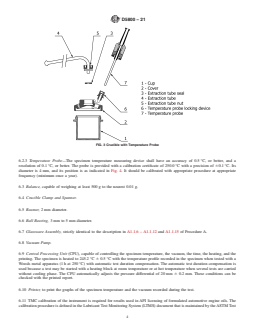
6.2.2 Evaporative Crucible, with screw cover (see Fig. 3).
erties. Elemental analysis of the collected volatiles may be
The crucible is made of stainless steel (see Fig. 4).Above the
helpful in identifying components such as phosphorous, which
supportringisthethreadforthecover.Thenickel-platedbrass
has been linked to premature degradation of the emission
cover (see Fig. 5) is hermetically sealed to the crucible by an
system catalyst.
internal conical sealing surface. Three nozzles of hardened
steel (see Fig. 6) permit the air stream to pass through the
Procedure B—Non-Woods Metal Apparatus
cover. The extraction tube (see Figs. 7 and 8), which slopes
downward, leads from a threaded and sealed connection in the
6. Apparatus
center of the cover.
6.1 The following procedure, Procedure B, describes an
6.2.3 Temperature Probe—The specimen temperature mea-
automated test method that uses the same principle, and the
suring device shall have an accuracy of 0.5°C, or better, and a
same crucible as Procedure A. Only the heat transfer medium
resolution of 0.1°C, or better. The probe is provided with a
tothesampleandlidaredifferent.ItdoesnotuseWoodsalloy,
calibration certificate of 250.0°C with a precision of 60.1°C.
and the sample temperature is directly monitored.
Its diameter is 4mm, and its position is as indicated in Fig. 4.
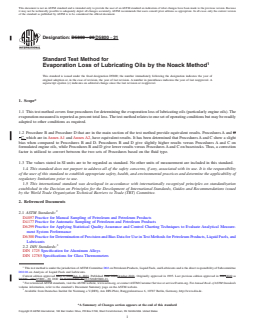
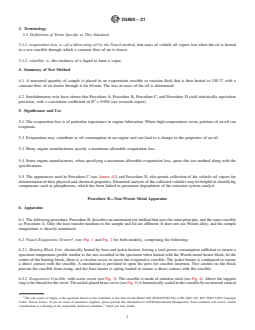
6.2 Noack Evaporative Testers , (see Fig. 1 and Fig. 2 for
It should be calibrated with appropriate procedure at appropri-
both models), comprising the following:
ate frequency (minimum once a year).
6.2.1 Heating Block Unit, electrically heated by base and
6.3 Balance, capable of weighing at least 500g to the
jacket heaters, having a total power consumption sufficient to
nearest 0.01 g.
ensure a specimen temperature profile similar to the one
6.4 Crucible Clamp and Spanner.
6.5 Reamer, 2mm diameter.
The sole source of supply of the apparatus known to the committee at this time
fortheModelA/B(NCK2/NCK25G)isISL(PACLP),B.P.7028514653Carpiquet
6.6 Ball Bearing, 3mm to 5mm diameter.
Cedex,Verson, France. If you are aware of alternative suppliers, please provide this
information to ASTM International Headquarters. Your comments will receive
6.7 Glassware Assembly, strictly identical to the description
careful consideration at a meeting of the responsible technical committee, which
in A1.1.6 – A1.1.12 and A1.1.15 of Procedure A.
you may attend.
FIG. 1 Model A
D5800 − 21
FIG. 2 Model B
FIG. 3 Crucible with Temperature Probe
6.8 Vacuum Pump.
D5800 − 21
FIG. 5 Crucible Cover (continued)
6.10 Printer,toprintthegraphsofthespecimentemperature
FIG. 4 Noack Cup (Detail 1 of Fig. 3)
and the vacuum recorded during the test.
6.11 TMC calibration of the instrument is required for
results used inAPI licensing of formulated automotive engine
oils. The calibration procedure is defined in the Lubricant Test
Monitoring System (LTMS) document that is maintained by
theASTMTest Monitoring Center (TMC) and is governed by
the D02.B0.07 Volatility Surveillance Panel. LTMS severity
adjustments shall be applied to results used inAPI licensing of
FIG. 5 Crucible Cover (Detail 2 of Fig. 3) automotive engine oils (12.2.1).
NOTE 1—It is the perception of the D02.B0.07 Volatility Surveillance
Panel that maintaining crucible cup and lid pairings is a measure of good
practice which minimizes variability. Under authority of the D02.B0.07
6.9 Central Processing Unit (CPU), capable of controlling
Volatility Surveillance Panel, it has determined that for D5800 Procedure
the specimen temperature, the vacuum, the time, the heating,
B tests to be considered operationally valid on TMC calibrated
and the printing. The specimen is heated to 245.2°C 6 0.5°C instruments, crucible cups and lids are to be initially paired by the testing
lab and then remain paired for the entire life-cycle of the crucible set.
with the temperature profile recorded in the specimen when
Moreover, labs may implement and retire paired crucible sets as needed
tested with a Woods metal apparatus (1h at 250°C) with
but once initially paired for calibration and candidate product testing,
automatic test duration compensation. The automatic test
crucible cups and lids must remain paired for all subsequent test runs.
duration compensation is used because a test may be started
Cups and lids shall be engraved or indelibly marked to maintain unique
withaheatingblockatroomtemperatureorathottemperature identification.Notethattheuseofmultiplecup-lidpairingsdoesnotaffect
the TMC calibration status of an instrument.
when several tests are carried without cooling phase.The CPU
automatically adjusts the pressure differential of 20mm 6
0.2mm. These conditions can be checked with the printed
ASTMTestMonitoringCenter,6555PennAvenue,Pittsburgh,PA15206-4489,
report. http://www.astmtmc.org.
D5800 − 21
FIG. 5 Crucible Cover (continued)
FIG. 6 Specimen Temperature Probe Positioning
7. Reagents and Materials
NOTE2—IthasbeenreportedduringtestinghighNoackoilsusingsome
7.1 Cleaning Solvent—Amixture of naphtha and toluene is
models that the thermocouple probe can become exposed when evapora-
recommended for cleaning the crucible. (Warning—
tion loss is high. While the instrument will alarm to indicate that the
Flammable, vapor harmful.) Overnight soaking may be neces-
temperature fluctuation is greater than allowed in the test method, the
sary.
heaterwillnotshutoff.Ifnotnoticed,theoilcancontinuetoheattoclose
toitsflashpoint,andonelaboratoryhasreportedthesampletoflashwhen
7.2 Noack Reference Fluid—Oil such as NCO-12 having a
the probe was removed at the end of the test. Hence, it is suggested to
known evaporative loss for use with all D5800 method
contact the instrument manufacturer to remedy possible malfunction.
procedures. The value of which is provided by the manufac-
8.2 (Warning—Though the test method calls for a draft-
turer.
free area, the exhaust fumes from the evaporating oil must be
7.3 Insulated Gloves.
ventilated to an outside source. Precaution shall be taken to
avoid any possibility of fire or explosion.) (See Note A1.3.)
7.4 Drying Paper.
8.3 An alternate means for preventing draft described in
8. Hazards
Appendix X3 was not used in the development of the test
8.1 Safety Hazards—It is assumed that anyone using this
method precision statement.
test method will either be fully trained and familiar with all
normal laboratory practices, or will be under the direct super- 9. Preparation of Apparatus
vision of such a person. It is the responsibility of the operator
9.1 To avoid disturbing the thermal equilibrium, the appa-
to ensure that all local legislative and statutory requirements
ratus shall be assembled in a draft-free area Plexi-glass draft
are met.
shields are available from the manufacturer, for the model
shown in Fig. 2, if drafts in the room cause thermal distur-
bances (see Appendix X3).
The sole source of supply of the reference fluid known to the committee at this
time is Tannas Co., 4800 James Savage Rd., Midland, MI 48642. If you are aware
9.2 Prepare the automated apparatus for operation in accor-
of alternative suppliers, please provide this information to ASTM International
dance with the manufacturer’s instructions for calibrating,
Headquarters.Your comments will receive careful consideration at a meeting of the
responsible technical committee, which you may attend. checking, and operating the equipment.
D5800 − 21
FIG. 7 Extraction Tube (Stainless Steel) with Its Seal (Details 3 and 4 of Fig. 3)
10.4 Run the ball bearing through the extraction tube to
ensure that it is clear of contaminants.
10.5 Calibrate the vacuum measuring device in accordance
with the manufacturer’s instructions.
10.6 Weigh the empty cup without its cover to the nearest
0.01g.
10.7 Weigh into the tared crucible 65.0g 6 0.1g of
reference fluid to a precision of 0.01g.This mass is called M .
10.8 Screw on the cover using the clamp and the spanner.
During this phase, make sure that the specimen will never
splash on the inside part of the cover. If this occurs, even only
one time, the test shall be repeated from 10.3.
10.9 Connect the specimen temperature probe to the instru-
ment.
10.10 Press down on the locking lever located on the front
FIG. 8 Extraction Tube Nut (Stainless Steel) (Detail 5 of Fig. 3)
of the heating block. Place the crucible in the heating block.
Rotate the crucible, securing the flange under the screw heads.
Adjust the final position of the extraction tube so that it is
9.3 Cleantheglassbottles,theglasstubing,andtheY-piece located in front of the arm of the glassY-piece, and release the
to prevent a build-up of condensate. locking lever.
10.11 Connect the extraction tube to the arm of the glass
NOTE 3—Condensate should not be allowed to build up in the 2Lglass
bottles. These should be washed out with solvent and dried before a
Y-piece,andsecuretheconnectionwiththeclamp.Besurethat
maximum 2 cm of condensate collects.
thestainlessextractiontube,themaleconnection,andtheright
arm of the Y-piece are properly aligned.
10. Verification
10.12 Start the test by following manufacturer’s instruc-
10.1 It is recommended that a Noack reference oil check,
tions. When the audible alarm signals the last 3minutes of the
such as NCO-12, be run each day of operation. Switch the
test, turn off the alarm. Stay in front of the equipment, and be
instrumentonaminimumof30minutesbeforerunningthetest
prepared to disconnect the extraction tube.
to allow temperature stabilization of measurement circuitry
10.13 After 60min, the test is automatically stopped, and
10.2 Makesurethattheglasswareassemblyandthevacuum
the end of the test alarm sounds. Remove the specimen
pump are cleaned and all the connections are sealed.
temperature probe. Disconnect the extraction tube within 15 s
10.3 Thoroughly clean and dry all parts of the test cup and
maximum. Press down the locking lever. Remove the crucible.
its accessories before starting the test. Check that the crucible
Stop the audible alarm.
and cover are free from lacquer. Stubborn lacquer should be
10.14 Stand the crucible in a cold DI or distilled water bath
removed by soaking in the appropriate solvent (see manufac-
to a minimum depth of 30mm.
turer’s manual). Pass the reamer through each of the three
nozzles in the cover to ensure that they are clear. (Warning— 10.15 Check the printed report to ensure that the specimen
Using a reamer with a diameter larger than 2mm can enlarge temperature and vacuum plotted curves stayed within the
the nozzles. This can lead to a wrong losses result due to indicated limits. Occasionally the electronics will generate
increased air flow.) erroneous noise spikes in the graphs. These spikes are evident
D5800 − 21
by a rapid temperature or pressure excursion followed by a checking of these conditions can be done with the printed
rapid return to baseline conditions. These spikes are not cause report. Calculate evaporation loss, using the following equa-
for invalidating a test. If however, there are gradual tempera- tion:
ture and/or pressure drifts or excessive noise spikes beyond
M 2 M /M 3100 (2)
@~ ! #
1 2 1
specified limits, perform the necessary system maintenance
where:
and/or calibrations. In addition, ensure the apparatus complies
with the manufacturer’s instruction and that the procedure has M = B–A,
M = C–A,
been adhered to. After these checks, rerun the test from 10.6.
A = empty crucible weight,
10.16 After 30min, remove the crucible from the water
B = crucible plus specimen weight, and
bath, dry the outside, and carefully remove the lid. This phase
C = crucible plus specimen after the test.
is very critical. Make sure that the sample is never in contact
12.2 Procedure B and D provide equivalent results (see
with the inside part of the lid.
RR:D02-1887). Some consistent differences in results deter-
NOTE4—Itisveryimportantduringthemanipulationofthecrucible,at
mined using Procedures A/C and B/D have been observed
thestartandtheendofthetest,tonotsplashtheinternalfaceofthecover
depending on the type of sample tested. A test result obtained
with the specimen in the cup. When this occurs, it leads to higher losses
usingoneoftheprocedurescanbetransformedtoanestimated
and the test must be rerun.
result on the basis of the other procedure as follows:
10.17 Reweigh the crucible without the lid to the nearest
12.2.1 Formulated Engine Oils—The following relation-
0.01g.
ships are based on the round robin test results on formulated
10.18 Calculate the M mass by subtracting the empty cup engine oils with volatilities in the range of 10.5% to 21.5 %
Noack:
mass from the mass measured in 10.7.
ValuebyNoackProcedureB⁄D 51.030
10.19 Calculate to the nearest 0.1% M/M the evaporation
loss of the reference fluid, using the following equation: 3ValuebyNoackProcedureA⁄C(3)
@~M 2 M !/M # 3100 (1) ValuebyNoackProcedureA⁄C 50.970
1 2 1
3ValuebyNoackProcedureB⁄D(4)
where:
The 95 % confidence limits for the regression coefficient in
M = specimen mass before the test, and
Eq 3 are 1.021 to 1.033; those for the coefficient in Eq 4 are
M = specimen mass after the test at 245.2°C.
2 0.968 to 0.980.
10.20 Compare the result obtained against the given value
When results are utilized for API licensing of automotive
for the reference fluid. If the result is within limits, proceed to
engine oils, a severity adjustment (SA) shall be applied to the
Section 11.
finalresultofEq2.Theseverityadjustmentisdeterminedfrom
the TMC calibration procedure, as stated in 6.11.
10.21 If the result is not within the limits, check that the
12.2.2 Thefollowingrelationshipsarebasedonroundrobin
apparatus complies with the manufacturer’s instruction and
test results on basestocks with volatilities in the range of 4%
that the procedure has been adhered to.
to 25 % Noack:
10.22 Recheck the evaporation loss of the reference oil. To
ValuebyNoackProcedureB⁄D 50.962
do so, proceed as described in 10.2.
3ValuebyNoackProcedureA⁄C(5)
11. Procedure
ValuebyNoackProcedureA⁄C 51.039
11.1 Weighintoataredcrucible65g 60.1grepresentative 3ValuebyNoackProcedureB⁄D(6)
The 95 % confidence limits for the regression coefficient in
of test specimen to a precision of 0.01g.
Eq 5 are 0.950 to 0.959; those for the coefficient in Eq 6 are
NOTE 5—Sample in accordance with Practice D4057 or Practice
1.043 to 1.053.
D4177.
NOTE6—TheresultsofNoackresidueshouldnotberoundedupbefore
using the multiplication factors given in Eq 3-6.
11.2 Proceed as described in 10.3 – 10.17.
11.3 Calculate to the nearest 0.1% M/M the evaporation
13. Report
loss of the specimen, using Eq 1.
13.1 Report the following information:
13.1.1 The nearest 0.1% M/M as evaporation loss (Test
12. Calculation
Method D5800, Procedure B).
12.1 Evaporation loss is obtained from the difference in 13.1.2 Ifaseverityadjustmentisapplicabletotheresult,the
weight before and after test. The specimen is heated in
non-adjusted value, the severity adjustment, and the severity-
accordance with the temperature profile recorded in the speci- adjusted value are to be reported.
menwhentestedwithaWoodsmetalapparatus(1hat250°C)
with automatic test duration compensation. The automatic test
duration compensation is used because a test may be started
Supporting data have been filed atASTM International Headquarters and may
withaheatingblockatroomtemperatureorathottemperature
beobtainedbyrequestingResearchReportRR:D02-1887.ContactASTMCustomer
when several tests are carried without cooling phase. The Service at service@astm.org.
D5800 − 21
13.2 ConversionofvaluesfromeitherD5800A/CorD5800 14.1 To estimate the precision of Procedure B, the test
B/D to the other: results from the interlaboratory study were analyzed following
13.2.1 Onlyifthenatureofthetestspecimenisknownwith
Practice D6300.
certainty,inotherwords,itisknowntobeeitherabasestockor
14.2 The interlaboratory study included ten oils, three base
a formulated engine oil, the evaporation loss calculated in
oils, and seven finished oils, tested in thirty laboratories.
12.2.1 on the basis of either Procedure A/C or Procedure B/D
may be converted to an equivalent result on the basis of the
14.3 Theprecisionofthistestmethod,asdeterminedbythe
other procedure. The appropriate equation from those above
statistical examination of the interlaboratory study test results,
should be selected and applied according to the type of the
is as follows:
sample tested (formulated engine oil or basestock).
14.3.1 Repeatability—The quantitative expression for the
13.3 Report the converted result from Procedure A/C to
random error associated with the difference between two
B/D, or Procedure B/D to A/C to the nearest 0.1m%as
independent results obtained under repeatability conditions
evaporation loss of the test sample as converted from the
thatwouldbeexceededwithanapproximateprobabilityof5%
original procedure to the calculated basis procedure.
(one case in 20 in the long run) in the normal and correct
operation of the test method:
13.4 Ifthenatureofthetestspecimenisnotknownasbeing
either a basestock or a formulated engine oil, the results of the 0.7443
Repeatability 50.1331 · X (7)
test using Procedure B or D must be identified as being run
where:
under Procedure B or D and the value of percent evaporation
X = average of the two determinations under consideration.
soobtainedwillrequireadditionalinformationonthenatureof
the test specimen for calculations to be made to generate the
14.3.2 Reproducibility—A quantitative expression for the
standard value produced by Procedure A or C.
random error associated with the difference between two
13.4.1 Converted results should be reported as D5800 A/C
independent results obtained under reproducibility conditions
(converted from the results obtained by D5800 B/D) or as
thatwouldbeexceededwithanapproximateprobabilityof5%
D5800 B/D (converted from the results obtained by D5800
(one case in 20 in the long run) in the normal and correct
A/C).
operation of the test method:
0.7443
14. Precision and Bias
Reproducibility 50.2411· X (8)
NOTE 7—Noack S2, Procedure D equipment has been shown to be
where:
equivalent in two separate studies (see RR:D02-1887).
X = average of the two determinations under consideration.
Supporting data have been filed atASTM International Headquarters and may
14.4 Bias—Since there is no accepted reference suitable for
beobtainedbyrequestingResearchReportRR:D02-1785.ContactASTMCustomer
determiningthebiasforthisprocedure,nostatementonbiasis
Service at service@astm.org. As determined by the round robin, no significant
difference in results exists between Procedure B and Procedure C. being made.
D5800 − 21
Procedure D—Automated Non-Woods Metal Noack S2 16.2 Hydrocarbon Solvent, such as hexane.
Volatility Test Apparatus
16.3 Medium Volatility Reference Oil.
15. Apparatus 16.4 High Volatility Reference Oil.
15.1 Noack S2 (Trademark) Instrument—Fig. 9, including
17. Preparation and Setup of the Apparatus
parts as follows:
17.1 Locatetheinstrumentonalaboratorybenchifpossible
15.1.1 Reaction Vessel and Heater, capable of heating a
(rather than a hood) to minimize atmospheric pressure fluctua-
sample quickly to test temperatures of 250°C.
tion.Vent the vacuum pump outlet provided on the back of the
15.1.2 Teflon Lid Assembly.
instrument with a metal or plastic tube leading to a suitable
15.1.3 Coalescing Filter.
exhaust outlet.
15.1.4 Pump Filter.
15.1.5 Orifice Tube.
17.2 Insert the thermocouple connector into the thermo-
15.1.6 Magnetic Cross Stir Bar.
couple receptacle on the back of the cabinet.
15.1.7 Thermocouple, PT100.
17.3 Besurethattheinsideofthereactorvesseliscleanand
15.1.8 Viton O-rings.
that the other hardware and tubing are free of any oil residue.
15.1.9 Coalescing Filter Cartridges.
17.4 If collection of the volatilized oil is desired, clean the
15.1.10 Pump Filter Cartridges.
coalescing filter housing with a hydrocarbon solvent, dry, and
15.2 Balance, capable of weighing at least 500g to the
install new filter cartridge.
nearest 0.01g.
17.5 Turn on the main power switch located on the front
15.3 Beaker, 600mL.
panel.
15.4 Cork spacer, capable of supporting reaction vessel
18. Calibration
during weighing.
18.1 The Noack S2 should be warmed up at the beginning
16. Reagents and Materials
of the day. The unit should be turned on with the heat and
16.1 Cleaning Solvent,suchasVarClean,capableofremov- vacuum pump on for 15min to 30min before the first test. If
ing varnish.
the electronics have already been on for at least 15min, it is
only necessary to wait for the instrument to control the heater
temperature to 175°C 6 5°C before the first run.
The sole source of supply of the apparatus known to the committee at this time
is Tannas Co., 4800 James Savage Rd., Midland, MI 48642. If you are aware of
18.2 Calibrate the thermocouple at 250°C against a certi-
alternative suppliers, please provide this information to ASTM International
fied thermometer or other standard temperature measuring
Headquarters.Your comments will receive careful consideration at a meeting of the
responsible technical committee, which you may attend. device and, if necessary, adjust the calibration offset on the
FIG. 9 Noack S2 Test Equipment
D5800 − 21
temperaturecontrolleraccordingtothemanufacturer’sinstruc- 19.10 Perform a leak check of the reaction vessel assembly
tions. This shall be performed semi-annually. as per the manufacturer’s instructions.
19.11 Remove the heat-resistant stopper, turn the vacuum
18.3 Calibratethevacuumpressureto2.0cmofwaterusing
the manufacturer’s instructions. This shall be performed switch “ON,” place the reaction vessel assembly in the heater
assembly, and connect the reaction vessel lid tubing to the
weekly.
system connector.
18.4 Set stir motor speed to/by manufacturer’s
19.12 Start the reference run using the controller.
recommendations/instructions and shall be performed semi-
annually.
19.13 When the test is complete, the system will shut down
the vacuum pump and the heater (even with the switches still
18.5 In addition to the procedures described above, TMC
“ON”).Inaddition,anaudiblebuzzerwillsound,testcomplete
calibration of the instrument is required for results used inAPI
light will illuminate, and the test complete screen will be
licensing of automotive engine oils. The calibration procedure
displayed.
is defined in the Lubricant Test Monitoring System (LTMS)
document that is maintained by the ASTM Test Monitoring
19.14 Remove the sample thermocouple. Be careful not to
Center (TMC) and is governed by the D02.B0.07 Volatility
bend the sample thermocouple during removal.
Surveillance Panel. LTMS severity adjustments shall be ap-
19.15 Disconnect the Teflon lid tubing quick connect.
pliedtoresultsusedinAPIlicensingofautomotiveengineoils
(22.1.1).
19.16 Use heat-resistant gloves to remove the reaction
vessel assembly.
19. Reference Check
19.17 Reset the controller.
19.1 It is recommended that the Noack reference oil check,
19.18 Carefully place the reaction vessel assembly in the
NCO-12, be run each day of operation and the orifice adjusted
cooling cup of cold water.Avoid tilting or jostling the reaction
if necessary (see manufacturer’s manual). If applicable, see
vesselassemblyduringthisprocesssoresidualoildoesnotget
18.5fortheTMCcertificationprocessasdefinedbytheLTMS
transferred to the Teflon lid assembly. The water level should
document.
be lower than the flange on the reaction vessel assembly to
19.2 Allow the unit to warm up with the pump on while prevent any contamination to the sample.
preparing the sample. The heater can stay at 175°C continu-
19.19 Removethecoalescingfilterhousingassembly.Drain
ously.
thecollectedvolatiles.Replacethefilterelementasrequired.If
19.3 Clean the reaction vessel and stir bar with solvent needed, reassemble coalescing filter housing assembly and
(hydrocarbon solvents such as cyclohexane, heptane, and so replace in the unit.
forth) and dry it prior to the next test.
19.20 Checkthepumpfilterhousingassemblytobesurethe
pump filter it is not wet or yellowed. Never leave liquid in the
19.4 Clean the lid assembly with solvent and wipe dry prior
to the next test. Periodically, run a pipe cleaner through the pump filter housing assembly. Replace the filter as needed.
orifice tube to ensure no blockage or restrictions exist.
19.21 Carefully remove the sample thermocouple from the
thermocouple holder and clean with a scrub pad.
19.5 Place a clean reaction vessel with the stir bar on a
scale. Record and compare the weight with the previous run.
19.22 The reaction vessel assembly should be cool after
The weight of the empty, clean reaction vessel and stir bar
approximately 15min.
should consistently be within 60.05g. If the comparative
19.23 Carefully open the reaction vessel assembly. Slowly
weight is within tolerance of the previous weight, tare the
movetheTeflonlidassemblyuptoavoidsplashingliquidonto
scale. If not, check the reaction vessel and/or stir bar for
the underside of the lid.
cleanliness. Reweigh, compare, and tare the scale.
NOTE 9—Some condensed volatiles may cling to the Teflon lid
19.6 Place 65g 6 0.02g of reference oil in the reaction
assembly. This is not concerning and has been taken into account in the
vessel. The stir bar magnet may affect some balances.
method. However, care should be taken not to splash additional material.
NOTE 8—It is recommended to use the stopper (supplied with the
19.24 Place the stopper on the scale, weigh, and record the
instrument) to minimize any interference between the magnet and the
weight of the reaction vessel and contents.
balance.
19.25 Determinetheamountofoilvolatilizedanddivideby
19.7 Place the lid assembly in the reaction vessel and close
the initial sample weight to determine the weight loss percent-
by tightening the lid retaining ring.
age (see Section A2.8).
19.7.1 If measuring the percent volatiles collected, follow
the manufacturer’s recommendations. 19.26 Comparetheresulttothegivenvalueofthereference
fluid. If results are within limits, proceed to the sample
19.8 Check the system temperature. To start the test, the
procedure. If the result is not within the limits of the reference
system temperature must be between 170°C and 180°C.
fluid, check that the procedure has been followed and that the
19.9 Place the reaction vessel assembly on top of the unit apparatus is set up properly with no leaks. Check the calibra-
and insert the sample thermocouple. tion of the temperature controller and pressure sensing device.
D5800 − 21
NOTE 10—Procedures for calibration of the temperature controller and
22. Calculation
pressure controller can be found in the Operations Manual for the
22.1 Percent volatility is determined by mass loss found by
Selby-Noack II Volatility test.
subtracting the combined weight of the flask bottom and oil
19.27 If no errors in setup or procedure are identified,
after testing from their combined weight before the test.
proceedtochangingthesizeoftheorificetube.Thesizeshould
NOTE 11—The percent volatility is obtained by taking the mass loss of
be changed in increments of 0.05mm, with each change
thereactionflaskanddividingthatbytheexactmassofthetestoilsample
corresponding to a directly related change of about 0.3%
recorded earlier: that is, if weight of the oil sample is 65.1g and weight
evaporation loss. A larger orifice tube increases the volatile
of the oil lost is 10.2g, then (10.2g⁄65.1g) × 100 = 15.67%.
value and a smaller orifice tube decreases the volatile value.
22.1.1 When results are utilized for API licensing of auto-
Rerun the reference fluid after making any changes.
motive engine oils, a severity adjustment (SA) shall be applied
19.28 If problems persist, contact the instrument manufac-
to the final result of Eq 2. The severity adjustment is deter-
turer.
mined from the TMC calibration procedure, as stated in 18.5.
19.29 Drain and rinse the reaction vessel, stir bar, and lid
NOTE 12—When results are utilized for API licensing of automotive
engine oils, a severity adjustment (SA) shall be applied to the final result
assembly and O-ring, and wipe with a clean towel to ensure
of Eq 3. The severity adjustment is determined from the TMC calibration
that both are clean and dry.
procedure, as stated in 18.5.
19.30 Check the vacuum flow with the inclined manometer
22.2 Themassofvolatilescollectedisobtainedbysubtract-
assembly once per month or if the daily reference oil value
ing the coalescing filter assembly weight before the test from
begins to drift.
its weight at the end of the test.
19.31 Oncethesystemhasreached175°C 65°C,itisnow
NOTE13—Thepercentofvolatilescollectedisobtainedbydividingthe
ready for the next run.
mass of volatiles collected by the mass loss: that is, if the weight of the
empty coalescing filter assembly is 163.2g and the weight of the filter
assemblyaftervolatilizationgained9.8g,andiftheweightlossshownby
20. Sample Procedure
22.1 is 10.2g, then (9.8g⁄10.2g) × 100 = 96.08% of the volatiles were
collected.
20.1 Perform the steps from Section A2.5 substituting a test
sample for the reference fluid.
EvaporationLoss%=$@~B 2 A! 2 ~C 2 A!#⁄~B 2 A!% 3100
(9)
20.2 Calculate the percent evaporation loss of the test
sample to the nearest 0.1%.
where:
20.3 Collect the volatilized oil (if desired for further analy-
A = reaction vessel + stir bar weight,
sis) from the coalescing filter. B = A + sample weight, and
C = B after 1h of heating.
21. Cleaning
23. Report
21.1 Clean all of the hardware, with the exception of the
23.1 Report the evaporation loss to the nearest 0.1%.
reaction flask bottom, with a suitable hydrocarbon solvent (for
example, hexane, heptane, cyclo-hexane).
24. Precision
21.2 If the coalescing filter is to be used for collecting NOTE 14—Procedures B and D were shown to be equivalent in
RR:D02-1887 and therefore the same precision is reported as Procedure
volatilized oil, it can be cleaned while disassembled. Unscrew
B.
the collection cup, remove the filter cartridge, and clean with a
24.1 Repeatability—Thequantitativeexpressionfortheran-
suitable hydrocarbon solvent (for example, hexane, heptane,
domerrorassociatedwiththedifferencebetweentwoindepen-
cyclohexane). Upon reassembly, the filter cartridge can be
dent results obtained under repeatability conditions that would
replaced with a new, clean cartridge. The filter can also be
be exceeded with an approximate probability of 5 %, one case
removed from the bracket, if necessary, for cleaning.
in 20, in the normal and correct operation of the test method:
21.3 Place 10mL of a varnish removing solvent into the
0.7443
Repeatability=0.1331X (10)
reaction flask bottom. Insert clean paper towel into the solvent
and wipe inside of flask thoroughly, removing any varnish that
24.2 Reproducibility—Aquantitativeexpressionfortheran-
may be present on the wall. Rinse carefully with hot water and
domerrorassociatedwiththedifferencebetweentwoindepen-
dry.
dent results obtained under reproducibility conditions that
would be exceeded with an approximate probability of 5 %
21.4 If other parts develop a varnish film, clean these with
(one case in 20 in the long run) in the normal and correct
the same procedure as indicated in A2.6.5 or put the parts into
operation of the test method:
a half/half water or full-strength solution of varnish remover
overnight. 0.7443
Reproducibility=0.2411X (11)
21.5 Withatoweldampenedwithvarnishremovingsolvent,
25. Quality Control for Procedures A, B, C, and D
clean the end of the thermocouple.Wipe with towel dampened
with hot water and dry to remove any remaining cleaning 25.1 ProceduresA, B, C, and D require confirmation of the
solvent or wipe with emery paper. performance of the apparatus by analyzing a quality control
D5800 − 21
(QC) sample. Procedures A and C are equivalent and Proce- 25.4 The frequency of QC testing is dependent on the
dures B and D are equivalent. demonstrated stability of the testing process, customer
requirements, and the recommendations of the equipment
25.2 Prior to monitoring the measurement process, the user
manufacturer.The QC sample precision should be periodically
of the test method needs to determine the average value and
checkedagainsttheASTMtestmethodprecisiontoensuredata
control limits of the QC sample. (See Practice D6299 and
quality.
MNL 7. )
25.5 It is recommended that, if possible, the type of QC
25.3 Record the QC results and analyze by control charts or
sample that is regularly tested be representative of the samples
other statistically equivalent techniques to ascertain the statis-
routinely analyzed. An ample supply of QC sample material
tical control status of the total testing process. (See Practice
should be available for the intended period of use and must be
D6299 and MNL 7. ) Any out-of-control data should trigger
homogeneous and stable under the anticipated storage condi-
investigation for root cause(s).The results of this investigation
tions.
may, but not necessarily, result in instrument recalibration.
26. Keywords
ASTM MNL7, Manual on Presentation of Data Control Chart Analysis, 6th
26.1 evaporation loss of lubricants; Noack volatility; vola-
ed., Section 3, Control Chart for Individuals, ASTM International, W.
Conshohocken, PA 19428. tility of lubricants
ANNEXES
(Mandatory Information)
A1. PROCEDURE A—WOODS METAL APPARATUS
A1.1 Apparatus The thermometer should be calibrated with appropriate proce-
dure at appropriate frequency (generally every six months).
A1.1.1 Noack Evaporative Tester,comprisingthefollowing:
A1.1.1.1 Electrically Heated Block Unit, made from a
A1.1.7 Contact-Type Control Thermometer (for manual).
malleablealuminumalloy(seeDIN1725,Sheet1),insulatedat
A1.1.8 Glass Y-piece, an internal diameter of 4mm. The
thejacketandbaseagainstlossofheat.(Warning—Thisblock
uprightarms,each45mmlong,shouldformananglesuchthat
is heated to 250°C.)The block is heated electrically by a base
the arm connected to the crucible extraction tube and the
andjacketheater,havingatotalpowerconsumptionof1kWto
Y-piece form a straight line. The vertical arm is 60mm long
1.2kW. In this respect the difference between both individual
and beveled at 45°.
power consumption should not exceed 0.15kW. In the center
of the heating block, there is a circular recess to insert the A1.1.9 Glass Delivery Tubes, an internal diameter of 4mm,
evaporating crucible, the space between block and crucible
each arm length 100mm, beveled at 45° at ends entering and
being filled with Woods alloy or a suitable equivalent. Two leaving the bottles.
catches on the block prevent the crucible from rising in the
A1.1.9.1 Bent at an angle of approximately 80°.
liquid metal bath. Two additional circular recesses at equal
A1.1.9.2 Bent at an angle of approximately 100°, length to
intervals from the center of the block are provided for the
20mm of bottle base.
thermometers (see Fig. A1.1).
A1.1.9.3 Bent at an angle of approximately 90°.
A1.1.1.2 Evaporating Crucible, with screw cover. The cru-
A1.1.10 Two Glass Bottles, approximately 2L capacity,
cible is made of stainless steel (see Fig. A1.2). Above the
fitted with rubber bungs bored to receive inlet and outlet tubes
supportringisthethreadforthecover.Thenickel-platedbrass
(see Fig. A1.4).
cover is hermetically sealed to the crucible by an internal
conical sealing surface (see Fig. A1.3). Three nozzles of
A1.1.11 Manometer, inclined form, water-filled, precision
hardened steel permit the air stream to pass through the cover.
0.2mm H O or suitable pressure sensor capable of measuring
The extraction tube, which slopes downward, leads from a
20mm 6 0.2mm of H O (a 0mm to 50mm H O pressure
2 2
threaded and sealed connection in the center of the cover.
transducer has been found to be satisfactory).
A1.1.2 Balance, capable of weighing at least 200g to the
NOTEA1.1—Some manometers use water as the reference fluid, others
nearest 0.01g.
may use a lower density fluid correlated to read in millimetres of water.
Users should ensure that the manometer is filled with the correct density
A1.1.3 Crucible Clamp and Spanner.
reference fluid.
A1.1.4 Reamer, 2mm diameter.
A1.1.12 Glass T-Piece, with bleed valve attached.
A1.1.5 Ball Bearing, 3.5mm diameter.
A1.1.13 Vacuum Pump.
A1.1.6 Thermometer, M260 (see DIN 12785) or tempera-
ture sensing device capable of reading temperature to 0.1°C. A1.1.14 Timer, with accuracy of 0.2s.
D5800 − 21
NOTE 1—All dimensions in millilitres.
FIG. A1.1 Heating Block
D5800 − 21
NOTE 1—All dimensions in millilitres.
NOTE 1—All dimensions in millilitres.
FIG. A1.3 Cover
FIG. A1.2 Crucible
A1.1.15 Silicone Rubber Tubing, cut to size, with an inter-
nal diameter of 4mm.
A1.2.2 Noack Reference Fluid NCO-12 —Oil having a
A1.1.15.1 40mm long; three pieces required,
known evaporative loss for use with all D5800 method
A1.1.15.2 300mm long, and
procedures. The value of which is provided by the manufac-
A1.1.15.3 100mm long.
turer.
NOTEA1.2—The use of automated equipment is permissible as long as
A1.2.3 Insulated Gloves.
it gives equivalent results specified in this test method. All hardware
dimensions, make-up of the block, crucible, heat capacity, and so forth,
A1.2.4 Paint Brush,suchasatinnerpsacidbrush(15mmto
and glassware must conform to the specifications given in this test
25mm width).
method.
A1.2 Reagents and Materials
A1.2.1 CleaningSolvent—Amixtureofnaphthaandtoluene
is recommended for the cleaning of the crucible. (Warning—
Flammable, vapor harmful.) Overnight soaking may be neces-
sary.
D5800 − 21
apparatus shall be assembled in a draft-free area and comply
with Fig. A1.5 in dimensions and apparatus. (See A1.3.2.)
A1.4.2 AddsufficientWoodsmetalorequivalentmaterialto
the recesses of the heating block so that, with the crucible and
thermometer in place, the remaining spaces will be filled with
the molten metal.
A1.4.3 Using the highest heating rate possible, raise the
temperature of the heating block until the Woods metal is
molten. Insert the thermometers with their bulbs touching the
bottomoftherecesses,andensurethatthecontactthermometer
is plugged in the back of the heating block. Adjust the power
supplied to the heating block so that the temperature can be
maintained at 250°C 6 0.5°C.
A1.4.4 Assembletheremainingapparatus,lessthecrucible,
as shown in Fig. A1.5.
A1.4.5 Place an empty crucible in the heating block, secur-
ing the flange under the screw heads against the buoyancy of
...
This document is not an ASTM standard and is intended only to provide the user of an ASTM standard an indication of what changes have been made to the previous version. Because
it may not be technically possible to adequately depict all changes accurately, ASTM recommends that users consult prior editions as appropriate. In all cases only the current version
of the standard as published by ASTM is to be considered the official document.
Designation: D5800 − 20 D5800 − 21
Standard Test Method for
Evaporation Loss of Lubricating Oils by the Noack Method
This standard is issued under the fixed designation D5800; the number immediately following the designation indicates the year of
original adoption or, in the case of revision, the year of last revision. A number in parentheses indicates the year of last reapproval. A
superscript epsilon (´) indicates an editorial change since the last revision or reapproval.
1. Scope*
1.1 This test method covers four procedures for determining the evaporation loss of lubricating oils (particularly engine oils). The
evaporation measured is reported as percent total loss. The test method relates to one set of operating conditions but may be readily
adapted to other conditions as required.
1.2 Procedure B and Procedure D that are in the main section of the test method provide equivalent results. Procedures A and C
, C, which are in Annex A1 and Annex A2, have equivalent results. It has been determined that Procedures A and C show a slight
bias when compared to Procedures B and D. Procedures B and D give slightly higher results versus Procedures A and C on
formulated engine oils, while Procedures B and D give lower results versus Procedures A and C on basestocks. Thus, a correction
factor is utilized to convert between the two sets of Procedures based on the fluid type.
1.3 The values stated in SI units are to be regarded as standard. No other units of measurement are included in this standard.
1.4 This standard does not purport to address all of the safety concerns, if any, associated with its use. It is the responsibility
of the user of this standard to establish appropriate safety, health, and environmental practices and determine the applicability of
regulatory limitations prior to use.
1.5 This international standard was developed in accordance with internationally recognized principles on standardization
established in the Decision on Principles for the Development of International Standards, Guides and Recommendations issued
by the World Trade Organization Technical Barriers to Trade (TBT) Committee.
2. Referenced Documents
2.1 ASTM Standards:
D4057 Practice for Manual Sampling of Petroleum and Petroleum Products
D4177 Practice for Automatic Sampling of Petroleum and Petroleum Products
D6299 Practice for Applying Statistical Quality Assurance and Control Charting Techniques to Evaluate Analytical Measure-
ment System Performance
D6300 Practice for Determination of Precision and Bias Data for Use in Test Methods for Petroleum Products, Liquid Fuels, and
Lubricants
2.2 DIN Standards:
DIN 1725 Specification for Aluminum Alloys
DIN 12785 Specifications for Glass Thermometers
This test method is under the jurisdiction of ASTM Committee D02 on Petroleum Products, Liquid Fuels, and Lubricants and is the direct responsibility of Subcommittee
D02.06 on Analysis of Liquid Fuels and Lubricants.
Current edition approved May 1, 2020Oct. 1, 2021. Published June 2020October 2021. Originally approved in 1995. Last previous edition approved in 20192020 as
D5800 – 19a.D5800 – 20. DOI: 10.1520/D5800-20.10.1520/D5800-21.
For referenced ASTM standards, visit the ASTM website, www.astm.org, or contact ASTM Customer Service at service@astm.org. For Annual Book of ASTM Standards
volume information, refer to the standard’s Document Summary page on the ASTM website.
Available from Deutsches Institut für Normung e.V.(DIN), Am DIN-Platz, Burggrafenstrasse 6, 10787 Berlin, Germany, http://www.din.de.
*A Summary of Changes section appears at the end of this standard
Copyright © ASTM International, 100 Barr Harbor Drive, PO Box C700, West Conshohocken, PA 19428-2959. United States
D5800 − 21
3. Terminology
3.1 Definitions of Terms Specific to This Standard:
3.1.1 evaporation loss, n—of a lubricating oil by the Noack method, that mass of volatile oil vapors lost when the oil is heated
in a test crucible through which a constant flow of air is drawn.
3.1.2 volatility, n—the tendency of a liquid to form a vapor.
4. Summary of Test Method
4.1 A measured quantity of sample is placed in an evaporation crucible or reaction flask that is then heated to 250 °C with a
constant flow of air drawn through it for 60 min. The loss in mass of the oil is determined.
4.2 Interlaboratory tests have shown that Procedure A, Procedure B, Procedure C, and Procedure D yield statistically equivalent
precision, with a correlation coefficient of R = 0.996 (see research report).
5. Significance and Use
5.1 The evaporation loss is of particular importance in engine lubrication. Where high temperatures occur, portions of an oil can
evaporate.
5.2 Evaporation may contribute to oil consumption in an engine and can lead to a change in the properties of an oil.
5.3 Many engine manufacturers specify a maximum allowable evaporation loss.
5.4 Some engine manufacturers, when specifying a maximum allowable evaporation loss, quote this test method along with the
specifications.
5.5 The apparatuses used in Procedure C (see Annex A2) and Procedure D, also permit collection of the volatile oil vapors for
determination of their physical and chemical properties. Elemental analysis of the collected volatiles may be helpful in identifying
components such as phosphorous, which has been linked to premature degradation of the emission system catalyst.
Procedure B—Non-Woods Metal Apparatus
6. Apparatus
6.1 The following procedure, Procedure B, describes an automated test method that uses the same principle, and the same crucible
as Procedure A. Only the heat transfer medium to the sample and lid are different. It does not use Woods alloy, and the sample
temperature is directly monitored.
6.2 Noack Evaporative Testers , (see Fig. 1 and Fig. 2 for both models), comprising the following:
6.2.1 Heating Block Unit, electrically heated by base and jacket heaters, having a total power consumption sufficient to ensure a
specimen temperature profile similar to the one recorded in the specimen when heated with the Woods metal heater block. In the
center of the heating block, there is a circular recess to insert the evaporative crucible. The jacket heater is configured to ensure
a direct contact with the crucible. A mechanism is provided to open the jaws for crucible insertion. Two catches on the block
prevent the crucible from rising, and the base heater is spring loaded to ensure a direct contact with the crucible.
6.2.2 Evaporative Crucible, with screw cover (see Fig. 3). The crucible is made of stainless steel (see Fig. 4). Above the support
ring is the thread for the cover. The nickel-plated brass cover (see Fig. 5) is hermetically sealed to the crucible by an internal conical
The sole source of supply of the apparatus known to the committee at this time for the Model A/B (NCK2/NCK2 5G) is ISL (PAC LP), B.P. 70285 14653 Carpiquet
Cedex, Verson, France. If you are aware of alternative suppliers, please provide this information to ASTM International Headquarters. Your comments will receive careful
consideration at a meeting of the responsible technical committee, which you may attend.
D5800 − 21
FIG. 1 Model A
FIG. 2 Model B
sealing surface. Three nozzles of hardened steel (see Fig. 6) permit the air stream to pass through the cover. The extraction tube
(see Figs. 7 and 8), which slopes downward, leads from a threaded and sealed connection in the center of the cover.
D5800 − 21
FIG. 3 Crucible with Temperature Probe
6.2.3 Temperature Probe—The specimen temperature measuring device shall have an accuracy of 0.5 °C, or better, and a
resolution of 0.1 °C, or better. The probe is provided with a calibration certificate of 250.0 °C with a precision of 60.1 °C. Its
diameter is 4 mm, and its position is as indicated in Fig. 4. It should be calibrated with appropriate procedure at appropriate
frequency (minimum once a year).
6.3 Balance, capable of weighing at least 500 g to the nearest 0.01 g.
6.4 Crucible Clamp and Spanner.
6.5 Reamer, 2 mm diameter.
6.6 Ball Bearing, 3 mm to 5 mm diameter.
6.7 Glassware Assembly, strictly identical to the description in A1.1.6 – A1.1.12 and A1.1.15 of Procedure A.
6.8 Vacuum Pump.
6.9 Central Processing Unit (CPU), capable of controlling the specimen temperature, the vacuum, the time, the heating, and the
printing. The specimen is heated to 245.2 °C 6 0.5 °C with the temperature profile recorded in the specimen when tested with a
Woods metal apparatus (1 h at 250 °C) with automatic test duration compensation. The automatic test duration compensation is
used because a test may be started with a heating block at room temperature or at hot temperature when several tests are carried
without cooling phase. The CPU automatically adjusts the pressure differential of 20 mm 6 0.2 mm. These conditions can be
checked with the printed report.
6.10 Printer, to print the graphs of the specimen temperature and the vacuum recorded during the test.
6.11 TMC calibration of the instrument is required for results used in API licensing of formulated automotive engine oils. The
calibration procedure is defined in the Lubricant Test Monitoring System (LTMS) document that is maintained by the ASTM Test
D5800 − 21
FIG. 4 Noack Cup (Detail 1 of Fig. 3)
FIG. 5 Crucible Cover (Detail 2 of Fig. 3)
Monitoring Center (TMC) and is governed by the D02.B0.07 Volatility Surveillance Panel. LTMS severity adjustments shall be
applied to results used in API licensing of automotive engine oils (12.2.1).
NOTE 1—It is the perception of the D02.B0.07 Volatility Surveillance Panel that maintaining crucible cup and lid pairings is a measure of good practice
which minimizes variability. Under authority of the D02.B0.07 Volatility Surveillance Panel, it has determined that for D5800 Procedure B tests to be
considered operationally valid on TMC calibrated instruments, crucible cups and lids are to be initially paired by the testing lab and then remain paired
for the entire life-cycle of the crucible set. Moreover, labs may implement and retire paired crucible sets as needed but once initially paired for calibration
and candidate product testing, crucible cups and lids must remain paired for all subsequent test runs. Cups and lids shall be engraved or indelibly marked
to maintain unique identification. Note that the use of multiple cup-lid pairings does not affect the TMC calibration status of an instrument.
ASTM Test Monitoring Center, 6555 Penn Avenue, Pittsburgh, PA 15206-4489, http://www.astmtmc.cmu.edu.http://www.astmtmc.org.
D5800 − 21
FIG. 5 Crucible Cover (continued)
7. Reagents and Materials
7.1 Cleaning Solvent—A mixture of naphtha and toluene is recommended for cleaning the crucible. (Warning—Flammable,
vapor harmful.) Overnight soaking may be necessary.
7.2 Noack Reference Fluid NCO-12Fluid——Oil such as NCO-12 having a known evaporative loss for use with all D5800
method procedures. The value of which is provided by the manufacturer.
7.3 Insulated Gloves.
7.4 Drying Paper.
8. Hazards
8.1 Safety Hazards—It is assumed that anyone using this test method will either be fully trained and familiar with all normal
laboratory practices, or will be under the direct supervision of such a person. It is the responsibility of the operator to ensure that
all local legislative and statutory requirements are met.
NOTE 2—It has been reported during testing high Noack oils using some models that the thermocouple probe can become exposed when evaporation loss
The sole source of supply of the reference fluid known to the committee at this time is Tannas Co., 4800 James Savage Rd., Midland, MI 48642. If you are aware of
alternative suppliers, please provide this information to ASTM International Headquarters. Your comments will receive careful consideration at a meeting of the responsible
technical committee, which you may attend.
D5800 − 21
FIG. 5 Crucible Cover (continued)
is high. While the instrument will alarm to indicate that the temperature fluctuation is greater than allowed in the test method, the heater will not shut
off. If not noticed, the oil can continue to heat to close to its flash point, and one laboratory has reported the sample to flash when the probe was removed
at the end of the test. Hence, it is suggested to contact the instrument manufacturer to remedy possible malfunction.
8.2 (Warning—Though the test method calls for a draft-free area, the exhaust fumes from the evaporating oil must be ventilated
to an outside source. Precaution shall be taken to avoid any possibility of fire or explosion.) (See Note A1.3.)
8.3 An alternate means for preventing draft described in Appendix X3 was not used in the development of the test method
precision statement.
9. Preparation of Apparatus
9.1 To avoid disturbing the thermal equilibrium, the apparatus shall be assembled in a draft-free area Plexi-glass draft shields are
available from the manufacturer, for the model shown in Fig. 2, if drafts in the room cause thermal disturbances (see Appendix
X3).
9.2 Prepare the automated apparatus for operation in accordance with the manufacturer’s instructions for calibrating, checking,
and operating the equipment.
9.3 Clean the glass bottles, the glass tubing, and the Y-piece to prevent a build-up of condensate.
NOTE 3—Condensate should not be allowed to build up in the 2 L glass bottles. These should be washed out with solvent and dried before a maximum
2 cm of condensate collects.
D5800 − 21
FIG. 6 Specimen Temperature Probe Positioning
10. Verification
10.1 It is recommended that a Noack reference oil check, such as NCO-12, be run each day of operation. Switch the instrument
on a minimum of 30 minutes before running the test to allow temperature stabilization of measurement circuitry
10.2 Make sure that the glassware assembly and the vacuum pump are cleaned and all the connections are sealed.
10.3 Thoroughly clean and dry all parts of the test cup and its accessories before starting the test. Check that the crucible and cover
are free from lacquer. Stubborn lacquer should be removed by soaking in the appropriate solvent (see manufacturer’s manual). Pass
the reamer through each of the three nozzles in the cover to ensure that they are clear. (Warning—Using a reamer with a diameter
larger than 2 mm can enlarge the nozzles. This can lead to a wrong losses result due to increased air flow.)
10.4 Run the ball bearing through the extraction tube to ensure that it is clear of contaminants.
10.5 Calibrate the vacuum measuring device in accordance with the manufacturer’s instructions.
10.6 Weigh the empty cup without its cover to the nearest 0.01 g.
10.7 Weigh into the tared crucible 65.0 g 6 0.1 g of reference fluid to a precision of 0.01 g. This mass is called M .
10.8 Screw on the cover using the clamp and the spanner. During this phase, make sure that the specimen will never splash on
the inside part of the cover. If this occurs, even only one time, the test shall be repeated from 10.3.
D5800 − 21
FIG. 7 Extraction Tube (Stainless Steel) with Its Seal (Details 3 and 4 of Fig. 3)
FIG. 8 Extraction Tube Nut (Stainless Steel) (Detail 5 of Fig. 3)
10.9 Connect the specimen temperature probe to the instrument.
10.10 Press down on the locking lever located on the front of the heating block. Place the crucible in the heating block. Rotate
the crucible, securing the flange under the screw heads. Adjust the final position of the extraction tube so that it is located in front
of the arm of the glass Y-piece, and release the locking lever.
10.11 Connect the extraction tube to the arm of the glass Y-piece, and secure the connection with the clamp. Be sure that the
stainless extraction tube, the male connection, and the right arm of the Y-piece are properly aligned.
10.12 Start the test by following manufacturer’s instructions. When the audible alarm signals the last 3 minutes of the test, turn
off the alarm. Stay in front of the equipment, and be prepared to disconnect the extraction tube.
10.13 After 60 min, the test is automatically stopped, and the end of the test alarm sounds. Remove the specimen temperature
probe. Disconnect the extraction tube within 15 s maximum. Press down the locking lever. Remove the crucible. Stop the audible
alarm.
10.14 Stand the crucible in a cold DI or distilled water bath to a minimum depth of 30 mm.
10.15 Check the printed report to ensure that the specimen temperature and vacuum plotted curves stayed within the indicated
limits. Occasionally the electronics will generate erroneous noise spikes in the graphs. These spikes are evident by a rapid
D5800 − 21
temperature or pressure excursion followed by a rapid return to baseline conditions. These spikes are not cause for invalidating
a test. If however, there are gradual temperature and/or pressure drifts or excessive noise spikes beyond specified limits, perform
the necessary system maintenance and/or calibrations. In addition, ensure the apparatus complies with the manufacturer’s
instruction and that the procedure has been adhered to. After these checks, rerun the test from 10.6.
10.16 After 30 min, remove the crucible from the water bath, dry the outside, and carefully remove the lid. This phase is very
critical. Make sure that the sample is never in contact with the inside part of the lid.
NOTE 4—It is very important during the manipulation of the crucible, at the start and the end of the test, to not splash the internal face of the cover with
the specimen in the cup. When this occurs, it leads to higher losses and the test must be rerun.
10.17 Reweigh the crucible without the lid to the nearest 0.01 g.
10.18 Calculate the M mass by subtracting the empty cup mass from the mass measured in 10.7.
10.19 Calculate to the nearest 0.1 % M/M the evaporation loss of the reference fluid, using the following equation:
M 2 M /M 3100 (1)
@~ ! #
1 2 1
where:
M = specimen mass before the test, and
M = specimen mass after the test at 245.2 °C.
10.20 Compare the result obtained against the given value for the reference fluid. If the result is within limits, proceed to Section
11.
10.21 If the result is not within the limits, check that the apparatus complies with the manufacturer’s instruction and that the
procedure has been adhered to.
10.22 Recheck the evaporation loss of the reference oil. To do so, proceed as described in 10.2.
11. Procedure
11.1 Weigh into a tared crucible 65 g 6 0.1 g representative of test specimen to a precision of 0.01 g.
NOTE 5—Sample in accordance with Practice D4057 or Practice D4177.
11.2 Proceed as described in 10.3 – 10.17.
11.3 Calculate to the nearest 0.1 % M/M the evaporation loss of the specimen, using Eq 1.
12. Calculation
12.1 Evaporation loss is obtained from the difference in weight before and after test. The specimen is heated in accordance with
the temperature profile recorded in the specimen when tested with a Woods metal apparatus (1 h at 250 °C) with automatic test
duration compensation. The automatic test duration compensation is used because a test may be started with a heating block at
room temperature or at hot temperature when several tests are carried without cooling phase. The checking of these conditions can
be done with the printed report. Calculate evaporation loss, using the following equation:
@~M 2 M !/M # 3100 (2)
1 2 1
where:
M = B – A,
M = C – A,
A = empty crucible weight,
D5800 − 21
B = crucible plus specimen weight, and
C = crucible plus specimen after the test.
12.2 Procedure B and D provide equivalent results (see RR:D02-1887). Some consistent differences in results determined using
Procedures A/C and B/D have been observed depending on the type of sample tested. A test result obtained using one of the
procedures can be transformed to an estimated result on the basis of the other procedure as follows:
12.2.1 Formulated Engine Oils—The following relationships are based on the round robin test results on formulated engine oils
with volatilities in the range of 10.5 % to 21.5 % Noack:
Value by Noack Procedure B⁄D5 1.030 3Value by Noack Procedure A⁄C (3)
Value by Noack Procedure A⁄C5 0.970 3Value by Noack Procedure B⁄D (4)
The 95 % confidence limits for the regression coefficient in Eq 3 are 1.021 to 1.033; those for the coefficient in Eq 4 are
0.968 to 0.980.
When results are utilized for API licensing of automotive engine oils, a severity adjustment (SA) shall be applied to the final
result of Eq 2. The severity adjustment is determined from the TMC calibration procedure, as stated in 6.11.
12.2.2 The following relationships are based on round robin test results on basestocks with volatilities in the range of 4 % to 25
% Noack:
Value by Noack Procedure B⁄D5 0.962 3Value by Noack Procedure A⁄C (5)
Value by Noack Procedure A⁄C5 1.039 3Value by Noack Procedure B⁄D (6)
The 95 % confidence limits for the regression coefficient in Eq 5 are 0.950 to 0.959; those for the coefficient in Eq 6 are
1.043 to 1.053.
NOTE 6—The results of Noack residue should not be rounded up before using the multiplication factors given in Eq 3-6.
13. Report
13.1 Report the following information:
13.1.1 The nearest 0.1 % M/M as evaporation loss (Test Method D5800, Procedure B).
13.1.2 If a severity adjustment is applicable to the result, the non-adjusted value, the severity adjustment, and the severity-adjusted
value are to be reported.
13.2 Conversion of values from either D5800 A/C or D5800 B/D to the other:
13.2.1 Only if the nature of the test specimen is known with certainty, in other words, it is known to be either a basestock or a
formulated engine oil, the evaporation loss calculated in 12.2.1 on the basis of either Procedure A/C or Procedure B/D may be
converted to an equivalent result on the basis of the other procedure. The appropriate equation from those above should be selected
and applied according to the type of the sample tested (formulated engine oil or basestock).
13.3 Report the converted result from Procedure A/C to B/D, or Procedure B/D to A/C to the nearest 0.1 m % as evaporation loss
of the test sample as converted from the original procedure to the calculated basis procedure.
13.4 If the nature of the test specimen is not known as being either a basestock or a formulated engine oil, the results of the test
using Procedure B or D must be identified as being run under Procedure B or D and the value of percent evaporation so obtained
will require additional information on the nature of the test specimen for calculations to be made to generate the standard value
produced by Procedure A or C.
13.4.1 Converted results should be reported as D5800 A/C (converted from the results obtained by D5800 B/D) or as D5800 B/D
(converted from the results obtained by D5800 A/C).
Supporting data have been filed at ASTM International Headquarters and may be obtained by requesting Research Report RR:D02-1887. Contact ASTM Customer
Service at service@astm.org.
D5800 − 21
14. Precision and Bias
NOTE 7—Noack S2, Procedure D equipment has been shown to be equivalent in two separate studies (see RR:D02-1887).
14.1 To estimate the precision of Procedure B, the test results from the interlaboratory study were analyzed following Practice
D6300.
14.2 The interlaboratory study included ten oils, three base oils, and seven finished oils, tested in thirty laboratories.
14.3 The precision of this test method, as determined by the statistical examination of the interlaboratory study test results, is as
follows:
14.3.1 Repeatability—The quantitative expression for the random error associated with the difference between two independent
results obtained under repeatability conditions that would be exceeded with an approximate probability of 5 % (one case in 20 in
the long run) in the normal and correct operation of the test method:
0.7443
Repeatability 5 0.1331 · X (7)
where:
X = average of the two determinations under consideration.
14.3.2 Reproducibility—A quantitative expression for the random error associated with the difference between two independent
results obtained under reproducibility conditions that would be exceeded with an approximate probability of 5 % (one case in 20
in the long run) in the normal and correct operation of the test method:
0.7443
Reproducibility 5 0.2411· X (8)
where:
X = average of the two determinations under consideration.
14.4 Bias—Since there is no accepted reference suitable for determining the bias for this procedure, no statement on bias is being
made.
Supporting data have been filed at ASTM International Headquarters and may be obtained by requesting Research Report RR:D02-1785. Contact ASTM Customer
Service at service@astm.org. As determined by the round robin, no significant difference in results exists between Procedure B and Procedure C.
D5800 − 21
Procedure D—Automated Non-Woods Metal Noack S2 Volatility Test Apparatus
15. Apparatus
15.1 Noack S2 (Trademark) Instrument—Fig. 9, including parts as follows:
15.1.1 Reaction Vessel and Heater, capable of heating a sample quickly to test temperatures of 250 °C.
15.1.2 Teflon Lid Assembly.
15.1.3 Coalescing Filter.
15.1.4 Pump Filter.
15.1.5 Orifice Tube.
15.1.6 Magnetic Cross Stir Bar.
15.1.7 Thermocouple, PT100.
15.1.8 Viton O-rings.
15.1.9 Coalescing Filter Cartridges.
15.1.10 Pump Filter Cartridges.
15.2 Balance, capable of weighing at least 500 g to the nearest 0.01 g.
FIG. 9 Noack S2 Test Equipment
The sole source of supply of the apparatus known to the committee at this time is Tannas Co., 4800 James Savage Rd., Midland, MI 48642. If you are aware of alternative
suppliers, please provide this information to ASTM International Headquarters. Your comments will receive careful consideration at a meeting of the responsible technical
committee, which you may attend.
D5800 − 21
15.3 Beaker, 600 mL.
15.4 Cork spacer, capable of supporting reaction vessel during weighing.
16. Reagents and Materials
16.1 Cleaning Solvent, such as VarClean, capable of removing varnish.
16.2 Hydrocarbon Solvent, such as hexane.
16.3 Medium Volatility Reference Oil.
16.4 High Volatility Reference Oil.
17. Preparation and Setup of the Apparatus
17.1 Locate the instrument on a laboratory bench if possible (rather than a hood) to minimize atmospheric pressure fluctuation.
Vent the vacuum pump outlet provided on the back of the instrument with a metal or plastic tube leading to a suitable exhaust
outlet.
17.2 Insert the thermocouple connector into the thermocouple receptacle on the back of the cabinet.
17.3 Be sure that the inside of the reactor vessel is clean and that the other hardware and tubing are free of any oil residue.
17.4 If collection of the volatilized oil is desired, clean the coalescing filter housing with a hydrocarbon solvent, dry, and install
new filter cartridge.
17.5 Turn on the main power switch located on the front panel.
18. Calibration
18.1 The Noack S2 should be warmed up at the beginning of the day. The unit should be turned on with the heat and vacuum pump
on for 15 min to 30 min before the first test. If the electronics have already been on for at least 15 min, it is only necessary to wait
for the instrument to control the heater temperature to 175 °C 6 5 °C before the first run.
18.2 Calibrate the thermocouple at 250 °C against a certified thermometer or other standard temperature measuring device and,
if necessary, adjust the calibration offset on the temperature controller according to the manufacturer’s instructions. This shall be
performed semi-annually.
18.3 Calibrate the vacuum pressure to 2.0 cm of water using the manufacturer’s instructions. This shall be performed weekly.
18.4 Set stir motor speed to/by manufacturer’s recommendations/instructions and shall be performed semi-annually.
18.5 In addition to the procedures described above, TMC calibration of the instrument is required for results used in API licensing
of automotive engine oils. The calibration procedure is defined in the Lubricant Test Monitoring System (LTMS) document that
is maintained by the ASTM Test Monitoring Center (TMC) and is governed by the D02.B0.07 Volatility Surveillance Panel. LTMS
severity adjustments shall be applied to results used in API licensing of automotive engine oils (22.1.1).
19. Reference Check
19.1 It is recommended that the Noack reference oil check, NCO-12, be run each day of operation and the orifice adjusted if
necessary (see manufacturer’s manual). If applicable, see 18.5 for the TMC certification process as defined by the LTMS document.
D5800 − 21
19.2 Allow the unit to warm up with the pump on while preparing the sample. The heater can stay at 175 °C continuously.
19.3 Clean the reaction vessel and stir bar with solvent (hydrocarbon solvents such as cyclohexane, heptane, and so forth) and dry
it prior to the next test.
19.4 Clean the lid assembly with solvent and wipe dry prior to the next test. Periodically, run a pipe cleaner through the orifice
tube to ensure no blockage or restrictions exist.
19.5 Place a clean reaction vessel with the stir bar on a scale. Record and compare the weight with the previous run. The weight
of the empty, clean reaction vessel and stir bar should consistently be within 60.05 g. If the comparative weight is within tolerance
of the previous weight, tare the scale. If not, check the reaction vessel and/or stir bar for cleanliness. Reweigh, compare, and tare
the scale.
19.6 Place 65 g 6 0.02 g of reference oil in the reaction vessel. The stir bar magnet may affect some balances.
NOTE 8—It is recommended to use the stopper (supplied with the instrument) to minimize any interference between the magnet and the balance.
19.7 Place the lid assembly in the reaction vessel and close by tightening the lid retaining ring.
19.7.1 If measuring the percent volatiles collected, follow the manufacturer’s recommendations.
19.8 Check the system temperature. To start the test, the system temperature must be between 170 °C and 180 °C.
19.9 Place the reaction vessel assembly on top of the unit and insert the sample thermocouple.
19.10 Perform a leak check of the reaction vessel assembly as per the manufacturer’s instructions.
19.11 Remove the heat-resistant stopper, turn the vacuum switch “ON,” place the reaction vessel assembly in the heater assembly,
and connect the reaction vessel lid tubing to the system connector.
19.12 Start the reference run using the controller.
19.13 When the test is complete, the system will shut down the vacuum pump and the heater (even with the switches still “ON”).
In addition, an audible buzzer will sound, test complete light will illuminate, and the test complete screen will be displayed.
19.14 Remove the sample thermocouple. Be careful not to bend the sample thermocouple during removal.
19.15 Disconnect the Teflon lid tubing quick connect.
19.16 Use heat-resistant gloves to remove the reaction vessel assembly.
19.17 Reset the controller.
19.18 Carefully place the reaction vessel assembly in the cooling cup of cold water. Avoid tilting or jostling the reaction vessel
assembly during this process so residual oil does not get transferred to the Teflon lid assembly. The water level should be lower
than the flange on the reaction vessel assembly to prevent any contamination to the sample.
19.19 Remove the coalescing filter housing assembly. Drain the collected volatiles. Replace the filter element as required. If
needed, reassemble coalescing filter housing assembly and replace in the unit.
D5800 − 21
19.20 Check the pump filter housing assembly to be sure the pump filter it is not wet or yellowed. Never leave liquid in the pump
filter housing assembly. Replace the filter as needed.
19.21 Carefully remove the sample thermocouple from the thermocouple holder and clean with a scrub pad.
19.22 The reaction vessel assembly should be cool after approximately 15 min.
19.23 Carefully open the reaction vessel assembly. Slowly move the Teflon lid assembly up to avoid splashing liquid onto the
underside of the lid.
NOTE 9—Some condensed volatiles may cling to the Teflon lid assembly. This is not concerning and has been taken into account in the method. However,
care should be taken not to splash additional material.
19.24 Place the stopper on the scale, weigh, and record the weight of the reaction vessel and contents.
19.25 Determine the amount of oil volatilized and divide by the initial sample weight to determine the weight loss percentage (see
Section A2.8).
19.26 Compare the result to the given value of the reference fluid. If results are within limits, proceed to the sample procedure.
If the result is not within the limits of the reference fluid, check that the procedure has been followed and that the apparatus is set
up properly with no leaks. Check the calibration of the temperature controller and pressure sensing device.
NOTE 10—Procedures for calibration of the temperature controller and pressure controller can be found in the Operations Manual for the Selby-Noack
II Volatility test.
19.27 If no errors in setup or procedure are identified, proceed to changing the size of the orifice tube. The size should be changed
in increments of 0.05 mm, with each change corresponding to a directly related change of about 0.3 % evaporation loss. A larger
orifice tube increases the volatile value and a smaller orifice tube decreases the volatile value. Rerun the reference fluid after
making any changes.
19.28 If problems persist, contact the instrument manufacturer.
19.29 Drain and rinse the reaction vessel, stir bar, and lid assembly and O-ring, and wipe with a clean towel to ensure that both
are clean and dry.
19.30 Check the vacuum flow with the inclined manometer assembly once per month or if the daily reference oil value begins to
drift.
19.31 Once the system has reached 175 °C 6 5 °C, it is now ready for the next run.
20. Sample Procedure
20.1 Perform the steps from Section A2.5 substituting a test sample for the reference fluid.
20.2 Calculate the percent evaporation loss of the test sample to the nearest 0.1 %.
20.3 Collect the volatilized oil (if desired for further analysis) from the coalescing filter.
21. Cleaning
21.1 Clean all of the hardware, with the exception of the reaction flask bottom, with a suitable hydrocarbon solvent (for example,
hexane, heptane, cyclo-hexane).
D5800 − 21
21.2 If the coalescing filter is to be used for collecting volatilized oil, it can be cleaned while disassembled. Unscrew the collection
cup, remove the filter cartridge, and clean with a suitable hydrocarbon solvent (for example, hexane, heptane, cyclohexane). Upon
reassembly, the filter cartridge can be replaced with a new, clean cartridge. The filter can also be removed from the bracket, if
necessary, for cleaning.
21.3 Place 10 mL of a varnish removing solvent into the reaction flask bottom. Insert clean paper towel into the solvent and wipe
inside of flask thoroughly, removing any varnish that may be present on the wall. Rinse carefully with hot water and dry.
21.4 If other parts develop a varnish film, clean these with the same procedure as indicated in A2.6.5 or put the parts into a
half/half water or full-strength solution of varnish remover overnight.
21.5 With a towel dampened with varnish removing solvent, clean the end of the thermocouple. Wipe with towel dampened with
hot water and dry to remove any remaining cleaning solvent or wipe with emery paper.
22. Calculation
22.1 Percent volatility is determined by mass loss found by subtracting the combined weight of the flask bottom and oil after
testing from their combined weight before the test.
NOTE 11—The percent volatility is obtained by taking the mass loss of the reaction flask and dividing that by the exact mass of the test oil sample recorded
earlier: that is, if weight of the oil sample is 65.1 g and weight of the oil lost is 10.2 g, then (10.2 g ⁄65.1 g) × 100 = 15.67 %.
22.1.1 When results are utilized for API licensing of automotive engine oils, a severity adjustment (SA) shall be applied to the
final result of Eq 2. The severity adjustment is determined from the TMC calibration procedure, as stated in 18.5.
NOTE 12—When results are utilized for API licensing of automotive engine oils, a severity adjustment (SA) shall be applied to the final result of Eq 3.
The severity adjustment is determined from the TMC calibration procedure, as stated in 18.5.
22.2 The mass of volatiles collected is obtained by subtracting the coalescing filter assembly weight before the test from its weight
at the end of the test.
NOTE 13—The percent of volatiles collected is obtained by dividing the mass of volatiles collected by the mass loss: that is, if the weight of the empty
coalescing filter assembly is 163.2 g and the weight of the filter assembly after volatilization gained 9.8 g, and if the weight loss shown by 22.1 is 10.2 g,
then (9.8 g ⁄10.2 g) × 100 = 96.08 % of the volatiles were collected.
Evaporation Loss %= @ B 2 A 2 C 2 A #⁄ B 2 A 3100 (9)
$ ~ ! ~ ! ~ !%
where:
A = reaction vessel + stir bar weight,
B = A + sample weight, and
C = B after 1 h of heating.
23. Report
23.1 Report the evaporation loss to the nearest 0.1 %.
24. Precision
NOTE 14—Procedures B and D were shown to be equivalent in RR:D02-1887 and therefore the same precision is reported as Procedure B.
24.1 Repeatability—The quantitative expression for the random error associated with the difference between two independent
results obtained under repeatability conditions that would be exceeded with an approximate probability of 5 %, one case in 20,
in the normal and correct operation of the test method:
0.7443
Repeatability = 0.1331X (10)
D5800 − 21
24.2 Reproducibility—A quantitative expression for the random error associated with the difference between two independent
results obtained under reproducibility conditions that would be exceeded with an approximate probability of 5 % (one case in 20
in the long run) in the normal and correct operation of the test method:
0.7443
Reproducibility = 0.2411X (11)
25. Quality Control for Procedures A, B, C, and D
25.1 Procedures A, B, C, and D require confirmation of the performance of the apparatus by analyzing a quality control (QC)
sample. Procedures A and C are equivalent and Procedures B and D are equivalent.
25.2 Prior to monitoring the measurement process, the user of the test method needs to determine the average value and control
limits of the QC sample. (See Practice D6299 and MNL 7. )
25.3 Record the QC results and analyze by control charts or other statistically equivalent techniques to ascertain the statistical
control status of the total testing process. (See Practice D6299 and MNL 7. ) Any out-of-control data should trigger investigation
for root cause(s). The results of this investigation may, but not necessarily, result in instrument recalibration.
25.4 The frequency of QC testing is dependent on the demonstrated stability of the testing process, customer requirements, and
the recommendations of the equipment manufacturer. The QC sample precision should be periodically checked against the ASTM
test method precision to ensure data quality.
25.5 It is recommended that, if possible, the type of QC sample that is regularly tested be representative of the samples routinely
analyzed. An ample supply of QC sample material should be available for the intended period of use and must be homogeneous
and stable under the anticipated storage conditions.
26. Keywords
26.1 evaporation loss of lubricants; Noack volatility; volatility of lubricants
ANNEXES
(Mandatory Information)
A1. PROCEDURE A—WOODS METAL APPARATUS
A1.1 Apparatus
A1.1.1 Noack Evaporative Tester, comprising the following:
A1.1.1.1 Electrically Heated Block Unit, made from a malleable aluminum alloy (see DIN 1725, Sheet 1), insulated at the jacket
and base against loss of heat. (Warning—This block is heated to 250 °C.) The block is heated electrically by a base and jacket
heater, having a total power consumption of 1 kW to 1.2 kW. In this respect the difference between both individual power
consumption should not exceed 0.15 kW. In the center of the heating block, there is a circular recess to insert the evaporating
crucible, the space between block and crucible being filled with Woods alloy or a suitable equivalent. Two catches on the block
prevent the crucible from rising in the liquid metal bath. Two additional circular recesses at equal intervals from the center of the
block are provided for the thermometers (see Fig. A1.1).
ASTM MNL7, Manual on Presentation of Data Control Chart Analysis, 6th ed., Section 3, Control Chart for Individuals, ASTM International, W. Conshohocken, PA
19428.
D5800 − 21
NOTE 1—All dimensions in millilitres.
D5800 − 21
FIG. A1.1 Heating Block
A1.1.1.2 Evaporating Crucible, with screw cover. The crucible is made of stainless steel (see Fig. A1.2). Above the support ring
is the thread for the cover. The nickel-plated brass cover is hermetically sealed to the crucible by an internal conical sealing surface
(see Fig. A1.3). Three nozzles of hardened steel permit the air stream to pass through the cover. The extraction tube, which slopes
downward, leads from a threaded and sealed connection in the center of the cover.
A1.1.2 Balance, capable of weighing at least 200 g to the nearest 0.01 g.
A1.1.3 Crucible Clamp and Spanner.
A1.1.4 Reamer, 2 mm diameter.
A1.1.5 Ball Bearing, 3.5 mm diameter.
A1.1.6 Thermometer, M260 (see DIN 12785) or temperature sensing device capable of reading temperature to 0.1 °C. The
thermometer should be calibrated with appropriate procedure at appropriate frequency (generally every six months).
NOTE 1—All dimensions in millilitres.
FIG. A1.2 Crucible
D5800 − 21
NOTE 1—All dimensions in millilitres.
FIG. A1.3 Cover
A1.1.7 Contact-Type Control Thermometer (for manual).
A1.1.8 Glass Y-piece, an internal diameter of 4 mm. The upright arms, each 45 mm long, should form an angle such that the arm
connected to the crucible extraction tube and the Y-piece form a straight line. The vertical arm is 60 mm long and beveled at 45°.
A1.1.9 Glass Delivery Tubes, an internal diameter of 4 mm, each arm length 100 mm, beveled at 45° at ends entering and leaving
the bottles.
A1.1.9.1 Bent at an angle of approximately 80°.
A1.1.9.2 Bent at an angle of approximately 100°, length to 20 mm of bottle base.
A1.1.9.3 Bent at an angle of approximately 90°.
A1.1.10 Two Glass Bottles, approximately 2 L capacity, fitted with rubber bungs bored to receive inlet and outlet tubes (see Fig.
A1.4).
D5800 − 21
FIG. A1.4 Glassware
A1.1.11 Manometer, inclined form, water-filled, precision 0.2 mm H O or suitable pressure sensor capable of measuring 20 mm
6 0.2 mm of H O (a 0 mm to 50 mm H O pressure transducer has been found to be satisfactory).
2 2
NOTE A1.1—Some manometers use water as the reference fluid, others may use a lower density fluid correlated to read in millimetres of water. Users
should ensure that the manometer is filled with the correct density reference fluid.
A1.1.12 Glass T-Piece, with bleed valve attached.
A1.1.13 Vacuum Pump.
A1.1.14 Timer, with accuracy of 0.2 s.
A1.1.15 Silicone Rubber Tubing, cut to size, with an internal diameter of 4 mm.
A1.1.15.1 40 mm long; three pieces required,
A1.1.15.2 300 mm long, and
A1.1.15.3 100 mm long.
D5800 − 21
NOTE A1.2—The use of automate
...