

ASTM D1264-18e1
(Test Method)Standard Test Method for Determining the Water Washout Characteristics of Lubricating Greases
General Information
- Abstract
SIGNIFICANCE AND USE
4.1 This test method estimates the resistance of greases to water washout from ball bearings under conditions of the test. No correlation with field service has been established.
SCOPE
1.1 This test method covers the evaluation of the resistance of a lubricating grease to washout by water from a bearing, when tested at 38 °C and 79 °C (100 °F and 175 °F) under the prescribed laboratory conditions. It is not to be considered the equivalent of service evaluation tests. Precision and bias was determined using grease ranging from NLGI 3 to 0 grades in the research report (see Section 10).
1.2 This test method may not be suitable for some greases containing highly volatile components. This test method does not attempt to account for sample evaporation. It is the user's responsibility to determine if evaporation of the sample is a significant contributor to mass loss at the required drying temperature.
1.3 The values stated in SI units are to be regarded as standard. The values given in parentheses after SI units are provided for information only and are not considered standard.
1.4 This standard does not purport to address all of the safety concerns, if any, associated with its use. It is the responsibility of the user of this standard to establish appropriate safety, health, and environmental practices and determine the applicability of regulatory limitations prior to use. For specific warning statements, see 6.3.
1.5 This international standard was developed in accordance with internationally recognized principles on standardization established in the Decision on Principles for the Development of International Standards, Guides and Recommendations issued by the World Trade Organization Technical Barriers to Trade (TBT) Committee.
- Status
- Published
- Publication Date
- 31-Aug-2018
- Technical Committee
- D02 - Petroleum Products, Liquid Fuels, and Lubricants
- Drafting Committee
- D02.G0.06 - Functional Tests - Contamination

Overview
ASTM D1264-18e1 - Standard Test Method for Determining the Water Washout Characteristics of Lubricating Greases - provides a widely recognized laboratory procedure for evaluating the resistance of lubricating greases to water washout when used in ball bearings. Developed by ASTM International under committee D02 on Petroleum Products, this standard does not correlate directly with field performance, but offers a controlled method to compare different grease products under standardized conditions of water exposure.
This test method is essential for manufacturers, formulators, and users of lubricating greases seeking to understand how products perform under water spray conditions at temperatures of 38 °C (100 °F) and 79 °C (175 °F). It is particularly valuable for quality control, product development, and comparative analysis in industrial and automotive lubrication.
Key Topics
- Purpose: Measures the tendency of lubricating grease to be washed out from a ball bearing by water spray under specified laboratory conditions.
- Scope: Applies to greases tested at specified temperatures (38 °C and 79 °C) and using a defined apparatus; relevant for NLGI grades 0 through 3.
- Limitations: May not be suitable for greases with highly volatile components, as sample evaporation is not accounted for in the mass loss measurement.
- Test Summary: Grease is packed into a ball bearing, which is then subjected to water spray at a controlled rate and temperature. The amount of grease lost after one hour indicates resistance to water washout.
- Repeatability and Reproducibility: Precision statements are provided, outlining the expected variation between repeated tests under the same and different conditions.
- Units of Measurement: SI units are standard, with other units included for reference only.
Applications
- Quality Control: Manufacturers use this standard to ensure lubricating greases meet specified water resistance criteria before product release.
- Product Comparison: Formulators compare the water washout resistance of different grease formulations for improved performance, especially in environments exposed to moisture.
- Research and Development: Laboratories and R&D teams utilize ASTM D1264-18e1 to benchmark new products and identify optimal grease chemistries for wet conditions.
- Specification Validation: Ensures compliance with customer or regulatory requirements when water washout properties are critical, such as in bearings for marine, automotive, or heavy-duty equipment.
- Troubleshooting: Helps pinpoint grease performance issues related to water exposure in bearings and lubricated components.
Related Standards
- ASTM D4950: Standard Classification and Specification for Automotive Service Greases
- ASTM D217: Standard Test Methods for Cone Penetration of Lubricating Grease
- ASTM D4048: Standard Test Method for Detection of Copper Corrosion from Lubricating Grease
- ISO 11009: Determination of water washout characteristics of lubricating greases
By referencing ASTM D1264-18e1, professionals involved in the production, application, and assessment of lubricating greases can reliably and consistently determine water washout resistance, aiding in the selection and validation of products for wet or challenging operating environments.
Keywords: water washout test, lubricating grease, ASTM D1264, grease performance, bearing lubrication, industrial greases, laboratory test method.
Relations
- Effective Date
- 01-Sep-2018
- Effective Date
- 01-Sep-2018
- Effective Date
- 01-Sep-2018
- Referred By
ASTM G63-15(2023) - Standard Guide for Evaluating Nonmetallic Materials for Oxygen Service - Effective Date
- 01-Sep-2018
- Effective Date
- 01-Sep-2018
- Referred By
ASTM F2489-06(2022) - Standard Guide for Instrument and Precision Bearing Lubricants-Part 2 Greases - Effective Date
- 01-Sep-2018
- Effective Date
- 01-Sep-2018
Get Certified
Connect with accredited certification bodies for this standard

Element Materials Technology
Materials testing and product certification.

ABS Group Brazil
ABS Group certification services in Brazil.

ABS Quality Evaluations Inc.
American Bureau of Shipping quality certification.
Sponsored listings
Frequently Asked Questions
ASTM D1264-18e1 is a standard published by ASTM International. Its full title is "Standard Test Method for Determining the Water Washout Characteristics of Lubricating Greases". This standard covers: SIGNIFICANCE AND USE 4.1 This test method estimates the resistance of greases to water washout from ball bearings under conditions of the test. No correlation with field service has been established. SCOPE 1.1 This test method covers the evaluation of the resistance of a lubricating grease to washout by water from a bearing, when tested at 38 °C and 79 °C (100 °F and 175 °F) under the prescribed laboratory conditions. It is not to be considered the equivalent of service evaluation tests. Precision and bias was determined using grease ranging from NLGI 3 to 0 grades in the research report (see Section 10). 1.2 This test method may not be suitable for some greases containing highly volatile components. This test method does not attempt to account for sample evaporation. It is the user's responsibility to determine if evaporation of the sample is a significant contributor to mass loss at the required drying temperature. 1.3 The values stated in SI units are to be regarded as standard. The values given in parentheses after SI units are provided for information only and are not considered standard. 1.4 This standard does not purport to address all of the safety concerns, if any, associated with its use. It is the responsibility of the user of this standard to establish appropriate safety, health, and environmental practices and determine the applicability of regulatory limitations prior to use. For specific warning statements, see 6.3. 1.5 This international standard was developed in accordance with internationally recognized principles on standardization established in the Decision on Principles for the Development of International Standards, Guides and Recommendations issued by the World Trade Organization Technical Barriers to Trade (TBT) Committee.
SIGNIFICANCE AND USE 4.1 This test method estimates the resistance of greases to water washout from ball bearings under conditions of the test. No correlation with field service has been established. SCOPE 1.1 This test method covers the evaluation of the resistance of a lubricating grease to washout by water from a bearing, when tested at 38 °C and 79 °C (100 °F and 175 °F) under the prescribed laboratory conditions. It is not to be considered the equivalent of service evaluation tests. Precision and bias was determined using grease ranging from NLGI 3 to 0 grades in the research report (see Section 10). 1.2 This test method may not be suitable for some greases containing highly volatile components. This test method does not attempt to account for sample evaporation. It is the user's responsibility to determine if evaporation of the sample is a significant contributor to mass loss at the required drying temperature. 1.3 The values stated in SI units are to be regarded as standard. The values given in parentheses after SI units are provided for information only and are not considered standard. 1.4 This standard does not purport to address all of the safety concerns, if any, associated with its use. It is the responsibility of the user of this standard to establish appropriate safety, health, and environmental practices and determine the applicability of regulatory limitations prior to use. For specific warning statements, see 6.3. 1.5 This international standard was developed in accordance with internationally recognized principles on standardization established in the Decision on Principles for the Development of International Standards, Guides and Recommendations issued by the World Trade Organization Technical Barriers to Trade (TBT) Committee.
ASTM D1264-18e1 is classified under the following ICS (International Classification for Standards) categories: 75.100 - Lubricants, industrial oils and related products. The ICS classification helps identify the subject area and facilitates finding related standards.
ASTM D1264-18e1 has the following relationships with other standards: It is inter standard links to ASTM D1264-18, ASTM D4950-22, ASTM D4732-13(2020), ASTM G63-15(2023), ASTM D6185-11(2017), ASTM F2489-06(2022), ASTM D8324-21. Understanding these relationships helps ensure you are using the most current and applicable version of the standard.
ASTM D1264-18e1 is available in PDF format for immediate download after purchase. The document can be added to your cart and obtained through the secure checkout process. Digital delivery ensures instant access to the complete standard document.
Standards Content (Sample)
This international standard was developed in accordance with internationally recognized principles on standardization established in the Decision on Principles for the
Development of International Standards, Guides and Recommendations issued by the World Trade Organization Technical Barriers to Trade (TBT) Committee.
´1
Designation: D1264 − 18
Standard Test Method for
Determining the Water Washout Characteristics of
Lubricating Greases
This standard is issued under the fixed designation D1264; the number immediately following the designation indicates the year of
original adoption or, in the case of revision, the year of last revision. A number in parentheses indicates the year of last reapproval. A
superscript epsilon (´) indicates an editorial change since the last revision or reapproval.
This standard has been approved for use by agencies of the U.S. Department of Defense.
ε NOTE—Editorially updated Footnote 2 and 5.1 in February 2020.
1. Scope* 2. Referenced Documents
2.1 ASTM Adjuncts:
1.1 This test method covers the evaluation of the resistance
Standard Ball Bearing
of a lubricating grease to washout by water from a bearing,
D2PP, Version 4.43, Determination of Precision and Bias
when tested at 38 °C and 79 °C (100 °F and 175 °F) under the
Data for Use in Test Methods for Petroleum Products
prescribed laboratory conditions. It is not to be considered the
equivalent of service evaluation tests. Precision and bias was
3. Summary of Test Method
determined using grease ranging from NLGI 3 to 0 grades in
3.1 The grease is packed into a ball bearing, the bearing is
the research report (see Section 10).
then inserted in a housing with specified clearances, and
rotated at 600 r⁄min 6 30 r⁄min. Water, controlled at the
1.2 This test method may not be suitable for some greases
specified test temperature, impinges on the bearing housing at
containing highly volatile components. This test method does
arateof5 mL⁄s 60.5 mL⁄s.Theamountofgreasewashedout
not attempt to account for sample evaporation. It is the user’s
in 60 min 6 1 min is a measure of the resistance of the grease
responsibility to determine if evaporation of the sample is a
to water washout.
significant contributor to mass loss at the required drying
temperature.
4. Significance and Use
4.1 This test method estimates the resistance of greases to
1.3 The values stated in SI units are to be regarded as
water washout from ball bearings under conditions of the test.
standard. The values given in parentheses after SI units are
No correlation with field service has been established.
provided for information only and are not considered standard.
5. Apparatus
1.4 This standard does not purport to address all of the
safety concerns, if any, associated with its use. It is the
5.1 Ball Bearing, Size 6204 deep groove ball bearing
responsibility of the user of this standard to establish appro-
containing eight 7.9 mm ( ⁄16 in.) balls, separated by a two-
priate safety, health, and environmental practices and deter-
piece, pressed steel cage, having an internal free volume of
3 3 2
mine the applicability of regulatory limitations prior to use.
6.5 cm 6 0.5 cm . ADJD126419 bearings meet these
For specific warning statements, see 6.3.
requirements, however other bearings with the same dimen-
sions may be used.
1.5 This international standard was developed in accor-
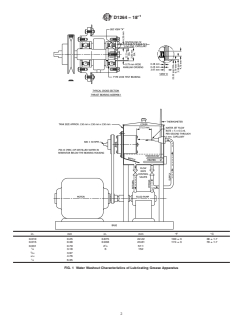
dance with internationally recognized principles on standard- 5.2 Bearing Housing and Shield with dimensions as shown
ization established in the Decision on Principles for the
in Fig. 1.
Development of International Standards, Guides and Recom-
5.3 Reservoir, Bearing-Housing Mount, Circulating Pump,
mendations issued by the World Trade Organization Technical
and Drive Motor, similar or equivalent to those shown in Fig.
Barriers to Trade (TBT) Committee.
1.
5.4 Heating Source, to maintain the water temperature at
38 °C 6 1.7 °C (100 °F 6 3 °F) or 79 °C 6 1.7 °C (174 °F 6
This test method is under the jurisdiction of ASTM Committee D02 on
3 °F).
Petroleum Products, Liquid Fuels, and Lubricants and is the direct responsibility of
Subcommittee D02.G0.06 on Functional Tests - Contamination.
Current edition approved Sept. 1, 2018. Published September 2018. Originally Available from ASTM International Headquarters. Order Adjunct No.
approved in 1953. Last previous edition approved in 2016 as D1264 – 16. DOI: ADJD126419. Original adjunct produced in 1984.
10.1520/D1264-18E01 ADJD6300 is no longer available.
*A Summary of Changes section appears at the end of this standard
Copyright © ASTM International, 100 Barr Harbor Drive, PO Box C700, West Conshohocken, PA 19428-2959. United States
´1
D1264 − 18
in. mm in. mm °F °C
0.010 0.25 0.875 22.22 100 ± 3 38 ± 1.7
0.015 0.38 0.938 23.81 174 ± 3 79 ± 1.7
0.031 0.79 2 ⁄4 57.1
⁄8 3.18 6 152
⁄32 3.97
⁄16 4.76
⁄4 6.35
FIG. 1 Water Washout Characteristics of Lubricating Grease Apparatus
´1
D1264 − 18
NOTE 1—Suitable temperature control may be obtained by the use of
tube or with a deflecting metal shield until equilibrium tem-
immersionheaters,steamcoils,orinfraredheatlamps,inconjunctionwith
perature is attained. When the test is to be made at the test
transformers or thermostats.
temperatures of 38 °C 6 1.7 °C (100 °F 6 3 °F) or 79 °C 6
5.5 Thermometer or Thermocouple, to determine the tem-
1.7 °C (174 °F 6 3 °F), it will be necessary to heat the water
perature of the water reservoir.
to the specified temperature by a previously selected source of
heat.
6. Materials and Reagents
8.2.1 If the rig has one motor driving both pump and test
6.1 Purity of Reagents—Reagent grade chemicals shall be
bearing, remove the belt from the test bearing spindle pulley
used in all tests. Unless otherwise indicated, it is intended that during water warm-up time.
all reagents shall conform to the specifications of the commit-
8.3 When the water reaches the specified temperature,
tee onAnalytical Reagents of theAmerican Chemical Society,
adjust the bypass valve to give a water-flow rate, through the
where such specifications are available. Other grades may be
rubber tubing and into a glass graduate, of 5 mL⁄s 6 0.5 mL⁄s
used, provided it is first ascertained that the reagent is of
(Note 4). Remove the rubber tubing from the capillary dis-
sufficiently high purity to permit its use without lessening the
charge tube, and adjust the water jet so that it impinges on the
accuracy of the determination.
end plate 6 mm ( ⁄4 in.) above the outer opening of the bearing
6.2 Distilled Water. housing. Start the bearing.
6.3 Cleaning Solvent—Capable of sufficiently cleaning the
NOTE 4—Sufficient experience should be obtained with a particular
tester to make sure that the water-flow rate can be maintained within the
test bearing for use in the test. Either reagent grade Stoddard
specified limits for a 60 min 6 1 min test run.
solvent, also known as Mineral Spirits, (Warning—
Combustible. Vapor harmful), or American Chemical Society 8.4 With the bearing operating at a speed of 600 r⁄min 6
reagent grade n-heptane (Warning—Flammable. Harmful if 30 r⁄min,
...