

ASTM D4950-22
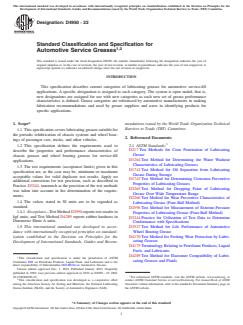
(Specification)Standard Classification and Specification for Automotive Service Greases
General Information
- Abstract
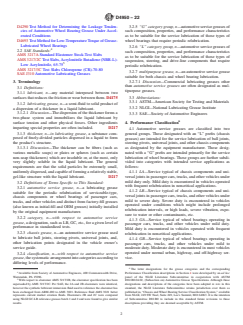
SCOPE
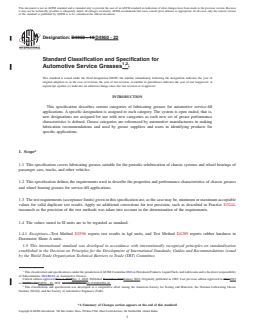
1.1 This specification covers lubricating greases suitable for the periodic relubrication of chassis systems and wheel bearings of passenger cars, trucks, and other vehicles.
1.2 This specification defines the requirements used to describe the properties and performance characteristics of chassis greases and wheel bearing greases for service-fill applications.
1.3 The test requirements (acceptance limits) given in this specification are, as the case may be, minimum or maximum acceptable values for valid duplicate test results. Apply no additional corrections for test precision, such as described in Practice D3244, inasmuch as the precision of the test methods was taken into account in the determination of the requirements.
1.4 The values stated in SI units are to be regarded as standard.
1.4.1 Exceptions—Test Method D2596 reports test results in kgf units, and Test Method D4289 reports rubber hardness in Durometer Shore A units.
1.5 This international standard was developed in accordance with internationally recognized principles on standardization established in the Decision on Principles for the Development of International Standards, Guides and Recommendations issued by the World Trade Organization Technical Barriers to Trade (TBT) Committee.
- Status
- Published
- Publication Date
- 30-Nov-2022
- Technical Committee
- D02 - Petroleum Products, Liquid Fuels, and Lubricants
- Drafting Committee
- D02.B0.04 - Automotive Greases
Buy Documents
ASTM D4950-22 - Standard Classification and Specification for Automotive Service Greases
REDLINE ASTM D4950-22 - Standard Classification and Specification for Automotive Service Greases
Overview
ASTM D4950-22 is the current edition of the "Standard Classification and Specification for Automotive Service Greases," published by ASTM International. This standard outlines the requirements for lubricating greases specifically intended for the periodic relubrication of chassis systems and wheel bearings in passenger cars, trucks, and other vehicles. It addresses both the classification and performance characteristics essential for selecting and verifying the quality of automotive service greases for service-fill applications.
By specifying acceptance limits for physical and chemical properties, ASTM D4950-22 provides manufacturers, suppliers, and end-users with a reliable framework for the consistent identification and application of effective greases, helping to ensure vehicle reliability and longevity.
Key Topics
Specification Scope
- Covers lubricating greases for relubricating vehicle chassis and wheel bearings
- Applicable to passenger cars, trucks, and a wide range of automotive equipment
- Provides requirements for properties and performance characteristics
Classification System
- Greases sorted by intended application and service severity
- "L" category: Chassis greases (for suspension, steering, and drive-line components)
- "G" category: Wheel bearing greases
- Further subdivision includes:
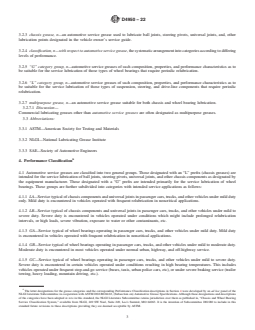
- LA: Mild duty chassis
- LB: Mild to severe duty chassis
- GA: Mild duty wheel bearings
- GB: Mild to moderate duty wheel bearings
- GC: Mild to severe duty wheel bearings
- Greases sorted by intended application and service severity
Performance Requirements
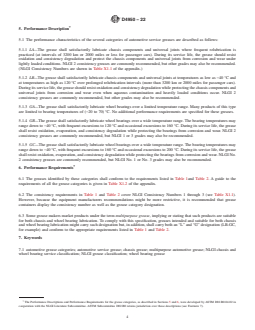
- Minimum or maximum values defined for each grease type, verified by standardized test methods
- Covers aspects including:
- Consistency (NLGI grades)
- Dropping point
- Wear and corrosion protection
- Water resistance and oil separation
- Low-temperature and high-temperature performance
- Elastomer compatibility
Standardization and Collaboration
- Developed with input from ASTM, NLGI (National Lubricating Grease Institute), and SAE (Society of Automotive Engineers)
- Ensures international consistency through alignment with WTO TBT Committee principles
Applications
ASTM D4950-22 serves as a critical quality benchmark in the following practical applications:
Automotive Lubrication Selection
- Helps OEMs, service technicians, and replacement part suppliers match the appropriate grease to specific vehicle components, operating conditions, and manufacturer recommendations
Quality Assurance
- Assists grease manufacturers in validating product compliance through standardized tests, enabling consistent performance in the marketplace
Maintenance Practices
- Guides fleet managers, repair workshops, and service businesses in choosing products that meet or exceed vehicle requirements for periodic relubrication, reducing equipment failures and downtime
Product Labelling
- Sets guidelines for container labeling, such as displaying the NLGI consistency number and the correct category designation (e.g., GC-LB), aiding in clear product communication and selection
Related Standards
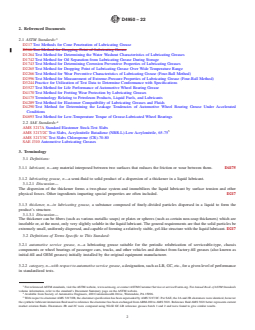
- ASTM D217: Test Methods for Cone Penetration of Lubricating Grease
- ASTM D1264: Test Method for Determining Water Washout Characteristics
- ASTM D1743: Test Method for Corrosion Preventive Properties of Lubricating Greases
- ASTM D2266, D2596: Wear and extreme-pressure performance testing
- SAE J310: Automotive Lubricating Greases (includes NLGI letter designations and classification)
Related standards ensure a comprehensive framework for evaluating lubricant quality, ensuring compatibility, and supporting ongoing industry innovation in automotive lubrication practices.
Keywords: ASTM D4950-22, automotive service greases, chassis grease, wheel bearing grease, NLGI grease classification, multipurpose automotive grease, grease specification, grease performance standards.
Relations
- Refers
ASTM D4175-23a - Standard Terminology Relating to Petroleum Products, Liquid Fuels, and Lubricants - Effective Date
- 15-Dec-2023
- Refers
ASTM D4175-23e1 - Standard Terminology Relating to Petroleum Products, Liquid Fuels, and Lubricants - Effective Date
- 01-Jul-2023
- Effective Date
- 01-Jun-2020
- Effective Date
- 01-May-2020
- Refers
ASTM D1742-20 - Standard Test Method for Oil Separation from Lubricating Grease During Storage - Effective Date
- 01-May-2020
- Effective Date
- 01-Nov-2019
- Effective Date
- 01-Jul-2019
- Effective Date
- 01-Jun-2019
- Effective Date
- 01-May-2019
- Effective Date
- 01-Sep-2018
- Effective Date
- 01-Sep-2018
- Refers
ASTM D1742-18 - Standard Test Method for Oil Separation from Lubricating Grease During Storage - Effective Date
- 01-Apr-2018
- Effective Date
- 01-Dec-2016
- Effective Date
- 01-Oct-2016
- Effective Date
- 01-Apr-2016
Buy Documents
ASTM D4950-22 - Standard Classification and Specification for Automotive Service Greases
REDLINE ASTM D4950-22 - Standard Classification and Specification for Automotive Service Greases
Get Certified
Connect with accredited certification bodies for this standard

Element Materials Technology
Materials testing and product certification.

ABS Group Brazil
ABS Group certification services in Brazil.

ABS Quality Evaluations Inc.
American Bureau of Shipping quality certification.
Sponsored listings
Frequently Asked Questions
ASTM D4950-22 is a technical specification published by ASTM International. Its full title is "Standard Classification and Specification for Automotive Service Greases". This standard covers: SCOPE 1.1 This specification covers lubricating greases suitable for the periodic relubrication of chassis systems and wheel bearings of passenger cars, trucks, and other vehicles. 1.2 This specification defines the requirements used to describe the properties and performance characteristics of chassis greases and wheel bearing greases for service-fill applications. 1.3 The test requirements (acceptance limits) given in this specification are, as the case may be, minimum or maximum acceptable values for valid duplicate test results. Apply no additional corrections for test precision, such as described in Practice D3244, inasmuch as the precision of the test methods was taken into account in the determination of the requirements. 1.4 The values stated in SI units are to be regarded as standard. 1.4.1 Exceptions—Test Method D2596 reports test results in kgf units, and Test Method D4289 reports rubber hardness in Durometer Shore A units. 1.5 This international standard was developed in accordance with internationally recognized principles on standardization established in the Decision on Principles for the Development of International Standards, Guides and Recommendations issued by the World Trade Organization Technical Barriers to Trade (TBT) Committee.
SCOPE 1.1 This specification covers lubricating greases suitable for the periodic relubrication of chassis systems and wheel bearings of passenger cars, trucks, and other vehicles. 1.2 This specification defines the requirements used to describe the properties and performance characteristics of chassis greases and wheel bearing greases for service-fill applications. 1.3 The test requirements (acceptance limits) given in this specification are, as the case may be, minimum or maximum acceptable values for valid duplicate test results. Apply no additional corrections for test precision, such as described in Practice D3244, inasmuch as the precision of the test methods was taken into account in the determination of the requirements. 1.4 The values stated in SI units are to be regarded as standard. 1.4.1 Exceptions—Test Method D2596 reports test results in kgf units, and Test Method D4289 reports rubber hardness in Durometer Shore A units. 1.5 This international standard was developed in accordance with internationally recognized principles on standardization established in the Decision on Principles for the Development of International Standards, Guides and Recommendations issued by the World Trade Organization Technical Barriers to Trade (TBT) Committee.
ASTM D4950-22 is classified under the following ICS (International Classification for Standards) categories: 75.100 - Lubricants, industrial oils and related products. The ICS classification helps identify the subject area and facilitates finding related standards.
ASTM D4950-22 has the following relationships with other standards: It is inter standard links to ASTM D4175-23a, ASTM D4175-23e1, ASTM D4290-20, ASTM D2596-20, ASTM D1742-20, ASTM D4290-19, ASTM D217-19a, ASTM D2265-19, ASTM D217-19, ASTM D1264-18e1, ASTM D1264-18, ASTM D1742-18, ASTM D4170-16, ASTM D217-16, ASTM D1264-16. Understanding these relationships helps ensure you are using the most current and applicable version of the standard.
ASTM D4950-22 is available in PDF format for immediate download after purchase. The document can be added to your cart and obtained through the secure checkout process. Digital delivery ensures instant access to the complete standard document.
Standards Content (Sample)
This international standard was developed in accordance with internationally recognized principles on standardization established in the Decision on Principles for the
Development of International Standards, Guides and Recommendations issued by the World Trade Organization Technical Barriers to Trade (TBT) Committee.
Designation:D4950 −22
Standard Classification and Specification for
1,2
Automotive Service Greases
This standard is issued under the fixed designation D4950; the number immediately following the designation indicates the year of
original adoption or, in the case of revision, the year of last revision.Anumber in parentheses indicates the year of last reapproval.A
superscript epsilon (´) indicates an editorial change since the last revision or reapproval.
INTRODUCTION
This specification describes current categories of lubricating greases for automotive service-fill
applications. A specific designation is assigned to each category. The system is open ended, that is,
new designations are assigned for use with new categories as each new set of grease performance
characteristics is defined. Grease categories are referenced by automotive manufacturers in making
lubrication recommendations and used by grease suppliers and users in identifying products for
specific applications.
1. Scope* mendations issued by the World Trade Organization Technical
Barriers to Trade (TBT) Committee.
1.1 Thisspecificationcoverslubricatinggreasessuitablefor
the periodic relubrication of chassis systems and wheel bear-
2. Referenced Documents
ings of passenger cars, trucks, and other vehicles.
2.1 ASTM Standards:
1.2 This specification defines the requirements used to
D217Test Methods for Cone Penetration of Lubricating
describe the properties and performance characteristics of
Grease
chassis greases and wheel bearing greases for service-fill
D1264Test Method for Determining the Water Washout
applications.
Characteristics of Lubricating Greases
1.3 The test requirements (acceptance limits) given in this
D1742Test Method for Oil Separation from Lubricating
specification are, as the case may be, minimum or maximum
Grease During Storage
acceptable values for valid duplicate test results. Apply no
D1743Test Method for Determining Corrosion Preventive
additional corrections for test precision, such as described in
Properties of Lubricating Greases
Practice D3244, inasmuch as the precision of the test methods
D2265Test Method for Dropping Point of Lubricating
was taken into account in the determination of the require-
Grease Over Wide Temperature Range
ments.
D2266Test Method for Wear Preventive Characteristics of
1.4 The values stated in SI units are to be regarded as
Lubricating Grease (Four-Ball Method)
standard.
D2596Test Method for Measurement of Extreme-Pressure
1.4.1 Exceptions—TestMethodD2596reportstestresultsin
Properties of Lubricating Grease (Four-Ball Method)
kgf units, and Test Method D4289 reports rubber hardness in
D3244Practice for Utilization of Test Data to Determine
Durometer Shore A units.
Conformance with Specifications
D3527Test Method for Life Performance of Automotive
1.5 This international standard was developed in accor-
dance with internationally recognized principles on standard- Wheel Bearing Grease
D4170Test Method for Fretting Wear Protection by Lubri-
ization established in the Decision on Principles for the
Development of International Standards, Guides and Recom- cating Greases
D4175Terminology Relating to Petroleum Products, Liquid
Fuels, and Lubricants
D4289Test Method for Elastomer Compatibility of Lubri-
This classification and specification is under the jurisdiction of ASTM
cating Greases and Fluids
Committee D02 on Petroleum Products, Liquid Fuels, and Lubricants and is the
direct responsibility of Subcommittee D02.B0.04 on Automotive Greases.
Current edition approved Dec. 1, 2022. Published January 2023. Originally
published in 1989. Last previous edition approved in 2019 as D4950–19. DOI:
10.1520/D4950-22. For referenced ASTM standards, visit the ASTM website, www.astm.org, or
This classification and specification was developed as a cooperative effort contact ASTM Customer Service at service@astm.org. For Annual Book of ASTM
among the American Society for Testing and Materials, the National Lubricating Standards volume information, refer to the standard’s Document Summary page on
Grease Institute (NLGI), and the Society of Automotive Engineers (SAE). the ASTM website.
*A Summary of Changes section appears at the end of this standard
Copyright © ASTM International, 100 Barr Harbor Drive, PO Box C700, West Conshohocken, PA 19428-2959. United States
D4950−22
D4290Test Method for Determining the Leakage Tenden- 3.2.5 “G” category group, n—automotiveservicegreasesof
cies of Automotive Wheel Bearing Grease Under Accel- such composition, properties, and performance characteristics
erated Conditions as to be suitable for the service lubrication of those types of
D4693TestMethodforLow-TemperatureTorqueofGrease- wheel bearings that require periodic relubrication.
Lubricated Wheel Bearings
3.2.6 “L” category group, n—automotiveservicegreasesof
2.2 SAE Standards:
such composition, properties, and performance characteristics
AMS 3217AStandard Elastomer Stock-Test Slabs
as to be suitable for the service lubrication of those types of
AMS3217/2CTestSlabs,AcrylonitrileButadiene(NBR-L)-
suspension, steering, and drive-line components that require
Low Acrylonitrile, 65-75
periodic relubrication.
AMS 3217/3CTest Slabs Chloroprene (CR)-70-80
3.2.7 multipurpose grease, n—an automotive service grease
SAE J310Automotive Lubricating Greases
suitable for both chassis and wheel bearing lubrication.
3. Terminology 3.2.7.1 Discussion—Commercial lubricating greases other
than automotive service greases are often designated as mul-
3.1 Definitions:
tipurpose greases.
3.1.1 lubricant, n—any material interposed between two
surfacesthatreducesthefrictionorwearbetweenthem. D4175 3.3 Abbreviations:
3.3.1 ASTM—American Society for Testing and Materials
3.1.2 lubricating grease, n—a semi-fluid to solid product of
a dispersion of a thickener in a liquid lubricant. 3.3.2 NLGI—National Lubricating Grease Institute
3.1.2.1 Discussion—Thedispersionofthethickenerformsa
3.3.3 SAE—Society of Automotive Engineers
two-phase system and immobilizes the liquid lubricant by
4. Performance Classification
surface tension and other physical forces. Other ingredients
imparting special properties are often included. D217
4.1 Automotive service greases are classified into two
3.1.3 thickener, n—in lubricating grease, a substance com- general groups. Those designated with an “L” prefix (chassis
posed of finely-divided particles dispersed in a liquid to form greases) are intended for the service lubrication of ball joints,
the product’s structure. steering pivots, universal joints, and other chassis components
3.1.3.1 Discussion—The thickener can be fibers (such as as designated by the equipment manufacturer. Those desig-
various metallic soaps) or plates or spheres (such as certain
nated with a “G” prefix are intended primarily for the service
non-soap thickeners) which are insoluble or, at the most, only lubrication of wheel bearings. These groups are further subdi-
very slightly soluble in the liquid lubricant. The general
vided into categories with intended service applications as
requirements are that the solid particles be extremely small, follows:
uniformlydispersed,andcapableofformingarelativelystable,
4.1.1 LA—Service typical of chassis components and uni-
gel-like structure with the liquid lubricant. D217 versaljointsinpassengercars,trucks,andothervehiclesunder
mild duty only. Mild duty is encountered in vehicles operated
3.2 Definitions of Terms Specific to This Standard:
with frequent relubrication in noncritical applications.
3.2.1 automotive service grease, n—a lubricating grease
4.1.2 LB—Service typical of chassis components and uni-
suitable for the periodic relubrication of serviceable-type,
versaljointsinpassengercars,trucks,andothervehiclesunder
chassis components or wheel bearings of passenger cars,
mild to severe duty. Severe duty is encountered in vehicles
trucks, and other vehicles and distinct from factory-fill greases
operated under conditions which might include prolonged
(also known as initial-fill and OEM greases) initially installed
relubrication intervals, or high loads, severe vibration, expo-
by the original equipment manufacturer.
sure to water or other contaminants, etc.
3.2.2 category, n—with respect to automotive service
4.1.3 GA—Service typical of wheel bearings operating in
grease,adesignation,suchasLB,GC,etc.,foragivenlevelof
passenger cars, trucks, and other vehicles under mild duty.
performance in standardized tests.
Mild duty is encountered in vehicles operated with frequent
3.2.3 chassis grease, n—an automotive service grease used
relubrication in noncritical applications.
to lubricate ball joints, steering pivots, universal joints, and,
4.1.4 GB—Service typical of wheel bearings operating in
other lubrication points designated in the vehicle owner’s
passenger cars, trucks, and other vehicles under mild to
service guide.
moderate duty. Moderate duty is encountered in most vehicles
operated under normal urban, highway, and off-highway ser-
3.2.4 classification, n—with respect to automotive service
vice.
grease,thesystematicarrangementintocategoriesaccordingto
differing levels of performance.
The letter designations for the grease categories and the corresponding
Available from Society of Automotive Engineers, 400 Commonwealth Drive, Performance Classification descriptions in Section 4 were developed by an ad hoc
Warrendale, PA 15096. panel of the NLGI Literature Subcommittee in cooperation with ASTM
With respect to elastomerAMS 3217/2B, the elastomer specification has been D02.B0.04.02, (Subsection on) Automotive Grease Specifications. Although these
superseded by AMS 3217/2C. Per SAE, the 2A and 2B elastomers were identical, designations and descriptions of the categories have been adopted in toto in this
however the synthetic lubricant immersion fluid used to reference the elastomer has standard, the NLGI Literature Subcommittee retains jurisdiction over them as
been exchanged from ARM-200 to AMS 3021. Reference fluid AMS 3021 better published in, “Chassis andWheel Bearing Service Classification System,” available
represents current market aviation fluids. Elastomers 2B and 2C were compared from NLGI, 249 SW Noel, Suite 249, Lee’s Summit, MO 64063. It is the intention
using NLGI GC-LB reference greases batch 1 and 2 and were found to give similar of Subcommittee D02.B0 to include in this standard future revisions to these
results. descriptions providing they are deemed acceptable by ASTM.
D4950−22
TABLE 1 “L” Chassis Grease Categories
Acceptance
Category Test Property
Limit
A
LA D217 Consistency, worked penetration, mm/10 220–340
D2265 Dropping point, °C, min 80
D2266 Wear protection, scar diameter, mm, max 0.9
C
D4289 Elastomer SAE AMS 3217/3C Compatibility
(incubated for 70 hours -0 +2 hours at 100.0 °C ± 2.5 °C):
Volume change, percent 0 to 40
Hardness change, Durometer-A points −15 to 0
A
LB D217 Consistency, worked penetration, mm/10 220–340
D2265 Dropping point, °C, min 150
D2266 Wear protection, scar diameter, mm, max 0.6
C
D4289 Elastomer SAE AMS 3217/3C Compatibility
(incubated for 70 hours -0 +2 hours at 100.0 °C ± 2.5 °C):
Volume change, percent 0 to 40
Hardness change, Durometer-A points −15 to 0
D1742 Oil separation, mass percent, max 10
D1743 Rust protection, rating, max Pass
D2596 EP performance:
Load wear index, N (kgf), min 295 (30)
Weld point, N (kgf), min 1960 (200)
B
D4170 Fretting protection, mass loss, mg, max 10
D4693 Low-temperature performance, torque at −40 °C from 60 s to the end of the test, 15.5
N·m, max
A
Vehicle manufacturer’s requirement might be more restrictive; grease containers should display NLGI Consistency Number as well as category designation.
B
The fretting wear requirement is significant in passenger car and light-duty truck service, but it has not been shown to be significant in heavy-duty truck applications.
C
With respect to elastomer
...
This document is not an ASTM standard and is intended only to provide the user of an ASTM standard an indication of what changes have been made to the previous version. Because
it may not be technically possible to adequately depict all changes accurately, ASTM recommends that users consult prior editions as appropriate. In all cases only the current version
of the standard as published by ASTM is to be considered the official document.
Designation: D4950 − 19 D4950 − 22
Standard Classification and Specification for
1,2,
Automotive Service Greases
This standard is issued under the fixed designation D4950; the number immediately following the designation indicates the year of
original adoption or, in the case of revision, the year of last revision. A number in parentheses indicates the year of last reapproval. A
superscript epsilon (´) indicates an editorial change since the last revision or reapproval.
INTRODUCTION
This specification describes current categories of lubricating greases for automotive service-fill
applications. A specific designation is assigned to each category. The system is open ended, that is,
new designations are assigned for use with new categories as each new set of grease performance
characteristics is defined. Grease categories are referenced by automotive manufacturers in making
lubrication recommendations and used by grease suppliers and users in identifying products for
specific applications.
1. Scope*
1.1 This specification covers lubricating greases suitable for the periodic relubrication of chassis systems and wheel bearings of
passenger cars, trucks, and other vehicles.
1.2 This specification defines the requirements used to describe the properties and performance characteristics of chassis greases
and wheel bearing greases for service-fill applications.
1.3 The test requirements (acceptance limits) given in this specification are, as the case may be, minimum or maximum acceptable
values for valid duplicate test results. Apply no additional corrections for test precision, such as described in Practice D3244,
inasmuch as the precision of the test methods was taken into account in the determination of the requirements.
1.4 The values stated in SI units are to be regarded as standard.
1.4.1 Exceptions—Test Method D2596 reports test results in kgf units, and Test Method D4289 reports rubber hardness in
Durometer Shore A units.
1.5 This international standard was developed in accordance with internationally recognized principles on standardization
established in the Decision on Principles for the Development of International Standards, Guides and Recommendations issued
by the World Trade Organization Technical Barriers to Trade (TBT) Committee.
This classification and specification is under the jurisdiction of ASTM Committee D02 on Petroleum Products, Liquid Fuels, and Lubricants and is the direct responsibility
of Subcommittee D02.B0.04 on Automotive Greases.
Current edition approved Nov. 1, 2019Dec. 1, 2022. Published November 2019January 2023. Originally published in 1989. Last previous edition approved in 20142019
as D4950 – 14.D4950 – 19. DOI: 10.1520/D4950-19.10.1520/D4950-22.
This classification and specification was developed as a cooperative effort among the American Society for Testing and Materials, the National Lubricating Grease
Institute (NLGI), and the Society of Automotive Engineers (SAE).
*A Summary of Changes section appears at the end of this standard
Copyright © ASTM International, 100 Barr Harbor Drive, PO Box C700, West Conshohocken, PA 19428-2959. United States
D4950 − 22
2. Referenced Documents
2.1 ASTM Standards:
D217 Test Methods for Cone Penetration of Lubricating Grease
D566 Test Method for Dropping Point of Lubricating Grease
D1264 Test Method for Determining the Water Washout Characteristics of Lubricating Greases
D1742 Test Method for Oil Separation from Lubricating Grease During Storage
D1743 Test Method for Determining Corrosion Preventive Properties of Lubricating Greases
D2265 Test Method for Dropping Point of Lubricating Grease Over Wide Temperature Range
D2266 Test Method for Wear Preventive Characteristics of Lubricating Grease (Four-Ball Method)
D2596 Test Method for Measurement of Extreme-Pressure Properties of Lubricating Grease (Four-Ball Method)
D3244 Practice for Utilization of Test Data to Determine Conformance with Specifications
D3527 Test Method for Life Performance of Automotive Wheel Bearing Grease
D4170 Test Method for Fretting Wear Protection by Lubricating Greases
D4175 Terminology Relating to Petroleum Products, Liquid Fuels, and Lubricants
D4289 Test Method for Elastomer Compatibility of Lubricating Greases and Fluids
D4290 Test Method for Determining the Leakage Tendencies of Automotive Wheel Bearing Grease Under Accelerated
Conditions
D4693 Test Method for Low-Temperature Torque of Grease-Lubricated Wheel Bearings
2.2 SAE Standards:
AMS 3217A Standard Elastomer Stock-Test Slabs
AMS 3217/2C Test Slabs, Acrylonitrile Butadiene (NBR-L)-Low Acrylonitrile, 65-75
AMS 3217/3C Test Slabs Chloroprene (CR)-70-80
SAE J310 Automotive Lubricating Greases
3. Terminology
3.1 Definitions:
3.1.1 lubricant, n—any material interposed between two surfaces that reduces the friction or wear between them. D4175
3.1.2 lubricating grease, n—a semi-fluid to solid product of a dispersion of a thickener in a liquid lubricant.
3.1.2.1 Discussion—
The dispersion of the thickener forms a two-phase system and immobilizes the liquid lubricant by surface tension and other
physical forces. Other ingredients imparting special properties are often included. D217
3.1.3 thickener, n—in lubricating grease, a substance composed of finely-divided particles dispersed in a liquid to form the
product’s structure.
3.1.3.1 Discussion—
The thickener can be fibers (such as various metallic soaps) or plates or spheres (such as certain non-soap thickeners) which are
insoluble or, at the most, only very slightly soluble in the liquid lubricant. The general requirements are that the solid particles be
extremely small, uniformly dispersed, and capable of forming a relatively stable, gel-like structure with the liquid lubricant. D217
3.2 Definitions of Terms Specific to This Standard:
3.2.1 automotive service grease, n—a lubricating grease suitable for the periodic relubrication of serviceable-type, chassis
components or wheel bearings of passenger cars, trucks, and other vehicles and distinct from factory-fill greases (also known as
initial-fill and OEM greases) initially installed by the original equipment manufacturer.
3.2.2 category, n—with respect to automotive service grease, a designation, such as LB, GC, etc., for a given level of performance
in standardized tests.
For referenced ASTM standards, visit the ASTM website, www.astm.org, or contact ASTM Customer Service at service@astm.org. For Annual Book of ASTM Standards
volume information, refer to the standard’s Document Summary page on the ASTM website.
Available from Society of Automotive Engineers, 400 Commonwealth Drive, Warrendale, PA 15096.
With respect to elastomer AMS 3217/2B, the elastomer specification has been superseded by AMS 3217/2C. Per SAE, the 2A and 2B elastomers were identical, however
the synthetic lubricant immersion fluid used to reference the elastomer has been exchanged from ARM-200 to AMS 3021. Reference fluid AMS 3021 better represents current
market aviation fluids. Elastomers 2B and 2C were compared using NLGI GC-LB reference greases batch 1 and 2 and were found to give similar results.
D4950 − 22
3.2.3 chassis grease, n—an automotive service grease used to lubricate ball joints, steering pivots, universal joints, and, other
lubrication points designated in the vehicle owner’s service guide.
3.2.4 classification, n—with respect to automotive service grease, the systematic arrangement into categories according to differing
levels of performance.
3.2.5 “G” category group, n—automotive service greases of such composition, properties, and performance characteristics as to
be suitable for the service lubrication of those types of wheel bearings that require periodic relubrication.
3.2.6 “L” category group, n—automotive service greases of such composition, properties, and performance characteristics as to
be suitable for the service lubrication of those types of suspension, steering, and drive-line components that require periodic
relubrication.
3.2.7 multipurpose grease, n—an automotive service grease suitable for both chassis and wheel bearing lubrication.
3.2.7.1 Discussion—
Commercial lubricating greases other than automotive service greases are often designated as multipurpose greases.
3.3 Abbreviations:
3.3.1 ASTM—American Society for Testing and Materials
3.3.2 NLGI—National Lubricating Grease Institute
3.3.3 SAE—Society of Automotive Engineers
4. Performance Classification
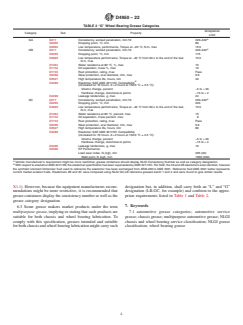
4.1 Automotive service greases are classified into two general groups. Those designated with an “L” prefix (chassis greases) are
intended for the service lubrication of ball joints, steering pivots, universal joints, and other chassis components as designated by
the equipment manufacturer. Those designated with a “G” prefix are intended primarily for the service lubrication of wheel
bearings. These groups are further subdivided into categories with intended service applications as follows:
4.1.1 LA—Service typical of chassis components and universal joints in passenger cars, trucks, and other vehicles under mild duty
only. Mild duty is encountered in vehicles operated with frequent relubrication in noncritical applications.
4.1.2 LB—Service typical of chassis components and universal joints in passenger cars, trucks, and other vehicles under mild to
severe duty. Severe duty is encountered in vehicles operated under conditions which might include prolonged relubrication
intervals, or high loads, severe vibration, exposure to water or other contaminants, etc.
4.1.3 GA—Service typical of wheel bearings operating in passenger cars, trucks, and other vehicles under mild duty. Mild duty
is encountered in vehicles operated with frequent relubrication in noncritical applications.
4.1.4 GB—Service typical of wheel bearings operating in passenger cars, trucks, and other vehicles under mild to moderate duty.
Moderate duty is encountered in most vehicles operated under normal urban, highway, and off-highway service.
4.1.5 GC—Service typical of wheel bearings operating in passenger cars, trucks, and other vehicles under mild to severe duty.
Severe duty is encountered in certain vehicles operated under conditions resulting in high bearing temperatures. This includes
vehicles operated under frequent stop-and-go service (buses, taxis, urban police cars, etc), or under severe braking service (trailer
towing, heavy loading, mountain driving, etc.).
The letter designations for the grease categories and the corresponding Performance Classification descriptions in Section 4 were developed by an ad hoc panel of the
NLGI Literature Subcommittee in cooperation with ASTM D02.B0.04.02, (Subsection on) Automotive Grease Specifications. Although these designations and descriptions
of the categories have been adopted in toto in this standard, the NLGI Literature Subcommittee retains jurisdiction over them as published in, “Chassis and Wheel Bearing
Service Classification System,” available from NLGI, 249 SW Noel, Suite 249, Lee’s Summit, MO 64063. It is the intention of Subcommittee D02.B0 to include in this
standard future revisions to these descriptions providing they are deemed acceptable by ASTM.
D4950 − 22
5. Performance Description
5.1 The performance characteristics of the several categories of automotive service greases are described as follows:
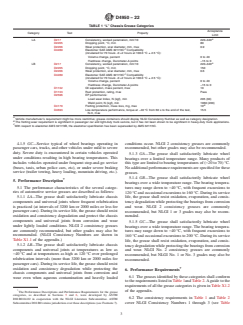
5.1.1 LA—The grease shall satisfactorily lubricate chassis components and universal joints where frequent relubrication is
practiced (at intervals of 3200 km or 2000 miles or less for passenger cars). During its service life, the grease should resist
oxidation and consistency degradation and protect the chassis components and universal joints from corrosion and wear under
lightly loaded conditions. NLGI 2 consistency greases are commonly recommended, but other grades may also be recommended.
(NLGI Consistency Numbers are shown in Table X1.1 of the appendix.)
5.1.2 LB—The grease shall satisfactorily lubricate chassis components and universal joints at temperatures as low as −40 °C and
at temperatures as high as 120 °C over prolonged relubrication intervals (more than 3200 km or 2000 miles for passenger cars).
During its service life, the grease should resist oxidation and consistency degradation while protecting the chassis components and
universal joints from corrosion and wear even when aqueous contamination and heavily loaded conditions occur. NL
...