

ASTM D706-20
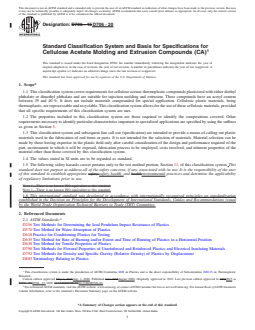
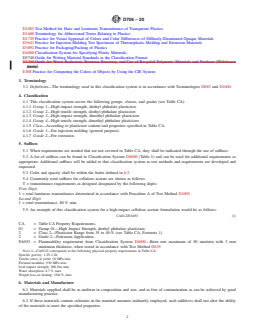
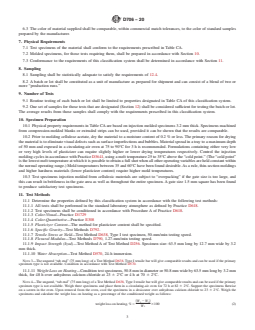
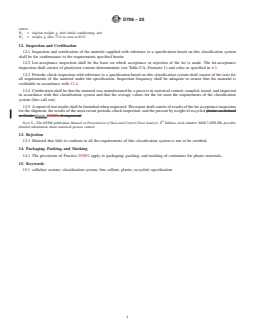
(Specification)Standard Classification System and Basis for Specifications for Cellulose Acetate Molding and Extrusion Compounds (CA)
General Information
- Abstract
SCOPE
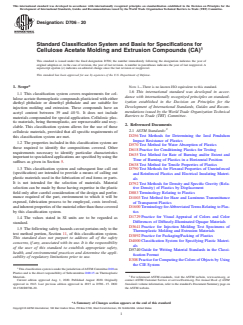
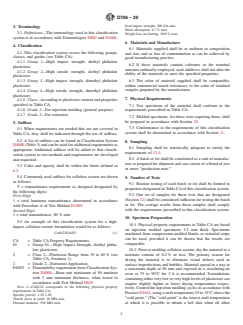
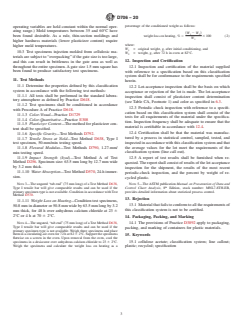
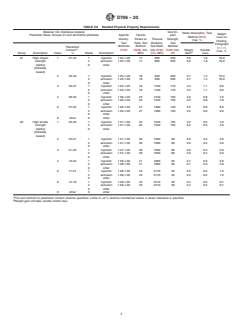
1.1 This classification system covers requirements for cellulose acetate thermoplastic compounds plasticized with either diethyl phthalate or dimethyl phthalate and are suitable for injection molding and extrusion. These compounds have an acetyl content between 39 and 40 %. It does not include materials compounded for special application. Cellulosic plastic materials, being thermoplastic, are reprocessable and recyclable. This classification system allows for the use of those cellulosic materials, provided that all specific requirements of this classification system are met.
1.2 The properties included in this classification system are those required to identify the compositions covered. Other requirements necessary to identify particular characteristics important to specialized applications are specified by using the suffixes as given in Section 5.
1.3 This classification system and subsequent line call out (specification) are intended to provide a means of calling out plastic materials used in the fabrication of end items or parts. It is not intended for the selection of materials. Material selection can be made by those having expertise in the plastic field only after careful consideration of the design and performance required of the part, environment to which it will be exposed, fabrication process to be employed, costs involved, and inherent properties of the material other than those covered by this classification system.
1.4 The values stated in SI units are to be regarded as standard.
1.5 The following safety hazards caveat pertains only to the test method portion, Section 11, of this classification system. This standard does not purport to address all of the safety concerns, if any, associated with its use. It is the responsibility of the user of this standard to establish appropriate safety, health, and environmental practices and determine the applicability of regulatory limitations prior to use.
Note 1: There is no known ISO equivalent to this standard.
1.6 This international standard was developed in accordance with internationally recognized principles on standardization established in the Decision on Principles for the Development of International Standards, Guides and Recommendations issued by the World Trade Organization Technical Barriers to Trade (TBT) Committee.
- Status
- Published
- Publication Date
- 31-Jul-2020
- Technical Committee
- D20 - Plastics
- Drafting Committee
- D20.15 - Thermoplastic Materials
Buy Documents
ASTM D706-20 - Standard Classification System and Basis for Specifications for Cellulose Acetate Molding and Extrusion Compounds (CA)
REDLINE ASTM D706-20 - Standard Classification System and Basis for Specifications for Cellulose Acetate Molding and Extrusion Compounds (CA)
Overview
ASTM D706-20 is the internationally recognized standard that establishes a classification system for cellulose acetate (CA) molding and extrusion compounds. Developed by ASTM International, this standard provides a clear system to identify and specify cellulose acetate thermoplastic materials plasticized with either diethyl phthalate or dimethyl phthalate. These compounds, with an acetyl content between 39 and 40%, are widely used for injection molding and extrusion applications. ASTM D706-20 ensures uniformity in product characteristics, rationalizes industry requirements, and supports consistent quality for manufacturers and end users.
Cellulose acetate compounds covered by this standard are valued for their thermoplastic properties, allowing them to be reprocessed and recycled. The standard sets out mandatory physical property requirements and outlines optional suffixes for additional characteristics important to specialized end uses.
Key Topics
- Classification Criteria: The standard organizes CA compounds by groups (impact or tensile strength), class (plasticizer content and type), and grade (suitability for injection molding or extrusion).
- Material Scope: Covers cellulose acetate thermoplastic compounds suitable for mass production via injection molding or extrusion.
- Specification Basis: Defines line call-outs and designations that capture essential compound characteristics, including strength, flexibility, and processing method.
- Physical Properties: Identifies key properties such as specific gravity, tensile stress at yield, flexural modulus, impact strength, water absorption, and more.
- Testing Methods: Recommends ASTM test methods (e.g., D638 for tensile properties, D256 for impact, D790 for flexural) to ensure conformity.
- Recyclability: Confirms that CA thermoplastics can be reprocessed and recycled, supporting sustainability objectives.
- Color and Opacity: Specifies requirements for color and transmittance, crucial for visual and functional aspects of finished goods.
- Safety and Compliance: Emphasizes the need for appropriate safety, health, and environmental practices during testing and use.
Applications
ASTM D706-20 is essential for industries and professionals working with cellulose acetate molding and extrusion compounds. Typical applications include:
- Consumer Products: Used in manufacturing items such as tool handles, combs, eyeglass frames, and household goods.
- Automotive Components: Applied in interior trim parts that require toughness and durability.
- Packaging: Suitable for containers, closures, and display materials due to its clarity and stability.
- Extruded Sheets and Films: Employed in specialty packaging, graphic arts, and protective coatings.
- Injection-Molded Parts: Ideal for high-volume part production where precision and repeatability are needed.
The standard benefits material specifiers, manufacturers, and quality assurance personnel by providing a common framework for specifying and verifying the required properties of CA compounds.
Related Standards
Several other ASTM standards support or complement ASTM D706-20 by offering additional guidance on testing, terminology, and material specification:
- ASTM D638: Test Method for Tensile Properties of Plastics
- ASTM D256: Test Methods for Determining the Izod Pendulum Impact Resistance of Plastics
- ASTM D790: Test Methods for Flexural Properties of Unreinforced and Reinforced Plastics
- ASTM D570: Test Method for Water Absorption of Plastics
- ASTM D792: Test Methods for Density and Specific Gravity of Plastics
- ASTM D4000: Classification System for Specifying Plastic Materials
- ASTM D3892: Practice for Packaging/Packing of Plastics
For manufacturers and specifiers relying on cellulose acetate materials in molding or extrusion, referencing ASTM D706-20 and related standards is critical to ensuring reliable product performance, regulatory compliance, and supply chain consistency.
Keywords: ASTM D706-20, cellulose acetate, molding compounds, extrusion compounds, thermoplastic, material specification, injection molding, plastic recyclability, plastics classification system, ASTM standards
Relations
- Effective Date
- 01-Aug-2020
- Effective Date
- 01-Feb-2024
- Effective Date
- 01-Nov-2023
- Effective Date
- 01-Jan-2020
- Effective Date
- 01-Aug-2019
- Effective Date
- 15-Apr-2019
- Effective Date
- 01-Feb-2019
- Effective Date
- 01-Dec-2018
- Effective Date
- 01-Nov-2018
- Refers
ASTM D1600-18 - Standard Terminology for Abbreviated Terms Relating to Plastics (Withdrawn 2024) - Effective Date
- 01-Jan-2018
- Effective Date
- 15-Aug-2017
- Effective Date
- 01-Jul-2017
- Effective Date
- 01-May-2017
- Effective Date
- 01-Sep-2016
- Effective Date
- 01-Dec-2015
Buy Documents
ASTM D706-20 - Standard Classification System and Basis for Specifications for Cellulose Acetate Molding and Extrusion Compounds (CA)
REDLINE ASTM D706-20 - Standard Classification System and Basis for Specifications for Cellulose Acetate Molding and Extrusion Compounds (CA)
Get Certified
Connect with accredited certification bodies for this standard

DIN CERTCO
DIN Group product certification.

Smithers Quality Assessments
US management systems and product certification.
Sponsored listings
Frequently Asked Questions
ASTM D706-20 is a technical specification published by ASTM International. Its full title is "Standard Classification System and Basis for Specifications for Cellulose Acetate Molding and Extrusion Compounds (CA)". This standard covers: SCOPE 1.1 This classification system covers requirements for cellulose acetate thermoplastic compounds plasticized with either diethyl phthalate or dimethyl phthalate and are suitable for injection molding and extrusion. These compounds have an acetyl content between 39 and 40 %. It does not include materials compounded for special application. Cellulosic plastic materials, being thermoplastic, are reprocessable and recyclable. This classification system allows for the use of those cellulosic materials, provided that all specific requirements of this classification system are met. 1.2 The properties included in this classification system are those required to identify the compositions covered. Other requirements necessary to identify particular characteristics important to specialized applications are specified by using the suffixes as given in Section 5. 1.3 This classification system and subsequent line call out (specification) are intended to provide a means of calling out plastic materials used in the fabrication of end items or parts. It is not intended for the selection of materials. Material selection can be made by those having expertise in the plastic field only after careful consideration of the design and performance required of the part, environment to which it will be exposed, fabrication process to be employed, costs involved, and inherent properties of the material other than those covered by this classification system. 1.4 The values stated in SI units are to be regarded as standard. 1.5 The following safety hazards caveat pertains only to the test method portion, Section 11, of this classification system. This standard does not purport to address all of the safety concerns, if any, associated with its use. It is the responsibility of the user of this standard to establish appropriate safety, health, and environmental practices and determine the applicability of regulatory limitations prior to use. Note 1: There is no known ISO equivalent to this standard. 1.6 This international standard was developed in accordance with internationally recognized principles on standardization established in the Decision on Principles for the Development of International Standards, Guides and Recommendations issued by the World Trade Organization Technical Barriers to Trade (TBT) Committee.
SCOPE 1.1 This classification system covers requirements for cellulose acetate thermoplastic compounds plasticized with either diethyl phthalate or dimethyl phthalate and are suitable for injection molding and extrusion. These compounds have an acetyl content between 39 and 40 %. It does not include materials compounded for special application. Cellulosic plastic materials, being thermoplastic, are reprocessable and recyclable. This classification system allows for the use of those cellulosic materials, provided that all specific requirements of this classification system are met. 1.2 The properties included in this classification system are those required to identify the compositions covered. Other requirements necessary to identify particular characteristics important to specialized applications are specified by using the suffixes as given in Section 5. 1.3 This classification system and subsequent line call out (specification) are intended to provide a means of calling out plastic materials used in the fabrication of end items or parts. It is not intended for the selection of materials. Material selection can be made by those having expertise in the plastic field only after careful consideration of the design and performance required of the part, environment to which it will be exposed, fabrication process to be employed, costs involved, and inherent properties of the material other than those covered by this classification system. 1.4 The values stated in SI units are to be regarded as standard. 1.5 The following safety hazards caveat pertains only to the test method portion, Section 11, of this classification system. This standard does not purport to address all of the safety concerns, if any, associated with its use. It is the responsibility of the user of this standard to establish appropriate safety, health, and environmental practices and determine the applicability of regulatory limitations prior to use. Note 1: There is no known ISO equivalent to this standard. 1.6 This international standard was developed in accordance with internationally recognized principles on standardization established in the Decision on Principles for the Development of International Standards, Guides and Recommendations issued by the World Trade Organization Technical Barriers to Trade (TBT) Committee.
ASTM D706-20 is classified under the following ICS (International Classification for Standards) categories: 83.080.20 - Thermoplastic materials; 83.140.99 - Other rubber and plastics products. The ICS classification helps identify the subject area and facilitates finding related standards.
ASTM D706-20 has the following relationships with other standards: It is inter standard links to ASTM D706-15, ASTM D883-24, ASTM D883-23, ASTM D883-20, ASTM D883-19c, ASTM D883-19a, ASTM D883-19, ASTM D883-18a, ASTM D883-18, ASTM D1600-18, ASTM D883-17, ASTM D790-17, ASTM E308-17, ASTM D5740-16, ASTM D790-15. Understanding these relationships helps ensure you are using the most current and applicable version of the standard.
ASTM D706-20 is available in PDF format for immediate download after purchase. The document can be added to your cart and obtained through the secure checkout process. Digital delivery ensures instant access to the complete standard document.
Standards Content (Sample)
This international standard was developed in accordance with internationally recognized principles on standardization established in the Decision on Principles for the
Development of International Standards, Guides and Recommendations issued by the World Trade Organization Technical Barriers to Trade (TBT) Committee.
Designation:D706 −20
Standard Classification System and Basis for Specifications for
Cellulose Acetate Molding and Extrusion Compounds (CA)
This standard is issued under the fixed designation D706; the number immediately following the designation indicates the year of
original adoption or, in the case of revision, the year of last revision. A number in parentheses indicates the year of last reapproval. A
superscript epsilon (´) indicates an editorial change since the last revision or reapproval.
This standard has been approved for use by agencies of the U.S. Department of Defense.
NOTE 1—There is no known ISO equivalent to this standard.
1. Scope*
1.6 This international standard was developed in accor-
1.1 This classification system covers requirements for cel-
dance with internationally recognized principles on standard-
lulose acetate thermoplastic compounds plasticized with either
ization established in the Decision on Principles for the
diethyl phthalate or dimethyl phthalate and are suitable for
Development of International Standards, Guides and Recom-
injection molding and extrusion. These compounds have an
mendations issued by the World Trade Organization Technical
acetyl content between 39 and 40 %. It does not include
Barriers to Trade (TBT) Committee.
materials compounded for special application. Cellulosic plas-
tic materials, being thermoplastic, are reprocessable and recy-
2. Referenced Documents
clable. This classification system allows for the use of those
2.1 ASTM Standards:
cellulosic materials, provided that all specific requirements of
D256 Test Methods for Determining the Izod Pendulum
this classification system are met.
Impact Resistance of Plastics
1.2 The properties included in this classification system are
D570 Test Method for Water Absorption of Plastics
those required to identify the compositions covered. Other
D618 Practice for Conditioning Plastics for Testing
requirements necessary to identify particular characteristics
D635 Test Method for Rate of Burning and/or Extent and
important to specialized applications are specified by using the
Time of Burning of Plastics in a Horizontal Position
suffixes as given in Section 5.
D638 Test Method for Tensile Properties of Plastics
1.3 This classification system and subsequent line call out
D790 Test Methods for Flexural Properties of Unreinforced
(specification) are intended to provide a means of calling out
and Reinforced Plastics and Electrical Insulating Materi-
plastic materials used in the fabrication of end items or parts.
als
It is not intended for the selection of materials. Material
D792 Test Methods for Density and Specific Gravity (Rela-
selection can be made by those having expertise in the plastic
tive Density) of Plastics by Displacement
field only after careful consideration of the design and perfor-
D883 Terminology Relating to Plastics
mance required of the part, environment to which it will be
D1003 Test Method for Haze and Luminous Transmittance
exposed, fabrication process to be employed, costs involved,
of Transparent Plastics
andinherentpropertiesofthematerialotherthanthosecovered
D1600 Terminology forAbbreviatedTerms Relating to Plas-
by this classification system.
tics
D1729 Practice for Visual Appraisal of Colors and Color
1.4 The values stated in SI units are to be regarded as
Differences of Diffusely-Illuminated Opaque Materials
standard.
D3641 Practice for Injection Molding Test Specimens of
1.5 The following safety hazards caveat pertains only to the
Thermoplastic Molding and Extrusion Materials
test method portion, Section 11, of this classification system.
D3892 Practice for Packaging/Packing of Plastics
This standard does not purport to address all of the safety
D4000 Classification System for Specifying Plastic Materi-
concerns, if any, associated with its use. It is the responsibility
als
of the user of this standard to establish appropriate safety,
D5740 Guide for Writing Material Standards in the Classi-
health, and environmental practices and determine the appli-
fication Format
cability of regulatory limitations prior to use.
E308 PracticeforComputingtheColorsofObjectsbyUsing
the CIE System
ThisclassificationsystemisunderthejurisdictionofASTMCommitteeD20on
Plastics and is the direct responsibility of Subcommittee D20.15 on Thermoplastic
Materials. For referenced ASTM standards, visit the ASTM website, www.astm.org, or
Current edition approved Aug. 1, 2020. Published August 2020. Originally contact ASTM Customer Service at service@astm.org. For Annual Book of ASTM
approved in 1943. Last previous edition approved in 2015 as D706 - 15. DOI: Standards volume information, refer to the standard’s Document Summary page on
10.1520/D0706-20. the ASTM website.
*A Summary of Changes section appears at the end of this standard
Copyright © ASTM International, 100 Barr Harbor Drive, PO Box C700, West Conshohocken, PA 19428-2959. United States
D706−20
Izod impact strength: 200 J/m min.
3. Terminology
Water absorption: 4.7 % max.
3.1 Definitions—The terminology used in this classification
Weight loss on heating: 10.0 % max.
system is in accordance with Terminologies D883 and D1600.
6. Materials and Manufacture
4. Classification
6.1 Materials supplied shall be as uniform in composition
4.1 This classification system covers the following groups,
and size, and as free of contamination as can be achieved by
classes, and grades (see Table CA):
good manufacturing practice.
4.1.1 Group 1—High impact strength, diethyl phthalate
6.2 If these materials contain colorants in the nominal
plasticizer.
amounts ordinarily employed, such additives shall not alter the
4.1.2 Group 2—High tensile strength, diethyl phthalate
ability of the materials to meet the specified properties.
plasticizer.
4.1.3 Group 3—High impact strength, dimethyl phthalate 6.3 The color of material supplied shall be comparable,
within commercial match tolerances, to the color of standard
plasticizer.
4.1.4 Group 4—High tensile strength, dimethyl phthalate samples prepared by the manufacturer.
plasticizer.
7. Physical Requirements
4.1.5 Class—Accordingtoplasticizercontentandproperties
specified in Table CA.
7.1 Test specimens of the material shall conform to the
4.1.6 Grade 1—For injection molding (general purpose).
requirements prescribed in Table CA.
4.1.7 Grade 2—For extrusion.
7.2 Molded specimens, for those tests requiring them, shall
be prepared in accordance with Section 10.
5. Suffixes
7.3 Conformance to the requirements of this classification
5.1 When requirements are needed that are not covered in
system shall be determined in accordance with Section 11.
Table CA, they shall be indicated through the use of suffixes.
5.2 A list of suffixes can be found in Classification System
8. Sampling
D4000(Table3)andcanbeusedforadditionalrequirementsas
8.1 Sampling shall be statistically adequate to satisfy the
appropriate. Additional suffixes will be added to that classifi-
requirements of 12.4.
cation system as test methods and requirements are developed
8.2 Abatch or lot shall be constituted as a unit of manufac-
and requested.
ture as prepared for shipment and can consist of a blend of two
5.3 Color and opacity shall be within the limits defined in
or more “production runs.”
6.3.
5.4 Commonly used suffixes for cellulose acetate are shown
9. Number of Tests
as follows:
9.1 Routine testing of each batch or lot shall be limited to
T = transmittance requirements as designed designated by
properties designated in Table CAof this classification system.
the following digits:
9.2 One set of samples for those tests that are designated
First Digit
(Section 12) shall be considered sufficient for testing the batch
1 = total luminous transmittance determined in accordance
or lot. The average results from those samples shall comply
with Procedure A of Test Method D1003.
with the requirements prescribed in this classification system.
Second Digit
1 = total transmittance, 80 % min.
10. Specimen Preparation
5.5 An example of this classification system for a high-
10.1 Physical property requirements in Table CA are based
impact cellulose acetate formulation would be as follows:
on injection molded specimens 3.2 mm thick. Specimens
CA0122FA053 (1)
machined from compression-molded blanks or extruded strips
can be used, provided it can be shown that the results are
CA = Table CA Property Requirements.
comparable.
01 = Group 01—High Impact Strength, diethyl phtha-
late plasticizer.
10.2 Prior to molding cellulose acetate, dry the material to a
2 = Class 2—Plasticizer Range from 35 to 40 % (see
moisture content of 0.2 % or less. The primary reason for
Table CA, Footnote 1).
drying the material is to eliminate visual defects such as
2 = Grade 2—Extrusion Application.
surface imperfections and bubbles. Material spread in a tray to
FA053 = Flammability requirement from Classification Sys-
a maximum depth of 50 mm and exposed in a circulating-air
tem D4000—Burn rate maximum of 50 mm/min
oven at 75 to 90°C for3his recommended. Formulations
with 3 mm minimum thickness, when tested in
containing either very low or very high levels of plasticizer can
accordance with Test Method D635
require slightly higher or lower drying temperatures respec-
NOTE 2—CA0122 corresponds to the following physical property
tively. Control the injection molding cycles in accordance with
requirements in Table CA:
Practice D3641, using a melt temperature 25 to 35°C above the
Specific gravity: 1.25-1.28.
“cold point.” (The “cold point” is the lowest melt temperature
Tensile stress at yield: 18 MPa min.
Flexural modulus: 930 MPa min. at which it is possible to obtain a full shot when all other
D706−20
percentage of the conditioned we
...
This document is not an ASTM standard and is intended only to provide the user of an ASTM standard an indication of what changes have been made to the previous version. Because
it may not be technically possible to adequately depict all changes accurately, ASTM recommends that users consult prior editions as appropriate. In all cases only the current version
of the standard as published by ASTM is to be considered the official document.
Designation: D706 − 15 D706 − 20
Standard Classification System and Basis for Specifications for
Cellulose Acetate Molding and Extrusion Compounds (CA)
This standard is issued under the fixed designation D706; the number immediately following the designation indicates the year of
original adoption or, in the case of revision, the year of last revision. A number in parentheses indicates the year of last reapproval. A
superscript epsilon (´) indicates an editorial change since the last revision or reapproval.
This standard has been approved for use by agencies of the U.S. Department of Defense.
1. Scope*
1.1 This classification system covers requirements for cellulose acetate thermoplastic compounds plasticized with either diethyl
phthalate or dimethyl phthalate and are suitable for injection molding and extrusion. These compounds have an acetyl content
between 39 and 40 %. It does not include materials compounded for special application. Cellulosic plastic materials, being
thermoplastic, are reprocessable and recyclable. This classification system allows for the use of those cellulosic materials, provided
that all specific requirements of this classification system are met.
1.2 The properties included in this classification system are those required to identify the compositions covered. Other
requirements necessary to identify particular characteristics important to specialized applications are specified by using the suffixes
as given in Section 5.
1.3 This classification system and subsequent line call out (specification) are intended to provide a means of calling out plastic
materials used in the fabrication of end items or parts. It is not intended for the selection of materials. Material selection can be
made by those having expertise in the plastic field only after careful consideration of the design and performance required of the
part, environment to which it will be exposed, fabrication process to be employed, costs involved, and inherent properties of the
material other than those covered by this classification system.
1.4 The values stated in SI units are to be regarded as standard.
1.5 The following safety hazards caveat pertains only to the test method portion, Section 11, of this classification system. This
standard does not purport to address all of the safety concerns, if any, associated with its use. It is the responsibility of the user
of this standard to establish appropriate safety safety, health, and healthenvironmental practices and determine the applicability
of regulatory limitations prior to use.
NOTE 1—There is no known ISO equivalent to this standard.
NOTE 1—There is no known ISO equivalent to this standard.
1.6 This international standard was developed in accordance with internationally recognized principles on standardization
established in the Decision on Principles for the Development of International Standards, Guides and Recommendations issued
by the World Trade Organization Technical Barriers to Trade (TBT) Committee.
2. Referenced Documents
2.1 ASTM Standards:
D256 Test Methods for Determining the Izod Pendulum Impact Resistance of Plastics
D570 Test Method for Water Absorption of Plastics
D618 Practice for Conditioning Plastics for Testing
D635 Test Method for Rate of Burning and/or Extent and Time of Burning of Plastics in a Horizontal Position
D638 Test Method for Tensile Properties of Plastics
D790 Test Methods for Flexural Properties of Unreinforced and Reinforced Plastics and Electrical Insulating Materials
D792 Test Methods for Density and Specific Gravity (Relative Density) of Plastics by Displacement
D883 Terminology Relating to Plastics
This classification system is under the jurisdiction of ASTM Committee D20 on Plastics and is the direct responsibility of Subcommittee D20.15 on Thermoplastic
Materials.
Current edition approved May 1, 2015Aug. 1, 2020. Published June 2015August 2020. Originally approved in 1943. Last previous edition approved in 20092015 as
D706 - 09.D706 - 15. DOI: 10.1520/D0706-15.10.1520/D0706-20.
For referenced ASTM standards, visit the ASTM website, www.astm.org, or contact ASTM Customer Service at service@astm.org. For Annual Book of ASTM Standards
volume information, refer to the standard’s Document Summary page on the ASTM website.
*A Summary of Changes section appears at the end of this standard
Copyright © ASTM International, 100 Barr Harbor Drive, PO Box C700, West Conshohocken, PA 19428-2959. United States
D706 − 20
D1003 Test Method for Haze and Luminous Transmittance of Transparent Plastics
D1600 Terminology for Abbreviated Terms Relating to Plastics
D1729 Practice for Visual Appraisal of Colors and Color Differences of Diffusely-Illuminated Opaque Materials
D3641 Practice for Injection Molding Test Specimens of Thermoplastic Molding and Extrusion Materials
D3892 Practice for Packaging/Packing of Plastics
D4000 Classification System for Specifying Plastic Materials
D5740 Guide for Writing Material Standards in the Classification Format
D7209 Guide for Waste Reduction, Resource Recovery, and Use of Recycled Polymeric Materials and Products (Withdrawn
2015)
E308 Practice for Computing the Colors of Objects by Using the CIE System
3. Terminology
3.1 Definitions—The terminology used in this classification system is in accordance with Terminologies D883 and D1600.
4. Classification
4.1 This classification system covers the following groups, classes, and grades (see Table CA):
4.1.1 Group 1—High impact strength, diethyl phthalate plasticizer.
4.1.2 Group 2—High tensile strength, diethyl phthalate plasticizer.
4.1.3 Group 3—High impact strength, dimethyl phthalate plasticizer.
4.1.4 Group 4—High tensile strength, dimethyl phthalate plasticizer.
4.1.5 Class—According to plasticizer content and properties specified in Table CA.
4.1.6 Grade 1—For injection molding (general purpose).
4.1.7 Grade 2—For extrusion.
5. Suffixes
5.1 When requirements are needed that are not covered in Table CA, they shall be indicated through the use of suffixes.
5.2 A list of suffixes can be found in Classification System D4000 (Table 3) and can be used for additional requirements as
appropriate. Additional suffixes will be added to that classification system as test methods and requirements are developed and
requested.
5.3 Color and opacity shall be within the limits defined in 6.3.
5.4 Commonly used suffixes for cellulose acetate are shown as follows:
T = transmittance requirements as designed designated by the following digits:
First Digit
1 = total luminous transmittance determined in accordance with Procedure A of Test Method D1003.
Second Digit
1 = total transmittance, 80 % min.
5.5 An example of this classification system for a high-impact cellulose acetate formulation would be as follows:
CA0122FA053 (1)
CA = Table CA Property Requirements.
01 = Group 01—High Impact Strength, diethyl phthalate plasticizer.
2 = Class 2—Plasticizer Range from 35 to 40 % (see Table CA, Footnote 1).
2 = Grade 2—Extrusion Application.
FA053 = Flammability requirement from Classification System D4000—Burn rate maximum of 50 mm/min with 3 mm
minimum thickness, when tested in accordance with Test Method D635
NOTE 2—CA0122 corresponds to the following physical property requirements in Table CA:
Specific gravity: 1.25-1.28.
Tensile stress at yield: 18 MPa min.
Flexural modulus: 930 MPa min.
Izod impact strength: 200 J/m min.
Water absorption: 4.7 % max.
Weight loss on heating: 10.0 % max.
6. Materials and Manufacture
6.1 Materials supplied shall be as uniform in composition and size, and as free of contamination as can be achieved by good
manufacturing practice.
6.2 If these materials contain colorants in the nominal amounts ordinarily employed, such additives shall not alter the ability
of the materials to meet the specified properties.
D706 − 20
6.3 The color of material supplied shall be comparable, within commercial match tolerances, to the color of standard samples
prepared by the manufacturer.
7. Physical Requirements
7.1 Test specimens of the material shall conform to the requirements prescribed in Table CA.
7.2 Molded specimens, for those tests requiring them, shall be prepared in accordance with Section 10.
7.3 Conformance to the requirements of this classification system shall be determined in accordance with Section 11.
8. Sampling
8.1 Sampling shall be statistically adequate to satisfy the requirements of 12.4.
8.2 A batch or lot shall be constituted as a unit of manufacture as prepared for shipment and can consist of a blend of two or
more “production runs.”
9. Number of Tests
9.1 Routine testing of each batch or lot shall be limited to properties designated in Table CA of this classification system.
9.2 One set of samples for those tests that are designated (Section 12) shall be considered sufficient for testing the batch or lot.
The average results from those samples shall comply with the requirements prescribed in this classification system.
10. Specimen Preparation
10.1 Physical property requirements in Table CA are based on injection molded specimens 3.2 mm thick. Specimens machined
from compression-molded blanks or extruded strips can be used, provided it can be shown that the results are comparable.
10.2 Prior to molding cellulose acetate, dry the material to a moisture content of 0.2 % or less. The primary reason for drying
the material is to eliminate visual defects such as surface imperfections and bubbles. Material spread in a tray to a maximum depth
of 50 mm and exposed in a circulating-air oven at 75 to 90°C for 3 h is recommended. Formulations containing either very low
or very high levels of plasticizer can require slightly higher or lower drying temperatures respectively. Control the injection
molding cycles in accordance with Practice D3641, using a melt temperature 25 to 35°C above the “cold point.” (The “cold point”
is the lowest melt temperature at which it is possible to obtain a full shot when all othe
...