

ASTM D2463-23
(Test Method)Standard Test Method for Drop Impact Resistance of Blow-Molded Thermoplastic Containers
General Information
- Abstract
SIGNIFICANCE AND USE
5.1 These procedures provide a means to assess the drop impact resistance of the group or lot of blown containers from which the test specimens were selected.
5.2 It is acceptable to use these procedures for routine inspection purposes.
5.3 These procedures will evaluate the combined effect of construction, materials, and processing conditions on the impact resistance of the blown containers.
5.4 Before proceeding with this test method, reference the specification of the material being tested. Any test specimen preparation, conditioning, dimensions, or testing parameters, or combination thereof, covered in the materials specification shall take precedence over those mentioned in this test method. If there are no material specifications, then the default conditions apply.
SCOPE
1.1 This test method provides a means to assess the drop impact resistance of water-filled, blow-molded thermoplastic containers, which is a summation of the effects of material, manufacturing conditions, container design, and perhaps other factors.
1.2 Two procedures are provided as follows:
1.2.1 Procedure A, Static Drop Height Method—This procedure is particularly useful for quality control since it is quick.
1.2.2 Procedure B, Bruceton Staircase Method—This procedure is used to determine the mean failure height and the standard deviation of the distribution.
1.3 The values stated in SI units are to be regarded as standard. The inch-pound units given in parentheses are for information only.
Note 1: There is no known ISO equivalent to this standard.
1.4 This standard does not purport to address all of the safety concerns, if any, associated with its use. It is the responsibility of the user of this standard to establish appropriate safety, health, and environmental practices and determine the applicability of regulatory limitations prior to use.
1.5 This international standard was developed in accordance with internationally recognized principles on standardization established in the Decision on Principles for the Development of International Standards, Guides and Recommendations issued by the World Trade Organization Technical Barriers to Trade (TBT) Committee.
- Status
- Published
- Publication Date
- 31-Jul-2023
- Technical Committee
- D20 - Plastics
- Drafting Committee
- D20.19 - Film, Sheeting, and Molded Products
Buy Documents
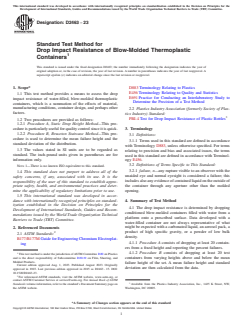
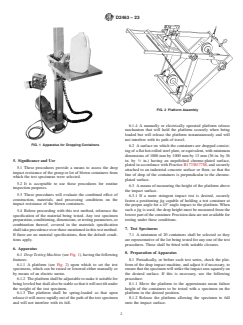
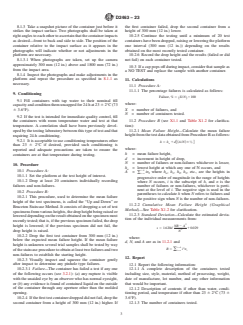
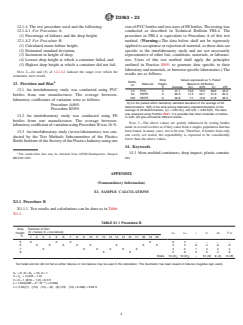
ASTM D2463-23 - Standard Test Method for Drop Impact Resistance of Blow-Molded Thermoplastic Containers
REDLINE ASTM D2463-23 - Standard Test Method for Drop Impact Resistance of Blow-Molded Thermoplastic Containers
Overview
ASTM D2463-23: Standard Test Method for Drop Impact Resistance of Blow-Molded Thermoplastic Containers establishes procedures for evaluating the drop impact resistance of water-filled, blow-molded thermoplastic containers. Developed by ASTM Committee D20 on Plastics, this standard is a critical tool for manufacturers, quality assurance teams, and laboratories to assess container durability and monitor production consistency.
ASTM D2463-23 is widely used for quality control and routine inspection in the packaging industry. It measures the combined effects of material properties, container design, and manufacturing conditions on a container’s resistance to damage from drops-a key indicator of packaging performance under real-world handling and transport scenarios.
Key Topics
Test Procedures
ASTM D2463-23 specifies two primary test methods:- Procedure A: Static Drop Height Method
This quick, straightforward process is ideal for routine quality control by dropping containers from a fixed height and recording the failure rate. - Procedure B: Bruceton Staircase Method
This method determines the mean failure height and the standard deviation of drop resistance, providing deeper insights into the variation within a batch.
- Procedure A: Static Drop Height Method
Scope and Limitations
- Applicable to water-filled, blow-molded thermoplastic containers.
- Focuses on the summary impact of material, container design, and process variables.
- The standard does not address containers with other contents, and test results may not directly represent performance for different products (e.g., carbonated liquids or powders).
Apparatus and Conditioning
- Uses a drop testing machine with a chromed steel impact surface.
- Requires conditioning of containers at specified temperatures before testing.
Failure Definition
- A container is classified as failed if any rupture or leakage is visible to an observer without special equipment.
Reporting and Precision
- The standard outlines detailed reporting requirements for test conditions and results.
- Recognizes variations between labs and provides recommendations for interlaboratory studies following ASTM E691.
Applications
ASTM D2463-23 is essential for:
- Quality Assurance in Manufacturing: Regularly assessing the drop impact resistance of production lots to ensure reliability and consistency of blow-molded plastic containers.
- Product Development: Evaluating the combined effects of new materials, designs, and process changes on container durability before full-scale production.
- Comparative Analysis: Benchmarking different batches or suppliers of plastic bottles for performance uniformity.
- Regulatory Compliance: Supporting documentation for packaging used in regulated industries such as food, beverages, household chemicals, and pharmaceuticals.
This standard helps prevent product loss, reduce return rates due to packaging failures, and supports supply chain confidence by verifying the physical robustness of thermoplastic containers used in transit and handling.
Related Standards
When working with ASTM D2463-23, professionals may also reference related standards for plastics testing and terminology, including:
- ASTM D883 – Terminology Relating to Plastics
- ASTM E456 – Terminology Relating to Quality and Statistics
- ASTM E691 – Practice for Conducting an Interlaboratory Study to Determine the Precision of a Test Method
- Plastics Industry Association PBI-4 – Test for Drop Impact Resistance of Plastic Bottles
Note: There is currently no ISO equivalent to ASTM D2463-23.
By following ASTM D2463-23, stakeholders ensure that blow-molded thermoplastic containers meet impact resistance requirements, maintaining product integrity throughout distribution and use. This standard remains a vital reference for drop impact testing in the global plastics and packaging industries.
Relations
- Effective Date
- 01-Feb-2024
- Effective Date
- 01-Nov-2023
- Effective Date
- 01-Apr-2022
- Effective Date
- 01-Jan-2020
- Effective Date
- 01-Aug-2019
- Effective Date
- 15-Apr-2019
- Effective Date
- 01-Feb-2019
- Effective Date
- 01-Dec-2018
- Effective Date
- 01-Nov-2018
- Effective Date
- 01-Oct-2017
- Effective Date
- 01-Oct-2017
- Effective Date
- 15-Aug-2017
- Effective Date
- 15-Nov-2013
- Effective Date
- 15-Nov-2013
- Effective Date
- 15-Nov-2013
Buy Documents
ASTM D2463-23 - Standard Test Method for Drop Impact Resistance of Blow-Molded Thermoplastic Containers
REDLINE ASTM D2463-23 - Standard Test Method for Drop Impact Resistance of Blow-Molded Thermoplastic Containers
Get Certified
Connect with accredited certification bodies for this standard

DIN CERTCO
DIN Group product certification.

Smithers Quality Assessments
US management systems and product certification.
Sponsored listings
Frequently Asked Questions
ASTM D2463-23 is a standard published by ASTM International. Its full title is "Standard Test Method for Drop Impact Resistance of Blow-Molded Thermoplastic Containers". This standard covers: SIGNIFICANCE AND USE 5.1 These procedures provide a means to assess the drop impact resistance of the group or lot of blown containers from which the test specimens were selected. 5.2 It is acceptable to use these procedures for routine inspection purposes. 5.3 These procedures will evaluate the combined effect of construction, materials, and processing conditions on the impact resistance of the blown containers. 5.4 Before proceeding with this test method, reference the specification of the material being tested. Any test specimen preparation, conditioning, dimensions, or testing parameters, or combination thereof, covered in the materials specification shall take precedence over those mentioned in this test method. If there are no material specifications, then the default conditions apply. SCOPE 1.1 This test method provides a means to assess the drop impact resistance of water-filled, blow-molded thermoplastic containers, which is a summation of the effects of material, manufacturing conditions, container design, and perhaps other factors. 1.2 Two procedures are provided as follows: 1.2.1 Procedure A, Static Drop Height Method—This procedure is particularly useful for quality control since it is quick. 1.2.2 Procedure B, Bruceton Staircase Method—This procedure is used to determine the mean failure height and the standard deviation of the distribution. 1.3 The values stated in SI units are to be regarded as standard. The inch-pound units given in parentheses are for information only. Note 1: There is no known ISO equivalent to this standard. 1.4 This standard does not purport to address all of the safety concerns, if any, associated with its use. It is the responsibility of the user of this standard to establish appropriate safety, health, and environmental practices and determine the applicability of regulatory limitations prior to use. 1.5 This international standard was developed in accordance with internationally recognized principles on standardization established in the Decision on Principles for the Development of International Standards, Guides and Recommendations issued by the World Trade Organization Technical Barriers to Trade (TBT) Committee.
SIGNIFICANCE AND USE 5.1 These procedures provide a means to assess the drop impact resistance of the group or lot of blown containers from which the test specimens were selected. 5.2 It is acceptable to use these procedures for routine inspection purposes. 5.3 These procedures will evaluate the combined effect of construction, materials, and processing conditions on the impact resistance of the blown containers. 5.4 Before proceeding with this test method, reference the specification of the material being tested. Any test specimen preparation, conditioning, dimensions, or testing parameters, or combination thereof, covered in the materials specification shall take precedence over those mentioned in this test method. If there are no material specifications, then the default conditions apply. SCOPE 1.1 This test method provides a means to assess the drop impact resistance of water-filled, blow-molded thermoplastic containers, which is a summation of the effects of material, manufacturing conditions, container design, and perhaps other factors. 1.2 Two procedures are provided as follows: 1.2.1 Procedure A, Static Drop Height Method—This procedure is particularly useful for quality control since it is quick. 1.2.2 Procedure B, Bruceton Staircase Method—This procedure is used to determine the mean failure height and the standard deviation of the distribution. 1.3 The values stated in SI units are to be regarded as standard. The inch-pound units given in parentheses are for information only. Note 1: There is no known ISO equivalent to this standard. 1.4 This standard does not purport to address all of the safety concerns, if any, associated with its use. It is the responsibility of the user of this standard to establish appropriate safety, health, and environmental practices and determine the applicability of regulatory limitations prior to use. 1.5 This international standard was developed in accordance with internationally recognized principles on standardization established in the Decision on Principles for the Development of International Standards, Guides and Recommendations issued by the World Trade Organization Technical Barriers to Trade (TBT) Committee.
ASTM D2463-23 is classified under the following ICS (International Classification for Standards) categories: 83.080.20 - Thermoplastic materials; 83.140.99 - Other rubber and plastics products. The ICS classification helps identify the subject area and facilitates finding related standards.
ASTM D2463-23 has the following relationships with other standards: It is inter standard links to ASTM D883-24, ASTM D883-23, ASTM E456-13a(2022)e1, ASTM D883-20, ASTM D883-19c, ASTM D883-19a, ASTM D883-19, ASTM D883-18a, ASTM D883-18, ASTM E456-13A(2017)e1, ASTM E456-13A(2017)e3, ASTM D883-17, ASTM E456-13ae3, ASTM E456-13ae2, ASTM E456-13ae1. Understanding these relationships helps ensure you are using the most current and applicable version of the standard.
ASTM D2463-23 is available in PDF format for immediate download after purchase. The document can be added to your cart and obtained through the secure checkout process. Digital delivery ensures instant access to the complete standard document.
Standards Content (Sample)
This international standard was developed in accordance with internationally recognized principles on standardization established in the Decision on Principles for the
Development of International Standards, Guides and Recommendations issued by the World Trade Organization Technical Barriers to Trade (TBT) Committee.
Designation: D2463 − 23
Standard Test Method for
Drop Impact Resistance of Blow-Molded Thermoplastic
Containers
This standard is issued under the fixed designation D2463; the number immediately following the designation indicates the year of
original adoption or, in the case of revision, the year of last revision. A number in parentheses indicates the year of last reapproval. A
superscript epsilon (´) indicates an editorial change since the last revision or reapproval.
1. Scope* D883 Terminology Relating to Plastics
E456 Terminology Relating to Quality and Statistics
1.1 This test method provides a means to assess the drop
E691 Practice for Conducting an Interlaboratory Study to
impact resistance of water-filled, blow-molded thermoplastic
Determine the Precision of a Test Method
containers, which is a summation of the effects of material,
manufacturing conditions, container design, and perhaps other
2.2 Plastics Industry Association (formerly Society of Plas-
factors.
tics Industry) Standard:
PBI-4 Test for Drop Impact Resistance of Plastic Bottles
1.2 Two procedures are provided as follows:
1.2.1 Procedure A, Static Drop Height Method—This pro-
3. Terminology
cedure is particularly useful for quality control since it is quick.
1.2.2 Procedure B, Bruceton Staircase Method—This pro-
3.1 Definitions:
cedure is used to determine the mean failure height and the
3.1.1 Terms used in this standard are defined in accordance
standard deviation of the distribution.
with Terminology D883, unless otherwise specified. For terms
1.3 The values stated in SI units are to be regarded as
relating to precision and bias and associated issues, the terms
standard. The inch-pound units given in parentheses are for
used in this standard are defined in accordance with Terminol-
information only.
ogy E456.
3.2 Definitions of Terms Specific to This Standard:
NOTE 1—There is no known ISO equivalent to this standard.
3.2.1 failure, n—any rupture visible to an observer with the
1.4 This standard does not purport to address all of the
unaided eye and normal eyesight is considered a failure; this
safety concerns, if any, associated with its use. It is the
includes also any evidence of contained liquid on the outside of
responsibility of the user of this standard to establish appro-
the container through any aperture other than the molded
priate safety, health, and environmental practices and deter-
mine the applicability of regulatory limitations prior to use. opening.
1.5 This international standard was developed in accor-
dance with internationally recognized principles on standard- 4. Summary of Test Method
ization established in the Decision on Principles for the
4.1 The drop impact resistance is determined by dropping
Development of International Standards, Guides and Recom-
conditioned blow-molded containers filled with water from a
mendations issued by the World Trade Organization Technical
platform onto a prescribed surface. Data developed with a
Barriers to Trade (TBT) Committee.
water-filled container are not always representative of what
2. Referenced Documents might be expected with a carbonated liquid, an aerosol pack, a
product of high specific gravity, or a powder of low bulk
2.1 ASTM Standards:
density.
B177/B177M Guide for Engineering Chromium Electroplat-
4.1.1 Procedure A consists of dropping at least 20 contain-
ing
ers from a fixed height and reporting the percent failures.
1 4.1.2 Procedure B consists of dropping at least 20 test
This test method is under the jurisdiction of ASTM Committee D20 on Plastics
and is the direct responsibility of Subcommittee D20.19 on Film, Sheeting, and
containers from varying heights above and below the mean
Molded Products.
failure height of the set. A mean failure height and standard
Current edition approved Aug. 1, 2023. Published August 2023. Originally
deviation are then calculated from the data.
approved in 1965. Last previous edition approved in 2015 as D2463 - 15. DOI:
10.1520/D2463-23.
For referenced ASTM standards, visit the ASTM website, www.astm.org, or
contact ASTM Customer Service at service@astm.org. For Annual Book of ASTM
Standards volume information, refer to the standard’s Document Summary page on Available from the Plastics Industry Association, Inc., 1425 K Street, NW,
the ASTM website. Washington, DC 20005.
*A Summary of Changes section appears at the end of this standard
Copyright © ASTM International, 100 Barr Harbor Drive, PO Box C700, West Conshohocken, PA 19428-2959. United States
D2463 − 23
FIG. 2 Platform Assembly
6.1.4 A manually or electrically operated platform release
mechanism that will hold the platform securely when being
loaded but will release the platform instantaneously and will
not interfere with its path of travel.
FIG. 1 Apparatus for Dropping Containers
6.2 A surface on which the containers are dropped consist-
ing of a flat hot-rolled steel plate, or equivalent, with minimum
dimensions of 1000 mm by 1000 mm by 13 mm (36 in. by 36
in. by ⁄2 in.) having an unpolished chrome-plated surface,
5. Significance and Use
plated in accordance with Practice B177/B177M, and securely
5.1 These procedures provide a means to assess the drop
attached to an industrial concrete surface or floor, so that the
impact resistance of the group or lot of blown containers from
line of drop of the containers is perpendicular to the chrome-
which the test specimens were selected.
plated surface.
5.2 It is acceptable to use these procedures for routine
6.3 A means of measuring the height of the platform above
inspection purposes.
the impact surface.
5.3 These procedures will evaluate the combined effect of
6.3.1 If a more stringent impact test is desired, securely
construction, materials, and processing conditions on the
fasten a positioning jig capable of holding a test container at
impact resistance of the blown containers.
the proper angle for a 45° angle impact to the platform. When
such a jig is used, the drop height must be measured from the
5.4 Before proceeding with this test method, reference the
lowest part of the container. Precision data are not available for
specification of the material being tested. Any test specimen
testing under these conditions.
preparation, conditioning, dimensions, or testing parameters, or
combination thereof, covered in the materials specification
7. Test Specimens
shall take precedence over those mentioned in this test method.
If there are no material specifications, then the default condi-
7.1 A minimum of 20 containers shall be selected so they
tions apply. are representative of the lot being tested for any one of the test
procedures. These shall be fitted with suitable closures.
6. Apparatus
8. Preparation of Apparatus
6.1 Drop Testing Machine (see Fig. 1), having the following
features: 8.1 Periodically, or before each test series, check the plat-
6.1.1 A platform (see Fig. 2) upon which to set the test form of the drop impact machine, and adjust it if necessary, to
specimens, which can be raised or lowered either manually or ensure that the specimen will strike the impact area squarely on
by means of an electric motor. the desired surface. If this is necessary, use the following
6.1.2 The platform shall be adjustable to make it suitable for procedure:
being leveled but shall also be stable so that it will not tilt under 8.1.1 Move the platform to the approximate mean failure
the weight of the test specimen. height of the containers to be tested with a specimen on the
6.1.3 The platform shall be spring-loaded so that upon platform in the desired position.
release it will move rapidly out of the path of the test specimen 8.1.2 Release the platform allowing the specimen to fall
and will not interfere with its fall. onto the impact surface.
D2463 − 23
8.1.3 Take a snapshot picture of the container just before it the first container failed, drop the second container from a
strikes the impact surface. Two photographs shall be taken at height of 300 mm (12 in.) lower.
right angles to each other to ascertain that the container impacts 10.2.5 Continue the testing until a minimum of 20 test
as desired—front to back and side to side. The position of the containers have been dropped, raising or lowering the platform
container relative to the impact surface as it appears in the one interval (300 mm (12 in.)) depending on the results
photographs will indicate whether or not adjustments in the obtained on the most recently tested container.
platform are necessary. 10.2.6 Record the drop height and the results (failed or did
8.1.3.1 When photographs are taken, set up the camera not fail) on each container tested.
approximately 300 mm (12 in.) above and 1800 mm (72 in.)
10.3 If a cap pops off during impact, consider that sample as
from the impact area.
a NO TEST and replace the sample with another container.
8.1.4 Inspect the photographs and make adjustments in the
platform and repeat the procedure as specified in 8.1.1 as
11. Calculations
necessary.
11.1 Procedure A:
11.1.1 The percentage failures is calculated as follows:
9. Conditioning
Failure, % 5 X/N × 100
~ !
9.1 Fill
...
This document is not an ASTM standard and is intended only to provide the user of an ASTM standard an indication of what changes have been made to the previous version. Because
it may not be technically possible to adequately depict all changes accurately, ASTM recommends that users consult prior editions as appropriate. In all cases only the current version
of the standard as published by ASTM is to be considered the official document.
Designation: D2463 − 15 D2463 − 23
Standard Test Method for
Drop Impact Resistance of Blow-Molded Thermoplastic
Containers
This standard is issued under the fixed designation D2463; the number immediately following the designation indicates the year of
original adoption or, in the case of revision, the year of last revision. A number in parentheses indicates the year of last reapproval. A
superscript epsilon (´) indicates an editorial change since the last revision or reapproval.
1. Scope*
1.1 This test method provides a means to assess the drop impact resistance of water-filled, blow-molded thermoplastic containers,
which is a summation of the effects of material, manufacturing conditions, container design, and perhaps other factors.
1.2 Two procedures are provided as follows:
1.2.1 Procedure A, Static Drop Height Method—This procedure is particularly useful for quality control since it is quick.
1.2.2 Procedure B, Bruceton Staircase Method—This procedure is used to determine the mean failure height and the standard
deviation of the distribution.
1.3 The values stated in SI units are to be regarded as standard. The inch-pound units given in parentheses are for information only.
NOTE 1—There is no known ISO equivalent to this standard.
1.4 This standard does not purport to address all of the safety concerns, if any, associated with its use. It is the responsibility
of the user of this standard to establish appropriate safety and healthsafety, health, and environmental practices and determine
the applicability of regulatory limitations prior to use.
1.5 This international standard was developed in accordance with internationally recognized principles on standardization
established in the Decision on Principles for the Development of International Standards, Guides and Recommendations issued
by the World Trade Organization Technical Barriers to Trade (TBT) Committee.
2. Referenced Documents
2.1 ASTM Standards:
B177B177/B177M Guide for Engineering Chromium Electroplating
D883 Terminology Relating to Plastics
E456 Terminology Relating to Quality and Statistics
E691 Practice for Conducting an Interlaboratory Study to Determine the Precision of a Test Method
This test method is under the jurisdiction of ASTM Committee D20 on Plastics and is the direct responsibility of Subcommittee D20.19 on Film, Sheeting, and Molded
Products.
Current edition approved April 1, 2015Aug. 1, 2023. Published April 2015August 2023. Originally approved in 1965. Last previous edition approved in 20102015 as
D2463 - 10b.D2463 - 15. DOI: 10.1520/D2463-15.10.1520/D2463-23.
For referenced ASTM standards, visit the ASTM website, www.astm.org, or contact ASTM Customer Service at service@astm.org. For Annual Book of ASTM Standards
volume information, refer to the standard’s Document Summary page on the ASTM website.
*A Summary of Changes section appears at the end of this standard
Copyright © ASTM International, 100 Barr Harbor Drive, PO Box C700, West Conshohocken, PA 19428-2959. United States
D2463 − 23
2.2 Plastics Industry Association (formerly Society of Plastics IndustryIndustry) Standard:
PBI-4 Test for Drop Impact Resistance of Plastic Bottles
3. Terminology
3.1 Definitions:
3.1.1 For definitions of terms found in this test method refer to Terms used in this standard are defined in accordance with
Terminology D883, unless otherwise specified. For terms relating to precision and bias and associated issues, the terms used in
this standard are defined in accordance with Terminology E456.
3.2 Definitions of Terms Specific to This Standard:
3.2.1 failure, n—any rupture visible to an observer with the unaided eye and normal eyesight is considered a failure; this includes
also any evidence of contained liquid on the outside of the container through any aperture other than the molded opening.
4. Summary of Test Method
4.1 The drop impact resistance is determined by dropping conditioned blow-molded containers filled with water from a platform
onto a prescribed surface. Data developed with a water-filled container are not always representative of what might be expected
with a carbonated liquid, an aerosol pack, a product of high specific gravity, or a powder of low bulk density.
4.1.1 Procedure A consists of dropping at least 20 containers from a fixed height and reporting the percent failures.
4.1.2 Procedure B consists of dropping at least 20 test containers from varying heights above and below the mean failure height
of the set. A mean failure height and standard deviation are then calculated from the data.
5. Significance and Use
5.1 These procedures provide a means to assess the drop impact resistance of the group or lot of blown containers from which
the test specimens were selected.
5.2 It is acceptable to use these procedures for routine inspection purposes.
5.3 These procedures will evaluate the combined effect of construction, materials, and processing conditions on the impact
resistance of the blown containers.
5.4 Before proceeding with this test method, reference the specification of the material being tested. Any test specimen
preparation, conditioning, dimensions, or testing parameters, or combination thereof, covered in the materials specification shall
take precedence over those mentioned in this test method. If there are no material specifications, then the default conditions apply.
6. Apparatus
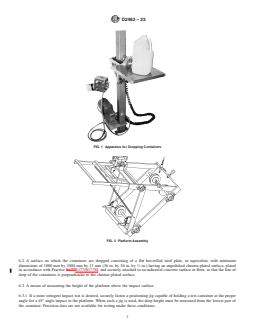
6.1 Drop Testing Machine (see Fig. 1), having the following features:
6.1.1 A platform (see Fig. 2) upon which to set the test specimens, which can be raised or lowered either manually or by means
of an electric motor.
6.1.2 The platform shall be adjustable to make it suitable for being leveled but shall also be stable so that it will not tilt under the
weight of the test specimen.
6.1.3 The platform shall be spring-loaded so that upon release it will move rapidly out of the path of the test specimen and will
not interfere with its fall.
6.1.4 A manually or electrically operated platform release mechanism that will hold the platform securely when being loaded but
will release the platform instantaneously and will not interfere with its path of travel.
Available from the Society of the Plastics Industry, Inc., 1295 K Street, N.W.,Plastics Industry Association, Inc., 1425 K Street, NW, Washington, DC 20005.
D2463 − 23
FIG. 1 Apparatus for Dropping Containers
FIG. 2 Platform Assembly
6.2 A surface on which the containers are dropped consisting of a flat hot-rolled steel plate, or equivalent, with minimum
dimensions of 1000 mm by 1000 mm by 13 mm (36 in. by 36 in. by ⁄2 in.) having an unpolished chrome-plated surface, plated
in accordance with Practice B177B177/B177M, and securely attached to an industrial concrete surface or floor, so that the line of
drop of the containers is perpendicular to the chrome-plated surface.
6.3 A means of measuring the height of the platform above the impact surface.
6.3.1 If a more stringent impact test is desired, securely fasten a positioning jig capable of holding a test container at the proper
angle for a 45° angle impact to the platform. When such a jig is used, the drop height must be measured from the lowest part of
the container. Precision data are not available for testing under these conditions.
D2463 − 23
7. Test Specimens
7.1 A minimum of 20 containers shall be selected so they are representative of the lot being tested for any one of the test
procedures. These shall be fitted with suitable closures.
8. Preparation of Apparatus
8.1 Periodically, or before each test series, check the platform of the drop impact machine, and adjust it if necessary, to ensure
that the specimen will strike the impact area squarely on the desired surface. If this is necessary, use the following procedure:
8.1.1 Move the platform to the approximate mean failure height of the containers to be tested with a specimen on the platform
in the desired position.
8.1.2 Release the platform allowing the specimen to fall onto the impact surface.
8.1.3 Take a snapshot picture of the container just before it strikes the impact surface. Two photographs shall be taken at right
angles to each other to ascertain that the container impacts as desired—front to back and side to side. The position of the container
relative to the impact surface as it appears in the photographs will indicate whether or not adjustments in the platform are necessary.
8.1.3.1 When photographs are taken, set up the camera approximately 300 mm (12 in.) above and 1800 mm (72 in.) from the
impact area.
8.1.4 Inspect the photographs and make adjustments in the platform and repeat the procedure as specified in 8.1.1 as necessary.
9. Conditioning
9.1 Fill containers with tap water to their nominal fill capacity and condition them uncapped for 24 h at 23 6 2°C (73 6 3.6°F).
9.2 If the test is intended for immediate quality control, fill the containers with room temperature water and test at that temperature.
A correlation shall have been previously developed by the testing laboratory between this type of test and that requiring 24-h
conditioning.
9.2.1 It is acceptable to use conditioning temperatures other than 23 6 2°C if desired, provided such conditioning is reported and
adequate precautions are taken to ensure the containers are at that temperature during testing.
10. Procedure
10.1 Procedure A:
10.1.1 Set the platform at the test height of interest.
10.1.2 Drop at least 20 containers individually record
...