


ASTM C830-00(2016)
(Test Method)Standard Test Methods for Apparent Porosity, Liquid Absorption, Apparent Specific Gravity, and Bulk Density of Refractory Shapes by Vacuum Pressure
Standard Test Methods for Apparent Porosity, Liquid Absorption, Apparent Specific Gravity, and Bulk Density of Refractory Shapes by Vacuum Pressure
SIGNIFICANCE AND USE
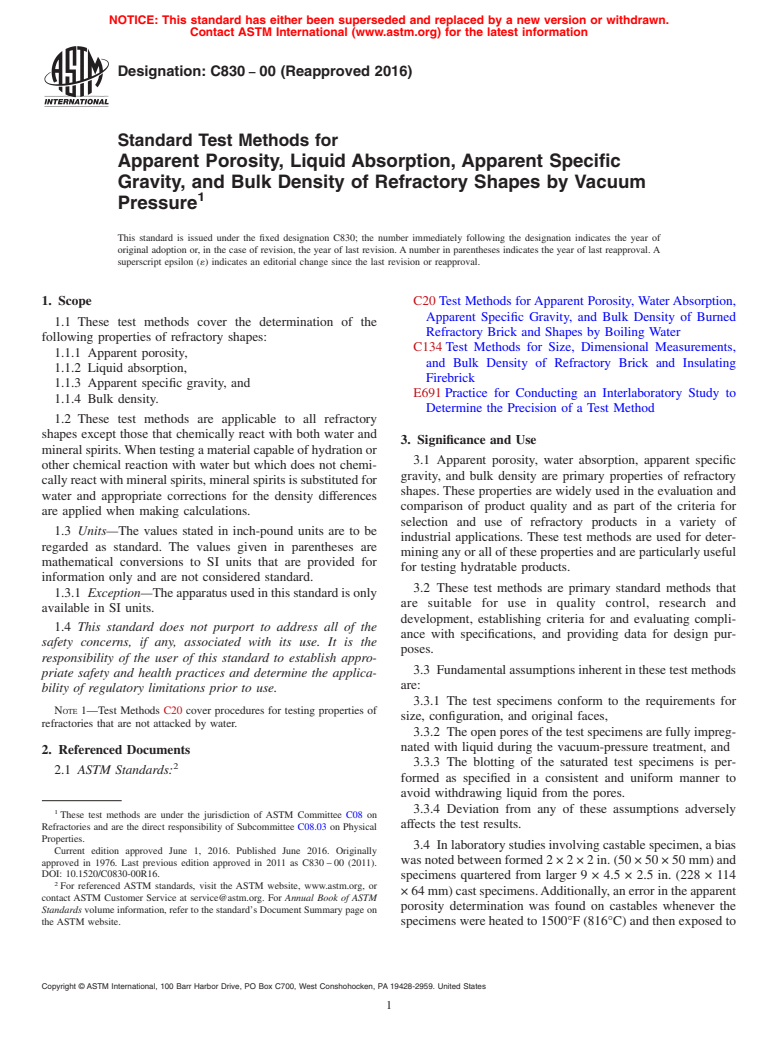
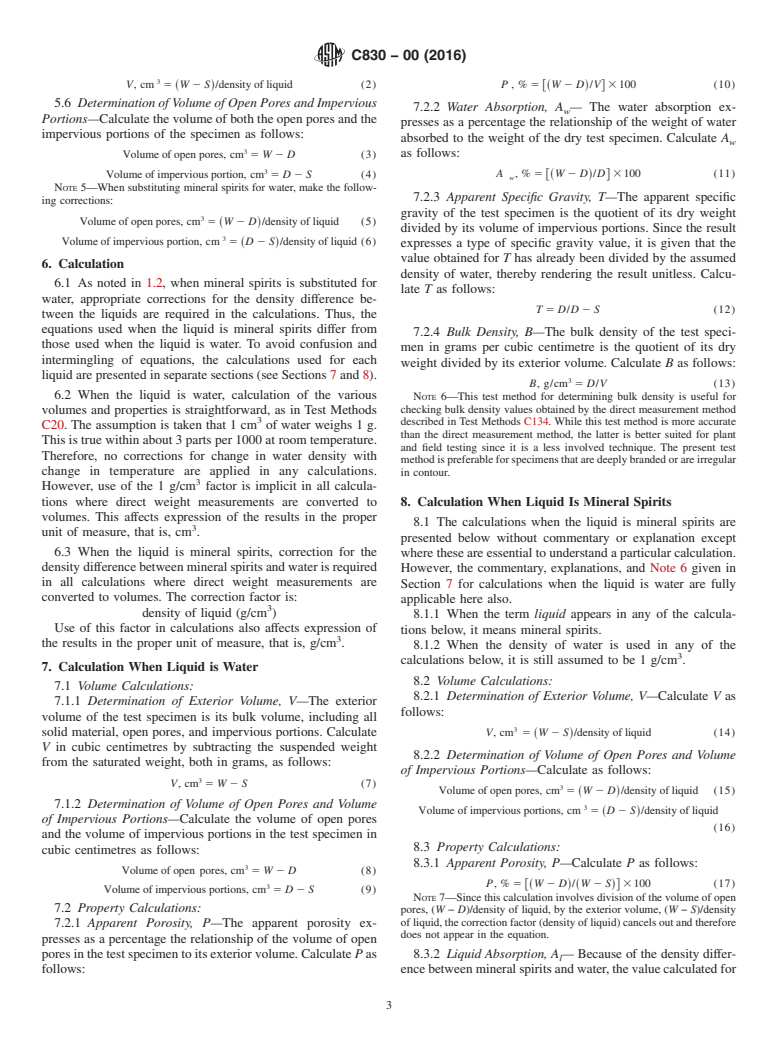
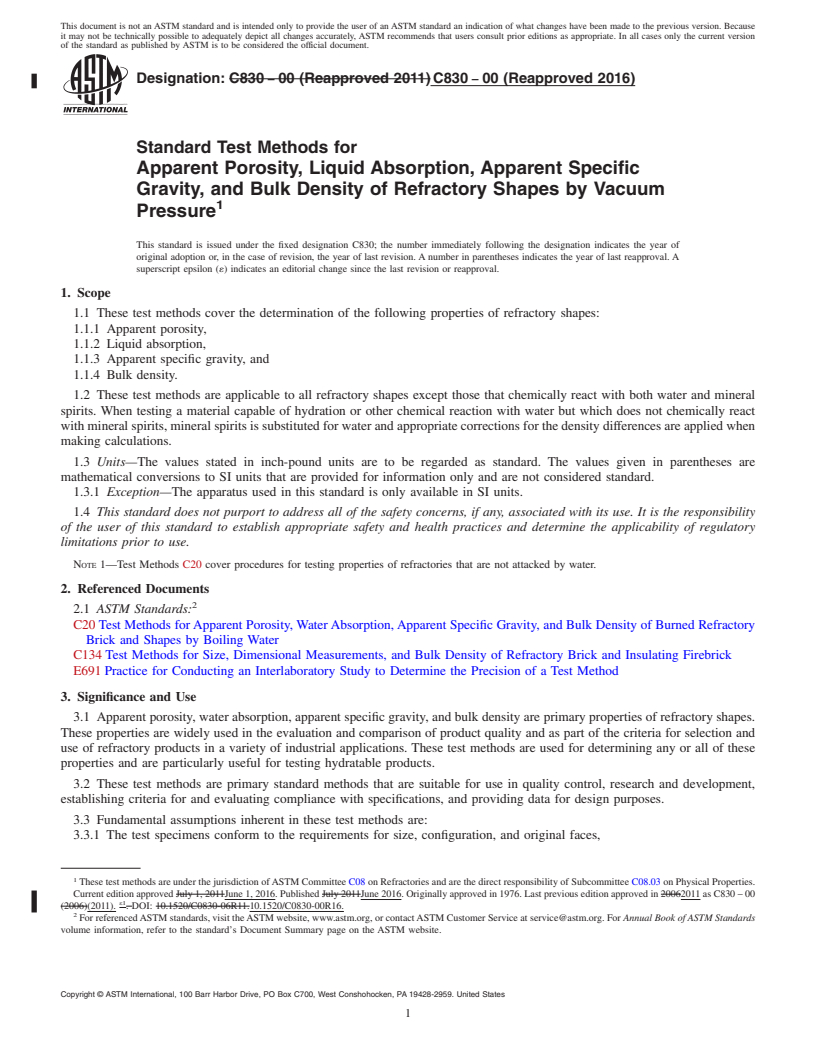
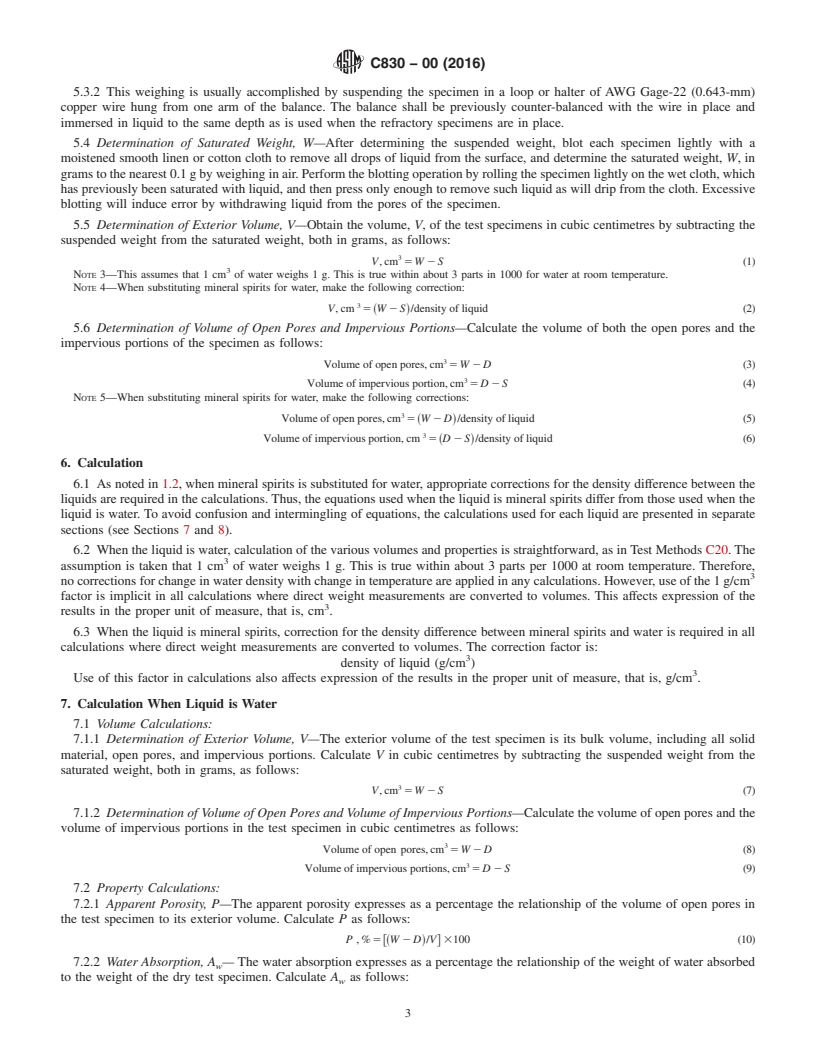
3.1 Apparent porosity, water absorption, apparent specific gravity, and bulk density are primary properties of refractory shapes. These properties are widely used in the evaluation and comparison of product quality and as part of the criteria for selection and use of refractory products in a variety of industrial applications. These test methods are used for determining any or all of these properties and are particularly useful for testing hydratable products.
3.2 These test methods are primary standard methods that are suitable for use in quality control, research and development, establishing criteria for and evaluating compliance with specifications, and providing data for design purposes.
3.3 Fundamental assumptions inherent in these test methods are:
3.3.1 The test specimens conform to the requirements for size, configuration, and original faces,
3.3.2 The open pores of the test specimens are fully impregnated with liquid during the vacuum-pressure treatment, and
3.3.3 The blotting of the saturated test specimens is performed as specified in a consistent and uniform manner to avoid withdrawing liquid from the pores.
3.3.4 Deviation from any of these assumptions adversely affects the test results.
3.4 In laboratory studies involving castable specimen, a bias was noted between formed 2 × 2 × 2 in. (50 × 50 × 50 mm) and specimens quartered from larger 9 × 4.5 × 2.5 in. (228 × 114 × 64 mm) cast specimens. Additionally, an error in the apparent porosity determination was found on castables whenever the specimens were heated to 1500°F (816°C) and then exposed to water as a saturation media. The error was attributed to reactivity of cement with water and subsequent re-hydration of cement phases. The higher the cement level of the castable, the greater the error noted. It was concluded that an error in porosity values could occur for refractory materials having a potential to form hydrated species with water. Testing under the same conditions in ke...
SCOPE
1.1 These test methods cover the determination of the following properties of refractory shapes:
1.1.1 Apparent porosity,
1.1.2 Liquid absorption,
1.1.3 Apparent specific gravity, and
1.1.4 Bulk density.
1.2 These test methods are applicable to all refractory shapes except those that chemically react with both water and mineral spirits. When testing a material capable of hydration or other chemical reaction with water but which does not chemically react with mineral spirits, mineral spirits is substituted for water and appropriate corrections for the density differences are applied when making calculations.
1.3 Units—The values stated in inch-pound units are to be regarded as standard. The values given in parentheses are mathematical conversions to SI units that are provided for information only and are not considered standard.
1.3.1 Exception—The apparatus used in this standard is only available in SI units.
1.4 This standard does not purport to address all of the safety concerns, if any, associated with its use. It is the responsibility of the user of this standard to establish appropriate safety and health practices and determine the applicability of regulatory limitations prior to use.
Note 1: Test Methods C20 cover procedures for testing properties of refractories that are not attacked by water.
General Information
Buy Standard
Standards Content (Sample)
NOTICE: This standard has either been superseded and replaced by a new version or withdrawn.
Contact ASTM International (www.astm.org) for the latest information
Designation: C830 − 00 (Reapproved 2016)
Standard Test Methods for
Apparent Porosity, Liquid Absorption, Apparent Specific
Gravity, and Bulk Density of Refractory Shapes by Vacuum
Pressure
This standard is issued under the fixed designation C830; the number immediately following the designation indicates the year of
original adoption or, in the case of revision, the year of last revision. A number in parentheses indicates the year of last reapproval. A
superscript epsilon (´) indicates an editorial change since the last revision or reapproval.
1. Scope C20 Test Methods for Apparent Porosity, Water Absorption,
Apparent Specific Gravity, and Bulk Density of Burned
1.1 These test methods cover the determination of the
Refractory Brick and Shapes by Boiling Water
following properties of refractory shapes:
C134 Test Methods for Size, Dimensional Measurements,
1.1.1 Apparent porosity,
and Bulk Density of Refractory Brick and Insulating
1.1.2 Liquid absorption,
Firebrick
1.1.3 Apparent specific gravity, and
E691 Practice for Conducting an Interlaboratory Study to
1.1.4 Bulk density.
Determine the Precision of a Test Method
1.2 These test methods are applicable to all refractory
shapes except those that chemically react with both water and
3. Significance and Use
mineral spirits. When testing a material capable of hydration or
3.1 Apparent porosity, water absorption, apparent specific
other chemical reaction with water but which does not chemi-
gravity, and bulk density are primary properties of refractory
cally react with mineral spirits, mineral spirits is substituted for
shapes. These properties are widely used in the evaluation and
water and appropriate corrections for the density differences
comparison of product quality and as part of the criteria for
are applied when making calculations.
selection and use of refractory products in a variety of
1.3 Units—The values stated in inch-pound units are to be
industrial applications. These test methods are used for deter-
regarded as standard. The values given in parentheses are
mining any or all of these properties and are particularly useful
mathematical conversions to SI units that are provided for
for testing hydratable products.
information only and are not considered standard.
3.2 These test methods are primary standard methods that
1.3.1 Exception—The apparatus used in this standard is only
are suitable for use in quality control, research and
available in SI units.
development, establishing criteria for and evaluating compli-
1.4 This standard does not purport to address all of the
ance with specifications, and providing data for design pur-
safety concerns, if any, associated with its use. It is the
poses.
responsibility of the user of this standard to establish appro-
3.3 Fundamental assumptions inherent in these test methods
priate safety and health practices and determine the applica-
are:
bility of regulatory limitations prior to use.
3.3.1 The test specimens conform to the requirements for
NOTE 1—Test Methods C20 cover procedures for testing properties of
size, configuration, and original faces,
refractories that are not attacked by water.
3.3.2 The open pores of the test specimens are fully impreg-
nated with liquid during the vacuum-pressure treatment, and
2. Referenced Documents
3.3.3 The blotting of the saturated test specimens is per-
2.1 ASTM Standards:
formed as specified in a consistent and uniform manner to
avoid withdrawing liquid from the pores.
3.3.4 Deviation from any of these assumptions adversely
These test methods are under the jurisdiction of ASTM Committee C08 on
affects the test results.
Refractories and are the direct responsibility of Subcommittee C08.03 on Physical
Properties.
3.4 In laboratory studies involving castable specimen, a bias
Current edition approved June 1, 2016. Published June 2016. Originally
was noted between formed 2 × 2 × 2 in. (50 × 50 × 50 mm) and
approved in 1976. Last previous edition approved in 2011 as C830 – 00 (2011).
DOI: 10.1520/C0830-00R16.
specimens quartered from larger 9 × 4.5 × 2.5 in. (228 × 114
For referenced ASTM standards, visit the ASTM website, www.astm.org, or
× 64 mm) cast specimens. Additionally, an error in the apparent
contact ASTM Customer Service at service@astm.org. For Annual Book of ASTM
porosity determination was found on castables whenever the
Standards volume information, refer to the standard’s Document Summary page on
the ASTM website. specimens were heated to 1500°F (816°C) and then exposed to
Copyright © ASTM International, 100 Barr Harbor Drive, PO Box C700, West Conshohocken, PA 19428-2959. United States
C830 − 00 (2016)
water as a saturation media. The error was attributed to 5.1.2 The drying procedure may be omitted only when the
reactivity of cement with water and subsequent re-hydration of test specimens are known to be dry, as may be the case with
cement phases. The higher the cement level of the castable, the samples taken directly from kilns.
greater the error noted. It was concluded that an error in
5.1.3 The drying of the specimens to constant weight and
porosity values could occur for refractory materials having a the determination of their dry weight may be done either before
potential to form hydrated species with water. Testing under the
or after the saturation operation (5.2). Usually, the dry weight
same conditions in kerosene produced results that were be- is determined before saturation; if, however, the specimens are
lieved to be more accurate, but the data suggested that the
friable or evidence indicates that particles have broken loose
kerosene might not have saturated the open pores of cast during the saturating operation, dry and weigh the specimens
specimen as readily as water.
after the suspended weight, S, and the saturated weight, W,
have been determined as described in 5.3 and 5.4. Use this
3.5 Certain precautions must be exercised in interpreting
second dry weight in all appropriate calculations.
and using results from these test methods. All four property
values are interrelated by at least two of the three base data
5.2 Saturation—Place the test specimens in a suitable
values generated during testing. Thus, an error in any base data
vacuum-pressure vessel (Note 2) which shall be closed,
value will cause an error in at least three of the property values
secured, and pumped down to an absolute pressure of not more
for a given test specimen. Certain of the properties, that is,
than 1.9 in. Hg (6.4 kPa). Hold this pressure for 30 min. Allow
apparent specific gravity and bulk density, are functions of
the water or mineral spirits (see 1.2) to enter the vessel while
other factors such as product composition, compositional
maintaining the vacuum for 5 min. Then close the vacuum line
variability within the same product, impervious porosity, and
and pressurize the vessel by means of compressed air or a
total porosity. Generalizations on or comparisons of property
pressure pump. Maintain this pressure at 30 psi (207 kPa) or
values should be judiciously made between like products tested
more for 60 min. Then release the pressure; the saturated
by these test methods or with full recognition of potentially
specimens are now ready for weighing.
inherent differences between the products being compared or
NOTE 2—The vacuum-pressure vessel should be capable of withstand-
the test method used.
ing an absolute pressure of 1.0 in. Hg (3.4 kPa) or a pressure of 65 to 70
psi (448 to 483 kPa) without deforming or rupturing. It should be provided
3.6 When a liquid other than water is used, such as types of
with gages or manometers for indicating vacuum or pressure and a relief
kerosene or mineral spirits, specific gravity must be known by
valve, as well as vacuum, pressure, and liquid lines. The liquid may be
either determination or monitoring on a controlled basis.
introduced at the bottom, in which case a dual-acting valve will suffice for
Specific gravity will change due to different grades of liquids,
both filling and draining the vessel.
evaporation, or contamination with dirt or foreign material.
5.3 Determination of Suspended Weight, S:
The test should not be run if the liquid becomes dirty, foamy,
5.3.1 Determine the weight, S, of each test specimen in
or changes color, because foreign particles can block pores and
grams to the nearest 0.1 g after saturation and while suspended
prevent impregnation of the sample.
in liquid.
5.3.2 This weighing is usually accomplished by suspending
4. Test Specimens
the specimen in a loop or halter of AWG Gage-22 (0.643-mm)
4.1 When testing 9-in. (228-mm) straight brick, use a
copper wire hung from one arm of the balance. The balance
quarter-brick specimen obtained by halving the brick along a
shall be previously counter-balanced with the wire in place and
plane parallel to the 9 by 2 ⁄2 or 3-in. (228 by 64 or 76-mm)
immersed in liquid to the same depth as is used when the
1 1
face and along a plane parallel to the 4 ⁄2 by 2 ⁄2 or 3-in. (114
refractory specimens are in place.
by 64 or 76-mm) face. Four of the surfaces of the resultant
5.4 Determination of Saturated Weight, W—After determin-
quarter-brick specimen include part of the original molded
ing the suspended weight, blot each specimen lightly with a
faces.
moistened smooth linen or cotton cloth to remove all drops of
4.2 When testing other refractory shapes, cut drill, or break
liquid from the surface, and determine the saturated weight, W,
from each shape a specimen having a volume of approximately
in grams to the nearest 0.1 g by weighing in air. Perform the
3 3
25 to 30 in. (410 to 490 cm ). The specimen shall include
blotting operation by rolling the specimen lightly on the wet
interior and exterior portions of the shape.
cloth, which has previously been saturated with liquid, and
4.3 Remove all loosely adhering particles from each speci-
then press only enough to remove such liquid as will drip from
men.
the cloth. Excessive blotting will induce error by withdrawing
liquid from the pores of the specimen.
5. Procedures
5.5 Determination of Exterior Volume, V—Obtain the
5.1 Determination of Dry Weight, D:
volume, V, of the test specimens in cubic centimetres by
5.1.1 Dry the test specimens to constant weight by heating
subtracting the suspended weight from the saturated weight,
to 220 to 230°F (105 to 110°C) and determine the dry weight,
both in grams, as follows:
D, in grams to the nearest 0.1 g.
V, cm 5 W 2 S (1)
NOTE 3—This assumes that 1 c
...
This document is not an ASTM standard and is intended only to provide the user of an ASTM standard an indication of what changes have been made to the previous version. Because
it may not be technically possible to adequately depict all changes accurately, ASTM recommends that users consult prior editions as appropriate. In all cases only the current version
of the standard as published by ASTM is to be considered the official document.
Designation: C830 − 00 (Reapproved 2011) C830 − 00 (Reapproved 2016)
Standard Test Methods for
Apparent Porosity, Liquid Absorption, Apparent Specific
Gravity, and Bulk Density of Refractory Shapes by Vacuum
Pressure
This standard is issued under the fixed designation C830; the number immediately following the designation indicates the year of
original adoption or, in the case of revision, the year of last revision. A number in parentheses indicates the year of last reapproval. A
superscript epsilon (´) indicates an editorial change since the last revision or reapproval.
1. Scope
1.1 These test methods cover the determination of the following properties of refractory shapes:
1.1.1 Apparent porosity,
1.1.2 Liquid absorption,
1.1.3 Apparent specific gravity, and
1.1.4 Bulk density.
1.2 These test methods are applicable to all refractory shapes except those that chemically react with both water and mineral
spirits. When testing a material capable of hydration or other chemical reaction with water but which does not chemically react
with mineral spirits, mineral spirits is substituted for water and appropriate corrections for the density differences are applied when
making calculations.
1.3 Units—The values stated in inch-pound units are to be regarded as standard. The values given in parentheses are
mathematical conversions to SI units that are provided for information only and are not considered standard.
1.3.1 Exception—The apparatus used in this standard is only available in SI units.
1.4 This standard does not purport to address all of the safety concerns, if any, associated with its use. It is the responsibility
of the user of this standard to establish appropriate safety and health practices and determine the applicability of regulatory
limitations prior to use.
NOTE 1—Test Methods C20 cover procedures for testing properties of refractories that are not attacked by water.
2. Referenced Documents
2.1 ASTM Standards:
C20 Test Methods for Apparent Porosity, Water Absorption, Apparent Specific Gravity, and Bulk Density of Burned Refractory
Brick and Shapes by Boiling Water
C134 Test Methods for Size, Dimensional Measurements, and Bulk Density of Refractory Brick and Insulating Firebrick
E691 Practice for Conducting an Interlaboratory Study to Determine the Precision of a Test Method
3. Significance and Use
3.1 Apparent porosity, water absorption, apparent specific gravity, and bulk density are primary properties of refractory shapes.
These properties are widely used in the evaluation and comparison of product quality and as part of the criteria for selection and
use of refractory products in a variety of industrial applications. These test methods are used for determining any or all of these
properties and are particularly useful for testing hydratable products.
3.2 These test methods are primary standard methods that are suitable for use in quality control, research and development,
establishing criteria for and evaluating compliance with specifications, and providing data for design purposes.
3.3 Fundamental assumptions inherent in these test methods are:
3.3.1 The test specimens conform to the requirements for size, configuration, and original faces,
These test methods are under the jurisdiction of ASTM Committee C08 on Refractories and are the direct responsibility of Subcommittee C08.03 on Physical Properties.
Current edition approved July 1, 2011June 1, 2016. Published July 2011June 2016. Originally approved in 1976. Last previous edition approved in 20062011 as C830 – 00
ε1
(2006)(2011). . DOI: 10.1520/C0830-06R11.10.1520/C0830-00R16.
For referenced ASTM standards, visit the ASTM website, www.astm.org, or contact ASTM Customer Service at service@astm.org. For Annual Book of ASTM Standards
volume information, refer to the standard’s Document Summary page on the ASTM website.
Copyright © ASTM International, 100 Barr Harbor Drive, PO Box C700, West Conshohocken, PA 19428-2959. United States
C830 − 00 (2016)
3.3.2 The open pores of the test specimens are fully impregnated with liquid during the vacuum-pressure treatment, and
3.3.3 The blotting of the saturated test specimens is performed as specified in a consistent and uniform manner to avoid
withdrawing liquid from the pores.
3.3.4 Deviation from any of these assumptions adversely affects the test results.
3.4 In laboratory studies involving castable specimen, a bias was noted between formed 2 × 2 × 2 in. (50 × 50 × 50 mm) and
specimens quartered from larger 9 × 4.5 × 2.5 in. (228 × 114 × 64 mm) cast specimens. Additionally, an error in the apparent
porosity determination was found on castables whenever the specimens were heated to 1500°F (816°C) and then exposed to water
as a saturation media. The error was attributed to reactivity of cement with water and subsequent re-hydration of cement phases.
The higher the cement level of the castable, the greater the error noted. It was concluded that an error in porosity values could occur
for refractory materials having a potential to form hydrated species with water. Testing under the same conditions in kerosene
produced results that were believed to be more accurate, but the data suggested that the kerosene might not have saturated the open
pores of cast specimen as readily as water.
3.5 Certain precautions must be exercised in interpreting and using results from these test methods. All four property values are
interrelated by at least two of the three base data values generated during testing. Thus, an error in any base data value will cause
an error in at least three of the property values for a given test specimen. Certain of the properties, that is, apparent specific gravity
and bulk density, are functions of other factors such as product composition, compositional variability within the same product,
impervious porosity, and total porosity. Generalizations on or comparisons of property values should be judiciously made between
like products tested by these test methods or with full recognition of potentially inherent differences between the products being
compared or the test method used.
3.6 When a liquid other than water is used, such as types of kerosene or mineral spirits, specific gravity must be known by either
determination or monitoring on a controlled basis. Specific gravity will change due to different grades of liquids, evaporation, or
contamination with dirt or foreign material. The test should not be run if the liquid becomes dirty, foamy, or changes color, because
foreign particles can block pores and prevent impregnation of the sample.
4. Test Specimens
4.1 When testing 9-in. (228-mm) straight brick, use a quarter-brick specimen obtained by halving the brick along a plane
1 1 1
parallel to the 9 by 2 ⁄2 or 3-in. (228 by 64 or 76-mm) face and along a plane parallel to the 4 ⁄2 by 2 ⁄2 or 3-in. (114 by 64 or
76-mm) face. Four of the surfaces of the resultant quarter-brick specimen include part of the original molded faces.
4.2 When testing other refractory shapes, cut drill, or break from each shape a specimen having a volume of approximately 25
3 3
to 30 in. (410 to 490 cm ). The specimen shall include interior and exterior portions of the shape.
4.3 Remove all loosely adhering particles from each specimen.
5. Procedures
5.1 Determination of Dry Weight, D:
5.1.1 Dry the test specimens to constant weight by heating to 220 to 230°F (105 to 110°C) and determine the dry weight, D,
in grams to the nearest 0.1 g.
5.1.2 The drying procedure may be omitted only when the test specimens are known to be dry, as may be the case with samples
taken directly from kilns.
5.1.3 The drying of the specimens to constant weight and the determination of their dry weight may be done either before or
after the saturation operation (5.2). Usually, the dry weight is determined before saturation; if, however, the specimens are friable
or evidence indicates that particles have broken loose during the saturating operation, dry and weigh the specimens after the
suspended weight, S, and the saturated weight, W, have been determined as described in 5.3 and 5.4. Use this second dry weight
in all appropriate calculations.
5.2 Saturation—Place the test specimens in a suitable vacuum-pressure vessel (Note 2) which shall be closed, secured, and
pumped down to an absolute pressure of not more than 1.9 in. Hg (6.4 kPa). Hold this pressure for 30 min. Allow the water or
mineral spirits (see 1.2) to enter the vessel while maintaining the vacuum for 5 min. Then close the vacuum line and pressurize
the vessel by means of compressed air or a pressure pump. Maintain this pressure at 30 psi (207 kPa) or more for 60 min. Then
release the pressure; the saturated specimens are now ready for weighing.
NOTE 2—The vacuum-pressure vessel should be capable of withstanding an absolute pressure of 1.0 in. Hg (3.4 kPa) or a pressure of 65 to 70 psi (448
to 483 kPa) without deforming or rupturing. It should be provided with gages or manometers for indicating vacuum or pressure and a relief valve, as
well as vacuum, pressure, and liquid lines. The liquid may be introduced at the bottom, in which case a dual-acting valve will suffice for both filling and
draining the vessel.
5.3 Determination of Suspended Weight, S:
5.3.1 Determine the weight, S, of each test specimen in grams to the nearest 0.1 g after saturation and while suspended in liquid.
Supporting data have been filed at ASTM International Headquarters and may be obtained by requesting Research Report RR:C08-1014.
C830 − 00 (2016)
5.3.2 This weighing is usually accomplished by suspending the specimen in a loop or halter of AWG Gage-22 (0.643-mm)
copper wire hung from one arm of the balance. The balance shall be previously counter-balanced with the wire in place and
immersed in liquid to the same depth as is used when the refractory specimens are in place.
5.4 Determination of Saturated Weight, W—After determining the suspended weight, blot each specimen lightly with a
moistened smooth linen or cotton cloth to remove all drops of liquid from the surface, and determine the saturated weight, W, in
grams to the nearest 0.1 g by weighing in air. Perform the blotting operation by rolling the specimen lightly on the wet cloth, which
has previously been saturated with
...
Questions, Comments and Discussion
Ask us and Technical Secretary will try to provide an answer. You can facilitate discussion about the standard in here.