

ASTM A242/A242M-24
(Specification)Standard Specification for High-Strength Low-Alloy Structural Steel
General Information
- Abstract
ABSTRACT
This specification covers high-strength low-alloy structural steel shapes, plates, and bars for welded, riveted, or bolted construction intended primarily for use as structural members where savings in weight (mass) or added durability are important. Steel specimens shall be semi-killed or killed. Heat analysis shall be performed wherein steel specimens shall conform to required chemical compositions of carbon, manganese, phosphorus, sulfur, and copper. Atmospheric corrosion resistance shall be estimated for steel specimens. Specimens shall also undergo tension tests and shall conform to specified values of tensile strength, yield point, and elongation.
SCOPE
1.1 This specification covers high-strength low-alloy structural steel shapes, plates, and bars for welded, riveted, or bolted construction intended primarily for use as structural members where savings in weight [mass] or added durability are important. The atmospheric corrosion resistance of the steel in most environments is substantially better than that of carbon structural steels with or without copper addition. When properly exposed to the atmosphere, this steel can be used bare (unpainted) for many applications (see Note 1). This specification is limited to material up to 4 in. [100 mm], inclusive, in thickness.
Note 1: For methods of estimating the atmospheric corrosion resistance of low-alloy steels, see Guide G101.
1.2 When the steel is to be welded, it is presupposed that a welding procedure suitable for the grade of steel and intended use or service will be utilized. See Appendix X3 of Specification A6/A6M for information on weldability.
1.3 The values stated in either inch-pound units or SI units are to be regarded as standard. Within the text, the SI units are shown in brackets. The values stated in each system are not exact equivalents; therefore, each system must be used independently of the other. Combining values from the two systems may result in nonconformance with the specification.
1.4 For structural products produced from coil and furnished without heat treatment or with stress relieving only, the additional requirements, including additional testing requirements and the reporting of additional test results, of Specification A6/A6M apply.
1.5 This international standard was developed in accordance with internationally recognized principles on standardization established in the Decision on Principles for the Development of International Standards, Guides and Recommendations issued by the World Trade Organization Technical Barriers to Trade (TBT) Committee.
- Status
- Published
- Publication Date
- 29-Feb-2024
- Technical Committee
- A01 - Steel, Stainless Steel and Related Alloys
Buy Documents
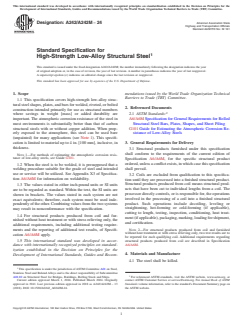
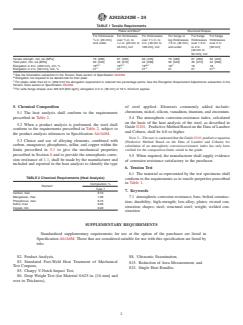


ASTM A242/A242M-24 - Standard Specification for High-Strength Low-Alloy Structural Steel
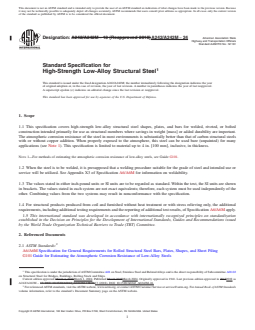
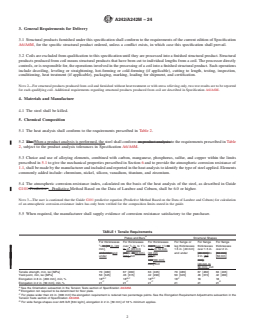

REDLINE ASTM A242/A242M-24 - Standard Specification for High-Strength Low-Alloy Structural Steel
Overview
ASTM A242/A242M-24 is the standard specification for high-strength low-alloy structural steel developed by ASTM International. This specification covers shapes, plates, and bars designed for welded, riveted, or bolted construction where increased durability and weight savings are critical design considerations. One of the distinguishing features of ASTM A242/A242M steel is its superior atmospheric corrosion resistance compared to standard carbon structural steels, making it suitable for applications where the material can be left bare and unpainted in many service environments.
Key Topics
- Material Scope: The standard applies to steel shapes, plates, and bars up to 4 in. [100 mm] in thickness.
- Corrosion Resistance: Enhanced atmospheric corrosion resistance allows for bare (unpainted) applications, reducing maintenance needs.
- Mechanical Properties: The steel must conform to set requirements for tensile strength, yield point, and elongation, ensuring reliability in structural applications.
- Chemical Composition: Heat analysis ensures compliance with specific limits for carbon, manganese, phosphorus, sulfur, and copper, promoting ductility and strength.
- Manufacturing Requirements: Steel must be semi-killed or killed, with procedures outlined for processing coils into finished products.
- Testing and Quality Control: Includes tension tests and guidelines for additional requirements for coils, as referenced in ASTM A6/A6M.
- Supplementary Requirements: Optional tests, such as Charpy V-Notch impact, ultrasonic examination, and others, offer further quality assurance to meet specific project needs.
Applications
ASTM A242/A242M-24 steel is widely used in industries and projects where strength, durability, and resistance to harsh weather are critical. Typical application areas include:
- Bridges: Structural components in highways and railways where weathering steel's corrosion resistance eliminates the need for paint.
- Building Structures: High-rise buildings and heavy industrial facilities utilizing both the strength and natural patina for aesthetic and functional benefits.
- Transportation Infrastructure: Platforms, support structures, and exterior elements exposed to the environment.
- Architectural Design: Facades, landscape structures, and outdoor installations that benefit from the steel’s weathered appearance and minimal maintenance.
- Riveted, Bolted, or Welded Construction: Suitable for diverse fabrication methods, providing flexibility during installation while maintaining structural integrity.
Related Standards
Reference to other standards is important for ensuring comprehensive compliance and best practices:
- ASTM A6/A6M: General requirements for rolled structural steel bars, plates, shapes, and sheet piling. Provides additional guidelines for testing, tolerances, and supplemental requirements for products covered by ASTM A242/A242M.
- ASTM G101: Guide for estimating the atmospheric corrosion resistance of low-alloy steels, used to evaluate and predict the performance of weathering steels.
- AASHTO M 161: Equivalent specification for transportation projects, especially relevant for highway and bridge construction.
- WTO TBT Committee Standards: Affirms development under internationally recognized principles for use in global projects and compliance with international trade requirements.
Practical Value
Implementing ASTM A242/A242M-24 ensures that steel structures benefit from weight savings, increased durability, and reduced lifecycle costs due to corrosion resistance. Its robust mechanical properties and straightforward integration with common construction practices make it a reliable choice for architects, engineers, and infrastructure developers seeking high-performance structural steel solutions.
Keywords: high-strength, low-alloy, structural steel, ASTM A242, corrosion resistance, weathering steel, welded construction, bolted construction, steel plates, steel shapes, steel bars, infrastructure, ASTM standards.
Relations
- Replaces
ASTM A242/A242M-13(2018) - Standard Specification for High-Strength Low-Alloy Structural Steel - Effective Date
- 01-Mar-2024
- Effective Date
- 01-Mar-2024
- Effective Date
- 01-Nov-2023
- Effective Date
- 01-Mar-2024
- Referred By
ASTM F1155-10(2019) - Standard Practice for Selection and Application of Piping System Materials - Effective Date
- 01-Mar-2024
- Effective Date
- 01-Mar-2024
- Effective Date
- 01-Mar-2024
- Effective Date
- 01-Mar-2024
Buy Documents
ASTM A242/A242M-24 - Standard Specification for High-Strength Low-Alloy Structural Steel
REDLINE ASTM A242/A242M-24 - Standard Specification for High-Strength Low-Alloy Structural Steel
Get Certified
Connect with accredited certification bodies for this standard

Element Materials Technology
Materials testing and product certification.

Inštitut za kovinske materiale in tehnologije
Institute of Metals and Technology. Materials testing, metallurgical analysis, NDT.
Sponsored listings
Frequently Asked Questions
ASTM A242/A242M-24 is a technical specification published by ASTM International. Its full title is "Standard Specification for High-Strength Low-Alloy Structural Steel". This standard covers: ABSTRACT This specification covers high-strength low-alloy structural steel shapes, plates, and bars for welded, riveted, or bolted construction intended primarily for use as structural members where savings in weight (mass) or added durability are important. Steel specimens shall be semi-killed or killed. Heat analysis shall be performed wherein steel specimens shall conform to required chemical compositions of carbon, manganese, phosphorus, sulfur, and copper. Atmospheric corrosion resistance shall be estimated for steel specimens. Specimens shall also undergo tension tests and shall conform to specified values of tensile strength, yield point, and elongation. SCOPE 1.1 This specification covers high-strength low-alloy structural steel shapes, plates, and bars for welded, riveted, or bolted construction intended primarily for use as structural members where savings in weight [mass] or added durability are important. The atmospheric corrosion resistance of the steel in most environments is substantially better than that of carbon structural steels with or without copper addition. When properly exposed to the atmosphere, this steel can be used bare (unpainted) for many applications (see Note 1). This specification is limited to material up to 4 in. [100 mm], inclusive, in thickness. Note 1: For methods of estimating the atmospheric corrosion resistance of low-alloy steels, see Guide G101. 1.2 When the steel is to be welded, it is presupposed that a welding procedure suitable for the grade of steel and intended use or service will be utilized. See Appendix X3 of Specification A6/A6M for information on weldability. 1.3 The values stated in either inch-pound units or SI units are to be regarded as standard. Within the text, the SI units are shown in brackets. The values stated in each system are not exact equivalents; therefore, each system must be used independently of the other. Combining values from the two systems may result in nonconformance with the specification. 1.4 For structural products produced from coil and furnished without heat treatment or with stress relieving only, the additional requirements, including additional testing requirements and the reporting of additional test results, of Specification A6/A6M apply. 1.5 This international standard was developed in accordance with internationally recognized principles on standardization established in the Decision on Principles for the Development of International Standards, Guides and Recommendations issued by the World Trade Organization Technical Barriers to Trade (TBT) Committee.
ABSTRACT This specification covers high-strength low-alloy structural steel shapes, plates, and bars for welded, riveted, or bolted construction intended primarily for use as structural members where savings in weight (mass) or added durability are important. Steel specimens shall be semi-killed or killed. Heat analysis shall be performed wherein steel specimens shall conform to required chemical compositions of carbon, manganese, phosphorus, sulfur, and copper. Atmospheric corrosion resistance shall be estimated for steel specimens. Specimens shall also undergo tension tests and shall conform to specified values of tensile strength, yield point, and elongation. SCOPE 1.1 This specification covers high-strength low-alloy structural steel shapes, plates, and bars for welded, riveted, or bolted construction intended primarily for use as structural members where savings in weight [mass] or added durability are important. The atmospheric corrosion resistance of the steel in most environments is substantially better than that of carbon structural steels with or without copper addition. When properly exposed to the atmosphere, this steel can be used bare (unpainted) for many applications (see Note 1). This specification is limited to material up to 4 in. [100 mm], inclusive, in thickness. Note 1: For methods of estimating the atmospheric corrosion resistance of low-alloy steels, see Guide G101. 1.2 When the steel is to be welded, it is presupposed that a welding procedure suitable for the grade of steel and intended use or service will be utilized. See Appendix X3 of Specification A6/A6M for information on weldability. 1.3 The values stated in either inch-pound units or SI units are to be regarded as standard. Within the text, the SI units are shown in brackets. The values stated in each system are not exact equivalents; therefore, each system must be used independently of the other. Combining values from the two systems may result in nonconformance with the specification. 1.4 For structural products produced from coil and furnished without heat treatment or with stress relieving only, the additional requirements, including additional testing requirements and the reporting of additional test results, of Specification A6/A6M apply. 1.5 This international standard was developed in accordance with internationally recognized principles on standardization established in the Decision on Principles for the Development of International Standards, Guides and Recommendations issued by the World Trade Organization Technical Barriers to Trade (TBT) Committee.
ASTM A242/A242M-24 is classified under the following ICS (International Classification for Standards) categories: 77.140.10 - Heat-treatable steels. The ICS classification helps identify the subject area and facilitates finding related standards.
ASTM A242/A242M-24 has the following relationships with other standards: It is inter standard links to ASTM A242/A242M-13(2018), ASTM A6/A6M-24, ASTM A6/A6M-23, ASTM C1802-23, ASTM F1155-10(2019), ASTM G101-04(2020), ASTM A1065/A1065M-18, ASTM A786/A786M-15(2021). Understanding these relationships helps ensure you are using the most current and applicable version of the standard.
ASTM A242/A242M-24 is available in PDF format for immediate download after purchase. The document can be added to your cart and obtained through the secure checkout process. Digital delivery ensures instant access to the complete standard document.
Standards Content (Sample)
This international standard was developed in accordance with internationally recognized principles on standardization established in the Decision on Principles for the
Development of International Standards, Guides and Recommendations issued by the World Trade Organization Technical Barriers to Trade (TBT) Committee.
Designation: A242/A242M − 24 American Association State
Highway and Transportation Officials
Standard AASHTO No.: M 161
Standard Specification for
High-Strength Low-Alloy Structural Steel
This standard is issued under the fixed designation A242/A242M; the number immediately following the designation indicates the year
of original adoption or, in the case of revision, the year of last revision. A number in parentheses indicates the year of last reapproval.
A superscript epsilon (´) indicates an editorial change since the last revision or reapproval.
This standard has been approved for use by agencies of the U.S. Department of Defense.
1. Scope mendations issued by the World Trade Organization Technical
Barriers to Trade (TBT) Committee.
1.1 This specification covers high-strength low-alloy struc-
tural steel shapes, plates, and bars for welded, riveted, or bolted
2. Referenced Documents
construction intended primarily for use as structural members
where savings in weight [mass] or added durability are 2.1 ASTM Standards:
important. The atmospheric corrosion resistance of the steel in A6/A6M Specification for General Requirements for Rolled
most environments is substantially better than that of carbon Structural Steel Bars, Plates, Shapes, and Sheet Piling
structural steels with or without copper addition. When prop- G101 Guide for Estimating the Atmospheric Corrosion Re-
erly exposed to the atmosphere, this steel can be used bare sistance of Low-Alloy Steels
(unpainted) for many applications (see Note 1). This specifi-
cation is limited to material up to 4 in. [100 mm], inclusive, in 3. General Requirements for Delivery
thickness.
3.1 Structural products furnished under this specification
shall conform to the requirements of the current edition of
NOTE 1—For methods of estimating the atmospheric corrosion resis-
tance of low-alloy steels, see Guide G101.
Specification A6/A6M, for the specific structural product
ordered, unless a conflict exists, in which case this specification
1.2 When the steel is to be welded, it is presupposed that a
shall prevail.
welding procedure suitable for the grade of steel and intended
use or service will be utilized. See Appendix X3 of Specifica-
3.2 Coils are excluded from qualification to this specifica-
tion A6/A6M for information on weldability.
tion until they are processed into a finished structural product.
Structural products produced from coil means structural prod-
1.3 The values stated in either inch-pound units or SI units
ucts that have been cut to individual lengths from a coil. The
are to be regarded as standard. Within the text, the SI units are
processor directly controls, or is responsible for, the operations
shown in brackets. The values stated in each system are not
involved in the processing of a coil into a finished structural
exact equivalents; therefore, each system must be used inde-
product. Such operations include decoiling, leveling or
pendently of the other. Combining values from the two systems
straightening, hot-forming or cold-forming (if applicable),
may result in nonconformance with the specification.
cutting to length, testing, inspection, conditioning, heat treat-
1.4 For structural products produced from coil and fur-
ment (if applicable), packaging, marking, loading for shipment,
nished without heat treatment or with stress relieving only, the
and certification.
additional requirements, including additional testing require-
NOTE 2—For structural products produced from coil and furnished
ments and the reporting of additional test results, of Specifi-
without heat treatment or with stress relieving only, two test results are to
cation A6/A6M apply.
be reported for each qualifying coil. Additional requirements regarding
1.5 This international standard was developed in accor-
structural products produced from coil are described in Specification
dance with internationally recognized principles on standard- A6/A6M.
ization established in the Decision on Principles for the
4. Materials and Manufacture
Development of International Standards, Guides and Recom-
4.1 The steel shall be killed.
This specification is under the jurisdiction of ASTM Committee A01 on Steel,
Stainless Steel and Related Alloys and is the direct responsibility of Subcommittee
A01.02 on Structural Steel for Bridges, Buildings, Rolling Stock and Ships. For referenced ASTM standards, visit the ASTM website, www.astm.org, or
Current edition approved March 1, 2024. Published March 2024. Originally contact ASTM Customer Service at service@astm.org. For Annual Book of ASTM
approved in 1941. Last previous edition approved in 2018 as A242/A242M – 13 Standards volume information, refer to the standard’s Document Summary page on
(2018). DOI: 10.1520/A0242_A0242M-24. the ASTM website.
Copyright © ASTM International, 100 Barr Harbor Drive, PO Box C700, West Conshohocken, PA 19428-2959. United States
...
This document is not an ASTM standard and is intended only to provide the user of an ASTM standard an indication of what changes have been made to the previous version. Because
it may not be technically possible to adequately depict all changes accurately, ASTM recommends that users consult prior editions as appropriate. In all cases only the current version
of the standard as published by ASTM is to be considered the official document.
Designation: A242/A242M − 13 (Reapproved 2018) A242/A242M − 24 American Association State
Highway and Transportation Officials
Standard AASHTO No.: M 161
Standard Specification for
High-Strength Low-Alloy Structural Steel
This standard is issued under the fixed designation A242/A242M; the number immediately following the designation indicates the year
of original adoption or, in the case of revision, the year of last revision. A number in parentheses indicates the year of last reapproval.
A superscript epsilon (´) indicates an editorial change since the last revision or reapproval.
This standard has been approved for use by agencies of the U.S. Department of Defense.
1. Scope
1.1 This specification covers high-strength low-alloy structural steel shapes, plates, and bars for welded, riveted, or bolted
construction intended primarily for use as structural members where savings in weight [mass] or added durability are important.
The atmospheric corrosion resistance of the steel in most environments is substantially better than that of carbon structural steels
with or without copper addition. When properly exposed to the atmosphere, this steel can be used bare (unpainted) for many
applications (see Note 1). This specification is limited to material up to 4 in. [100 mm], inclusive, in thickness.
NOTE 1—For methods of estimating the atmospheric corrosion resistance of low-alloy steels, see Guide G101.
1.2 When the steel is to be welded, it is presupposed that a welding procedure suitable for the grade of steel and intended use or
service will be utilized. See Appendix X3 of Specification A6/A6M for information on weldability.
1.3 The values stated in either inch-pound units or SI units are to be regarded as standard. Within the text, the SI units are shown
in brackets. The values stated in each system are not exact equivalents; therefore, each system must be used independently of the
other. Combining values from the two systems may result in nonconformance with the specification.
1.4 For structural products produced from coil and furnished without heat treatment or with stress relieving only, the additional
requirements, including additional testing requirements and the reporting of additional test results, of Specification A6/A6M apply.
1.5 This international standard was developed in accordance with internationally recognized principles on standardization
established in the Decision on Principles for the Development of International Standards, Guides and Recommendations issued
by the World Trade Organization Technical Barriers to Trade (TBT) Committee.
2. Referenced Documents
2.1 ASTM Standards:
A6/A6M Specification for General Requirements for Rolled Structural Steel Bars, Plates, Shapes, and Sheet Piling
G101 Guide for Estimating the Atmospheric Corrosion Resistance of Low-Alloy Steels
This specification is under the jurisdiction of ASTM Committee A01 on Steel, Stainless Steel and Related Alloys and is the direct responsibility of Subcommittee A01.02
on Structural Steel for Bridges, Buildings, Rolling Stock and Ships.
Current edition approved March 1, 2018March 1, 2024. Published March 2018March 2024. Originally approved in 1941. Last previous edition approved in 20132018 as
A242/A242M – 13. DOI: 10.1520/A0242_A0242M-13R18.13 (2018). DOI: 10.1520/A0242_A0242M-24.
For referenced ASTM standards, visit the ASTM website, www.astm.org, or contact ASTM Customer Service at service@astm.org. For Annual Book of ASTM Standards
volume information, refer to the standard’s Document Summary page on the ASTM website.
Copyright © ASTM International, 100 Barr Harbor Drive, PO Box C700, West Conshohocken, PA 19428-2959. United States
A242/A242M − 24
3. General Requirements for Delivery
3.1 Structural products furnished under this specification shall conform to the requirements of the current edition of Specification
A6/A6M, for the specific structural product ordered, unless a conflict exists, in which case this specification shall prevail.
3.2 Coils are excluded from qualification to this specification until they are processed into a finished structural product. Structural
products produced from coil means structural products that have been cut to individual lengths from a coil. The processor directly
controls, or is responsible for, the operations involved in the processing of a coil into a finished structural product. Such operations
include decoiling, leveling or straightening, hot-forming or cold-forming (if applicable), cutting to length, testing, inspection,
conditioning, heat treatment (if applicable), packaging, marking, loading for shipment, and certification.
NOTE 2—For structural products produced from coil and furnished without heat treatment or with stress relieving only, two test results are to be reported
for each qualifying coil. Additional requirements regarding structural products produced from coil are described in Specification A6/A6M.
4. Materials and Manufactur
...