

ASTM A572/A572M-21e1
(Specification)Standard Specification for High-Strength Low-Alloy Columbium-Vanadium Structural Steel
General Information
- Abstract
ABSTRACT
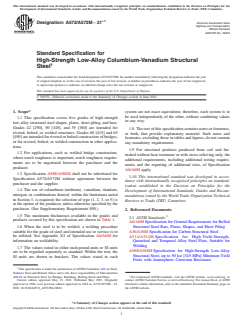
This specifiation covers the standard requirements for Grades 42 [290], 50 [345], 55 [380], 60 [415], and 65 [450] of high-strength low-alloy columbium-vanadium structural steel shapes, plates, sheet piling, and bars for applications in bolted, welded, and riveted structures in bridges and buildings. The alloy shall conform to the required contents of columbium, vanadium, titanium, and nitrogen. Permissible values for the product thickness and size is given. Tensile requirements (including yield point, tensile strength, and minimum elongation) and alloy content are also specified. General delivery and test report requirements are also cited.
SCOPE
1.1 This specification covers five grades of high-strength low-alloy structural steel shapes, plates, sheet piling, and bars. Grades 42 [290], 50 [345], and 55 [380] are intended for riveted, bolted, or welded structures. Grades 60 [415] and 65 [450] are intended for riveted or bolted construction of bridges, or for riveted, bolted, or welded construction in other applications.
1.2 For applications, such as welded bridge construction, where notch toughness is important, notch toughness requirements are to be negotiated between the purchaser and the producer.
1.3 Specification A588/A588M shall not be substituted for Specification A572/A572M without agreement between the purchaser and the supplier.
1.4 The use of columbium (niobium), vanadium, titanium, nitrogen, or combinations thereof, within the limitations noted in Section 5, is required; the selection of type (1, 2, 3, or 5) is at the option of the producer, unless otherwise specified by the purchaser. (See Supplementary Requirement S90.)
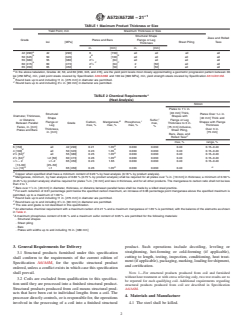
1.5 The maximum thicknesses available in the grades and products covered by this specification are shown in Table 1.
1.6 When the steel is to be welded, a welding procedure suitable for the grade of steel and intended use or service is to be utilized. See Appendix X3 of Specification A6/A6M for information on weldability.
1.7 The values stated in either inch-pound units or SI units are to be regarded separately as standard. Within the text, the SI units are shown in brackets. The values stated in each system are not exact equivalents; therefore, each system is to be used independently of the other, without combining values in any way.
1.8 The text of this specification contains notes or footnotes, or both, that provide explanatory material. Such notes and footnotes, excluding those in tables and figures, do not contain any mandatory requirements.
1.9 For structural products produced from coil and furnished without heat treatment or with stress relieving only, the additional requirements, including additional testing requirements and the reporting of additional tests, of Specification A6/A6M apply.
1.10 This international standard was developed in accordance with internationally recognized principles on standardization established in the Decision on Principles for the Development of International Standards, Guides and Recommendations issued by the World Trade Organization Technical Barriers to Trade (TBT) Committee.
- Status
- Published
- Publication Date
- 14-May-2021
- Technical Committee
- A01 - Steel, Stainless Steel and Related Alloys

Overview
ASTM A572/A572M-21e1 is the standard specification for high-strength, low-alloy columbium-vanadium structural steel. Developed by ASTM International, this standard defines the mechanical and chemical properties for five specific grades: 42 [290], 50 [345], 55 [380], 60 [415], and 65 [450]. These steel grades are widely used in the fabrication of shapes, plates, sheet piling, and bars for bolted, welded, and riveted construction in bridges, buildings, and other structural applications. The specification addresses requirements for both U.S. customary and SI units, ensuring practicality for global projects.
Key Topics
Scope of Grades: The standard covers five grades with increasing yield strengths, suitable for various structural applications:
- Grades 42 [290], 50 [345], and 55 [380] for riveted, bolted, or welded structures.
- Grades 60 [415] and 65 [450] primarily for bridge construction and higher-stress designs.
Material Composition: The steel must contain specific amounts of columbium (niobium), vanadium, titanium, and nitrogen or combinations thereof, as specified in Sections 5 and Table 3. These alloying elements improve strength and performance in critical applications.
Product Dimensions: Each grade includes limitations on maximum product thickness for plates, bars, and sheet piling (as detailed in Table 1), ensuring material suitability for both heavy and light structural members.
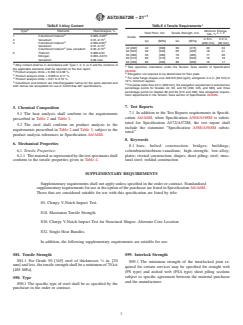
Mechanical Properties: The standard outlines minimum requirements for yield point, tensile strength, and elongation (per Table 4), ensuring consistency and safety in structural applications.
Weldability: When welding is required, ASTM A572/A572M mandates the use of weld procedures compatible with the grade and intended service environment, referring to Additional Guidelines in Specification A6/A6M.
Testing and Reporting: Products must conform to mandatory testing and certifications, including detailed chemical and mechanical analyses. Supplementary impact testing (Charpy V-notch) can be specified for applications where toughness is critical.
Applications
ASTM A572/A572M high-strength low-alloy steel is widely used in civil and structural engineering due to its combination of durability, strength, and weldability. Common applications include:
- Bridges: Used in load-bearing components such as girders, trusses, and piers, where high strength and toughness are essential.
- Buildings: Ideal for frames of commercial, industrial, and high-rise buildings, as it reduces weight while maintaining structural integrity.
- Sheet Piling: Utilized in retaining walls, foundations, and waterfront structures for their high strength-to-weight ratio and corrosion resistance.
- Bars and Plates: Suitable for components requiring precise mechanical performance, such as columns, cross-bracing, and support beams.
The flexibility across grades and product forms makes ASTM A572/A572M a preferred choice for structural steel projects demanding both reliability and cost-effectiveness.
Related Standards
- ASTM A36/A36M: Specification for carbon structural steel, often compared with A572 for general structural purposes.
- ASTM A6/A6M: General requirements for delivery, inspection, and testing of rolled structural steel products.
- ASTM A514/A514M: Covers quenched and tempered alloy steel plate, used in high-yield strength applications.
- ASTM A588/A588M: Specification for high-strength low-alloy steel with atmospheric corrosion resistance.
Conclusion
ASTM A572/A572M-21e1 sets the industry benchmark for high-strength low-alloy columbium-vanadium structural steel, balancing performance requirements with manufacturing flexibility. Its rigorous criteria for chemical composition, mechanical properties, and product dimensions ensure suitability for demanding structural applications in bridges, buildings, and infrastructure worldwide. This standard is vital for engineers, architects, fabricators, and project managers seeking reliable, compliant, and high-performing structural steel solutions.
Relations
- Effective Date
- 01-Mar-2024
- Effective Date
- 01-Nov-2023
- Effective Date
- 15-Nov-2018
- Effective Date
- 01-Nov-2017
- Effective Date
- 15-Nov-2016
- Effective Date
- 01-May-2016
- Effective Date
- 01-May-2014
- Effective Date
- 01-May-2014
- Effective Date
- 15-Oct-2013
- Effective Date
- 01-Oct-2013
- Effective Date
- 01-May-2013
- Effective Date
- 01-Nov-2012
- Effective Date
- 01-Nov-2012
- Effective Date
- 01-Mar-2012
- Effective Date
- 01-Apr-2011
Get Certified
Connect with accredited certification bodies for this standard

Element Materials Technology
Materials testing and product certification.

Inštitut za kovinske materiale in tehnologije
Institute of Metals and Technology. Materials testing, metallurgical analysis, NDT.
Sponsored listings
Frequently Asked Questions
ASTM A572/A572M-21e1 is a technical specification published by ASTM International. Its full title is "Standard Specification for High-Strength Low-Alloy Columbium-Vanadium Structural Steel". This standard covers: ABSTRACT This specifiation covers the standard requirements for Grades 42 [290], 50 [345], 55 [380], 60 [415], and 65 [450] of high-strength low-alloy columbium-vanadium structural steel shapes, plates, sheet piling, and bars for applications in bolted, welded, and riveted structures in bridges and buildings. The alloy shall conform to the required contents of columbium, vanadium, titanium, and nitrogen. Permissible values for the product thickness and size is given. Tensile requirements (including yield point, tensile strength, and minimum elongation) and alloy content are also specified. General delivery and test report requirements are also cited. SCOPE 1.1 This specification covers five grades of high-strength low-alloy structural steel shapes, plates, sheet piling, and bars. Grades 42 [290], 50 [345], and 55 [380] are intended for riveted, bolted, or welded structures. Grades 60 [415] and 65 [450] are intended for riveted or bolted construction of bridges, or for riveted, bolted, or welded construction in other applications. 1.2 For applications, such as welded bridge construction, where notch toughness is important, notch toughness requirements are to be negotiated between the purchaser and the producer. 1.3 Specification A588/A588M shall not be substituted for Specification A572/A572M without agreement between the purchaser and the supplier. 1.4 The use of columbium (niobium), vanadium, titanium, nitrogen, or combinations thereof, within the limitations noted in Section 5, is required; the selection of type (1, 2, 3, or 5) is at the option of the producer, unless otherwise specified by the purchaser. (See Supplementary Requirement S90.) 1.5 The maximum thicknesses available in the grades and products covered by this specification are shown in Table 1. 1.6 When the steel is to be welded, a welding procedure suitable for the grade of steel and intended use or service is to be utilized. See Appendix X3 of Specification A6/A6M for information on weldability. 1.7 The values stated in either inch-pound units or SI units are to be regarded separately as standard. Within the text, the SI units are shown in brackets. The values stated in each system are not exact equivalents; therefore, each system is to be used independently of the other, without combining values in any way. 1.8 The text of this specification contains notes or footnotes, or both, that provide explanatory material. Such notes and footnotes, excluding those in tables and figures, do not contain any mandatory requirements. 1.9 For structural products produced from coil and furnished without heat treatment or with stress relieving only, the additional requirements, including additional testing requirements and the reporting of additional tests, of Specification A6/A6M apply. 1.10 This international standard was developed in accordance with internationally recognized principles on standardization established in the Decision on Principles for the Development of International Standards, Guides and Recommendations issued by the World Trade Organization Technical Barriers to Trade (TBT) Committee.
ABSTRACT This specifiation covers the standard requirements for Grades 42 [290], 50 [345], 55 [380], 60 [415], and 65 [450] of high-strength low-alloy columbium-vanadium structural steel shapes, plates, sheet piling, and bars for applications in bolted, welded, and riveted structures in bridges and buildings. The alloy shall conform to the required contents of columbium, vanadium, titanium, and nitrogen. Permissible values for the product thickness and size is given. Tensile requirements (including yield point, tensile strength, and minimum elongation) and alloy content are also specified. General delivery and test report requirements are also cited. SCOPE 1.1 This specification covers five grades of high-strength low-alloy structural steel shapes, plates, sheet piling, and bars. Grades 42 [290], 50 [345], and 55 [380] are intended for riveted, bolted, or welded structures. Grades 60 [415] and 65 [450] are intended for riveted or bolted construction of bridges, or for riveted, bolted, or welded construction in other applications. 1.2 For applications, such as welded bridge construction, where notch toughness is important, notch toughness requirements are to be negotiated between the purchaser and the producer. 1.3 Specification A588/A588M shall not be substituted for Specification A572/A572M without agreement between the purchaser and the supplier. 1.4 The use of columbium (niobium), vanadium, titanium, nitrogen, or combinations thereof, within the limitations noted in Section 5, is required; the selection of type (1, 2, 3, or 5) is at the option of the producer, unless otherwise specified by the purchaser. (See Supplementary Requirement S90.) 1.5 The maximum thicknesses available in the grades and products covered by this specification are shown in Table 1. 1.6 When the steel is to be welded, a welding procedure suitable for the grade of steel and intended use or service is to be utilized. See Appendix X3 of Specification A6/A6M for information on weldability. 1.7 The values stated in either inch-pound units or SI units are to be regarded separately as standard. Within the text, the SI units are shown in brackets. The values stated in each system are not exact equivalents; therefore, each system is to be used independently of the other, without combining values in any way. 1.8 The text of this specification contains notes or footnotes, or both, that provide explanatory material. Such notes and footnotes, excluding those in tables and figures, do not contain any mandatory requirements. 1.9 For structural products produced from coil and furnished without heat treatment or with stress relieving only, the additional requirements, including additional testing requirements and the reporting of additional tests, of Specification A6/A6M apply. 1.10 This international standard was developed in accordance with internationally recognized principles on standardization established in the Decision on Principles for the Development of International Standards, Guides and Recommendations issued by the World Trade Organization Technical Barriers to Trade (TBT) Committee.
ASTM A572/A572M-21e1 is classified under the following ICS (International Classification for Standards) categories: 77.140.10 - Heat-treatable steels. The ICS classification helps identify the subject area and facilitates finding related standards.
ASTM A572/A572M-21e1 has the following relationships with other standards: It is inter standard links to ASTM A6/A6M-24, ASTM A6/A6M-23, ASTM A514/A514M-18, ASTM A6/A6M-17a, ASTM A6/A6M-16a, ASTM A6/A6M-16, ASTM A6/A6M-14, ASTM A514/A514M-14, ASTM A514/A514M-13, ASTM A6/A6M-13a, ASTM A6/A6M-13, ASTM A6/A6M-12a, ASTM A36/A36M-12, ASTM A6/A6M-12, ASTM A6/A6M-11. Understanding these relationships helps ensure you are using the most current and applicable version of the standard.
ASTM A572/A572M-21e1 is available in PDF format for immediate download after purchase. The document can be added to your cart and obtained through the secure checkout process. Digital delivery ensures instant access to the complete standard document.
Standards Content (Sample)
This international standard was developed in accordance with internationally recognized principles on standardization established in the Decision on Principles for the
Development of International Standards, Guides and Recommendations issued by the World Trade Organization Technical Barriers to Trade (TBT) Committee.
´1
Designation:A572/A572M −21 American Association State
Highway and Transportation
Officals Standard
AASHTO No.: M223
Standard Specification for
High-Strength Low-Alloy Columbium-Vanadium Structural
Steel
This standard is issued under the fixed designationA572/A572M; the number immediately following the designation indicates the year
of original adoption or, in the case of revision, the year of last revision. A number in parentheses indicates the year of last reapproval.
A superscript epsilon (´) indicates an editorial change since the last revision or reapproval.
This standard has been approved for use by agencies of the U.S. Department of Defense.
ε NOTE—Editorial corrections made to the Summary of Changes section in June 2021.
1. Scope* system are not exact equivalents; therefore, each system is to
be used independently of the other, without combining values
1.1 This specification covers five grades of high-strength
in any way.
low-alloy structural steel shapes, plates, sheet piling, and bars.
Grades 42 [290], 50 [345], and 55 [380] are intended for
1.8 Thetextofthisspecificationcontainsnotesorfootnotes,
riveted, bolted, or welded structures. Grades 60 [415] and 65
or both, that provide explanatory material. Such notes and
[450] are intended for riveted or bolted construction of bridges,
footnotes, excluding those in tables and figures, do not contain
or for riveted, bolted, or welded construction in other applica-
any mandatory requirements.
tions.
1.9 For structural products produced from coil and fur-
1.2 For applications, such as welded bridge construction,
nished without heat treatment or with stress relieving only, the
where notch toughness is important, notch toughness require-
additional requirements, including additional testing require-
ments are to be negotiated between the purchaser and the
ments and the reporting of additional tests, of Specification
producer.
A6/A6M apply.
1.3 Specification A588/A588M shall not be substituted for
1.10 This international standard was developed in accor-
Specification A572/A572M without agreement between the
dance with internationally recognized principles on standard-
purchaser and the supplier.
ization established in the Decision on Principles for the
1.4 The use of columbium (niobium), vanadium, titanium,
Development of International Standards, Guides and Recom-
nitrogen, or combinations thereof, within the limitations noted
mendations issued by the World Trade Organization Technical
in Section 5, is required; the selection of type (1, 2, 3, or 5) is
Barriers to Trade (TBT) Committee.
at the option of the producer, unless otherwise specified by the
purchaser. (See Supplementary Requirement S90.)
2. Referenced Documents
1.5 The maximum thicknesses available in the grades and
2.1 ASTM Standards:
products covered by this specification are shown in Table 1.
A6/A6M Specification for General Requirements for Rolled
1.6 When the steel is to be welded, a welding procedure
Structural Steel Bars, Plates, Shapes, and Sheet Piling
suitable for the grade of steel and intended use or service is to A36/A36M Specification for Carbon Structural Steel
be utilized. See Appendix X3 of Specification A6/A6M for
A514/A514M Specification for High-Yield-Strength,
information on weldability. Quenched and Tempered Alloy Steel Plate, Suitable for
Welding
1.7 The values stated in either inch-pound units or SI units
A588/A588M Specification for High-Strength Low-Alloy
are to be regarded separately as standard. Within the text, the
Structural Steel, up to 50 ksi [345 MPa] Minimum Yield
SI units are shown in brackets. The values stated in each
Point, with Atmospheric Corrosion Resistance
This specification is under the jurisdiction of ASTM Committee A01 on Steel,
Stainless Steel and Related Alloys and is the direct responsibility of Subcommittee
A01.02 on Structural Steel for Bridges, Buildings, Rolling Stock and Ships. For referenced ASTM standards, visit the ASTM website, www.astm.org, or
Current edition approved May 15, 2021. Published May 2021. Originally contact ASTM Customer Service at service@astm.org. For Annual Book of ASTM
approved in 1966. Last previous edition approved in 2018 as A572/A572M – 18. Standards volume information, refer to the standard’s Document Summary page on
DOI: 10.1520/A0572_A0572M-21E01. the ASTM website.
*A Summary of Changes section appears at the end of this standard
Copyright © ASTM International, 100 Barr Harbor Drive, PO Box C700, West Conshohocken, PA 19428-2959. United States
´1
A572/A572M−21
TABLE 1 Maximum Product Thickness or Size
Yield Point, min Maximum Thickness or Size
Structural Shape
Zees and Rolled
Grade Plates and Bars Flange or Leg
Tees
ksi [MPa] Sheet Piling
Thickness
in. [mm] in. [mm]
A
42 [290] 42 [290] 6 [150] all all all all
A B B
50 [345] 50 [345] 4 [100] all all all all
55 [380] 55 [380] 2 ⁄2 [64] all all all all
A C C
60 [415] 60 [415] 2 ⁄2 [64] 2 [50] all all
65 [450] 65 [450] 2 [50] 2 [50] all all
A
In the above tabulation, Grades 42, 50, and 60 [290, 345, and 415], are the yield point levels most closely approximating a geometric progression pattern between 36
ksi [250 MPa], min, yield point steels covered by Specification A36/A36M and 100 ksi [690 MPa], min, yield strength steels covered by Specification A514/A514M.
B
Round bars up to and including 11 in. [275 mm] in diameter are permitted.
C
Round bars up to and including 3 ⁄2 in. [90 mm] in diameter are permitted.
A
TABLE 2 Chemical Requirements
(Heat Analysis)
Silicon
Plates to 1 ⁄2 in.
[40 mm] Thick,
Structural Plates Over 1 ⁄2 in.
Diameter, Thickness,
Shapes with
Shape [40 mm] Thick and
I
or Distance Flange or Leg
Sulfur,
B I
Flange or Carbon, Shapes with Flange
Manganese, Phosphorus,
Between Parallel Grade max, Thickness to 3 in.
max, % max, %
Leg max, % Thickness
%
Faces, in. [mm] [75 mm] inclusive,
Thickness, Over 3 in.
Plates and Bars Sheet Piling,
in. [mm] [75 mm]
Bars, Zees, and
C
Rolled Tees
max, % range, %
D
6 [150] all 42 [290] 0.21 1.35 0.030 0.030 0.40 0.15–0.40
E D
4 [100] all 50 [345] 0.23 1.35 0.030 0.030 0.40 0.15–0.40
F D
2 ⁄2 [64] all 55 [380] 0.25 1.35 0.030 0.030 0.40 0.15–0.40
F D
2 ⁄2 [64] #2 [50] 60 [415] 0.26 1.35 0.030 0.030 0.40 0.15–0.40
> ⁄2–2 >1–2 65 [450] 0.23 1.65 0.030 0.030 0.40 0.15–0.40
[13–50] [25–50]
H D G
# ⁄2 [13] #1 65 [450] 0.26 1.35 0.030 0.030 0.40
A
Copper when specified shall have a minimum content of 0.20 % by heat analysis (0.18 % by product analysis).
B
Manganese, minimum, by heat analysis of 0.80 % (0.75 % by product analysis) shall be required for all plates over ⁄8 in. [10 mm] in thickness; a minimum of 0.50 %
(0.45 % by product analysis) shall be required for plates ⁄8 in. [10 mm] and less in thickness, and for all other products. The manganese to carbon ratio shall not be less
than2to1.
C
Bars over 1 ⁄2 in. [40 mm] in diameter, thickness, or distance between parallel faces shall be made by a killed steel practice.
D
For each reduction of 0.01 percentage point below the specified carbon maximum, an increase of 0.06 percentage point manganese above the specified maximum is
permitted, up to a maximum of 1.60 %.
E
Round bars up to and including 11 in. [275 mm] in diameter are permitted.
F 1
Round bars up to and including 3 ⁄2 in. [90 mm] in diameter are permitted.
G
The size and grade is not described in this specification.
H
An alternative chemical requirement with a maximum carbon of 0.21 % and a maximum manganese of 1
...