

ASTM D3550/D3550M-17
(Practice)Standard Practice for Thick Wall, Ring-Lined, Split Barrel, Drive Sampling of Soils
General Information
- Abstract
SIGNIFICANCE AND USE
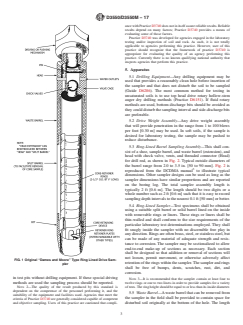
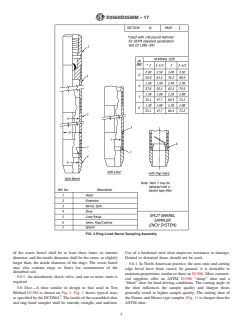
4.1 The thick-wall ring lined drive sampler has been used for over 50 years in the arid southwest regions of the U.S. where unsaturated soils are too difficult to sample using the thin-walled tube (Practice D1587). Variations of the sampler include names such as “Dames and Moore, California, Modified California barrels” with outside barrel diameters ranging from 2.5 to 3.5 in. [60-90 mm].4 In addition to the blow count, these drive samplers have the added benefit of having a ring lined specimens that can be evaluated in the laboratory. Versions of the original Dames and Moore type sampler shown in Fig. 1 are still used, but many now use the Diamond Drill Core Manufacturers Association (DCDMA)5 specification split barrel drive samplers Fig. 2. The ring lined samplers normally have provisions for a 6-in. [150 mm] waste barrel with or without rings in the top section of the barrel. Drilling in the unsaturated soils is performed almost exclusively with hollow-stem augers (Practice D6151) because it is a dry drilling method. The test can be performed in fluid rotary or other drill holes but use of fluid rotary methods are not recommended in unsaturated soils as the drill fluid may alter the sample properties. Most operators use a 140 lb [75 kg] hammer mass but other hammer masses may be used.Practice D3740 was developed for agencies engaged in the laboratory testing and/or inspection of soil and rock. As such, it is not totally applicable to agencies performing this practice. However, user of this practice should recognize that the framework of practice D3740 is appropriate for evaluating the quality of an agency performing this practice. Currently there is no known qualifying national authority that inspects agencies that perform this practice.
SCOPE
1.1 This practice covers procedure for thick wall, split barrel drive sampling of soil to obtain representative samples of soil for classification and laboratory testing. The sampler is considered to be a thick wall sampler with sharpened cutting shoe and ball check vent. The middle barrel section is split barrel design containing ring liners. The sampler is often driven, but can also be pushed in softer deposits. Penetration resistance data may be recorded. This standard uses procedures similar to Test Method D1586 on Penetration Resistance and Split Barrel Sampling of Soils. However, in this practice, differing hammer weights, drop heights, and different size samplers are used, so the data must not be reported as conforming to Test Method D1586 and cannot be used to determine Normalized penetration resistance data for sands in accordance with Practice D6066.
1.2 This practice involves use of rotary drilling equipment (Guide D5783, Practice D6151). Other drilling and sampling procedures (Guide D6286, Guide D6169) are available and may be more appropriate. Considerations for hand driving or shallow sampling without boreholes are not addressed. Subsurface explorations should be recorded in accordance with Guide D5434. Soil samples should be classified in accordance with Practice D2488.
1.3 The soil samples from this test will have some degree of disturbance because the sampler is a driven thick walled sample tube. Table 2 of Guide D6169 on Soil and Rock Sampling provides guidance for selection of soil samplers for samples that may require intact samples defined by Terminology D653 for laboratory testing. The degree of disturbance must be evaluated by the user (engineer) to determine the suitability of the sample for use in laboratory tests. If samples are not suitable for laboratory testing, other soil samplers should be used (see 4.4.1).
1.4 The values stated in either inch-pound units or SI units [presented in brackets] are to be regarded separately as standard. The values stated in each system may not be exact equivalents; therefore, each system shall be used independently of the other. Combining values from the two systems may result in ...
- Status
- Published
- Publication Date
- 31-Mar-2017
- Technical Committee
- D18 - Soil and Rock
- Drafting Committee
- D18.02 - Sampling and Related Field Testing for Soil Evaluations
Overview
ASTM D3550/D3550M-17: Standard Practice for Thick Wall, Ring-Lined, Split Barrel, Drive Sampling of Soils provides standardized procedures for obtaining representative soil samples using a thick-wall, split barrel sampler equipped with ring liners. This practice is primarily used in geotechnical investigations, particularly in regions with unsaturated or difficult-to-sample soils where thin-walled tube methods are inadequate.
Developed by ASTM Committee D18, this standard is essential for professionals seeking reliable sample collection for soil classification and laboratory testing. It addresses not only the procedures for sampling but also the necessary equipment, quality controls, and documentation requirements to ensure samples are suitable for engineering and environmental analysis.
Key Topics
Sampling Equipment
- Thick-wall, split barrel samplers with ring liners
- Drilling methods, especially hollow-stem augers for dry sampling in unsaturated soils
- Use of drive weight assemblies (hammers) and accessories such as check valves and retainers
Sampling Procedures
- Guidelines for preparing sampling sites to minimize soil disturbance
- Steps for driving or pushing the sampler and recording penetration resistance data
- Techniques for extracting, handling, and trimming soil samples to preserve their integrity
Sample Quality and Suitability
- Importance of evaluating sample disturbance when using thick-walled samplers
- Criteria for determining if samples are appropriate for laboratory testing
- Recommendations for alternate sampling methods if higher quality or less disturbed samples are required
Reporting and Documentation
- Standardized recording of drilling and sampling data, including depths, soil description, equipment used, and any laboratory results
- Requirements for labeling, preserving, and transporting samples
- Adherence to safety practices and regulatory guidelines
Applications
ASTM D3550/D3550M-17 is widely applied in geotechnical site investigations, foundation engineering, and environmental site assessments. Its primary uses include:
Soil Classification and Laboratory Testing
Obtain samples for physical property tests such as water content, particle size, and Atterberg limits.Engineering Design
Gather data required for foundation design, slope stability analysis, and assessing soil compaction and consolidation characteristics.Construction Quality Control
Monitor subsurface conditions and verify soil parameters during construction activities.Environmental Investigations
Collect soil samples for contamination analysis, especially when intact or minimally disturbed samples are essential.
The standard is particularly valuable in arid or semi-arid regions where unsaturated soils challenge other sampling methods, such as the thin-walled tube technique.
Related Standards
ASTM D3550/D3550M-17 is used in conjunction with several related ASTM standards. Key references include:
- ASTM D1586: Standard Penetration Test (SPT) and Split-Barrel Sampling of Soils
- ASTM D1587: Thin-Walled Tube Sampling of Fine-Grained Soils
- ASTM D2488: Standard Practice for Description and Identification of Soils (Visual-Manual Procedures)
- ASTM D6151: Using Hollow-Stem Augers for Geotechnical Exploration and Soil Sampling
- ASTM D5434: Guide for Field Logging of Subsurface Explorations of Soil and Rock
- ASTM D6169: Guide for Selection of Soil and Rock Sampling Devices Used With Drill Rigs
Each of these standards provides complementary guidance on soil sampling, classification, field logging, and testing to ensure comprehensive geotechnical and environmental site characterization.
Keywords: ASTM D3550, split barrel sampler, ring-lined soil sampling, thick-wall drive sampling, geotechnical soil sampling, soil classification, ASTM soils standards, hollow-stem auger, penetration resistance, laboratory testing of soils
Relations
- Effective Date
- 01-Apr-2017
- Effective Date
- 01-Nov-2023
- Effective Date
- 01-Oct-2019
- Effective Date
- 01-Oct-2019
- Effective Date
- 01-Mar-2019
- Effective Date
- 01-Jan-2018
- Effective Date
- 15-Dec-2017
- Effective Date
- 15-Dec-2017
- Effective Date
- 15-Jul-2017
- Effective Date
- 01-Aug-2014
- Effective Date
- 01-Mar-2014
- Effective Date
- 01-Sep-2012
- Effective Date
- 01-Sep-2012
- Effective Date
- 15-May-2012
- Effective Date
- 01-May-2012
Get Certified
Connect with accredited certification bodies for this standard

Zavod za gradbeništvo Slovenije (ZAG) - Inšpekcija
ZAG inspection body for construction products, structures, and materials.
Sponsored listings
Frequently Asked Questions
ASTM D3550/D3550M-17 is a standard published by ASTM International. Its full title is "Standard Practice for Thick Wall, Ring-Lined, Split Barrel, Drive Sampling of Soils". This standard covers: SIGNIFICANCE AND USE 4.1 The thick-wall ring lined drive sampler has been used for over 50 years in the arid southwest regions of the U.S. where unsaturated soils are too difficult to sample using the thin-walled tube (Practice D1587). Variations of the sampler include names such as “Dames and Moore, California, Modified California barrels” with outside barrel diameters ranging from 2.5 to 3.5 in. [60-90 mm].4 In addition to the blow count, these drive samplers have the added benefit of having a ring lined specimens that can be evaluated in the laboratory. Versions of the original Dames and Moore type sampler shown in Fig. 1 are still used, but many now use the Diamond Drill Core Manufacturers Association (DCDMA)5 specification split barrel drive samplers Fig. 2. The ring lined samplers normally have provisions for a 6-in. [150 mm] waste barrel with or without rings in the top section of the barrel. Drilling in the unsaturated soils is performed almost exclusively with hollow-stem augers (Practice D6151) because it is a dry drilling method. The test can be performed in fluid rotary or other drill holes but use of fluid rotary methods are not recommended in unsaturated soils as the drill fluid may alter the sample properties. Most operators use a 140 lb [75 kg] hammer mass but other hammer masses may be used.Practice D3740 was developed for agencies engaged in the laboratory testing and/or inspection of soil and rock. As such, it is not totally applicable to agencies performing this practice. However, user of this practice should recognize that the framework of practice D3740 is appropriate for evaluating the quality of an agency performing this practice. Currently there is no known qualifying national authority that inspects agencies that perform this practice. SCOPE 1.1 This practice covers procedure for thick wall, split barrel drive sampling of soil to obtain representative samples of soil for classification and laboratory testing. The sampler is considered to be a thick wall sampler with sharpened cutting shoe and ball check vent. The middle barrel section is split barrel design containing ring liners. The sampler is often driven, but can also be pushed in softer deposits. Penetration resistance data may be recorded. This standard uses procedures similar to Test Method D1586 on Penetration Resistance and Split Barrel Sampling of Soils. However, in this practice, differing hammer weights, drop heights, and different size samplers are used, so the data must not be reported as conforming to Test Method D1586 and cannot be used to determine Normalized penetration resistance data for sands in accordance with Practice D6066. 1.2 This practice involves use of rotary drilling equipment (Guide D5783, Practice D6151). Other drilling and sampling procedures (Guide D6286, Guide D6169) are available and may be more appropriate. Considerations for hand driving or shallow sampling without boreholes are not addressed. Subsurface explorations should be recorded in accordance with Guide D5434. Soil samples should be classified in accordance with Practice D2488. 1.3 The soil samples from this test will have some degree of disturbance because the sampler is a driven thick walled sample tube. Table 2 of Guide D6169 on Soil and Rock Sampling provides guidance for selection of soil samplers for samples that may require intact samples defined by Terminology D653 for laboratory testing. The degree of disturbance must be evaluated by the user (engineer) to determine the suitability of the sample for use in laboratory tests. If samples are not suitable for laboratory testing, other soil samplers should be used (see 4.4.1). 1.4 The values stated in either inch-pound units or SI units [presented in brackets] are to be regarded separately as standard. The values stated in each system may not be exact equivalents; therefore, each system shall be used independently of the other. Combining values from the two systems may result in ...
SIGNIFICANCE AND USE 4.1 The thick-wall ring lined drive sampler has been used for over 50 years in the arid southwest regions of the U.S. where unsaturated soils are too difficult to sample using the thin-walled tube (Practice D1587). Variations of the sampler include names such as “Dames and Moore, California, Modified California barrels” with outside barrel diameters ranging from 2.5 to 3.5 in. [60-90 mm].4 In addition to the blow count, these drive samplers have the added benefit of having a ring lined specimens that can be evaluated in the laboratory. Versions of the original Dames and Moore type sampler shown in Fig. 1 are still used, but many now use the Diamond Drill Core Manufacturers Association (DCDMA)5 specification split barrel drive samplers Fig. 2. The ring lined samplers normally have provisions for a 6-in. [150 mm] waste barrel with or without rings in the top section of the barrel. Drilling in the unsaturated soils is performed almost exclusively with hollow-stem augers (Practice D6151) because it is a dry drilling method. The test can be performed in fluid rotary or other drill holes but use of fluid rotary methods are not recommended in unsaturated soils as the drill fluid may alter the sample properties. Most operators use a 140 lb [75 kg] hammer mass but other hammer masses may be used.Practice D3740 was developed for agencies engaged in the laboratory testing and/or inspection of soil and rock. As such, it is not totally applicable to agencies performing this practice. However, user of this practice should recognize that the framework of practice D3740 is appropriate for evaluating the quality of an agency performing this practice. Currently there is no known qualifying national authority that inspects agencies that perform this practice. SCOPE 1.1 This practice covers procedure for thick wall, split barrel drive sampling of soil to obtain representative samples of soil for classification and laboratory testing. The sampler is considered to be a thick wall sampler with sharpened cutting shoe and ball check vent. The middle barrel section is split barrel design containing ring liners. The sampler is often driven, but can also be pushed in softer deposits. Penetration resistance data may be recorded. This standard uses procedures similar to Test Method D1586 on Penetration Resistance and Split Barrel Sampling of Soils. However, in this practice, differing hammer weights, drop heights, and different size samplers are used, so the data must not be reported as conforming to Test Method D1586 and cannot be used to determine Normalized penetration resistance data for sands in accordance with Practice D6066. 1.2 This practice involves use of rotary drilling equipment (Guide D5783, Practice D6151). Other drilling and sampling procedures (Guide D6286, Guide D6169) are available and may be more appropriate. Considerations for hand driving or shallow sampling without boreholes are not addressed. Subsurface explorations should be recorded in accordance with Guide D5434. Soil samples should be classified in accordance with Practice D2488. 1.3 The soil samples from this test will have some degree of disturbance because the sampler is a driven thick walled sample tube. Table 2 of Guide D6169 on Soil and Rock Sampling provides guidance for selection of soil samplers for samples that may require intact samples defined by Terminology D653 for laboratory testing. The degree of disturbance must be evaluated by the user (engineer) to determine the suitability of the sample for use in laboratory tests. If samples are not suitable for laboratory testing, other soil samplers should be used (see 4.4.1). 1.4 The values stated in either inch-pound units or SI units [presented in brackets] are to be regarded separately as standard. The values stated in each system may not be exact equivalents; therefore, each system shall be used independently of the other. Combining values from the two systems may result in ...
ASTM D3550/D3550M-17 is classified under the following ICS (International Classification for Standards) categories: 93.020 - Earthworks. Excavations. Foundation construction. Underground works. The ICS classification helps identify the subject area and facilitates finding related standards.
ASTM D3550/D3550M-17 has the following relationships with other standards: It is inter standard links to ASTM D3550-01(2007), ASTM D3740-23, ASTM D3740-19, ASTM D6286-19, ASTM D2216-19, ASTM D5783-18, ASTM D2487-17, ASTM D2487-17e1, ASTM D2488-17, ASTM D653-14, ASTM D4546-14, ASTM D5783-95(2012), ASTM D6286-12, ASTM D1587-08(2012)e1, ASTM D3740-12a. Understanding these relationships helps ensure you are using the most current and applicable version of the standard.
ASTM D3550/D3550M-17 is available in PDF format for immediate download after purchase. The document can be added to your cart and obtained through the secure checkout process. Digital delivery ensures instant access to the complete standard document.
Standards Content (Sample)
This international standard was developed in accordance with internationally recognized principles on standardization established in the Decision on Principles for the
Development of International Standards, Guides and Recommendations issued by the World Trade Organization Technical Barriers to Trade (TBT) Committee.
Designation: D3550/D3550M − 17
Standard Practice for
Thick Wall, Ring-Lined, Split Barrel, Drive Sampling of
Soils
This standard is issued under the fixed designation D3550/D3550M; the number immediately following the designation indicates the
year of original adoption or, in the case of revision, the year of last revision. A number in parentheses indicates the year of last
reapproval. A superscript epsilon (´) indicates an editorial change since the last revision or reapproval.
1. Scope* 1.4 The values stated in either inch-pound units or SI units
[presented in brackets] are to be regarded separately as
1.1 Thispracticecoversprocedureforthickwall,splitbarrel
standard. The values stated in each system may not be exact
drive sampling of soil to obtain representative samples of soil
equivalents;therefore,eachsystemshallbeusedindependently
for classification and laboratory testing. The sampler is con-
of the other. Combining values from the two systems may
sidered to be a thick wall sampler with sharpened cutting shoe
result in non-conformance with the standard
and ball check vent. The middle barrel section is split barrel
design containing ring liners. The sampler is often driven, but
1.5 All observed and calculated values shall conform to the
can also be pushed in softer deposits. Penetration resistance
guidelines for significant digits and rounding established in
data may be recorded. This standard uses procedures similar to
Practice D6026, unless superseded by this standard.
Test Method D1586 on Penetration Resistance and Split Barrel
1.6 This practice offers an organized collection of informa-
Sampling of Soils. However, in this practice, differing hammer
tion or a series of options and does not recommend a specific
weights, drop heights, and different size samplers are used, so
course of action. This document cannot replace education or
the data must not be reported as conforming to Test Method
experienceandshouldbeusedinconjunctionwithprofessional
D1586 and cannot be used to determine Normalized penetra-
judgement.Notallaspectsofthispracticemaybeapplicablein
tion resistance data for sands in accordance with Practice
all circumstances. This ASTM standard is not intended to
D6066.
represent or replace the standard of care by which the
1.2 This practice involves use of rotary drilling equipment
adequacy of a given professional service must be judged, nor
(Guide D5783, Practice D6151). Other drilling and sampling
should this document be applied without consideration of a
procedures (Guide D6286, Guide D6169) are available and
project’s many unique aspects. The word “Standard” in the
may be more appropriate. Considerations for hand driving or
title of this document means only that the document has been
shallow sampling without boreholes are not addressed. Sub-
approved through the ASTM consensus process.
surface explorations should be recorded in accordance with
1.6.1 This practice does not purport to comprehensively
Guide D5434. Soil samples should be classified in accordance
address all of the methods and the issues associated with soil
with Practice D2488.
sampling. Users should seek qualified professionals for the
1.3 The soil samples from this test will have some degree of
decisions as to the proper equipment and methods that would
disturbance because the sampler is a driven thick walled
be most successful for their site exploration. Other methods
sample tube. Table 2 of Guide D6169 on Soil and Rock
may be available for monitoring soil sampling and qualified
Sampling provides guidance for selection of soil samplers for
professionals should have flexibility to exercise judgement as
samples that may require intact samples defined by Terminol-
to possible alternatives not covered in this practice.
ogy D653 for laboratory testing. The degree of disturbance
1.7 This standard does not purport to address all of the
must be evaluated by the user (engineer) to determine the
safety concerns, if any, associated with its use. It is the
suitability of the sample for use in laboratory tests. If samples
responsibility of the user of this standard to establish appro-
are not suitable for laboratory testing, other soil samplers
priate safety and health practices. The user must comply with
should be used (see 4.4.1).
prevalent regulatory codes, such as OSHA (Occupational
Health and Safety Administration) guidelines while using this
practice. For good safety practice, consult applicable OSHA
This practice is under the jurisdiction of ASTM Committee D18 on Soil and
regulations and other safety guides on drilling.
Rock and is the direct responsibility of Subcommittee D18.02 on Sampling and
Related Field Testing for Soil Evaluations.
Current edition approved April 1, 2017. Published April 2017. Originally
approved in 1977. Last previous edition approved in 2007 as D3550 – 01(2007),
which was withdrawn January 2016 and reinstated in April 2017. DOI: 10.1520/ Drilling Safety Guide, National Drilling Association, 6089 Frantz Rd. Suite
D3550_D3550M-17. 101, Dublin, Ohio, 43017.
*A Summary of Changes section appears at the end of this standard
Copyright © ASTM International, 100 Barr Harbor Drive, PO Box C700, West Conshohocken, PA 19428-2959. United States
D3550/D3550M − 17
1.8 This international standard was developed in accor- where unsaturated soils are too difficult to sample using the
dance with internationally recognized principles on standard- thin-walled tube (Practice D1587). Variations of the sampler
ization established in the Decision on Principles for the include names such as “Dames and Moore, California, Modi-
Development of International Standards, Guides and Recom- fied California barrels” with outside barrel diameters ranging
mendations issued by the World Trade Organization Technical from 2.5 to 3.5 in. [60-90 mm]. In addition to the blow count,
Barriers to Trade (TBT) Committee. these drive samplers have the added benefit of having a ring
lined specimens that can be evaluated in the laboratory.
2. Referenced Documents
Versions of the original Dames and Moore type sampler shown
2.1 ASTM Standards:
in Fig. 1 are still used, but many now use the Diamond Drill
D653 Terminology Relating to Soil, Rock, and Contained
Core ManufacturersAssociation (DCDMA) specification split
Fluids
barrel drive samplers Fig. 2. The ring lined samplers normally
D1586 Test Method for Standard PenetrationTest (SPT) and
have provisions for a 6-in. [150 mm] waste barrel with or
Split-Barrel Sampling of Soils
without rings in the top section of the barrel. Drilling in the
D1587 Practice for Thin-Walled Tube Sampling of Fine-
unsaturated soils is performed almost exclusively with hollow-
Grained Soils for Geotechnical Purposes
stem augers (Practice D6151) because it is a dry drilling
D2216 Test Methods for Laboratory Determination of Water
method. The test can be performed in fluid rotary or other drill
(Moisture) Content of Soil and Rock by Mass
holes but use of fluid rotary methods are not recommended in
D2487 Practice for Classification of Soils for Engineering
unsaturated soils as the drill fluid may alter the sample
Purposes (Unified Soil Classification System)
properties. Most operators use a 140 lb [75 kg] hammer mass
D2488 Practice for Description and Identification of Soils
but other hammer masses may be used.
(Visual-Manual Procedures)
4.2 This practice is used for general soil explorations where
D3740 Practice for Minimum Requirements for Agencies
samples are required for identification and testing. Disturbed
Engaged in Testing and/or Inspection of Soil and Rock as
samples can be classified in accordance with Practice D2487
Used in Engineering Design and Construction
and can be tested for water content, particle size, andAtterberg
D4220 Practices for Preserving and Transporting Soil
limits.
Samples
4.3 The sampler can be driven with a hammer and the
D4546 Test Methods for One-Dimensional Swell or Col-
penetration resistance can be recorded. Numerous combina-
lapse of Soils
tions of hammer size and drop height have been used in
D5434 Guide for Field Logging of Subsurface Explorations
practice. Hammer size and drop height should be reported.
of Soil and Rock
Users of this practice have derived local correlations of
D5783 Guide for Use of Direct Rotary Drilling with Water-
penetration resistance and engineering properties based on
Based Drilling Fluid for Geoenvironmental Exploration
local conditions and a particular hammer system and sampler,
and the Installation of Subsurface Water-Quality Monitor-
however, the penetration resistance may differ from Test
ing Devices
Method D1586.
D6026 Practice for Using Significant Digits in Geotechnical
Data
4.4 The sampler can be equipped with stacked ring liners,
D6066 Practice for Determining the Normalized Penetration
which can be used directly for other laboratory tests. The lab
Resistance of Sands for Evaluation of Liquefaction Poten-
tests are combined with the penetration resistance data, for
tial
estimates of soil engineering properties based on engineering
D6151 Practice for Using Hollow-StemAugers for Geotech-
experience.
nical Exploration and Soil Sampling
NOTE1—Themostcommonlabtestsareonedimensionalconsolidation
D6169 Guide for Selection of Soil and Rock Sampling
or swell or collapse with wetting, determination of trimmed density, and
Devices Used With Drill Rigs for Environmental Investi-
direct shear testing.
gations
4.4.1 The engineer in charge of the exploration is respon-
D6286 Guide for Selection of Drilling Methods for Environ-
sible for evaluating the suitability of the samples for lab
mental Site Characterization
testing, evaluating the test result data quality, and for how and
3. Terminology
what data are to be used in design. If the samples and test
results are not suitable, the user should specify other methods
3.1 Definitions:
to obtain soil samples such Thin-wall Tubes (Practice D1587)
3.1.1 Forcommondefinitionsoftermsinthisstandard,refer
for soft soils or rotary soil core barrels (Guide D6169)or
to Terminology D653.
hollow-stem auger soil cores (Practice D6151) for harder soils.
4. Significance and Use
4.5 This standard addresses sampling in drill holes with
4.1 The thick-wall ring lined drive sampler has been used
drilling equipment. The sampler can be hand driven or driven
for over 50 years in the arid southwest regions of the U.S.
3 4
For referenced ASTM standards, visit the ASTM website, www.astm.org, or Problems and Some Solutions in Geotechnical Sampling, H.E. Davis, http://
contact ASTM Customer Service at service@astm.org. For Annual Book of ASTM www.quest-ech.biz/Pages/Geotechnical%20Sampling.htm
Standards volume information, refer to the standard’s Document Summary page on DCDMA Technical Manual, National Drilling Association, 6089 Frantz Rd.
the ASTM website. Suite 101, Dublin, Ohio 43017, 1991.
D3550/D3550M − 17
ancewithPracticeD3740doesnotinitselfassurereliableresults.Reliable
results depend on many factors; Practice D3740 provides a means of
evaluating some of those factors.
Practice D3740 was developed for agencies engaged in the laboratory
testing and/or inspection of soil and rock. As such, it is not totally
applicable to agencies performing this practice. However, user of this
practice should recognize that the framework of practice D3740 is
appropriate for evaluating the quality of an agency performing this
practice. Currently there is no known qualifying national authority that
inspects agencies that perform this practice.
5. Apparatus
5.1 Drilling Equipment—Any drilling equipment may be
used that provides a reasonably clean hole before insertion of
the sampler and that does not disturb the soil to be sampled
(Guide D6286). The most common method for testing in
unsaturated soils is to use top head drive rotary hollow-stem
auger dry drilling methods (Practice D6151). If fluid rotary
methods are used, bottom discharge bits should be avoided as
theycoulddisturbthesamplingintervalandside-dischargebits
are preferable.
5.2 Drive Weight Assembly—Any drive weight assembly
that will provide penetration in the range from 1 to 100 blows
per foot [0.30 m] may be used. In soft soils, if the sample is
desired for laboratory testing, the sample may be pushed to
reduce disturbance.
5.3 Ring-Lined Barrel Sampling Assembly—This shall con-
sist of a shoe, sample barrel, and waste barrel (extension), and
head with check valve, vents, and threaded connector (Head)
for drill rod, as shown in Fig. 2. Typical outside diameters of
the barrel range from 2.0 to 3.5 in. [50 to 90 mm]. Fig. 2 is
reproduced from the DCDMA manual to illustrate typical
dimensions. Other sampler designs can be used as long as the
sampler dimensions have similar proportions and are reported
on the boring log. The total sampler assembly length is
typically 2 ft [0.6 m]. The length should be two digits or a
whole number such as 2 ft [0.6 m] such that it is easy to record
sampling depth intervals to the nearest 0.1 ft [50 mm] or better.
5.4 Ring-Lined Sampler—Test specimens shall be obtained
using a suitable split barrel or solid barrel lined on the inside
with removable rings or liners. These rings or li
...