

ASTM E935-21
(Test Method)Standard Test Methods for Performance of Permanent Metal Railing Systems and Rails for Buildings
General Information
- Abstract
SIGNIFICANCE AND USE
4.1 These test methods are intended to provide information from which applicable design and performance data can be derived for the performance of metal railing systems and rails installed and fastened to structural elements of concrete, masonry, wood, and metal as well as related products.
4.2 These test methods may be used to determine whether railing systems comply with requirements of the applicable performance specifications.
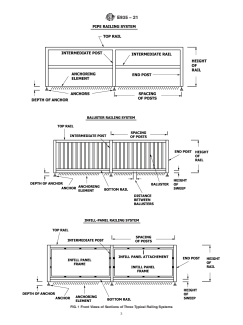
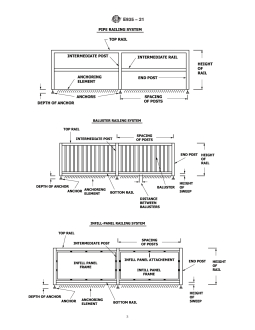
4.3 These test methods are intended for use in the buying and selling of railing systems and components according to performance specifications, for use in product development research, for use in quality assurance and manufacturing process control, for use in developing performance standards, and for use in field and laboratory compliance determination. Typical floor-mounted railings are shown in Fig. 1.
FIG. 1 Front Views of Sections of Three Typical Railing Systems
SCOPE
1.1 These test methods cover procedures to be followed in testing the performance of permanent metal railing systems (guard, stair, and ramp-rail systems), including components such as rails (hand, wall, grab, and transfer rails) and swing gates or other forms of required guardrail opening protection, installed in and for agricultural, assembly, commercial, educational, industrial, institutional, recreational, and residential buildings and other structures, such as towers or elevated platforms.
1.2 These test methods are applicable to such railing systems and rails having major structural components made of metal, with their secondary components, including swing gates or other forms of guardrail opening protection, made of metal or other materials such as wood, plastic, and glass.
1.3 These test methods can be used to determine whether permanent metal railing systems and rails,2 including components, comply with requirements of the applicable performance specifications, such as building codes, or performance standards such as those described in Specification E985, ANSI/ASSE A1264.1, and OSHA 1910.23.
1.4 Specifically, these test methods cover procedures for determining the static strength of metal railing systems, rails and components as structural elements when installed and fastened to concrete, masonry, wood, and metal, as well as related products.
1.5 No consideration is given in these test methods to any possible deterioration of metal railing systems, rails, and connections, resulting from adverse environmental conditions. The performance of special tests covering this aspect may be desirable.
1.6 These test methods are limited to the application of the loads described herein.
1.7 Should computations make it possible to provide the needed information, testing can be employed for verification.
1.8 The values stated in inch-pound units are to be regarded as standard. The values given in parentheses are mathematical conversions to SI units that are provided for information only and are not considered standard.
1.9 This standard does not purport to address all of the safety concerns, if any, associated with its use. It is the responsibility of the user of this standard to establish appropriate safety, health, and environmental practices and determine the applicability of regulatory limitations prior to use. For specific hazard statements, see 11.2.
1.10 This international standard was developed in accordance with internationally recognized principles on standardization established in the Decision on Principles for the Development of International Standards, Guides and Recommendations issued by the World Trade Organization Technical Barriers to Trade (TBT) Committee.
- Status
- Published
- Publication Date
- 31-Jul-2021
- Technical Committee
- E06 - Performance of Buildings
- Drafting Committee
- E06.56 - Performance of Railing Systems and Glass for Floors and Stairs
Buy Documents
ASTM E935-21 - Standard Test Methods for Performance of Permanent Metal Railing Systems and Rails for Buildings
REDLINE ASTM E935-21 - Standard Test Methods for Performance of Permanent Metal Railing Systems and Rails for Buildings
Overview
ASTM E935-21: Standard Test Methods for Performance of Permanent Metal Railing Systems and Rails for Buildings provides established procedures for evaluating the performance and safety of metal railing systems and their components. Developed by ASTM International, this standard is vital for manufacturers, architects, engineers, building officials, and product specifiers who need to ensure that permanent metal railing systems and rails meet performance criteria for various building types. Its test methods are applied to guardrails, stair rails, ramp rails, handrails, wall rails, grab rails, transfer rails, and components such as swing gates and guardrail opening protection systems. The aim is to verify conformance to building codes and safety regulations while supporting quality assurance and reliable product development across residential, commercial, and industrial construction.
Key Topics
- Test Methods: Procedures focus on measuring the static strength of permanent metal railing systems and rails when installed in and fastened to concrete, masonry, wood, or metal structural elements.
- Scope of Application: Applicable to guard, stair, and ramp-rail systems; includes secondary components like swing gates, with elements made of metal and permissible use of wood, plastic, or glass for secondary pieces.
- Compliance Assessment: Used to verify conformance with relevant performance specifications, such as building codes (e.g., OSHA 1910.23, ANSI/ASSE A1264.1).
- Performance Criteria: Covers loading scenarios such as in-fill load, uniform load, and concentrated load tests, as well as determination of deflection, failure modes, and structural adequacy.
- Testing Apparatus and Procedures: Specifies requirements for test equipment, mounting, installation, sampling, specimen assembly, and measurement techniques.
- Reporting Requirements: Listing of data on load, deflection, failure analysis, rate of loading, and assembly details, supporting clear quality documentation.
Applications
- Product Development and Research: Supports the design, innovation, and validation of new metal railing systems and components for a wide range of building types including agricultural, educational, industrial, commercial, institutional, recreational, and residential structures.
- Code Compliance and Verification: Enables manufacturers and building officials to confirm that railing installations meet safety and performance criteria stipulated in performance standards or local and national building codes.
- Quality Assurance: Used by manufacturers for routine testing to ensure ongoing compliance with specifications and to maintain product reliability and safety.
- Procurement and Contracting: Assists buyers and specifiers in verifying that railing systems meet minimum design and performance standards before procurement or installation.
- Performance Standard Development: Provides a technical foundation for writing or updating industry performance standards for metal railing systems.
Related Standards
- ASTM E985 (Withdrawn 2015) - Specification for Permanent Metal Railing Systems and Rails for Buildings
- ASTM E4 - Practices for Force Calibration and Verification of Testing Machines
- ASTM E575 - Practice for Reporting Data from Structural Tests of Building Constructions, Elements, Connections, and Assemblies
- ASTM E631 - Terminology of Building Constructions
- ASTM E1481 - Terminology of Railing Systems and Rails for Buildings
- ANSI/ASSE A1264.1 - Safety Requirements for Workplace Walking/Working Surfaces and Their Access
- OSHA 1910.23 - Guarding Floor and Wall Openings and Holes
ASTM E935-21 is a key technical reference for anyone involved in the design, testing, procurement, or installation of metal railing systems in buildings, providing assurance of structural adequacy and aiding safety compliance throughout the built environment. Use of this standard fosters industry confidence and promotes safer buildings worldwide.
Relations
- Refers
ASTM E985-24 - Standard Specification for Permanent Metal Railing Systems and Rails for Buildings - Effective Date
- 15-Apr-2024
- Effective Date
- 01-Jul-2018
- Effective Date
- 01-Mar-2015
- Effective Date
- 01-Nov-2014
- Effective Date
- 01-Jun-2014
- Effective Date
- 01-Apr-2011
- Effective Date
- 01-Jun-2010
- Effective Date
- 01-Nov-2009
- Effective Date
- 01-Apr-2009
- Effective Date
- 01-Dec-2008
- Effective Date
- 01-Mar-2008
- Effective Date
- 01-Jan-2007
- Effective Date
- 15-Nov-2006
- Effective Date
- 01-Jun-2006
- Effective Date
- 01-Oct-2005
Buy Documents
ASTM E935-21 - Standard Test Methods for Performance of Permanent Metal Railing Systems and Rails for Buildings
REDLINE ASTM E935-21 - Standard Test Methods for Performance of Permanent Metal Railing Systems and Rails for Buildings
Get Certified
Connect with accredited certification bodies for this standard

DIBt (Deutsches Institut für Bautechnik)
German Institute for Building Technology.
DIN CERTCO
DIN Group product certification.

Aboma Certification B.V.
Specialized in construction, metal, and transport sectors.
Sponsored listings
Frequently Asked Questions
ASTM E935-21 is a standard published by ASTM International. Its full title is "Standard Test Methods for Performance of Permanent Metal Railing Systems and Rails for Buildings". This standard covers: SIGNIFICANCE AND USE 4.1 These test methods are intended to provide information from which applicable design and performance data can be derived for the performance of metal railing systems and rails installed and fastened to structural elements of concrete, masonry, wood, and metal as well as related products. 4.2 These test methods may be used to determine whether railing systems comply with requirements of the applicable performance specifications. 4.3 These test methods are intended for use in the buying and selling of railing systems and components according to performance specifications, for use in product development research, for use in quality assurance and manufacturing process control, for use in developing performance standards, and for use in field and laboratory compliance determination. Typical floor-mounted railings are shown in Fig. 1. FIG. 1 Front Views of Sections of Three Typical Railing Systems SCOPE 1.1 These test methods cover procedures to be followed in testing the performance of permanent metal railing systems (guard, stair, and ramp-rail systems), including components such as rails (hand, wall, grab, and transfer rails) and swing gates or other forms of required guardrail opening protection, installed in and for agricultural, assembly, commercial, educational, industrial, institutional, recreational, and residential buildings and other structures, such as towers or elevated platforms. 1.2 These test methods are applicable to such railing systems and rails having major structural components made of metal, with their secondary components, including swing gates or other forms of guardrail opening protection, made of metal or other materials such as wood, plastic, and glass. 1.3 These test methods can be used to determine whether permanent metal railing systems and rails,2 including components, comply with requirements of the applicable performance specifications, such as building codes, or performance standards such as those described in Specification E985, ANSI/ASSE A1264.1, and OSHA 1910.23. 1.4 Specifically, these test methods cover procedures for determining the static strength of metal railing systems, rails and components as structural elements when installed and fastened to concrete, masonry, wood, and metal, as well as related products. 1.5 No consideration is given in these test methods to any possible deterioration of metal railing systems, rails, and connections, resulting from adverse environmental conditions. The performance of special tests covering this aspect may be desirable. 1.6 These test methods are limited to the application of the loads described herein. 1.7 Should computations make it possible to provide the needed information, testing can be employed for verification. 1.8 The values stated in inch-pound units are to be regarded as standard. The values given in parentheses are mathematical conversions to SI units that are provided for information only and are not considered standard. 1.9 This standard does not purport to address all of the safety concerns, if any, associated with its use. It is the responsibility of the user of this standard to establish appropriate safety, health, and environmental practices and determine the applicability of regulatory limitations prior to use. For specific hazard statements, see 11.2. 1.10 This international standard was developed in accordance with internationally recognized principles on standardization established in the Decision on Principles for the Development of International Standards, Guides and Recommendations issued by the World Trade Organization Technical Barriers to Trade (TBT) Committee.
SIGNIFICANCE AND USE 4.1 These test methods are intended to provide information from which applicable design and performance data can be derived for the performance of metal railing systems and rails installed and fastened to structural elements of concrete, masonry, wood, and metal as well as related products. 4.2 These test methods may be used to determine whether railing systems comply with requirements of the applicable performance specifications. 4.3 These test methods are intended for use in the buying and selling of railing systems and components according to performance specifications, for use in product development research, for use in quality assurance and manufacturing process control, for use in developing performance standards, and for use in field and laboratory compliance determination. Typical floor-mounted railings are shown in Fig. 1. FIG. 1 Front Views of Sections of Three Typical Railing Systems SCOPE 1.1 These test methods cover procedures to be followed in testing the performance of permanent metal railing systems (guard, stair, and ramp-rail systems), including components such as rails (hand, wall, grab, and transfer rails) and swing gates or other forms of required guardrail opening protection, installed in and for agricultural, assembly, commercial, educational, industrial, institutional, recreational, and residential buildings and other structures, such as towers or elevated platforms. 1.2 These test methods are applicable to such railing systems and rails having major structural components made of metal, with their secondary components, including swing gates or other forms of guardrail opening protection, made of metal or other materials such as wood, plastic, and glass. 1.3 These test methods can be used to determine whether permanent metal railing systems and rails,2 including components, comply with requirements of the applicable performance specifications, such as building codes, or performance standards such as those described in Specification E985, ANSI/ASSE A1264.1, and OSHA 1910.23. 1.4 Specifically, these test methods cover procedures for determining the static strength of metal railing systems, rails and components as structural elements when installed and fastened to concrete, masonry, wood, and metal, as well as related products. 1.5 No consideration is given in these test methods to any possible deterioration of metal railing systems, rails, and connections, resulting from adverse environmental conditions. The performance of special tests covering this aspect may be desirable. 1.6 These test methods are limited to the application of the loads described herein. 1.7 Should computations make it possible to provide the needed information, testing can be employed for verification. 1.8 The values stated in inch-pound units are to be regarded as standard. The values given in parentheses are mathematical conversions to SI units that are provided for information only and are not considered standard. 1.9 This standard does not purport to address all of the safety concerns, if any, associated with its use. It is the responsibility of the user of this standard to establish appropriate safety, health, and environmental practices and determine the applicability of regulatory limitations prior to use. For specific hazard statements, see 11.2. 1.10 This international standard was developed in accordance with internationally recognized principles on standardization established in the Decision on Principles for the Development of International Standards, Guides and Recommendations issued by the World Trade Organization Technical Barriers to Trade (TBT) Committee.
ASTM E935-21 is classified under the following ICS (International Classification for Standards) categories: 91.060.30 - Ceilings. Floors. Stairs. The ICS classification helps identify the subject area and facilitates finding related standards.
ASTM E935-21 has the following relationships with other standards: It is inter standard links to ASTM E985-24, ASTM E575-05(2018), ASTM E631-15, ASTM E631-14, ASTM E4-14, ASTM E575-05(2011), ASTM E4-10, ASTM E4-09a, ASTM E4-09, ASTM E4-08, ASTM E1481-00a(2008), ASTM E4-07, ASTM E985-00(2006), ASTM E631-06, ASTM E575-05. Understanding these relationships helps ensure you are using the most current and applicable version of the standard.
ASTM E935-21 is available in PDF format for immediate download after purchase. The document can be added to your cart and obtained through the secure checkout process. Digital delivery ensures instant access to the complete standard document.
Standards Content (Sample)
This international standard was developed in accordance with internationally recognized principles on standardization established in the Decision on Principles for the
Development of International Standards, Guides and Recommendations issued by the World Trade Organization Technical Barriers to Trade (TBT) Committee.
Designation: E935 − 21
Standard Test Methods for
Performance of Permanent Metal Railing Systems and Rails
for Buildings
This standard is issued under the fixed designation E935; the number immediately following the designation indicates the year of
original adoption or, in the case of revision, the year of last revision. A number in parentheses indicates the year of last reapproval. A
superscript epsilon (´) indicates an editorial change since the last revision or reapproval.
1. Scope 1.6 These test methods are limited to the application of the
loads described herein.
1.1 These test methods cover procedures to be followed in
testing the performance of permanent metal railing systems
1.7 Should computations make it possible to provide the
(guard, stair, and ramp-rail systems), including components
needed information, testing can be employed for verification.
such as rails (hand, wall, grab, and transfer rails) and swing
1.8 The values stated in inch-pound units are to be regarded
gates or other forms of required guardrail opening protection,
as standard. The values given in parentheses are mathematical
installed in and for agricultural, assembly, commercial,
conversions to SI units that are provided for information only
educational, industrial, institutional, recreational, and residen-
and are not considered standard.
tial buildings and other structures, such as towers or elevated
platforms.
1.9 This standard does not purport to address all of the
safety concerns, if any, associated with its use. It is the
1.2 These test methods are applicable to such railing sys-
responsibility of the user of this standard to establish appro-
tems and rails having major structural components made of
priate safety, health, and environmental practices and deter-
metal, with their secondary components, including swing gates
mine the applicability of regulatory limitations prior to use.
or other forms of guardrail opening protection, made of metal
For specific hazard statements, see 11.2.
or other materials such as wood, plastic, and glass.
1.10 This international standard was developed in accor-
1.3 These test methods can be used to determine whether
dance with internationally recognized principles on standard-
permanent metal railing systems and rails, including
ization established in the Decision on Principles for the
components, comply with requirements of the applicable
Development of International Standards, Guides and Recom-
performance specifications, such as building codes, or perfor-
mendations issued by the World Trade Organization Technical
mancestandardssuchasthosedescribedinSpecificationE985,
Barriers to Trade (TBT) Committee.
ANSI/ASSE A1264.1, and OSHA 1910.23.
1.4 Specifically, these test methods cover procedures for
2. Referenced Documents
determining the static strength of metal railing systems, rails
2.1 ASTM Standards:
and components as structural elements when installed and
E4 Practices for Force Calibration and Verification of Test-
fastened to concrete, masonry, wood, and metal, as well as
ing Machines
related products.
E575 Practice for Reporting Data from Structural Tests of
1.5 No consideration is given in these test methods to any
Building Constructions, Elements, Connections, and As-
possible deterioration of metal railing systems, rails, and
semblies
connections, resulting from adverse environmental conditions.
E631 Terminology of Building Constructions
The performance of special tests covering this aspect may be
E985 Specification for Permanent Metal Railing Systems
desirable. 4
and Rails for Buildings (Withdrawn 2015)
E1481 Terminology of Railing Systems and Rails for Build-
ings
These test methods are under the jurisdiction of ASTM Committee E06 on
Performance of Buildings and are the direct responsibility of Subcommittee E06.56
on Performance of Railing Systems and Glass for Floors and Stairs.
Current edition approved Aug. 1, 2021. Published September 2021. Originally For referenced ASTM standards, visit the ASTM website, www.astm.org, or
ɛ1
approved in 1983. Last previous edition approved in 2013 as E935–13 . DOI: contact ASTM Customer Service at service@astm.org. For Annual Book of ASTM
10.1520/E0935-21. Standards volume information, refer to the standard’s Document Summary page on
“Field Testing Device for Railing Systems and Rails,” Journal of Testing and the ASTM website.
Evaluation, Vol. 16, No. 6, ID JTE11274J, Online, Available: http://www.astm.org, The last approved version of this historical standard is referenced on
01 November 1988. www.astm.org.
Copyright © ASTM International, 100 Barr Harbor Drive, PO Box C700, West Conshohocken, PA 19428-2959. United States
E935 − 21
2.2 Other Standards: 5.3 Deflection Measurements—Unless otherwise specified
ANSI/ASSE A1264.1 Safety Requirements for Workplace by the applicable performance specification, dial gages, having
Walking/Working Surfaces and Their Access a smallest division of not more than 0.01 in. (0.25 mm), or any
OSHA1910.23 Guarding floor and wall openings and holes suitable measurement devices or calibrated sensors of at least
comparable accuracy and sensitivity shall be used to measure
3. Terminology
the horizontal displacements of the top of the railing system or
rail relative to its original location at each loading point prior
3.1 Definitions—For definitions of terms used in these test
to load application. These devices shall have sufficient mea-
methods, see Terminology E631 and Terminology E1481.
surementcapabilitytoindicatethedisplacementthroughoutthe
3.2 Definitions of Terms Specific to This Standard:
test range.
3.2.1 failure—the loss of load carrying capacity or the
inability to meet the required load carrying capacity specified
6. Test Selection
in the applicable performance standard, depending on the
6.1 The only tests that need to be performed are those that
purpose of the test.
arenecessarytoprovideinformationrequiredbytherequesting
3.2.2 guardrail opening protection—swing gates or other
party, testing agency, and regulatory body involved or those
form of barrier to prevent unintended egress or fall through
that are specified by, or otherwise required to provide infor-
guardrail openings.
mation related to, applicable performance specifications.
4. Significance and Use
7. Installation
4.1 These test methods are intended to provide information
7.1 Install the railing system, rail or component being tested
from which applicable design and performance data can be
in accordance with the manufacturer’s or designer’s specifica-
derived for the performance of metal railing systems and rails
tions.
installed and fastened to structural elements of concrete,
masonry, wood, and metal as well as related products.
8. Sampling
4.2 These test methods may be used to determine whether
railing systems comply with requirements of the applicable 8.1 Asampling plan appropriate for the purposes of the test
shall be used.
performance specifications.
8.1.1 If a sampling plan is specified by the applicable
4.3 These test methods are intended for use in the buying
performance specification, that plan shall be used for compli-
and selling of railing systems and components according to
ance testing.
performance specifications, for use in product development
research, for use in quality assurance and manufacturing
9. Test Specimens
process control, for use in developing performance standards,
and for use in field and laboratory compliance determination. 9.1 Specimen Definition—The guard and handrail test speci-
Typical floor-mounted railings are shown in Fig. 1. men shall be defined as two vertical posts at maximum
center-to-center spacing, and all components, and all connec-
5. Apparatus
tions used in the guard and handrail system, including the
vertical post bases.
5.1 Testing Machine—Any testing machine or loading
9.1.1 A guardrail opening protection specimen such as a
device, capable of imposing forces accurate to within 61%
swing gate shall be defined as a single example of the guardrail
when calibrated in accordance with Practices E4, is suitable
opening protection, at maximum span if adjustable, all connec-
and may be used provided the requirements of specified rate of
tions used in attachment to the guardrail system, the two
loading are met. The testing device shall be of sufficient
vertical posts that define the opening, and sufficient installation
capacity to prevent yielding of its various components and
of the guardrail system to permit installation of the guardrail
shall insure that the applied load remains essentially parallel to
opening protection according to the manufacturer’s instruc-
the relevant axis of the assembly during testing.
tions with adequate structural support by the guardrail system.
5.2 Test System—Attach the loading device to the assembly
If the purpose of the test is to determine compliance or
by means of pins or a swivel connector to prevent the direct
performance as installed in a specific field example, the span of
transfer of any flexural forces through the connection. Load
the gate should be as in the field installation.
contact points against the test specimen shall be a maximum
9.2 Specimen Assembly—Test specimens may be assembled
width of 2 in. (51 mm), unless otherwise specified by the
using the actual post base anchors to be installed to a
applicable performance specification or required for the pur-
representative substrate of the completed installation, or test
pose of the test and applied such that the centerline of the load
specimens may be assembled using post base anchors consis-
contact point is located at the position indicated by the test
tent with the size and location of anchors to be installed in the
method.
completed installation, connected to a rigid support, installed
according to the manufacturer’s recommendations and as
Available from American Society of Safety Engineers (ASSE), 520 N.
specifiedbytheapplicableperformancestandardorasrequired
Northwest Hwy., Park Ridge, IL 60068, http://www.asse.org.
for the purposes of the test. If adhesive anchors are used, cure
Available from Occupational Safety and Health Administration (OSHA), 200
Constitution Ave., Washi
...
This document is not an ASTM standard and is intended only to provide the user of an ASTM standard an indication of what changes have been made to the previous version. Because
it may not be technically possible to adequately depict all changes accurately, ASTM recommends that users consult prior editions as appropriate. In all cases only the current version
of the standard as published by ASTM is to be considered the official document.
´1
Designation: E935 − 13 E935 − 21
Standard Test Methods for
Performance of Permanent Metal Railing Systems and Rails
for Buildings
This standard is issued under the fixed designation E935; the number immediately following the designation indicates the year of
original adoption or, in the case of revision, the year of last revision. A number in parentheses indicates the year of last reapproval. A
superscript epsilon (´) indicates an editorial change since the last revision or reapproval.
ε NOTE—Section 1.2 was editorially revised in October 2013.
1. Scope
1.1 These test methods cover procedures to be followed in testing the performance of permanent metal railing systems (guard,
stair, and ramp-rail systems), including components such as rails (hand, wall, grab, and transfer rails) and swing gates or other
forms of required guardrail opening protection, installed in and for agricultural, assembly, commercial, educational, industrial,
institutional, recreational, and residential buildings and other structures, such as towers or elevated platforms.
1.2 These test methods are applicable to such railing systems and rails having major structural components made of metal, with
their secondary components, including swing gates or other forms of guardrail opening protection, made of metal or other materials
such as wood, plastic, and glass.
1.3 These test methods can be used to determine whether permanent metal railing systems and rails, including components,
comply with requirements of the applicable performance specifications, such as building codes, or performance standards such as
those described in Specification E985, ANSI/ASSE A1264.1, and OSHA 1910.23.
1.4 Specifically, these test methods cover procedures for determining the static strength of metal railing systems, rails and
components as structural elements when installed and fastened to concrete, masonry, wood, and metal, as well as related products.
1.5 No consideration is given in these test methods to any possible deterioration of metal railing systems, rails, and connections,
resulting from adverse environmental conditions. The performance of special tests covering this aspect may be desirable.
1.6 These test methods are limited to the application of the loads described herein.
1.7 Should computations make it possible to provide the needed information, testing can be employed for verification.
1.8 The values stated in inch-pound units are to be regarded as standard. The values given in parentheses are mathematical
conversions to SI units that are provided for information only and are not considered standard.
These test methods are under the jurisdiction of ASTM Committee E06 on Performance of Buildings and are the direct responsibility of Subcommittee E06.56 on
Performance of Railing Systems and Glass for Floors and Stairs.
Current edition approved April 1, 2013Aug. 1, 2021. Published April 2013September 2021. Originally approved in 1983. Last previous edition approved in 20062013 as
ɛ1
E935-00(2006).E935–13 . DOI: 10.1520/E0935-13E01.10.1520/E0935-21.
“Field Testing Device for Railing Systems and Rails,” Journal of Testing and Evaluation, Vol. 16, No. 6, ID JTE11274J, Online, Available: http://www.astm.org, 01
November 1988.
Copyright © ASTM International, 100 Barr Harbor Drive, PO Box C700, West Conshohocken, PA 19428-2959. United States
E935 − 21
1.9 This standard does not purport to address all of the safety concerns, if any, associated with its use. It is the responsibility
of the user of this standard to establish appropriate safety safety, health, and healthenvironmental practices and determine the
applicability of regulatory limitations prior to use. For specific hazard statements, see 11.2.
1.10 This international standard was developed in accordance with internationally recognized principles on standardization
established in the Decision on Principles for the Development of International Standards, Guides and Recommendations issued
by the World Trade Organization Technical Barriers to Trade (TBT) Committee.
2. Referenced Documents
2.1 ASTM Standards:
E4 Practices for Force Calibration and Verification of Testing Machines
E575 Practice for Reporting Data from Structural Tests of Building Constructions, Elements, Connections, and Assemblies
E631 Terminology of Building Constructions
E985 Specification for Permanent Metal Railing Systems and Rails for Buildings (Withdrawn 2015)
E1481 Terminology of Railing Systems and Rails for Buildings
2.2 Other Standards:
ANSI/ASSE A1264.1 Safety Requirements for Workplace Walking/Working Surfaces and Their Access
OSHA 1910.23 Guarding floor and wall openings and holes
3. Terminology
3.1 Definitions—For definitions of terms used in these test methods, see Terminology E631 and Terminology E1481.
3.2 Definitions of Terms Specific to This Standard:
3.2.1 failure—the loss of load carrying capacity or the inability to meet the required load carrying capacity specified in the
applicable performance standard, depending on the purpose of the test.
3.2.2 guardrail opening protection—swing gates or other form of barrier to prevent unintended egress or fall through guardrail
openings.
4. Significance and Use
4.1 These test methods are intended to provide information from which applicable design and performance data can be derived
for the performance of metal railing systems and rails installed and fastened to structural elements of concrete, masonry, wood,
and metal as well as related products.
4.2 These test methods may be used to determine whether railing systems comply with requirements of the applicable performance
specifications.
4.3 These test methods are intended for use in the buying and selling of railing systems and components according to performance
specifications, for use in product development research, for use in quality assurance and manufacturing process control, for use
in developing performance standards, and for use in field and laboratory compliance determination. Typical floor-mounted railings
are shown in Fig. 1.
5. Apparatus
5.1 Testing Machine—Any testing machine or loading device, capable of imposing forces accurate to within 61 % when calibrated
in accordance with Practices E4, is suitable and may be used provided the requirements of specified rate of loading are met. The
testing device shall be of sufficient capacity to prevent yielding of its various components and shall insure that the applied load
remains essentially parallel to the relevant axis of the assembly during testing.
For referenced ASTM standards, visit the ASTM website, www.astm.org, or contact ASTM Customer Service at service@astm.org. For Annual Book of ASTM Standards
volume information, refer to the standard’sstandard’s Document Summary page on the ASTM website.
The last approved version of this historical standard is referenced on www.astm.org.
Available from American Society of Safety Engineers (ASSE), 1800 E. Oakton St., Des Plaines, IL 60018,520 N. Northwest Hwy., Park Ridge, IL 60068,
http://www.asse.org.
Available from Occupational Safety and Health Administration (OSHA), 200 Constitution Ave., Washington, DC 20210, http://www.osha.gov/law-regs.html.
E935 − 21
E935 − 21
FIG. 1 Front Views of Sections of Three Typical Railing Systems
5.2 Test System—Attach the loading device to the assembly by means of pins or a swivel connector to prevent the direct transfer
of any flexural forces through the connection. Load contact points against the test specimen shall be a maximum width of 2 in.
(51 mm), unless otherwise specified by the applicable performance specification or required for the purpose of the test and applied
such that the centerline of the load contact point is located at the position indicated by the test method.
5.3 Deflection Measurements—Unless otherwise specified by the applicable performance specification, dial gages, having a
smallest division of not more than 0.01 in. (0.25 mm), or any suitable measurement devices or calibrated sensors of at least
comparable accuracy and sensitivity shall be used to measure the horizontal displacements of the top of the railing system or rail
relative to its original location at each loading point prior to load application. These devices shall have sufficient measurement
capability to indicate the displacement throughout the test range.
6. Test Selection
6.1 The only tests that need to be performed are those that are necessary to provide information required by the requesting party,
testing agency, and regulatory body involved or those that are specified by, or otherwise required to provide information related
to, applicable performance specifications.
7. Installation
7.1 Install the railing system, rail or component being tested in accordance with the manufacturer’s or designer’s specifications.
8. Sampling
8.1 A sampling plan appropriate for the purposes of the test shall be used.
8.1.1 If a sampling plan is specified by the applicable performance specification, that plan shall be used for compliance testing.
9. Test Specimens
9.1 Specimen Definition—The guard and handrail test specimen shall be defined as two vertical posts at maximum center-to-center
spacing, and all components, and all connections used in the guard and handrail system, including the vertical post bases.
9.1.1 A guardrail opening protection specimen such as a swing gate shall be defined as a single example of the guardrail opening
protection, at maximum span if adjustable, all connections used in attachment to the guardrail system, the two vertical posts that
define the opening, and sufficient installation of the guardrail system to permit installation of the guardrail opening protection
according to the manufacturer’s instructions with adequate structural support by the guardrail system. If the purpose of the test is
to determine compliance or performance as installed in a specific field example, the span of the gate should be as in the field
installation.
9.2 Specimen Assembly—Test specimens may be assembled using the actual post base anchors to be installed to a representative
substrate of the completed installation, or test specimens may be assembled using post base anchors c
...