

ASTM D4535-21
(Test Method)Standard Test Methods for Measurement of Thermal Expansion of Rock Using Dilatometer
General Information
- Abstract
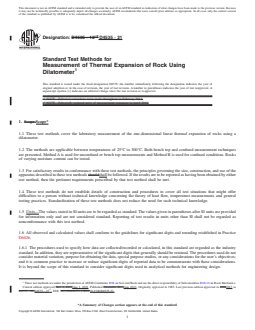
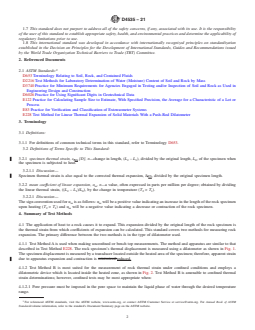
SIGNIFICANCE AND USE
5.1 Information concerning the thermal expansion characteristics of rocks is important in the design of any underground excavation where the surrounding rock may be heated. Thermal strain causes thermal stresses which ultimately affect excavation stability. Examples of applications where rock thermal strain is important include: nuclear waste repositories, underground power stations, compressed air energy storage facilities, and geothermal energy facilities.
5.2 The coefficient of thermal expansion, α, of rock is known to vary as the temperature changes. These methods provide continuous thermal strain values as a function of temperature, and therefore provide information on how the coefficient of thermal expansion changes with temperature.
5.3 Rocks are also often anisotropic, thus displaying different thermal strains depending on the orientation of strain measurement. These methods allow for measuring strain in one direction only. If anisotropy is expected, specimens with different orientations shall be prepared and tested.
Note 1: The quality of the result produced by this standard is dependent on the competence of the personnel performing it, and the suitability of the equipment and facilities used. Agencies that meet the criteria of Practice D3740 are generally considered capable of competent and objective testing. Users of this standard are cautioned that compliance with Practice D3740 does not in itself assure reliable results. Reliable results depend on many factors; Practice D3740 provides a means of evaluating some of those factors.
SCOPE
1.1 These test methods cover the laboratory measurement of the one-dimensional linear thermal expansion of rocks using a dilatometer.
1.2 The methods are applicable between temperatures of 25°C to 300°C. Both bench top and confined measurement techniques are presented. Method A is used for unconfined or bench top measurements and Method B is used for confined conditions. Rocks of varying moisture content can be tested.
1.3 For satisfactory results in conformance with these test methods, the principles governing the size, construction, and use of the apparatus described in these test methods shall be followed. If the results are to be reported as having been obtained by either test method, then the pertinent requirements prescribed by that test method shall be met.
1.4 These test methods do not establish details of construction and procedures to cover all test situations that might offer difficulties to a person without technical knowledge concerning the theory of heat flow, temperature measurement, and general testing practices. Standardization of these test methods does not reduce the need for such technical knowledge.
1.5 Units—The values stated in SI units are to be regarded as standard. The values given in parentheses after SI units are provided for information only and are not considered standard. Reporting of test results in units other than SI shall not be regarded as nonconformance with this test method.
1.6 All observed and calculated values shall conform to the guidelines for significant digits and rounding established in Practice D6026.
1.6.1 The procedures used to specify how data are collected/recorded or calculated, in this standard are regarded as the industry standard. In addition, they are representative of the significant digits that generally should be retained. The procedures used do not consider material variation, purpose for obtaining the data, special purpose studies, or any considerations for the user’s objectives; and it is common practice to increase or reduce significant digits of reported data to be commensurate with these considerations. It is beyond the scope of this standard to consider significant digits used in analytical methods for engineering design.
1.7 This standard does not purport to address all of the safety concerns, if any, associated with its use. It is the responsibility of...
- Status
- Published
- Publication Date
- 31-May-2021
- Technical Committee
- D18 - Soil and Rock
- Drafting Committee
- D18.12 - Rock Mechanics
Buy Documents
ASTM D4535-21 - Standard Test Methods for Measurement of Thermal Expansion of Rock Using Dilatometer
REDLINE ASTM D4535-21 - Standard Test Methods for Measurement of Thermal Expansion of Rock Using Dilatometer
Overview
ASTM D4535-21: Standard Test Methods for Measurement of Thermal Expansion of Rock Using Dilatometer provides established procedures for determining the one-dimensional linear thermal expansion of rock specimens in the laboratory. Utilizing a dilatometer, these methods are designed for both unconfined (bench top) and confined testing conditions over a temperature range of 25°C to 300°C. The standard supports the assessment of thermal strain in rocks, which is critical for geotechnical and civil engineering projects where the stability of surrounding rock may be affected by temperature changes.
Understanding the thermal expansion behavior of rocks is vital in the safe design of underground excavations, including facilities such as nuclear waste repositories, underground power stations, compressed air energy storage, and geothermal installations.
Key Topics
- Thermal Expansion Measurement: Employs bench top (Method A) and confined (Method B) dilatometry techniques to measure how rock length changes with temperature.
- Coefficient of Thermal Expansion: Provides continuous data on how the coefficient of thermal expansion (α) changes as the rock specimen is heated or cooled.
- Anisotropic Properties: Recognizes that rocks can display different thermal expansion in various directions, so specimens may need orientation-specific testing.
- Moisture Content Considerations: Discusses the impact of varying moisture levels on results and recommends preservation and preparation methods.
- Measurement Accuracy: Outlines equipment requirements, data reporting, and statistical considerations to achieve reliable and repeatable results.
Applications
The ASTM D4535-21 test methods are used in several important engineering fields:
- Underground Excavation Design: Essential in environments where heat will be introduced, such as nuclear waste storage, ensuring rock stability by anticipating thermal stress.
- Geothermal Energy Projects: Evaluating expansion characteristics at elevated temperatures ensures safe and sustainable design.
- Infrastructure Safety: For underground power stations and compressed air energy storage, accurate measurement of rock expansion supports long-term facility integrity.
- Rock Mechanics Research: Provides foundational data for modeling and simulating rock section behavior under thermal loads.
- Quality Control: Supports consistent testing standards for laboratories and agencies working in geotechnical engineering.
Related Standards
- ASTM D653: Terminology Relating to Soil, Rock, and Contained Fluids
- ASTM D2216: Test Methods for Determination of Water (Moisture) Content of Soil and Rock by Mass
- ASTM D3740: Practice for Minimum Requirements for Agencies Engaged in Testing of Soil and Rock
- ASTM D6026: Practice for Using Significant Digits in Geotechnical Data
- ASTM E122: Practice for Calculating Sample Size with Specified Precision
- ASTM E83: Practice for Verification and Classification of Extensometer Systems
- ASTM E228: Test Method for Linear Thermal Expansion of Solid Materials with a Push-Rod Dilatometer
These referenced standards complement ASTM D4535-21 by providing terminology, apparatus standards, data reporting practices, and supporting procedures ensuring uniformity in laboratory testing of rock thermal expansion.
Keywords: ASTM D4535, rock thermal expansion, dilatometer, coefficient of thermal expansion, thermal strain, rock mechanics, geotechnical testing, underground excavation, laboratory test methods, anisotropic rock properties.
Relations
- Effective Date
- 01-Nov-2023
- Effective Date
- 01-Oct-2019
- Effective Date
- 01-Mar-2019
- Effective Date
- 01-Sep-2016
- Effective Date
- 01-Aug-2014
- Effective Date
- 01-May-2012
- Effective Date
- 01-Mar-2012
- Effective Date
- 01-Sep-2011
- Effective Date
- 01-Sep-2011
- Effective Date
- 01-Aug-2011
- Effective Date
- 01-Jul-2010
- Effective Date
- 01-Jun-2010
- Effective Date
- 01-Mar-2010
- Effective Date
- 01-Jan-2010
- Effective Date
- 01-Aug-2009
Buy Documents
ASTM D4535-21 - Standard Test Methods for Measurement of Thermal Expansion of Rock Using Dilatometer
REDLINE ASTM D4535-21 - Standard Test Methods for Measurement of Thermal Expansion of Rock Using Dilatometer
Get Certified
Connect with accredited certification bodies for this standard

Zavod za gradbeništvo Slovenije (ZAG) - Inšpekcija
ZAG inspection body for construction products, structures, and materials.
Sponsored listings
Frequently Asked Questions
ASTM D4535-21 is a standard published by ASTM International. Its full title is "Standard Test Methods for Measurement of Thermal Expansion of Rock Using Dilatometer". This standard covers: SIGNIFICANCE AND USE 5.1 Information concerning the thermal expansion characteristics of rocks is important in the design of any underground excavation where the surrounding rock may be heated. Thermal strain causes thermal stresses which ultimately affect excavation stability. Examples of applications where rock thermal strain is important include: nuclear waste repositories, underground power stations, compressed air energy storage facilities, and geothermal energy facilities. 5.2 The coefficient of thermal expansion, α, of rock is known to vary as the temperature changes. These methods provide continuous thermal strain values as a function of temperature, and therefore provide information on how the coefficient of thermal expansion changes with temperature. 5.3 Rocks are also often anisotropic, thus displaying different thermal strains depending on the orientation of strain measurement. These methods allow for measuring strain in one direction only. If anisotropy is expected, specimens with different orientations shall be prepared and tested. Note 1: The quality of the result produced by this standard is dependent on the competence of the personnel performing it, and the suitability of the equipment and facilities used. Agencies that meet the criteria of Practice D3740 are generally considered capable of competent and objective testing. Users of this standard are cautioned that compliance with Practice D3740 does not in itself assure reliable results. Reliable results depend on many factors; Practice D3740 provides a means of evaluating some of those factors. SCOPE 1.1 These test methods cover the laboratory measurement of the one-dimensional linear thermal expansion of rocks using a dilatometer. 1.2 The methods are applicable between temperatures of 25°C to 300°C. Both bench top and confined measurement techniques are presented. Method A is used for unconfined or bench top measurements and Method B is used for confined conditions. Rocks of varying moisture content can be tested. 1.3 For satisfactory results in conformance with these test methods, the principles governing the size, construction, and use of the apparatus described in these test methods shall be followed. If the results are to be reported as having been obtained by either test method, then the pertinent requirements prescribed by that test method shall be met. 1.4 These test methods do not establish details of construction and procedures to cover all test situations that might offer difficulties to a person without technical knowledge concerning the theory of heat flow, temperature measurement, and general testing practices. Standardization of these test methods does not reduce the need for such technical knowledge. 1.5 Units—The values stated in SI units are to be regarded as standard. The values given in parentheses after SI units are provided for information only and are not considered standard. Reporting of test results in units other than SI shall not be regarded as nonconformance with this test method. 1.6 All observed and calculated values shall conform to the guidelines for significant digits and rounding established in Practice D6026. 1.6.1 The procedures used to specify how data are collected/recorded or calculated, in this standard are regarded as the industry standard. In addition, they are representative of the significant digits that generally should be retained. The procedures used do not consider material variation, purpose for obtaining the data, special purpose studies, or any considerations for the user’s objectives; and it is common practice to increase or reduce significant digits of reported data to be commensurate with these considerations. It is beyond the scope of this standard to consider significant digits used in analytical methods for engineering design. 1.7 This standard does not purport to address all of the safety concerns, if any, associated with its use. It is the responsibility of...
SIGNIFICANCE AND USE 5.1 Information concerning the thermal expansion characteristics of rocks is important in the design of any underground excavation where the surrounding rock may be heated. Thermal strain causes thermal stresses which ultimately affect excavation stability. Examples of applications where rock thermal strain is important include: nuclear waste repositories, underground power stations, compressed air energy storage facilities, and geothermal energy facilities. 5.2 The coefficient of thermal expansion, α, of rock is known to vary as the temperature changes. These methods provide continuous thermal strain values as a function of temperature, and therefore provide information on how the coefficient of thermal expansion changes with temperature. 5.3 Rocks are also often anisotropic, thus displaying different thermal strains depending on the orientation of strain measurement. These methods allow for measuring strain in one direction only. If anisotropy is expected, specimens with different orientations shall be prepared and tested. Note 1: The quality of the result produced by this standard is dependent on the competence of the personnel performing it, and the suitability of the equipment and facilities used. Agencies that meet the criteria of Practice D3740 are generally considered capable of competent and objective testing. Users of this standard are cautioned that compliance with Practice D3740 does not in itself assure reliable results. Reliable results depend on many factors; Practice D3740 provides a means of evaluating some of those factors. SCOPE 1.1 These test methods cover the laboratory measurement of the one-dimensional linear thermal expansion of rocks using a dilatometer. 1.2 The methods are applicable between temperatures of 25°C to 300°C. Both bench top and confined measurement techniques are presented. Method A is used for unconfined or bench top measurements and Method B is used for confined conditions. Rocks of varying moisture content can be tested. 1.3 For satisfactory results in conformance with these test methods, the principles governing the size, construction, and use of the apparatus described in these test methods shall be followed. If the results are to be reported as having been obtained by either test method, then the pertinent requirements prescribed by that test method shall be met. 1.4 These test methods do not establish details of construction and procedures to cover all test situations that might offer difficulties to a person without technical knowledge concerning the theory of heat flow, temperature measurement, and general testing practices. Standardization of these test methods does not reduce the need for such technical knowledge. 1.5 Units—The values stated in SI units are to be regarded as standard. The values given in parentheses after SI units are provided for information only and are not considered standard. Reporting of test results in units other than SI shall not be regarded as nonconformance with this test method. 1.6 All observed and calculated values shall conform to the guidelines for significant digits and rounding established in Practice D6026. 1.6.1 The procedures used to specify how data are collected/recorded or calculated, in this standard are regarded as the industry standard. In addition, they are representative of the significant digits that generally should be retained. The procedures used do not consider material variation, purpose for obtaining the data, special purpose studies, or any considerations for the user’s objectives; and it is common practice to increase or reduce significant digits of reported data to be commensurate with these considerations. It is beyond the scope of this standard to consider significant digits used in analytical methods for engineering design. 1.7 This standard does not purport to address all of the safety concerns, if any, associated with its use. It is the responsibility of...
ASTM D4535-21 is classified under the following ICS (International Classification for Standards) categories: 93.020 - Earthworks. Excavations. Foundation construction. Underground works. The ICS classification helps identify the subject area and facilitates finding related standards.
ASTM D4535-21 has the following relationships with other standards: It is inter standard links to ASTM D3740-23, ASTM D3740-19, ASTM D2216-19, ASTM E228-11(2016), ASTM D653-14, ASTM D3740-12a, ASTM D3740-12, ASTM D653-11, ASTM D3740-11, ASTM E122-09e1, ASTM D2216-10, ASTM E83-10a, ASTM D3740-10, ASTM E83-10, ASTM E122-09. Understanding these relationships helps ensure you are using the most current and applicable version of the standard.
ASTM D4535-21 is available in PDF format for immediate download after purchase. The document can be added to your cart and obtained through the secure checkout process. Digital delivery ensures instant access to the complete standard document.
Standards Content (Sample)
This international standard was developed in accordance with internationally recognized principles on standardization established in the Decision on Principles for the
Development of International Standards, Guides and Recommendations issued by the World Trade Organization Technical Barriers to Trade (TBT) Committee.
Designation: D4535 − 21
Standard Test Methods for
Measurement of Thermal Expansion of Rock Using
Dilatometer
This standard is issued under the fixed designation D4535; the number immediately following the designation indicates the year of
original adoption or, in the case of revision, the year of last revision. A number in parentheses indicates the year of last reapproval. A
superscript epsilon (´) indicates an editorial change since the last revision or reapproval.
1. Scope* obtaining the data, special purpose studies, or any consider-
ations for the user’s objectives; and it is common practice to
1.1 Thesetestmethodscoverthelaboratorymeasurementof
increase or reduce significant digits of reported data to be
the one-dimensional linear thermal expansion of rocks using a
commensuratewiththeseconsiderations.Itisbeyondthescope
dilatometer.
of this standard to consider significant digits used in analytical
1.2 The methods are applicable between temperatures of
methods for engineering design.
25°C to 300°C. Both bench top and confined measurement
1.7 This standard does not purport to address all of the
techniques are presented. Method A is used for unconfined or
safety concerns, if any, associated with its use. It is the
bench top measurements and Method B is used for confined
responsibility of the user of this standard to establish appro-
conditions. Rocks of varying moisture content can be tested.
priate safety, health, and environmental practices and deter-
1.3 For satisfactory results in conformance with these test
mine the applicability of regulatory limitations prior to use.
methods, the principles governing the size, construction, and
1.8 This international standard was developed in accor-
use of the apparatus described in these test methods shall be
dance with internationally recognized principles on standard-
followed. If the results are to be reported as having been
ization established in the Decision on Principles for the
obtained by either test method, then the pertinent requirements
Development of International Standards, Guides and Recom-
prescribed by that test method shall be met.
mendations issued by the World Trade Organization Technical
1.4 These test methods do not establish details of construc-
Barriers to Trade (TBT) Committee.
tion and procedures to cover all test situations that might offer
difficultiestoapersonwithouttechnicalknowledgeconcerning
2. Referenced Documents
the theory of heat flow, temperature measurement, and general
2.1 ASTM Standards:
testing practices. Standardization of these test methods does
D653 Terminology Relating to Soil, Rock, and Contained
not reduce the need for such technical knowledge.
Fluids
1.5 Units—The values stated in SI units are to be regarded
D2216 Test Methods for Laboratory Determination of Water
as standard. The values given in parentheses after SI units are
(Moisture) Content of Soil and Rock by Mass
provided for information only and are not considered standard.
D3740 Practice for Minimum Requirements for Agencies
Reporting of test results in units other than SI shall not be
Engaged in Testing and/or Inspection of Soil and Rock as
regarded as nonconformance with this test method.
Used in Engineering Design and Construction
1.6 All observed and calculated values shall conform to the
D6026 Practice for Using Significant Digits in Geotechnical
guidelines for significant digits and rounding established in
Data
Practice D6026.
E122 Practice for Calculating Sample Size to Estimate,With
1.6.1 Theproceduresusedtospecifyhowdataarecollected/
Specified Precision, the Average for a Characteristic of a
recorded or calculated, in this standard are regarded as the
Lot or Process
industry standard. In addition, they are representative of the
E83 Practice for Verification and Classification of Exten-
significant digits that generally should be retained. The proce-
someter Systems
dures used do not consider material variation, purpose for
E228 Test Method for Linear Thermal Expansion of Solid
Materials With a Push-Rod Dilatometer
These test methods are under the jurisdiction ofASTM Committee D18 on Soil
and Rock and are the direct responsibility of Subcommittee D18.12 on Rock
Mechanics. For referenced ASTM standards, visit the ASTM website, www.astm.org, or
Current edition approved June 1, 2021. Published June 2021. Originally contact ASTM Customer Service at service@astm.org. For Annual Book of ASTM
ɛ2
approved in 1985. Last previous edition approved in 2013 as D4535 – 13 . DOI: Standardsvolume information, refer to the standard’s Document Summary page on
10.1520/D4535-21. the ASTM website.
*A Summary of Changes section appears at the end of this standard
Copyright © ASTM International, 100 Barr Harbor Drive, PO Box C700, West Conshohocken, PA 19428-2959. United States
D4535 − 21
3. Terminology
3.1 Definitions:
3.1.1 For definitions of common technical terms in this
standard, refer to Terminology D653.
3.2 Definitions of Terms Specific to This Standard:
3.2.1 specimen thermal strain,ε [D], n—changeinlength,
TS
(L – L ), divided by the original length, L , of the specimen
2 1 0
when the specimen is subjected to heat.
3.2.1.1 Discussion—Specimen thermal strain is also equal
to the corrected thermal expansion,δ , divided by the original
TS
specimen length.
3.2.2 mean coeffıcient of linear expansion, α ,n—a value,
m
often expressed in parts per million per degree; obtained by
dividing the linear thermal strain, ((L – L )/L ), by the change
2 1 0
in temperature (T > T ).
2 1
3.2.2.1 Discussion—The sign convention used for α is as
m
follows: α will be a positive value indicating an increase in
m
the length of the rock specimen upon heating (T > T ) and α
2 1 m
will be a negative value indicating a decrease or contraction of
the rock specimen.
4. Summary of Test Methods
4.1 The application of heat to a rock causes it to expand.
This expansion divided by the original length of the rock
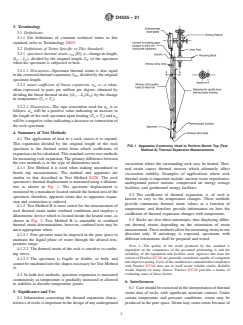
FIG. 1 Apparatus Commonly Used to Perform Bench Top (Test
specimen is the thermal strain from which coefficients of
Method A) Thermal Expansion Measurements
expansioncanbecalculated.Thisstandardcoverstwomethods
for measuring rock expansion.The primary difference between
the two methods is in the type of dilatometer used.
excavation where the surrounding rock may be heated. Ther-
4.1.1 Test Method A is used when making unconfined or
mal strain causes thermal stresses which ultimately affect
bench top measurements. The method and apparatus are
excavation stability. Examples of applications where rock
similar to that described in Test Method E228. The rock
thermal strain is important include: nuclear waste repositories,
specimen’s thermal displacement is measured using a dilatom-
underground power stations, compressed air energy storage
eter as shown in Fig. 1. The specimen displacement is
facilities, and geothermal energy facilities.
measured by a transducer located outside the heated area of the
5.2 The coefficient of thermal expansion, α, of rock is
specimen; therefore, apparent strain due to apparatus expan-
known to vary as the temperature changes. These methods
sion and contraction is reduced.
provide continuous thermal strain values as a function of
4.1.2 Test Method B is most suited for the measurement of
temperature, and therefore provide information on how the
rock thermal strain under confined conditions and employs a
coefficient of thermal expansion changes with temperature.
dilatometric device which is located inside the heated zone, as
5.3 Rocks are also often anisotropic, thus displaying differ-
shown in Fig. 2. Test Method B is amenable to confined
ent thermal strains depending on the orientation of strain
thermal strain determinations; however, confined tests may be
measurement.Thesemethodsallowformeasuringstraininone
most appropriate when:
direction only. If anisotropy is expected, specimens with
4.1.2.1 Pore pressure must be imposed in the pore space to
different orientations shall be prepared and tested.
maintain the liquid phase of water through the desired tem-
perature range.
NOTE 1—The quality of the result produced by this standard is
4.1.2.2 The thermal strain of the rock is sensitive to confin-
dependent on the competence of the personnel performing it, and the
ing stress. suitability of the equipment and facilities used. Agencies that meet the
criteria of Practice D3740 are generally considered capable of competent
4.1.2.3 The specimen is fragile or friable, or both, and
and objective testing. Users of this standard are cautioned that compliance
cannot be machined into the shapes necessary for Test Method
with Practice D3740 does not in itself assure reliable results. Reliable
A.
results depend on many factors; Practice D3740 provides a means of
evaluating some of those factors.
4.2 In both test methods, specimen expansion is measured
continuously as temperature is gradually increased or allowed
6. Interferences
to stabilize at discrete temperature points.
6.1 Care should be exercised in the interpretation of thermal
5. Significance and Use
strain data of rocks with significant moisture content. Under
5.1 Information concerning the thermal expansion charac- certain temperature and pressure conditions, steam may be
teristics of rocks is important in the design of any underground produced in the pore space. Steam may cause errors because of
D4535 − 21
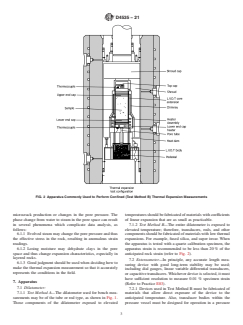
FIG. 2 Apparatus Commonly Used to Perform Confined (Test Method B) Thermal Expansion Measurements
microcrack production or changes in the pore pressure. The temperaturesshouldbefabricatedofmaterialswithcoefficients
phase change from water to steam in the pore space can result of linear expansion that are as small as practicable.
in several phenomena which complicate data analysis, as 7.1.2 Test Method B—The entire dilatometer is exposed to
follows: elevated temperature; therefore, transducers, rods, and other
6.1.1 Evolved steam may change the pore pressure and thus components should be fabricated of materials with low thermal
the effective stress in the rock, resulting in anomalous strain expansions. For example, fused silica, and super invar. When
readings. the apparatus is tested with a quartz calibration specimen, the
6.1.2 Losing moisture may dehydrate clays in the pore apparatus strain is recommended to be less than 20 % of the
space and thus change expansion characteristics, especially in anticipated rock strain (refer to Fig. 2).
layered rocks.
7.2 Extensometer—In principle, any accurate length mea-
6.1.3 Good judgment should be used when deciding how to
suring device with good long-term stability may be used;
make the thermal expansion measurement so that it accurately
including dial gauges, linear variable differential transducers,
represents the conditions in the field.
or capacitive transducers.Whichever device is selected, it must
have sufficient resolution to measure 0.01 % specimen strain
7. Apparatus
(Refer to Practice E83).
7.1 Dilatometer: 7.2.1 Devices used in Test Method B must be fabricated of
7.1.1 Test Method A—The dilatometer used for bench mea- materials that allow direct exposure of the device to the
surements may be of the tube or rod type, as shown in Fig. 1. anticipated temperature. Also, transducer bodies within the
Those components of the dilatometer exposed to elevated pressure vessel must be designed for operation in a pressure
D4535 − 21
environment. At least two transducers are used, as shown in order to assess the degree of anisotropy, the thermal expansion
Fig. 2, and their outputs averaged. must be measured in several directions.
7.3 Furnace—The furnace shall be large enough to contain
9. Preparation of Test Specimens
the specimen and apparatus and maintain uniform temperature
9.1 Take the samples and machine them into the proper
along the axis of the specimen with variations no greater than
geometry as discussed in 9.2.
61°C. The mean specimen temperature shall be controlled
9.1.1 Do not degrade the rock during machining. Prevent
within 61°C. The use of a programmable temperature control-
mechanical and fracture damage to the rock fabric by appro-
ler that can slowly increase or decrease specimen temperatures
priately slow machining processes and the use of proper
at rates at least as low as 0.1°C/min is recommended.
coolant. Select coolant fluids based upon chemical compatibil-
7.4 Temperature Measuring Instruments—Thermocouples
ity with the rock; for example, tap water may be adequate for
or platinum resistant thermometers are recommended. The
granite, whereas a saturated brine or mineral oil is more
exact type will depend on the temperature range of interest. In
suitable for salt.
general, the temperature shall be measured to within 60.5°C
9.2 Dimension and Geometry—In general, the proper geom-
with a resolution of at least 60.2°C. Make measurements near
etry of a specimen is a right circular cylinder. The specific
the midlength of the specimen.
recommended dimensions for Test MethodAare given in Test
7.5 Specimen Size Measurement Devices—Devices used to
Method E228. For Test Method B, a specimen that is a right
measure the length and diameter of the specimen shall be
circular cylinder with a length to diameter ratio of 2 to 1 is
capable of measuring the desired dimension to within 0.1 % of
recommended. For both methods the minimum dimension
its actual length.
should be 10 times the largest grain size. Measure and record
7.6 Verification Specimen—A specimen fabricated from
the length and diameter of the specimen. Take a minimum of
fused silica or other material with a small, known coefficient of three length measurements 120° apart and at least three
thermalexpansionthatisofthesamedimensionsandgeometry diameter measurements at the quarter points of the height.
as the rock specimens to be tested. Determine the average length and diameter of the specimen.
9.3 Moisture Condition of Specimens—Test the specimens
8. Sampling
in a manner that adequately simulates the in situ conditions of
interest. For natural conditions, the moisture content of the
8.1 Thenumberandtypesofrockcorestesteddependpartly
on the intended application of the test results. For example, an rock core and the chemical characteristics of the pore fluid
shall be preserved between the time of recovery and testing.
initial mechanical characterization of a site might require
several samples from a variety of formations, while a detailed Determine the moisture content of core material contiguous to
the test specimen in accordance with Test Method D2216.
thermo-mechanical evaluation of a particular location may
require many rock tests from a single formation. The testing 9.3.1
...
This document is not an ASTM standard and is intended only to provide the user of an ASTM standard an indication of what changes have been made to the previous version. Because
it may not be technically possible to adequately depict all changes accurately, ASTM recommends that users consult prior editions as appropriate. In all cases only the current version
of the standard as published by ASTM is to be considered the official document.
´2
Designation: D4535 − 13 D4535 − 21
Standard Test Methods for
Measurement of Thermal Expansion of Rock Using
Dilatometer
This standard is issued under the fixed designation D4535; the number immediately following the designation indicates the year of
original adoption or, in the case of revision, the year of last revision. A number in parentheses indicates the year of last reapproval. A
superscript epsilon (´) indicates an editorial change since the last revision or reapproval.
ε NOTE—Editorial corrections were made throughout in February 2014.
ε NOTE—Editorially updated units of measurement statement in April 2018.
1. Scope Scope*
1.1 These test methods cover the laboratory measurement of the one-dimensional linear thermal expansion of rocks using a
dilatometer.
1.2 The methods are applicable between temperatures of 25°C to 300°C. Both bench top and confined measurement techniques
are presented. Method A is used for unconfined or bench top measurements and Method B is used for confined conditions. Rocks
of varying moisture content can be tested.
1.3 For satisfactory results in conformance with these test methods, the principles governing the size, construction, and use of the
apparatus described in these test methods shouldshall be followed. If the results are to be reported as having been obtained by either
test method, then the pertinent requirements prescribed by that test method shall be met.
1.4 These test methods do not establish details of construction and procedures to cover all test situations that might offer
difficulties to a person without technical knowledge concerning the theory of heat flow, temperature measurement, and general
testing practices. Standardization of these test methods does not reduce the need for such technical knowledge.
1.5 Units—The values stated in SI units are to be regarded as standard. The values given in parentheses after SI units are provided
for information only and are not considered standard. Reporting of test results in units other than SI shall not be regarded as
nonconformance with this test method.
1.6 All observed and calculated values shall conform to the guidelines for significant digits and rounding established in Practice
D6026.
1.6.1 The procedures used to specify how data are collected/recorded or calculated, in this standard are regarded as the industry
standard. In addition, they are representative of the significant digits that generally should be retained. The procedures used do not
consider material variation, purpose for obtaining the data, special purpose studies, or any considerations for the user’s objectives;
and it is common practice to increase or reduce significant digits of reported data to be commensurate with these considerations.
It is beyond the scope of this standard to consider significant digits used in analytical methods for engineering design.
These test methods are under the jurisdiction of ASTM Committee D18 on Soil and Rock and are the direct responsibility of Subcommittee D18.12 on Rock Mechanics.
Current edition approved Nov. 1, 2013June 1, 2021. Published December 2013June 2021. Originally approved in 1985. Last previous edition approved in 20042013 as
ɛ2
D4535 – 08.D4535 – 13 . DOI: 10.1520/D4535-13E02.10.1520/D4535-21.
*A Summary of Changes section appears at the end of this standard
Copyright © ASTM International, 100 Barr Harbor Drive, PO Box C700, West Conshohocken, PA 19428-2959. United States
D4535 − 21
1.7 This standard does not purport to address all of the safety concerns, if any, associated with its use. It is the responsibility
of the user of this standard to establish appropriate safety, health, and environmental practices and determine the applicability of
regulatory limitations prior to use.
1.8 This international standard was developed in accordance with internationally recognized principles on standardization
established in the Decision on Principles for the Development of International Standards, Guides and Recommendations issued
by the World Trade Organization Technical Barriers to Trade (TBT) Committee.
2. Referenced Documents
2.1 ASTM Standards:
D653 Terminology Relating to Soil, Rock, and Contained Fluids
D2216 Test Methods for Laboratory Determination of Water (Moisture) Content of Soil and Rock by Mass
D3740 Practice for Minimum Requirements for Agencies Engaged in Testing and/or Inspection of Soil and Rock as Used in
Engineering Design and Construction
D6026 Practice for Using Significant Digits in Geotechnical Data
E122 Practice for Calculating Sample Size to Estimate, With Specified Precision, the Average for a Characteristic of a Lot or
Process
E83 Practice for Verification and Classification of Extensometer Systems
E228 Test Method for Linear Thermal Expansion of Solid Materials With a Push-Rod Dilatometer
3. Terminology
3.1 Definitions:
3.1.1 For definitions of common technical terms in this standard, refer to Terminology D653.
3.2 Definitions of Terms Specific to This Standard:
3.2.1 specimen thermal strain, ε [D], n—change in length, (L – L ), divided by the original length, L , of the specimen when
tTS 2 1 0
the specimen is subjected to heat.
3.2.1.1 Discussion—
Specimen thermal strain is also equal to the corrected thermal expansion, δ , divided by the original specimen length.
tTS
3.2.2 mean coeffıcient of linear expansion, α , n—a value, often expressed in parts per million per degree; obtained by dividing
m
the linear thermal strain, ((L – L )/L ), by the change in temperature (T > T ).
2 1 0 2 1
3.2.2.1 Discussion—
The sign convention used for α is as follows: α will be a positive value indicating an increase in the length of the rock specimen
m m
upon heating (T > T ) and α will be a negative value indicating a decrease or contraction of the rock specimen.
2 1 m
4. Summary of Test Methods
4.1 The application of heat to a rock causes it to expand. This expansion divided by the original length of the rock specimen is
the thermal strain from which coefficients of expansion can be calculated. This standard covers two methods for measuring rock
expansion. The primary difference between the two methods is in the type of dilatometer used.
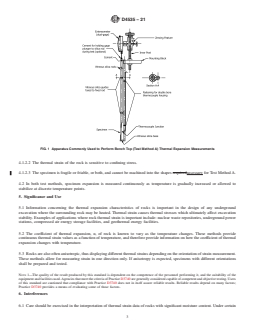
4.1.1 Test Method A is used when making unconfined or bench top measurements. The method and apparatus are similar to that
described in Test Method E228. The rock specimen’s thermal displacement is measured using a dilatometer as shown in Fig. 1.
The specimen displacement is measured by a transducer located outside the heated area of the specimen; therefore, apparent strain
due to apparatus expansion and contraction is minimized.reduced.
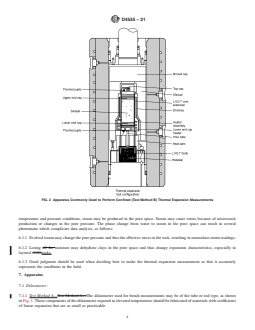
4.1.2 Test Method B is most suited for the measurement of rock thermal strain under confined conditions and employs a
dilatometric device which is located inside the heated zone, as shown in Fig. 2. Test Method B is amenable to confined thermal
strain determinations; however, confined tests may be most appropriate when:
4.1.2.1 Pore pressure must be imposed in the pore space to maintain the liquid phase of water through the desired temperature
range.
For referenced ASTM standards, visit the ASTM website, www.astm.org, or contact ASTM Customer Service at service@astm.org. For Annual Book of ASTM
Standardsvolume information, refer to the standard’s Document Summary page on the ASTM website.
D4535 − 21
FIG. 1 Apparatus Commonly Used to Perform Bench Top (Test Method A) Thermal Expansion Measurements
4.1.2.2 The thermal strain of the rock is sensitive to confining stress.
4.1.2.3 The specimen is fragile or friable, or both, and cannot be machined into the shapes requirednecessary for Test Method A.
4.2 In both test methods, specimen expansion is measured continuously as temperature is gradually increased or allowed to
stabilize at discrete temperature points.
5. Significance and Use
5.1 Information concerning the thermal expansion characteristics of rocks is important in the design of any underground
excavation where the surrounding rock may be heated. Thermal strain causes thermal stresses which ultimately affect excavation
stability. Examples of applications where rock thermal strain is important include: nuclear waste repositories, underground power
stations, compressed air energy storage facilities, and geothermal energy facilities.
5.2 The coefficient of thermal expansion, α, of rock is known to vary as the temperature changes. These methods provide
continuous thermal strain values as a function of temperature, and therefore provide information on how the coefficient of thermal
expansion changes with temperature.
5.3 Rocks are also often anisotropic, thus displaying different thermal strains depending on the orientation of strain measurement.
These methods allow for measuring strain in one direction only. If anisotropy is expected, specimens with different orientations
shall be prepared and tested.
NOTE 1—The quality of the result produced by this standard is dependent on the competence of the personnel performing it, and the suitability of the
equipment and facilities used. Agencies that meet the criteria of Practice D3740 are generally considered capable of competent and objective testing. Users
of this standard are cautioned that compliance with Practice D3740 does not in itself assure reliable results. Reliable results depend on many factors;
Practice D3740 provides a means of evaluating some of those factors.
6. Interferences
6.1 Care should be exercised in the interpretation of thermal strain data of rocks with significant moisture content. Under certain
D4535 − 21
FIG. 2 Apparatus Commonly Used to Perform Confined (Test Method B) Thermal Expansion Measurements
temperature and pressure conditions, steam may be produced in the pore space. Steam may cause errors because of microcrack
production or changes in the pore pressure. The phase change from water to steam in the pore space can result in several
phenomena which complicate data analysis, as follows:
6.1.1 Evolved steam may change the pore pressure and thus the effective stress in the rock, resulting in anomalous strain readings.
6.1.2 Losing all the moisture may dehydrate clays in the pore space and thus change expansion characteristics, especially in
layered rocksrocks.
6.1.3 Good judgment should be used when deciding how to make the thermal expansion measurement so that it accurately
represents the conditions in the field.
7. Apparatus
7.1 Dilatometer:
7.1.1 Test Method A—Test Method A—The dilatometer used for bench measurements may be of the tube or rod type, as shown
in Fig. 1. Those components of the dilatometer exposed to elevated temperatures should be fabricated of materials with coefficients
of linear expansion that are as small as practicable.
D4535 − 21
7.1.2 Test Method B—The entire dilatometer is exposed to elevated temperature; therefore, transducers, rods, and other
components should be fabricated of materials with low thermal expansions. For example, fused silica, and super invar. When the
apparatus is tested with a quartz calibration specimen, the apparatus strain should is recommended to be less than 20 % 20 % of
the anticipated rock strain (refer to Fig. 2).
7.2 Extensometer—Extensometers measure length change. In principle, any accurate length measuring device with good long-term
stability may be used; including dial gauges, linear variable differential transducers, or capacitive transducers. Whichever device
is selected, it must have sufficient resolution to measure 0.01 % specimen strain (Refer to Practice E83).
7.2.1 Devices used in Test Method B must be fabricated of materials that allow direct exposure of the device to the anticipated
temperature. Also, transducer bodies should be ventedwithin the pressure vessel must be designed for operation in a pressure
environment. At least two transducers are used, as shown in Fig. 2, and their outputs averaged.
7.3 Furnace—The furnace shall be large enough to contain the specimen and apparatus and maintain uniform temperature along
the axis of the specimen with variations no greater than 61°C. The mean specimen temperature shall be controlled within 61°C.
The use of a programmable temperature controller that can slowly increase or decrease specimen temperatures at rates at least as
low as 0.1°C/min is recommended.
7.4 Temperature Measuring Instruments—Thermocouples or platinum resistant thermometers are recommended. The exact type
will depend on the temperature range of interest. In general, the temperature shouldshall be measured to within 60.5°C with a
resolution of at least 60.2°C. Make measurements at three locations on the axis of the specimen, one near each end and one at
the specimen midpoint.near the midlength of the specimen.
7.5 Specimen Size Measurement Devices—Devices used to measure the length and diameter of the specimen shall be capable of
measuring the desired dimension to within 0.1 % of its actual length.
7.6 Verification Specimen—A specimen fabricated from fused silica or other material with a small, known coefficient of thermal
expansion that is of the same dimensions and geometry as the rock specimens to be tested.
8. Sampling
8.1 The number and types of rock cores tested depend partly on the intended application of the test results. For example, an initial
mechanical characterization of a site might require several samples from a variety of formations, while a detailed thermo-
mechanical investigationevaluation of a particular location may require many rock tests from a single formation. The final testing
program will depend on the technical judgment and the experience of project personnel.
8.2 Statistical Requirements—The number of samples and specimens tested shall be sufficient to provide an adequate statistical
basis for evaluation of the results. Rock types that are highly variable will require more tests than relatively uniform rocks in order
to evaluate the results with equal certainty.
8.2.1 The number of samples and specimens requirednecessary to obtain a specific level of statistically valid results may be
determined using Test Method E122. However, it may not be economically possiblepractical to achieve specific confidence levels
and professional judgment may be required.is advised.
8.2.2 Documentation—Since the thermal expansion of most rock is anisotropic, it is important that the field orientation of each
sample is recorded. Note the The orientation of each sample shall be recorded on the sample and carry suitable markings through
each cutting until the final specimen is ready for testing. These If applicable, these markings should indicate compass direction and
up/down directions, and other orientation with respect to geologic structures.
8.3 Moisture Condition of Samples—The moisture condition of the rock can influence the measured thermal expansion. The
samples shall be preserved to prevent moisture changechange.
8.4 Anisotropy—The thermal expansion coefficient of many rocks is different along various axes of the rock; therefore, in order
to assess the degree of anisotropy, the thermal expansion must be measured in several directions.
D4535 − 21
9. Preparation of Test Specimens
9.1 Take the samples and machine them into the proper geometry as discussed in 9.2.
9.1.1 Do not degrade the rock during machining. Prevent mechanical and fracture damage to the rock fabric by appropriately slow
machining processes and the use of proper coolant. Select coolant fluids based upon chemical compatibility with the rock; for
example, tap water may be adequate for granite, whereas a saturated brine or mineral oil may be bestis more suitable for salt.
9.2 Dimension and Geometry—In general, the proper geometry of a specimen is a right circular cylinder. The specific
recommended dimensions for Test Method A are given in Test Method E228. For Test Method B, thea specimen should bethat is
a right circular cylinder with a length to diameter ratio of 2 to 1. 1 is recommended. For both methods the minimum dimension
should be 10 times the largest grain size. Measure and record the length and diameter of the specimen to 0.001 mm. specimen.
Take a minimum of three length measurements 120° apart and at least three diameter measurements at the quarter points of the
height. Determine the average length and diameter of the specimen.
9.3 Moisture Condition of Specimens—Test the specimens in a manner that bestadequately simulates the in situ conditions of
interest. For natural co
...