

ASTM D7419-18
(Test Method)Standard Test Method for Determination of Total Aromatics and Total Saturates in Lube Basestocks by High Performance Liquid Chromatography (HPLC) with Refractive Index Detection
General Information
- Abstract
SIGNIFICANCE AND USE
5.1Â The composition of a lubricating oil has a large effect on the characteristicsand uses of the oil. The determination of saturates, aromatics, and polars is a key analysis of this composition. The characterization of the composition of lubricating oils is important in determining their interchangeability for use in blending etcetera.
SCOPE
1.1Â This test method covers the determination of total aromatics and total saturats in additive-free lube basestocks using high performance liquid chromatography (HPLC) with refractive index (RI) detection. This test method is applicable to samples containing total saturates in the concentration range of 74.9 % to 100.0 % by mass and aromatics in the concentration range of 0.0 % to 25.1 % by mass. The precision is expressed in terms of the total saturates.
1.1.1Â Polar comounds, if present, are combined with the total aromatics. Precision was determined for basestocks with polars content
1.2Â This test method includes a relative bias section for total saturates in basestocks based n a Practice D6708 accuracy assessment between Test Method D7419 and Test Method D2007. The derived correlation equation is only applicable for basestocks in the total saturates concentration range from 75.0 % to 100.0 % by mass as measured by Test Method D7419.
1.2.1Â The applicable range for total saturates by Test Method D2007D2007.
1.3Â The vlues stated in SI units are to be regarded as standard. No other units of measurement are included in this standard.
1.4Â This standard does not purport to address all of the safety concerns, if any, associated with its use. It is the responibility of the user of this standard to establish appropriate safety, health, and environmental practices and determine the applicability of regulatory limitations prior to use.
1.5Â This international standard was developed in accordnce with internationally recognized principles on standardization established in the Decision on Principles for the Development of International Standards, Guides and Recommendations issued by the World Trade Organization Technical Barriers to Trade (TBT) Committee.
- Status
- Published
- Publication Date
- 30-Jun-2018
- Technical Committee
- D02 - Petroleum Products, Liquid Fuels, and Lubricants
- Drafting Committee
- D02.04.0C - Liquid Chromatography
Buy Documents
ASTM D7419-18 - Standard Test Method for Determination of Total Aromatics and Total Saturates in Lube Basestocks by High Performance Liquid Chromatography (HPLC) with Refractive Index Detection
REDLINE ASTM D7419-18 - Standard Test Method for Determination of Total Aromatics and Total Saturates in Lube Basestocks by High Performance Liquid Chromatography (HPLC) with Refractive Index Detection
Overview
ASTM D7419-18 is a standard test method developed by ASTM International for the determination of total aromatics and total saturates in additive-free lubricating oil basestocks, utilizing high performance liquid chromatography (HPLC) equipped with refractive index (RI) detection. This analytical method is significant in characterizing the composition of lube basestocks, as the ratio of saturates, aromatics, and polars directly affects the performance and suitability of lubricating oils for various applications, particularly in oil blending and formulation.
With relevance across the petroleum industry, ASTM D7419-18 provides precise and reproducible results for samples containing total saturates in the range of 74.9% to 100.0% by mass, and aromatics from 0.0% to 25.1% by mass.
Key Topics
- High Performance Liquid Chromatography (HPLC): The standard outlines the process of using HPLC with RI detection to separate and measure saturate and aromatic hydrocarbon groups in lubricating oil basestocks.
- Quantification Ranges: Applicable for basestocks with high levels of saturates and lower to moderate levels of aromatics.
- Sample Condition: Suitable for additive-free lube basestocks; polar compounds, if present (typically <1% by mass), are combined with the total aromatics measurement.
- Calibration and Data Processing: The method specifies preparation of calibration standards, chromatographic performance checks, and calculation of response factors to ensure analytic accuracy.
- Precision and Bias: Repeatability and reproducibility criteria are established for inter- and intra-laboratory comparison, referencing ASTM D2007 for cross-methodological bias assessment.
- Quality Control: Emphasizes regular calibration, use of performance standards, and monitoring to guarantee data integrity over time.
Applications
- Lubricating Oil Formulation: Critical for determining base oil quality and ensuring correct proportions of saturates, aromatics, and polars for targeted oil characteristics.
- Oil Blending: Facilitates assessment of basestock interchangeability and compatibility when formulating or modifying lubricant blends.
- Quality Assurance: Used in laboratory settings for incoming basestock quality control, supporting compliance with blend specifications and industry regulations.
- Material Characterization: Provides fundamental data for R&D, helping oil companies optimize lubricant performance for diverse industrial, automotive, and machinery uses.
- Inter-laboratory Comparisons: Enables benchmarking of results across different facilities, aided by ASTM’s precision and bias guidelines.
Related Standards
- ASTM D2007: Test method for characteristic groups in petroleum and other oils by clay-gel absorption chromatography.
- ASTM D4057: Practice for manual sampling of petroleum and petroleum products.
- ASTM D4177: Practice for automatic sampling of petroleum and petroleum products.
- ASTM D6299: Practice for applying statistical quality control in evaluating measurement system performance.
- ASTM D6300: Practice for determination of precision and bias data for petroleum product test methods.
- ASTM D6708: Practice for statistical assessment of agreement between two test methods measuring the same property.
Practical Value
By adhering to ASTM D7419-18, laboratories and manufacturers ensure standardized, reproducible, and accurate measurement of the aromatics and saturates in lube basestocks. This supports efficient formulation, reliable performance, and regulatory compliance in the production and use of lubricating oils. The method's widespread acceptance reinforces its importance for those involved in oil analysis and lubricant development, helping to guarantee product quality and consistency across the petroleum supply chain.
Relations
- Effective Date
- 01-Jul-2018
- Effective Date
- 01-Mar-2024
- Effective Date
- 01-Mar-2024
- Effective Date
- 01-Mar-2024
- Effective Date
- 01-Dec-2023
- Effective Date
- 01-Dec-2023
- Effective Date
- 15-Dec-2019
- Effective Date
- 01-Dec-2019
- Effective Date
- 01-May-2019
- Effective Date
- 01-Apr-2018
- Effective Date
- 15-Dec-2017
- Effective Date
- 15-Nov-2017
- Effective Date
- 01-Jan-2017
- Effective Date
- 01-Oct-2016
- Effective Date
- 01-Apr-2016
Buy Documents
ASTM D7419-18 - Standard Test Method for Determination of Total Aromatics and Total Saturates in Lube Basestocks by High Performance Liquid Chromatography (HPLC) with Refractive Index Detection
REDLINE ASTM D7419-18 - Standard Test Method for Determination of Total Aromatics and Total Saturates in Lube Basestocks by High Performance Liquid Chromatography (HPLC) with Refractive Index Detection
Get Certified
Connect with accredited certification bodies for this standard

Element Materials Technology
Materials testing and product certification.

ABS Group Brazil
ABS Group certification services in Brazil.

ABS Quality Evaluations Inc.
American Bureau of Shipping quality certification.
Sponsored listings
Frequently Asked Questions
ASTM D7419-18 is a standard published by ASTM International. Its full title is "Standard Test Method for Determination of Total Aromatics and Total Saturates in Lube Basestocks by High Performance Liquid Chromatography (HPLC) with Refractive Index Detection". This standard covers: SIGNIFICANCE AND USE 5.1Â The composition of a lubricating oil has a large effect on the characteristicsand uses of the oil. The determination of saturates, aromatics, and polars is a key analysis of this composition. The characterization of the composition of lubricating oils is important in determining their interchangeability for use in blending etcetera. SCOPE 1.1Â This test method covers the determination of total aromatics and total saturats in additive-free lube basestocks using high performance liquid chromatography (HPLC) with refractive index (RI) detection. This test method is applicable to samples containing total saturates in the concentration range of 74.9 % to 100.0 % by mass and aromatics in the concentration range of 0.0 % to 25.1 % by mass. The precision is expressed in terms of the total saturates. 1.1.1Â Polar comounds, if present, are combined with the total aromatics. Precision was determined for basestocks with polars content 1.2Â This test method includes a relative bias section for total saturates in basestocks based n a Practice D6708 accuracy assessment between Test Method D7419 and Test Method D2007. The derived correlation equation is only applicable for basestocks in the total saturates concentration range from 75.0 % to 100.0 % by mass as measured by Test Method D7419. 1.2.1Â The applicable range for total saturates by Test Method D2007D2007. 1.3Â The vlues stated in SI units are to be regarded as standard. No other units of measurement are included in this standard. 1.4Â This standard does not purport to address all of the safety concerns, if any, associated with its use. It is the responibility of the user of this standard to establish appropriate safety, health, and environmental practices and determine the applicability of regulatory limitations prior to use. 1.5Â This international standard was developed in accordnce with internationally recognized principles on standardization established in the Decision on Principles for the Development of International Standards, Guides and Recommendations issued by the World Trade Organization Technical Barriers to Trade (TBT) Committee.
SIGNIFICANCE AND USE 5.1Â The composition of a lubricating oil has a large effect on the characteristicsand uses of the oil. The determination of saturates, aromatics, and polars is a key analysis of this composition. The characterization of the composition of lubricating oils is important in determining their interchangeability for use in blending etcetera. SCOPE 1.1Â This test method covers the determination of total aromatics and total saturats in additive-free lube basestocks using high performance liquid chromatography (HPLC) with refractive index (RI) detection. This test method is applicable to samples containing total saturates in the concentration range of 74.9 % to 100.0 % by mass and aromatics in the concentration range of 0.0 % to 25.1 % by mass. The precision is expressed in terms of the total saturates. 1.1.1Â Polar comounds, if present, are combined with the total aromatics. Precision was determined for basestocks with polars content 1.2Â This test method includes a relative bias section for total saturates in basestocks based n a Practice D6708 accuracy assessment between Test Method D7419 and Test Method D2007. The derived correlation equation is only applicable for basestocks in the total saturates concentration range from 75.0 % to 100.0 % by mass as measured by Test Method D7419. 1.2.1Â The applicable range for total saturates by Test Method D2007D2007. 1.3Â The vlues stated in SI units are to be regarded as standard. No other units of measurement are included in this standard. 1.4Â This standard does not purport to address all of the safety concerns, if any, associated with its use. It is the responibility of the user of this standard to establish appropriate safety, health, and environmental practices and determine the applicability of regulatory limitations prior to use. 1.5Â This international standard was developed in accordnce with internationally recognized principles on standardization established in the Decision on Principles for the Development of International Standards, Guides and Recommendations issued by the World Trade Organization Technical Barriers to Trade (TBT) Committee.
ASTM D7419-18 is classified under the following ICS (International Classification for Standards) categories: 75.100 - Lubricants, industrial oils and related products. The ICS classification helps identify the subject area and facilitates finding related standards.
ASTM D7419-18 has the following relationships with other standards: It is inter standard links to ASTM D7419-13, ASTM D6300-24, ASTM D2007-19(2024)e1, ASTM D6708-24, ASTM D6299-23a, ASTM D6300-23a, ASTM D2007-19, ASTM D6300-19a, ASTM D6708-19, ASTM D6708-18, ASTM D6299-17b, ASTM D6299-17a, ASTM D6299-17, ASTM D2007-11(2016), ASTM D6300-16. Understanding these relationships helps ensure you are using the most current and applicable version of the standard.
ASTM D7419-18 is available in PDF format for immediate download after purchase. The document can be added to your cart and obtained through the secure checkout process. Digital delivery ensures instant access to the complete standard document.
Standards Content (Sample)
This international standard was developed in accordance with internationally recognized principles on standardization established in the Decision on Principles for the
Development of International Standards, Guides and Recommendations issued by the World Trade Organization Technical Barriers to Trade (TBT) Committee.
Designation: D7419 − 18
Standard Test Method for
Determination of Total Aromatics and Total Saturates in
Lube Basestocks by High Performance Liquid
Chromatography (HPLC) with Refractive Index Detection
This standard is issued under the fixed designation D7419; the number immediately following the designation indicates the year of
original adoption or, in the case of revision, the year of last revision.Anumber in parentheses indicates the year of last reapproval.A
superscript epsilon (´) indicates an editorial change since the last revision or reapproval.
1. Scope* Development of International Standards, Guides and Recom-
mendations issued by the World Trade Organization Technical
1.1 This test method covers the determination of total
Barriers to Trade (TBT) Committee.
aromatics and total saturates in additive-free lube basestocks
using high performance liquid chromatography (HPLC) with
2. Referenced Documents
refractive index (RI) detection. This test method is applicable
2.1 ASTM Standards:
tosamplescontainingtotalsaturatesintheconcentrationrange
D2007Test Method for Characteristic Groups in Rubber
of 74.9% to 100.0% by mass and aromatics in the concentra-
Extender and Processing Oils and Other Petroleum-
tion range of 0.0% to 25.1% by mass. The precision is
Derived Oils by the Clay-Gel Absorption Chromato-
expressed in terms of the total saturates.
graphic Method
1.1.1 Polar compounds, if present, are combined with the
D4057Practice for Manual Sampling of Petroleum and
total aromatics. Precision was determined for basestocks with
Petroleum Products
polars content <1.0% by mass.
D4177Practice for Automatic Sampling of Petroleum and
1.2 Thistestmethodincludesarelativebiassectionfortotal
Petroleum Products
saturates in basestocks based on a Practice D6708 accuracy
D6299Practice for Applying Statistical Quality Assurance
assessment between Test Method D7419 and Test Method
and Control Charting Techniques to Evaluate Analytical
D2007.The derived correlation equation is only applicable for
Measurement System Performance
basestocks in the total saturates concentration range from
D6300Practice for Determination of Precision and Bias
75.0% to 100.0% by mass as measured by Test Method
Data for Use in Test Methods for Petroleum Products and
D7419.
Lubricants
1.2.1 The applicable range for total saturates by Test
D6708Practice for StatisticalAssessment and Improvement
Method D2007 is from 71.0% to 99.0% by mass as reported
of Expected Agreement Between Two Test Methods that
by Test Method D2007.
Purport to Measure the Same Property of a Material
1.3 The values stated in SI units are to be regarded as
3. Terminology
standard. No other units of measurement are included in this
standard.
3.1 Definitions:
1.4 This standard does not purport to address all of the 3.1.1 aromatics, n—in high performance liquid
safety concerns, if any, associated with its use. It is the chromatography, aromatic hydrocarbon components, minus
polar material, that have a longer retention time than saturates
responsibility of the user of this standard to establish appro-
priate safety, health, and environmental practices and deter- on the specified polar columns, but can be removed as a single
peak by backflushing the columns with heptane.
mine the applicability of regulatory limitations prior to use.
1.5 This international standard was developed in accor- 3.1.1.1 Discussion—Generally, aromatic hydrocarbons con-
tain one to four rings.
dance with internationally recognized principles on standard-
ization established in the Decision on Principles for the
3.1.2 backflush, v—elutionoftheHPLCmobilephaseinthe
backward or reverse direction from the silica gel column
towards the cyano column.
This test method is under the jurisdiction of ASTM Committee D02 on
Petroleum Products, Liquid Fuels, and Lubricants and is the direct responsibility of
Subcommittee D02.04.0C on Liquid Chromatography. For referenced ASTM standards, visit the ASTM website, www.astm.org, or
Current edition approved July 1, 2018. Published November 2018. Originally contact ASTM Customer Service at service@astm.org. For Annual Book of ASTM
approved in 2007. Last previous edition approved in 2013 as D7419–13. DOI: Standards volume information, refer to the standard’s Document Summary page on
10.1520/D7419-18. the ASTM website.
*A Summary of Changes section appears at the end of this standard
Copyright © ASTM International, 100 Barr Harbor Drive, PO Box C700, West Conshohocken, PA 19428-2959. United States
D7419 − 18
3.1.2.1 Discussion—In this test method, it is used to elute meetstheresolutionandcapacityrequirementsspecifiedin9.3
the total aromatics plus polars as one sharp component. is suitable. Use a single silica column or two connected in
series with a total length of 500 mm with an internal diameter
3.1.3 foreflush, v—elution of HPLC mobile phase in the
of 7.5mm to 10 mm and packed with 5 µm particle size. In
forward direction.
addition to the silica column, an HPLC column packed with
3.1.3.1 Discussion—In this test method, the sample enters
cyano (CN) stationary phase is required and placed in series in
the cyano column first followed by elution through the silica
front of the silica column.ACN column length of 100mm to
gel column.
250 mm with an internal diameter of 7.7mm to 10 mm and
3.1.4 polars, n—in high performance liquid
packed with 5µm to 10 µm particle size stationary phase has
chromatography, components that may contain organically
been found to be satisfactory. Table 1 gives examples of
bonded nitrogen, oxygen, and oxidized sulfur components and
column sets used in the cooperative study.
are more strongly retained than aromatic hydrocarbons.
6.4 Backflush Valve—Automatic flow-switching valve de-
3.1.4.1 Discussion—In this HPLC method, polars are back-
signed for use in HPLC systems that is capable of operating at
flushedwiththearomaticsandthetwocannotbedistinguished.
pressures up to2×10 kPa.
Generally present in very small amounts, such as < 1% by
mass.
6.5 Refractive Index Detector—Any refractive index detec-
tor may be used provided it is capable of being operated over
3.1.5 saturates, n—hydrocarbon components that are not
the refractive index range from 1.3 to 1.6 or equivalent, meets
retained strongly by the specified polar columns when heptane
thesensitivityandlinearityofcalibrationrequirementspecified
is used as the mobile phase.
in the method, and has a suitable output signal for the data
3.1.5.1 Discussion—Generally, these consist of paraffins
system. If the refractive index detector has a facility for
and cycloparaffins.
independent temperature control, it is recommended that this
4. Summary of Test Method
be set at 5°C above the laboratory temperature.
6.5.1 UV Detector—An optional but recommended UV
4.1 Aknown mass of sample is diluted in the mobile phase
detector set to wavelength 254 nm may be used in series with
and a fixed volume of this solution is injected into a calibrated
the RI detector to aid in setting and monitoring the backflush
high performance liquid chromatograph. The separation col-
time between saturates and aromatics in lube samples.
umn set has little affinity for the saturates while retarding the
aromatic hydrocarbons and the polars. As a result of this
6.6 Computer or Computing Integrator—Any data system
retardation,thearomatichydrocarbonsandpolarsareseparated
can be used provided it is compatible with the refractive index
fromthesaturates.Atapredeterminedtime,aftertheelutionof
detector, has a minimum sampling rate of 1 Hz, and is capable
the saturates, the column is backflushed to elute the aromatics
of peak area and retention time measurement.The data system
and polars as a single sharp band.
shall have minimum capabilities for post-analysis data
processing, such as automatic or manual baseline correction
4.2 The column set is connected to a refractive index
and reintegration.
detector that detects the components as they elute from the
column. The electronic signal from the detector is continually
6.7 Volumetric Flasks—Grade B or better, of 10 mL capac-
monitored by a data processor. The integrated signals (peak
ity.
areas) from the saturates and aromatics components are cor-
6.8 Autosampler Vials—Per instrument manufacturer. Vials
rected using a predetermined response factor and the percent
with a capacity of >1.5 mL have been used successfully.
by mass saturates and aromatics plus polars are calculated.
6.9 Analytical Balance—Accurate to 60.0001 g.
5. Significance and Use
7. Reagents and Materials
5.1 Thecompositionofalubricatingoilhasalargeeffecton
the characteristics and uses of the oil. The determination of
7.1 Heptane, HPLC grade. If necessary, dry solvent with
saturates, aromatics, and polars is a key analysis of this
molecular sieves and then filter before use.
composition. The characterization of the composition of lubri-
7.2 Dichloromethane, HPLC or UVgrade. If necessary, dry
cating oils is important in determining their interchangeability
solvent with molecular sieves and then filter before use.
for use in blending etcetera.
7.3 Octadecylbenzene, ≥97% pure.
6. Apparatus
7.4 Hexadecane, ≥98% pure.
6.1 High Performance Liquid Chromatograph (HPLC)—
Any HPLC capable of pumping the mobile phase at flow rates
8. Sampling
between 3mL⁄min and 5 mL/min, with a precision better than
8.1 Follow Practice D4057 or D4177, or a similar standard
0.5%.
to obtain a representative laboratory sample of the basestock.
6.2 HPLC Sample Injection System—Capable of injecting
Mix well before sampling.
10 µL(nominal) of sample solution with a repeatability of 1%
or better. 9. Preparation of Apparatus
6.3 Column System—A column set is used. Any stainless 9.1 Set up the liquid chromatograph, injection system,
steelHPLCcolumnpackedwithsilicagelstationaryphasethat columns, backflush valve, optional column oven, optional UV
D7419 − 18
detector, refractive index detector, and computing integrator in where:
accordance with the manufacturer’s instructions and as de-
t = retention time of the hexadecane peak in minutes,
picted in Fig. 1. Insert the backflush valve so that the detector
t = retentiontimeoftheoctadecylbenzenepeakinminutes,
is always connected independently of the direction of flow y = half-height width of the hexadecane peak in minutes,
through the column (see Fig. 1). Maintain the sample injection
and
y = half-height width of the octadecylbenzene peak in
valve at the same temperature as the sample solution; in most
cases this will be at room temperature. To minimize drifts in minutes.
signal, ensure that the ambient temperature is relatively con-
If the resolution is less than 5, verify that all system
stant during analysis and calibration.
components are functioning correctly and that the chromato-
9.2 New commercial columns may be packed in water/ graphic dead volume has been minimized by using low dead
methanol or other polar solvents. Before these columns can be volume connectors, tubing, etcetera. Ensure that the mobile
used, flush them with dichloromethane followed with heptane phase is of sufficiently high quality. Finally, regenerate or
before proceeding. Other suitable solvents that restore the
replace the column if necessary. The column may be regener-
required resolution may be used. If the resolution requirement ated by flushing with dichloromethane followed by heptane
is not met, the column may be reactivated by flushing it with
untilthesignalisrelativelyconstantontheRIdetector.Ifafter
additional dichloromethane. If the resolution still cannot be regenerating the silica columns, the resolution is still less than
attained,itmaybenecessarytoreplacethecolumnorpurchase
5 then replace the silica columns. Si60 was found to be an
an appropriate column from other vendors. Si60 silica gel was effective silica gel with proper conditioning. For a proper
found effective in yielding acceptable resolution and perfor-
analysis, a resolution of at least 5 is required.
mance when properly conditioned. When not analyzing
NOTE 1—Resolution loss over time may occur if a heptane mobile
samples, column may be flushed with a low flow of heptane
phase of low water content is not used. Use heptane as specified in this
such as 0.1 mL/min.
method. If necessary, dry the heptane with the addition of activated
9.2.1 Adjust the flow rate of the mobile phase to a constant
molecular sieves, such as MS 5Aand then filter with at least 0.45 micron
HPLC filter before use.
3.0mL⁄minto3.5mL/min,andensurethereferencecellofthe
refractive index detector is full of mobile phase. Fill the
9.3.4 Calculate the capacity factor, k, for octadecylbenzene
reference cell as instructed by the manufacturer.
from 9.3.2 as follows:
9.2.2 To minimize drift, it is essential to make sure the
t 2 t
~ !
2 1
referencecelloftheRIdetectorisfullofsolvent.Thebestway
Capacity Factor 5 k 5 (2)
~t !
to accomplish this is either (1) to flush the mobile phase
through the reference cell (then isolate the reference cell to
where:
prevent evaporation of the solvent) immediately prior to
t = retention time of the hexadecane peak in minutes, and
analysis, or (2) to continuously make up for solvent evapora-
t = retention time of the octadecylbenzene peak in minutes.
tion by supplying a steady independent flow through the
Ensure that the capacity factor is > 0.4.
referencecell.Themake-upflowisoptimizedsothatreference
9.3.5 Using the determined retention times of the hexade-
andanalyticalcellmismatchduetodrying-out,temperature,or
cane and octadecylbenzene peaks in 9.3.2, calculate an ap-
pressure gradients is minimized. Typically, this can be accom-
proximateswitchingvalvebackflushtime, B,inseconds,using
plished with a make-up flow set at one-tenth of the analytical
the following equation:
flow.
B 5 t 10.1 3 ~t 2 t ! (3)
1 2 1
9.3 Column Resolution and Capacity Factor:
9.3.1 Prepare a system performance standard (SPS) by
where:
weighing hexadecane (1.0g 6 0.1g) and octadecylbenzene
t = retention time of hexadecane in minutes, and
(1.0g 6 0.1 g) into a 10 mLvolumetric flask and filling to the
t = retention time of octadecylbenzene in minutes.
mark with heptane. For the preparation of standards, use the
9.4 Oncethebackflushtimeisdetermined,re-injecttheSPS
same source for the heptane as that used for the mobile phase.
mixture with backflush in place and ensure that the backflush
Ensure that the octadecylbenzene is completely dissolved in
time as observed as a signal marker on the chromatogram
the mixture, for example, by using an ultrasonic bath.
occurs at the base of the eluted saturate peak. The return to
9.3.2 When operating conditions are steady, as indicated by
baseline shall display as shown in Fig. 3, point B. This
a stable horizontal baseline of the RI detector, inject 10 µL of
observation shall be made also for all actual lube samples
the SPS in the foreflush mode (backflush valve = OFF) and
analyzed. If necessary optimize, reconfirm the resolution and
recordthechromatogramusingthedatasystem.Fig.2givesan
capacity factor, and recheck the backflush time.The use of the
example chromatogram of the SPS mixture.
optional UV detector will simplify optimization of the back-
9.3.3 Ensure that the resolution between hexadecane and
flush time.
octadecylbenzene is five or greater as defined below. Calculate
the resolution between hexadecane and octadecylbenzene as
9.5 Check system precision as described in 12.3.
follows:
NOTE 2—If peak area precision
...
This document is not an ASTM standard and is intended only to provide the user of an ASTM standard an indication of what changes have been made to the previous version. Because
it may not be technically possible to adequately depict all changes accurately, ASTM recommends that users consult prior editions as appropriate. In all cases only the current version
of the standard as published by ASTM is to be considered the official document.
Designation: D7419 − 13 D7419 − 18
Standard Test Method for
Determination of Total Aromatics and Total Saturates in
Lube Basestocks by High Performance Liquid
Chromatography (HPLC) with Refractive Index Detection
This standard is issued under the fixed designation D7419; the number immediately following the designation indicates the year of
original adoption or, in the case of revision, the year of last revision. A number in parentheses indicates the year of last reapproval. A
superscript epsilon (´) indicates an editorial change since the last revision or reapproval.
1. Scope*
1.1 This test method covers the determination of total aromatics and total saturates in additive-free lube basestocks using high
performance liquid chromatography (HPLC) with refractive index (RI) detection. This test method is applicable to samples
containing total saturates in the concentration range of 74.9 % to 100.0 % by mass and aromatics in the concentration range of 0.2
to 46 mass %.0.0 % to 25.1 % by mass. The precision is expressed in terms of the total saturates.
1.1.1 Polar compounds, if present, are combined with the total aromatics. Precision was determined for basestocks with polars
content < 1.0 mass %.<1.0 % by mass.
1.2 This test method includes a relative bias section for total saturates in basestocks based on a Practice D6708 accuracy
assessment between Test Method D7419 and Test Method D2007. The derived correlation equation is only applicable for
basestocks in the total saturates concentration range from 75.0 % to 100.0 % by mass as measured by Test Method D7419.
1.2.1 The applicable range for total saturates by Test Method D2007 is from 71.0 % to 99.0 % by mass as reported by Test
Method D2007.
1.3 The values stated in SI units are to be regarded as standard. No other units of measurement are included in this standard.
1.4 This standard does not purport to address all of the safety concerns, if any, associated with its use. It is the responsibility
of the user of this standard to establish appropriate safety safety, health, and healthenvironmental practices and determine the
applicability of regulatory limitations prior to use.
1.5 This international standard was developed in accordance with internationally recognized principles on standardization
established in the Decision on Principles for the Development of International Standards, Guides and Recommendations issued
by the World Trade Organization Technical Barriers to Trade (TBT) Committee.
2. Referenced Documents
2.1 ASTM Standards:
D2007 Test Method for Characteristic Groups in Rubber Extender and Processing Oils and Other Petroleum-Derived Oils by the
Clay-Gel Absorption Chromatographic Method
D4057 Practice for Manual Sampling of Petroleum and Petroleum Products
D4177 Practice for Automatic Sampling of Petroleum and Petroleum Products
D6299 Practice for Applying Statistical Quality Assurance and Control Charting Techniques to Evaluate Analytical Measure-
ment System Performance
D6300 Practice for Determination of Precision and Bias Data for Use in Test Methods for Petroleum Products and Lubricants
D6708 Practice for Statistical Assessment and Improvement of Expected Agreement Between Two Test Methods that Purport
to Measure the Same Property of a Material
3. Terminology
3.1 Definitions:
This test method is under the jurisdiction of ASTM Committee D02 on Petroleum Products, Liquid Fuels, and Lubricants and is the direct responsibility of Subcommittee
D02.04.0C on Liquid Chromatography.
Current edition approved May 1, 2013July 1, 2018. Published June 2013November 2018. Originally approved in 2007. Last previous edition approved in 20072013 as
D7419 – 07.D7419 – 13. DOI: 10.1520/D7419-13.10.1520/D7419-18.
For referenced ASTM standards, visit the ASTM website, www.astm.org, or contact ASTM Customer Service at service@astm.org. For Annual Book of ASTM Standards
volume information, refer to the standard’s Document Summary page on the ASTM website.
*A Summary of Changes section appears at the end of this standard
Copyright © ASTM International, 100 Barr Harbor Drive, PO Box C700, West Conshohocken, PA 19428-2959. United States
D7419 − 18
3.1.1 aromatics, n—in high performance liquid chromatography, aromatic hydrocarbon components, minus polar material, that
hashave a longer retention time than saturates on the specified polar columns, but can be removed as a single peak by backflushing
the columns with heptane.
3.1.1.1 Discussion—
Generally, aromatic hydrocarbons contain 1one to 4four rings.
3.1.2 backflush, v—elution of the HPLC mobile phase in the backward or reverse direction from the silica gel column towards
the cyano column.
3.1.2.1 Discussion—
In this test method, it is used to elute the total aromatics plus polars as one sharp component.
3.1.3 foreflush, v—elution of HPLC mobile phase in the forward direction.
3.1.3.1 Discussion—
In this test method, the sample enters the cyano column first followed by elution through the silica gel column.
3.1.4 polars, n—in high performance liquid chromatography, components that may contain organically bonded nitrogen,
oxygen, and oxidized sulfur components and are more strongly retained than aromatic hydrocarbons.
3.1.4.1 Discussion—
In this HPLC method, polars are backflushed with the aromatics and the two cannot be distinguished. Generally present in very
small amounts, such as < 1 mass %.1 % by mass.
3.1.5 saturates, n—hydrocarbon components that are not retained strongly by the specified polar columns when heptane is used
as the mobile phase.
3.1.5.1 Discussion—
Generally, these consist of paraffins and cycloparaffins.
4. Summary of Test Method
4.1 A known mass of sample is diluted in the mobile phase and a fixed volume of this solution is injected into a calibrated high
performance liquid chromatograph. The separation column set has little affinity for the saturates while retarding the aromatic
hydrocarbons and the polars. As a result of this retardation, the aromatic hydrocarbons and polars are separated from the saturates.
At a predetermined time, after the elution of the saturates, the column is backflushed to elute the aromatics and polars as a single
sharp band.
4.2 The column set is connected to a refractive index detector that detects the components as they elute from the column. The
electronic signal from the detector is continually monitored by a data processor. The integrated signals (peak areas) from the
saturates and aromatics components are corrected using a predetermined response factor and the mass % percent by mass saturates
and aromatics plus polars are calculated.
5. Significance and Use
5.1 The composition of a lubricating oil has a large effect on the characteristics and uses of the oil. The determination of
saturates, aromatics, and polars is a key analysis of this composition. The characterization of the composition of lubricating oils
is important in determining their interchangeability for use in blending etcetera.
6. Apparatus
6.1 High Performance Liquid Chromatograph (HPLC)—Any HPLC capable of pumping the mobile phase at flow rates between
33 mL ⁄min and 5 mL/min, with a precision better than 0.5 %.
6.2 HPLC Sample Injection System—Capable of injecting 10 μL (nominal) of sample solution with a repeatability of 1 % or
better.
6.3 Column System—A column set is used. Any stainless steel HPLC column packed with silica gel stationary phase that meets
the resolution and capacity requirements specified in 9.3 is suitable. Use a single silica column or two connected in series with
D7419 − 18
a total length of 500 mm with an internal diameter of 7.57.5 mm to 10 mm and packed with 5 μm particle size. In addition to the
silica column, an HPLC column packed with cyano (CN) stationary phase is required and placed in series in front of the silica
column. A CN column length of 100100 mm to 250 mm with an internal diameter of 7.77.7 mm to 10 mm and packed with 55 μm
to 10 μm particle size stationary phase has been found to be satisfactory. Table 1 gives examples of column sets used in the
cooperative study.
6.4 Backflush Valve—Automatic flow-switching valve designed for use in HPLC systems that is capable of operating at
pressures up to 2 × 10 kPa.
6.5 Refractive Index Detector—Any refractive index detector may be used provided it is capable of being operated over the
refractive index range from 1.3 to 1.6 or equivalent, meets the sensitivity and linearity of calibration requirement specified in the
method, and has a suitable output signal for the data system. If the refractive index detector has a facility for independent
temperature control, it is recommended that this be set at 5°C5 °C above the laboratory temperature.
6.5.1 UV-Detector—UV Detector—An optional but recommended UV detector set to wavelength 254 nm may be used in series
with the RI detector to aid in setting and monitoring the backflush time between saturates and aromatics in lube samples.
6.6 Computer or Computing Integrator—Any data system can be used provided it is compatible with the refractive index
detector, has a minimum sampling rate of 1 Hz, and is capable of peak area and retention time measurement. The data system shall
have minimum capabilities for post-analysis data processing, such as automatic or manual baseline correction and reintegration.
6.7 Volumetric Flasks—Grade B or better, of 10 mL capacity.
6.8 Autosampler Vials—perPer instrument manufacturer. Vials with a capacity of >1.5 mL have been used successfully.
6.9 Analytical Balance—accurateAccurate to 60.0001 g.
7. Reagents and Materials
7.1 Heptane, HPLC grade. If necessary, dry solvent with molecular sieves and then filter before use.
7.2 Dichloromethane, HPLC or UV grade. If necessary, dry solvent with molecular sieves and then filter before use.
7.3 Octadecylbenzene, ≥ 97 % ≥97 % pure.
7.4 Hexadecane, ≥ 98 % ≥98 % pure.
8. Sampling
8.1 Follow Practice D4057 or D4177, or a similar standard to obtain a representative laboratory sample of the basestock. Mix
well before sampling.
9. Preparation of Apparatus
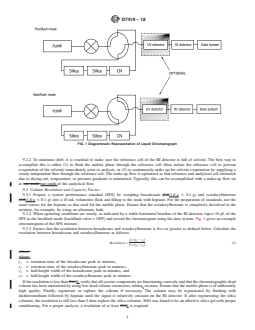
9.1 Set up the liquid chromatograph, injection system, columns, backflush valve, optional column oven, optional UV detector,
refractive index detector, and computing integrator in accordance with the manufacturer’s instructions and as depicted in Fig. 1.
Insert the backflush valve so that the detector is always connected independently of the direction of flow through the column (see
Fig. 1). Maintain the sample injection valve at the same temperature as the sample solution; in most cases this will be at room
temperature. To minimize drifts in signal, ensure that the ambient temperature is relatively constant during analysis and calibration.
9.2 New commercial columns may be packed in water/methanol or other polar solvents. Before these columns can be used, flush
them with dichloromethane followed with heptane before proceeding. Other suitable solvents that restore the required resolution
may be used. If the resolution requirement is not met, the column may be reactivated by flushing it with additional
dichloromethane. If the resolution still cannot be attained, it may be necessary to replace the column or purchase an appropriate
column from other vendors. Si60 silica gel was found effective in yielding acceptable resolution and performance when properly
conditioned. When not analyzing samples, column may be flushed with a low flow of heptane such as 0.1 mL/min.
9.2.1 Adjust the flow rate of the mobile phase to a constant 3.03.0 mL ⁄min to 3.5 mL/min, and ensure the reference cell of the
refractive index detector is full of mobile phase. Fill the reference cell as instructed by the manufacturer.
TABLE 1 Examples of Operating Conditions Used in Cooperative Studies
Lab A Lab B Lab C
Silica Column Varian, 50 cm length by 7.7 mm i.d. 5 μm Si60 Varian, 50 cm by 7.7 mm Si60 (CP28526) Phenomenex, 2 x Si60 (10 by 250 mm, 5 μm
Cyano Column Alltech//YMC, 100 by 10 mm 10 μm Waters/YMC, 100 by 12 mm 5 μm YMC, 10 by 100 mm 5 μm
RI Detector Agilent 1200 Hewlett Packard RI, model HP1047A Shimadzu RID-10A
Heptane Flow (mL/min) 3.5 mL/min 3.0 3.0
Resolution 5 5-6 10.3
Injected Volume (microlitres) 10 10 10
D7419 − 18
FIG. 1 Diagrammatic Representation of Liquid Chromatograph
9.2.2 To minimize drift, it is essential to make sure the reference cell of the RI detector is full of solvent. The best way to
accomplish this is either (1) to flush the mobile phase through the reference cell (then isolate the reference cell to prevent
evaporation of the solvent) immediately prior to analysis, or (2) to continuously make up for solvent evaporation by supplying a
steady independent flow through the reference cell. The make-up flow is optimized so that reference and analytical cell mismatch
due to drying-out, temperature, or pressure gradients is minimized. Typically, this can be accomplished with a make-up flow set
at one tenth one-tenth of the analytical flow.
9.3 Column Resolution and Capacity Factor:
9.3.1 Prepare a system performance standard (SPS) by weighing hexadecane (1.0(1.0 g 6 0.1 g) and octadecylbenzene
(1.0(1.0 g 6 0.1 g) into a 10 mL volumetric flask and filling to the mark with heptane. For the preparation of standards, use the
same source for the heptane as that used for the mobile phase. Ensure that the octadecylbenzene is completely dissolved in the
mixture, for example, by using an ultrasonic bath.
9.3.2 When operating conditions are steady, as indicated by a stable horizontal baseline of the RI detector, inject 10 μL of the
SPS in the foreflush mode (backflush valve = OFF) and record the chromatogram using the data system. Fig. 2 gives an example
chromatogram of the SPS mixture.
9.3.3 Ensure that the resolution between hexadecane and octadecylbenzene is five or greater as defined below. Calculate the
resolution between hexadecane and octadecylbenzene as follows:
23 t 2 t
~ !
2 1
Resolution 5 (1)
33 y 1y
~ !
1 2
where:
where:
t = retention time of the hexadecane peak in minutes,
t = retention time of the octadecylbenzene peak in minutes,
y = half-height width of the hexadecane peak in minutes, and
y = half-height width of the octadecylbenzene peak in minutes.
If the resolution is less than five,5, verify that all system components are functioning correctly and that the chromatographic dead
volume has been minimized by using low dead volume connectors, tubing, etcetera. Ensure that the mobile phase is of sufficiently
high quality. Finally, regenerate or replace the column if necessary. The column may be regenerated by flushing with
dichloromethane followed by heptane until the signal is relatively constant on the RI detector. If after regenerating the silica
columns, the resolution is still less than 5 then replace the silica columns. Si60 was found to be an effective silica gel with proper
conditioning. For a proper analysis, a resolution of at least five5 is required.
D7419 − 18
FIG. 2 Chromatogram of System Performance Standard in Foreflush Mode for Determination of Resolution, Capacity Factor, and Back-
flush Time
NOTE 1—Resolution loss over time may occur if a heptane mobile phase of low water content is not used. Use heptane as specified in this method.
If necessary, dry the heptane with the addition of activated molecular sieves, such as MS 5A and then filter with at least 0.45 micron HPLC filter before
use.
9.3.4 Calculate the capacity factor, k, for octadecylbenzene from 9.3.2 as follows:
~t 2 t !
2 1
Capacity Factor 5 k 5 (2)
t
~ !
where:
where:
t = retention time of the hexadecane peak in minutes,
t = retention time of the octadecylbenzene peak in minutes
t = retention time of the hexadecane peak in minutes, and
t = retention time of the octadecylbenzene peak in minutes.
Ensure that the capacity factor is > 0.4.
9.3.5 Using the determined retention times of the hexadecane and octadecylbenzene peaks in 9.3.2, calculate an approximate
switching valve backflush time, B, in seconds, using the following equation:
B 5 t 10.1 3 t 2 t (3)
~ !
1 2 1
where:where:
t = retention time of hexadecane in minutes, and
t = retention time of octadecylbenzene in minutes.
9.4 Once the backflush time is determined, re-inject the SPS mixture with backflush in place and ensure that the backflush time
as observed as a signal marker on the chromatogram occurs at the base of the eluted saturate peak. The return to baseline shall
display as shown in Fig. 3, point B. This observation shall be made also for all actual lube samples analyze
...