


ASTM C272/C272M-18
(Test Method)Standard Test Method for Water Absorption of Core Materials for Sandwich Constructions
Standard Test Method for Water Absorption of Core Materials for Sandwich Constructions
SIGNIFICANCE AND USE
5.1 Absorbed water affects the characteristic properties of sandwich core materials, such as electrical properties (for example, dielectric constant, loss tangent, and electrical resistance) and mechanical properties (for example, strength and modulus). The mass of absorbed water may also affect the behavior of sandwich structures. It should be noted that in a sandwich panel the presence of facings bonded on two sides of the core may affect the amount of water absorbed by the core.
5.2 This test method provides a standard method of obtaining sandwich core moisture absorption data for design properties, material specifications, research and development applications, and quality assurance.
5.3 Factors that influence the water absorption and shall therefore be reported include the following: core material, methods of material fabrication, core geometry (honeycomb cell size, honeycomb cell wall thickness, foam pore size, etc.), specimen geometry, specimen preparation, methods of mass and dimensional measurement, specimen conditioning, and moisture content during mass and dimensional measurements.
SCOPE
1.1 This test method covers the determination of the relative amount of water absorption by various types of sandwich construction core materials when immersed in water, or when subjected to a high relative humidity environment. Permissible core material forms include those with continuous bonding surfaces (such as balsa wood and foams) as well as those with discontinuous bonding surfaces (such as honeycomb).
1.2 The values stated in either SI units or inch-pound units are to be regarded separately as standard. The values stated in each system may not be exact equivalents; therefore, each system shall be used independently of the other. Combining values from the two systems may result in non-conformance with the standard.
1.2.1 Within the text the inch-pound units are shown in brackets.
1.3 This standard does not purport to address all of the safety concerns, if any, associated with its use. It is the responsibility of the user of this standard to establish appropriate safety, health, and environmental practices and determine the applicability of regulatory limitations prior to use.
1.4 This international standard was developed in accordance with internationally recognized principles on standardization established in the Decision on Principles for the Development of International Standards, Guides and Recommendations issued by the World Trade Organization Technical Barriers to Trade (TBT) Committee.
General Information
- Status
- Published
- Publication Date
- 31-Jul-2018
- Technical Committee
- D30 - Composite Materials
- Drafting Committee
- D30.09 - Sandwich Construction
Relations
- Effective Date
- 01-Aug-2018
- Effective Date
- 01-Feb-2024
- Effective Date
- 01-Nov-2023
- Effective Date
- 01-Apr-2022
- Effective Date
- 01-Jan-2020
- Effective Date
- 15-Oct-2019
- Effective Date
- 01-Aug-2019
- Effective Date
- 15-Apr-2019
- Effective Date
- 15-Apr-2019
- Effective Date
- 01-Feb-2019
- Effective Date
- 01-Dec-2018
- Effective Date
- 01-Nov-2018
- Effective Date
- 01-Apr-2018
- Effective Date
- 01-Oct-2017
- Effective Date
- 01-Oct-2017
Overview
ASTM C272/C272M-18: Standard Test Method for Water Absorption of Core Materials for Sandwich Constructions establishes a uniform procedure to determine the amount of water absorbed by various sandwich construction core materials. Accurate measurement of water absorption is critical because absorbed moisture can significantly affect both the mechanical and electrical properties of core materials used in sandwich panels. This standard applies to core materials with both continuous and discontinuous bonding surfaces, including balsa wood, rigid foams, and honeycomb structures.
By following ASTM C272/C272M-18, manufacturers, testing laboratories, and designers can ensure consistency in evaluating moisture resistance, which is key to product durability, structural performance, and compliance in industries such as aerospace, marine, automotive, and construction.
Key Topics
Test Scope
- Evaluates water absorption in core materials subjected to immersion or high humidity.
- Covers a variety of materials including foams, balsa wood, and honeycomb.
- Specifies results reporting in either SI or inch-pound units.
Significance of Water Absorption
- Mechanical Impact: Water absorption can reduce core strength and modulus.
- Electrical Properties: Moisture affects dielectric constant, loss tangent, and electrical resistance.
- Behaviour in Structures: Total absorbed water influences sandwich panel performance.
Standardized Test Method
- Exposes specimens to controlled moisture conditions (immersion or humidity).
- Measures the change in mass to determine water absorption.
- Procedures for specimen preparation, conditioning, and post-immersion evaluation are detailed.
Reporting Requirements
- Records critical factors such as core material type, fabrication methods, specimen geometry, and conditioning parameters.
- Requires the reporting of measured mass, water absorption percentage, and relevant test details.
Applications
ASTM C272/C272M-18 is widely applied for:
Design and Engineering
- Developing material selection criteria for moisture-critical applications.
- Assessing core materials in sandwich constructions where water resistance is vital.
- Supporting qualification and certification in aerospace, marine, building panels, and transport.
Quality Assurance and Material Specification
- Routine inspection of sandwich panel cores for manufacturing quality control.
- Acceptance testing in procurement specifications.
Research and Development
- Characterizing new core materials and comparing moisture absorption performance.
- Studying how fabrication variables affect water uptake.
Compliance and Documentation
- Ensuring products meet industry and regulatory moisture resistance standards.
- Providing traceable, standardized test records for contract and regulatory requirements.
Related Standards
ASTM C272/C272M-18 references and relates to several other ASTM standards, enhancing its utility and integration within materials testing protocols:
- ASTM D3878: Terminology for Composite Materials, providing shared vocabulary relevant to sandwich constructions.
- ASTM D1193: Specification for Reagent Water, for preparing distilled or deionized water used in testing.
- ASTM E122: Practice for Calculating Sample Size, supporting statistical validity of test results.
- ASTM D883: Terminology Relating to Plastics, for comprehensive material characterization.
- ASTM E456 and E177: Quality and statistics standards, assisting in precision and reporting consistency.
Using ASTM C272/C272M-18 facilitates consistent, reliable measurement of water absorption, fostering improved performance and longevity of sandwich construction products across diverse industries.
Keywords: water absorption, sandwich construction, core materials, ASTM C272, moisture content, core testing, composite panel, quality assurance, material specification, humidity resistance, structural core, foam core, honeycomb core.
Buy Documents
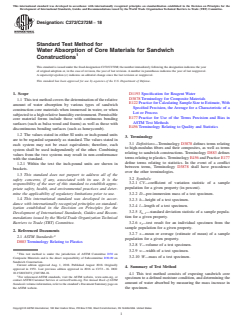
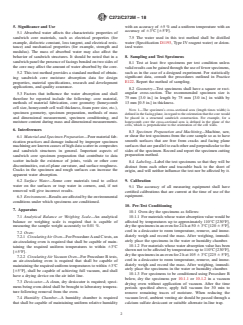
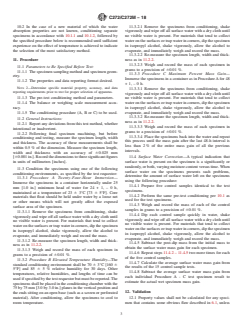

ASTM C272/C272M-18 - Standard Test Method for Water Absorption of Core Materials for Sandwich Constructions
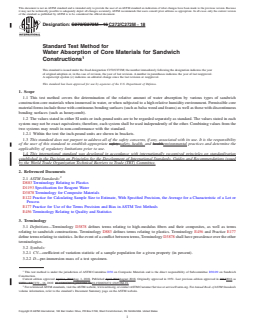
REDLINE ASTM C272/C272M-18 - Standard Test Method for Water Absorption of Core Materials for Sandwich Constructions
Get Certified
Connect with accredited certification bodies for this standard

Smithers Quality Assessments
US management systems and product certification.

DIN CERTCO
DIN Group product certification.
Sponsored listings
Frequently Asked Questions
ASTM C272/C272M-18 is a standard published by ASTM International. Its full title is "Standard Test Method for Water Absorption of Core Materials for Sandwich Constructions". This standard covers: SIGNIFICANCE AND USE 5.1 Absorbed water affects the characteristic properties of sandwich core materials, such as electrical properties (for example, dielectric constant, loss tangent, and electrical resistance) and mechanical properties (for example, strength and modulus). The mass of absorbed water may also affect the behavior of sandwich structures. It should be noted that in a sandwich panel the presence of facings bonded on two sides of the core may affect the amount of water absorbed by the core. 5.2 This test method provides a standard method of obtaining sandwich core moisture absorption data for design properties, material specifications, research and development applications, and quality assurance. 5.3 Factors that influence the water absorption and shall therefore be reported include the following: core material, methods of material fabrication, core geometry (honeycomb cell size, honeycomb cell wall thickness, foam pore size, etc.), specimen geometry, specimen preparation, methods of mass and dimensional measurement, specimen conditioning, and moisture content during mass and dimensional measurements. SCOPE 1.1 This test method covers the determination of the relative amount of water absorption by various types of sandwich construction core materials when immersed in water, or when subjected to a high relative humidity environment. Permissible core material forms include those with continuous bonding surfaces (such as balsa wood and foams) as well as those with discontinuous bonding surfaces (such as honeycomb). 1.2 The values stated in either SI units or inch-pound units are to be regarded separately as standard. The values stated in each system may not be exact equivalents; therefore, each system shall be used independently of the other. Combining values from the two systems may result in non-conformance with the standard. 1.2.1 Within the text the inch-pound units are shown in brackets. 1.3 This standard does not purport to address all of the safety concerns, if any, associated with its use. It is the responsibility of the user of this standard to establish appropriate safety, health, and environmental practices and determine the applicability of regulatory limitations prior to use. 1.4 This international standard was developed in accordance with internationally recognized principles on standardization established in the Decision on Principles for the Development of International Standards, Guides and Recommendations issued by the World Trade Organization Technical Barriers to Trade (TBT) Committee.
SIGNIFICANCE AND USE 5.1 Absorbed water affects the characteristic properties of sandwich core materials, such as electrical properties (for example, dielectric constant, loss tangent, and electrical resistance) and mechanical properties (for example, strength and modulus). The mass of absorbed water may also affect the behavior of sandwich structures. It should be noted that in a sandwich panel the presence of facings bonded on two sides of the core may affect the amount of water absorbed by the core. 5.2 This test method provides a standard method of obtaining sandwich core moisture absorption data for design properties, material specifications, research and development applications, and quality assurance. 5.3 Factors that influence the water absorption and shall therefore be reported include the following: core material, methods of material fabrication, core geometry (honeycomb cell size, honeycomb cell wall thickness, foam pore size, etc.), specimen geometry, specimen preparation, methods of mass and dimensional measurement, specimen conditioning, and moisture content during mass and dimensional measurements. SCOPE 1.1 This test method covers the determination of the relative amount of water absorption by various types of sandwich construction core materials when immersed in water, or when subjected to a high relative humidity environment. Permissible core material forms include those with continuous bonding surfaces (such as balsa wood and foams) as well as those with discontinuous bonding surfaces (such as honeycomb). 1.2 The values stated in either SI units or inch-pound units are to be regarded separately as standard. The values stated in each system may not be exact equivalents; therefore, each system shall be used independently of the other. Combining values from the two systems may result in non-conformance with the standard. 1.2.1 Within the text the inch-pound units are shown in brackets. 1.3 This standard does not purport to address all of the safety concerns, if any, associated with its use. It is the responsibility of the user of this standard to establish appropriate safety, health, and environmental practices and determine the applicability of regulatory limitations prior to use. 1.4 This international standard was developed in accordance with internationally recognized principles on standardization established in the Decision on Principles for the Development of International Standards, Guides and Recommendations issued by the World Trade Organization Technical Barriers to Trade (TBT) Committee.
ASTM C272/C272M-18 is classified under the following ICS (International Classification for Standards) categories: 83.120 - Reinforced plastics. The ICS classification helps identify the subject area and facilitates finding related standards.
ASTM C272/C272M-18 has the following relationships with other standards: It is inter standard links to ASTM C272/C272M-16, ASTM D883-24, ASTM D883-23, ASTM E456-13a(2022)e1, ASTM D883-20, ASTM D3878-19a, ASTM D883-19c, ASTM D3878-19, ASTM D883-19a, ASTM D883-19, ASTM D883-18a, ASTM D883-18, ASTM D3878-18, ASTM E456-13A(2017)e3, ASTM E456-13A(2017)e1. Understanding these relationships helps ensure you are using the most current and applicable version of the standard.
ASTM C272/C272M-18 is available in PDF format for immediate download after purchase. The document can be added to your cart and obtained through the secure checkout process. Digital delivery ensures instant access to the complete standard document.
Standards Content (Sample)
This international standard was developed in accordance with internationally recognized principles on standardization established in the Decision on Principles for the
Development of International Standards, Guides and Recommendations issued by the World Trade Organization Technical Barriers to Trade (TBT) Committee.
Designation: C272/C272M − 18
Standard Test Method for
Water Absorption of Core Materials for Sandwich
Constructions
This standard is issued under the fixed designation C272/C272M; the number immediately following the designation indicates the year
of original adoption or, in the case of revision, the year of last revision.Anumber in parentheses indicates the year of last reapproval.
A superscript epsilon (´) indicates an editorial change since the last revision or reapproval.
This standard has been approved for use by agencies of the U.S. Department of Defense.
1. Scope D1193Specification for Reagent Water
D3878Terminology for Composite Materials
1.1 Thistestmethodcoversthedeterminationoftherelative
E122PracticeforCalculatingSampleSizetoEstimate,With
amount of water absorption by various types of sandwich
Specified Precision, the Average for a Characteristic of a
construction core materials when immersed in water, or when
Lot or Process
subjected to a high relative humidity environment. Permissible
E177Practice for Use of the Terms Precision and Bias in
core material forms include those with continuous bonding
ASTM Test Methods
surfaces (such as balsa wood and foams) as well as those with
E456Terminology Relating to Quality and Statistics
discontinuous bonding surfaces (such as honeycomb).
1.2 The values stated in either SI units or inch-pound units
3. Terminology
are to be regarded separately as standard. The values stated in
3.1 Definitions—Terminology D3878 defines terms relating
each system may not be exact equivalents; therefore, each
to high-modulus fibers and their composites, as well as terms
system shall be used independently of the other. Combining
relating to sandwich constructions. Terminology D883 defines
values from the two systems may result in non-conformance
termsrelatingtoplastics.TerminologyE456andPracticeE177
with the standard.
define terms relating to statistics. In the event of a conflict
1.2.1 Within the text the inch-pound units are shown in
between terms, Terminology D3878 shall have precedence
brackets.
over the other terminologies.
1.3 This standard does not purport to address all of the
3.2 Symbols:
safety concerns, if any, associated with its use. It is the
3.2.1 CV—coefficient of variation statistic of a sample
responsibility of the user of this standard to establish appro-
population for a given property (in percent).
priate safety, health, and environmental practices and deter-
mine the applicability of regulatory limitations prior to use.
3.2.2 D—pre-immersion mass of a test specimen.
1.4 This international standard was developed in accor-
3.2.3 h—height of a test specimen.
dance with internationally recognized principles on standard-
3.2.4 l—length of a test specimen.
ization established in the Decision on Principles for the
3.2.5 S —standard deviation statistic of a sample popula-
Development of International Standards, Guides and Recom-
n–1
tion for a given property.
mendations issued by the World Trade Organization Technical
Barriers to Trade (TBT) Committee.
3.2.6 x —test result for an individual specimen from the
sample population for a given property.
2. Referenced Documents
3.2.7 x—mean or average (estimate of mean) of a sample
2.1 ASTM Standards:
population for a given property.
D883Terminology Relating to Plastics
3.2.8 V—volume of a test specimen.
3.2.9 w—width of a test specimen.
This test method is under the jurisdiction of ASTM Committee D30 on
3.2.10 W—mass of a test specimen.
Composite Materials and is the direct responsibility of Subcommittee D30.09 on
Sandwich Construction.
Current edition approved Aug. 1, 2018. Published August 2018. Originally
4. Summary of Test Method
approved in 1951. Last previous edition approved in 2016 as C272–16. DOI:
10.1520/C0272_C0272M-18.
4.1 This test method consists of exposing sandwich core
For referenced ASTM standards, visit the ASTM website, www.astm.org, or
specimen to a defined moisture condition, and determining the
contact ASTM Customer Service at service@astm.org. For Annual Book of ASTM
amount of water absorbed by measuring the mass increase in
Standards volume information, refer to the standard’s Document Summary page on
the ASTM website. the specimen.
Copyright © ASTM International, 100 Barr Harbor Drive, PO Box C700, West Conshohocken, PA 19428-2959. United States
C272/C272M − 18
5. Significance and Use with an accuracy of 65 % and a uniform temperature with an
accuracy of 63°C [65°F].
5.1 Absorbed water affects the characteristic properties of
sandwich core materials, such as electrical properties (for 7.5 The water used in this test method shall be distilled
example, dielectric constant, loss tangent, and electrical resis- water (Specification D1193, Type IV reagent water) or deion-
tance) and mechanical properties (for example, strength and ized water.
modulus). The mass of absorbed water may also affect the
8. Sampling and Test Specimens
behavior of sandwich structures. It should be noted that in a
sandwichpanelthepresenceoffacingsbondedontwosidesof
8.1 Test at least five specimens per test condition unless
the core may affect the amount of water absorbed by the core.
validresultscanbegainedthroughtheuseoffewerspecimens,
such as in the case of a designed experiment. For statistically
5.2 This test method provides a standard method of obtain-
significant data, consult the procedures outlined in Practice
ing sandwich core moisture absorption data for design
E122. Report the method of sampling.
properties, material specifications, research and development
applications, and quality assurance.
8.2 Geometry—Test specimens shall have a square or rect-
angular cross-section. The recommended specimen size is
5.3 Factors that influence the water absorption and shall
75mm [3.0 in.] in length by 75 mm [3.0 in.] in width by
therefore be reported include the following: core material,
13mm [0.5 in.] in thickness.
methods of material fabrication, core geometry (honeycomb
cell size, honeycomb cell wall thickness, foam pore size, etc.),
NOTE 1—The specimen’s cross-sectional area (length times width) is
specimen geometry, specimen preparation, methods of mass
definedinthefacingplane,inregardtotheorientationthatthecorewould
and dimensional measurement, specimen conditioning, and be placed in a structural sandwich construction. For example, for a
honeycomb core the cross-sectional area is defined in the plane of the
moisture content during mass and dimensional measurements.
cells, which is perpendicular to the orientation of the cell walls.
6. Interferences
8.3 Specimen Preparation and Machining—Machine, saw,
or shear the test specimens from the core sample so as to have
6.1 Material and Specimen Preparation—Poormaterialfab-
smooth surfaces that are free from cracks and facing plane
rication practices and damage induced by improper specimen
surfaces that are parallel to each other and perpendicular to the
machiningareknowncausesofhighdatascatterincomposites
sides of the specimen. Record and report the specimen cutting
and sandwich structures in general. Important aspects of
preparation method.
sandwich core specimen preparation that contribute to data
scatter include the existence of joints, voids or other core
8.4 Labeling—Label the test specimens so that they will be
discontinuities, out-of-plane curvature, and surface roughness.
distinct from each other and traceable back to the sheet of
Cracks in the specimen and rough surfaces can increase the
origin, and will neither influence the test nor be affected by it.
apparent water absorption.
9. Calibration
6.2 Surface Water—Some core materials tend to collect
water on the surfaces or trap water in corners, and, if not
9.1 The accuracy of all measuring equipment shall have
removed will give incorrect results.
certified calibrations that are current at the time of use of the
equipment.
6.3 Environment—Resultsareaffectedbytheenvironmental
conditions under which specimens are conditioned.
10. Pre-Test Conditioning
7. Apparatus
10.1 Oven dry the specimens as follows:
7.1 Analytical Balance or Weighing Scale—An analytical 10.1.1 Formaterialswhosewaterabsorptionvaluewouldbe
balance or weighing scale is required that is capable of affected by temperatures up to approximately 110°C [230°F],
measuring the sample weight accurately to 0.01 %. drythespecimensinanovenfor24hat50 63°C[120 65°F],
cool in a desiccator to room temperature, remove, and imme-
7.2 Oven:
diately weigh and record the mass. After weighing, immedi-
7.2.1 CirculatingAirOven—ForProcedureAandCtests,an
ately place the specimens in the water or humidity chamber.
air-circulating oven is required that shall be capable of main-
10.1.2 For materials whose water absorption value has been
taining the required uniform temperatures to within 63°C
shown not to be affected by temperatures up to 110°C [230°F],
[65°F].
drythespecimensinanovenfor2hat105 63°C[225 65°F],
7.2.2 Circulating Air Vacuum Oven—For Procedure B tests,
cool in a desiccator to room temperature, remove, and imme-
an air-circulating oven is required that shall be capable of
diately weigh and record the mass. After weighing, immedi-
maintainingtherequireduniformtemperaturestowithin 63°C
ately place the specimens in the water or humidity chamber.
[65°F], shall be capable of achieving full vacuum, and shall
10.1.3 For specimens to be conditioned using Procedure B
have a drying device on the air inlet line.
below, dry the specimens per 10.1.1 or 10.1.2 in a vacuum
7.3 Desiccator—A clean, dry desiccator is required; speci-
drying oven without application of vacuum. After the time
mens being oven-dried shall be brought to laboratory tempera-
periods specified above, apply full vacuum for 30 min to
ture following removal from the oven.
remove remaining traces of moisture. When reducing the
7.4 Humidity Chamber—A humidity chamber is required vacuum level, ambient venting air should be passed through a
that shall be capable of maintaining uniform relative humidity calcium sulfate desiccant or suitable alternate in-line trap.
C272/C272M − 18
10.2 In the case of a new material of which the water 11.3.2.1 Remove the specimens from conditioning, s
...
This document is not an ASTM standard and is intended only to provide the user of an ASTM standard an indication of what changes have been made to the previous version. Because
it may not be technically possible to adequately depict all changes accurately, ASTM recommends that users consult prior editions as appropriate. In all cases only the current version
of the standard as published by ASTM is to be considered the official document.
Designation: C272/C272M − 16 C272/C272M − 18
Standard Test Method for
Water Absorption of Core Materials for Sandwich
Constructions
This standard is issued under the fixed designation C272/C272M; the number immediately following the designation indicates the year
of original adoption or, in the case of revision, the year of last revision. A number in parentheses indicates the year of last reapproval.
A superscript epsilon (´) indicates an editorial change since the last revision or reapproval.
This standard has been approved for use by agencies of the U.S. Department of Defense.
1. Scope
1.1 This test method covers the determination of the relative amount of water absorption by various types of sandwich
construction core materials when immersed in water, or when subjected to a high relative humidity environment. Permissible core
material forms include those with continuous bonding surfaces (such as balsa wood and foams) as well as those with discontinuous
bonding surfaces (such as honeycomb).
1.2 The values stated in either SI units or inch-pound units are to be regarded separately as standard. The values stated in each
system may not be exact equivalents; therefore, each system shall be used independently of the other. Combining values from the
two systems may result in non-conformance with the standard.
1.2.1 Within the text the inch-pound units are shown in brackets.
1.3 This standard does not purport to address all of the safety concerns, if any, associated with its use. It is the responsibility
of the user of this standard to establish appropriate safety safety, health, and healthenvironmental practices and determine the
applicability of regulatory limitations prior to use.
1.4 This international standard was developed in accordance with internationally recognized principles on standardization
established in the Decision on Principles for the Development of International Standards, Guides and Recommendations issued
by the World Trade Organization Technical Barriers to Trade (TBT) Committee.
2. Referenced Documents
2.1 ASTM Standards:
D883 Terminology Relating to Plastics
D1193 Specification for Reagent Water
D3878 Terminology for Composite Materials
E122 Practice for Calculating Sample Size to Estimate, With Specified Precision, the Average for a Characteristic of a Lot or
Process
E177 Practice for Use of the Terms Precision and Bias in ASTM Test Methods
E456 Terminology Relating to Quality and Statistics
3. Terminology
3.1 Definitions—Terminology D3878 defines terms relating to high-modulus fibers and their composites, as well as terms
relating to sandwich constructions. Terminology D883 defines terms relating to plastics. Terminology E456 and Practice E177
define terms relating to statistics. In the event of a conflict between terms, Terminology D3878 shall have precedence over the other
terminologies.
3.2 Symbols:
3.2.1 CV—coefficient of variation statistic of a sample population for a given property (in percent).
3.2.2 D—pre-immersion mass of a test specimen.
This test method is under the jurisdiction of ASTM Committee D30 on Composite Materials and is the direct responsibility of Subcommittee D30.09 on Sandwich
Construction.
Current edition approved April 1, 2016Aug. 1, 2018. Published April 2016August 2018. Originally approved in 1951. Last previous edition approved in 20122016 as
C272 – 12.C272 – 16. DOI: 10.1520/C0272_C0272M-16.10.1520/C0272_C0272M-18.
For referenced ASTM standards, visit the ASTM website, www.astm.org, or contact ASTM Customer Service at service@astm.org. For Annual Book of ASTM Standards
volume information, refer to the standard’s Document Summary page on the ASTM website.
Copyright © ASTM International, 100 Barr Harbor Drive, PO Box C700, West Conshohocken, PA 19428-2959. United States
C272/C272M − 18
3.2.3 h—height of a test specimen.
3.2.4 l—length of a test specimen.
3.2.5 S —standard deviation statistic of a sample population for a given property.
n–1
3.2.6 x —test result for an individual specimen from the sample population for a given property.
3.2.7 x—mean or average (estimate of mean) of a sample population for a given property.
3.2.8 V—volume of a test specimen.
3.2.9 w—width of a test specimen.
3.2.10 W—mass of a test specimen.
4. Summary of Test Method
4.1 This test method consists of exposing sandwich core specimen to a defined moisture condition, and determining the amount
of water absorbed by measuring the mass increase in the specimen.
5. Significance and Use
5.1 Absorbed water affects the characteristic properties of sandwich core materials, such as electrical properties (for example,
dielectric constant, loss tangent, and electrical resistance) and mechanical properties (for example, strength and modulus). The
mass of absorbed water may also affect the behavior of sandwich structures. It should be noted that in a sandwich panel the
presence of facings bonded on two sides of the core may affect the amount of water absorbed by the core.
5.2 This test method provides a standard method of obtaining sandwich core moisture absorption data for design properties,
material specifications, research and development applications, and quality assurance.
5.3 Factors that influence the water absorption and shall therefore be reported include the following: core material, methods of
material fabrication, core geometry (honeycomb cell size, honeycomb cell wall thickness, foam pore size, etc.), specimen
geometry, specimen preparation, methods of mass and dimensional measurement, specimen conditioning, and moisture content
during mass and dimensional measurements.
6. Interferences
6.1 Material and Specimen Preparation—Poor material fabrication practices and damage induced by improper specimen
machining are known causes of high data scatter in composites and sandwich structures in general. Important aspects of sandwich
core specimen preparation that contribute to data scatter include the existence of joints, voids or other core discontinuities,
out-of-plane curvature, and surface roughness. Cracks in the specimen and rough surfaces can increase the apparent water
absorption.
6.2 Surface Water—Some core materials tend to collect water on the surfaces or trap water in corners, and, if not removed will
give incorrect results.
6.3 Environment—Results are affected by the environmental conditions under which specimens are conditioned.
7. Apparatus
7.1 Analytical Balance or Weighing Scale—An analytical balance or weighing scale is required that is capable of measuring the
sample weight accurately to 0.001 g.0.01 %.
7.2 Oven:
7.2.1 Circulating Air Oven—For Procedure A and C tests, an air-circulating oven is required that shall be capable of maintaining
the required uniform temperatures to within 63°C [65°F].
7.2.2 Circulating Air Vacuum Oven—For Procedure B tests, an air-circulating oven is required that shall be capable of
maintaining the required uniform temperatures to within 63°C [65°F], shall be capable of achieving full vacuum, and shall have
a drying device on the air inlet line.
7.3 Desiccator—A clean, dry desiccator is required; specimens being oven-dried shall be brought to laboratory temperature
following removal from the oven.
7.4 Humidity Chamber—A humidity chamber is required that shall be capable of maintaining uniform relative humidity with
an accuracy of 65 % and a uniform temperature with an accuracy of 63°C [65°F].
7.5 The water used in this test method shall be distilled water (Specification D1193, Type IV reagent water) or deionized water.
8. Sampling and Test Specimens
8.1 Test at least five specimens per test condition unless valid results can be gained through the use of fewer specimens, such
as in the case of a designed experiment. For statistically significant data, consult the procedures outlined in Practice E122. Report
the method of sampling.
C272/C272M − 18
8.2 Geometry—Test specimens shall have a square or rectangular cross-section. The recommended specimen size is 75 mm [3.0
in.] in length by 75 mm [3.0 in.] in width by 13 mm [0.5 in.] in thickness.
NOTE 1—The specimen’s cross-sectional area (length times width) is defined in the facing plane, in regard to the orientation that the core would be
placed in a structural sandwich construction. For example, for a honeycomb core the cross-sectional area is defined in the plane of the cells, which is
perpendicular to the orientation of the cell walls.
8.3 Specimen Preparation and Machining—Machine, saw, or shear the test specimens from the core sample so as to have
smooth surfaces that are free from cracks and facing plane surfaces that are parallel to each other and perpendicular to the sides
of the specimen. Record and report the specimen cutting preparation method.
8.4 Labeling—Label the test specimens so that they will be distinct from each other and traceable back to the sheet of origin,
and will neither influence the test nor be affected by it.
9. Calibration
9.1 The accuracy of all measuring equipment shall have certified calibrations that are current at the time of use of the equipment.
10. Pre-Test Conditioning
10.1 Oven dry the specimens as follows:
10.1.1 For materials whose water absorption value would be affected by temperatures up to approximately 110°C [230°F], dry
the specimens in an oven for 24 h at 50 6 3°C [120 6 5°F], cool in a desiccator to room temperature, remove, and immediately
weigh and record the mass. After weighing, immediately place the specimens in the water or humidity chamber.
10.1.2 For materials whose water absorption value has been shown not to be affected by temperatures up to 110°C [230°F], dry
the specimens in an oven for 2 h at 105 6 3°C [225 6 5°F], cool in a desiccator to room temperature, remove, and immediately
weigh and record the mass. After weighing, immediately place the specimens in the water or humidity chamber.
10.1.3 For specimens to be conditioned using Procedure B below, dry the specimens per 10.1.1 or 10.1.2 in a vacuum drying
oven without application of vacuum. After the time periods specified above, apply full vacuum for 30 min to remove remaining
traces of moisture. When reducing the vacuum level, ambient venting air should be passed through a calcium sulfate desiccant or
suitable alternate in-line trap.
10.2 In the case of a new material of which the water absorption properties are not kn
...
Questions, Comments and Discussion
Ask us and Technical Secretary will try to provide an answer. You can facilitate discussion about the standard in here.
Loading comments...