

ASTM D8170-20
(Guide)Standard Guide for Using Disposable Handheld Soil Core Samplers for the Collection and Storage of Soil for Volatile Organic Analysis
General Information
- Abstract
SIGNIFICANCE AND USE
5.1 This guide is for the use of disposable handheld soil core samplers in collecting and storing approximately 5 or 25 g soil samples for volatile organic analysis in a manner that reduces loss of contaminants due to volatilization or biodegradation. In general, an initial soil core sample is collected (see Guides D6169/D6169M and D6282/D6282M) and the disposable handheld soil core sampler is then used to collect the 5 or 25 g soil sample from the initial soil core sample. The disposable handheld soil core sampler can also serve as a sample storage chamber.
5.2 The physical integrity of the soil sample is maintained during sample collection, storage, and transfer in the laboratory for analysis or preservation.
5.3 During sample collection, storage, and transfer, there is very limited exposure of the sample to the atmosphere.
5.4 Laboratory subsampling is not required for samples collected following this guide. The sample is expelled directly from the coring body/storage chamber into the appropriate container for analysis, or preservation, at the analytical laboratory without disrupting the integrity of the sample. Subsampling from the disposable handheld soil core sampler should not be performed to obtain smaller sample sizes for analysis.
5.5 This guide specifies sample storage in the disposable handheld soil core sampler at 4 ± 2°C for up to 48 h.
5.6 This guide does not use methanol preservation or other chemical preservatives in the field. As a result, there are no problems associated with flammability hazards, shipping restrictions, or dilution of samples containing low volatile concentrations due to solvents being added to samples in the field.
5.7 The disposable handheld soil core samplers are single-use devices. They should not be cleaned or reused.
5.8 This disposable handheld soil core samplers cannot be used for collecting cemented material, consolidated material, or material having fragments wider than the mouth of the device or coa...
SCOPE
1.1 This guide is intended for application to soils that may contain volatile organic compounds.
1.2 This guide provides a general procedure and considerations associated with using a disposable handheld soil core sampler to collect and temporarily store a soil sample for volatile organic analysis.
1.3 In general, an initial soil sample is collected (see Guides D6169/D6169M and D6282/D6282M) and the disposable handheld soil core sampler is then used to collect the 5 or 25 g soil sample from the initial soil core sample. The disposable handheld soil core sampler can also serve as a sample storage chamber. It is recommended that this standard be used in conjunction with Guides D4547, D4687, D6169/D6169M, D6232, D6282/D6282M, D6418, and D6640, as appropriate, which provide information on the collection of the initial soil core sample.
1.4 Units—The values stated in SI units are to be regarded as standard. No other units of measurement are included in this standard. All observed and calculated values shall conform to the guidelines for significant digits and rounding established in Practice D6026. Reporting of test results in units other than SI shall not be regarded as nonconformance with this standard.
1.5 This guide offers an organized collection of information or a series of options and does not recommend a specific course of action. This document cannot replace education or experience and should be used in conjunction with professional judgment. Not all aspects of this guide may be applicable in all circumstances. This ASTM standard is not intended to represent or replace the standard of care by which the adequacy of a given professional service must be judged, nor should this document be applied without consideration of a project’s many unique aspects. The word “Standard” in the title of this document means only that the document has been approved through the ASTM consensus process.
1.6 This standard doe...
- Status
- Published
- Publication Date
- 31-May-2020
- Technical Committee
- D18 - Soil and Rock
- Drafting Committee
- D18.21 - Groundwater and Vadose Zone Investigations

Overview
ASTM D8170-20 is the internationally recognized standard guide developed by ASTM International for the use of disposable handheld soil core samplers in collecting and storing soil samples targeted for volatile organic analysis. The purpose of this guide is to outline procedures that minimize the loss of contaminants due to volatilization or biodegradation during sampling, storage, and transfer to the laboratory. By focusing on best practices and practical solutions, this standard promotes effective and reliable collection of soil samples for volatile organic compound (VOC) analysis, contributing to accurate environmental monitoring and compliance.
Key Topics
- Minimizing Contaminant Loss: The guide emphasizes techniques for reducing atmospheric exposure of soil samples to prevent volatilization and biodegradation of VOCs.
- Sample Integrity: The design and use of the disposable handheld soil core sampler help protect the physical integrity of the soil throughout collection, storage, and transfer.
- Sample Storage: Collected samples are securely stored within the same sampler at 4 ± 2°C for up to 48 hours, ensuring integrity without chemical field preservatives.
- No Methanol or Chemical Preservatives: By avoiding chemical preservatives like methanol, issues related to flammability, shipping hazards, and dilution of samples are eliminated.
- Single-Use Devices: The standard specifies that disposable handheld soil core samplers are single-use, ensuring no cross-contamination between samples.
- Direct Transfer for Analysis: Laboratory subsampling is not required if collected according to this guide; the sample is expelled directly into the analysis or preservation container.
- Applicable Soils: The guide is applicable to soils that may contain VOCs but is not suitable for cemented, consolidated, or highly fragmented materials.
Applications
ASTM D8170-20 is valuable in a variety of environmental and regulatory contexts, including:
- Environmental Site Assessments: Collecting soil samples for VOC analysis at potentially contaminated sites and during routine monitoring.
- Waste Site Investigations: Gathering data for waste characterization, remediation planning, or compliance with environmental regulations.
- Laboratory Submissions: Providing an efficient workflow where samples can be transferred directly from the field sampler to laboratory analysis, reducing risk of contamination or loss.
- Field Sampling Programs: Supporting field teams with a simple, effective method for collecting discrete, undisturbed soil samples without the need for on-site chemical preservation.
- Data Quality Objectives (DQOs): Helping users meet project data quality requirements by minimizing sample handling and preserving VOC concentrations.
Related Standards
For the most robust soil sampling and analysis program, ASTM D8170-20 should be used in conjunction with other key standards:
- ASTM D4547: Guide for Sampling Waste and Soils for Volatile Organic Compounds
- ASTM D4687: Guide for General Planning of Waste Sampling
- ASTM D6169/D6169M: Guide for Selection of Soil and Rock Sampling Devices Used With Drill Rigs for Environmental Investigations
- ASTM D6282/D6282M: Guide for Direct Push Soil Sampling for Environmental Site Characterizations
- ASTM D6418: Practice for Using the Disposable En Core Sampler for Sampling and Storing Soil for Volatile Organic Analysis
- ASTM D6640: Practice for Collection and Handling of Soils Obtained in Core Barrel Samplers for Environmental Investigations
- ASTM D6026: Practice for Using Significant Digits in Geotechnical Data
Practical Value
The adoption of ASTM D8170-20 enables environmental professionals to:
- Ensure accurate VOC analysis results by minimizing sample exposure and handling
- Streamline sampling processes in the field and laboratory
- Meet regulatory requirements for soil sampling and analysis
- Avoid complications related to chemical preservatives and shipping restrictions
- Improve overall data quality for environmental assessments
By following this standard, organizations demonstrate a commitment to best practices in soil sampling for volatile organic analysis, fostering confidence in analytical results and regulatory compliance.
Relations
- Effective Date
- 01-Nov-2023
- Effective Date
- 01-Nov-2023
- Effective Date
- 01-May-2020
- Effective Date
- 01-Oct-2019
- Effective Date
- 01-Sep-2015
- Effective Date
- 01-Sep-2015
- Effective Date
- 01-Aug-2015
- Effective Date
- 15-Jan-2015
- Effective Date
- 01-Aug-2014
- Effective Date
- 01-May-2012
- Effective Date
- 01-Mar-2012
- Effective Date
- 01-Sep-2011
- Effective Date
- 01-Sep-2011
- Effective Date
- 01-Dec-2010
- Effective Date
- 01-May-2010
Get Certified
Connect with accredited certification bodies for this standard

CIS Institut d.o.o.
Personal Protective Equipment (PPE) certification body. Notified Body NB-2890 for EU Regulation 2016/425 PPE.

Kiwa BDA Testing
Building and construction product certification.
Kmetijski inštitut Slovenije
Agricultural Institute of Slovenia. Soil testing, plant health, agricultural product analysis.
Sponsored listings
Frequently Asked Questions
ASTM D8170-20 is a guide published by ASTM International. Its full title is "Standard Guide for Using Disposable Handheld Soil Core Samplers for the Collection and Storage of Soil for Volatile Organic Analysis". This standard covers: SIGNIFICANCE AND USE 5.1 This guide is for the use of disposable handheld soil core samplers in collecting and storing approximately 5 or 25 g soil samples for volatile organic analysis in a manner that reduces loss of contaminants due to volatilization or biodegradation. In general, an initial soil core sample is collected (see Guides D6169/D6169M and D6282/D6282M) and the disposable handheld soil core sampler is then used to collect the 5 or 25 g soil sample from the initial soil core sample. The disposable handheld soil core sampler can also serve as a sample storage chamber. 5.2 The physical integrity of the soil sample is maintained during sample collection, storage, and transfer in the laboratory for analysis or preservation. 5.3 During sample collection, storage, and transfer, there is very limited exposure of the sample to the atmosphere. 5.4 Laboratory subsampling is not required for samples collected following this guide. The sample is expelled directly from the coring body/storage chamber into the appropriate container for analysis, or preservation, at the analytical laboratory without disrupting the integrity of the sample. Subsampling from the disposable handheld soil core sampler should not be performed to obtain smaller sample sizes for analysis. 5.5 This guide specifies sample storage in the disposable handheld soil core sampler at 4 ± 2°C for up to 48 h. 5.6 This guide does not use methanol preservation or other chemical preservatives in the field. As a result, there are no problems associated with flammability hazards, shipping restrictions, or dilution of samples containing low volatile concentrations due to solvents being added to samples in the field. 5.7 The disposable handheld soil core samplers are single-use devices. They should not be cleaned or reused. 5.8 This disposable handheld soil core samplers cannot be used for collecting cemented material, consolidated material, or material having fragments wider than the mouth of the device or coa... SCOPE 1.1 This guide is intended for application to soils that may contain volatile organic compounds. 1.2 This guide provides a general procedure and considerations associated with using a disposable handheld soil core sampler to collect and temporarily store a soil sample for volatile organic analysis. 1.3 In general, an initial soil sample is collected (see Guides D6169/D6169M and D6282/D6282M) and the disposable handheld soil core sampler is then used to collect the 5 or 25 g soil sample from the initial soil core sample. The disposable handheld soil core sampler can also serve as a sample storage chamber. It is recommended that this standard be used in conjunction with Guides D4547, D4687, D6169/D6169M, D6232, D6282/D6282M, D6418, and D6640, as appropriate, which provide information on the collection of the initial soil core sample. 1.4 Units—The values stated in SI units are to be regarded as standard. No other units of measurement are included in this standard. All observed and calculated values shall conform to the guidelines for significant digits and rounding established in Practice D6026. Reporting of test results in units other than SI shall not be regarded as nonconformance with this standard. 1.5 This guide offers an organized collection of information or a series of options and does not recommend a specific course of action. This document cannot replace education or experience and should be used in conjunction with professional judgment. Not all aspects of this guide may be applicable in all circumstances. This ASTM standard is not intended to represent or replace the standard of care by which the adequacy of a given professional service must be judged, nor should this document be applied without consideration of a project’s many unique aspects. The word “Standard” in the title of this document means only that the document has been approved through the ASTM consensus process. 1.6 This standard doe...
SIGNIFICANCE AND USE 5.1 This guide is for the use of disposable handheld soil core samplers in collecting and storing approximately 5 or 25 g soil samples for volatile organic analysis in a manner that reduces loss of contaminants due to volatilization or biodegradation. In general, an initial soil core sample is collected (see Guides D6169/D6169M and D6282/D6282M) and the disposable handheld soil core sampler is then used to collect the 5 or 25 g soil sample from the initial soil core sample. The disposable handheld soil core sampler can also serve as a sample storage chamber. 5.2 The physical integrity of the soil sample is maintained during sample collection, storage, and transfer in the laboratory for analysis or preservation. 5.3 During sample collection, storage, and transfer, there is very limited exposure of the sample to the atmosphere. 5.4 Laboratory subsampling is not required for samples collected following this guide. The sample is expelled directly from the coring body/storage chamber into the appropriate container for analysis, or preservation, at the analytical laboratory without disrupting the integrity of the sample. Subsampling from the disposable handheld soil core sampler should not be performed to obtain smaller sample sizes for analysis. 5.5 This guide specifies sample storage in the disposable handheld soil core sampler at 4 ± 2°C for up to 48 h. 5.6 This guide does not use methanol preservation or other chemical preservatives in the field. As a result, there are no problems associated with flammability hazards, shipping restrictions, or dilution of samples containing low volatile concentrations due to solvents being added to samples in the field. 5.7 The disposable handheld soil core samplers are single-use devices. They should not be cleaned or reused. 5.8 This disposable handheld soil core samplers cannot be used for collecting cemented material, consolidated material, or material having fragments wider than the mouth of the device or coa... SCOPE 1.1 This guide is intended for application to soils that may contain volatile organic compounds. 1.2 This guide provides a general procedure and considerations associated with using a disposable handheld soil core sampler to collect and temporarily store a soil sample for volatile organic analysis. 1.3 In general, an initial soil sample is collected (see Guides D6169/D6169M and D6282/D6282M) and the disposable handheld soil core sampler is then used to collect the 5 or 25 g soil sample from the initial soil core sample. The disposable handheld soil core sampler can also serve as a sample storage chamber. It is recommended that this standard be used in conjunction with Guides D4547, D4687, D6169/D6169M, D6232, D6282/D6282M, D6418, and D6640, as appropriate, which provide information on the collection of the initial soil core sample. 1.4 Units—The values stated in SI units are to be regarded as standard. No other units of measurement are included in this standard. All observed and calculated values shall conform to the guidelines for significant digits and rounding established in Practice D6026. Reporting of test results in units other than SI shall not be regarded as nonconformance with this standard. 1.5 This guide offers an organized collection of information or a series of options and does not recommend a specific course of action. This document cannot replace education or experience and should be used in conjunction with professional judgment. Not all aspects of this guide may be applicable in all circumstances. This ASTM standard is not intended to represent or replace the standard of care by which the adequacy of a given professional service must be judged, nor should this document be applied without consideration of a project’s many unique aspects. The word “Standard” in the title of this document means only that the document has been approved through the ASTM consensus process. 1.6 This standard doe...
ASTM D8170-20 is classified under the following ICS (International Classification for Standards) categories: 13.080.99 - Other standards related to soil quality. The ICS classification helps identify the subject area and facilitates finding related standards.
ASTM D8170-20 has the following relationships with other standards: It is inter standard links to ASTM D5792-10(2023), ASTM D3740-23, ASTM D5088-20, ASTM D3740-19, ASTM D5792-10(2015), ASTM D4547-15, ASTM D5088-15a, ASTM D5088-15, ASTM D653-14, ASTM D3740-12a, ASTM D3740-12, ASTM D653-11, ASTM D3740-11, ASTM D5792-10, ASTM D6640-01(2010). Understanding these relationships helps ensure you are using the most current and applicable version of the standard.
ASTM D8170-20 is available in PDF format for immediate download after purchase. The document can be added to your cart and obtained through the secure checkout process. Digital delivery ensures instant access to the complete standard document.
Standards Content (Sample)
This international standard was developed in accordance with internationally recognized principles on standardization established in the Decision on Principles for the
Development of International Standards, Guides and Recommendations issued by the World Trade Organization Technical Barriers to Trade (TBT) Committee.
Designation: D8170 − 20
Standard Guide for
Using Disposable Handheld Soil Core Samplers for the
Collection and Storage of Soil for Volatile Organic Analysis
This standard is issued under the fixed designation D8170; the number immediately following the designation indicates the year of
original adoption or, in the case of revision, the year of last revision. A number in parentheses indicates the year of last reapproval. A
superscript epsilon (´) indicates an editorial change since the last revision or reapproval.
1. Scope 1.6 This standard does not purport to address all of the
safety concerns, if any, associated with its use. It is the
1.1 This guide is intended for application to soils that may
responsibility of the user of this standard to establish appro-
contain volatile organic compounds.
priate safety, health, and environmental practices and deter-
1.2 This guide provides a general procedure and consider-
mine the applicability of regulatory limitations prior to use.
ations associated with using a disposable handheld soil core
1.7 This international standard was developed in accor-
sampler to collect and temporarily store a soil sample for
dance with internationally recognized principles on standard-
volatile organic analysis.
ization established in the Decision on Principles for the
1.3 In general, an initial soil sample is collected (see Guides Development of International Standards, Guides and Recom-
mendations issued by the World Trade Organization Technical
D6169/D6169M and D6282/D6282M) and the disposable
handheld soil core sampler is then used to collect the 5 or 25 Barriers to Trade (TBT) Committee.
g soil sample from the initial soil core sample. The disposable
handheld soil core sampler can also serve as a sample storage 2. Referenced Documents
chamber. It is recommended that this standard be used in
2.1 ASTM Standards:
conjunction with Guides D4547, D4687, D6169/D6169M,
D653 Terminology Relating to Soil, Rock, and Contained
D6232, D6282/D6282M, D6418, and D6640, as appropriate,
Fluids
which provide information on the collection of the initial soil
D3740 Practice for Minimum Requirements for Agencies
core sample.
Engaged in Testing and/or Inspection of Soil and Rock as
Used in Engineering Design and Construction
1.4 Units—The values stated in SI units are to be regarded
D4547 Guide for Sampling Waste and Soils for Volatile
as standard. No other units of measurement are included in this
Organic Compounds
standard. All observed and calculated values shall conform to
the guidelines for significant digits and rounding established in D4687 Guide for General Planning of Waste Sampling
D5088 Practice for Decontamination of Field Equipment
Practice D6026. Reporting of test results in units other than SI
shall not be regarded as nonconformance with this standard. Used at Waste Sites
D5792 Practice for Generation of Environmental Data Re-
1.5 This guide offers an organized collection of information
lated to Waste Management Activities: Development of
oraseriesofoptionsanddoesnotrecommendaspecificcourse
Data Quality Objectives
of action. This document cannot replace education or experi-
D6026 Practice for Using Significant Digits in Geotechnical
ence and should be used in conjunction with professional
Data
judgment. Not all aspects of this guide may be applicable in all
D6169/D6169M Guide for Selection of Soil and Rock Sam-
circumstances. This ASTM standard is not intended to repre-
pling Devices Used With Drill Rigs for Environmental
sent or replace the standard of care by which the adequacy of
Investigations
a given professional service must be judged, nor should this
D6232 Guide for Selection of Sampling Equipment for
document be applied without consideration of a project’s many
WasteandContaminatedMediaDataCollectionActivities
unique aspects. The word “Standard” in the title of this
D6282/D6282M Guide for Direct Push Soil Sampling for
document means only that the document has been approved
Environmental Site Characterizations
through the ASTM consensus process.
D6418 Practice for Using the Disposable En Core Sampler
ThistestmethodisunderthejurisdictionofASTMCommitteeD18onSoiland
Rock and is the direct responsibility of Subcommittee D18.21 on Groundwater and For referenced ASTM standards, visit the ASTM website, www.astm.org, or
Vadose Zone Investigations. contact ASTM Customer Service at service@astm.org. For Annual Book of ASTM
Current edition approved June 1, 2020. Published June 2020. DOI: 10.1520/ Standards volume information, refer to the standard’s Document Summary page on
D8170-20. the ASTM website.
Copyright © ASTM International, 100 Barr Harbor Drive, PO Box C700, West Conshohocken, PA 19428-2959. United States
D8170 − 20
for Sampling and Storing Soil for Volatile OrganicAnaly- 5.3 During sample collection, storage, and transfer, there is
sis (Withdrawn 2018) very limited exposure of the sample to the atmosphere.
D6640 Practice for Collection and Handling of Soils Ob-
5.4 Laboratory subsampling is not required for samples
tained in Core Barrel Samplers for Environmental Inves-
collected following this guide. The sample is expelled directly
tigations
from the coring body/storage chamber into the appropriate
container for analysis, or preservation, at the analytical labo-
3. Terminology
ratory without disrupting the integrity of the sample. Subsam-
3.1 Definitions—For definitions of common technical terms
pling from the disposable handheld soil core sampler should
used in this standard, refer to Terminology D653.
not be performed to obtain smaller sample sizes for analysis.
4. Summary of Guide
5.5 This guide specifies sample storage in the disposable
handheld soil core sampler at 4 6 2°C for up to 48 h.
4.1 This guide discusses the use of disposable handheld soil
core samplers to collect and store a soil sample of approxi-
5.6 This guide does not use methanol preservation or other
mately 5 or 25 g for volatile organic analysis. The disposable
chemical preservatives in the field. As a result, there are no
handheld soil core samplers, which generally consist of a
problems associated with flammability hazards, shipping
coring body/storage chamber, O-ring sealed plunger, and
restrictions, or dilution of samples containing low volatile
air-tight sealing cap, are designed to collect and hold a soil
concentrations due to solvents being added to samples in the
sample during shipment to the laboratory for analysis. The
field.
disposable handheld soil core sampler should be made to
5.7 The disposable handheld soil core samplers are single-
prevent the release of volatile organic compounds and should
use devices. They should not be cleaned or reused.
not adsorb the volatile organic compounds.
5.8 This disposable handheld soil core samplers cannot be
4.2 After the sample is collected in the disposable handheld
used for collecting cemented material, consolidated material,
soil core sampler, the coring body/storage chamber is sealed
or material having fragments wider than the mouth of the
with an air-tight cap and immediately becomes a sample
device or coarse enough to interfere with proper coring
storage chamber. To minimize loss of volatile compounds due
techniques.
to volatilization or biodegradation from the time of collection
NOTE 1—The quality of the result produced by this standard is
until analysis or chemical preservation in the laboratory,
dependent on the competence of the personnel performing it, and the
sample storage in the disposable handheld soil core sampler is
suitability of the equipment and facilities used. Agencies that meet the
specified at 4 6 2°C for up to 48 h (see Guide D4547, Practice
criteria of Practice D3740 are generally considered capable of competent
and objective sampling. Users of this practice are cautioned that compli-
D6418, and any local, regional or national requirement, for
ancewithPracticeD3740doesnotinitselfassurereliableresults.Reliable
example USEPA SW-846 Method 5035A in the United
results depend on many factors; Practice D3740 provides a means of
States). For storage periods beyond 48 h, other storage tem-
evaluating some of those factors.
peratures can be used as an option, provided it can be shown
Practice D3740 was developed for agencies engaged in the laboratory
that the longer storage time used does not influence the testing and/or inspection of soil and rock. As such, it is not totally
applicable to agencies performing this practice. However, user of this
concentrations of the volatile organic compounds (VOCs) of
practice should recognize that the framework of practice D3740 is
interest in the samples (see Guide D4547), or that the data
appropriate for evaluating the quality of an agency performing this
generated by analysis of the samples meet the data quality
practice. Currently there is no known qualifying national authority that
objectives (DQOs) (see Practice D5792).
inspects agencies that perform this practice.
5. Significance and Use
6. Apparatus
5.1 Thisguideisfortheuseofdisposablehandheldsoilcore
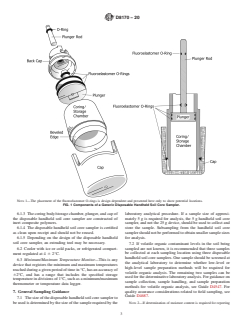
6.1 Disposable Handheld Soil Core Sampler—The dispos-
samplers in collecting and storing approximately 5 or 25 g soil
able handheld soil core sampler has three basic components:
samples for volatile organic analysis in a manner that reduces
the coring body/storage chamber, which is volumetrically
loss of contaminants due to volatilization or biodegradation. In
designed to collect and store a soil sample of approximately 5
general, an
...