


ASTM F2389-23
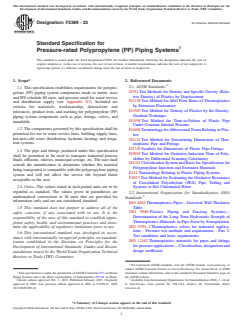
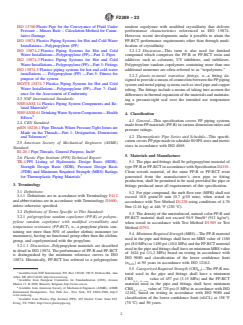
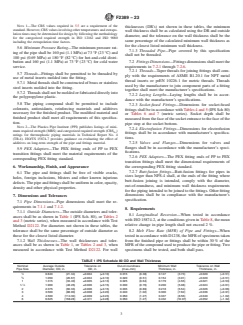
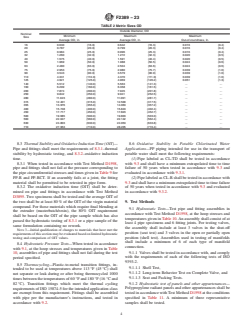
(Specification)Standard Specification for Pressure-rated Polypropylene (PP) Piping Systems
Standard Specification for Pressure-rated Polypropylene (PP) Piping Systems
ABSTRACT
This specification establishes the requirements for polypropylene (PP) piping system components such as pipe, fittings, valves, and manifolds used in water service lines, hot-and-cold water distribution, hydronic heating, and irrigation systems to transport industrial process fluids, effluents, slurries, municipal sewage, etc. The piping system components covered here are made to metric sizes and IPS schedule 80 sizes, and pressure rated for water service and distribution supply. When tested according to the procedures provided herein, the piping components shall adhere to specified requirements for workmanship, dimensions, longitudinal reversion, melt flow rate, impact resistance, thermal stability and oxidative induction time (OIT), hydrostatic pressure, thermocycling, and oxidative stability in potable chlorinated water.
SCOPE
1.1 This specification establishes requirements for polypropylene (PP) piping system components made to metric sizes and IPS schedule 80 sizes, and pressure rated for water service and distribution supply (see Appendix X1). Included are criteria for materials, workmanship, dimensions and tolerances, product tests, and marking for polypropylene (PP) piping system components such as pipe, fittings, valves, and manifolds.
1.2 The components governed by this specification shall be permitted for use in water service lines, building supply lines, hot-and-cold water distribution, hydronic heating, and irrigation systems.
1.3 The pipe and fittings produced under this specification shall be permitted to be used to transport industrial process fluids, effluents, slurries, municipal sewage, etc. The user shall consult the manufacturer to determine whether the material being transported is compatible with the polypropylene piping system and will not affect the service life beyond limits acceptable to the user.
1.4 Units—The values stated in inch-pound units are to be regarded as standard. The values given in parentheses are mathematical conversions to SI units that are provided for information only and are not considered standard.
1.5 This standard does not purport to address all of the safety concerns, if any, associated with its use. It is the responsibility of the user of this standard to establish appropriate safety, health, and environmental practices and determine the applicability of regulatory limitations prior to use.
1.6 This international standard was developed in accordance with internationally recognized principles on standardization established in the Decision on Principles for the Development of International Standards, Guides and Recommendations issued by the World Trade Organization Technical Barriers to Trade (TBT) Committee.
General Information
- Status
- Published
- Publication Date
- 31-Jan-2023
- Technical Committee
- F17 - Plastic Piping Systems
- Drafting Committee
- F17.61 - Water
Relations
- Effective Date
- 01-Feb-2024
- Refers
ASTM D1238-23a - Standard Test Method for Melt Flow Rates of Thermoplastics by Extrusion Plastometer - Effective Date
- 15-Nov-2023
- Effective Date
- 01-Apr-2020
- Effective Date
- 01-Jan-2019
- Refers
ASTM D1600-18 - Standard Terminology for Abbreviated Terms Relating to Plastics (Withdrawn 2024) - Effective Date
- 01-Jan-2018
- Effective Date
- 01-Aug-2017
- Effective Date
- 01-Feb-2017
- Effective Date
- 15-Nov-2016
- Effective Date
- 01-Aug-2016
- Effective Date
- 01-Nov-2015
- Effective Date
- 01-Jun-2015
- Refers
ASTM D2122-15 - Standard Test Method for Determining Dimensions of Thermoplastic Pipe and Fittings - Effective Date
- 15-Mar-2015
- Effective Date
- 01-Mar-2014
- Effective Date
- 01-Mar-2014
- Effective Date
- 01-Feb-2014
Overview
ASTM F2389-23 is the international standard specification for pressure-rated polypropylene (PP) piping system components. Developed by ASTM International, this standard outlines requirements for pipes, fittings, valves, and manifolds made from polypropylene that are designed for use in water service lines, hot-and-cold water distribution, hydronic heating, irrigation, and the transport of various industrial and municipal fluids. These system components are manufactured in both metric and IPS schedule 80 sizes and must meet stringent criteria for pressure rating, durability, and performance when conveying fluids under pressure.
By adhering to ASTM F2389-23, manufacturers, engineers, and specifiers ensure that PP piping systems are robust, safe, and suitable for a wide range of demanding applications in potable water, industrial process fluids, effluent, slurries, and sewage management.
Key Topics
- Scope and Coverage: Specifies requirements for PP piping components in metric and IPS Sch 80 sizes, covering pipes, fittings, valves, and manifolds.
- Material Types: Supports both PP-R (polypropylene random copolymer) and PP-RCT (modified crystallinity and temperature resistance).
- Performance Requirements: Includes standards for workmanship, dimensions, tolerances, product testing, and marking.
- Testing and Quality: Details product tests for melt flow rate, density, impact resistance, hydrostatic pressure, oxidative stability, and thermocycling.
- Marking: Mandates clear manufacturer and product identification, size, pressure ratings, and material type marking to ensure traceability and compliance.
- Potable Water Requirements: Pipes and components for potable water must be certified according to NSF/ANSI standards for health safety.
- Compatibility and Use Cases: Users must verify material compatibility with transported fluids to ensure optimal service life and safety.
Applications
ASTM F2389-23 polypropylene piping systems are widely used for:
- Potable Water Services: Reliable distribution of both hot and cold potable water in residential, commercial, and institutional buildings.
- Hydronic Heating Systems: Efficient and corrosion-resistant options for hot water heating distribution due to PP's chemical stability and pressure rating.
- Irrigation Systems: Durable and leak-resistant piping for agricultural and landscape irrigation.
- Industrial and Municipal Fluids: Safe transport of process fluids, effluents, and municipal sewage, as well as slurries and chemicals, with proper validation for compatibility.
- Retrofitting and New Construction: Well-suited for both new installations and the replacement or upgrade of metal or other plastic piping systems because of excellent chemical resistance and long-term reliability.
Related Standards
When specifying or installing PP piping systems according to ASTM F2389-23, reference to related standards ensures comprehensive compliance and system integrity:
- ASTM D4101: Polypropylene Injection and Extrusion Materials
- ASTM D1238: Melt Flow Rates of Thermoplastics
- ASTM D1598: Time-to-Failure of Plastic Pipe Under Constant Internal Pressure
- ASTM D2122: Determining Dimensions of Thermoplastic Pipe and Fittings
- ISO 15874: Plastics Piping Systems for Hot and Cold Water Installations - Polypropylene (PP)
- NSF/ANSI 61: Drinking Water System Components - Health Effects
- ASME B1.20.1: Pipe Threads, General Purpose, Inch
By adhering to ASTM F2389-23 and related standards, piping systems achieve high reliability, safety, and regulatory compliance for diverse water and fluid transport needs. This standard is essential for those involved in engineering, specifying, or installing PP piping systems across multiple sectors.
Buy Documents
ASTM F2389-23 - Standard Specification for Pressure-rated Polypropylene (PP) Piping Systems
REDLINE ASTM F2389-23 - Standard Specification for Pressure-rated Polypropylene (PP) Piping Systems
Get Certified
Connect with accredited certification bodies for this standard

Institut za varilstvo d.o.o. (Welding Institute)
Slovenia's leading welding institute since 1952. ISO 3834, EN 1090, pressure equipment certification, NDT personnel, welder qualification. Only IIW Au
Sponsored listings
Frequently Asked Questions
ASTM F2389-23 is a technical specification published by ASTM International. Its full title is "Standard Specification for Pressure-rated Polypropylene (PP) Piping Systems". This standard covers: ABSTRACT This specification establishes the requirements for polypropylene (PP) piping system components such as pipe, fittings, valves, and manifolds used in water service lines, hot-and-cold water distribution, hydronic heating, and irrigation systems to transport industrial process fluids, effluents, slurries, municipal sewage, etc. The piping system components covered here are made to metric sizes and IPS schedule 80 sizes, and pressure rated for water service and distribution supply. When tested according to the procedures provided herein, the piping components shall adhere to specified requirements for workmanship, dimensions, longitudinal reversion, melt flow rate, impact resistance, thermal stability and oxidative induction time (OIT), hydrostatic pressure, thermocycling, and oxidative stability in potable chlorinated water. SCOPE 1.1 This specification establishes requirements for polypropylene (PP) piping system components made to metric sizes and IPS schedule 80 sizes, and pressure rated for water service and distribution supply (see Appendix X1). Included are criteria for materials, workmanship, dimensions and tolerances, product tests, and marking for polypropylene (PP) piping system components such as pipe, fittings, valves, and manifolds. 1.2 The components governed by this specification shall be permitted for use in water service lines, building supply lines, hot-and-cold water distribution, hydronic heating, and irrigation systems. 1.3 The pipe and fittings produced under this specification shall be permitted to be used to transport industrial process fluids, effluents, slurries, municipal sewage, etc. The user shall consult the manufacturer to determine whether the material being transported is compatible with the polypropylene piping system and will not affect the service life beyond limits acceptable to the user. 1.4 Units—The values stated in inch-pound units are to be regarded as standard. The values given in parentheses are mathematical conversions to SI units that are provided for information only and are not considered standard. 1.5 This standard does not purport to address all of the safety concerns, if any, associated with its use. It is the responsibility of the user of this standard to establish appropriate safety, health, and environmental practices and determine the applicability of regulatory limitations prior to use. 1.6 This international standard was developed in accordance with internationally recognized principles on standardization established in the Decision on Principles for the Development of International Standards, Guides and Recommendations issued by the World Trade Organization Technical Barriers to Trade (TBT) Committee.
ABSTRACT This specification establishes the requirements for polypropylene (PP) piping system components such as pipe, fittings, valves, and manifolds used in water service lines, hot-and-cold water distribution, hydronic heating, and irrigation systems to transport industrial process fluids, effluents, slurries, municipal sewage, etc. The piping system components covered here are made to metric sizes and IPS schedule 80 sizes, and pressure rated for water service and distribution supply. When tested according to the procedures provided herein, the piping components shall adhere to specified requirements for workmanship, dimensions, longitudinal reversion, melt flow rate, impact resistance, thermal stability and oxidative induction time (OIT), hydrostatic pressure, thermocycling, and oxidative stability in potable chlorinated water. SCOPE 1.1 This specification establishes requirements for polypropylene (PP) piping system components made to metric sizes and IPS schedule 80 sizes, and pressure rated for water service and distribution supply (see Appendix X1). Included are criteria for materials, workmanship, dimensions and tolerances, product tests, and marking for polypropylene (PP) piping system components such as pipe, fittings, valves, and manifolds. 1.2 The components governed by this specification shall be permitted for use in water service lines, building supply lines, hot-and-cold water distribution, hydronic heating, and irrigation systems. 1.3 The pipe and fittings produced under this specification shall be permitted to be used to transport industrial process fluids, effluents, slurries, municipal sewage, etc. The user shall consult the manufacturer to determine whether the material being transported is compatible with the polypropylene piping system and will not affect the service life beyond limits acceptable to the user. 1.4 Units—The values stated in inch-pound units are to be regarded as standard. The values given in parentheses are mathematical conversions to SI units that are provided for information only and are not considered standard. 1.5 This standard does not purport to address all of the safety concerns, if any, associated with its use. It is the responsibility of the user of this standard to establish appropriate safety, health, and environmental practices and determine the applicability of regulatory limitations prior to use. 1.6 This international standard was developed in accordance with internationally recognized principles on standardization established in the Decision on Principles for the Development of International Standards, Guides and Recommendations issued by the World Trade Organization Technical Barriers to Trade (TBT) Committee.
ASTM F2389-23 is classified under the following ICS (International Classification for Standards) categories: 23.040.20 - Plastics pipes. The ICS classification helps identify the subject area and facilitates finding related standards.
ASTM F2389-23 has the following relationships with other standards: It is inter standard links to ASTM D4101-24, ASTM D1238-23a, ASTM F412-20, ASTM F412-19, ASTM D1600-18, ASTM F412-17a, ASTM F412-17, ASTM F412-16a, ASTM F412-16, ASTM D1598-15, ASTM F412-15, ASTM D2122-15, ASTM D4101-14, ASTM D4101-14e1, ASTM D1600-14. Understanding these relationships helps ensure you are using the most current and applicable version of the standard.
ASTM F2389-23 is available in PDF format for immediate download after purchase. The document can be added to your cart and obtained through the secure checkout process. Digital delivery ensures instant access to the complete standard document.
Standards Content (Sample)
This international standard was developed in accordance with internationally recognized principles on standardization established in the Decision on Principles for the
Development of International Standards, Guides and Recommendations issued by the World Trade Organization Technical Barriers to Trade (TBT) Committee.
Designation: F2389 − 23 An American National Standard
Standard Specification for
Pressure-rated Polypropylene (PP) Piping Systems
This standard is issued under the fixed designation F2389; the number immediately following the designation indicates the year of
original adoption or, in the case of revision, the year of last revision. A number in parentheses indicates the year of last reapproval. A
superscript epsilon (´) indicates an editorial change since the last revision or reapproval.
1. Scope* 2. Referenced Documents
2.1 ASTM Standards:
1.1 This specification establishes requirements for polypro-
D792 Test Methods for Density and Specific Gravity (Rela-
pylene (PP) piping system components made to metric sizes
tive Density) of Plastics by Displacement
and IPS schedule 80 sizes, and pressure rated for water service
D1238 Test Method for Melt Flow Rates of Thermoplastics
and distribution supply (see Appendix X1). Included are
by Extrusion Plastometer
criteria for materials, workmanship, dimensions and
D1505 Test Method for Density of Plastics by the Density-
tolerances, product tests, and marking for polypropylene (PP)
Gradient Technique
piping system components such as pipe, fittings, valves, and
D1598 Test Method for Time-to-Failure of Plastic Pipe
manifolds.
Under Constant Internal Pressure
1.2 The components governed by this specification shall be
D1600 Terminology for Abbreviated Terms Relating to Plas-
permitted for use in water service lines, building supply lines,
tics
hot-and-cold water distribution, hydronic heating, and irriga-
D2122 Test Method for Determining Dimensions of Ther-
tion systems.
moplastic Pipe and Fittings
D2749 Symbols for Dimensions of Plastic Pipe Fittings
1.3 The pipe and fittings produced under this specification
D3895 Test Method for Oxidative-Induction Time of Poly-
shall be permitted to be used to transport industrial process
olefins by Differential Scanning Calorimetry
fluids, effluents, slurries, municipal sewage, etc. The user shall
D4101 Classification System and Basis for Specification for
consult the manufacturer to determine whether the material
Polypropylene Injection and Extrusion Materials
being transported is compatible with the polypropylene piping
F412 Terminology Relating to Plastic Piping Systems
system and will not affect the service life beyond limits
F2023 Test Method for Evaluating the Oxidative Resistance
acceptable to the user.
of Crosslinked Polyethylene (PEX) Pipe, Tubing and
1.4 Units—The values stated in inch-pound units are to be
Systems to Hot Chlorinated Water
regarded as standard. The values given in parentheses are
2.2 International Organization for Standardization (ISO)
mathematical conversions to SI units that are provided for
Standards:
information only and are not considered standard.
ISO 4065 Thermoplastics Pipes—Universal Wall Thickness
Table
1.5 This standard does not purport to address all of the
ISO 9080 Plastics Piping and Ducting Systems—
safety concerns, if any, associated with its use. It is the
Determination of the Long-Term Hydrostatic Strength of
responsibility of the user of this standard to establish appro-
Thermoplastics Materials in Pipe Form by Extrapolation
priate safety, health, and environmental practices and deter-
ISO 9393–2 Thermoplastics valves for industrial applica-
mine the applicability of regulatory limitations prior to use.
tions - Pressure test methods and requirements - Part 2:
1.6 This international standard was developed in accor-
Test conditions and basic requirements
dance with internationally recognized principles on standard-
ISO 12162 Thermoplastics materials for pipes and fittings
ization established in the Decision on Principles for the
for pressure applications -- Classification, designation and
Development of International Standards, Guides and Recom-
design coefficient
mendations issued by the World Trade Organization Technical
Barriers to Trade (TBT) Committee.
For referenced ASTM standards, visit the ASTM website, www.astm.org, or
contact ASTM Customer Service at service@astm.org. For Annual Book of ASTM
This specification is under the jurisdiction of ASTM Committee F17 on Plastic Standards volume information, refer to the standard’s Document Summary page on
Piping Systems and is the direct responsibility of Subcommittee F17.61 on Water. the ASTM website.
Current edition approved Feb. 1, 2023. Published February 2023. Originally Available from International Organization for Standardization (ISO), 1, ch. de
approved in 2004. Last previous edition approved in 2021 as F2389-21. DOI: la Voie-Creuse, Case postale 56, CH-1211, Geneva 20, Switzerland, http://
10.1520/F2389-23. www.iso.ch.
*A Summary of Changes section appears at the end of this standard
Copyright © ASTM International, 100 Barr Harbor Drive, PO Box C700, West Conshohocken, PA 19428-2959. United States
F2389 − 23
ISO 13760 Plastic Pipe for the Conveyance of Fluid Under random copolymer with modified crystallinity that delivers
Pressure – Miners Rule – Calculation Method for Cumu- performance characteristics referenced in ISO 15874.
lative Damage However, recent developments make it possible to attain the
ISO 15874 Plastics Piping Systems for Hot and Cold Water PP-RCT performance requirements other than through modi-
Installations—Polypropylene (PP) fication of crystallinity.
ISO 15874-2 Plastics Piping Systems for Hot and Cold 3.2.1.2 Discussion—This term is also used for finished
Water Installations—Polypropylene (PP)—Part 2: Pipes compound which comprises the PP-R or PP-RCT resin and
ISO 15874-3 Plastics Piping Systems for Hot and Cold additives such as colorants, UV inhibitors, and stabilizers.
Water Installations—Polypropylene (PP)—Part 3: Fittings Polypropylene random copolymers containing more than one
ISO 15874-5 Plastics piping systems for hot and cold water additional monomer are often referred to as “terpolymers.”
installations — Polypropylene (PP) —Part 5: Fitness for
3.2.2 plastic-to-metal transition fittings, n—a fitting de-
purpose of the system
signed to provide a means of connection between the PP piping
ISO/TS 15874-7 Plastics Piping Systems for Hot and Cold
system and metal piping systems such as steel pipe and copper
Water Installations—Polypropylene (PP)—Part 7: Guid-
tubing. The fittings include a means of taking into account the
ance for the Assessment of Conformity
differences in thermal expansion of the materials and maintain-
2.3 NSF International Standards:
ing a pressure-tight seal over the intended use temperature
NSF/ANSI 14 Plastics Piping System Components and Re-
range.
lated Materials
NSF/ANSI 61 Drinking Water System Components—Health
4. Classification
Effects
4.1 General—This specification covers PP piping systems
2.4 CEN Standard:
made from PP materials (PP-R) in various dimension ratios and
prEN 10226-1 Pipe Threads Where Pressure Tight Joints are
pressure ratings.
Made on the Threads—Part 1: Designation, Dimensions
4.2 Thermoplastic Pipe Series and Schedule—This specifi-
and Tolerances
cation covers PP pipe made in schedule 80 IPS sizes and metric
2.5 American Society of Mechanical Engineers (ASME)
sizes in accordance with ISO 4065.
Standard:
B1.20.1 Pipe Threads, General Purpose, Inch
5. Materials and Manufacture
2.6 Plastic Pipe Institute (PPI) Technical Report:
TR-4 PPI Listing of Hydrostatic Design Basis (HDB), 5.1 The pipe and fittings shall be polypropylene material of
Strength Design Basis (SDB), Pressure Design Basis type PP-R or PP-RCT in accordance with Specification D4101.
(PDB) and Minimum Required Strength (MRS) Ratings Clean rework material, of the same PP-R or PP-RCT resin
for Thermoplastic Piping Materials generated from the manufacturer’s own pipe or fitting
production, shall be permitted to be used provided the pipe or
3. Terminology
fittings produced meet all requirements of this specification.
3.1 Definitions:
5.2 For pipe compound, the melt flow rate (MFR) shall not
3.1.1 Definitions are in accordance with Terminology F412
exceed 10.8 grain/10 min (0.7 g/10 min), when tested in
and abbreviations are in accordance with Terminology D1600,
accordance with Test Method D1238 using conditions of 4.76
unless otherwise specified.
lbm (2.16 kg) at 446 °F (230 °C).
3.2 Definitions of Terms Specific to This Standard:
5.3 The density of the unreinforced, natural color PP-R and
3 3
3.2.1 polypropylene random copolymer (PP-R) or polypro-
PP-RCT material shall not exceed 56.9 lbm/ft (912 kg/m ),
pylene random copolymer with modified crystallinity and
when tested in accordance with Test Method D1505 or Test
temperature resistance (PP-RCT), n—a propylene plastic con-
Method D792.
taining not more than 50% of another olefinic monomer (or
5.4 Minimum Required Strength (MRS)—The PP-R material
monomers), having no functional group other than the olefinic
used in the pipe and fittings shall have an MRS value of 1160
group, and copolymerized with the propylene.
psi (8.0 MPa) or 1450 psi (10.0 MPa) and the PP-RCT material
3.2.1.1 Discussion—Polypropylene materials are described
used in the pipe and fittings shall have an minimum MRS value
in detail in ISO 15874. The performance of PP-R and PP-RCT
of 1624 psi (11,2 MPa) based on testing in accordance with
is distinguished by the minimum reference curves in ISO
ISO 9080 and classification of the lower confidence limit
15874. Historically, PP-RCT has referred to a polypropylene
(σ ) at 50 years in accordance with ISO 12162.
LCL
5.5 Categorized Required Strength (CRS )—The PP-R ma-
θ,t
Available from NSF International, P.O. Box 130140, 789 N. Dixboro Rd., Ann
terial used in the pipe and fittings shall have a minimum
Arbor, MI 48113-0140, http://www.nsf.org.
5 CRS value of 457 psi (3.15 MPa) and the PP-RCT
Available from European Committee for Standardization (CEN), Avenue 70 °C, 50 years
material used in the pipe and fittings shall have minimum
Marnix 17, B-1000, Brussels, Belgium, http://www.cen.eu.
Available from American Society of Mechanical Engineers (ASME), ASME
CRS value of 725 psi (5 MPa) in accordance with ISO
70 °C, 50 years
International Headquarters, Two Park Ave., New York, NY 10016-5990, http://
12162, based on testing in accordance with ISO 9080 and
www.asme.org.
classification of the lower confidence limit (σLCL) at 158 °F
Available from Plastics Pipe Institute (PPI), 105 Decker Court, Suite 825,
Irving, TX 75062, http://www.plasticpipe.org. (70 °C) and 50 years.
F2389 − 23
NOTE 1—The CRS values required in 5.5 are a requirement of the
thicknesses (DR’s) not shown in these tables, the minimum
standard. However, CRS values involving other temperatures and extrapo-
wall thickness shall be as calculated using the DR and outside
lation times may be determined for design by following the methodology
diameter, and the tolerance on the wall thickness shall be the
for the categorized required strength in ISO 12162 and ISO 9080
same percentage of the calculated minimum wall thickness as
including the extrapolation time factors.
for the closest listed minimum wall thickness.
5.6 Minimum Pressure Rating—The minimum pressure rat-
7.1.3 Threaded Pipe—Pipe covered by this specification
ing of the pipe shall be 160 psi (1.1 MPa) at 73 °F (23 °C) and
shall not be threaded.
100 psi (0.69 MPa) at 180 °F (82 °C) for hot-and-cold distri-
7.2 Fittings Dimensions—Fittings dimensions shall meet the
bution and 160 psi (1.1 MPa) at 73 °F (23 °C) for cold water
requirements in 7.2.1 through 7.2.6.
service.
7.2.1 Threads—Taper threads for joining fittings shall com-
5.7 Threads—Fittings shall be permitted to be threaded by
ply with the requirements of ASME B1.20.1 for NPT metal
use of metal inserts molded into the fitting.
thread inserts or prEN 10226-1 for metric threads. Threads
5.7.1 Metal threads shall be constructed of brass or stainless
used by the manufacturer to join component parts of a fitting
steel inserts molded into the fitting.
together shall meet the manufacturer’s specifications.
5.7.2 Threads shall not be molded or fabricated directly into
7.2.2 Laying Lengths—Laying lengths shall be in accor-
the polypropylene plastic.
dance with the manufacturer’s specifications.
5.8 The piping compound shall be permitted to include
7.2.3 Socket-fused Fittings—Dimensions for socket-fused
colorants, antioxidants, reinforcing materials and additives
fittings shall be in accordance with Tables 4 and 5 (IPS Sch 80)
necessary for the finished product. The modified material and
or Tables 6 and 7 (metric series). Socket depth shall be
finished product shall meet all requirements of this specifica-
measured from the face of the socket entrance to the face of the
tion.
pipe stop at the socket bottom.
NOTE 2—The Plastics Pipe Institute (PPI) publishes listings of mini-
7.2.4 Electrofusion Fittings—Dimensions for electrofusion
mum required strength (MRS) and categorized required strength (CRS )
θ,t
fittings shall be in accordance with manufacturer’s specifica-
ratings for thermoplastic piping materials in Technical Report No. 4
tions.
(TR-4). ISO/TS 15874-7 provides guidance on evaluating the effect of
additives on long-term strength of the pipe and fittings material. 7.2.5 Valves and Flanges—Dimensions for valves and
flanges shall be in accordance with the manufacturer’s speci-
5.9 PEX Adapters—The PEX fitting ends of PP to PEX
fications.
transition fittings shall meet the material requirements of the
7.2.6 PEX Adapters—The PEX fitting ends of PP to PEX
corresponding PEX fitting standard.
transition fittings shall meet the dimensional requirements of
6. Workmanship, Finish, and Appearance the corresponding PEX fitting standard.
7.2.7 Butt-fusion fittings—Butt-fusion fittings for pipes in
6.1 The pipe and fittings shall be free of visible cracks,
sizes larger than NPS-4 shall, at the ends of the fitting where
holes, foreign inclusions, blisters and other known injurious
butt-fusion joining is intended, comply with the diameter,
defects. The pipe and fittings shall be uniform in color, opacity,
out-of-roundness, and minimum wall thickness requirements
density and other physical properties.
for the piping intended to be joined to the fittings. Other fitting
dimensions shall be in compliance with the manufacturer’s
7. Dimensions and Tolerances
specification.
7.1 Pipe Dimensions—Pipe dimensions shall meet the re-
quirements in 7.1.1 and 7.1.2.
8. Requirements
7.1.1 Outside Diameters—The outside diameters and toler-
8.1 Longitudinal Reversion—When tested in accordance
ances shall be as shown in Table 1 (IPS Sch. 80), or Tables 2
with ISO 15874-2, at the conditions given in Table 8, the mean
and 3 (metric series), when measured in accordance with Test
relative change in pipe length shall not exceed 2 %.
Method D2122. For diameters not shown in these tables, the
tolerance shall be the same percentage of outside diameter as 8.2 Melt Flow Rate (MFR) of Pipe and Fittings—When
those for the closest listed diameter. tested in accordance with D1238, the MFR of specimens taken
7.1.2 Wall Thicknesses—The wall thicknesses and toler- from the finished pipe or fittings shall be within 30 % of the
ances shall be as shown in Table 1, or Tables 2 and 3, when MFR of the compound used to produce the pipe or fitting. Two
measured in accordance with Test Method D2122. For wall specimens shall be tested, and both shall pass.
TABLE 1 IPS Schedule 80 OD and Wall Thickness
Nominal Average Outside Tolerance on Out-of-roundness Minimum Wall Tolerance on Wall
Pipe Size Diameter, OD, in. OD, in. (max–min) Thickness, in. Thickness, in.
⁄2 0.840 (21.34) ±0.004 (±0.10) 0.015 (0.38) 0.147 (3.73) +0.020 (+0.51)
⁄4 1.050 (26.67) ±0.004 (±0.10) 0.020 (0.51) 0.154 (3.91) +0.020 (+0.51)
1 1.315 (33.40) ±0.005 (±0.13) 0.025 (0.64) 0.179 (4.55) +0.021 (+0.53)
1- ⁄2 1.900 (48.26) ±0.006 (±0.15) 0.030 (0.76) 0.200 (5.08) +0.024 (+0.61)
2 2.375 (60.33) ±0.006 (±0.15) 0.035 (0.89) 0.218 (5.54) +0.026 (+0.66)
3 3.500 (88.90) ±0.008 (±0.20) 0.040 (1.02) 0.300 (7.62) +0.036 (+0.91)
4 4.500 (114.30) ±0.009 (±0.23) 0.050 (1.27) 0.337 (8.56) +0.040 (+1.02)
6 6.625 (168.28) ±0.011 (±0.28) 0.050 (1.27) 0.432 (10.97) +0.052 (+1.32)
F2389 − 23
TABLE 2 Metric Sizes OD
Outside Diameter, OD
Nominal
Minimum Maximum Maximum
Size
Average OD, in. Average OD, in. Out-of-roundness, in.
16 0.630 (16.0) 0.642 (16.3) 0.016 (0.4)
20 0.787 (20.0) 0.799 (20.3) 0.016 (0.4)
25 0.984 (25.0) 0.996 (25.3) 0.016 (0.4)
32 1.260 (32.0) 1.272 (32.3) 0.020 (0.5)
40 1.575 (40.0) 1.591 (40.4) 0.020 (0.5)
50 1.969 (50.0) 1.988 (50.5) 0.024 (0.6)
63 2.480 (63.0) 2.504 (63.6) 0.024 (0.6)
75 2.953 (75.0) 2.980 (75.7) 0.039 (1.0)
90 3.543 (90.0) 3.579 (90.9) 0.039 (1.0)
110 4.331 (110.0) 4.370 (111.0) 0.039 (1.0)
125 4.921 (125.0) 4.969 (126.2) 0.051 (1.3)
140 5.512 (140.0) 5.563 (141.3) . .
160 6.299 (160.0) 6.358 (161.5) . .
200 7.874 (200.0) 7.945 (201.8) . .
250 9.842 (250.0) 9.941 (252.5) . .
280 11.023 (280.0) 11.091 (281.7) . .
315 12.401 (315.0) 12.500 (317.5) . .
355 13.976 (355.0) 14.063 (357.2) . .
400 15.748 (400.0) 15.843 (402.4) . .
450 17.717 (450.0) 17.823 (452.7) . .
500 19.685 (500.0) 19.803 (503.0) . .
560 22.047 (560.0) 22.142 (562.4) . .
630 24.803 (630.0) 24.953 (633.8) . .
710 27.953 (710.0) 28.205 (716.4) . .
8.3 Thermal Stability and Oxidative Induction Time (OIT)— 8.6 Oxidative Stability in Potable Chlorinated Water
Pipe and fittings shall meet the requirements of 8.3.1–thermal Applications—PP piping intended for use in the transport of
stability by hydrostatic testing, and 8.3.2–oxidative induction potable water shall meet the following requirements:
time. (1) Pipe labeled as CL-TD shall be tested in accordance
8.3.1 When tested in accordance with Test Method D1598, with 9.3 and shall have a minimum extrapolated time to time
pipe and fittings shall not fail at the pressure corresponding to failure of 50 years when tested in accordance with 9.3 and
the pipe circumferential stresses and times given in Table 9 for evaluated in accordance with 9.3.1.
PP-R and PP-RCT. If an assembly fails at a joint, the fitting (2) Pipe labeled as CL-R shall be tested in accordance with
material shall be permitted to be retested in pipe form. 9.3 and shall have a minimum extrapolated time to time failure
8.3.2 The oxidative induction time (OIT) shall be deter- of 50 years when tested in accordance with 9.3 and evaluated
mined on pipe and fittings in accordance with Test Method in accordance with 9.3.2.
D3895. Two specimens shall be tested and the average OIT of
the two shall be at least 80 % of the OIT of the virgin material
9. Test Methods
compound. For those materials which require final blending at
9.1 Hydrostatic Tests—Test pipe and fitting assemblies in
the extruder (masterbatch/resin), the 80% OIT requirement
accordance with Test Method D1598, at the hoop stresses and
shall be based on the OIT of the pipe sample which has also
temperatures given in Table 10. An assembly shall consist of at
passed the hydrostatic testing of 8.3.1 or a pipe sample of the
least 4 pipe specimens and 6 fitting joints. For testing valves,
same formulation containing no rework.
the assembly shall include at least 3 valves in the shut-off
NOTE 3—Initial qualification of changes to materials that have met the
position (seat test) and 3 valves in the open or partially open
requirements of this section may be evaluated based on limited hydrostatic
position (shell test). Assemblies used in testing of manifolds
testing and comparison of OIT values.
shall include a minimum of 6 of each type of manifold
8.4 Hydrostatic Pressure Tests—When tested in accordance
connection.
with 9.1, at the hoop stresses and temperatures given in Table
9.1.1 Valves shall be tested in accordance with, and comply
10, assemblies of pipe and fittings shall not fail during the test
with the requirements of each of the following tests of ISO
period specified.
9393-2.
8.5 Thermocycling—Plastic-to-metal transition fittings, in-
9.1.1.1 Shell Test,
tended to be used at temperatures above 113 °F (45 °C) shall
9.1.1.2 Long-term Behavior Test on Complete Valve, and
not separate or leak during or after being thermocycled 1000
9.1.1.3 Seat and Packing Tests.
times between the temperatures of 60 °F and 180 °F (16 °C and
82 °C). Transition fittings which meet the thermal cycling 9.1.2 Hydrostatic test of panels and other appurtenances—
requirements of ISO 15874-5 for the intended application class Polypropylene radiant panels and other appurtenances shall be
are exempt from this requirement. Fittings shall be assembled tested in accordance with Test Method D1598 at the conditions
with pipe per the manufacturer’s instructions, and tested in specified in Table 11. A minimum of three representative
accordance with 9.2. samples shall be tested.
F2389 − 23
TABLE 3 Metric Sizes Wall Thickness
Minimum Wall Thickness
Nom-
inal DR = 17.6 DR = 17 DR = 11 DR = 9 DR = 7.4 DR = 6 DR = 5
Size
Min Wall Tolerance Min Wall Tolerance Min Wall Tolerance Min Wall Tolerance Min Wall Tolerance Min Wall Tolerance Min Wall Tolerance
in. mm in. mm in. mm in. mm in. mm in. mm in. mm in. mm in. mm in. mm in. mm in. mm in. mm in. mm
16 . . . . . . . . 0.071 (1.8) +0.012 (+0.3) 0.071 (1.8) +0.012 (+0.3) 0.087 (2.2) +0.016 (+0.4) 0.106 (2.7) +0.016 (+0.4) 0.130 (3.3) +0.020 (+0.50)
20 . . . . . . . . 0.075 (1.9) +0.012 (+0.3) 0.091 (2.3) +0.016 (+0.4) 0.110 (2.8) +0.016 (+0.4) 0.134 (3.4) +0.020 (+0.5) 0.161 (4.1) +0.019 (+0.49)
25 . . . . . . . . 0.091 (2.3) +0.016 (+0.4) 0.110 (2.8) +0.016 (+0.4) 0.138 (3.5) +0.020 (+0.5) 0.165 (4.2) +0.024 (+0.6) 0.201 (5.1) +0.024 (+0.61)
32 0.071 (1.8) +0.016 (+0.4) 0.075 (1.9) +0.016 (+0.4) 0.114 (2.9) +0.016 (+0.4) 0.142 (3.6) +0.020 (+0.5) 0.173 (4.4) +0.024 (+0.6) 0.213 (5.4) +0.028 (+0.7) 0.256 (6.5) +0.031 (+0.78)
40 0.091 (2.3) +0.020 (+0.5) 0.094 (2.4) +0.020 (+0.5) 0.146 (3.7) +0.020 (+0.5) 0.177 (4.5) +0.024 (+0.6) 0.217 (5.5) +0.028 (+0.7) 0.264 (6.7) +0.035 (+0.9) 0.319 (8.1) +0.038 (+0.97)
50 0.114 (2.9) +0.020 (+0.5) 0.118 (3.0) +0.020 (+0.5) 0.181 (4.6) +0.024 (+0.6) 0.220 (5.6) +0.028 (+0.7) 0.272 (6.9) +0.031 (+0.8) 0.327 (8.3) +0.043 (+1.1) 0.398 (10.1) +0.048 (+1.21)
63 0.142 (3.6) +0.024 (+0.6) 0.150 (3.8) +0.024 (+0.6) 0.228 (5.8) +0.028 (+0.70) 0.280 (7.1) +0.035 (+0.9) 0.339 (8.6) +0.039 (+1.0) 0.413 (10.5) +0.047 (+1.2) 0.500 (12.7) +0.060 (+1.52)
75 0.169 (4.3) +0.028 (+0.7) 0.177 (4.5) +0.028 (+0.7) 0.268 (6.8) +0.031 (+0.8) 0.331 (8.4) +0.039 (+1.0) 0.406 (10.3) +0.047 (+1.2) 0.492 (12.5) +0.055 (+1.4) 0.594 (15.1) +0.071 (+1.81)
90 0.201 (5.1) +0.031 (+0.8) 0.213 (5.4) +0.031 (+0.8) 0.323 (8.2) +0.039 (+1.0) 0.398 (10.1) +0.047 (+1.2) 0.484 (12.3) +0.055 (+1.4) 0.591 (15.0) +0.067 (+1.7) 0.713 (18.1) +0.086 (+2.17)
110 0.248 (6.3) +0.035 (+0.9) 0.260 (6.6) +0.035 (+0.9) 0.394 (10.0) +0.047 (+1.20) 0.484 (12.3) +0.055 (+1.4) 0.594 (15.1) +0.067 (+1.7) 0.720 (18.3) +0.083 (+2.1) 0.870 (22.
...
This document is not an ASTM standard and is intended only to provide the user of an ASTM standard an indication of what changes have been made to the previous version. Because
it may not be technically possible to adequately depict all changes accurately, ASTM recommends that users consult prior editions as appropriate. In all cases only the current version
of the standard as published by ASTM is to be considered the official document.
Designation: F2389 − 21 F2389 − 23 An American National Standard
Standard Specification for
Pressure-rated Polypropylene (PP) Piping Systems
This standard is issued under the fixed designation F2389; the number immediately following the designation indicates the year of
original adoption or, in the case of revision, the year of last revision. A number in parentheses indicates the year of last reapproval. A
superscript epsilon (´) indicates an editorial change since the last revision or reapproval.
1. Scope*
1.1 This specification establishes requirements for polypropylene (PP) piping system components made to metric sizes and IPS
schedule 80 sizes, and pressure rated for water service and distribution supply (see Appendix X1). Included are criteria for
materials, workmanship, dimensions and tolerances, product tests, and marking for polypropylene (PP) piping system components
such as pipe, fittings, valves, and manifolds.
1.2 The components governed by this specification shall be permitted for use in water service lines, building supply lines,
hot-and-cold water distribution, hydronic heating, and irrigation systems.
1.3 The pipe and fittings produced under this specification shall be permitted to be used to transport industrial process fluids,
effluents, slurries, municipal sewage, etc. The user shall consult the manufacturer to determine whether the material being
transported is compatible with the polypropylene piping system and will not affect the service life beyond limits acceptable to the
user.
1.4 Units—The values stated in inch-pound units are to be regarded as standard. The values given in parentheses are mathematical
conversions to SI units that are provided for information only and are not considered standard.
1.5 This standard does not purport to address all of the safety concerns, if any, associated with its use. It is the responsibility
of the user of this standard to establish appropriate safety, health, and environmental practices and determine the applicability of
regulatory limitations prior to use.
1.6 This international standard was developed in accordance with internationally recognized principles on standardization
established in the Decision on Principles for the Development of International Standards, Guides and Recommendations issued
by the World Trade Organization Technical Barriers to Trade (TBT) Committee.
2. Referenced Documents
2.1 ASTM Standards:
D792 Test Methods for Density and Specific Gravity (Relative Density) of Plastics by Displacement
D1238 Test Method for Melt Flow Rates of Thermoplastics by Extrusion Plastometer
D1505 Test Method for Density of Plastics by the Density-Gradient Technique
D1598 Test Method for Time-to-Failure of Plastic Pipe Under Constant Internal Pressure
D1600 Terminology for Abbreviated Terms Relating to Plastics
D2122 Test Method for Determining Dimensions of Thermoplastic Pipe and Fittings
This specification is under the jurisdiction of ASTM Committee F17 on Plastic Piping Systems and is the direct responsibility of Subcommittee F17.61 on Water.
Current edition approved April 1, 2021Feb. 1, 2023. Published May 2021February 2023. Originally approved in 2004. Last previous edition approved in 20192021 as
F2389-19. DOI: 10.1520/F2389-21.-21. DOI: 10.1520/F2389-23.
For referenced ASTM standards, visit the ASTM website, www.astm.org, or contact ASTM Customer Service at service@astm.org. For Annual Book of ASTM Standards
volume information, refer to the standard’s Document Summary page on the ASTM website.
*A Summary of Changes section appears at the end of this standard
Copyright © ASTM International, 100 Barr Harbor Drive, PO Box C700, West Conshohocken, PA 19428-2959. United States
F2389 − 23
D2749 Symbols for Dimensions of Plastic Pipe Fittings
D3895 Test Method for Oxidative-Induction Time of Polyolefins by Differential Scanning Calorimetry
D4101 Classification System and Basis for Specification for Polypropylene Injection and Extrusion Materials
F412 Terminology Relating to Plastic Piping Systems
F2023 Test Method for Evaluating the Oxidative Resistance of Crosslinked Polyethylene (PEX) Pipe, Tubing and Systems to
Hot Chlorinated Water
2.2 International Organization for Standardization (ISO) Standards:
ISO 4065 Thermoplastics Pipes—Universal Wall Thickness Table
ISO 9080 Plastics Piping and Ducting Systems—Determination of the Long-Term Hydrostatic Strength of Thermoplastics
Materials in Pipe Form by Extrapolation
ISO 9393–2 Thermoplastics valves for industrial applications - Pressure test methods and requirements - Part 2: Test conditions
and basic requirements
ISO 12162 Thermoplastics materials for pipes and fittings for pressure applications -- Classification, designation and design
coefficient
ISO 13760 Plastic Pipe for the Conveyance of Fluid Under Pressure – Miners Rule – Calculation Method for Cumulative
Damage
ISO 15874 Plastics Piping Systems for Hot and Cold Water Installations—Polypropylene (PP)
ISO 15874-2 Plastics Piping Systems for Hot and Cold Water Installations—Polypropylene (PP)—Part 2: Pipes
ISO 15874-3 Plastics Piping Systems for Hot and Cold Water Installations—Polypropylene (PP)—Part 3: Fittings
ISO 15874-5 Plastics piping systems for hot and cold water installations — Polypropylene (PP) —Part 5: Fitness for purpose
of the system
ISO/TS 15874-7 Plastics Piping Systems for Hot and Cold Water Installations—Polypropylene (PP)—Part 7: Guidance for the
Assessment of Conformity
2.3 NSF International Standards:
NSF/ANSI 14 Plastics Piping System Components and Related Materials
NSF/ANSI 61 Drinking Water System Components—Health Effects
2.4 CEN Standard:
prEN 10226-1 Pipe Threads Where Pressure Tight Joints are Made on the Threads—Part 1: Designation, Dimensions and
Tolerances
2.5 American Society of Mechanical Engineers (ASME) Standard:
B1.20.1 Pipe Threads, General Purpose, Inch
2.6 Plastic Pipe Institute (PPI) Technical Report:
TR-4 PPI Listing of Hydrostatic Design Basis (HDB), Strength Design Basis (SDB), Pressure Design Basis (PDB) and
Minimum Required Strength (MRS) Ratings for Thermoplastic Piping Materials
3. Terminology
3.1 Definitions:
3.1.1 Definitions are in accordance with Terminology F412 and abbreviations are in accordance with Terminology D1600, unless
otherwise specified.
3.2 Definitions of Terms Specific to This Standard:
3.2.1 polypropylene random copolymer (PP-R) or polypropylene random copolymer with modified crystallinity and temperature
resistance (PP-RCT), n—a propylene plastic containing not more than 50% of another olefinic monomer (or monomers), having
no functional group other than the olefinic group, and copolymerized with the propylene.
3.2.1.1 Discussion—
Polypropylene materials are described in detail in ISO 15874. The performance of PP-R and PP-RCT is distinguished by the
minimum reference curves in ISO 15874. Historically, PP-RCT has referred to a polypropylene random copolymer with modified
crystallinity that delivers performance characteristics referenced in ISO 15874. However, recent developments make it possible to
attain the PP-RCT performance requirements other than through modification of crystallinity.
Available from International Organization for Standardization (ISO), 1, ch. de la Voie-Creuse, Case postale 56, CH-1211, Geneva 20, Switzerland, http://www.iso.ch.
Available from NSF International, P.O. Box 130140, 789 N. Dixboro Rd., Ann Arbor, MI 48113-0140, http://www.nsf.org.
Available from European Committee for Standardization (CEN), Avenue Marnix 17, B-1000, Brussels, Belgium, http://www.cen.eu.
Available from American Society of Mechanical Engineers (ASME), ASME International Headquarters, Two Park Ave., New York, NY 10016-5990, http://
www.asme.org.
Available from Plastics Pipe Institute (PPI), 105 Decker Court, Suite 825, Irving, TX 75062, http://www.plasticpipe.org.
F2389 − 23
3.2.1.2 Discussion—
This term is also used for finished compound which comprises the PP-R or PP-RCT resin and additives such as colorants, UV
inhibitors, and stabilizers. Polypropylene random copolymers containing more than one additional monomer are often referred to
as “terpolymers.”
3.2.2 plastic-to-metal transition fittings, n—a fitting designed to provide a means of connection between the PP piping system and
metal piping systems such as steel pipe and copper tubing. The fittings include a means of taking into account the differences in
thermal expansion of the materials and maintaining a pressure-tight seal over the intended use temperature range.
4. Classification
4.1 General—This specification covers PP piping systems made from PP materials (PP-R) in various dimension ratios and pressure
ratings.
4.2 Thermoplastic Pipe Series and Schedule—This specification covers PP pipe made in schedule 80 IPS sizes and metric sizes
in accordance with ISO 4065.
5. Materials and Manufacture
5.1 The pipe and fittings shall be polypropylene material of type PP-R or PP-RCT in accordance with Specification D4101. Clean
rework material, of the same PP-R or PP-RCT resin generated from the manufacturer’s own pipe or fitting production, shall be
permitted to be used provided the pipe or fittings produced meet all requirements of this specification.
5.2 For pipe compound, the melt flow rate (MFR) shall not exceed 10.8 grain/10 min (0.7 g/10 min), when tested in accordance
with Test Method D1238 using conditions of 4.76 lbm (2.16 kg) at 446 °F (230 °C).
3 3
5.3 The density of the unreinforced, natural color PP-R and PP-RCT material shall not exceed 56.9 lbm/ft (912 kg/m ), when
tested in accordance with Test Method D1505 or Test Method D792.
5.4 Minimum Required Strength (MRS)—The PP-R material used in the pipe and fittings shall have an MRS value of 1160 psi (8.0
MPa) or 1450 psi (10.0 MPa) and the PP-RCT material used in the pipe and fittings shall have an minimum MRS value of 1624
psi (11,2 MPa) based on testing in accordance with ISO 9080 and classification of the lower confidence limit (σ ) at 50 years
LCL
in accordance with ISO 12162.
5.5 Categorized Required Strength (CRS )—The PP-R material used in the pipe and fittings shall have a minimum CRS
θ,t 70 °C, 50
years value of 457 psi (3.15 MPa) and the PP-RCT material used in the pipe and fittings shall have minimum CRS value
70 °C, 50 years
of 725 psi (5 MPa) in accordance with ISO 12162, based on testing in accordance with ISO 9080 and classification of the lower
confidence limit (σLCL) at 158 °F (70 °C) and 50 years.
NOTE 1—The CRS values required in 5.5 are a requirement of the standard. However, CRS values involving other temperatures and extrapolation times
may be determined for design by following the methodology for the categorized required strength in ISO 12162 and ISO 9080 including the extrapolation
time factors.
5.6 Minimum Pressure Rating—The minimum pressure rating of the pipe shall be 160 psi (1.1 MPa) at 73 °F (23 °C) and 100 psi
(0.69 MPa) at 180 °F (82 °C) for hot-and-cold distribution and 160 psi (1.1 MPa) at 73 °F (23 °C) for cold water service.
5.7 Threads—Fittings shall be permitted to be threaded by use of metal inserts molded into the fitting.
5.7.1 Metal threads shall be constructed of brass or stainless steel inserts molded into the fitting.
5.7.2 Threads shall not be molded or fabricated directly into the polypropylene plastic.
5.8 The piping compound shall be permitted to include colorants, antioxidants, reinforcing materials and additives necessary for
the finished product. The modified material and finished product shall meet all requirements of this specification.
NOTE 2—The Plastics Pipe Institute (PPI) publishes listings of minimum required strength (MRS) and categorized required strength (CRS ) ratings for
θ,t
F2389 − 23
thermoplastic piping materials in Technical Report No. 4 (TR-4). ISO/TS 15874-7 provides guidance on evaluating the effect of additives on long-term
strength of the pipe and fittings material.
5.9 PEX Adapters—The PEX fitting ends of PP to PEX transition fittings shall meet the material requirements of the corresponding
PEX fitting standard.
6. Workmanship, Finish, and Appearance
6.1 The pipe and fittings shall be free of visible cracks, holes, foreign inclusions, blisters and other known injurious defects. The
pipe and fittings shall be uniform in color, opacity, density and other physical properties.
7. Dimensions and Tolerances
7.1 Pipe Dimensions—Pipe dimensions shall meet the requirements in 7.1.1 and 7.1.2.
7.1.1 Outside Diameters—The outside diameters and tolerances shall be as shown in Table 1 (IPS Sch. 80), or Tables 2 and 3
(metric series), when measured in accordance with Test Method D2122. For diameters not shown in these tables, the tolerance shall
be the same percentage of outside diameter as those for the closest listed diameter.
7.1.2 Wall Thicknesses—The wall thicknesses and tolerances shall be as shown in Table 1, or Tables 2 and 3, when measured in
accordance with Test Method D2122. For wall thicknesses (DR’s) not shown in these tables, the minimum wall thickness shall be
as calculated using the DR and outside diameter, and the tolerance on the wall thickness shall be the same percentage of the
calculated minimum wall thickness as for the closest listed minimum wall thickness.
7.1.3 Threaded Pipe—Pipe covered by this specification shall not be threaded.
7.2 Fittings Dimensions—Fittings dimensions shall meet the requirements in 7.2.1 through 7.2.6.
7.2.1 Threads—Taper threads for joining fittings shall comply with the requirements of ASME B1.20.1 for NPT metal thread
inserts or prEN 10226-1 for metric threads. Threads used by the manufacturer to join component parts of a fitting together shall
meet the manufacturer’s specifications.
7.2.2 Laying Lengths—Laying lengths shall be in accordance with the manufacturer’s specifications.
7.2.3 Socket-fused Fittings—Dimensions for socket-fused fittings shall be in accordance with Tables 4 and 5 (IPS Sch 80) or
Tables 6 and 7 (metric series). Socket depth shall be measured from the face of the socket entrance to the face of the pipe stop
at the socket bottom.
7.2.4 Electrofusion Fittings—Dimensions for electrofusion fittings shall be in accordance with manufacturer’s specifications.
7.2.5 Valves and Flanges—Dimensions for valves and flanges shall be in accordance with the manufacturer’s specifications.
7.2.6 PEX Adapters—The PEX fitting ends of PP to PEX transition fittings shall meet the dimensional requirements of the
corresponding PEX fitting standard.
7.2.7 Butt-fusion fittings—Butt-fusion fittings for pipes in sizes larger than NPS-4 shall, at the ends of the fitting where butt-fusion
TABLE 1 IPS Schedule 80 OD and Wall Thickness
Nominal Average Outside Tolerance on Out-of-roundness Minimum Wall Tolerance on Wall
Pipe Size Diameter, OD, in. OD, in. (max–min) Thickness, in. Thickness, in.
⁄2 0.840 (21.34) ±0.004 (±0.10) 0.015 (0.38) 0.147 (3.73) +0.020 (+0.51)
⁄4 1.050 (26.67) ±0.004 (±0.10) 0.020 (0.51) 0.154 (3.91) +0.020 (+0.51)
1 1.315 (33.40) ±0.005 (±0.13) 0.025 (0.64) 0.179 (4.55) +0.021 (+0.53)
1- ⁄2 1.900 (48.26) ±0.006 (±0.15) 0.030 (0.76) 0.200 (5.08) +0.024 (+0.61)
2 2.375 (60.33) ±0.006 (±0.15) 0.035 (0.89) 0.218 (5.54) +0.026 (+0.66)
3 3.500 (88.90) ±0.008 (±0.20) 0.040 (1.02) 0.300 (7.62) +0.036 (+0.91)
4 4.500 (114.30) ±0.009 (±0.23) 0.050 (1.27) 0.337 (8.56) +0.040 (+1.02)
6 6.625 (168.28) ±0.011 (±0.28) 0.050 (1.27) 0.432 (10.97) +0.052 (+1.32)
F2389 − 23
TABLE 2 Metric Sizes OD
Outside Diameter, OD
Nominal
Minimum Maximum Maximum
Size
Average OD, in. Average OD, in. Out-of-roundness, in.
16 0.630 (16.0) 0.642 (16.3) 0.016 (0.4)
20 0.787 (20.0) 0.799 (20.3) 0.016 (0.4)
25 0.984 (25.0) 0.996 (25.3) 0.016 (0.4)
32 1.260 (32.0) 1.272 (32.3) 0.020 (0.5)
40 1.575 (40.0) 1.591 (40.4) 0.020 (0.5)
50 1.969 (50.0) 1.988 (50.5) 0.024 (0.6)
63 2.480 (63.0) 2.504 (63.6) 0.024 (0.6)
75 2.953 (75.0) 2.980 (75.7) 0.039 (1.0)
90 3.543 (90.0) 3.579 (90.9) 0.039 (1.0)
110 4.331 (110.0) 4.370 (111.0) 0.039 (1.0)
125 4.921 (125.0) 4.969 (126.2) 0.051 (1.3)
140 5.512 (140.0) 5.563 (141.3) . .
160 6.299 (160.0) 6.358 (161.5) . .
200 7.874 (200.0) 7.945 (201.8) . .
250 9.842 (250.0) 9.941 (252.5) . .
280 11.023 (280.0) 11.091 (281.7) . .
315 12.401 (315.0) 12.500 (317.5) . .
355 13.976 (355.0) 14.063 (357.2) . .
400 15.748 (400.0) 15.843 (402.4) . .
450 17.717 (450.0) 17.823 (452.7) . .
500 19.685 (500.0) 19.803 (503.0) . .
560 22.047 (560.0) 22.142 (562.4) . .
630 24.803 (630.0) 24.953 (633.8) . .
710 27.953 (710.0) 28.205 (716.4) . .
joining is intended, comply with the diameter, out-of-roundness, and minimum wall thickness requirements for the piping intended
to be joined to the fittings. Other fitting dimensions shall be in compliance with the manufacturer’s specification.
8. Requirements
8.1 Longitudinal Reversion—When tested in accordance with ISO 15874-2, at the conditions given in Table 8, the mean relative
change in pipe length shall not exceed 2 %.
8.2 Melt Flow Rate (MFR) of Pipe and Fittings—When tested in accordance with D1238, the MFR of specimens taken from the
finished pipe or fittings shall be within 30 % of the MFR of the compound used to produce the pipe or fitting. Two specimens shall
be tested, and both shall pass.
8.3 Thermal Stability and Oxidative Induction Time (OIT)—Pipe and fittings shall meet the requirements of 8.3.1–thermal stability
by hydrostatic testing, and 8.3.2–oxidative induction time.
8.3.1 When tested in accordance with Test Method D1598, pipe and fittings shall not fail at the pressure corresponding to the pipe
circumferential stresses and times given in Table 9 for PP-R and PP-RCT. If an assembly fails at a joint, the fitting material shall
be permitted to be retested in pipe form.
8.3.2 The oxidative induction time (OIT) shall be determined on pipe and fittings in accordance with Test Method D3895. Two
specimens shall be tested and the average OIT of the two shall be at least 80 % of the OIT of the virgin material compound. For
those materials which require final blending at the extruder (masterbatch/resin), the 80% OIT requirement shall be based on the
OIT of the pipe sample which has also passed the hydrostatic testing of 8.3.1 or a pipe sample of the same formulation containing
no rework.
NOTE 3—Initial qualification of changes to materials that have met the requirements of this section may be evaluated based on limited hydrostatic testing
and comparison of OIT values.
8.4 Hydrostatic Pressure Tests—When tested in accordance with 9.1, at the hoop stresses and temperatures given in Table 10,
assemblies of pipe and fittings shall not fail during the test period specified.
8.5 Thermocycling—Plastic-to-metal transition fittings, intended to be used at temperatures above 113 °F (45 °C) shall not
separate or leak during or after being thermocycled 1000 times between the temperatures of 60 °F and 180 °F (16 °C and 82 °C).
F2389 − 23
TABLE 3 Metric Sizes Wall Thickness
Minimum Wall Thickness
Nom-
inal DR = 17.6 DR = 17 DR = 11 DR = 9 DR = 7.4 DR = 6 DR = 5
Size
Min Wall Tolerance Min Wall Tolerance Min Wall Tolerance Min Wall Tolerance Min Wall Tolerance Min Wall Tolerance Min Wall Tolerance
in. mm in. mm in. mm in. mm in. mm in. mm in. mm in. mm in. mm in. mm in. mm in. mm in. mm in. mm
16 . . . . . . . . 0.071 (1.8) +0.012 (+0.3) 0.071 (1.8) +0.012 (+0.3) 0.087 (2.2) +0.016 (+0.4) 0.106 (2.7) +0.016 (+0.4) 0.130 (3.3) +0.020 (+0.50)
20 . . . . . . . . 0.075 (1.9) +0.012 (+0.3) 0.091 (2.3) +0.016 (+0.4) 0.110 (2.8) +0.016 (+0.4) 0.134 (3.4) +0.020 (+0.5) 0.161 (4.1) +0.019 (+0.49)
25 . . . . . . . . 0.091 (2.3) +0.016 (+0.4) 0.110 (2.8) +0.016 (+0.4) 0.138 (3.5) +0.020 (+0.5) 0.165 (4.2) +0.024 (+0.6) 0.201 (5.1) +0.024 (+0.61)
32 0.071 (1.8) +0.016 (+0.4) 0.075 (1.9) +0.016 (+0.4) 0.114 (2.9) +0.016 (+0.4) 0.142 (3.6) +0.020 (+0.5) 0.173 (4.4) +0.024 (+0.6) 0.213 (5.4) +0.028 (+0.7) 0.256 (6.5) +0.031 (+0.78)
40 0.091 (2.3) +0.020 (+0.5) 0.094 (2.4) +0.020 (+0.5) 0.146 (3.7) +0.020 (+0.5) 0.177 (4.5) +0.024 (+0.6) 0.217 (5.5) +0.028 (+0.7) 0.264 (6.7) +0.035 (+0.9) 0.319 (8.1) +0.038 (+0.97)
50 0.114 (2.9) +0.020 (+0.5) 0.118 (3.0) +0.020 (+0.5) 0.181 (4.6) +0.024 (+0.6) 0.220 (5.6) +0.028 (+0.7) 0.272 (6.9) +0.031 (+0.8) 0.327 (8.3) +0.043 (+1.1) 0.398 (10.1) +0.048 (+1.21)
63 0.142 (3.6) +0.024 (+0.6) 0.150 (3.8) +0.024 (+0.6) 0.228 (5.8) +0.028 (+0.70) 0.280 (7.1) +0.035 (+0.9) 0.339 (8.6) +0.039 (+1.0) 0.413 (10.5) +0.047 (+1.2) 0.500 (12.7) +0.060 (+1.52)
75 0.169 (4.3) +0.028 (+0.7) 0.177 (4.5) +0.028 (+0.7) 0.268 (6.8) +0.031 (+0.8) 0.331 (8.4) +0.039 (+1.0) 0.406 (10.3) +0.047 (+1.2) 0.492 (12.5) +0.055 (+1.4) 0.594 (15.1) +0.071 (+1.81)
90 0.201 (5.1) +0.031 (+0.8) 0.213 (5.4) +0.031 (+0.8) 0.323 (8.2) +0.039 (+1.0) 0.398 (10.1) +0.047 (+1.2) 0.484 (12.3) +0.055 (+1.4) 0.591 (15.0) +0.067 (+1.7) 0.713 (18.1) +0.086 (+2.17)
110 0.248 (6.3) +0.035 (+0.9) 0.260 (6.6) +0.035 (+0.9) 0.394 (10.0) +0.047 (+1.20) 0.484 (12.3) +0.055 (+1.4) 0.594 (15.1) +0.067 (+1.7) 0.720 (18.3) +0.083 (+2.1) 0.870 (22.1) +0.104 (+2.65)
125 0.280 (7.1) +0.039 (+1.0) 0.291 (7.4) +0.039 (+1.0) 0.449 (11.4) +0.051 (+1.3) 0.551 (14.0) +0.063 (+1.6) 0.673 (17.1) +0.075 (+1.9) 0.819 (20.8) +0.094 (+2.4) 0.988 (25.1) +0.119 (+3.01)
140 0.315 (8.0) +0.039 (+1.0) 0.327 (8.3) +0.043 (+1.1) 0.500 (12.7) +0.060 (+1.52) 0.618 (15.7) +0.071 (+1.8) 0.756 (19.2) +0.091 (+2.30) 0.917 (23.3) +0.110 (+2.80) 1.106 (28.1) +0.133 (+3.37)
160 0.358 (9.1) +0.043 (+1.1) 0.374 (9.5) +0.043 (+1.1) 0.575 (14.6) +0.063 (+1.6) 0.705 (17.9) +0.075 (+1.9) 0.862 (21.9) +0.098 (+2.5) 1.047 (26.6) +0.122 (+3.1) 1.264 (32.1) +0.152 (+3.85)
200 0.449 (11.4) +0.051 (+1.3) 0.469 (11.9) +0.051 (+1.3) 0.717 (18.2) +0.079 (+2.0) 0.882 (22.4) +0.094 (+2.4) 1.079 (27.4) +0.114 (+2.9) 1.307 (33.2) +0.138 (+3.5) 1.575 (40.0) +0.181 (+4.6)
250 0.559 (14.2) +0.063 (+1.6) 0.583 (14.8) +0.063 (+1.6) 0.894 (22.7) +0.094 (+2.4) 1.098 (27.9) +0.114 (+2.9) 1.346 (34.2) +0.142 (+3.6) 1.642 (41.5) +0.169 (+4.3) 1.968 (50.0) +0.220 (+5.6)
280 0.626 (15.9) +0.071 (+1.8) 0.653 (16.6) +0.075 (+1.9) 1.000 (25.4) +0.110 (+2.8) 1.232 (31.3) +0.134 (+3.4) 1.508 (38.3) +0.161 (+4.1) . . . . . . . .
315 0.705 (17.9) +0.075 (+1.9) 0.736 (18.7) +0.079 (+2.0) 1.126 (28.6) +0.122 (+3.1) 1.386 (35.2) +0.146 (+3.7) . . . . . . . . . . .
355 0.791 (20.1) +0.087 (+2.2) 0.831 (21.1) +0.091 (+2.3) 1.268 (32.2) +0.138 (+3.5) 1.563 (39.7) +0.165 (+4.2) . . . . . . . . . . .
400 0.894 (22.7) +0.094 (+2.4) 0.933 (23.7) +0.098 (+2.5) 1.429 (36.3) . . . . . . . . . . . . . . . . . .
450 1.004 (25.5) +0.106 (+2.7) 1.051 (26.7) +0.110 (+2.8) 1.610 (40.9) . . . . . . . . . . . . . . . . . .
500 1.118 (28.4) +0.118 (+3.0) 1.169 (29.7) +0.122 (+3.1) . . . . . . . . . . . . . . . . . . . .
560 1.248 (31.7) +0.130 (+3.3) 1.307 (33.2) +0.138 (+3.5) . . . . . . . . . . . . . . . . . . . .
630 1.406 (35.7) +0.146 (+3.7) 1.472 (37.4) +0.154 (+3.9) .
...
Questions, Comments and Discussion
Ask us and Technical Secretary will try to provide an answer. You can facilitate discussion about the standard in here.
Loading comments...