


ASTM F2953-12(2021)
(Specification)Standard Specification for Phenolic Raw Materials for the Use in Bearing Cages
Standard Specification for Phenolic Raw Materials for the Use in Bearing Cages
SCOPE
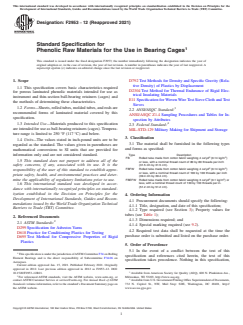
1.1 This specification covers basic characteristics required for porous laminated phenolic materials intended for use as instrument and thin-section ball-bearing retainers (cages) and the methods of determining these characteristics.
1.2 Forms—Sheets, rolled tubes, molded tubes, and rods are recommended forms of laminated material covered by this specification.
1.3 Intended Use—Materials produced to this specification are intended for use as ball-bearing retainers (cages). Temperature range is limited to 250 °F (117 °C) and below.
1.4 Units—The values stated in inch-pound units are to be regarded as the standard. The values given in parentheses are mathematical conversions to SI units that are provided for information only and are not considered standard.
1.5 This standard does not purport to address all of the safety concerns, if any, associated with its use. It is the responsibility of the user of this standard to establish appropriate safety, health, and environmental practices and determine the applicability of regulatory limitations prior to use.
1.6 This international standard was developed in accordance with internationally recognized principles on standardization established in the Decision on Principles for the Development of International Standards, Guides and Recommendations issued by the World Trade Organization Technical Barriers to Trade (TBT) Committee.
General Information
- Status
- Published
- Publication Date
- 14-Jan-2021
- Technical Committee
- F34 - Rolling Element Bearings
- Drafting Committee
- F34.06 - Aerospace
Relations
- Effective Date
- 01-Oct-2013
- Refers
ASTM D2304-10 - Standard Test Method for Thermal Endurance of Rigid Electrical Insulating Materials - Effective Date
- 01-Oct-2010
- Effective Date
- 01-Apr-2010
- Effective Date
- 01-May-2009
- Effective Date
- 01-Nov-2008
- Effective Date
- 01-Aug-2008
- Effective Date
- 15-Jun-2008
- Effective Date
- 01-Nov-2005
- Effective Date
- 01-May-2004
- Effective Date
- 10-Aug-2002
- Effective Date
- 10-Apr-2002
- Effective Date
- 10-Apr-2002
- Effective Date
- 10-May-2001
- Effective Date
- 10-May-2001
- Effective Date
- 10-Dec-2000
Overview
ASTM F2953-12(2021) is the internationally recognized standard specification developed by ASTM International for the quality and performance of porous laminated phenolic raw materials used in bearing cages (ball bearing retainers). This standard defines the essential characteristics required for materials and specifies forms, testing, and inspection methods to ensure reliability in applications such as instrument and thin-section ball bearing cages.
This specification applies to phenolic materials provided as sheets, rolled tubes, molded tubes, and rods. The recommended temperature range for use is limited to 250 °F (117 °C) or below. Materials covered by ASTM F2953-12(2021) provide a crucial function in the manufacturing of precision bearing components, supporting durability and consistency under demanding operational conditions.
Key Topics
Material Characteristics and Forms
- Covers base materials made of woven cotton fabric or paper substrate impregnated and bonded with phenolic resin.
- Materials must conform to controlled limits for acetone extraction, compressive strength, specific gravity, and warpage.
- Forms include:
- Sheets
- Rolled tubes (types FB, FBFW, FBEFW)
- Molded tubes
- Rods
Performance Requirements
- Specifies minimum compressive strength, impact strength, flexural strength, and maximum water absorption for different forms and thicknesses.
- Details tolerances for diameters, wall thickness, and sheet thickness to ensure precise manufacturing.
- Defines quality criteria for appearance and workmanship, ensuring products are free from defects such as blisters, cracks, or resin pockets.
Testing and Inspection
- Outlines methods for sampling, inspection, and lot acceptance using ANSI/ASQC Z1.4 Sampling Procedures.
- References specific ASTM test methods (e.g., D695 for compressive properties, D792 for specific gravity).
- Describes procedures for measurement of acetone-extractable matter, ensuring proper cure and material integrity.
- Inspection for attributes such as warpage, color, and uniformity of finish.
Ordering Information and Compliance
- Procurement documentation should specify material type, dimensions, performance properties, and required test data.
- Ensures supplier compliance and traceability, including marking requirements for shipping containers in alignment with MIL-STD-129.
Applications
Phenolic Bearing Cage Materials
- Instrument and Thin-Section Bearings: Used extensively in aerospace, automotive, and precision engineering industries to support ball bearings and reduce friction.
- Temperature-Sensitive Applications: Suitable for environments requiring stable performance at temperatures up to 250 °F (117 °C).
- Custom Fabrication: Can be machined or processed into custom shapes and sizes due to defined material forms and tolerances.
- Quality-Critical Manufacturing: Ensures material traceability, reliability, and compliance for safety and performance-critical assemblies.
Related Standards
- ASTM D695: Test Method for Compressive Properties of Rigid Plastics
- ASTM D792: Test Methods for Density and Specific Gravity (Relative Density) of Plastics by Displacement
- ASTM D618: Practice for Conditioning Plastics for Testing
- ANSI/ASQC Z1.4: Sampling Procedures and Tables for Inspection by Attributes
- MIL-STD-129: Military Standard for Marking for Shipment and Storage
Practical Value
Adhering to ASTM F2953-12(2021) ensures that phenolic raw materials for bearing cages meet critical performance standards, supporting product longevity, operational consistency, and regulatory compliance. Manufacturers, suppliers, and end-users in industries requiring high-precision bearing assemblies benefit from the robust requirements and traceability defined in this standard, contributing to reduced maintenance costs and higher confidence in component reliability.
Keywords: phenolic bearing materials, ASTM F2953, ball bearing cages, laminated phenolic, material specification, bearing retainers, aerospace materials, engineered plastics, industrial standards, quality control
Frequently Asked Questions
ASTM F2953-12(2021) is a technical specification published by ASTM International. Its full title is "Standard Specification for Phenolic Raw Materials for the Use in Bearing Cages". This standard covers: SCOPE 1.1 This specification covers basic characteristics required for porous laminated phenolic materials intended for use as instrument and thin-section ball-bearing retainers (cages) and the methods of determining these characteristics. 1.2 Forms—Sheets, rolled tubes, molded tubes, and rods are recommended forms of laminated material covered by this specification. 1.3 Intended Use—Materials produced to this specification are intended for use as ball-bearing retainers (cages). Temperature range is limited to 250 °F (117 °C) and below. 1.4 Units—The values stated in inch-pound units are to be regarded as the standard. The values given in parentheses are mathematical conversions to SI units that are provided for information only and are not considered standard. 1.5 This standard does not purport to address all of the safety concerns, if any, associated with its use. It is the responsibility of the user of this standard to establish appropriate safety, health, and environmental practices and determine the applicability of regulatory limitations prior to use. 1.6 This international standard was developed in accordance with internationally recognized principles on standardization established in the Decision on Principles for the Development of International Standards, Guides and Recommendations issued by the World Trade Organization Technical Barriers to Trade (TBT) Committee.
SCOPE 1.1 This specification covers basic characteristics required for porous laminated phenolic materials intended for use as instrument and thin-section ball-bearing retainers (cages) and the methods of determining these characteristics. 1.2 Forms—Sheets, rolled tubes, molded tubes, and rods are recommended forms of laminated material covered by this specification. 1.3 Intended Use—Materials produced to this specification are intended for use as ball-bearing retainers (cages). Temperature range is limited to 250 °F (117 °C) and below. 1.4 Units—The values stated in inch-pound units are to be regarded as the standard. The values given in parentheses are mathematical conversions to SI units that are provided for information only and are not considered standard. 1.5 This standard does not purport to address all of the safety concerns, if any, associated with its use. It is the responsibility of the user of this standard to establish appropriate safety, health, and environmental practices and determine the applicability of regulatory limitations prior to use. 1.6 This international standard was developed in accordance with internationally recognized principles on standardization established in the Decision on Principles for the Development of International Standards, Guides and Recommendations issued by the World Trade Organization Technical Barriers to Trade (TBT) Committee.
ASTM F2953-12(2021) is classified under the following ICS (International Classification for Standards) categories: 21.100.20 - Rolling bearings. The ICS classification helps identify the subject area and facilitates finding related standards.
ASTM F2953-12(2021) has the following relationships with other standards: It is inter standard links to ASTM E11-13, ASTM D2304-10, ASTM D695-10, ASTM E11-09e1, ASTM D618-08, ASTM D695-08, ASTM D792-08, ASTM D618-05, ASTM E11-04, ASTM D695-02a, ASTM D695-02, ASTM D695-96, ASTM E11-95, ASTM E11-01, ASTM D792-00. Understanding these relationships helps ensure you are using the most current and applicable version of the standard.
ASTM F2953-12(2021) is available in PDF format for immediate download after purchase. The document can be added to your cart and obtained through the secure checkout process. Digital delivery ensures instant access to the complete standard document.
Standards Content (Sample)
This international standard was developed in accordance with internationally recognized principles on standardization established in the Decision on Principles for the
Development of International Standards, Guides and Recommendations issued by the World Trade Organization Technical Barriers to Trade (TBT) Committee.
Designation:F2953 −12 (Reapproved 2021)
Standard Specification for
Phenolic Raw Materials for the Use in Bearing Cages
This standard is issued under the fixed designation F2953; the number immediately following the designation indicates the year of
original adoption or, in the case of revision, the year of last revision. A number in parentheses indicates the year of last reapproval. A
superscript epsilon (´) indicates an editorial change since the last revision or reapproval.
1. Scope D792 Test Methods for Density and Specific Gravity (Rela-
tive Density) of Plastics by Displacement
1.1 This specification covers basic characteristics required
D2304 Test Method for Thermal Endurance of Rigid Elec-
for porous laminated phenolic materials intended for use as
trical Insulating Materials
instrument and thin-section ball-bearing retainers (cages) and
E11 Specification for Woven Wire Test Sieve Cloth and Test
the methods of determining these characteristics.
Sieves
1.2 Forms—Sheets, rolled tubes, molded tubes, and rods are
2.2 ANSI/ASQC Standard:
recommended forms of laminated material covered by this
ANSI/ASQC Z1.4 Sampling Procedures and Tables for In-
specification.
spection by Attributes
1.3 Intended Use—Materials produced to this specification
2.3 Federal Standard:
are intended for use as ball-bearing retainers (cages).Tempera-
MIL-STD-129 Military Making for Shipment and Storage
ture range is limited to 250 °F (117 °C) and below.
3. Classification
1.4 Units—The values stated in inch-pound units are to be
3.1 The material shall be furnished in the following types
regarded as the standard. The values given in parentheses are
and forms as specified:
mathematical conversions to SI units that are provided for
information only and are not considered standard. Type Description
2 2
FB Rolled tube made from cotton fabric weighing 4 oz/yd (0.14 kg/m )
1.5 This standard does not purport to address all of the
or less, with a nominal thread count of 80 by 80 threads per inch
safety concerns, if any, associated with its use. It is the (31.5 cm by 31.5 cm).
2 2
FBFW Rolled tube made from cotton fabric weighing 4 oz/yd (0.14 kg/m )
responsibility of the user of this standard to establish appro-
or less, with a nominal thread count of 100 by 100 threads per inch
priate safety, health, and environmental practices and deter-
(39.4 cm by 39.4 cm).
2 2
mine the applicability of regulatory limitations prior to use. FBEFW Rolled tube made from cotton fabric weighing 3 oz/yd (0.1 kg/m)or
less, with a nominal thread count of 130 by 130 threads per in.
1.6 This international standard was developed in accor-
(51.2 cm by 51.2 cm).
dance with internationally recognized principles on standard-
ization established in the Decision on Principles for the
4. Ordering Information
Development of International Standards, Guides and Recom-
4.1 Procurement documents should specify the following:
mendations issued by the World Trade Organization Technical
4.1.1 Title, designation, and date of this specification;
Barriers to Trade (TBT) Committee.
4.1.2 Type required (see Section 3); Property values for
tubes (see Table 1);
2. Referenced Documents
4.1.3 Dimensions required; and
2.1 ASTM Standards:
4.1.4 Special marking required (see 9.2).
D299 Specification for Asbestos Yarns
4.2 Required test data shall be requested at the time the
D618 Practice for Conditioning Plastics for Testing
purchase order is submitted and listed on the purchase order.
D695 Test Method for Compressive Properties of Rigid
Plastics
5. Order of Precedence
5.1 In the event of a conflict between the text of this
This specification is under the jurisdiction ofASTM Committee F34 on Rolling
specification and references cited herein, the text of this
Element Bearings and is the direct responsibility of Subcommittee F34.06 on
specification takes precedence. Nothing in this specification,
Aerospace.
Current edition approved Jan. 15, 2021. Published February 2021. Originally
approved in 2012. Last previous edition approved in 2012 as F2953–12. DOI:
10.1520/F2953–12R21. Available from American Society for Quality (ASQ), 600 N. Plankinton Ave.,
For referenced ASTM standards, visit the ASTM website, www.astm.org, or Milwaukee, WI 53203, http://www.asq.org.
contact ASTM Customer Service at service@astm.org. For Annual Book of ASTM AvailablefromU.S.GovernmentPrintingOfficeSuperintendentofDocuments,
Standards volume information, refer to the standard’s Document Summary page on 732 N. Capitol St., NW, Mail Stop: SDE, Washington, DC 20401, http://
the ASTM website. www.access.gpo.gov.
Copyright © ASTM International, 100 Barr Harbor Drive, PO Box C700, West Conshohocken, PA 19428-2959. United States
F2953−12 (2021)
TABLE 1 Performance Requirements for Tubes TABLE 3 Cotton Fabrics
ASTM Test FB FBFW FBEFW
PB FB FBFW FBEFW
Method D348
80 × 80 100 × 100 130 × 130
Acetone extraction 1.5 1.5 1.5 1.5 Tolerance of ±5 % Tolerance of ±5 % Tolerance of ±5 %
(Maximum %)
Compressive strength 18 000 28 000 28 000 28 000
A
axial (Minimum psi)
A
Specific gravity 1.24-1.34 1.24-1.34 1.28-1.38 1.28-1.38
(Range gm/cc)
A
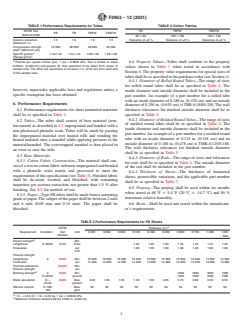
Pounds per square inches (psi). 1 psi = 6.8948 kPa. Test is limited to tubes 6.4 Property Values—Tubes shall conform to the property
0.250-in. (0.635-cm) and greater ID. One specimen to be taken from center of
values shown in Table 1 when tested in accordance with
sample tube. The other two specimens to be taken 1 in. (2.54 cm) from each end
Section 8. The property value requirements for special sizes of
of the sample tube.
tubesshallbeasspecifiedinthepurchaseorder(seeSection4).
6.4.1 Diameter of Rolled Round Tubes—The range of sizes
for rolled round tubes shall be as specified in Table 4. The
however, supersedes applicable laws and regulations unless a
inside diameter and outside diameter shall be included in the
specific exemption has been obtained.
part number. An example of a part number for a rolled tube
with an inside diameter of 0.188 in. (0.478 cm) and an outside
6. Performance Requirements
diameter of 0.250 in. (0.635 cm) isTRR-0.188/0.250.The wall
6.1 Performance requirements for sheet laminated materials thickness tolerances for finished outside diameter shall be as
shall be as specified in Table 2. specified in Table 5.
6.4.2 Diameter of Molded Round Tubes—The range of sizes
6.2 Tubes—The tubes shall consist of base material (rein-
of molded round tubes shall be as specified in Table 4. The
forcement) as described in 6.3 impregnated and bonded with a
inside diameter and outside diameter shall be included in the
non-plasticized phenolic resin. Tubes will be made by passing
part number.An example of a part number for a molded round
the impregnated material over heated rolls and winding the
tube with an inside diameter of 0.125 in. (0.318 cm) and an
heated material onto a mandrel while applying pressure to the
outside diameter of 0.188 in. (0.478 cm) is TMR-0.125/0.188.
material/mandrel. The overwrapped mandrel is then placed in
The wall thickness tolerances for finished outside diameter
an oven to cure the tube.
shall be as specified in Table 5.
6.3 Base Materials:
6.4.3 Diameter of Rods—The range of sizes and tolerances
6.3.1 Cotton Fabric Construction—The material shall con-
for rods shall be as specified in Table 4. The outside diameter
sist of a woven cotton fabric substrate impregnated and bonded
of the rod shall be included in the part number.
with a phenolic resin matrix and processed to meet the
6.4.4 Thickness of Sheets—The thickness of laminated
requirements of this specification (see Table 3). Finished fabric
sheets, permissible variations, and the applicable part number
shall be de-sized, washed, and bleached, with remaining
shall be as specified in Table 7.
impurities per acetone extraction, not greater than 1.5 % after
6.5 Prepreg—The prepreg shall be used within six months
finishing. See 8.5 for method of test.
when stored at 68 °F 6 5.4 °F (20 °C 6 -14.7 °C) and 50 %
6.3.2 Paper—TypePBtubesshallbemadefromasaturating
maximum relative humidity.
gradeofpaper.Thecaliperofthepapershallbebetween2mils
and 6 mils (0.05 mm and 0.15 mm). The paper shall be 6.6 Resin—Shall be used and stored within the manufactur-
bleached. er’s requirements.
TABLE 2 Performance Requirements for FB Sheets
A
Thickness (in.)
ASTM
Requirement Condition Test Unit
0.031 0.062 0.094 0.125 0.188 0.250 0.500 0.750 1.000 1.001
Method
– Max.
B
Impact strength Min.
Lengthwise: E-48/50 D299 ft-lbs 1.25 1.25 1.25 1.25 1.25 1.25 1.25
Crosswise: per 1.00 1.00 1.00 1.00 1.00 1.00 1.00
inch
Flexural strength
Lengthwise: A D299 Min. 16 000 16 000 16 000 16 000 16 000 16 000 15 000 15 000 14 500 14 500
Crosswise: psi 14 000 14 000 14 000 14 000 14 000 14 000 13 500 13 500 13 000 13 000
Thermal endurance D2304 Min.
Flexural strength: psi
B
Bonding strength A D299 Min. 1600 1600 1600 1600
D-48/50 pounds 1500 1500 1500 1500
Water absorption D – D299 Max. 4.00 1.95 1.55 1.30 1.00 0.95 0.70 0.60 0.55 0.55
24/23 percent
Silicone content E-168/ Max. 50 50 50 50 50 50 50 50 50 50
185 ppm
A
1 in. = 2.54 cm. 1 lb = 0.45 kg. 1 psi = 6.8948 kPa.
B
Maximum thickness tested shall be 2.000 in. (5.08 cm).
F2953−12 (2021)
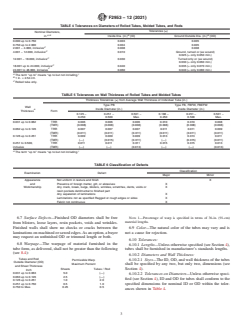
TABLE 4 Tolerances on Diameters of Rolled Tubes, Molded Tubes, and Rods
Tolerances (±)
Nominal Diameters,
A,B
B B
in.
Inside Dia. (in.) (ID) Ground Outside Dia. (in.) (OD)
0.090 up to 0.750 0.003 0.005
0.750 up to 2.000 0.004 0.005
C
2.001 – 4.000, inclusive 0.008 0.008
C
4.001 – 12.000, inclusive 0.010 Ground, turned or (as wound)
0.025 (+ only 0.050 min.)
C
12.001 – 18.000, inclusive 0.030 Turned only or (as wound)
0.030 (+ only 0.060 min.)
C
18.001 up to 24.000, inclusive 0.040 0.035 (+ only 0.070 min.)
C
24.001 to 48.000, inclusive 0.060 0.040 (+ only 0.080 min.)
A
The term “up to” means “up to but not including.”
B
1in.=2.54cm.
C
Rolled tube only.
TABLE 5 Tolerances on Wall Thickness of Rolled Tubes and Molded Tubes
Thickness Tolerances (±) from Average Wall Thickness of Individual Tube (in.)
Type PB Type FB, FBFW, FBEFW
Wall
Inside Diameter (in.) Inside Diameter (in.)
A
Thickness
Form
0.125 – 0.251 – 0.501 – 0.188 – 0.251 – 0.501 –
0.250 0.500 Max. 0.250 0.500 Max.
0.031 up to 0.062 TRR 0.006 0.006 0.006 0.010 0.010 0.008
(TMR) (0.008) (0.008) (0.008) (0.008) (0.008) (0.008)
0.062 up to 0.126 TRR 0.007 0.007 0.007 0.011 0.011 0.009
(TMR) (0.011) (0.011) (0.011) (0.011) (0.011) (0.011)
0.126 up to 0.251 TRR 0.009 0.009 0.009 0.013 0.013 0.011
(TMR) (---) (0.015) (0.011) (---) (0.015) (0.011)
0.251 to 0.500, TRR 0.011 0.011 0.011 0.015 0.015 0.013
inclusive (TMR) (---) (---) (0.013) (---) (---) (0.013)
A
The term “up to” means “up to but not including.”
TABLE 6 Classification of Defects
Classification
Examination Defect
Major Minor
Appearance Not uniform in texture and finish X
and Presence of foreign matter, grit, or abrasives X
Workmanship Any crack, break, bulge, blisters, wrinkles, scratches, dents, voids or X
resin pockets detrimental to finished part
Any separation of laminations X
Laminations not as specified Ragged or rough edges or sides X
Fabric not continuous X
NOTE 1—Percentage of warp is specified in terms of 36-in. (91-cm)
6.7 Surface Defects—Finished OD diameters shall be free
material lengths.
from blisters, loose layers, resin pockets, voids and wrinkles.
Finished walls shall show no checks or cracks between the 6.9 Color—The natural color of the tubes may vary and is
laminationsonmachinedorsawededges.Asanoption,abuyer
not a cause for rejection.
may request an unfinished OD or trimmed length or both.
6.10 Tolerances:
6.8 Warpage—The warpage of material furnished in the
6.10.1 Lengths—Unless otherwise specified (see Section 4),
tube form, as delivered, shall not be greater than the following
tubes shall be furnished in manufacturer’s standards lengths.
(see 8.4):
6.10.2 Diameters and Wall Thickness:
Tubes and Rod
Permissible Warp 6.10.2.1 Sizes—The ID, OD, and wall thickness of the tubes
Outside Diameter (OD)
Maximum Percent
shall be specified by any two, but only two, dimensions (see
and Sheet Thickness
Sheets Tubes / Rod Section 4).
Inch
0.031 up to 0.063 5.0 (---)
6.10.2.2 Tolerances on Diameters—Unless otherwise speci-
0.063 up to 0.126 2.5 (---)
fied (see Section 4), ID and OD for tubes shall conform to the
0.126 up to 0.251 1.0 2.0
0.251 up to 0.750 0.5 1.0 specified dimensions for nominal ID or OD within the toler-
0.750 to Max. 0.25 0.5
ances shown in Table 4.
F2953−12 (2021)
A
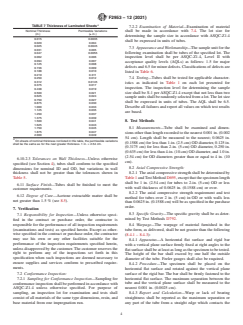
TABLE 7 Thickness of Laminated Sheets
7.2.2 Examination of Material—Examination of material
Nominal Thickness Permissible Variations
shall be made in accordance with 7.4. The lot size for
(in.
...
Questions, Comments and Discussion
Ask us and Technical Secretary will try to provide an answer. You can facilitate discussion about the standard in here.
Loading comments...