


ASTM D4188-17
(Practice)Standard Practice for Performing Pressure In-Line Coagulation-Flocculation-Filtration Test in Water
Standard Practice for Performing Pressure In-Line Coagulation-Flocculation-Filtration Test in Water
SIGNIFICANCE AND USE
5.1 Pressure in-line coagulation-flocculation followed by filtration is an effective process to remove suspended and colloidal matter from water and waste water.
5.2 The effectiveness of this process is dependent on the type and concentration of the flocculant or coagulant, or both, the pH, the temperature, the filtration medium(a), and the filtration rate. This practice permits the evaluation of these various parameters.
5.3 This practice can also be used to determine filter backwash and rinse requirements.
5.4 The results obtained from this practice can be used for plant design of large systems.
SCOPE
1.1 This practice covers the procedure used to perform pressure in-line coagulation-flocculation-filtration of water and waste water. It is applicable to water and waste water with relatively low suspended solids (
1.2 This practice for performing pressure in-line coagulation-flocculation-filtration tests in water relies on turbidity measurement to assess the water quality, referring to Test Methods D7315, D6698, or D6855 to perform the turbidity measurement.
1.3 This practice can be used to determine the effectiveness of flocculants or coagulants, or both, and filter medium(a) in removing suspended and colloidal material from water and waste water.
1.4 Interval between filter backwashing, backwash requirements, rinse requirements, and effect of filtration rate on effluent quality can also be obtained with this practice.
1.5 The values stated in SI units are to be regarded as standard. The values given in parentheses are mathematical conversions to inch-pound units that are provided for information only and are not considered standard.
1.6 This standard does not purport to address all of the safety concerns, if any, associated with its use. It is the responsibility of the user of this standard to establish appropriate safety, health, and environmental practices and determine the applicability of regulatory limitations prior to use.
1.7 This international standard was developed in accordance with internationally recognized principles on standardization established in the Decision on Principles for the Development of International Standards, Guides and Recommendations issued by the World Trade Organization Technical Barriers to Trade (TBT) Committee.
General Information
- Status
- Published
- Publication Date
- 14-Dec-2017
- Technical Committee
- D19 - Water
Relations
- Effective Date
- 15-Dec-2017
- Effective Date
- 01-Nov-2023
- Effective Date
- 01-Nov-2023
- Refers
ASTM D6855-17(2023) - Standard Test Method for Determination of Turbidity Below 5 NTU in Static Mode - Effective Date
- 01-Nov-2023
- Effective Date
- 01-May-2020
- Effective Date
- 01-Mar-2019
- Effective Date
- 01-Jan-2013
- Effective Date
- 01-Jun-2012
- Refers
ASTM D6698-12 - Standard Test Method for On-Line Measurement of Turbidity Below 5 NTU in Water - Effective Date
- 01-Jun-2012
- Effective Date
- 01-Dec-2010
- Refers
ASTM D6855-10 - Standard Test Method for Determination of Turbidity Below 5 NTU in Static Mode - Effective Date
- 15-Jun-2010
- Effective Date
- 01-Mar-2010
- Effective Date
- 01-Oct-2008
- Effective Date
- 01-May-2008
- Effective Date
- 01-Dec-2007
Overview
ASTM D4188-17: Standard Practice for Performing Pressure In-Line Coagulation-Flocculation-Filtration Test in Water offers an industry-accepted methodology for evaluating water and wastewater treatment processes. This standard, developed by ASTM International, provides procedures to test and assess the effectiveness of pressure in-line coagulation-flocculation followed by filtration-a proven approach for removing suspended and colloidal matter from water streams with low solids content. The results generated are invaluable for selecting treatment chemicals, optimizing filtration, determining operational requirements, and sizing plant systems.
Key Topics
- Coagulation-Flocculation Under Pressure: The standard outlines steps for introducing flocculants or coagulants into a pressurized water stream to foster particle aggregation prior to filtration.
- Reliance on Turbidity Measurement: Assessment of water quality before and after treatment is centered on turbidity, using referenced ASTM test methods (D6698, D6855, D7315).
- Variable Evaluation: The practice evaluates how factors such as chemical type and concentration, pH, temperature, filtration rate, and medium affect removal efficiency.
- System Performance Parameters: Includes determination of optimal backwash and rinse intervals, pressure and flow settings, and effluent quality control.
- Reporting and Calculations: Specifies data to record, such as filter characteristics, operational rates, and volumes of water used in different stages, as well as percentage yield of clarified water.
Applications
- Water and Wastewater Treatment Plants: This standard is commonly used in municipal or industrial settings to pilot and optimize processes for potable water preparation and wastewater reclamation, especially when treating water with less than 30 mg/L suspended solids.
- Pilot Testing and Plant Design: Results support design decisions for large-scale treatment systems, assisting engineers in selecting coagulant/flocculant types, filter media, and operational conditions.
- Routine Quality Monitoring: By standardizing evaluation procedures, facilities can implement ongoing monitoring programs to check system integrity and performance.
- Process Optimization: Treatment plants use this standard practice to fine-tune chemical dosing and filtration cycles to maximize removal efficiency and minimize resource use.
- Regulatory Compliance: Adhering to ASTM D4188-17 helps ensure water quality meets regulatory standards, supporting documentation for permits or inspections.
Related Standards
ASTM D4188-17 references and aligns with several important standards to ensure robust, accurate results:
- ASTM D1129: Terminology Relating to Water
- ASTM D2035: Practice for Coagulation-Flocculation Jar Test of Water
- ASTM D3370: Practices for Sampling Water from Closed Conduits
- ASTM D4189: Test Method for Silt Density Index of Water
- ASTM D6698: Test Method for On-Line Measurement of Turbidity Below 5 NTU in Water
- ASTM D6855: Test Method for Determination of Turbidity Below 5 NTU in Static Mode
- ASTM D7315: Test Method for Determination of Turbidity Above 1 Turbidity Unit in Static Mode
Practical Value
Implementing ASTM D4188-17 enables water professionals to:
- Enhance Treatment Efficiency: By systematically testing variables, facilities can identify the most effective treatment configurations.
- Reduce Operational Costs: Proper chemical dosing and optimal backwash/rinse intervals prevent waste and extend media life.
- Ensure Consistent Water Quality: Standardized methods allow for reproducible evaluations, improving the reliability of water treatment processes.
- Support Regulatory and Environmental Goals: Reliable removal of particulates ensures compliance with water quality guidelines, protecting public health and the environment.
Keywords: pressure in-line coagulation, flocculation, filtration, water treatment, turbidity, wastewater testing, filter efficiency, ASTM D4188-17, process optimization, water quality standards
Buy Documents

ASTM D4188-17 - Standard Practice for Performing Pressure In-Line Coagulation-Flocculation-Filtration Test in Water
REDLINE ASTM D4188-17 - Standard Practice for Performing Pressure In-Line Coagulation-Flocculation-Filtration Test in Water
Get Certified
Connect with accredited certification bodies for this standard

NSF International
Global independent organization facilitating standards development and certification.

CIS Institut d.o.o.
Personal Protective Equipment (PPE) certification body. Notified Body NB-2890 for EU Regulation 2016/425 PPE.

Kiwa BDA Testing
Building and construction product certification.
Sponsored listings
Frequently Asked Questions
ASTM D4188-17 is a standard published by ASTM International. Its full title is "Standard Practice for Performing Pressure In-Line Coagulation-Flocculation-Filtration Test in Water". This standard covers: SIGNIFICANCE AND USE 5.1 Pressure in-line coagulation-flocculation followed by filtration is an effective process to remove suspended and colloidal matter from water and waste water. 5.2 The effectiveness of this process is dependent on the type and concentration of the flocculant or coagulant, or both, the pH, the temperature, the filtration medium(a), and the filtration rate. This practice permits the evaluation of these various parameters. 5.3 This practice can also be used to determine filter backwash and rinse requirements. 5.4 The results obtained from this practice can be used for plant design of large systems. SCOPE 1.1 This practice covers the procedure used to perform pressure in-line coagulation-flocculation-filtration of water and waste water. It is applicable to water and waste water with relatively low suspended solids ( 1.2 This practice for performing pressure in-line coagulation-flocculation-filtration tests in water relies on turbidity measurement to assess the water quality, referring to Test Methods D7315, D6698, or D6855 to perform the turbidity measurement. 1.3 This practice can be used to determine the effectiveness of flocculants or coagulants, or both, and filter medium(a) in removing suspended and colloidal material from water and waste water. 1.4 Interval between filter backwashing, backwash requirements, rinse requirements, and effect of filtration rate on effluent quality can also be obtained with this practice. 1.5 The values stated in SI units are to be regarded as standard. The values given in parentheses are mathematical conversions to inch-pound units that are provided for information only and are not considered standard. 1.6 This standard does not purport to address all of the safety concerns, if any, associated with its use. It is the responsibility of the user of this standard to establish appropriate safety, health, and environmental practices and determine the applicability of regulatory limitations prior to use. 1.7 This international standard was developed in accordance with internationally recognized principles on standardization established in the Decision on Principles for the Development of International Standards, Guides and Recommendations issued by the World Trade Organization Technical Barriers to Trade (TBT) Committee.
SIGNIFICANCE AND USE 5.1 Pressure in-line coagulation-flocculation followed by filtration is an effective process to remove suspended and colloidal matter from water and waste water. 5.2 The effectiveness of this process is dependent on the type and concentration of the flocculant or coagulant, or both, the pH, the temperature, the filtration medium(a), and the filtration rate. This practice permits the evaluation of these various parameters. 5.3 This practice can also be used to determine filter backwash and rinse requirements. 5.4 The results obtained from this practice can be used for plant design of large systems. SCOPE 1.1 This practice covers the procedure used to perform pressure in-line coagulation-flocculation-filtration of water and waste water. It is applicable to water and waste water with relatively low suspended solids ( 1.2 This practice for performing pressure in-line coagulation-flocculation-filtration tests in water relies on turbidity measurement to assess the water quality, referring to Test Methods D7315, D6698, or D6855 to perform the turbidity measurement. 1.3 This practice can be used to determine the effectiveness of flocculants or coagulants, or both, and filter medium(a) in removing suspended and colloidal material from water and waste water. 1.4 Interval between filter backwashing, backwash requirements, rinse requirements, and effect of filtration rate on effluent quality can also be obtained with this practice. 1.5 The values stated in SI units are to be regarded as standard. The values given in parentheses are mathematical conversions to inch-pound units that are provided for information only and are not considered standard. 1.6 This standard does not purport to address all of the safety concerns, if any, associated with its use. It is the responsibility of the user of this standard to establish appropriate safety, health, and environmental practices and determine the applicability of regulatory limitations prior to use. 1.7 This international standard was developed in accordance with internationally recognized principles on standardization established in the Decision on Principles for the Development of International Standards, Guides and Recommendations issued by the World Trade Organization Technical Barriers to Trade (TBT) Committee.
ASTM D4188-17 is classified under the following ICS (International Classification for Standards) categories: 13.060.30 - Sewage water. The ICS classification helps identify the subject area and facilitates finding related standards.
ASTM D4188-17 has the following relationships with other standards: It is inter standard links to ASTM D4188-13, ASTM D7315-17(2023), ASTM D4189-23, ASTM D6855-17(2023), ASTM D1129-13(2020)e2, ASTM D2035-19, ASTM D2035-13, ASTM D7315-12, ASTM D6698-12, ASTM D3370-10, ASTM D6855-10, ASTM D1129-10, ASTM D3370-08, ASTM D2035-08, ASTM D3370-07. Understanding these relationships helps ensure you are using the most current and applicable version of the standard.
ASTM D4188-17 is available in PDF format for immediate download after purchase. The document can be added to your cart and obtained through the secure checkout process. Digital delivery ensures instant access to the complete standard document.
Standards Content (Sample)
This international standard was developed in accordance with internationally recognized principles on standardization established in the Decision on Principles for the
Development of International Standards, Guides and Recommendations issued by the World Trade Organization Technical Barriers to Trade (TBT) Committee.
Designation: D4188 − 17
Standard Practice for
Performing Pressure In-Line Coagulation-Flocculation-
Filtration Test in Water
This standard is issued under the fixed designation D4188; the number immediately following the designation indicates the year of
original adoption or, in the case of revision, the year of last revision. A number in parentheses indicates the year of last reapproval. A
superscript epsilon (´) indicates an editorial change since the last revision or reapproval.
1. Scope 2. Referenced Documents
1.1 This practice covers the procedure used to perform 2.1 ASTM Standards:
pressure in-line coagulation-flocculation-filtration of water and D1129 Terminology Relating to Water
waste water. It is applicable to water and waste water with D2035 Practice for Coagulation-Flocculation Jar Test of
relatively low suspended solids (<30 mg/L). The practice is Water
applicable for any size filter greater than 100 mm (4 in.) in D3370 Practices for Sampling Water from Closed Conduits
diameter. D4189 Test Method for Silt Density Index (SDI) of Water
D6698 Test Method for On-Line Measurement of Turbidity
1.2 This practice for performing pressure in-line
Below 5 NTU in Water
coagulation-flocculation-filtration tests in water relies on tur-
D6855 Test Method for Determination of Turbidity Below 5
biditymeasurementtoassessthewaterquality,referringtoTest
NTU in Static Mode
Methods D7315, D6698,or D6855 to perform the turbidity
D7315 Test Method for Determination of TurbidityAbove 1
measurement.
Turbidity Unit (TU) in Static Mode
1.3 This practice can be used to determine the effectiveness
of flocculants or coagulants, or both, and filter medium(a) in
3. Terminology
removing suspended and colloidal material from water and
3.1 Definitions:
waste water.
3.1.1 For definitions of terms used in this standard, refer to
1.4 Interval between filter backwashing, backwash
Terminology D1129.
requirements,rinserequirements,andeffectoffiltrationrateon
4. Summary of Practice
effluent quality can also be obtained with this practice.
4.1 A flocculant or coagulant, or both, is added to a
1.5 The values stated in SI units are to be regarded as
standard. The values given in parentheses are mathematical pressurized flowing water or waste water stream, and the floc
that forms is removed, using a filter medium(a).
conversions to inch-pound units that are provided for informa-
tion only and are not considered standard.
4.2 The effectiveness of the system in removing suspended
1.6 This standard does not purport to address all of the and colloidal matter is determined by monitoring the quality of
safety concerns, if any, associated with its use. It is the the filter effluent.
responsibility of the user of this standard to establish appro-
4.3 A holding tank for floc formation or floc growth is
priate safety, health, and environmental practices and deter-
optional.
mine the applicability of regulatory limitations prior to use.
4.4 The practice also provides information on interval
1.7 This international standard was developed in accor-
between filter backwashing, backwash requirements, rinse
dance with internationally recognized principles on standard-
requirements, and effect of filtration rate on effluent quality.
ization established in the Decision on Principles for the
Development of International Standards, Guides and Recom-
5. Significance and Use
mendations issued by the World Trade Organization Technical
5.1 Pressure in-line coagulation-flocculation followed by
Barriers to Trade (TBT) Committee.
filtration is an effective process to remove suspended and
colloidal matter from water and waste water.
This practice is under the jurisdiction of ASTM Committee D19 on Water and
is the direct responsibility of Subcommittee D19.03 on Sampling Water and
Water-Formed Deposits, Analysis of Water for Power Generation and Process Use,
On-Line Water Analysis, and Surveillance of Water. For referenced ASTM standards, visit the ASTM website, www.astm.org, or
Current edition approved Dec. 15, 2017. Published January 2018. Originally contact ASTM Customer Service at service@astm.org. For Annual Book of ASTM
approved in 1982. Last previous edition approved in 2013 as D4188 – 13. DOI: Standards volume information, refer to the standard’s Document Summary page on
10.1520/D4188-17. the ASTM website.
Copyright © ASTM International, 100 Barr Harbor Drive, PO Box C700, West Conshohocken, PA 19428-2959. United States
D4188 − 17
5.2 The effectiveness of this process is dependent on the 6.1.5 Operate the apparatus by drawing water from the
type and concentration of the flocculant or coagulant, or both, water supply and pumping it through the system under pres-
the pH, the temperature, the filtration medium(a), and the sure. Use a gauge pressure of 275 to 345 kPa (40 to 50 psi) as
filtration rate. This practice permits the evaluation of these the filter inlet pressure.
various parameters.
NOTE 3—If the water supply is already sufficiently pressurized, the
pressurizing centrifugal pump is not required.
5.3 This practice can also be used to determine filter
backwash and rinse requirements.
6.1.6 Use a single calibrated pressure gauge equipped with
a“quick-connect”fittingtomeasurethefilterinletpressureand
5.4 The results obtained from this practice can be used for
filter pressure drop. Individual gauges are also satisfactory but
plant design of large systems.
not as reliable as a single “quick-connect” pressure gauge.
6. Apparatus 6.1.7 Use either a flowmeter or a calibrated volume con-
tainer and stopwatch to measure the filter effluent flow.
6.1 Installation:
6.1.8 Use an accurate metering pump to inject the flocculant
6.1.1 To prevent contamination by corrosion products, use
or coagulant, or both. Use an injector with a check valve and
stainless steel, plastic, or coated (rubber or epoxy-lined) steel
locatetheteatoftheinjectorinthecenteroftheflowingstream
for all wetted parts.
and in the vertical position.
6.1.2 Take care to ensure that no contamination will occur
6.1.9 Use a calibrated volume container and stopwatch to
from oil films on new metal piping, release agents on raw
measure the injection pump rate.
plastic components, or from solutions previously used in the
system. Thoroughly clean or degrease, or both, any materials
NOTE 4—If the suction line of the metering pump is placed into the
that are suspect. volume container, it is necessary to subtract the volume displaced by the
suction line.
6.1.3 Design all pressurized components based on the
manufacturer’s working pressure rating. Review the manufac-
6.1.10 With small inside diameter piping ( ⁄2-in. nominal),
turer’s rating for compliance with standard engineering prac-
use five or six right-angle elbows for mixing. With large inside
tice.
diameter piping, use in-line static mixing to obtain good
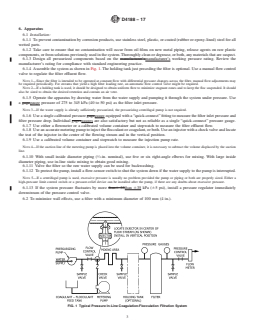
6.1.4 Assemble the system as shown in Fig. 1. The holding
mixing.
tank just preceding the filter is optional. Use a manual flow
6.1.11 Valve the filter so the raw water supply can be used
control valve to regulate the filter effluent flow.
for backwashing.
6.1.12 To protect the pump, install a flow-sensor switch to
NOTE1—Sincethefilterisintendedtobeoperatedatconstantflowwith
differential pressure changes across the filter, manual flow adjustments shut the system down if the water supply to the pump is
may be required periodically. For streams that yield a high filter loading
interrupted.
rate, an automatic flow control valve might be required.
NOTE 2—If a holding tank is used, it should be designed to obtain NOTE 5—If a centrifugal pump is used, excessive pressure is usually no
uniform flow to minimize stagnant zones and to keep the floc suspended. problem provided the pump or piping or both are properly sized. Either a
It should also be sized to obtain the desired retention and contain an air high-pressure limit control switch or a pressure-relief device can be
vent. installed after the pump, if there are any doubts about excessive pressure.
FIG. 1 Typical Pressure In-Line Coagulation-Flocculation Filtration System
D4188 − 17
6.1.13 If the system pressure fluctuates by more than 635 supply water: Dilution of polyelectrolyte feed solution of 100
kPa (65 psi), install a pressure regulator immediately down- to 1 will give 2 mg/L.
stream of the pressure control valve. Therefore:
6.2 To minimize wall effects, use a filter with a minimum ~3.785 L/min! / ~X L/min! 5 100 (1)
diameter of 100 mm (4 in.).
X 5 0.03785 L/min 5 37.85 mL/min (2)
7. Reagents
Therefore, set injection pump rate at 37.8 mL/min.
8.2.3.2 If polyelectrolyte from supplier is a liquid, assume
7.1 For a list of typical coagulants and the preparation of
100 % active ingredient.
polyelectrolyte solutions, refer to Practice D2035.
8.2.4 After the injection rate has been set, measure the
8. Procedure
injection rate (see 6.1.9).
8.2.5 Allow 5 min of operation to equilibrate the mixing
8.1 Start-Up Procedure:
section then obtain a water sample just after the mixing section
8.1.1 First, backwash the filter with the supply water to
and measure the zeta potential, if applicable.
thoroughly clean the filter mediu
...
This document is not an ASTM standard and is intended only to provide the user of an ASTM standard an indication of what changes have been made to the previous version. Because
it may not be technically possible to adequately depict all changes accurately, ASTM recommends that users consult prior editions as appropriate. In all cases only the current version
of the standard as published by ASTM is to be considered the official document.
Designation: D4188 − 13 D4188 − 17
Standard Practice for
Performing Pressure In-Line Coagulation-Flocculation-
Filtration Test in Water
This standard is issued under the fixed designation D4188; the number immediately following the designation indicates the year of
original adoption or, in the case of revision, the year of last revision. A number in parentheses indicates the year of last reapproval. A
superscript epsilon (´) indicates an editorial change since the last revision or reapproval.
1. Scope*Scope
1.1 This practice covers the procedure used to perform pressure in-line coagulation-flocculation-filtration of water and waste
water. It is applicable to water and waste water with relatively low suspended solids (<30 mg/L). The practice is applicable for
any size filter greater than 100 mm (4 in.) in diameter.
1.2 This practice for performing pressure in-line coagulation-flocculation-filtration tests in water relies on turbidity measure-
ment to assess the water quality, referring to Test Methods D7315, D6698, or D6855 to perform the turbidity measurement.
1.3 This practice can be used to determine the effectiveness of flocculants or coagulants, or both, and filter medium(a) in
removing suspended and colloidal material from water and waste water.
1.4 Interval between filter backwashing, backwash requirements, rinse requirements, and effect of filtration rate on effluent
quality can also be obtained with this practice.
1.5 The values stated in SI units are to be regarded as standard. The values listedgiven in parenthesis are for information
only.parentheses are mathematical conversions to inch-pound units that are provided for information only and are not considered
standard.
1.6 This standard does not purport to address all of the safety concerns, if any, associated with its use. It is the responsibility
of the user of this standard to establish appropriate safety safety, health, and healthenvironmental practices and determine the
applicability of regulatory limitations prior to use.
1.7 This international standard was developed in accordance with internationally recognized principles on standardization
established in the Decision on Principles for the Development of International Standards, Guides and Recommendations issued
by the World Trade Organization Technical Barriers to Trade (TBT) Committee.
2. Referenced Documents
2.1 ASTM Standards:
D1129 Terminology Relating to Water
D2035 Practice for Coagulation-Flocculation Jar Test of Water
D3370 Practices for Sampling Water from Closed Conduits
D4189 Test Method for Silt Density Index (SDI) of Water
D6698 Test Method for On-Line Measurement of Turbidity Below 5 NTU in Water
D6855 Test Method for Determination of Turbidity Below 5 NTU in Static Mode
D7315 Test Method for Determination of Turbidity Above 1 Turbidity Unit (TU) in Static Mode
3. Terminology
3.1 Definitions—Definitions: For definitions of terms used in this practice, refer to Definitions D1129.
3.1.1 For definitions of terms used in this standard, refer to Terminology D1129.
This practice is under the jurisdiction of ASTM Committee D19 on Water and is the direct responsibility of Subcommittee D19.03 on Sampling Water and Water-Formed
Deposits, Analysis of Water for Power Generation and Process Use, On-Line Water Analysis, and Surveillance of Water.
Current edition approved Jan. 1, 2013Dec. 15, 2017. Published February 2013January 2018. Originally approved in 1982. Last previous edition approved in 20082013
as D4188 – 08.D4188 – 13. DOI: 10.1520/D4188-13.10.1520/D4188-17.
For referenced ASTM standards, visit the ASTM website, www.astm.org, or contact ASTM Customer Service at service@astm.org. For Annual Book of ASTM Standards
volume information, refer to the standard’s Document Summary page on the ASTM website.
*A Summary of Changes section appears at the end of this standard
Copyright © ASTM International, 100 Barr Harbor Drive, PO Box C700, West Conshohocken, PA 19428-2959. United States
D4188 − 17
4. Summary of Practice
4.1 A flocculant or coagulant, or both, is added to a pressurized flowing water or waste water stream, and the floc that forms
is removed, using a filter medium(a).
4.2 The effectiveness of the system in removing suspended and colloidal matter is determined by monitoring the quality of the
filter effluent.
4.3 A holding tank for floc formation or floc growth is optional.
4.4 The practice also provides information on interval between filter backwashing, backwash requirements, rinse requirements,
and effect of filtration rate on effluent quality.
5. Significance and Use
5.1 Pressure in-line coagulation-flocculation followed by filtration is an effective process to remove suspended and colloidal
matter from water and waste water.
5.2 The effectiveness of this process is dependent on the type and concentration of the flocculant or coagulant, or both, the pH,
the temperature, the filtration medium(a), and the filtration rate. This practice permits the evaluation of these various parameters.
5.3 This practice can also be used to determine filter backwash and rinse requirements.
5.4 The results obtained from this practice can be used for plant design of large systems.
D4188 − 17
6. Apparatus
6.1 Installation:
6.1.1 To prevent contamination by corrosion products, use stainless steel, plastic, or coated (rubber or epoxy-lined) steel for all
wetted parts.
6.1.2 Take care to ensure that no contamination will occur from oil films on new metal piping, release agents on raw plastic
components, or from solutions previously used in the system. Thoroughly clean or degrease, or both, any materials that are suspect.
6.1.3 Design all pressurized components based on the manufacturer’smanufacturer’s working pressure rating. Review the
manufacturer’s rating for compliance with standard engineering practice.
6.1.4 Assemble the system as shown in Fig. 1. The holding tank just preceding the filter is optional. Use a manual flow control
valve to regulate the filter effluent flow.
NOTE 1—Since the filter is intended to be operated at constant flow with differential pressure changes across the filter, manual flow adjustments may
be required periodically. For streams that yield a high filter loading rate, an automatic flow control valve might be required.
NOTE 2—If a holding tank is used, it should be designed to obtain uniform flow to minimize stagnant zones and to keep the floc suspended. It should
also be sized to obtain the desired retention and contain an air vent.
6.1.5 Operate the apparatus by drawing water from the water supply and pumping it through the system under pressure. Use
a gagegauge pressure of 275 to 345 kPa (40 to 50 psi) as the filter inlet pressure.
NOTE 3—If the water supply is already sufficiently pressurized, the pressurizing centrifugal pump is not required.
6.1.6 Use a single calibrated pressure gagegauge equipped with a “quick-connect” fitting to measure the filter inlet pressure and
filter pressure drop. Individual gagesgauges are also satisfactory but not as reliable as a single “quick-connect” pressure gauge.
6.1.7 Use either a flowmeter or a calibrated volume container and stopwatch to measure the filter effluent flow.
6.1.8 Use an accurate metering pump to inject the flocculant or coagulant, or both. Use an injector with a check valve and locate
the teat of the injector in the center of the flowing stream and in the vertical position.
6.1.9 Use a calibrated volume container and stopwatch to measure the injection pump rate.
NOTE 4—If the suction line of the metering pump is placed into the volume container, it is necessary to subtract the volume displaced by the suction
line.
6.1.10 With small inside diameter piping ( ⁄2-in. nominal), use five or six right-angle elbows for mixing. With large inside
diameter piping, use in-line static mixing to obtain good mixing.
6.1.11 Valve the filter so the raw water supply can be used for backwashing.
6.1.12 To protect the pump, install a flow-sensor switch to shut the system down if the water supply to the pump is interrupted.
NOTE 5—If a centrifugal pump is used, excessive pressure is usually no problem provided the pump or piping or both are properly sized. Either a
high-pressure limit control switch or a pressure-relief device can be installed after the pump, if there are any doubts about excessive pressure.
6.1.13 If the system pressure fluctuates by more than6 35than 635 kPa (65 psi), install a pressure regulator immediately
downstream of the pressure control valve.
6.2 To minimize wall effects, use a filter with a minimum diameter of 100 mm (4 in.).
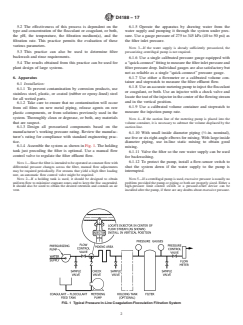
FIG. 1 Typical Pressure In-Line Coagulation-Flocculation Filtration System
D4188 − 17
7. Reagents
7.1 For a list of typical coagulants and the preparation of polyelectrolyte solutions, refer to Practice D2035.
8. Procedure
8.1 Start-Up Procedure:
8.1.1 First, backwash the filter with the supply water to thoroughly clean the filter medium. Use the backwash rate
3 2 2
recommended by the filter medium supplier, which is usually 20 to 50 m /(h·m ) of filter area (8 to 20 gal/(min·ft )). Backwash
the filter until the turbidity (as determined by Test Method D7315) of the backwash is equal (within 10 %) to the turbidity of the
supply water. For all sampling, follow the procedure given in Practices D3370.
NOTE 6—New medium usually contains many fines which need to be removed for the best filter performance. During backwash approximately 2 to
3 % of the medium can be siphoned off at the top of bed to remove fines.
8.1.2 After backwashing, operate the filter in the service mode and
...
Questions, Comments and Discussion
Ask us and Technical Secretary will try to provide an answer. You can facilitate discussion about the standard in here.
Loading comments...