

ASTM D5831-23
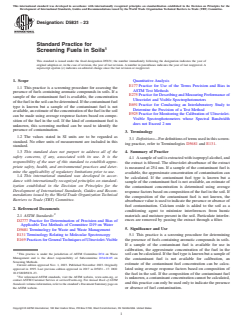
(Practice)Standard Practice for Screening Fuels in Soils
General Information
- Abstract
SIGNIFICANCE AND USE
5.1 This practice is a screening procedure for determining the presence of fuels containing aromatic compounds in soils. If a sample of the contaminant fuel is available for use in calibration, the approximate concentration of the fuel in the soil can be calculated. If the fuel type is known but a sample of the contaminant fuel is not available for calibration, an estimate of the contaminant fuel concentration can be calculated using average response factors based on composition of the fuel in the soil. If the composition of the contaminant fuel is unknown, a contaminant concentration cannot be calculated, and this practice can only be used only to indicate the presence or absence of fuel contamination.
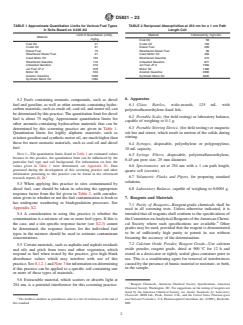
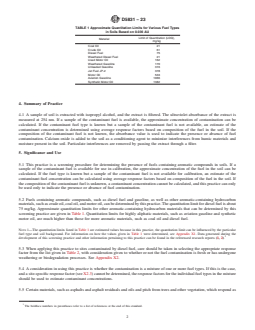
5.2 Fuels containing aromatic compounds, such as diesel fuel and gasoline, as well as other aromatic-containing hydrocarbon materials, such as crude oil, coal oil, and motor oil, can be determined by this practice. The quantitation limit for diesel fuel is about 75 mg/kg. Approximate quantitation limits for other aromatic-containing hydrocarbon materials that can be determined by this screening practice are given in Table 1. Quantitation limits for highly aliphatic materials, such as aviation gasoline and synthetic motor oil, are much higher than those for more aromatic materials, such as coal oil and diesel fuel.
Note 1: The quantitation limits listed in Table 1 are estimated values because in this practice, the quantitation limit can be influenced by the particular fuel type and soil background. For information on how the values given in Table 1 were determined, see Appendix X1. Data generated during the development of this screening practice and other information pertaining to this practice can be found in the referenced research reports (1, 2).3
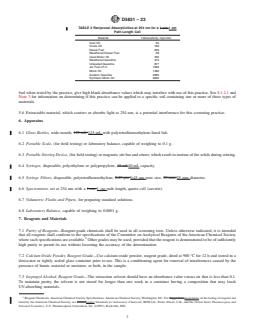
5.3 When applying this practice to sites contaminated by diesel fuel, care should be taken in selecting the appropriate response factor from the list given in Table 2, with consideration given to whether or not t...
SCOPE
1.1 This practice is a screening procedure for assessing the presence of fuels containing aromatic compounds in soils. If a sample of the contaminant fuel is available, the concentration of the fuel in the soil can be determined. If the contaminant fuel type is known but a sample of the contaminant fuel is not available, an estimate of the concentration of the fuel in the soil can be made using average response factors based on composition of the fuel in the soil. If the kind of contaminant fuel is unknown, this screening method can be used to identify the presence of contamination.
1.2 The values stated in SI units are to be regarded as standard. No other units of measurement are included in this standard.
1.3 This standard does not purport to address all of the safety concerns, if any, associated with its use. It is the responsibility of the user of this standard to establish appropriate safety, health, and environmental practices and determine the applicability of regulatory limitations prior to use.
1.4 This international standard was developed in accordance with internationally recognized principles on standardization established in the Decision on Principles for the Development of International Standards, Guides and Recommendations issued by the World Trade Organization Technical Barriers to Trade (TBT) Committee.
- Status
- Published
- Publication Date
- 31-Oct-2023
- Technical Committee
- D34 - Waste Management
- Drafting Committee
- D34.01.05 - Screening Methods
Overview
ASTM D5831-23: Standard Practice for Screening Fuels in Soils is an established international standard developed by ASTM International. This standard outlines a practical screening procedure to assess the presence of fuels containing aromatic compounds-such as diesel fuel, gasoline, crude oil, coal oil, and various types of motor oil-in soil samples. The method is widely used for environmental field screening as well as in laboratory settings to quickly determine the likelihood and degree of hydrocarbon contamination at a site.
The procedure employs ultraviolet-visible (UV-Vis) spectrophotometry to measure the absorbance of soil extracts, typically at 254 nm, as a means to detect and roughly quantify the level of fuel contamination in soils.
Key Topics
- Screening for Aromatic Fuel Contamination: The method is designed primarily to identify the presence or absence of hydrocarbon fuels containing aromatic compounds in soils.
- Approximate Quantitation: If a sample of the actual contaminant fuel is available, this method allows for approximate concentration calculations. If only the fuel type is known, estimations are provided using average response factors. When the contaminant composition is unknown, the standard only confirms contamination presence, not concentration.
- Applicable Fuels: The procedure is suitable for aromatic-rich fuels like diesel, gasoline, crude oil, coal oil, and both used and synthetic motor oils. It is less sensitive to highly aliphatic materials, such as aviation gasoline.
- Quantitation Limits: It provides estimated quantitation limits for a variety of hydrocarbon materials. For example:
- Diesel Fuel: ~75 mg/kg
- Coal Oil: ~21 mg/kg
- Weathered Gasoline: ~170 mg/kg
Applications
This screening method provides practical value in a range of real-world contexts, particularly for environmental professionals, site managers, and regulatory agencies involved in contamination assessment. Typical applications include:
- Site Screening and Assessment: Quickly determine if hydrocarbon contamination is present in soil at potentially impacted sites such as fueling stations, remediation sites, or spill locations.
- Remediation Planning: Provide field data for decision-making on further investigation or remediation efforts.
- Regulatory Compliance: Assist in compliance with environmental regulations that require assessment and reporting of fuel contamination.
- Industrial and Environmental Monitoring: Monitor the effectiveness of spill response or corrective actions over time.
By using readily available reagents (e.g., isopropyl alcohol and calcium oxide) and standard laboratory or portable field equipment, the method is accessible and cost-effective.
Related Standards
Several important ASTM standards and practices are referenced within ASTM D5831-23, enhancing its utility and integration with other methods:
- ASTM D2777 - Practice for Determination of Precision and Bias of Applicable Test Methods
- ASTM D5681 - Terminology for Waste and Waste Management
- ASTM E169 - Practices for General Techniques of Ultraviolet-Visible Quantitative Analysis
- ASTM E177 - Practice for Use of the Terms Precision and Bias in ASTM Test Methods
- ASTM E275 - Practice for Measuring Performance of UV-Visible Spectrophotometers
- ASTM E691 - Practice for Interlaboratory Study to Determine Test Method Precision
- ASTM E925 - Practice for Monitoring Calibration of UV-Visible Spectrophotometers
Conclusion
ASTM D5831-23 offers a reliable, rapid screening approach for detecting fuels in soils using UV-Vis spectrophotometry, supporting field and laboratory efforts in environmental protection and regulatory compliance. By following this standard, practitioners can effectively identify, estimate, and document fuel contamination, thereby facilitating risk assessment, remediation decisions, and ongoing environmental monitoring.
Keywords: fuel contamination in soils, soil screening, aromatic hydrocarbons, UV-Vis spectrophotometry, ASTM D5831-23, diesel contamination, environmental soil analysis, site assessment, hydrocarbon quantitation, remediation.
Relations
- Effective Date
- 01-Nov-2023
- Effective Date
- 01-Nov-2023
- Effective Date
- 01-May-2022
- Effective Date
- 01-Nov-2023
Get Certified
Connect with accredited certification bodies for this standard

CIS Institut d.o.o.
Personal Protective Equipment (PPE) certification body. Notified Body NB-2890 for EU Regulation 2016/425 PPE.

Kiwa BDA Testing
Building and construction product certification.
Kmetijski inštitut Slovenije
Agricultural Institute of Slovenia. Soil testing, plant health, agricultural product analysis.
Sponsored listings
Frequently Asked Questions
ASTM D5831-23 is a standard published by ASTM International. Its full title is "Standard Practice for Screening Fuels in Soils". This standard covers: SIGNIFICANCE AND USE 5.1 This practice is a screening procedure for determining the presence of fuels containing aromatic compounds in soils. If a sample of the contaminant fuel is available for use in calibration, the approximate concentration of the fuel in the soil can be calculated. If the fuel type is known but a sample of the contaminant fuel is not available for calibration, an estimate of the contaminant fuel concentration can be calculated using average response factors based on composition of the fuel in the soil. If the composition of the contaminant fuel is unknown, a contaminant concentration cannot be calculated, and this practice can only be used only to indicate the presence or absence of fuel contamination. 5.2 Fuels containing aromatic compounds, such as diesel fuel and gasoline, as well as other aromatic-containing hydrocarbon materials, such as crude oil, coal oil, and motor oil, can be determined by this practice. The quantitation limit for diesel fuel is about 75 mg/kg. Approximate quantitation limits for other aromatic-containing hydrocarbon materials that can be determined by this screening practice are given in Table 1. Quantitation limits for highly aliphatic materials, such as aviation gasoline and synthetic motor oil, are much higher than those for more aromatic materials, such as coal oil and diesel fuel. Note 1: The quantitation limits listed in Table 1 are estimated values because in this practice, the quantitation limit can be influenced by the particular fuel type and soil background. For information on how the values given in Table 1 were determined, see Appendix X1. Data generated during the development of this screening practice and other information pertaining to this practice can be found in the referenced research reports (1, 2).3 5.3 When applying this practice to sites contaminated by diesel fuel, care should be taken in selecting the appropriate response factor from the list given in Table 2, with consideration given to whether or not t... SCOPE 1.1 This practice is a screening procedure for assessing the presence of fuels containing aromatic compounds in soils. If a sample of the contaminant fuel is available, the concentration of the fuel in the soil can be determined. If the contaminant fuel type is known but a sample of the contaminant fuel is not available, an estimate of the concentration of the fuel in the soil can be made using average response factors based on composition of the fuel in the soil. If the kind of contaminant fuel is unknown, this screening method can be used to identify the presence of contamination. 1.2 The values stated in SI units are to be regarded as standard. No other units of measurement are included in this standard. 1.3 This standard does not purport to address all of the safety concerns, if any, associated with its use. It is the responsibility of the user of this standard to establish appropriate safety, health, and environmental practices and determine the applicability of regulatory limitations prior to use. 1.4 This international standard was developed in accordance with internationally recognized principles on standardization established in the Decision on Principles for the Development of International Standards, Guides and Recommendations issued by the World Trade Organization Technical Barriers to Trade (TBT) Committee.
SIGNIFICANCE AND USE 5.1 This practice is a screening procedure for determining the presence of fuels containing aromatic compounds in soils. If a sample of the contaminant fuel is available for use in calibration, the approximate concentration of the fuel in the soil can be calculated. If the fuel type is known but a sample of the contaminant fuel is not available for calibration, an estimate of the contaminant fuel concentration can be calculated using average response factors based on composition of the fuel in the soil. If the composition of the contaminant fuel is unknown, a contaminant concentration cannot be calculated, and this practice can only be used only to indicate the presence or absence of fuel contamination. 5.2 Fuels containing aromatic compounds, such as diesel fuel and gasoline, as well as other aromatic-containing hydrocarbon materials, such as crude oil, coal oil, and motor oil, can be determined by this practice. The quantitation limit for diesel fuel is about 75 mg/kg. Approximate quantitation limits for other aromatic-containing hydrocarbon materials that can be determined by this screening practice are given in Table 1. Quantitation limits for highly aliphatic materials, such as aviation gasoline and synthetic motor oil, are much higher than those for more aromatic materials, such as coal oil and diesel fuel. Note 1: The quantitation limits listed in Table 1 are estimated values because in this practice, the quantitation limit can be influenced by the particular fuel type and soil background. For information on how the values given in Table 1 were determined, see Appendix X1. Data generated during the development of this screening practice and other information pertaining to this practice can be found in the referenced research reports (1, 2).3 5.3 When applying this practice to sites contaminated by diesel fuel, care should be taken in selecting the appropriate response factor from the list given in Table 2, with consideration given to whether or not t... SCOPE 1.1 This practice is a screening procedure for assessing the presence of fuels containing aromatic compounds in soils. If a sample of the contaminant fuel is available, the concentration of the fuel in the soil can be determined. If the contaminant fuel type is known but a sample of the contaminant fuel is not available, an estimate of the concentration of the fuel in the soil can be made using average response factors based on composition of the fuel in the soil. If the kind of contaminant fuel is unknown, this screening method can be used to identify the presence of contamination. 1.2 The values stated in SI units are to be regarded as standard. No other units of measurement are included in this standard. 1.3 This standard does not purport to address all of the safety concerns, if any, associated with its use. It is the responsibility of the user of this standard to establish appropriate safety, health, and environmental practices and determine the applicability of regulatory limitations prior to use. 1.4 This international standard was developed in accordance with internationally recognized principles on standardization established in the Decision on Principles for the Development of International Standards, Guides and Recommendations issued by the World Trade Organization Technical Barriers to Trade (TBT) Committee.
ASTM D5831-23 is classified under the following ICS (International Classification for Standards) categories: 13.080.10 - Chemical characteristics of soils. The ICS classification helps identify the subject area and facilitates finding related standards.
ASTM D5831-23 has the following relationships with other standards: It is inter standard links to ASTM D5831-17, ASTM D5681-23, ASTM D5681-22e1, ASTM F2931-19a. Understanding these relationships helps ensure you are using the most current and applicable version of the standard.
ASTM D5831-23 is available in PDF format for immediate download after purchase. The document can be added to your cart and obtained through the secure checkout process. Digital delivery ensures instant access to the complete standard document.
Standards Content (Sample)
This international standard was developed in accordance with internationally recognized principles on standardization established in the Decision on Principles for the
Development of International Standards, Guides and Recommendations issued by the World Trade Organization Technical Barriers to Trade (TBT) Committee.
Designation: D5831 − 23
Standard Practice for
Screening Fuels in Soils
This standard is issued under the fixed designation D5831; the number immediately following the designation indicates the year of
original adoption or, in the case of revision, the year of last revision. A number in parentheses indicates the year of last reapproval. A
superscript epsilon (´) indicates an editorial change since the last revision or reapproval.
1. Scope Quantitative Analysis
E177 Practice for Use of the Terms Precision and Bias in
1.1 This practice is a screening procedure for assessing the
ASTM Test Methods
presence of fuels containing aromatic compounds in soils. If a
E275 Practice for Describing and Measuring Performance of
sample of the contaminant fuel is available, the concentration
Ultraviolet and Visible Spectrophotometers
of the fuel in the soil can be determined. If the contaminant fuel
E691 Practice for Conducting an Interlaboratory Study to
type is known but a sample of the contaminant fuel is not
Determine the Precision of a Test Method
available, an estimate of the concentration of the fuel in the soil
E925 Practice for Monitoring the Calibration of Ultraviolet-
can be made using average response factors based on compo-
Visible Spectrophotometers whose Spectral Bandwidth
sition of the fuel in the soil. If the kind of contaminant fuel is
does not Exceed 2 nm
unknown, this screening method can be used to identify the
presence of contamination.
3. Terminology
1.2 The values stated in SI units are to be regarded as
3.1 Definitions—For definitions of terms used in this screen-
standard. No other units of measurement are included in this
ing practice, refer to Terminologies D5681 and E131.
standard.
4. Summary of Practice
1.3 This standard does not purport to address all of the
safety concerns, if any, associated with its use. It is the
4.1 A sample of soil is extracted with isopropyl alcohol, and
responsibility of the user of this standard to establish appro-
the extract is filtered. The ultraviolet absorbance of the extract
priate safety, health, and environmental practices and deter-
is measured at 254 nm. If a sample of the contaminant fuel is
mine the applicability of regulatory limitations prior to use.
available, the approximate concentration of contamination can
1.4 This international standard was developed in accor-
be calculated. If the contaminant fuel type is known but a
dance with internationally recognized principles on standard-
sample of the contaminant fuel is not available, an estimate of
ization established in the Decision on Principles for the
the contaminant concentration is determined using average
Development of International Standards, Guides and Recom-
response factors based on composition of the fuel in the soil. If
mendations issued by the World Trade Organization Technical
the composition of the contaminant fuel is not known, the
Barriers to Trade (TBT) Committee.
absorbance value is used to indicate the presence or absence of
fuel contamination. Calcium oxide is added to the soil as a
2. Referenced Documents
conditioning agent to minimize interferences from humic
2.1 ASTM Standards: materials and moisture present in the soil. Particulate interfer-
D2777 Practice for Determination of Precision and Bias of ences are removed by passing the extract through a filter.
Applicable Test Methods of Committee D19 on Water
5. Significance and Use
D5681 Terminology for Waste and Waste Management
E131 Terminology Relating to Molecular Spectroscopy
5.1 This practice is a screening procedure for determining
E169 Practices for General Techniques of Ultraviolet-Visible
the presence of fuels containing aromatic compounds in soils.
If a sample of the contaminant fuel is available for use in
calibration, the approximate concentration of the fuel in the
This practice is under the jurisdiction of ASTM Committee D34 on Waste
soil can be calculated. If the fuel type is known but a sample of
Management and is the direct responsibility of Subcommittee D34.01.05 on
the contaminant fuel is not available for calibration, an
Screening Methods.
estimate of the contaminant fuel concentration can be calcu-
Current edition approved Nov. 1, 2023. Published November 2023. Originally
lated using average response factors based on composition of
approved in 1995. Last previous edition approved in 2017 as D5831 – 17. DOI:
10.1520/D5831-23.
the fuel in the soil. If the composition of the contaminant fuel
For referenced ASTM standards, visit the ASTM website, www.astm.org, or
is unknown, a contaminant concentration cannot be calculated,
contact ASTM Customer Service at service@astm.org. For Annual Book of ASTM
and this practice can only be used only to indicate the presence
Standards volume information, refer to the standard’s Document Summary page on
the ASTM website. or absence of fuel contamination.
Copyright © ASTM International, 100 Barr Harbor Drive, PO Box C700, West Conshohocken, PA 19428-2959. United States
D5831 − 23
TABLE 1 Approximate Quantitation Limits for Various Fuel Types TABLE 2 Reciprocal Absorptivities at 254 nm for a 1 cm Path
in Soils Based on 0.036 AU Length Cell
Limit of Quantitation (LOQ), Material 1/Absorptivity, mg/L/AU
Material
mg/kg
Coal Oil 59
Coal Oil 21 Crude Oil 169
Crude Oil 61 Diesel Fuel 209
Diesel Fuel 75
Weathered Diesel Fuel 58
Weathered Diesel Fuel 21 Used Motor Oil 450
Used Motor Oil 162 Weathered Gasoline 473
Weathered Gasoline 170 Unleaded Gasoline 877
Unleaded Gasoline 316 Jet Fuel JP-2 1050
Jet Fuel JP-2 378 Motor Oil 1480
Motor Oil 533 Aviation Gasoline 2960
Aviation Gasoline 1066 Synthetic Motor Oil 3840
Synthetic Motor Oil 1382
6. Apparatus
5.2 Fuels containing aromatic compounds, such as diesel
fuel and gasoline, as well as other aromatic-containing hydro-
6.1 Glass Bottles, wide-mouth, 125 mL with
carbon materials, such as crude oil, coal oil, and motor oil, can
polytetrafluoroethylene-lined lids.
be determined by this practice. The quantitation limit for diesel
6.2 Portable Scale, (for field testing) or laboratory balance,
fuel is about 75 mg/kg. Approximate quantitation limits for
capable of weighing to 0.1 g.
other aromatic-containing hydrocarbon materials that can be
6.3 Portable Stirring Device, (for field testing) or magnetic
determined by this screening practice are given in Table 1.
stir bar and stirrer, which result in motion of the solids during
Quantitation limits for highly aliphatic materials, such as
stirring.
aviation gasoline and synthetic motor oil, are much higher than
those for more aromatic materials, such as coal oil and diesel
6.4 Syringes, disposable, polyethylene or polypropylene,
fuel.
10 mL capacity.
NOTE 1—The quantitation limits listed in Table 1 are estimated values
6.5 Syringe Filters, disposable, polytetrafluoroethylene,
because in this practice, the quantitation limit can be influenced by the
0.45 μm pore size, 25 mm diameter.
particular fuel type and soil background. For information on how the
values given in Table 1 were determined, see Appendix X1. Data 6.6 Spectrometer, set at 254 nm with a 1 cm path length,
generated during the development of this screening practice and other
quartz cell (cuvette).
information pertaining to this practice can be found in the referenced
6.7 Volumetric Flasks and Pipets, for preparing standard
research reports (1, 2).
solutions.
5.3 When applying this practice to sites contaminated by
6.8 Laboratory Balance, capable of weighing to 0.0001 g.
diesel fuel, care should be taken in selecting the appropriate
response factor from the list given in Table 2, with consider-
ation given to whether or not the fuel contamination is fresh or 7. Reagents and Materials
has undergone weathering or biodegradation processes. See
7.1 Purity of Reagents—Reagent-grade chemicals shall be
Appendix X2.
used in all screening tests. Unless otherwise indicated, it is
intended that all reagents shall conform to the specifications of
5.4 A consideration in using this practice is whether the
the Committee on Analytical Reagents of the American Chemi-
contamination is a mixture of one or more fuel types. If this is
cal Society where such specifications are available. Other
the case, and a site-specific response factor (see X2.3) cannot
grades may be used, provided that the reagent is demonstrated
be determined, the response factors for the individual fuel
to be of sufficiently high purity to permit its use without
types in the mixture should be used to estimate contaminant
lessening the accuracy of the determination.
concentrations.
5.5 Certain materials, such as asphalts and asphalt residuals 7.2 Calcium Oxide Powder, Reagent Grade—Use calcium
oxide powder, reagent grade, dried at 900 °C for 12 h and
and oils and pitch from trees and other vegetation, which
respond as fuel when tested by the practice, give high blank stored in a desiccator or tightly sealed glass container prior to
use. This is a conditioning agent for removal of interferences
absorbance values which may interfere with use of this
practice. See 8.1.2.1 and Note 3 for information on determining caused by the presence of humic material or moisture, or both,
in the sample.
if this practice can be applied to a specific soil containing one
or more of these types of materials.
5.6 Extractable material, which scatters or absorbs light at
Reagent Chemicals, American Chemical Society Specifications, American
254 nm, is a potential interference for this screening practice.
Chemical Society, Washington, DC. For suggestions on the testing of reagents not
listed by the American Chemical Society, see Analar Standards for Laboratory
Chemicals, BDH Ltd., Poole, Dorset, U.K., and the United States Pharmacopeia
The boldface numbers in parentheses refer to a list of references at the end of and National Formulary, U.S. Pharmacopeial Convention, Inc. (USPC), Rockville,
this standard. MD.
D5831 − 23
7.3 Isopropyl Alcohol, Reagent Grade—The extraction sol- site should be tested to ensure that the blank soil absorbance is
vent should have an absorbance value versus air that is less constant by 60.02 absorbance units. If the blank absorbance
than 0.1. To maintain purity, the solvent is not stored for longer for the second blank is not decreased by the addition of 10 g of
than one week in a container having a composition that may calcium oxide and the absorbance of the blank extract is greater
leach UV-absorbing materials. than 0.1, or if blank correction is not desired, use of an
7.3.1 Transportation of isopropyl alcohol for field testing alternative non-UV-absorbing extraction solvent should be
must comply with current Department of Transportation (DOT) considered. If an alternative solvent is used, the steps described
regulations. in 8.1.1 and 8.1.2 should be repeated using the alternative
solvent.
8. Procedure 8.1.2.2 Record the time required for the soil and calcium
oxide to settle after stirring as determined in 8.1.2 or 8.1.2.1 by
8.1 Running Blank Analyses:
performing the blank soil analysis(es).
8.1.1 To ensure that the batch of conditioning agent,
syringe, filter cartridge, and so forth do not contain substances NOTE 2—An example of a non-UV-absorbing solvent that has been used
in place of isopropyl alcohol is n-heptane. Information on use of this
that contribute to the absorbance reading, it is recommended
solvent can be found in the research report referenced at the end of this
that the procedure be performed as specified in 8.3 and 8.4, in
standard (2).
the absence of soil and using approximately 5 g of calcium
NOTE 3—In testing soil suspected of containing asphaltic materials or
oxide. If the resulting extract has an absorbance value greater
oils or pitch from trees or other vegetation, it is recommended that if the
than 0.03, the various components should be tested individu- blank absorbance value cannot be lowered to less than 0.05 by the addition
of calcium oxide, the blank absorbance value should be subtracted from
ally for contamination by contacting them with the extraction
the sample absorbance values. However, as stated in 8.1.2.1, this should
solvent. Contaminated reagents are replaced prior to perform-
only be done if the blank absorbance is less than 0.1. If the blank
ing sample analysis.
absorbance is greater than 0.1, this method cannot be used to test the soil.
8.1.2 In this procedure, the conditioning agent inhibits the
8.1.3 It is recommended that one spike is run for every batch
extraction of most humic materials, and there is very little, if
of samples or for every 20 samples, whichever is most
any, background from inorganic materials. It is recommended,
frequent. A soil sample is spiked by adding 5 μL of diesel fuel
however, that a blank soil sample be tested as specified in 8.3
or 25 μL of gasoline and shaking the bottle for 3 min. The
and 8.4 by extracting contaminant-free soil of the same type
extraction and analysis then are performed as outlined in 8.3.3
and from the same general area as the site being studied.
– 8.4.5. Recovery is calculated by comparing the absorbance of
Approximately 5 g of calcium oxide should be used for blank
the extract from the spiked soil at 254 nm with the absorbance
extraction. Results from the blank soil analysis can be used to
of a solution of 5 μL of diesel fuel or 25 μL of gasoline in
provide information on the blank soil absorbance value, the
50 mL of isopropyl alcohol. After correction for any material
amount of calcium oxide required to dry the soil and inhibit
appearing in the unspiked soil, the recovery should be within
extraction of humic materials, and the time it takes the soil and
20 % of the theoretical value.
calcium oxide to settle after stirring.
8.2 Preparation of Standard Solutions:
8.1.2.1 If the absorbance value of the soil blank extract is
8.2.1 Weigh out 200 mg (weighed to 60.1 mg) of the fuel
less than 0.05, extraction of soil samples at the site can be
type of interest into a 100 mL volumetric flask and dilute to
performed using 5 g of calcium oxide. If the absorbance value
volume using isopropyl alcohol. This gives a 2000 mg/L
of the soil blank extract is greater than 0.05, a second blank
standard stock solution. Other standard solutions can be
sample should be extracted using additional calcium oxide. If
prepared as needed by appropriate dilution of this stock
a second blank analysis is required, approximately 10 g of
solution. For example, to prepare a 200 mg/L solution of the
calcium oxide should be added to the sample. If the absorbance
fuel type of interest, pipet 5 mL of the stock solution into a
value of the second blank extract is lower than for the first
50 mL volumetric flask and dilute to volume using isopropyl
blank extract, but is still greater than 0.05, a third blank sample
alcohol. For work in the field, a standard stock solution can be
should be tested using approximately 15 g of calcium oxide.
prepared by diluting 25 μL of a fuel standard (density can vary
These steps can be repeated, increasing the amount of calcium
from ;0.75 to 0.90 g/mL) to 100 mL with isopropyl alcohol.
oxide by approximately 5 g each time, until the blank absor-
bance value is less than 0.05. In this way, the amount of 8.3 Sample Preparation:
calcium oxide required to inhibit interferences from humic 8.3.1 Preweigh a 125 mL, wide-mouth glass sample collec-
material and moisture in the soil can be determined. Excess tion bottle having a polytetrafluoroethylene-lined lid. Record
calcium oxide will not affect the analysis results. If the the mass of the empty sample collection bottle to 60.1 g.
absorbance of the value of the second blank extract is not 8.3.2 Add 5 6 0.1 g of soil directly to the preweighed
decreased by the addition of 10 g of calcium oxide to the blank sample collection bottle. Weigh the sample bottle plus sample,
sample, or if the addition of calcium oxide does not lower the and record the mass of the soil sample added to the bottle to
absorbance of the blank extract to less than 0.05 even with the 60.1 g.
addition of a large quantity of conditioning agent, and the
8.3.3 Add the appropriate amount of calcium oxide as
absorbance of the blank extract is less than 0.1, the blank determined in 8.1.2.1 to the soil. The calcium oxide should be
absorbance value can be subtracted from the sample absor- prepared as specified in 7.2. Stir the soil and calcium oxide
bance values. If this is done, blank samples from around the with a spatula until a uniform dry mixture is obtained.
D5831 − 23
8.4 Sample Extraction and Analysis: estimated concentration of the fuel in the original soil sample
8.4.1 Pour 50 mL of isopropyl alcohol into the sample in mg/kg by multiplying the concentration of the fuel in the
extract in mg/L by a factor representing the solvent volume in
bottle.
8.4.2 Stir the slurry for 3 min using a portable stirring millilitres-to-sample mass in grams ratio used in the extraction,
that is, a factor of ten is used for a solvent volume-to-soil mass
device or magnetic stir bar and stirrer so that the solids are in
motion during stirring. A shorter stirring time or hand shaking ratio of 50 mL of isopropyl alcohol to 5 g of soil. If the extract
is diluted, the appropriate correction must be made. Record the
may decrease the extraction efficiency. Close attention should
be paid to the extraction step to ensure that the solids are in approximate/estimated concentration of the fuel in the soil
sample in mg/kg.
motion.
8.4.8 If the type of fuel contaminant is unknown, the
8.4.3 Allow the soil slurry to settle for the length of time
concentration of the contaminant can not be calculated. In this
determined in 8.1.2 or 8.1.2.1, then remove the lid and draw the
supernatant solution into a 10 mL disposable syringe. Attach a case, the absorbance of the extract at 254 nm (see 8.4.5) can be
used to indicate the presence of fuel contamination in the soil.
filter cartridge to the end of the syringe. Rinse the sample
cuvette with filtered extract. Then fill the cuvette with filtered
9. Record
extract for analysis.
9.1 Record the following information:
NOTE 4—If the soil slurry is not allowed to settle after extraction, the
9.1.1 Type of fuel contaminant,
filter will clog, and use of multiple filters will be required.
9.1.2 Mass of the empty sample collection bottle, g,
8.4.4 Calibration procedures specific to the spectrometer
9.1.3 Mass of the sample bottle plus soil sample, g,
being used to perform the absorbance measurements must be
9.1.4 Mass of the soil sample, g,
followed. Instrument instructions for spanning from 0 to 1
9.1.5 Volume of isopropyl alcohol (solvent) used in the
absorbance unit must be followed. Calibration is to be per-
extraction, mL,
formed using isopropyl alcohol to zero the instrument, and if a
9.1.6 Solvent for zeroing spectrometer,
calibration curve is to be established, calibration standards
9.1.7 Calibration standard solutions and absorbance values
prepared from the standard stock solution are used (see 8.2.1).
at 254 nm,
Calibration using a minimum of three standard concentrations
9.1.8 One/absorptivity for the fuel type of interest, if the
is recommended. Calibration curves are nonlinear above 1 AU
contaminant fuel is not used for calibration,
(>90 % of the light absorbed). As a result, readings must be
9.1.9 Absorbance of the soil sample extract at 254 nm,
made below this level. In addition, the extract absorbance
9.1.10 Approximate/estimated concentration of the fuel in
reading must fall between the maximum and minimum absor-
the filtered extract, mg/L, and
bance readings of the calibration curve.
9.1.11 Approximate/estimated concentration of the fuel in
NOTE 5—For general information on the techniques commonly used in
the soil sample, mg/kg.
ultraviolet analysis, see Practice E169. For additional information on the
9.1.12 Suggested data recording form for performing this
performance of ultraviolet spectrophotometers, see Practice E275. For
screening procedure is given in Fig. 1.
information on evaluating the performance of an ultraviolet spectropho-
tometer to verify its suitability for continued routine use, see Practice
10. Report
E925.
10.1 Report the presence or absence of fuel contamination
8.4.5 Read and record the absorbance of the extract at
or approximate or estimated concentration of contaminant fuel
254 nm.
in the sample. Contaminant concentration should be reported to
8.4.6 Determine an approximate or estimated concentration
two or three significant figures, depending on the number of
of a known fuel type in the filtered extract.
significant figures of the soil mass and response factor.
8.4.6.1 If the contaminant fuel was used for calibration, an
approximate concentration of the fuel in the extract can be
11. Precision and Bias
calculated using a calibration curve. Record this approximate
11.1 Precision:
concentration of the fuel in the extract in mg/L.
11.1.1 A collaborative study of this screening practice
8.4.6.2 If the contaminant fuel type is known but the
involving eight participants was conducted. Each participant
contaminant fuel was not used for calibration, an estimated
tested seven materials in triplicate. The test materials were a
concentration of the fuel type in the extract can be calculated
sand spiked with three different concentrations of diesel fuel
by multiplying the absorbance of the extract by the reciprocal
(Test Materials A, B, and C), an unspiked sand (Test Material
absorptivity for that fuel type (see Table 2 and Eq 1). Record
D), an organic soil spiked with two different concentrations of
this estimated concentration of the fuel in the extract in mg/L.
diesel fuel (Test Materials E and F), and an unspiked organic
Abso
...
This document is not an ASTM standard and is intended only to provide the user of an ASTM standard an indication of what changes have been made to the previous version. Because
it may not be technically possible to adequately depict all changes accurately, ASTM recommends that users consult prior editions as appropriate. In all cases only the current version
of the standard as published by ASTM is to be considered the official document.
Designation: D5831 − 17 D5831 − 23
Standard Practice for
Screening Fuels in Soils
This standard is issued under the fixed designation D5831; the number immediately following the designation indicates the year of
original adoption or, in the case of revision, the year of last revision. A number in parentheses indicates the year of last reapproval. A
superscript epsilon (´) indicates an editorial change since the last revision or reapproval.
1. Scope
1.1 This practice is a screening procedure for assessing the presence of fuels containing aromatic compounds in soils. If a sample
of the contaminant fuel is available, the concentration of the fuel in the soil can be performed.determined. If the contaminant fuel
type is known but a sample of the contaminant fuel is not available, an estimate of the concentration of the fuel in the soil can
be made using average response factors based on composition of the fuel in the soil. If the kind of contaminant fuel is unknown,
this screening method can be used to identify the presence of contamination.
1.2 The values stated in SI units are to be regarded as standard. No other units of measurement are included in this standard.
1.3 This standard does not purport to address all of the safety concerns, if any, associated with its use. It is the responsibility
of the user of this standard to establish appropriate safety, health, and environmental practices and determine the applicability of
regulatory limitations prior to use.
1.4 This international standard was developed in accordance with internationally recognized principles on standardization
established in the Decision on Principles for the Development of International Standards, Guides and Recommendations issued
by the World Trade Organization Technical Barriers to Trade (TBT) Committee.
2. Referenced Documents
2.1 ASTM Standards:
D2777 Practice for Determination of Precision and Bias of Applicable Test Methods of Committee D19 on Water
D5681 Terminology for Waste and Waste Management
E131 Terminology Relating to Molecular Spectroscopy
E169 Practices for General Techniques of Ultraviolet-Visible Quantitative Analysis
E177 Practice for Use of the Terms Precision and Bias in ASTM Test Methods
E275 Practice for Describing and Measuring Performance of Ultraviolet and Visible Spectrophotometers
E691 Practice for Conducting an Interlaboratory Study to Determine the Precision of a Test Method
E925 Practice for Monitoring the Calibration of Ultraviolet-Visible Spectrophotometers whose Spectral Bandwidth does not
Exceed 2 nm
3. Terminology
3.1 Definitions—For definitions of terms used in this screening practice, refer to Terminologies D5681 and E131.
This practice is under the jurisdiction of ASTM Committee D34 on Waste Management and is the direct responsibility of Subcommittee D34.01.05 on Screening Methods.
Current edition approved Dec. 1, 2017Nov. 1, 2023. Published December 2017November 2023. Originally approved in 1995. Last previous edition approved in 20092017
as D5831 – 09.D5831 – 17. DOI: 10.1520/D5831-17.10.1520/D5831-23.
For referenced ASTM standards, visit the ASTM website, www.astm.org, or contact ASTM Customer Service at service@astm.org. For Annual Book of ASTM Standards
volume information, refer to the standard’s Document Summary page on the ASTM website.
Copyright © ASTM International, 100 Barr Harbor Drive, PO Box C700, West Conshohocken, PA 19428-2959. United States
D5831 − 23
TABLE 1 Approximate Quantitation Limits for Various Fuel Types
in Soils Based on 0.036 AU
Limit of Quantitation (LOQ),
Material
mg/kg
Coal Oil 21
Crude Oil 61
Diesel Fuel 75
Weathered Diesel Fuel 21
Used Motor Oil 162
Weathered Gasoline 170
Unleaded Gasoline 316
Jet Fuel JP-2 378
Motor Oil 533
Aviation Gasoline 1066
Synthetic Motor Oil 1382
4. Summary of Practice
4.1 A sample of soil is extracted with isopropyl alcohol, and the extract is filtered. The ultraviolet absorbance of the extract is
measured at 254 nm. If a sample of the contaminant fuel is available, the approximate concentration of contamination can be
calculated. If the contaminant fuel type is known but a sample of the contaminant fuel is not available, an estimate of the
contaminant concentration is determined using average response factors based on composition of the fuel in the soil. If the
composition of the contaminant fuel is not known, the absorbance value is used to indicate the presence or absence of fuel
contamination. Calcium oxide is added to the soil as a conditioning agent to minimize interferences from humic materials and
moisture present in the soil. Particulate interferences are removed by passing the extract through a filter.
5. Significance and Use
5.1 This practice is a screening procedure for determining the presence of fuels containing aromatic compounds in soils. If a
sample of the contaminant fuel is available for use in calibration, the approximate concentration of the fuel in the soil can be
calculated. If the fuel type is known but a sample of the contaminant fuel is not available for calibration, an estimate of the
contaminant fuel concentration can be calculated using average response factors based on composition of the fuel in the soil. If
the composition of the contaminant fuel is unknown, a contaminant concentration cannot be calculated, and this practice can only
be used only to indicate the presence or absence of fuel contamination.
5.2 Fuels containing aromatic compounds, such as diesel fuel and gasoline, as well as other aromatic-containing hydrocarbon
materials, such as crude oil, coal oil, and motor oil, can be determined by this practice. The quantitation limit for diesel fuel is about
75 mg/kg. Approximate quantitation limits for other aromatic-containing hydrocarbon materials that can be determined by this
screening practice are given in Table 1. Quantitation limits for highly aliphatic materials, such as aviation gasoline and synthetic
motor oil, are much higher than those for more aromatic materials, such as coal oil and diesel fuel.
NOTE 1—The quantitation limits listed in Table 1 are estimated values because in this practice, the quantitation limit can be influenced by the particular
fuel type and soil background. For information on how the values given in Table 1 were determined, see Appendix X1. Data generated during the
development of this screening practice and other information pertaining to this practice can be found in the referenced research reports (1, 2).
5.3 When applying this practice to sites contaminated by diesel fuel, care should be taken in selecting the appropriate response
factor from the list given in Table 2, with consideration given to whether or not the fuel contamination is fresh or has undergone
weathering or biodegradation processes. See Appendix X2.
5.4 A consideration in using this practice is whether the contamination is a mixture of one or more fuel types. If this is the case,
and a site-specific response factor (see X2.3) cannot be determined, the response factors for the individual fuel types in the mixture
should be used to estimate contaminant concentrations.
5.5 Certain materials, such as asphalts and asphalt residuals and oils and pitch from trees and other vegetation, which respond as
The boldface numbers in parentheses refer to a list of references at the end of this standard.
D5831 − 23
TABLE 2 Reciprocal Absorptivities at 254 nm for a 1-cm 1 cm
Path Length Cell
Material 1/Absorptivity, mg/L/AU
Coal Oil 59
Crude Oil 169
Diesel Fuel 209
Weathered Diesel Fuel 58
Used Motor Oil 450
Weathered Gasoline 473
Unleaded Gasoline 877
Jet Fuel JP-2 1050
Motor Oil 1480
Aviation Gasoline 2960
Synthetic Motor Oil 3840
fuel when tested by the practice, give high blank absorbance values which may interfere with use of this practice. See 8.1.2.1 and
Note 3 for information on determining if this practice can be applied to a specific soil containing one or more of these types of
materials.
5.6 Extractable material, which scatters or absorbs light at 254 nm, is a potential interference for this screening practice.
6. Apparatus
6.1 Glass Bottles, wide-mouth, 125-mL 125 mL with polytetrafluoroethylene-lined lids.
6.2 Portable Scale, (for field testing) or laboratory balance, capable of weighing to 0.1 g.
6.3 Portable Stirring Device, (for field testing) or magnetic stir bar and stirrer, which result in motion of the solids during stirring.
6.4 Syringes, disposable, polyethylene or polypropylene, 10-mL10 mL capacity.
6.5 Syringe Filters, disposable, polytetrafluoroethylene, 0.45-μm 0.45 μm pore size, 25-mm 25 mm diameter.
6.6 Spectrometer, set at 254 nm with a 1-cm 1 cm path length, quartz cell (cuvette).
6.7 Volumetric Flasks and Pipets, for preparing standard solutions.
6.8 Laboratory Balance, capable of weighing to 0.0001 g.
7. Reagents and Materials
7.1 Purity of Reagents—Reagent-grade chemicals shall be used in all screening tests. Unless otherwise indicated, it is intended
that all reagents shall conform to the specifications of the Committee on Analytical Reagents of the American Chemical Society
where such specifications are available. Other grades may be used, provided that the reagent is demonstrated to be of sufficiently
high purity to permit its use without lessening the accuracy of the determination.
7.2 Calcium Oxide Powder, Reagent Grade—Use calcium oxide powder, reagent grade, dried at 900 °C for 12 h and stored in a
desiccator or tightly sealed glass container prior to use. This is a conditioning agent for removal of interferences caused by the
presence of humic material or moisture, or both, in the sample.
7.3 Isopropyl Alcohol, Reagent Grade—The extraction solvent should have an absorbance value versus air that is less than 0.1.
To maintain purity, the solvent is not stored for longer than one week in a container having a composition that may leach
UV-absorbing materials.
Reagent Chemicals, American Chemical Society Specifications, American Chemical Society, Washington, DC. For Suggestionssuggestions on the testing of reagents not
listed by the American Chemical Society, see AnnualAnalar Standards for Laboratory Chemicals, BDH Ltd., Poole, Dorset, U.K., and the United States Pharmacopeia and
National Formulary, U.S. Pharmacopeial Convention, Inc. (USPC), Rockville, MD.
D5831 − 23
7.3.1 Transportation of isopropyl alcohol for field testing must comply with current Department of Transportation (DOT)
regulations.
8. Procedure
8.1 Running Blank Analyses:
8.1.1 To ensure that the batch of conditioning agent, syringe, filter cartridge, and so forth do not contain substances that contribute
to the absorbance reading, it is recommended that the procedure be performed as specified in 8.3 and 8.4, in the absence of soil
and using approximately 5 g of calcium oxide. If the resulting extract has an absorbance value greater than 0.03, the various
components should be tested individually for contamination by contacting them with the extraction solvent. Contaminated reagents
are replaced prior to performing sample analysis.
8.1.2 In this procedure, the conditioning agent inhibits the extraction of most humic materials, and there is very little, if any,
background from inorganic materials. It is recommended, however, that a blank soil sample be tested as specified in 8.3 and 8.4
by extracting contaminant-free soil of the same type and from the same general area as the site being studied. Approximately 5
g of calcium oxide should be used for blank extraction. Results from the blank soil analysis can be used to provide information
on the blank soil absorbance value, the amount of calcium oxide required to dry the soil and inhibit extraction of humic materials,
and the time it takes the soil and calcium oxide to settle after stirring.
8.1.2.1 If the absorbance value of the soil blank extract is less than 0.05, extraction of soil samples at the site can be performed
using 5 g of calcium oxide. If the absorbance value of the soil blank extract is greater than 0.05, a second blank sample should
be extracted using additional calcium oxide. If a second blank analysis is required, approximately 10 g of calcium oxide should
be added to the sample. If the absorbance value of the second blank extract is lower than for the first blank extract, but is still
greater than 0.05, a third blank sample should be tested using approximately 15 g of calcium oxide. These steps can be repeated,
increasing the amount of calcium oxide by approximately 5 g each time, until the blank absorbance value is less than 0.05. In this
way, the amount of calcium oxide required to inhibit interferences from humic material and moisture in the soil can be determined.
Excess calcium oxide will not affect the analysis results. If the absorbance of the value of the second blank extract is not decreased
by the addition of 10 g of calcium oxide to the blank sample, or if the addition of calcium oxide does not lower the absorbance
of the blank extract to less than 0.05 even with the addition of a large quantity of conditioning agent, and the absorbance of the
blank extract is less than 0.1, the blank absorbance value can be subtracted from the sample absorbance values. If this is done,
blank samples from around the site should be tested to ensure that the blank soil absorbance is constant by 60.02 absorbance units.
If the blank absorbance for the second blank is not decreased by the addition of 10 g of calcium oxide and the absorbance of the
blank extract is greater than 0.1, or if blank correction is not desired, use of an alternative non-UV-absorbing extraction solvent
should be considered. If an alternative solvent is used, the steps described in 8.1.1 and 8.1.2 should be repeated using the alternative
solvent.
8.1.2.2 Record the time required for the soil and calcium oxide to settle after stirring as determined in 8.1.2 or 8.1.2.1 by
performing the blank soil analysis(es).
NOTE 2—An example of a non-UV-absorbing solvent that has been used in place of isopropyl alcohol is n-heptane. Information on use of this solvent
can be found in the research report referenced at the end of this standard (2).
NOTE 3—In testing soil suspected of containing asphaltic materials or oils or pitch from trees or other vegetation, it is recommended that if the blank
absorbance value cannot be lowered to less than 0.05 by the addition of calcium oxide, the blank absorbance value should be subtracted from the sample
absorbance values. However, as stated in 8.1.2.1, this should only be done if the blank absorbance is less than 0.1. If the blank absorbance is greater than
0.1, this method cannot be used to test the soil.
8.1.3 It is recommended that one spike is run for every batch of samples or for every 20 samples, whichever is most frequent. A
soil sample is spiked by adding 5 μL of diesel fuel or 25 μL of gasoline and shaking the bottle for 3 min. The extraction and analysis
then are performed as outlined in 8.3.3 – 8.4.5. Recovery is calculated by comparing the absorbance of the extract from the spiked
soil at 254 nm with the absorbance of a solution of 5 μL of diesel fuel or 25 μL of gasoline in 50 mL of isopropyl alcohol. After
correction for any material appearing in the unspiked soil, the recovery should be within 20 % of the theoretical value.
8.2 Preparation of Standard Solutions:
8.2.1 Weigh out 200 mg (weighed to 60.1 mg) of the fuel type of interest into a 100-mL 100 mL volumetric flask and dilute to
volume using isopropyl alcohol. This gives a 2000-mg/L 2000 mg/L standard stock solution. Other standard solutions can be
D5831 − 23
prepared as needed by appropriate dilution of this stock solution. For example, to prepare a 200-mg/L 200 mg/L solution of the
fuel type of interest, pipet 5 mL of the stock solution into a 50-mL50 mL volumetric flask and dilute to volume using isopropyl
alcohol. For work in the field, a standard stock solution can be prepared by diluting 25 μL of a fuel standard (density can vary from
;0.75 to 0.90 g/mL) to 100 mL with isopropyl alcohol.
8.3 Sample Preparation:
8.3.1 Preweigh a 125-mL, 125 mL, wide-mouth glass sample collection bottle having a polytetrafluoroethylene-lined lid. Record
the mass of the empty sample collection bottle to 60.1 g.
8.3.2 Add 5 6 0.1 g of soil directly to the preweighed sample collection bottle. Weigh the sample bottle plus sample, and record
the mass of the soil sample added to the bottle to 60.1 g.
8.3.3 Add the appropriate amount of calcium oxide as determined in 8.1.2.1 to the soil. The calcium oxide should be prepared as
specified in 7.2. Stir the soil and calcium oxide with a spatula until a uniform dry mixture is obtained.
D5831 − 23
8.4 Sample Extraction and Analysis:
8.4.1 Pour 50 mL of isopropyl alcohol into the sample bottle.
8.4.2 Stir the slurry for 3 min using a portable stirring device or magnetic stir bar and stirrer so that the solids are in motion during
stirring. A shorter stirring time or hand shaking may decrease the extraction efficiency. Close attention should be paid to the
extraction step to ensure that the solids are in motion.
8.4.3 Allow the soil slurry to settle for the length of time determined in 8.1.2 or 8.1.2.1, then remove the lid and draw the
supernatant solution into a 10-mL 10 mL disposable syringe. Attach a filter cartridge to the end of the syringe. Rinse the sample
cuvette with filtered extract. Then fill the cuvette with filtered extract for analysis.
NOTE 4—If the soil slurry is not allowed to settle after extraction, the filter will clog, and use of multiple filters will be required.
8.4.4 Calibration procedures specific to the spectrometer being used to perform the absorbance measurements must be followed.
Instrument instructions for spanning from 0 to 1 absorbance unit must be followed. Calibration is to be performed using isopropyl
alcohol to zero the instrument, and if a calibration curve is to be established, calibration standards prepared from the standard stock
solution are used (see 8.2.1). Calibration using a minimum of three standard concentrations is recommended. Calibration curves
are nonlinear above 1 AU (>90 % of the light absorbed). As a result, readings must be made below this level. In addition, the extract
absorbance reading must fall between the maximum and minimum absorbance readings of the calibration curve.
NOTE 5—For general information on the techniques commonly used in ultraviolet analysis, see Practice E169. For additional information on the
performance of ultraviolet spectrophotometers, see Practice E275. For information on evaluating the performance of an ultraviolet spectrophotometer to
verify its suitability for continued routine use, see Practice E925.
8.4.5 Read and record the absorbance of the extract at 254 nm.
8.4.6 Determine an approximate or estimated concentration of a known fuel type in the filtered extract.
8.4.6.1 If the contaminant fuel was used for calibration, an approximate concentration of the fuel in the extract can be calculated
using a calibration curve. Record this approximate concentration of the fuel in the extract in mg/L.
8.4.6.2 If the contaminant fuel type is known but the contaminant fuel was not used for calibration, an estimated concentration
of the fuel type in the extract can be calculated by multiplying the absorbance of the extract by the reciprocal absorptivity for that
fuel type (see Table 2 and Eq 1). Record this estimated concentration of the fuel in the extract in mg/L.
Absorbance × 1/Absorptivity 5 Estimated concentration of the (1)
~ ! ~ !
fuel in the filtered extract mg/L
~ !
~Absorbance! ×~1/Absorptivity!5 Estimated concentration of the (1)
fuel in the filtered extract ~mg/L!
NOTE 6—For information pertaining to the reciprocal absorptivity values (response factors), see Appendix X2 and Tables X1.1 and X2.1.
8.4.7 Convert the approximate or estimated concentration of fuel in the extract (see 8.4.6.1 or 8.4.6.2) to an approximate or
estimated concentration of the fuel in the original soil sample in mg/kg by multiplying the concentration of the fuel in the extract
in mg/L by a factor representing the solvent volume in millilitres-to-sample mass in grams ratio used in the extraction, that is, a
factor of ten is used for a solvent volume-to-soil mass ratio of 50 mL of isopropyl alcohol to 5 g of soil. If the extract is diluted,
the appropriate correction must be made. Record the approximate/estimated concentration of the fuel in the soil sample in mg/kg.
8.4.8 If the type of fuel contaminant is unknown, the concentration of the contaminant can not be calculated. In this case, the
absorbance of the extract at 254 nm (see 8.4.5) can be used to indicate the presence of fuel contamination in the soil.
9. Record
9.1 Record the following information:
D5831 − 23
9.1.1 Type of fuel contaminant,
9.1.2 Mass of the empty sample collection bottle, g,
9.1.3 Mass of the sample bottle plus soil sample, g,
9.1.4 Mass of the soil sample, g,
9.1.5 Volume of isopropyl alcohol (solvent) used in the extraction, mL,
9.1.6 Solvent for zeroing spectrometer,
9.1.7 Calibration standard solutions and absorbance values at 254 nm,
9.1.8 One/absorptivity for the fuel type of interest, if the contaminant fuel is not used for calibration,
9.1.9 Absorbance of the soil sample extract at 254 nm,
9.1.10 Approximate/estimated concentration of the fuel in the filtered extract, mg/L, and
9.1.11 Approximate/estimated concentration of the fuel in the soil sample, mg/kg.
9.1.12 Suggested data recording form for performing this screening procedure is given in Fig. 1.
10. Report
10.1 Report the presence or absence of fuel contamination or approximate or estimated concentration of contaminant fuel in the
sample. Contaminant concentration should be reported to
...