

ASTM F1502-23
(Test Method)Standard Test Method for Static Measurements on Tires for Passenger Cars, Light Trucks, and Medium Duty Vehicles
General Information
- Abstract
SIGNIFICANCE AND USE
4.1 Static measurements of tires are important to tire manufacturers, processing engineers, and vehicle design engineers for purposes of commerce (in consumer/vendor agreements) and in tire research and development.
4.2 The procedures are sufficiently detailed to achieve commercially acceptable reproducibility among laboratories and may therefore be used for specification, compliance, or reference purposes.
4.3 Changes attributable to growth after inflation may be obtained by comparing measurements made immediately after inflation with those made 18 to 24 h later.
SCOPE
1.1 This test method covers methods for performing certain mechanical static measurements on tires. The term “static” implies that the tire is not rotating while measurements are being made.
1.2 The values stated in SI units are to be regarded as standard. The values given in parentheses are for information only.
1.3 This standard does not purport to address all of the safety concerns, if any, associated with its use. It is the responsibility of the user of this standard to establish appropriate safety, health, and environmental practices and determine the applicability of regulatory limitations prior to use.
1.4 This international standard was developed in accordance with internationally recognized principles on standardization established in the Decision on Principles for the Development of International Standards, Guides and Recommendations issued by the World Trade Organization Technical Barriers to Trade (TBT) Committee.
- Status
- Published
- Publication Date
- 30-Apr-2023
- Technical Committee
- F09 - Tires
- Drafting Committee
- F09.30 - Laboratory (Non-Vehicular) Testing
Buy Documents
ASTM F1502-23 - Standard Test Method for Static Measurements on Tires for Passenger Cars, Light Trucks, and Medium Duty Vehicles
REDLINE ASTM F1502-23 - Standard Test Method for Static Measurements on Tires for Passenger Cars, Light Trucks, and Medium Duty Vehicles
Overview
ASTM F1502-23 specifies the standard test method for conducting static measurements on tires used in passenger cars, light trucks, and medium-duty vehicles. Developed by ASTM International, this standard details reproducible procedures to measure key mechanical characteristics of a tire when it is not in motion. Accurate static tire measurements are critical for manufacturers, engineers, and regulatory bodies, underpinning commerce, specification, compliance, and research in the automotive industry.
This test method enhances laboratory consistency, facilitates trade agreements, and supports ongoing tire R&D efforts. It also helps in monitoring dimensional changes after tire inflation, aiding in quality control and design validation.
Key Topics
- Scope of Static Measurements: The standard covers the determination of tire properties such as weight, outside diameter, overall width, tread radius, tread hardness, and tread arc width, all of which are measured while the tire is stationary.
- Significance for Industry: These measurements are widely recognized by tire manufacturers, vehicle design engineers, and processing engineers for meeting commercial and regulatory requirements.
- Reproducibility: Procedures outlined ensure commercially acceptable consistency among different laboratories, making the method suitable for inter-laboratory comparisons, compliance testing, and as a technical reference.
- Measurement Consistency: The standard describes requirements for equipment calibration, marking tire sections, and performing multiple measurements to ensure data reliability and precision.
- Safety and Compliance: While the standard provides detailed test methods, it is the user’s responsibility to adhere to appropriate safety, health, and environmental protocols, and to account for regulatory limitations.
Applications
ASTM F1502-23 is crucial for applications involving:
- Tire Manufacturing and Quality Assurance: Supports uniform evaluation of tire properties for production quality control and validation of design specifications.
- Vehicle Development: Assists automotive engineers by providing critical tire data needed for suspension design, vehicle dynamic analysis, and load-rating assessments.
- Research and Development: Enables robust evaluation of new tire compounds, constructions, or tread designs for performance optimization.
- Regulatory Compliance and Trade: Used to verify that tires conform to agreed-upon commercial specifications and regulatory standards, especially in consumer/vendor contracts.
- Inter-laboratory Comparisons: The highly reproducible methodology facilitates global data comparisons and benchmarking among tire testing laboratories.
Related Standards
ASTM F1502-23 references and complements several other standards to provide a comprehensive framework for tire testing and measurement:
- ASTM D2240 - Test Method for Rubber Property-Durometer Hardness
- ASTM D4483 - Practice for Evaluating Precision for Test Method Standards in the Rubber and Carbon Black Manufacturing Industries
- ASTM F421 - Test Method for Measuring Groove and Void Depth in Passenger Car Tires
- ASTM F538 - Terminology Relating to Characteristics and Performance of Tires
- ASTM F870 - Practice for Tread Footprints of Passenger Car Tires Groove Area Fraction and Dimensional Measurements
Practical Value
By adhering to ASTM F1502-23, stakeholders in the tire and automotive industries can:
- Ensure consistent, objective static tire measurement procedures worldwide
- Facilitate international trade with confidence in compliance and specification alignment
- Minimize disputes and variability due to standard test methodology
- Support product development, safety, and regulatory inspection with traceable, reproducible data
Keywords: ASTM F1502-23, static tire measurements, passenger car tires, light truck tires, medium duty vehicle tires, tire manufacturing standards, tire dimension measurement, automotive tire test methods, tire test reproducibility, laboratory tire testing.
Relations
- Effective Date
- 01-Jun-2013
- Effective Date
- 01-Dec-2010
- Effective Date
- 15-Jun-2009
- Refers
ASTM F421-07 - Standard Test Method for Measuring Groove and Void Depth in Passenger Car Tires - Effective Date
- 01-Aug-2007
- Effective Date
- 01-Jun-2005
- Effective Date
- 01-Dec-2003
- Refers
ASTM F421-00 - Standard Test Method for Measuring Groove and Void Depth in Passenger Car Tires - Effective Date
- 10-May-2000
- Effective Date
- 10-Jan-2000
- Effective Date
- 10-Apr-1999
Buy Documents
ASTM F1502-23 - Standard Test Method for Static Measurements on Tires for Passenger Cars, Light Trucks, and Medium Duty Vehicles
REDLINE ASTM F1502-23 - Standard Test Method for Static Measurements on Tires for Passenger Cars, Light Trucks, and Medium Duty Vehicles
Get Certified
Connect with accredited certification bodies for this standard

DIN CERTCO
DIN Group product certification.

Smithers Quality Assessments
US management systems and product certification.
Sponsored listings
Frequently Asked Questions
ASTM F1502-23 is a standard published by ASTM International. Its full title is "Standard Test Method for Static Measurements on Tires for Passenger Cars, Light Trucks, and Medium Duty Vehicles". This standard covers: SIGNIFICANCE AND USE 4.1 Static measurements of tires are important to tire manufacturers, processing engineers, and vehicle design engineers for purposes of commerce (in consumer/vendor agreements) and in tire research and development. 4.2 The procedures are sufficiently detailed to achieve commercially acceptable reproducibility among laboratories and may therefore be used for specification, compliance, or reference purposes. 4.3 Changes attributable to growth after inflation may be obtained by comparing measurements made immediately after inflation with those made 18 to 24 h later. SCOPE 1.1 This test method covers methods for performing certain mechanical static measurements on tires. The term “static” implies that the tire is not rotating while measurements are being made. 1.2 The values stated in SI units are to be regarded as standard. The values given in parentheses are for information only. 1.3 This standard does not purport to address all of the safety concerns, if any, associated with its use. It is the responsibility of the user of this standard to establish appropriate safety, health, and environmental practices and determine the applicability of regulatory limitations prior to use. 1.4 This international standard was developed in accordance with internationally recognized principles on standardization established in the Decision on Principles for the Development of International Standards, Guides and Recommendations issued by the World Trade Organization Technical Barriers to Trade (TBT) Committee.
SIGNIFICANCE AND USE 4.1 Static measurements of tires are important to tire manufacturers, processing engineers, and vehicle design engineers for purposes of commerce (in consumer/vendor agreements) and in tire research and development. 4.2 The procedures are sufficiently detailed to achieve commercially acceptable reproducibility among laboratories and may therefore be used for specification, compliance, or reference purposes. 4.3 Changes attributable to growth after inflation may be obtained by comparing measurements made immediately after inflation with those made 18 to 24 h later. SCOPE 1.1 This test method covers methods for performing certain mechanical static measurements on tires. The term “static” implies that the tire is not rotating while measurements are being made. 1.2 The values stated in SI units are to be regarded as standard. The values given in parentheses are for information only. 1.3 This standard does not purport to address all of the safety concerns, if any, associated with its use. It is the responsibility of the user of this standard to establish appropriate safety, health, and environmental practices and determine the applicability of regulatory limitations prior to use. 1.4 This international standard was developed in accordance with internationally recognized principles on standardization established in the Decision on Principles for the Development of International Standards, Guides and Recommendations issued by the World Trade Organization Technical Barriers to Trade (TBT) Committee.
ASTM F1502-23 is classified under the following ICS (International Classification for Standards) categories: 83.160.10 - Road vehicle tyres. The ICS classification helps identify the subject area and facilitates finding related standards.
ASTM F1502-23 has the following relationships with other standards: It is inter standard links to ASTM F421-07(2013)e1, ASTM F870-94(2010), ASTM F538-09, ASTM F421-07, ASTM F870-94(2005), ASTM F538-03, ASTM F421-00, ASTM F870-94(2000), ASTM F538-99. Understanding these relationships helps ensure you are using the most current and applicable version of the standard.
ASTM F1502-23 is available in PDF format for immediate download after purchase. The document can be added to your cart and obtained through the secure checkout process. Digital delivery ensures instant access to the complete standard document.
Standards Content (Sample)
This international standard was developed in accordance with internationally recognized principles on standardization established in the Decision on Principles for the
Development of International Standards, Guides and Recommendations issued by the World Trade Organization Technical Barriers to Trade (TBT) Committee.
Designation: F1502 − 23
Standard Test Method for
Static Measurements on Tires for Passenger Cars, Light
Trucks, and Medium Duty Vehicles
This standard is issued under the fixed designation F1502; the number immediately following the designation indicates the year of
original adoption or, in the case of revision, the year of last revision. A number in parentheses indicates the year of last reapproval. A
superscript epsilon (´) indicates an editorial change since the last revision or reapproval.
1. Scope Groove Area Fraction and Dimensional Measurements
1.1 This test method covers methods for performing certain
3. Terminology
mechanical static measurements on tires. The term “static”
implies that the tire is not rotating while measurements are 3.1 Definitions:
3.1.1 outside diameter, n—the maximum diameter of a tire
being made.
when it is mounted and inflated. F538
1.2 The values stated in SI units are to be regarded as
3.1.2 overall width, n—the maximum cross-sectional width
standard. The values given in parentheses are for information
of a tire, including protective or decorative ribs. F538
only.
3.1.3 tire weight, n—the weight of an unmounted tire
1.3 This standard does not purport to address all of the
without tube or flap. F538
safety concerns, if any, associated with its use. It is the
responsibility of the user of this standard to establish appro-
3.1.4 tread arc width, n—the length of the arc measured
priate safety, health, and environmental practices and deter-
from one extreme of the tread design proper to the opposite
mine the applicability of regulatory limitations prior to use.
extreme; that is, from shoulder to shoulder perpendicular to the
1.4 This international standard was developed in accor-
circumferential center line. F538
dance with internationally recognized principles on standard-
3.1.5 tread hardness, n—the hardness of an element in the
ization established in the Decision on Principles for the
tread design as measured by a designated standard gage. F538
Development of International Standards, Guides and Recom-
3.1.6 tread radius, n—the radius of a circle whose arc best
mendations issued by the World Trade Organization Technical
fits the tread surface when the appropriate radius template is
Barriers to Trade (TBT) Committee.
held perpendicular to the circumferential center line of an
inflated tire. F538
2. Referenced Documents
2.1 ASTM Standards:
4. Significance and Use
D2240 Test Method for Rubber Property—Durometer Hard-
4.1 Static measurements of tires are important to tire
ness
manufacturers, processing engineers, and vehicle design engi-
D4483 Practice for Evaluating Precision for Test Method
neers for purposes of commerce (in consumer/vendor agree-
Standards in the Rubber and Carbon Black Manufacturing
ments) and in tire research and development.
Industries
F421 Test Method for Measuring Groove and Void Depth in
4.2 The procedures are sufficiently detailed to achieve
Passenger Car Tires
commercially acceptable reproducibility among laboratories
F538 Terminology Relating to Characteristics and Perfor-
and may therefore be used for specification, compliance, or
mance of Tires
reference purposes.
F870 Practice for Tread Footprints of Passenger Car Tires
4.3 Changes attributable to growth after inflation may be
obtained by comparing measurements made immediately after
inflation with those made 18 to 24 h later.
This test method is under the jurisdiction of ASTM Committee F09 on Tires
and is the direct responsibility of Subcommittee F09.30 on Laboratory (Non-
Vehicular) Testing.
5. Tire Marking
Current edition approved May 1, 2023. Published May 2023. Originally
5.1 For measurements other than weight, the tire shall be
approved in 1994. Last previous edition approved in 2016 as F1502 – 05 (2016).
DOI: 10.1520/F1502-23.
marked at six equally spaced locations around the circumfer-
For referenced ASTM standards, visit the ASTM website, www.astm.org, or
ence. Starting at the DOT tire identification number (outboard
contact ASTM Customer Service at service@astm.org. For Annual Book of ASTM
side if applicable) or other serial number, make radial lines
Standards volume information, refer to the standard’s Document Summary page on
the ASTM website. from bead to bead, perpendicular to the tread center line, at 60°
Copyright © ASTM International, 100 Barr Harbor Drive, PO Box C700, West Conshohocken, PA 19428-2959. United States
F1502 − 23
FIG. 1 Type C: Tread Contour with a Center-Low Oxbow
intervals. Number the resulting sections “1” through “6” in a
clockwise sequence as viewed, if applicable, from the outboard
side, containing the tire identification or serial number.
6. Procedures
6.1 Tire Weight:
6.1.1 Weigh the test tire on a scale with accuracy to 0.045 kg
(0.1 lb) in the required range. A scale of 0-90 kg (0-200 lb) has
been found to be satisfactory for tires within the scope of this
test method.
6.1.2 The scale used should be calibrated with weights
FIG. 2 Outside Diameter Measurement
traceable to the National Institute of Standards Technology
(NIST).
6.2 Outside Diameter:
6.2.1 Mount the test tire on a rim of the correct diameter for
the tire size and the measuring rim width listed for that tire in
the current yearbook of the Tire and Rim Association (or other
4,5
applicable document ), unless another width is chosen.
6.2.2 Inflate the tire to the maximum pressure given on the
sidewall or associated with the maximum load, unless another
pressure has been chosen. Do not exceed the maximum
pressure given on the sidewall. Record the value used. Allow
24 h for inflation growth and adjust pressure if necessary.
6.2.3 The wheel and inflated tire assembly shall be in
temperature equilibrium with the environment in which the
measurements are to be made. This can usually be achieved
after 3 h at room temperature, 24 6 8°C (75 6 15°F). Record
ambient temperature at the time of measurements.
6.2.4 Anchor the end of a “diameter” (pi) tape in the tread
FIG. 3 Overall Width Measurement
center (or other maximum diameter location, in cases such as
a center low oxbow contour (Fig. 1)), at any circumferential
location. Use a thumbtack if necessary. See Fig. 2.
6.2.5 Carefully align the tape around the tire circumference
so that it is parallel to the plane of the tread center line. Read
and record the indicated diameter.
6.3 Overall Width:
6.3.1 Mount and condition the test tire as in 6.2.1 – 6.2.3.
6.3.2 Use an outside caliper or other direct-reading device
that is graduated in 0.25 mm (0.01 in.) increments. See Figs. 3
and 4.
6.3.3 The measured overall width shall include the highest
protective side ribs, bars, and decorations on both sidewalls.
Current yearbook of the Tire and Rim Association available from the Tire and
FIG. 4 Overall Width Measurement
Rim Association, Inc., 4000 Embassy Parkway, Suite 390, Akron, Ohio 44333,
https://www.us-tra.org.
Current yearbook of the European Tyre and Rim Technical Organization
available from the ETRTO, Avenue d’Auderghem, 22 - 28 Box 9 - B-1040, Brussels,
Belgium, https://www.etrto.org.
6.3.4 Section width can be obtained by subtracting heights
Current yearbook of the Japan Automotive Tire Manufacturers’ Association
th
of sidewall protuberances from the overall width obtained in
Inc. available from JATMA, 8 floor, No. 33 Mori Bldg., 3-8-21 Toranomon
Minato-ku, Tokyo, Japan 105-0001, https://www.jatma.or.jp. 6.3.3.
F1502 − 23
FIG. 6 Type A: Tread Contour with a Single Radius
FIG. 5 Tread Radius Measurement
6.3.5 Record individual and average overall width measure-
ments from 6.3.3 to the nearest 0.25 mm (0.01 in.) from at least
three equally spaced circumferential locations as marked in
5.1.
6.4 Tread Radius:
FIG. 7 Type B: Tread Contour with a Dual Radius
6.4.1 Prepare the tire as in 6.2.1 – 6.2.3.
6.4.2 Tread radius templates commonly have radii ranging
from 120 mm (4.75 in.) to 300 mm (12.0 in.) in 12.7-mm
(0.50-in.) increments and from 300 mm (12.0 in.) to 900 mm
(35.5 in.) in 12.8-mm (0.50-in.) increments. Choose the one
that most closely fits the tread arc defined by one of the
following types of contour. See Fig. 5.
FIG. 8 Type D: Tread Contour with a Center-High Oxbow Style
NOTE 1—For tires outside or different from these most popular tread
radius contours, that is, extreme low profile types, identify those radii that
most closely define the tread contour.
6.5 Tread Hardness:
6.4.2.1 Type A Single (Primary) (seeFig. 6)—This type is
6.5.1 Prepare the test tire as in 6.2.1 – 6.2.3.
characterized by a tread arc that can be uniformly contacted by
6.5.2 Mount the tire/wheel unit in a test fixture or stand it on
one of the templates. Choose the one that most closely fits the
a smooth surface so that its wheel axis is parallel to that
arc defined by three points: the tread center, and two shoulders.
surface.
Since a perfectly uniform radius is not always attainable, other
6.5.3 An A-scale durometer hardness gage may be used.
typical variations are discussed as means for arriving at a best
Report the brand name of the one chosen.
descriptive fit.
6.5.4 Make measurements in smooth and flat areas of the six
6.4.2.2 Type B Dual, Drop Shoulder (see Fig. 7)—This type
tread sections marked off in 5.1 (see Fig. 9). Avoid placing the
is characterized by the inability to fit a single-radius template
probe near sipes, mold vents, or edges of tread elements.
across the entire tread because of drops at the shoulders.
6.5.5 Results on crown and shoulder elements should be
Choose the one that most closely fits the center portion of the
recorded separately since they may differ from each other.
tread, ignor
...
This document is not an ASTM standard and is intended only to provide the user of an ASTM standard an indication of what changes have been made to the previous version. Because
it may not be technically possible to adequately depict all changes accurately, ASTM recommends that users consult prior editions as appropriate. In all cases only the current version
of the standard as published by ASTM is to be considered the official document.
Designation: F1502 − 05 (Reapproved 2016) F1502 − 23
Standard Test Method for
Static Measurements on Tires for Passenger Cars, Light
Trucks, and Medium Duty Vehicles
This standard is issued under the fixed designation F1502; the number immediately following the designation indicates the year of
original adoption or, in the case of revision, the year of last revision. A number in parentheses indicates the year of last reapproval. A
superscript epsilon (´) indicates an editorial change since the last revision or reapproval.
1. Scope
1.1 This test method covers methods for performing certain mechanical static measurements on tires. The term “static” implies
that the tire is not rotating while measurements are being made.
1.2 The values stated in SI units are to be regarded as standard. The values given in parentheses are for information only.
1.3 This standard does not purport to address all of the safety concerns, if any, associated with its use. It is the responsibility
of the user of this standard to establish appropriate safety and healthsafety, health, and environmental practices and determine
the applicability of regulatory limitations prior to use.
1.4 This international standard was developed in accordance with internationally recognized principles on standardization
established in the Decision on Principles for the Development of International Standards, Guides and Recommendations issued
by the World Trade Organization Technical Barriers to Trade (TBT) Committee.
2. Referenced Documents
2.1 ASTM Standards:
D2240 Test Method for Rubber Property—Durometer Hardness
D4483 Practice for Evaluating Precision for Test Method Standards in the Rubber and Carbon Black Manufacturing Industries
F421 Test Method for Measuring Groove and Void Depth in Passenger Car Tires
F538 Terminology Relating to Characteristics and Performance of Tires
F870 Practice for Tread Footprints of Passenger Car Tires Groove Area Fraction and Dimensional Measurements
F1082 Practice for Tires—Determining Precision for Test Method Standards (Withdrawn 2005)
3. Terminology
3.1 Definitions:
3.1.1 outside diameter, n—the maximum diameter of a tire when it is mounted and inflated. F538
3.1.2 overall width, n—the maximum cross-sectional width of a tire, including protective or decorative ribs. F538
3.1.3 tire weight, n—the weight of an unmounted tire without tube or flap. F538
This test method is under the jurisdiction of ASTM Committee F09 on Tires and is the direct responsibility of Subcommittee F09.30 on Laboratory (Non-Vehicular)
Testing.
Current edition approved Jan. 1, 2016May 1, 2023. Published February 2016May 2023. Originally approved in 1994. Last previous edition approved in 20102016 as
F1502 – 05 (2010).(2016). DOI: 10.1520/F1502-05R16.10.1520/F1502-23.
For referenced ASTM standards, visit the ASTM website, www.astm.org, or contact ASTM Customer Service at service@astm.org. For Annual Book of ASTM Standards
volume information, refer to the standard’s Document Summary page on the ASTM website.
Copyright © ASTM International, 100 Barr Harbor Drive, PO Box C700, West Conshohocken, PA 19428-2959. United States
F1502 − 23
FIG. 1 Type C: Tread Contour with a Center-Low Oxbow
3.1.4 tread arc width, n—the length of the arc measured from one extreme of the tread design proper to the opposite extreme; that
is, from shoulder to shoulder perpendicular to the circumferential center line. F538
3.1.5 tread hardness, n—the hardness of an element in the tread design as measured by a designated standard gage. F538
3.1.6 tread radius, n—the radius of a circle whose arc best fits the tread surface when the appropriate radius template used is held
perpendicular to the circumferential center line of an inflated tire. F538
3.2 For additional definitions of terms used in this test method, refer to Terminology F538.
4. Significance and Use
4.1 Static measurements of tires are important to tire manufacturers, processing engineers, and vehicle design engineers for
purposes of commerce (in consumer/vendor agreements) and in tire research and development.
4.2 The procedures are sufficiently detailed to achieve commercially acceptable reproducibility among laboratories and may
therefore be used for specification, compliance, or reference purposes.
4.3 Changes attributable to growth after inflation may be obtained by comparing measurements made immediately after inflation
with those made 18 to 24 h later.
5. Tire Marking
5.1 For measurements other than weight, the tire shall be marked at six equally spaced locations around the circumference.
Starting at the DOT serial, tire identification number (outboard side if applicable) or other serial number, make radial lines from
bead to bead, perpendicular to the tread center line, at 60-degree60° intervals. Number the resulting sections “1” through “6” in
a clockwise sequence as viewed viewed, if applicable, from the side outboard side, containing the tire identification or serial
number.
F1502 − 23
FIG. 2 Outside Diameter Measurement
6. Procedures
6.1 Tire Weight:
6.1.1 Weigh the test tire on a scale with accuracy to 0.045 kg (0.1 lb) in the required range. A scale of 0-90 kg (0-200 lb) has been
found to be satisfactory for tires within the scope of this test method.
6.1.2 The scale used should be calibrated with weights traceable to the National Institute of Standards Technology (NIST).
6.2 Outside Diameter:
6.2.1 Mount the test tire on a rim of the correct diameter for the tire size and the measuring rim width listed for that tire in the
3 4,5
current yearbook of the Tire and Rim Association (or other applicable document ), unless another width is chosen.
6.2.2 Inflate the tire to the maximum pressure given on the sidewall or associated with the maximum load, unless another pressure
has been chosen. Do not exceed the maximum pressure given on the sidewall. Record the value used. Allow 24 h for inflation
growth and adjust pressure if necessary.
6.2.3 The assembly of wheel and inflated tire assembly shall be in temperature equilibrium with the environment in which the
measurements are to be made. This can usually be achieved inafter 3 h at room temperature, 24 6 8°C (75 6 15°F). Record
ambient temperature at the time of measurements.
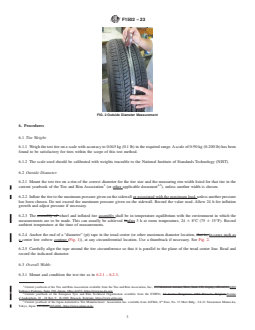
6.2.4 Anchor the end of a “diameter” (pi) tape in the tread center (or other maximum diameter location, that is, in cases such as
a center low oxbow contour (Fig. 1)), at any circumferential location. Use a thumbtack if necessary. See Fig. 2.
6.2.5 Carefully align the tape around the tire circumference so that it is parallel to the plane of the tread center line. Read and
record the indicated diameter.
6.3 Overall Width:
6.3.1 Mount and condition the test tire as in 6.2.1 – 6.2.3.
Current yearbook of the Tire and Rim Association available from the Tire and Rim Association, Inc., 175 Montrose Avenue, West, Suite 150, Copley, OH 44321.4000
Embassy Parkway, Suite 390, Akron, Ohio 44333, https://www.us-tra.org.
Current yearbook of the European Tyre and Rim Technical Organization available from the ETRTO, 32 Avenue Brugmann, 1060 Brussels, Belgium.Avenue
d’Auderghem, 22 - 28 Box 9 - B-1040, Brussels, Belgium, https://www.etrto.org.
th
Current yearbook of the Japan Automotive Tire Manufacturers’ Association Inc. available from JATMA, 8 floor, No. 33 Mori Bldg., 3-8-21 Toranomon Minato-ku,
Tokyo, Japan 105-0001.105-0001, https://www.jatma.or.jp.
F1502 − 23
FIG. 3 Overall Width Measurement
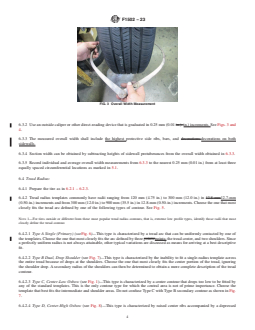
6.3.2 Use an outside caliper or other direct-reading device that is graduated in 0.25 mm (0.01 in.). in.) increments. See Figs. 3 and
4.
6.3.3 The measured overall width shall include the highest protective side ribs, bars, and decorations.decorations on both
sidewalls.
6.3.4 Section width can be obtained by subtracting heights of sidewall protuberances from the overall width obtained in 6.3.3.
6.3.5 Record individual and average overall width measurements from 6.3.3 to the nearest 0.25 mm (0.01 in.) from at least three
equally spaced circumferential locations as marked in 5.1.
6.4 Tread Radius:
6.4.1 Prepare the tire as in 6.2.1 – 6.2.3.
6.4.2 Tread radius templates commonly have radii ranging from 120 mm (4.75 in.) to 300 mm (12.0 in.) in 12.8-mm12.7-mm
(0.50-in.) increments and from 300 mm (12.0 in.) to 900 mm (35.5 in.) in 12.8-mm (0.50-in.) increments. Choose the one that most
closely fits the tread arc defined by one of the following types of contour. See Fig. 5.
NOTE 1—For tires outside or different from these most popular tread radius contours, that is, extreme low profile types, identify those radii that most
closely define the tread contour.
6.4.2.1 Type A Single (Primary) (seeFig. 6)—This type is characterized by a tread arc that can be uniformly contacted by one of
the templates. Choose the one that most closely fits the arc defined by three points,points: the tread center, and two shoulders. Since
a perfectly uniform radius is not always attainable, other typical variations are discussed as means for arriving at a best descriptive
fit.
6.4.2.2 Type B Dual, Drop Shoulder (see Fig. 7)—This type is characterized by the inability to fit a single-radius template across
the entire tread because of drops at the shoulders. Choose the one that most closely fits the center portion of the tread, ignoring
the shoulder drop. A secondary radius of the shoulders can then be determined to obtain a more complete description of the tread
contour.
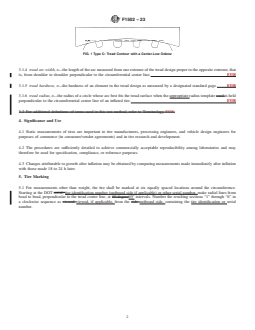
6.4.2.3 Type C, Center-Low Oxbow (see Fig. 1)—This type is characterized by a center contour that drops too low to be fitted by
any of the standard templates. This is the only contour type for which the central area is not of prime importance. Choose the
template that best fits the intermediate and shoulder areas. Do not confuse Type C with Type B secondary contour as shown in Fig.
7.
6.4.2.4 Type D, Center-High Oxbow (see Fig. 8)—This type is characterized by raised center ribs accompanied by a depressed
...