

ASTM F1035-23
(Practice)Standard Practice for Use of Rubber-Cord Pie Disk to Demonstrate the Discernment Capability of a Tire X-ray Imaging System
General Information
- Abstract
SIGNIFICANCE AND USE
5.1 All X-ray systems are subject to changing efficiencies, so a practice for checking the overall operation is needed. This practice will assure the operator of an optimized image when ambient conditions are controlled and the X-ray high voltage generator is adjusted as prescribed.
5.2 The densities of some tire cord materials are very close to that of the rubber matrix in which they are enclosed, so the resolving capability of an X-ray system is critical to the detection of abnormalities. The rubber-cord pie disk provides a means for optimizing the resolving power in a particular apparatus and for comparing its performance over any period of time.
5.3 The rubber-cord pie disk can be used to compare the performances of X-ray systems in different laboratories. It can also be used in special cases to optimize system performance for a particular sector or cord-type, as may be required for examining a specific tire.
SCOPE
1.1 This practice describes the construction and use of a rubber-cord pie-shaped standard disk for demonstrating the discernment capability of an X-ray imaging system.
1.2 This practice is applicable to direct viewing (fluoroscopic) X-ray imaging systems and film, plate or paper (radiographic) X-ray imaging systems that are used for checking the construction consistency of pneumatic tires.
1.3 The values stated in SI units are to be regarded as the standard.
1.4 This standard does not purport to address all of the safety concerns, if any, associated with its use. It is the responsibility of the user of this standard to establish appropriate safety, health, and environmental practices and determine the applicability of regulatory limitations prior to use.
1.5 This international standard was developed in accordance with internationally recognized principles on standardization established in the Decision on Principles for the Development of International Standards, Guides and Recommendations issued by the World Trade Organization Technical Barriers to Trade (TBT) Committee.
- Status
- Published
- Publication Date
- 30-Nov-2023
- Technical Committee
- F09 - Tires
- Drafting Committee
- F09.10 - Equipment, Facilities and Calibration
Buy Documents

ASTM F1035-23 - Standard Practice for Use of Rubber-Cord Pie Disk to Demonstrate the Discernment Capability of a Tire X-ray Imaging System
REDLINE ASTM F1035-23 - Standard Practice for Use of Rubber-Cord Pie Disk to Demonstrate the Discernment Capability of a Tire X-ray Imaging System
Overview
ASTM F1035-23 provides a standardized practice for the construction and use of a rubber-cord pie-shaped disk to assess the discernment capability of X-ray imaging systems used in tire inspection. The standard is developed by ASTM International and supports the quality assurance and operational optimization of both fluoroscopic and radiographic X-ray systems employed to examine pneumatic tires. This practice is particularly important when the density differences between various tire cord materials and the surrounding rubber matrix are minimal, making the detection of construction abnormalities highly reliant on X-ray system performance.
By using the rubber-cord pie disk, operators can ensure that X-ray systems deliver optimal image clarity and detail, enabling accurate assessment of tire cord construction and the identification of potential defects.
Key Topics
- Purpose of the Rubber-Cord Pie Disk: The disk features six sectors, each filled with a different type of tire cord material, representing the most commonly used cords in the industry. This simulates real-world conditions for evaluating the resolving power of X-ray imaging systems.
- Assessment of System Performance: The practice enables comparison of the performance of X-ray systems over time, between different laboratories, or across specific tire types and sectors.
- Recommended Usage Conditions: Precise control of ambient temperature, line voltage, and X-ray generator settings is emphasized to ensure reliable and repeatable results.
- Applicability to Different X-ray Technologies: Suitable for both direct-viewing (fluoroscopic) systems and radiographic systems using film, plate, or paper, commonly used for inspecting tire construction consistency.
- Practical Guidance on Setup and Operation:
- Installation and positioning of the pie disk between the X-ray source and the image plane
- Monitoring and recording of environmental parameters
- Optimization of voltage and current settings for maximum contrast and detail
Applications
- Tire Manufacturing Quality Assurance: Regular use of the rubber-cord pie disk helps verify that X-ray equipment in production environments provides sufficient resolution to detect construction inconsistencies, helping manufacturers maintain stringent quality standards.
- Calibration and Maintenance of X-ray Systems: Facilities can use the disk as a consistent test object for routine checks, equipment calibration, and performance trending, ensuring ongoing reliability in tire inspection processes.
- Inter-Laboratory Performance Comparison: The standard enables multiple facilities or testing environments to benchmark and compare the capability of their X-ray imaging systems, supporting harmonization and mutual recognition of tire quality evaluations.
- System Optimization for Specific Applications: Whether examining tires with unique cord materials or configurations, this practice assists in fine-tuning X-ray systems for specialized inspection requirements.
Related Standards
- ASTM D1349 - Practice for Rubber-Standard Conditions for Testing: Provides details on standard temperature and environmental conditions for rubber testing.
- ASTM D3186 - Test Methods for Rubber-Evaluation of SBR (Styrene-Butadiene Rubber) Mixed With Carbon Black or Carbon Black and Oil: Relates to the compound used in the rubber-cord disk.
- ASTM F538 - Terminology Relating to Characteristics and Performance of Tires: Offers definitions for terms and components referenced in ASTM F1035-23.
Keywords: rubber-cord pie disk, tire X-ray imaging, X-ray radiograph, image plane, tire quality inspection, ASTM F1035-23, X-ray system calibration, tire cord material discernment
Organizations and laboratories seeking to standardize and optimize their tire X-ray inspection processes will find ASTM F1035-23 a vital reference for benchmarking and enhancing system discernment capabilities.
Relations
- Effective Date
- 01-Dec-2023
Buy Documents
ASTM F1035-23 - Standard Practice for Use of Rubber-Cord Pie Disk to Demonstrate the Discernment Capability of a Tire X-ray Imaging System
REDLINE ASTM F1035-23 - Standard Practice for Use of Rubber-Cord Pie Disk to Demonstrate the Discernment Capability of a Tire X-ray Imaging System
Get Certified
Connect with accredited certification bodies for this standard

DIN CERTCO
DIN Group product certification.

Smithers Quality Assessments
US management systems and product certification.
Sponsored listings
Frequently Asked Questions
ASTM F1035-23 is a standard published by ASTM International. Its full title is "Standard Practice for Use of Rubber-Cord Pie Disk to Demonstrate the Discernment Capability of a Tire X-ray Imaging System". This standard covers: SIGNIFICANCE AND USE 5.1 All X-ray systems are subject to changing efficiencies, so a practice for checking the overall operation is needed. This practice will assure the operator of an optimized image when ambient conditions are controlled and the X-ray high voltage generator is adjusted as prescribed. 5.2 The densities of some tire cord materials are very close to that of the rubber matrix in which they are enclosed, so the resolving capability of an X-ray system is critical to the detection of abnormalities. The rubber-cord pie disk provides a means for optimizing the resolving power in a particular apparatus and for comparing its performance over any period of time. 5.3 The rubber-cord pie disk can be used to compare the performances of X-ray systems in different laboratories. It can also be used in special cases to optimize system performance for a particular sector or cord-type, as may be required for examining a specific tire. SCOPE 1.1 This practice describes the construction and use of a rubber-cord pie-shaped standard disk for demonstrating the discernment capability of an X-ray imaging system. 1.2 This practice is applicable to direct viewing (fluoroscopic) X-ray imaging systems and film, plate or paper (radiographic) X-ray imaging systems that are used for checking the construction consistency of pneumatic tires. 1.3 The values stated in SI units are to be regarded as the standard. 1.4 This standard does not purport to address all of the safety concerns, if any, associated with its use. It is the responsibility of the user of this standard to establish appropriate safety, health, and environmental practices and determine the applicability of regulatory limitations prior to use. 1.5 This international standard was developed in accordance with internationally recognized principles on standardization established in the Decision on Principles for the Development of International Standards, Guides and Recommendations issued by the World Trade Organization Technical Barriers to Trade (TBT) Committee.
SIGNIFICANCE AND USE 5.1 All X-ray systems are subject to changing efficiencies, so a practice for checking the overall operation is needed. This practice will assure the operator of an optimized image when ambient conditions are controlled and the X-ray high voltage generator is adjusted as prescribed. 5.2 The densities of some tire cord materials are very close to that of the rubber matrix in which they are enclosed, so the resolving capability of an X-ray system is critical to the detection of abnormalities. The rubber-cord pie disk provides a means for optimizing the resolving power in a particular apparatus and for comparing its performance over any period of time. 5.3 The rubber-cord pie disk can be used to compare the performances of X-ray systems in different laboratories. It can also be used in special cases to optimize system performance for a particular sector or cord-type, as may be required for examining a specific tire. SCOPE 1.1 This practice describes the construction and use of a rubber-cord pie-shaped standard disk for demonstrating the discernment capability of an X-ray imaging system. 1.2 This practice is applicable to direct viewing (fluoroscopic) X-ray imaging systems and film, plate or paper (radiographic) X-ray imaging systems that are used for checking the construction consistency of pneumatic tires. 1.3 The values stated in SI units are to be regarded as the standard. 1.4 This standard does not purport to address all of the safety concerns, if any, associated with its use. It is the responsibility of the user of this standard to establish appropriate safety, health, and environmental practices and determine the applicability of regulatory limitations prior to use. 1.5 This international standard was developed in accordance with internationally recognized principles on standardization established in the Decision on Principles for the Development of International Standards, Guides and Recommendations issued by the World Trade Organization Technical Barriers to Trade (TBT) Committee.
ASTM F1035-23 is classified under the following ICS (International Classification for Standards) categories: 83.160.10 - Road vehicle tyres. The ICS classification helps identify the subject area and facilitates finding related standards.
ASTM F1035-23 has the following relationships with other standards: It is inter standard links to ASTM F1035-03(2015). Understanding these relationships helps ensure you are using the most current and applicable version of the standard.
ASTM F1035-23 is available in PDF format for immediate download after purchase. The document can be added to your cart and obtained through the secure checkout process. Digital delivery ensures instant access to the complete standard document.
Standards Content (Sample)
This international standard was developed in accordance with internationally recognized principles on standardization established in the Decision on Principles for the
Development of International Standards, Guides and Recommendations issued by the World Trade Organization Technical Barriers to Trade (TBT) Committee.
Designation: F1035 − 23
Standard Practice for
Use of Rubber-Cord Pie Disk to Demonstrate the
Discernment Capability of a Tire X-ray Imaging System
This standard is issued under the fixed designation F1035; the number immediately following the designation indicates the year of
original adoption or, in the case of revision, the year of last revision. A number in parentheses indicates the year of last reapproval. A
superscript epsilon (´) indicates an editorial change since the last revision or reapproval.
1. Scope 3. Terminology
1.1 This practice describes the construction and use of a 3.1 Definitions:
rubber-cord pie-shaped standard disk for demonstrating the 3.1.1 pie disk, rubber-cord, n— in tire X-ray testing, a
discernment capability of an X-ray imaging system.
circular disk of a specified diameter having six pie-shaped
sections, each containing cord of different materials; it is used
1.2 This practice is applicable to direct viewing (fluoro-
for demonstrating the discernment capability of an X-ray
scopic) X-ray imaging systems and film, plate or paper
imaging system. (F538)
(radiographic) X-ray imaging systems that are used for check-
ing the construction consistency of pneumatic tires. 3.1.2 X-ray image plane, n— in tire testing, a surface
located at a specified distance from the X-ray tube “focal spot.”
1.3 The values stated in SI units are to be regarded as the
3.1.2.1 Discussion—The centerline of the cone of radiation
standard.
from the X-ray tube is normal to the image plane. F538
1.4 This standard does not purport to address all of the
3.1.3 X-ray imaging system, n— in tire testing, a collection
safety concerns, if any, associated with its use. It is the
of the components and subsystems needed to produce a
responsibility of the user of this standard to establish appro-
fluoroscopic or radiographic image of the tire.
priate safety, health, and environmental practices and deter-
3.1.3.1 Discussion—The collection includes the X-ray high
mine the applicability of regulatory limitations prior to use.
voltage generator, X-ray tube, and X-ray screen or radiograph.
1.5 This international standard was developed in accor-
F538
dance with internationally recognized principles on standard-
ization established in the Decision on Principles for the
3.1.4 X-ray radiograph, n—an X-ray film, plate, or paper
Development of International Standards, Guides and Recom- that is placed at the image plane and is used for recording an
mendations issued by the World Trade Organization Technical
X-ray image of the object being examined. F538
Barriers to Trade (TBT) Committee.
3.1.5 X-ray screen, n—a fluorescent screen, placed at the
image plane, that produces an X-ray image of the object being
2. Referenced Documents
examined.
2.1 ASTM Standards:
3.1.5.1 Discussion—This visible light may be photographed
D1349 Practice for Rubber—Standard Conditions for Test-
or input to a television system. F538
ing
D3186 Test Methods for Rubber—Evaluation of SBR
4. Summary of Practice
(Styrene-Butadiene Rubber) Mixed With Carbon Black or
4.1 The pie disk is a rubber-cord composite that is used as
Carbon Black and Oil
the subject in an X-ray imaging system. Each of the six
F538 Terminology Relating to Characteristics and Perfor-
sections of the disk has a different cord material which,
mance of Tires
together, represent the cords commonly used in vehicle tires.
The X-ray absorption of these cords range from very nearly the
same as that of the rubber matrix to quite different from it.
This practice is under the jurisdiction of ASTM Committee F09 on Tires and is
4.2 The rubber-cord pie disk shall be placed between the
the direct responsibility of Subcommittee F09.10 on Equipment, Facilities and
Calibration.
X-ray tube and the X-ray image plane at a specified distance
Current edition approved Dec. 1, 2023. Published March 2024. Originally
from the image plane (see Fig. 1). The ambient conditions are
approved in 1986. Last previous edition approved in 2015 as F1035 – 03 (2015).
controlled or monitored, and recorded.
DOI: 10.1520/F1035-23.
For referenced ASTM standards, visit the ASTM website, www.astm.org, or
4.3 The image of the disk on a fluorescent screen or
contact ASTM Customer Service at service@astm.org. For Annual Book of ASTM
photograph can be studied for clarity of detail for each cord
Standards volume information, refer to the standard’s Document Summary page on
the ASTM website. material. The voltage and current of the X-ray high voltage
Copyright © ASTM International, 100 Barr Harbor Drive, PO Box C700, West Conshohocken, PA 19428-2959. United States
F1035 − 23
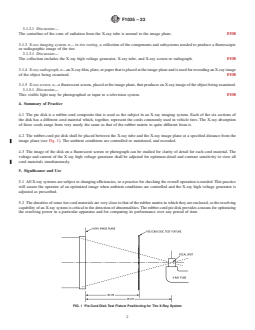
FIG. 1 Pie-Cord Disk Test Fixture Positioning for Tire X-Ray System
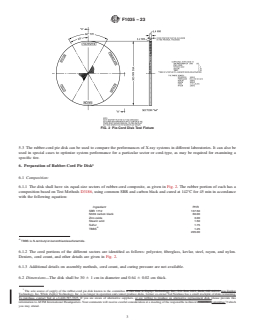
FIG. 2 Pie-Cord Disk Test Fixture
generator shall be adjusted for optimum detail and contrast 5.3 The rubber-cord pie disk can be used to compare the
sensitivity to view all cord materials simultaneously. performances of X-ray systems in different laboratories. It can
also be used in special cases to optimize system performance
5. Significance and Use
for a particular sector or cord-type, as may be required for
examining a specific tire.
5.1 All X-ray systems are subject to changing efficiencies,
so a practice for checking the overall operation is needed. This
6. Preparation of Rubber-Cord Pie Disk
practice will assu
...
This document is not an ASTM standard and is intended only to provide the user of an ASTM standard an indication of what changes have been made to the previous version. Because
it may not be technically possible to adequately depict all changes accurately, ASTM recommends that users consult prior editions as appropriate. In all cases only the current version
of the standard as published by ASTM is to be considered the official document.
Designation: F1035 − 03 (Reapproved 2015) F1035 − 23
Standard Practice for
Use of Rubber-Cord Pie Disk to Demonstrate the
Discernment Capability of a Tire X-ray Imaging System
This standard is issued under the fixed designation F1035; the number immediately following the designation indicates the year of
original adoption or, in the case of revision, the year of last revision. A number in parentheses indicates the year of last reapproval. A
superscript epsilon (´) indicates an editorial change since the last revision or reapproval.
1. Scope
1.1 This practice describes the construction and use of a rubber-cord pie-shaped standard disk for demonstrating the discernment
capability of an X-ray imaging system.
1.2 This practice is applicable to direct viewing (fluoroscopic) X-ray imaging systems and film, plate or paper (radiographic)
X-ray imaging systems that are used for checking the construction consistency of pneumatic tires.
1.3 The values stated in SI units are to be regarded as the standard.
1.4 This standard does not purport to address all of the safety concernss concerns, if any, associated with its use. It is the
responsibility of the user of this standard to establish appropriate safety and healthsafety, health, and environmental practices and
determine the applicability of regulatory limitations prior to use.
1.5 This international standard was developed in accordance with internationally recognized principles on standardization
established in the Decision on Principles for the Development of International Standards, Guides and Recommendations issued
by the World Trade Organization Technical Barriers to Trade (TBT) Committee.
2. Referenced Documents
2.1 ASTM Standards:
D1349 Practice for Rubber—Standard Conditions for Testing
D3186 Test Methods for Rubber—Evaluation of SBR (Styrene-Butadiene Rubber) Mixed With Carbon Black or Carbon Black
and Oil
F538 Terminology Relating to Characteristics and Performance of Tires
3. Terminology
3.1 Definitions:
3.1.1 pie disk, rubber-cord, n— in tire X-ray testing, a circular disk of a specified diameter having six pie-shaped sections, each
containing cord of different materials; it is used for demonstrating the discernment capability of an X-ray imaging system. (F538)
3.1.2 X-ray image plane, n— in tire testing, a surface located at a specified distance from the X-ray tube “focal spot.”
This practice is under the jurisdiction of ASTM Committee F09 on Tires and is the direct responsibility of Subcommittee F09.10 on Equipment, Facilities and Calibration.
Current edition approved June 1, 2015Dec. 1, 2023. Published September 2015March 2024. Originally approved in 1986. Last previous edition approved in 20082015
as F1035 – 03 (2008).(2015). DOI: 10.1520/F1035-03R15.10.1520/F1035-23.
For referenced ASTM standards, visit the ASTM website, www.astm.org, or contact ASTM Customer Service at service@astm.org. For Annual Book of ASTM Standards
volume information, refer to the standard’s Document Summary page on the ASTM website.
Copyright © ASTM International, 100 Barr Harbor Drive, PO Box C700, West Conshohocken, PA 19428-2959. United States
F1035 − 23
3.1.2.1 Discussion—
The centerline of the cone of radiation from the X-ray tube is normal to the image plane. F538
3.1.3 X-ray imaging system, n— in tire testing, a collection of the components and subsystems needed to produce a fluoroscopic
or radiographic image of the tire.
3.1.3.1 Discussion—
The collection includes the X-ray high voltage generator, X-ray tube, and X-ray screen or radiograph. F538
3.1.4 X-ray radiograph, n—an X-ray film, plate, or paper that is placed at the image plane and is used for recording an X-ray image
of the object being examined. F538
3.1.5 X-ray screen, n—a fluorescent screen, placed at the image plane, that produces an X-ray image of the object being examined.
3.1.5.1 Discussion—
This visible light may be photographed or input to a television system. F538
4. Summary of Practice
4.1 The pie disk is a rubber-cord composite that is used as the subject in an X-ray imaging system. Each of the six sections of
the disk has a different cord material which, together, represent the cords commonly used in vehicle tires. The X-ray absorption
of these cords range from very nearly the same as that of the rubber matrix to quite different from it.
4.2 The rubber-cord pie disk shall be placed between the X-ray tube and the X-ray image plane at a specified distance from the
image plane (see Fig. 1). The ambient conditions are controlled or monitored, and recorded.
4.3 The image of the disk on a fluorescent screen or photograph can be studied for clarity of detail for each cord material. The
voltage and current of the X-ray high voltage generator shall be adjusted for optimum detail and contrast sensitivity to view all
cord materials simultaneously.
5. Significance and Use
5.1 All X-ray systems are subject to changing efficiencies, so a practice for checking the overall operation is needed. This practice
will assure the operator of an optimized image when ambient conditions are controlled and the X-ray high voltage generator is
adjusted as prescribed.
5.2 The densities of some tire cord materials are very close to that of the rubber matrix in which they are enclosed, so the resolving
capability of an X-ray system is critical to the detection of abnormalities. The rubber-cord pie di
...