

ASTM D4291-21
(Test Method)Standard Test Method for Trace Ethylene Glycol in Used Engine Oil
General Information
- Abstract
SIGNIFICANCE AND USE
5.1 Leakage of aqueous engine coolant into the crank case weakens the ability of the oil to lubricate. If ethylene glycol is present, it promotes varnish and deposit formation. This test method is designed for early detection to prevent coolant from accumulating and seriously damaging the engine.
SCOPE
1.1 This test method covers the determination of ethylene glycol as a contaminant in used engine oil. This test method is designed to quantitate ethylene glycol in the range from 5 mass ppm to 200 mass ppm.
1.2 This standard does not purport to address all of the safety concerns, if any, associated with its use. It is the responsibility of the user of this standard to establish appropriate safety, health, and environmental practices and determine the applicability of regulatory limitations prior to use. For specific warning statements, see Section 7.
Note 1: A qualitative determination of glycol-base antifreeze is provided in Test Methods D2982. Procedure A is sensitive to about 100 ppm.
1.3 This international standard was developed in accordance with internationally recognized principles on standardization established in the Decision on Principles for the Development of International Standards, Guides and Recommendations issued by the World Trade Organization Technical Barriers to Trade (TBT) Committee.
- Status
- Published
- Publication Date
- 30-Nov-2021
- Technical Committee
- D02 - Petroleum Products, Liquid Fuels, and Lubricants
- Drafting Committee
- D02.04.0L - Gas Chromatography Methods

Overview
ASTM D4291-21: Standard Test Method for Trace Ethylene Glycol in Used Engine Oil is a critical international standard developed by ASTM International. This method focuses on the detection and quantification of ethylene glycol contamination in used engine oil, providing a way to identify coolant leaks that can severely impact engine performance and longevity. Early detection of ethylene glycol-a key component in antifreeze-prevents damage caused by coolant ingress, varnish, and deposit formation. The test is designed for quantifying ethylene glycol concentrations ranging from 5 mass ppm to 200 mass ppm.
Key Topics
- Purpose: Identifies trace amounts of ethylene glycol as a contaminant in used engine oils.
- Analytical Technique: Utilizes gas chromatography with flame ionization detection (FID) for sensitivity and precision.
- Calibration: Employs calibration mixtures spanning the designated measurement range for accurate quantification.
- Sample Preparation: Involves extraction of glycol from oil with water, followed by chromatographic analysis.
- Precision and Reproducibility: Contains detailed precision statements to guide repeatable and reliable results across laboratories.
Applications
The ASTM D4291-21 standard is widely used in the automotive, transport, and lubricant quality control sectors. Its ability to reliably detect and measure trace levels of ethylene glycol makes it instrumental for:
- Engine Maintenance and Diagnostics: Detecting glycol contamination early helps prevent major engine damage caused by coolant leaks, supporting predictive maintenance efforts and minimizing costly breakdowns.
- Oil Condition Monitoring: Enables oil analysis laboratories and fleet operators to assess lubricant integrity, schedule oil changes efficiently, and ensure engines run under optimal conditions.
- Quality Control in Oil Reclamation: Essential for businesses involved in recycling or re-refining used engine oils, ensuring that reclaimed lubricants are free from harmful contaminants.
- Regulatory Compliance: Helps laboratories and service providers adhere to standards for used oil management and environmental protection.
Related Standards
ASTM D4291-21 references and connects with several related ASTM standards, including:
- ASTM D1193: Specification for Reagent Water used in analytical testing.
- ASTM D2982: Qualitative test methods for detecting glycol-based antifreeze in used lubricating oils.
- ASTM D4057: Guidelines for manual sampling of petroleum and petroleum products.
- ASTM D4175: Terminology relating to petroleum products, liquid fuels, and lubricants.
- ASTM E355: Practice for terminology in gas chromatography.
- ASTM E594: Practice for testing flame ionization detectors in gas chromatography.
These standards collectively ensure consistency in terminology, sampling, reagent quality, and instrumental calibration for accurate glycol analysis in used oils.
By following ASTM D4291-21, industry professionals can safeguard engines, meet regulatory requirements, and maintain optimal lubricant performance. This standard is essential for anyone involved in engine oil analysis, maintenance, and quality control, offering a robust method for early detection of engine coolant leaks. For the latest official requirements and procedures, users should always reference the current published version from ASTM International.
Relations
- Refers
ASTM D4175-23a - Standard Terminology Relating to Petroleum Products, Liquid Fuels, and Lubricants - Effective Date
- 15-Dec-2023
- Refers
ASTM D4175-23e1 - Standard Terminology Relating to Petroleum Products, Liquid Fuels, and Lubricants - Effective Date
- 01-Jul-2023
- Effective Date
- 01-Dec-2019
- Effective Date
- 01-Sep-2019
- Effective Date
- 01-Nov-2011
- Refers
ASTM D4057-06(2011) - Standard Practice for Manual Sampling of Petroleum and Petroleum Products - Effective Date
- 01-Jun-2011
- Effective Date
- 01-Mar-2007
- Effective Date
- 01-Mar-2006
- Effective Date
- 01-Mar-2006
- Effective Date
- 01-Dec-2004
- Refers
ASTM D2982-07 - Standard Test Methods for Detecting Glycol-Base Antifreeze in Used Lubricating Oils - Effective Date
- 01-Dec-2004
- Effective Date
- 01-Jan-2001
- Effective Date
- 01-Jan-2001
- Effective Date
- 01-Jan-2001
- Effective Date
- 01-Jan-2001
Get Certified
Connect with accredited certification bodies for this standard

Element Materials Technology
Materials testing and product certification.

ABS Group Brazil
ABS Group certification services in Brazil.

ABS Quality Evaluations Inc.
American Bureau of Shipping quality certification.
Sponsored listings
Frequently Asked Questions
ASTM D4291-21 is a standard published by ASTM International. Its full title is "Standard Test Method for Trace Ethylene Glycol in Used Engine Oil". This standard covers: SIGNIFICANCE AND USE 5.1 Leakage of aqueous engine coolant into the crank case weakens the ability of the oil to lubricate. If ethylene glycol is present, it promotes varnish and deposit formation. This test method is designed for early detection to prevent coolant from accumulating and seriously damaging the engine. SCOPE 1.1 This test method covers the determination of ethylene glycol as a contaminant in used engine oil. This test method is designed to quantitate ethylene glycol in the range from 5 mass ppm to 200 mass ppm. 1.2 This standard does not purport to address all of the safety concerns, if any, associated with its use. It is the responsibility of the user of this standard to establish appropriate safety, health, and environmental practices and determine the applicability of regulatory limitations prior to use. For specific warning statements, see Section 7. Note 1: A qualitative determination of glycol-base antifreeze is provided in Test Methods D2982. Procedure A is sensitive to about 100 ppm. 1.3 This international standard was developed in accordance with internationally recognized principles on standardization established in the Decision on Principles for the Development of International Standards, Guides and Recommendations issued by the World Trade Organization Technical Barriers to Trade (TBT) Committee.
SIGNIFICANCE AND USE 5.1 Leakage of aqueous engine coolant into the crank case weakens the ability of the oil to lubricate. If ethylene glycol is present, it promotes varnish and deposit formation. This test method is designed for early detection to prevent coolant from accumulating and seriously damaging the engine. SCOPE 1.1 This test method covers the determination of ethylene glycol as a contaminant in used engine oil. This test method is designed to quantitate ethylene glycol in the range from 5 mass ppm to 200 mass ppm. 1.2 This standard does not purport to address all of the safety concerns, if any, associated with its use. It is the responsibility of the user of this standard to establish appropriate safety, health, and environmental practices and determine the applicability of regulatory limitations prior to use. For specific warning statements, see Section 7. Note 1: A qualitative determination of glycol-base antifreeze is provided in Test Methods D2982. Procedure A is sensitive to about 100 ppm. 1.3 This international standard was developed in accordance with internationally recognized principles on standardization established in the Decision on Principles for the Development of International Standards, Guides and Recommendations issued by the World Trade Organization Technical Barriers to Trade (TBT) Committee.
ASTM D4291-21 is classified under the following ICS (International Classification for Standards) categories: 75.100 - Lubricants, industrial oils and related products. The ICS classification helps identify the subject area and facilitates finding related standards.
ASTM D4291-21 has the following relationships with other standards: It is inter standard links to ASTM D4175-23a, ASTM D4175-23e1, ASTM D2982-07(2019), ASTM E594-96(2019), ASTM E594-96(2011), ASTM D4057-06(2011), ASTM E355-96(2007), ASTM E594-96(2006), ASTM D1193-06, ASTM D2982-98(2004), ASTM D2982-07, ASTM E355-96(2001), ASTM E355-96, ASTM E594-96, ASTM E594-96(2001). Understanding these relationships helps ensure you are using the most current and applicable version of the standard.
ASTM D4291-21 is available in PDF format for immediate download after purchase. The document can be added to your cart and obtained through the secure checkout process. Digital delivery ensures instant access to the complete standard document.
Standards Content (Sample)
This international standard was developed in accordance with internationally recognized principles on standardization established in the Decision on Principles for the
Development of International Standards, Guides and Recommendations issued by the World Trade Organization Technical Barriers to Trade (TBT) Committee.
Designation: D4291 − 21
Standard Test Method for
Trace Ethylene Glycol in Used Engine Oil
This standard is issued under the fixed designation D4291; the number immediately following the designation indicates the year of
original adoption or, in the case of revision, the year of last revision. A number in parentheses indicates the year of last reapproval. A
superscript epsilon (´) indicates an editorial change since the last revision or reapproval.
1. Scope* 3. Terminology
1.1 This test method covers the determination of ethylene 3.1 Definitions:
glycol as a contaminant in used engine oil. This test method is 3.1.1 This test method makes reference to common gas
designed to quantitate ethylene glycol in the range from chromatographicprocedures,terms,andrelationships.Detailed
5 mass ppm to 200 mass ppm. definitions of these can be found in Practices E355 and E594,
and Terminology D4175.
1.2 This standard does not purport to address all of the
safety concerns, if any, associated with its use. It is the
4. Summary of Test Method
responsibility of the user of this standard to establish appro-
4.1 The sample of oil is extracted with water and the
priate safety, health, and environmental practices and deter-
analysis is performed on the water extract. A reproducible
mine the applicability of regulatory limitations prior to use.
volume of the extract is injected into a gas chromatograph
For specific warning statements, see Section 7.
using on-column injection and the eluting compounds are
NOTE 1—A qualitative determination of glycol-base antifreeze is
detected by a flame ionization detector. The ethylene glycol
provided in Test Methods D2982. Procedure A is sensitive to about
peak area is determined and compared with areas obtained
100 ppm.
from the injection of freshly prepared known standards.
1.3 This international standard was developed in accor-
dance with internationally recognized principles on standard-
5. Significance and Use
ization established in the Decision on Principles for the
5.1 Leakage of aqueous engine coolant into the crank case
Development of International Standards, Guides and Recom-
weakens the ability of the oil to lubricate. If ethylene glycol is
mendations issued by the World Trade Organization Technical
present, it promotes varnish and deposit formation. This test
Barriers to Trade (TBT) Committee.
method is designed for early detection to prevent coolant from
accumulating and seriously damaging the engine.
2. Referenced Documents
2.1 ASTM Standards: 6. Apparatus
D1193 Specification for Reagent Water
6.1 Gas Chromatograph—Any gas chromatograph
D2982 Test Methods for Detecting Glycol-Base Antifreeze
equipped with the following:
in Used Lubricating Oils
6.1.1 Flame Ionization Detector, capable of operating con-
D4057 Practice for Manual Sampling of Petroleum and
tinuously at a temperature equivalent to the maximum column
Petroleum Products
temperature employed, and connected to the column so as to
D4175 Terminology Relating to Petroleum Products, Liquid
avoid any cold spots.
Fuels, and Lubricants
6.1.2 Sample Inlet System, providing for on-column injec-
E355 Practice for Gas Chromatography Terms and Relation-
tion and capable of operating continuously at a temperature
ships
equivalent to the maximum column temperature employed.
E594 Practice for Testing Flame Ionization Detectors Used
6.2 Recorder—Recording potentiometer with a full-scale
in Gas or Supercritical Fluid Chromatography
response time of 2 s or less may be used.
6.3 Columns—1.2 m by 6.4 mm (4 ft by ⁄4 in.) copper tube
This test method is under the jurisdiction of ASTM Committee D02 on
packed with 5 % by mass Carbowax 20-M liquid phase on
Petroleum Products, Liquid Fuels, and Lubricants and is the direct responsibility of
Subcommittee D02.04.0L on Gas Chromatography Methods.
30/60 mesh Chromosorb T solid support. As an alternative, a
Current edition approved Dec. 1, 2021. Published December 2021. Originally
fused silica capillary column, 15 m long with a 0.53 mm ID
approved in 1983. Last previous edition approved in 2017 as D4291 – 04 (2017).
and 2.0 micron film thickness of a bonded polyethylene glycol
DOI: 10.1520/D4291-21.
For referenced ASTM standards, visit the ASTM website, www.astm.org, or can be used.
contact ASTM Customer Service at service@astm.org. For Annual Book of ASTM
6.4 Integrator—Manual, mechanical, or electronic integra-
Standards volume information, refer to the standard’s Document Summary page on
the ASTM website. tion is required to determine the peak area. However, best
*A Summary of Changes section appears at the end of this standard
Copyright © ASTM International, 100 Barr Harbor Drive, PO Box C700, West Conshohocken, PA 19428-2959. United States
D4291 − 21
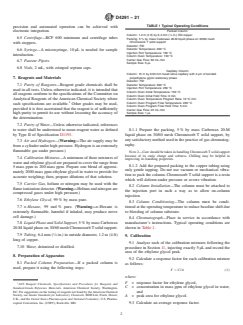
TABLE 1 Typical Operating Conditions
precision and automated operation can be achieved with
electronic integration. Packed Column
Column: 1.2 m (4 ft) by 6.4 mm ( ⁄4 in.) OD copper
6.5 Centrifuge—RCF 600 minimum and centrifuge tubes
Packing: 5 % by mass Carbowax 20-M liquid phase on 30/60 mesh
Chromosorb T solid support
with stoppers.
Detector: FID
Detector Temperature: 200 °C
6.6 Syringe—A microsyringe, 10 µL is needed for sample
Injection Port Temperature: 150 °C
introduction.
Column Oven Temperature: 130 °C
Carrier Gas Flow: 60 mL ⁄min
6.7 Pasteur Pipets.
Sample Size: 5 µL
6.8 Vials, 2 mL, with crimped septum caps.
Capillary Column
Column: 15 m by 0.53 mm fused silica capillary with 2 µm of bonded
polyethylene glycol stationary phase
7. Reagents and Materials
Detector: FID
7.1 Purity of Reagents—Reagent grade chemicals shall be Detector Temperature: 300 °C
Injection Port Temperature: 250 °C
used in all tests. Unless otherwise indicated, it is intended that
Column Oven Initial Temperature: 150 °C
all reagents conform to the specifications of the Committee on
Column Oven Initial Hold Time: 0 min
Analytical Reagents of the American Chemical Society where Column Oven Temperature Program Rate: 10 °C ⁄min
Column Oven Program Final Temperature: 200 °C
such specifications are available. Other grades may be used,
Column Oven Program Final Hold Time: 5 min
provided it is first ascertained that the reagent is of sufficiently
Carrier Gas Flow: 22 mL ⁄min
high purity to permit its use without lessening the accuracy of Sample Size: 1 µL
the determination.
7.2 Purity of Water—Unless otherwise indicated, references
to water shall be understood to mean reagent water as defined
8.1.1 Prepare the packing, 5 % by mass Carbowax 20-M
by Type II of Specification D1193.
liquid phase on 30/60 mesh Chromosorb T solid support, by
any satisfactory method used in the practice of gas chromatog-
7.3 Air and Hydrogen—(Warning—The air supply may be
raphy.
from a cylinder under high pressure. Hydrogen is an extremely
flammable gas under pressure.)
NOTE 2—Care should be taken in handling ChromosorbTsolid support
because of its static charge and softness. Chilling may be helpful in
7.4 Calibration Mixtures—Aminimum of three mixtures of
improving its handling properties.
water and ethylene glycol are prepared to cover the range from
8.1.2 Add the prepared packing to the copper tubing using
5 mass ppm to 200 mass ppm. Prepare one blend of approxi-
only gentle tapping. Do not use vacuum or mechanical vibra-
mately 2000
...
This document is not an ASTM standard and is intended only to provide the user of an ASTM standard an indication of what changes have been made to the previous version. Because
it may not be technically possible to adequately depict all changes accurately, ASTM recommends that users consult prior editions as appropriate. In all cases only the current version
of the standard as published by ASTM is to be considered the official document.
Designation: D4291 − 04 (Reapproved 2017) D4291 − 21
Standard Test Method for
Trace Ethylene Glycol in Used Engine Oil
This standard is issued under the fixed designation D4291; the number immediately following the designation indicates the year of
original adoption or, in the case of revision, the year of last revision. A number in parentheses indicates the year of last reapproval. A
superscript epsilon (´) indicates an editorial change since the last revision or reapproval.
1. Scope Scope*
1.1 This test method covers the determination of ethylene glycol as a contaminant in used engine oil. This test method is designed
to quantitate ethylene glycol in the range from 5 mass ppm to 200 mass ppm.
1.2 This standard does not purport to address all of the safety concerns, if any, associated with its use. It is the responsibility
of the user of this standard to establish appropriate safety, health, and environmental practices and determine the applicability of
regulatory limitations prior to use. For specific warning statements, see Section 67.
NOTE 1—A qualitative determination of glycol-base antifreeze is provided in Test Methods D2982. Procedure A is sensitive to about 100 ppm.
1.3 This international standard was developed in accordance with internationally recognized principles on standardization
established in the Decision on Principles for the Development of International Standards, Guides and Recommendations issued
by the World Trade Organization Technical Barriers to Trade (TBT) Committee.
2. Referenced Documents
2.1 ASTM Standards:
D1193 Specification for Reagent Water
D2982 Test Methods for Detecting Glycol-Base Antifreeze in Used Lubricating Oils
D4057 Practice for Manual Sampling of Petroleum and Petroleum Products
D4175 Terminology Relating to Petroleum Products, Liquid Fuels, and Lubricants
E355 Practice for Gas Chromatography Terms and Relationships
E594 Practice for Testing Flame Ionization Detectors Used in Gas or Supercritical Fluid Chromatography
3. Terminology
3.1 Definitions:
3.1.1 This test method makes reference to common gas chromatographic procedures, terms, and relationships. Detailed definitions
of these can be found in Practices E355 and E594, and Terminology D4175.
4. Summary of Test Method
4.1 The sample of oil is extracted with water and the analysis is performed on the water extract. A reproducible volume of the
This test method is under the jurisdiction of ASTM Committee D02 on Petroleum Products, Liquid Fuels, and Lubricants and is the direct responsibility of Subcommittee
D02.04.0L on Gas Chromatography Methods.
Current edition approved Oct. 1, 2017Dec. 1, 2021. Published November 2017December 2021. Originally approved in 1983. Last previous edition approved in 20132017
as D4291 – 04 (2013).(2017). DOI: 10.1520/D4291-04R17.10.1520/D4291-21.
For referenced ASTM standards, visit the ASTM website, www.astm.org, or contact ASTM Customer Service at service@astm.org. For Annual Book of ASTM Standards
volume information, refer to the standard’s Document Summary page on the ASTM website.
*A Summary of Changes section appears at the end of this standard
Copyright © ASTM International, 100 Barr Harbor Drive, PO Box C700, West Conshohocken, PA 19428-2959. United States
D4291 − 21
extract is injected into a gas chromatograph using on-column injection and the eluting compounds are detected by a flame
ionization detector. The ethylene glycol peak area is determined and compared with areas obtained from the injection of freshly
prepared known standards.
5. Significance and Use
5.1 Leakage of aqueous engine coolant into the crank case weakens the ability of the oil to lubricate. If ethylene glycol is present,
it promotes varnish and deposit formation. This test method is designed for early detection to prevent coolant from accumulating
and seriously damaging the engine.
6. Apparatus
6.1 Gas Chromatograph—Any gas chromatograph equipped with the following:
6.1.1 Flame Ionization Detector, capable of operating continuously at a temperature equivalent to the maximum column
temperature employed, and connected to the column so as to avoid any cold spots.
6.1.2 Sample Inlet System, providing for on-column injection and capable of operating continuously at a temperature equivalent
to the maximum column temperature employed.
6.2 Recorder—Recording potentiometer with a full-scale response time of 2 s or less may be used.
6.3 Columns—1.2 m by 6.4 mm (4 ft by ⁄4 in.) copper tube packed with 5 % by mass Carbowax 20-M liquid phase on 30/60 mesh
Chromosorb T solid support. As an alternative, a fused silica capillary column, 15 m long with a 0.53 mm ID and 2.0 micron film
thickness of a bonded polyethylene glycol can be used.
6.4 Integrator—Manual, mechanical, or electronic integration is required to determine the peak area. However, best precision and
automated operation can be achieved with electronic integration.
6.5 Centrifuge—RCF 600 minimum and centrifuge tubes with stoppers.
6.6 Syringe—A microsyringe, 10 μL is needed for sample introduction.
6.7 Pasteur Pipets.
6.8 Vials, 2 mL, with crimped septum caps.
7. Reagents and Materials
7.1 Purity of Reagents—Reagent grade chemicals shall be used in all tests. Unless otherwise indicated, it is intended that all
reagents conform to the specifications of the Committee on Analytical Reagents of the American Chemical Society where such
specifications are available. Other grades may be used, provided it is first ascertained that the reagent is of sufficiently high purity
to permit its use without lessening the accuracy of the determination.
7.2 Purity of Water—Unless otherwise indicated, references to water shall be understood to mean reagent water as defined by Type
II of Specification D1193.
7.3 Air and Hydrogen—(Warning—The air supply may be from a cylinder under high pressure. Hydrogen is an extremely
flammable gas under pressure.)
Reagent Chemicals, American Chemical Society Specifications,ACS Reagent Chemicals, Specifications and Procedures for Reagents and Standard-Grade Reference
Materials, American Chemical Society, Washington, DC. For Suggestionssuggestions on the testing of reagents not listed by the American Chemical Society, see
AnnualAnalar Standards for Laboratory Chemicals, BDH Ltd., Poole, Dorset, U.K., and the United States Pharmacopeia and National Formulary, U.S. Pharmacopeial
Convention, Inc. (USPC), Rockville, MD.
D4291 − 21
7.4 Calibration Mixtures—A minimum of three mixtures of water and ethylene glycol are prepared to cover the range from 5 mass
ppm to 200 mass ppm. Prepare one blend of approximately 2000 mass ppm ethylene glycol in water to provide for accurate
weighing; then, prepare dilutions of that solution.
7.5 Carrier Gas, helium or nitrogen may be used with the flame ionization detector. (Warning—Helium and nitrogen are
compressed gases under high pressure.)
7.6 Ethylene Glycol, 99 % by mass pure.
7.7 n-Hexane, 99 mol % pure. (Warning—n-Hexane is extremely flammable, harmful if inhaled, may produce nerve cell
damage.)
7.8 Liquid Phase and Solid Support, 5 % by mass Carbowax 20-M liquid phase on 30/60 mesh Chromosorb T solid support.
7.9 Tubing, 6.4 mm ( ⁄4 in.) in outside diameter, 1.2 m (4 ft) long of copper.
7.10 Water, deionized or distilled.
8. Preparation of Apparatus
8.1 Packed Column Preparation—If a packed column is used, prepare it using the following steps:
8.1.1 Prepare the packing, 5 % b
...