

ASTM E407-23
(Practice)Standard Practice for Microetching Metals and Alloys
General Information
- Abstract
SIGNIFICANCE AND USE
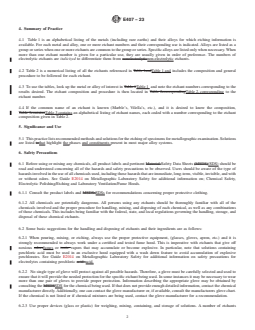
5.1 This practice lists recommended methods and solutions for the etching of specimens for metallographic examination. Solutions are listed that highlight the phases and constituents present in most major alloy systems.
SCOPE
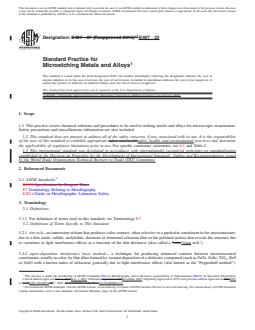
1.1 This practice covers chemical solutions and procedures to be used in etching metals and alloys for microscopic examination. Safety precautions and miscellaneous information are also included.
1.2 This standard does not purport to address all of the safety concerns, if any, associated with its use. It is the responsibility of the user of this standard to establish appropriate safety, health, and environmental practices and determine the applicability of regulatory limitations prior to use. For specific cautionary statements, see 6.1 and Table 2.
1.3 This international standard was developed in accordance with internationally recognized principles on standardization established in the Decision on Principles for the Development of International Standards, Guides and Recommendations issued by the World Trade Organization Technical Barriers to Trade (TBT) Committee.
- Status
- Published
- Publication Date
- 31-Oct-2023
- Technical Committee
- E04 - Metallography
- Drafting Committee
- E04.01 - Specimen Preparation
Overview
ASTM E407-23: Standard Practice for Microetching Metals and Alloys provides a comprehensive guide for the chemical etching of metallic specimens to prepare them for metallographic examination. Developed by ASTM International, this standard specifies recommended etching methods and solutions suitable for a broad range of metals and alloys. The primary goal is to reveal the microstructure-such as grain boundaries, phases, and constituents-of metals and alloys, making these features visible under a microscope. The document also includes essential safety precautions and general laboratory guidance, ensuring the process is both effective and safe.
Key Topics
Etching Solutions and Procedures
- Provides recommended chemical solutions for etching various metal and alloy systems.
- Includes instructions for both electrolytic and non-electrolytic etchants.
- Lists etchants alphabetically by metal or alloy for ease of reference.
Metallographic Examination
- Etching techniques highlighted in this standard are designed to enhance visibility of microstructural features for microscopic analysis.
- Supports quality control, research, failure analysis, and material development.
Safety Guidelines
- Details on proper handling, storage, and disposal of etching chemicals, emphasizing the use of protective equipment and fume hoods.
- Specific cautions for hazardous reagents such as HF, chromium (VI) compounds, and perchloric acid.
Miscellaneous Laboratory Practices
- Recommendations for using reagent-grade chemicals and reagent water.
- Guidance on specimen preparation such as polishing and cleaning prior to etching.
- Notes on the importance of fresh etchants and proper agitation during etching for optimal results.
Applications
The ASTM E407-23 standard is widely used in metallographic laboratories across materials science, engineering, and manufacturing sectors. Its practical value lies in its ability to standardize the microetching process, leading to consistent and reproducible results. Common applications include:
- Quality Assurance: Metallurgical laboratories use microetching to verify the quality and consistency of metal products by examining microstructures for defects, phase distribution, or contamination.
- Failure Analysis: Investigation of failed components often involves microetching to reveal underlying microstructural causes such as inclusions, segregations, or improper heat treatment.
- Research & Development: Scientists and engineers employ etching procedures from ASTM E407-23 to characterize new alloys or study the effects of various heat treatments and processing techniques.
- Education and Training: Universities and technical programs use the standard as a teaching tool for instructing students in metallography and material characterization.
Related Standards
ASTM E407-23 references and aligns with several other international standards to ensure clear terminology, laboratory safety, and consistent reagent quality. Key related standards include:
- ASTM D1193: Specification for Reagent Water-Defines the purity requirements for water used in etchant preparation.
- ASTM E7: Terminology Relating to Metallography-Provides standardized definitions used throughout ASTM E407-23.
- ASTM E2014: Guide on Metallographic Laboratory Safety-Details safety practices to prevent accidents in metallography labs.
This practice was developed in accordance with WTO principles for the development of international standards, supporting global harmonization in metallographic techniques.
Keywords: microetching, metallography, etching metals, etchant solutions, metallographic examination, ASTM E407-23, laboratory safety, microstructure analysis, material testing standards.
Relations
- Effective Date
- 01-Nov-2023
- Effective Date
- 01-Nov-2023
- Effective Date
- 01-Nov-2023
- Effective Date
- 01-Nov-2023
- Effective Date
- 01-Nov-2023
- Effective Date
- 01-Nov-2023
- Effective Date
- 01-Nov-2023
- Referred By
ASTM E1558-09(2021) - Standard Guide for Electrolytic Polishing of Metallographic Specimens - Effective Date
- 01-Nov-2023
- Effective Date
- 01-Nov-2023
- Effective Date
- 01-Nov-2023
- Effective Date
- 01-Nov-2023
- Effective Date
- 01-Nov-2023
- Effective Date
- 01-Nov-2023
- Effective Date
- 01-Nov-2023
- Effective Date
- 01-Nov-2023
Get Certified
Connect with accredited certification bodies for this standard

Element Materials Technology
Materials testing and product certification.

Inštitut za kovinske materiale in tehnologije
Institute of Metals and Technology. Materials testing, metallurgical analysis, NDT.
Sponsored listings
Frequently Asked Questions
ASTM E407-23 is a standard published by ASTM International. Its full title is "Standard Practice for Microetching Metals and Alloys". This standard covers: SIGNIFICANCE AND USE 5.1 This practice lists recommended methods and solutions for the etching of specimens for metallographic examination. Solutions are listed that highlight the phases and constituents present in most major alloy systems. SCOPE 1.1 This practice covers chemical solutions and procedures to be used in etching metals and alloys for microscopic examination. Safety precautions and miscellaneous information are also included. 1.2 This standard does not purport to address all of the safety concerns, if any, associated with its use. It is the responsibility of the user of this standard to establish appropriate safety, health, and environmental practices and determine the applicability of regulatory limitations prior to use. For specific cautionary statements, see 6.1 and Table 2. 1.3 This international standard was developed in accordance with internationally recognized principles on standardization established in the Decision on Principles for the Development of International Standards, Guides and Recommendations issued by the World Trade Organization Technical Barriers to Trade (TBT) Committee.
SIGNIFICANCE AND USE 5.1 This practice lists recommended methods and solutions for the etching of specimens for metallographic examination. Solutions are listed that highlight the phases and constituents present in most major alloy systems. SCOPE 1.1 This practice covers chemical solutions and procedures to be used in etching metals and alloys for microscopic examination. Safety precautions and miscellaneous information are also included. 1.2 This standard does not purport to address all of the safety concerns, if any, associated with its use. It is the responsibility of the user of this standard to establish appropriate safety, health, and environmental practices and determine the applicability of regulatory limitations prior to use. For specific cautionary statements, see 6.1 and Table 2. 1.3 This international standard was developed in accordance with internationally recognized principles on standardization established in the Decision on Principles for the Development of International Standards, Guides and Recommendations issued by the World Trade Organization Technical Barriers to Trade (TBT) Committee.
ASTM E407-23 is classified under the following ICS (International Classification for Standards) categories: 77.040.99 - Other methods of testing of metals. The ICS classification helps identify the subject area and facilitates finding related standards.
ASTM E407-23 has the following relationships with other standards: It is inter standard links to ASTM E407-07(2015)e1, ASTM B777-15(2020), ASTM F561-19, ASTM E1077-14(2021), ASTM F3056-14(2021), ASTM E1351-01(2020), ASTM F75-23, ASTM E1558-09(2021), ASTM F2924-14(2021), ASTM F2282-23, ASTM E1268-19, ASTM F3184-16, ASTM F139-19, ASTM F3001-14(2021), ASTM F1314-18. Understanding these relationships helps ensure you are using the most current and applicable version of the standard.
ASTM E407-23 is available in PDF format for immediate download after purchase. The document can be added to your cart and obtained through the secure checkout process. Digital delivery ensures instant access to the complete standard document.
Standards Content (Sample)
This international standard was developed in accordance with internationally recognized principles on standardization established in the Decision on Principles for the
Development of International Standards, Guides and Recommendations issued by the World Trade Organization Technical Barriers to Trade (TBT) Committee.
Designation: E407 − 23
Standard Practice for
Microetching Metals and Alloys
This standard is issued under the fixed designation E407; the number immediately following the designation indicates the year of
original adoption or, in the case of revision, the year of last revision. A number in parentheses indicates the year of last reapproval. A
superscript epsilon (´) indicates an editorial change since the last revision or reapproval.
This standard has been approved for use by agencies of the U.S. Department of Defense.
1. Scope reveals the structure due to variations in light interference
effects as a function of the film thickness (also called a “stain
1.1 This practice covers chemical solutions and procedures
etch”).
to be used in etching metals and alloys for microscopic
examination. Safety precautions and miscellaneous informa-
3.2.2 vapor-deposition interference layer method— a tech-
tion are also included.
nique for producing enhanced contrast between microstructural
constituents, usually in color, by thin films formed by vacuum
1.2 This standard does not purport to address all of the
deposition of a dielectric compound (such as ZnTe, ZnSe,
safety concerns, if any, associated with its use. It is the
TiO , ZnS or ZnO) with a known index of refraction, generally
responsibility of the user of this standard to establish appro- 2
due to light interference effects (also known as the “Pepperhoff
priate safety, health, and environmental practices and deter-
method”).
mine the applicability of regulatory limitations prior to use.
For specific cautionary statements, see 6.1 and Table 2.
4. Summary of Practice
1.3 This international standard was developed in accor-
dance with internationally recognized principles on standard-
4.1 Table 1 is an alphabetical listing of the metals (includ-
ization established in the Decision on Principles for the
ing rare earths) and their alloys for which etching information
Development of International Standards, Guides and Recom-
is available. For each metal and alloy, one or more etchant
mendations issued by the World Trade Organization Technical
numbers and their corresponding use is indicated. Alloys are
Barriers to Trade (TBT) Committee.
listed as a group or series when one or more etchants are
common to the group or series. Specific alloys are listed only
2. Referenced Documents
when necessary. When more than one etchant number is given
2.1 ASTM Standards:
for a particular use, they are usually given in order of
E7 Terminology Relating to Metallography
preference. The numbers of electrolytic etchants are italicized
E2014 Guide on Metallographic Laboratory Safety
to differentiate them from non-electrolytic etchants.
4.2 Table 2 is a numerical listing of all the etchants refer-
3. Terminology
enced in Table 1 and includes the composition and general
3.1 Definitions:
procedure to be followed for each etchant.
3.1.1 For definition of terms used in this standard, see
4.3 To use the tables, look up the metal or alloy of interest
Terminology E7.
in Table 1 and note the etchant numbers corresponding to the
3.2 Definitions of Terms Specific to This Standard:
results desired. The etchant composition and procedure is then
3.2.1 tint etch—an immersion etchant that produces color
located in Table 2, corresponding to the etchant number.
contrast, often selective to a particular constituent in the
microstructure, due to a thin oxide, sulfide, molybdate, chro-
4.4 If the common name of an etchant is known (Marble’s,
mate or elemental selenium film on the polished surface that
Vilella’s, etc.), and it is desired to know the composition,
Table 3 contains an alphabetical listing of etchant names, each
coded with a number corresponding to the etchant composition
This practice is under the jurisdiction of ASTM Committee E04 on Metallog-
given in Table 2.
raphy and is the direct responsibility of Subcommittee E04.01 on Specimen
Preparation.
Current edition approved Nov. 1, 2023. Published November 2023. Originally
5. Significance and Use
ɛ1
approved in 1970. Last previous edition approved in 2015 as E407–07(2015) .
DOI: 10.1520/E0407-23.
5.1 This practice lists recommended methods and solutions
For referenced ASTM standards, visit the ASTM website, www.astm.org, or
for the etching of specimens for metallographic examination.
contact ASTM Customer Service at service@astm.org. For Annual Book of ASTM
Solutions are listed that highlight the phases and constituents
Standards volume information, refer to the standard’s Document Summary page on
the ASTM website. present in most major alloy systems.
Copyright © ASTM International, 100 Barr Harbor Drive, PO Box C700, West Conshohocken, PA 19428-2959. United States
E407 − 23
6. Safety Precautions 6.2.6 Methanol is a cumulative poison hazard. Where etha-
nol or methanol, or both are listed as alternates, ethanol is the
6.1 Before using or mixing any chemicals, all product labels
preferred solvent. Methanol should be used in a properly
and pertinent Safety Data Sheets (SDS) should be read and
designed chemical fume hood.
understood concerning all of the hazards and safety precautions
6.2.7 When working with HF always be sure to wear the
to be observed. Users should be aware of the type of hazards
appropriate gloves, eye protection and apron. Buying HF at the
involved in the use of all chemicals used, including those
lowest useable concentration will significantly reduce risk.
hazards that are immediate, long-term, visible, invisible, and
Additionally, it is recommended that a calcium gluconate
with or without odors. See Guide E2014 on Metallographic
cream or other appropriate HF neutralizing agent be available
Laboratory Safety for additional information on; Chemical
for use if direct skin contact of the etchant occurs.
Safety, Electrolytic Polishing/Etching and Laboratory
6.2.8 The EPA states that human studies have clearly
Ventilation/Fume Hoods.
established that inhaled chromium (VI) is a human carcinogen,
6.1.1 Consult the product labels and SDSs for recommen-
resulting in an increased risk of lung cancer. Animal studies
dations concerning proper protective clothing.
have shown chromium (VI) to cause lung tumors via inhalation
6.1.2 All chemicals are potentially dangerous. All persons
exposure. Therefore, when working with Cr(VI) compounds
using any etchants should be thoroughly familiar with all of the
such as K Cr O and CrO always use a certified and tested
2 2 7 3
chemicals involved and the proper procedure for handling,
fume hood. Additional information can be obtained at the EPA
mixing, and disposing of each chemical, as well as any
website .
combinations of those chemicals. This includes being familiar
6.2.9 For safety in transportation, picric acid is distributed
with the federal, state, and local regulations governing the
by the manufacturer wet with greater than 30% water. Care
handling, storage, and disposal of these chemical etchants.
must be taken to keep it moist because dry picric acid is shock
6.2 Some basic suggestions for the handling and disposing
sensitive and highly explosive especially when it is combined
of etchants and their ingredients are as follows:
with metals such as copper, lead, zinc, and iron. It will also
6.2.1 When pouring, mixing, or etching, always use the react with alkaline materials including plaster and concrete to
proper protective equipment, (glasses, gloves, apron, etc.) and form explosive compounds. It should be purchased in small
quantities suitable for use in six to twelve months and checked
it is strongly recommended to always work under a certified
and tested fume hood. This is imperative with etchants that periodically for lack of hydration. Distilled water may be
added to maintain hydration, It must only be stored in plastic or
give off noxious fumes or vapors that may accumulate or
become explosive. In particular, note that solutions containing glass bottles with nonmetallic lids. If dried particles are noted
on or near the lid, submerge the bottle in water to re-hydrate
perchloric acid must be used in an exclusive hood equipped
with a wash down feature to avoid accumulation of explosive them before opening. It is recommended that any bottle of
picric acid that appears dry or is of unknown vintage not be
perchlorates. See Guide E2014 on Metallographic Laboratory
Safety for additional information on safety precautions for opened and that proper emergency personnel be notified.
electrolytes containing perchloric acid. 6.2.10 Wipe up or flush any and all spills, no matter how
minute in nature.
6.2.2 No single type of glove will protect against all
possible hazards. Therefore, a glove must be carefully selected 6.2.11 Properly dispose of all solutions that are not identi-
and used to ensure that it will provide the needed protection for fied by composition and concentration.
the specific etchant being used. In some instances it may be
6.2.12 Store, handle and dispose of chemicals according to
necessary to wear more than one pair of gloves to provide
the manufacturer’s recommendations. Observe printed cau-
proper protection. Information describing the appropriate glove
tions on reagent bottles.
may be obtained by consulting the SDS for the chemical being
6.2.13 Information pertaining to the toxicity, hazards, and
used. If that does not provide enough detailed information,
working precautions of the chemicals, solvents, acids, bases,
contact the chemical manufacturer directly. Additionally, one
etc. being used (such as safety data sheets, SDS) should be
can contact the glove manufacturer or, if available, consult the
available for rapid consultation. A selection of useful books on
manufacturers glove chart. If the chemical is not listed or if
this subject is given in Refs. (1-11) .
chemical mixtures are being used, contact the glove manufac-
6.2.14 Facilities that routinely use chemical etchants should
turer for a recommendation.
have an employee safety training program to insure the
6.2.3 Use proper devices (glass or plastic) for weighing,
employees have the knowledge to properly handle chemical
mixing, containing, and storage of solutions. A number of
etchants.
etchants generate fumes or vapors and should only be stored in
6.2.15 When working with etchants always know where the
properly vented containers. Storage of fuming etchants in
nearest safety shower, eye-wash station, and emergency tele-
sealed or non-vented containers may create an explosion
phone are located. These facilities should be close enough to
hazard.
the chemical working area to be effective.
6.2.4 When mixing etchants, always add reagents to the
solvent unless specific instructions indicate otherwise.
6.2.5 When etching, always avoid direct physical contact
https://iris.epa.gov/ChemicalLanding/&substance_nmbr=144
with the etchant and specimen; use devices such as tongs to
The boldface numbers in parentheses refer to the list of references at the end
hold the specimen (and tufts of cotton, if used). of this standard.
E407 − 23
7. Miscellaneous Information of the etchant by thorough washing and complete drying of the
specimen before placing it on the microscope stage.
7.1 If you know the trade name of an alloy and need to
know the composition to facilitate the use of Table 1, refer to 7.13 Tint etchants (13, 14-16) are always used by
a compilation such as Ref (12). immersion, never by swabbing, as this would inhibit film
formation. An extremely high quality of polish is required as
7.2 Reagent grade chemicals shall be used for all etchants.
tint etchants will reveal remaining polishing damage even if it
Unless otherwise indicated, it is intended that all reagents
is not visible with bright field illumination. After polishing, the
conform to specifications of the Committee on Analytical
surface must be carefully cleaned. Use a polyethylene beaker
Reagents of the American Chemical Society where such
to contain the etchant if it contains fluorine ions (for example,
specifications are available. Other grades, such as United States
etchants containing ammonium bifluoride, NH FHF). The
Pharmacopeia (USP), may be used, provided it is first ascer-
specimen is placed in the solution using tongs, polished face
tained that the reagent is of sufficiently high purity to permit its
up. Gently agitate the solution while observing the polished
use without detrimental effect.
surface. After coloration begins, allow the solution to settle and
7.2.1 Unless otherwise indicated, references to water shall
remain motionless. Remove the specimen from the etchant
be understood to mean distilled water. Experience has shown
when the surface is colored violet, rinse and dry. A light
that the quality of tap water varies significantly and can
pre-etch with a general-purpose chemical etchant may lead to
adversely affect some etchants.
sharper delineation of the structure after tint etching.
7.3 Methanol is usually available only as absolute methanol.
7.14 Specimens should be carefully cleaned before use of a
When using this alcohol it is imperative that approximately 5
vapor-deposition interference film (“Pepperhoff”) method (13,
volume % of water is added whenever an etchant composition
14-17). A light pre-etch, or a slight amount of polishing relief,
calls for 95 % methanol. Some of these etchants will not work
may lead to sharper delineation of the constituents after vapor
at all if water is not present.
deposition. The deposition is conducted inside a vacuum
7.4 For conversion of small liquid measurements, there are
evaporator of the type used to prepare replicas for electron
approximately 20 drops/mL.
microscopy. One or several small lumps of a suitable dielectric
7.5 Etching should be carried out on a freshly polished compound with the desired index of refraction is heated under
a vacuum until it evaporates. A vacuum level of 1.3 to 0.013 Pa
specimen.
−3 −5
(10 to 10 mm Hg) is adequate and the polished surface
7.6 Gentle agitation of the specimen or solution during
should be about 10–15 cm beneath the device that holds the
immersion etching will result in a more uniform etch.
dielectric compound. Slowly evaporate the lumps and observe
7.7 The etching times given are only suggested starting
the surface of the specimen. It may be helpful to place the
ranges and not absolute limits.
specimen on a small piece of white paper. As the film thickness
increases, the surface (and the paper) will become colored with
7.8 In electrolytic etching, direct current (DC) is implied
the color sequence changing in the order yellow, green, red,
unless indicated otherwise. AC for alternating current.
purple, violet, blue, silvery blue. Stop the evaporation when the
7.9 A good economical source of direct current for small
color is purple to violet, although in some cases, thinner films
scale electrolytic etching is the standard 6V lantern battery.
with green or red colors have produced good results.
7.10 In electrolytic etching, the specimen is the anode
7.15 The ASM Handbook Metallography and Microstruc-
unless indicated otherwise.
ture (18) provides additional advice on etching solutions and
7.11 Do not overlook the possibility of multiple etching
techniques for various alloys.
with more than one solution in order to fully develop the
8. Precision and Bias
structure of the specimen.
8.1 It is not possible to specify the precision or bias of this
7.12 Microscope objectives can be ruined by exposure to
practice since quantitative measurements are not made.
acid fumes from etchant residue inadvertently left on the
specimen. This problem is very common when the specimen or
9. Keywords
mounting media contain porosity and when the mounting
material (such as Bakelite) does not bond tightly to the 9.1 etch; etchant; interference method; metallography; met-
specimen resulting in seepage along the edges of the specimen. als; micro-etch; microscope; microstructure; Pepperhoff
In all cases, extreme care should be taken to remove all traces method; tint etch
E407 − 23
TABLE 1 Etchants for Metals
NOTE 1—It is strongly recommended to always mix and use etchants under a certified and tested fume hood.
NOTE 2—Electrolytic etchants are italicized.
Metal Etchants Uses
Aluminum Base:
Pure Al 1a, 2, 3 general structure
4, 5 grain structure under polarized light
1b grain boundaries and slip lines
1000 series 1a, 3, 2 general structure
4, 5 grain structure under polarized light
6, 7 phase identification
2000 series 3, 2, 1a general structure
8a, 6, 7 phase identification
3000 series 3, 1a general structure
4, 5 grain structure under polarized light
8a, 6, 7 phase identification
4000 series 3, 1a general structure
5000 series 3, 1a, 2, 6, 8a general structure
4, 5 grain structure under polarized light
6000 series 3, 1a, 2, 6, 8a, 222 general structure
4, 5 grain structure under polarized light
1a, 2, 7, 6, 8a phase identification
7000 series 3, 1a, 2 general structure
4, 5 grain structure under polarized light
3b, 6 phase identification
Beryllium Base:
Pure Be 9, 10 general structure via polarized light
Be alloys 11 general structure
Chromium Base: 12, 13c general structure
Cobalt Base:
Pure Co 14, 15, 16, 17 general structure
Hard-facing and tool metals 18, 19, 20 general structure
High-temperature alloys 20, 18, 16, 21, 22b, 24, 25 general structure
19 phase identification
Columbium Base (see niobium base)
Copper Base:
Pure Cu 26, 27, 28, 29, 30, 31d, 32, 33, 34b, 35, general structure
36, 37, 38, 39, 40, 41, 42, 8b, 210, 215
43, 28 chemical polish and etch
Cu-Al (aluminum bronze) 44, 31d, 34b, 35, 36, 37, 38, 39, 40, general structure
45, 215
Cu-Be 46, 41, 45 general structure
Cu-Cr 41 general structure
Cu-Mn 41 general structure
Cu-Ni 34, 47, 48, 40, 49, 50 general structure
Cu-Si 41 general structure
Cu-Sn (tin bronze) 51, 52 general structure
Admiralty metal 8b general structure
Gilding metal
Cartridge brass
Free-cutting brass
Nickel silver 31d, 32, 33, 41, 42, 49 general structure
Cu alloys 26, 27, 28, 29, 30, 44, 41, 31d, 32, 33, general structure
34b, 35, 36, 37, 38, 39, 210, 215
53, 43, 28, 49 chemical polish and etch
42, 49, 210 darkens beta in alpha-beta brass
54 etching of cold worked brass
Dysprosium Base: 55, 56 general structure
E407 − 23
TABLE 1 Continued
Metal Etchants Uses
Erbium Base: 55, 56 general structure
Gadolinium Base: 55, 56, 57 general structure
Germanium Base: 58, 59, 60 general structure
Gold Base:
Pure Au 61, 62 general structure
63 chemical polish and etch
Au alloys 64b, 62 general structure
63 chemical polish and etch
>90 % noble metals 61 general structure
<90 % noble metals 65 general structure
Hafnium base: 66, 67, 68, 69, 70 general structure
71 grain structure under polarized light
72 chemical polish and etch
Holmium Base: 55, 56 general structure
Iridium Base: 73c general structure
Iron Base:
Pure Fe 74a grain boundaries
75 substructure
210 colors ferrite grains
Fe + C 76, 74a, 77, 78, 79 general structure
and 74a, 77, 31a, 223 ferrite grain boundaries
Fe + <1C + <4 % additions 80, 81, 82 prior austenitic grain boundaries in martensitic and
bainitic steels
78, 222a untempered martensite
31b, 78 carbides and phosphides (matrix darkened, carbides
and phosphides remain bright)
83 cementite attacked rapidly, austenite less, ferrite and
iron phosphide least
84 overheating and burning
85 stains carbides
86 chemical polish-etch
210, 211 colors ferrite
213, 214 colors carbides
216 colors lath martensite in low-carbon high-alloy grades
222b for dual phase steels; reveals pearlite, darkens
martensite and outlines austenite
Fe + 4–12 Cr 80, 87, 88, 89, 90, 91, 79, 210 general structure
86 chemical polish-etch
Fe + 12–30 Cr + <6 Ni (400 Series) 80, 87, 88, 89, 34, 40, 92, 93, 94, 95, 91, 226 general structure
96, 97, 98 sigma phase
31c carbides
86 chemical polish-etch
219 grain boundary etch
220 darkens delta ferrite
Fe + 12–20 Cr + 4–10 Ni + <7 % 80, 31c, 89, 99, 100, 91 general structure
other elements (controlled trans- 31c carbides
formation, precipitation harden- 86 chemical polish-etch
ing, stainless maraging alloys) 220 darkens delta ferrite
Fe + 15–30 Cr + 6–40 Ni + <5 % 13b, 89, 87, 88, 83a, 80, 94, 95, 91, general structure
other elements (300 Series) 101, 212, 221, 226
13a, 102, 31c, 48c, 213 carbides and sensitization
and 48, 96, 97, 98 stains sigma phase
Fe + 16–25 Cr + 3–6 Ni + 5–10 103, 104, 98 delineates sigma phase and
Mn (200 series) 103, 104 welds of dissimilar metals
86 chemical polish-etch
219 grain boundary etch (no twins)
220 darkens delta ferrite
High temperature 89, 25, 105, 106, 97, 212, 221 general structure
107, 108, 213 γ' precipitate
86 chemical polish-etch
Non-stainless maraging steels 109, 89, 99, 100, 221 general structure
83b grain boundaries
86 chemical polish-etch
E407 − 23
TABLE 1 Continued
Metal Etchants Uses
Tool steels 74a, 80, 14 general structure
110 grain boundaries in tempered tool steel
210, 211 colors ferrite, lower alloy grades
214, 214 colors cementite
224, 225 carbides attacked and colored
Superalloys 86, 87, 94, 221, 226 general etch
111 general structure
111 γ' depletion
Lead Base:
Pure Pb 57, 112 general structure
113 for alternate polishing and etching
Pb + <2 Sb 114, 115, 57, 74b general structure
113 for alternate polishing and etching
Pb + >2 Sb 114, 57, 74b general structure
113 for alternate polishing and etching
Pb + Ca 112 general structure
113 for alternate polishing and etching
Pb alloys 116, 117b general structure
Babbitt 74b general structure
Magnesium Base:
Pure Mg 118, 119, 74a, 120, 121, 122 general structure
123 stain-free polish-etch
Mg-Mn 119, 74a, 124, 122 general structure
Mg-Al, Mg-Al-Zn (Al + Zn <5 %) 118, 119, 74a, 125, 124, 123, 122 general structure
120, 125, 126, 127 phase identification
124, 126, 127 grain structure
Mg-Al, Mg-Al-Zn (Al + Zn >5 %) 118, 119, 74a, 125, 124, 121, 122 general structure
120, 125, 126, 127 phase identification
Mg-Zn-Zr 118, 119, 74a, 1d, 128, 124, 126, general structure
and 127, 121, 122
Mg-Zn-Th-Zr 120, 121 phase identification
Mg-Th-Zr 118, 119, 74a, 1d, 124, 127, 121, 122 general structure
and
Mg-Rare Earth-Zr 120, 121 phase identification
Molybdenum Base: 98c, 129, 130, 131 general structure
As cast 132a chemical polish prior to etching
Nickel Base:
Pure Ni and high Ni alloys 133, 134, 47, 135, 136, 25, 108, 31c general structure
137 grain boundary sulfidation
Ni-Ag 38, 138, 50, 139 general structure
Ni-Al 50, 140, 141, 142, 89, 143 general structure
Ni-Cr 144, 50, 83, 134, 145, 98, 146, 147, 13a general structure
Ni-Cu 38, 138, 50, 133, 140, 25, 134, 47, general structure
48b, 94, 108, 34
Ni-Fe 50, 140, 141, 83, 134, 148, 40, 107, 149 general structure
74e, 25, 150 orientation pitting
Ni-Mn 74e general structure
Ni-Mo 143 general structure
Ni-Ti 143, 151, 50, 133 general structure
Ni-Zn 152 general structure
Superalloys 94, 105, 138, 153, 12, 87, 89, 212, 226 general structure
25, 94 grain size
107, 111, 13a reveals microstructural inhomogeneity
133 grain boundary sulfidation
154 fine precipitation structure
19b, 155, 156 differential matrix and nonmetallic staining
22a for passive alloys (for example, UNS Alloy N06625)
157 specific for UNS Alloy N10004
107 submicroscopic structure in aged superalloys particu-
larly for electron microscopy. Stains the matrix when γ'
precipitates are present
154 γ' banding
18 pre-etch activation for passive specimens
213 colors carbide and γ'
E407 − 23
TABLE 1 Continued
Metal Etchants Uses
Niobium (Columbium) Base: 129, 66, 158, 159, 160, 161, 162, 163 general structure
164, 129, 160 grain boundaries
Osmium Base: 165a general structure
165a etch-polishing for viewing grains with polarized light
Palladium Base:
Pure Pd 61, 166, 62, 165a general structure
Pd alloys 166, 64a, 62, 165a general structure
>90 % noble metals 61 general structure
<90 % noble metals 65 general structure
Platinum Base:
Pure Pt 64a, 73a general structure
167 electrolytic polish and etch
Pt Alloys 64b, 73a general structure
167 electrolytic polish and etch
>90 % noble metals 61 general structure
<90 % noble metals 65 general structure
Pt-10 % Rh 168 general structure
Plutonium Base: 169 general structure
Rhenium Base: 13b, 98c, 132b, 170a general structure
Rhodium Base: 171 general structure
Ruthenium Base: 73b general structure
73b etch-polishing for viewing grains with polarized light
Silver Base:
Pure Ag 172, 173, 62 general structure
Ag alloys 65, 61, 174, 175, 62 general structure
Ag-Cu alloys 130 general structure
Ag-Pd alloys 173 general structure
Ag solders 173, 176 general structure
Tantalum Base:
Pure Ta 177 general structure
Ta alloys 159, 66, 178, 163, 161, 179 general structure
164 grain boundaries and inclusions
158 grain boundaries—retains carbide precipitate
Thorium Base:
Pure Th 185 general structure
Th alloys 185 general structure
Tin Base:
Pure Sn 74d, 180, 151 general structure
181 grain boundaries
Sn-Cd 74d general structure
Sn-Fe 74d, 177a general structure
Sn-Pb 182, 183, 74b general structure
116 darkens Pb in Sn-Pb eutectic
Sn coatings (on steel) 183 general structure
Babbitts 184 general structure
Sn-Sb-Cu 74b general structure
Titanium Base:
Pure Ti 186, 187, 67, 68, 69, 217 general structure
188 removes stain
72 chemical polish and etch
Ti-5 Al-2,5 Sn 189 reveals hydrides
Ti-6 Al-6 V-2 Sn 190 Stains alpha and transformed beta, retained beta
remains white
Ti-Al-Zr 191 general structure
Ti-8Mn 192 general structure
Ti-13 V-11 Cr-3 Al (aged) 192 general structure
Ti-Si 193 general structure
Ti alloys 186, 187, 192, 194, 158, 132b, 1c, 67, general structure
68, 69, 3a, 218
11, 1c reveals alpha case
72, 192, 178 chemical polish and etch
170a outlines and darkens hydrides in some alloys
188 removes stain
Tungsten Base:
E407 − 23
TABLE 1 Continued
Metal Etchants Uses
Pure W 98c, 131 general structure
As cast 132a chemical polish prior to etching
W-Th 209 general structure
Uranium Base:
Pure U 67, 69, 195, 196 general structure
U + Zr 68 general structure
U beryllides 170a general structure
U alloys 67, 69, 195, 96 general structure
207 carbides
Vanadium Base:
Pure V 170b, 165b general structure
197, 198 grain boundaries
V alloys 199, 198 general structure
Zinc Base:
Pure Zn 200a general structure
Zn-Co 177 general structure
Zn-Cu 201 general structure
203 distinguishes gamma (γ) and epsilon (ε)
Zn-Fe 74a structure of galvanized sheet
Die castings 202 general structure
Zirconium Base: 66, 67, 204, 68, 69, 205 general structure
206 electrolytic polish and etch
71 grain structure under polarized light
72 chemical polish and etch
E407 − 23
TABLE 2 Numerical List of Etchants
NOTE 1—It is strongly recommended to always mix and use etchants under a certified and tested fume hood.
Etchant Composition Procedure
1 1 mL HF (a) Swab with cotton for 15 s.
200 mL water (b) Alternately immerse and polish several minutes.
(c) Immerse 3–5 s.
(d) Immerse 10–120 s.
2 3 mL HF (a) Swab 10 s to reveal general structure.
100 mL water (b) Immerse 15 min, wash 10 min in water to form film with hatching that varies with grain
orientation.
3 2 mL HF (a) Immerse 10–20 s Wash in stream of warm water. Reveals general structure.
3 mL HCl (b) Dilute with 4 parts water. Colors constituents—mix fresh.
5 mL HNO
190 mL water
4 24 mL H PO Electrolytic: Use carbon cathode raising DC voltage from 0–30 V in 30 s. Total etching time
3 4
3 min with agitation.
50 mL Carbitol (diethylene glycol monoethyl Wash and cool. Repeat if necessary.
ether)
4 g boric acid
2 g oxalic acid
10 mL HF
32 mL water
5 5 g HBF Electrolytic: Use Al, Pb, or stainless steel cathode. Anodize 1–3 min, 20–45 V DC. At 30 V,
200 mL water etch for 1 min.
6 25 mL HNO Immerse 40 s at 70°C (160°F). Rinse in cold water.
75 mL water
7 10–20 mL H SO Immerse 30 s at 70°C (160°F). Rinse in cold water.
2 4
80 mL water
8 10 mL H PO (a) Immerse 1–3 min at 50°C (120°F).
3 4
90 mL water (b) Electrolytic at 1–8 V for 5–10 s.
9 3–4 g sulfamic acid Use just prior to the last polishing operation. It is not intended as a final etchant. The
5 drops HF specimen is examined as polished under polarized light.
100 mL water
10 10 mL HF Immerse 10–30 s.
90 mL methanol (90 %)
11 2 mL HF Immerse or swab few seconds to a minute.
100 mL water
12 20 mL HNO Use a certified and tested hood. Do not store. Immerse or swab 5–60 s.
60 mL HCl
13 10 g oxalic acid Electrolytic at 6 V:
100 mL water (a) 10–15 s.
(b) 1 min.
(c) 2–3 s.
Use stainless steel cathode and platinum or Nichrome connection to specimen.
14 10 mL HNO Immerse few seconds to a minute.
90 mL methanol (95 %)
15 15 mL HNO Use a certified and tested hood. Age before use. Immerse 5–30 s. May be used electrolyti-
15 mL acetic acid cally.
60 mL HCl
15 mL water
16 5–10 mL HCl Electrolytic at 3 V for 2–10 s.
100 mL water
17 5 mL HCl Electrolytic at 6 V for few seconds.
10 g FeCl
100 mL water
18 2–10 g CrO Use a certified and tested hood. Electrolytic at 3 V for 2–10 s.
100 mL water
E407 − 23
TABLE 2 Continued
Etchant Composition Procedure
19 A Immerse in freshly mixed Solutions A + B (1:1) for 5–10 s. If surface activation is
8 g NaOH necessary, first use Etch #18, then rinse in water. While still wet, immerse in Solutions
100 mL water A + B (1:1). Mixture of solutions A + B has 15-min useful life. Note: KMnO is an aggres-
B sive staining agent.
Saturated aqueous solution of KMnO
20 5 mL H O (30 %) Use a certified and tested hood. Mix fresh. Immerse polished face up for few seconds.
2 2
100 mL HCl
21 1 g CrO Use a certified and tested hood. To mix, add the HCl to CrO . Electrolytic at 3 V for 2–10
3 3
140 mL HCl s.
22 100 mL HCl Use a certified and tested hood. Do not store.
0.5 mL H O (30 %) (a) Immerse or swab ⁄2 –3 min. Add H O dropwise to maintain action.
2 2 2 2
(b) Electrolytic, 4 V, 3–5 s.
23 5 mL HCl Electrolytic at 6 V for 10–20 s.
95 mL ethanol (95 %) or methanol (95 %)
24 5 mL HNO Use a certified and tested hood. Immerse few seconds.
200 mL HCl
65 g FeCl
25 10 g CuSO Immerse or swab 5–60 s. Made more active by adding few drops of H SO just before
4 2 4
50 mL HCl use.
50 mL water
26 5 g FeCl Swab 16–60 s. Activity may be decreased by substituting glycerol for water.
10 mL HCl
50 mL glycerol
30 mL water
27 1 g KOH Dissolve KOH in water, then slowly add NH OH to solution. Add 3 % H O last. Use
4 2 2
20 mL H O (3 %) fresh—immerse few seconds to a minute.
2 2
50 mL NH OH
30 mL water
28 1 g FeNO Swab or immerse few seconds to a minute.
100 mL water
29 1 g K Cr O Use a certified and tested hood. Add 2 drops of HCl just before using. Swab few seconds
2 2 7
4 mL H SO to a minute.
2 4
50 mL water
30 25 mL NH OH Mix NH OH and water before adding H O . Must be used fresh. Swab 5–45 s.
4 4 2 2
25 mL water
50 mL H O (3 %)
2 2
31 10 g ammonium persulfate (a) Swab or immerse up to 5 s.
100 mL water (b) Immerse up to 2 min to darken matrix to reveal carbides and phosphides.
(c) Electrolytic at 6 V for few seconds to a minute.
(d) Immerse 3–60 s. Can be heated to increase activity.
32 60 g CrO Use a certified and tested hood. Saturated solution.
100 mL water Immerse or swab 5–30 s.
33 10 g CrO Use a certified and tested hood. Add HCl just before use. Immerse 3–30 s. Phases can be
colored by Nos. 35, 36, 37.
2–4 drops HCl
100 mL water
34 5 g FeCl (a) Immerse or swab few seconds to few minutes. Small additions of HNO activate solu-
3 3
50 mL HCl tion and minimize pitting.
100 mL water
(b) Immerse or swab few seconds at a time. Repeat as necessary.
35 20 g FeCl Use a certified and tested hood. Immerse or swab few seconds at a time until desired re-
5 mL HCl sults are obtained.
1 g CrO
100 mL water
36 25 g FeCl Immerse or swab few seconds at a time until desired results are obtained.
25 mL HCl
100 mL water
E407 − 23
TABLE 2 Continued
Etchant Composition Procedure
37 1 g FeCl Immerse or swab few seconds at a time until desired results are obtained
10 mL HCl
100 mL water
38 8 g FeCl Swab 5–30 s.
25 mL HCl
100 mL water
39 5 g FeCl Immerse or swab few seconds at a time until desired results are obtained.
10 mL HCl
1 g CuCl
0.1 g SnCl
100 mL water
40 5 g FeCl Immerse or swab few seconds to few minutes.
16 mL HCl
60 mL ethanol (95 %) or methanol (95 %)
41 2 g K Cr O Use a certified and tested hood. Add the HCl just before using. Immerse 3–60 s.
2 2 7
8 mL H SO
2 4
4 drops HCl
100 mL water
42 10 g cupric ammonium chloride Add NH OH to solution until neutral or slightly alkaline. Immerse 5–60 s.
100 mL water
NH OH
43 20 mL NH OH Immerse 5–30 s.
1 g ammonium persulfate
60 mL water
44 50 mL NH OH Use fresh. Peroxide content varies directly with copper content of alloy to be etched. Im-
20–50 mL H O (3 %) merse or swab to 1 min. Film on etched aluminum bronze removed by No. 82.
2 2
0–50 mL water
45 1 g CrO Use a certified and tested hood. Electrolytic at 6 V for 3–6 s. Use aluminum cathode.
100 mL water
46 15 mL NH OH When mixing, add NaOH pellets last. For best results use before pellets have dissolved.
15 mL H O (3 %)
2 2
15 mL water
4 pellets NaOH
47 5 g NaCN or KCN Use a certified and tested hood—Can give off extremely poisonous hydrogen cyanide.
5 g (NH ) S O Precaution—Also poisonous by ingestion as well as skin contact.
4 2 2 2
100 mL water
48 10 g NaCN Use a certified and tested hood—Can give off extremely poisonous hydrogen cyanide.
100 mL water Precaution—Also poisonous by ingestion as well as skin contact. Electrolytic at 6 V:
(a) 5 s for sigma.
(b) 30 s for ferrite and general structure.
(c) to 5 min for carbides.
49 3 g FeSO Electrolytic at 8–10 V (0.1 A) for 5–15 s.
0.4 g NaOH
10 mL H SO
2 4
190 mL water
50 5 mL acetic acid Use a certified and tested hood. Do not store. Electrolytic at 1.5 V for 20 to 60 s. Use plati-
10 mL HNO num wires.
85 mL water
51 2 g FeCl Immerse few minutes.
5 mL HCl
30 mL water
60 mL ethanol or methanol
52 1 g sodium dichromate Swab few seconds.
1 g NaCl
4 mL H SO
2 4
250 mL water
53 1–5 mL NH OH Immerse 5–60 s.
100 mL water
E407 − 23
TABLE 2 Continued
Etchant Composition Procedure
54 1 g ammonium acetate Electrolytic at 0.3 A/cm for 5–30 s.
3 g sodium thiosulfate
7 mL NH OH
1300 mL water
55 1 mL H SO Use a certified and tested hood. Swab gently 10–15 s. Rinse with methanol and blow dry.
2 4
15 mL HNO Helps to chemically polish. If final etch is too mild, follow with No. 98. Do not store.
10 mL acetic acid
5 mL H PO
3 4
20 mL lactic acid
56 30 mL HNO Use a certified and tested hood. Swab gently 5–15 s. Rinse with ethanol or methanol and
10 mL H PO blow dry. Do not store.
3 4
20 mL acetic acid
10 mL lactic acid
57 75 mL acetic acid Use a certified and tested hood. Immerse 6–15 s. Do not store.
25 mL H O (30 %)
2 2
58 25 mL HF Swab 3–20 s.
25 mL HNO
5 mL water
59 2 g AgNO Mix AgNO and water, then add HF and HNO . Swab ⁄2 –2 min.
3 3 3
40 mL water
40 mL HF
20 mL HNO
60 25 mL HNO Use a certified and tested hood. Do not store. Let stand ⁄2 h before using. Swab 3–20 s.
15 mL acetic acid
15 mL HF
5–7 drops bromine
61 60 mL HCl Use a certified and tested hood. Immerse few seconds to a minute.
40 mL HNO
62 1–5 g CrO Use a certified and tested hood. Vary composition of reagent and aging of reagent after
100 mL HCl mixing to suit alloy. Swab or immerse few seconds to a minute.
63 0.1 g CrO Use a certified and tested hood. Swab few seconds to a minute.
10 mL HNO
100 mL HCl
64 5 mL HNO (a) Immerse 1–5 min.
25 mL HCl (b) Use hot. Will form chloride film on gold alloys if much silver is present. Ammonia will
30 mL water remove film.
65 A Use a certified and tested hood—Can give off extremely poisonous hydrogen cyanide.
10 g ammonium persulfate Precaution—Also poisonous by ingestion as well as skin contact. Mix 1 + 1 mixture of So-
100 mL water lutions A and B just before use. (A mixture of 5 drops of each will cover the surface of a 1
B in. dia. mount.) Immerse ⁄2 – 2 min.
10 g KCN
100 mL water
66 30 mL HF Use a certified and tested hood. Swab 3–10 s or immerse to 2 min.
15 mL HNO
30 mL HCl
67 10 mL perchloric acid Use in wash down/perchloric rated fume hood. Precaution—Keep etchant cool when mix-
10 mL 2-butoxyethanol ing and during use. Electrolytic at 30–65 V for 10–60 s.
70 mL ethanol (95 %)
10 mL water
68 3 mL perchloric acid Use in wash down/perchloric rated fume hood. Precaution—Keep etchant cool when mix-
35 mL 2-butoxyethanol ing and during use. Electrolytic at 60–150 V for 5–30 s.
60 mL methanol (absolute)
69 5 mL perchloric acid Use in wash down/perchloric rated fume hood. Precaution—Keep etchant cool when mix-
80 mL acetic acid ing and during use. Electrolytic at 20–60 V for 1–5 min. Do not store.
70 5 mL HF Swab for 5–60 s.
2 mL AgNO (5 %)
200 mL water
71 5 mL HF Add 5–10 drops of this solution on the final polishing wheel which has been charged with
95 mL water the polishing solution. The specimen is polished on this wheel until the surface turns black.
Distilled water is then slowly added to the wheel and polishing continued until the surface
is bright. At this time the specimen should be ready for examination via polarized light.
Note—Use inert substance between cloth and wheel to prevent attack of the wheel. Wear
appropriate protective equipment.
E407 − 23
TABLE 2 Continued
Etchant Composition Procedure
72 10 mL HF Swab for 5–20 s.
45 mL HNO
45 mL water
73 20 mL HCl Electrolytic etch—use carbon cathode and platinum wire connection to specimen.
25 g NaCl (a) 6 V AC for 1 min.
65 mL water (b) 5 V–20 V AC for 1–2 min.
(c) 20 V AC for 1–2 min.
For etch-polishing, use shorter times. After etching, water rinse, alcohol rinse, and dry.
74 1–5 mL HNO Etching rate is increased, sensitivity decreased with increased percentage of HNO .
3 3
100 mL ethanol (95 %) or methanol (95 %) (a) Immerse few seconds to a minute.
(b) Immerse 5–40 s in 5 % HNO solution. To remove stain, immerse 25 s in 10 % HCl-
methanol solution.
(c) For Inconels and Nimonics, use 5 mL HNO solution—electrolytic at 5–10 V for 5–20 s.
(d) Swab or immerse several minutes.
(e) Swab 5–60 s. HNO may be increased to 30 mL in methanol only depending on alloy.
(Ethanol is unstable with over 5 % HNO .) Do not store.
75 5 g picric acid Immerse 1–2 s at a time and immediately rinse with methanol. Repeat as often as neces-
8 g CuCl sary. (Long immersion times will result in copper deposition on surface.)
20 mL HCl
200 mL ethanol (95 %) or methanol (95 %)
76 4 g picric acid Composition given will saturate with picric acid. Immerse few seconds to a minute or more.
100 mL ethanol (95 %) or methanol (95 %) Adding a wetting agent such as zepherin chloride will increase response.
77 10 g picric acid Composition given will saturate the solution with picric acid. Immerse few seconds to a
5 drops HCl minute or more.
100 mL ethanol (95 %) or methanol (95 %)
78 10 g potassium metabisulfite Immerse 1–15 s. Better results are sometimes obtained by first etching lightly with No. 76
or 74.
100 mL water
79 40 mL HCl Swab few seconds to a minute.
5 g CuCl
30 mL water
25 mL ethanol (95 %) or methanol (95 %)
80 5 mL HCl Immerse or swab few seconds to 15 min. Reaction may be accelerated by adding a few
1 g picric acid drops of 3 % H O . Optional (for prior austenite grain boundaries)—temper specimen at
2 2
100 mL ethanol (95 %) or methanol (95 %) 600–900°F prior to preparation.
81 2 g picric acid Composition given will saturate the solution with picric acid.
1 g sodium tridecylbenzene sulfonate. (a) Immerse few seconds to a minute.
100 mL water (b) Immerse to 15 min with occasional swabbing for heavy grain boundary attack.
82 5 g FeCl Immerse 5–10 s.
5 drops HCl
100 mL water
83 10 g CrO Use a certified and tested hood—(a) Electrolytic at 6 V for 5–60 s. Attacks carbides.
100 mL water (b) Electrolytic at 6 V for 3–5 s.
84 10 mL H SO Use a certified and tested hood. Precaution—Add H SO slowly to water and cool, then
2 4 2 4
10 mL HNO add HNO . Immerse 30 s. Swab in running water. Repeat three times and repolish lightly.
3 3
80 mL water
85 2 g picric acid Use a certified and tested hood. Immerse in boiling solution for 5 min. Precaution—Do not
25 g NaOH boil dry—anhydrous picric acid is unstable and highly explosive. Alternative: Electrolytic at
100 mL water 6 V for 40 s (room temperature). Use stainless steel cathode.
86 3 g oxalic acid Use a certified and tested hood. Solution should be freshly prepared. Immerse 15–25 min
4 mL H O (30 %) when specimens or parts cannot be given usual metallographic polish. Multiple etching
2 2
100 mL water may be required.
87 10 mL HNO Use a certified and tested hood—Can give off nitrogen dioxide gas. Precaution—Mix HCl
20–50 mL HCl and glycerol thoroughly before adding HNO . Do not store. Properly discard before solution
30 mL glycerol attains a dark orange color. Immerse or swab few seconds to few minutes. Higher percent-
age of HCl minimizes pitting. A hot water rinse just prior to etching may be used to activate
the reaction. Sometimes a few passes on the final polishing wheel is also necessary to
remove a passive surface.
88 10 mL HNO Use a certified and tested hood—Can give off nitrogen dioxide gas. Precaution—Properly
20 mL HCl discard before solution attains a dark orange color. Immerse few seconds to a minute.
30 mL water Much stronger reaction than No. 87.
E407 − 23
TABLE 2 Continued
Etchant Composition Procedure
89 10 mL HNO Use a certified and tested hood. Do not store. Immerse or swab few seconds to few min-
10 mL acetic acid utes.
15 mL HCl
2–5 drops glycerol
90 10 mL HNO Use a certified and tested hood—Immerse 2–10 s. Do not store. Properly discard after
20 mL HF use. Solution decomposes on standing.
20–40 mL glycerol
91 5 mL HNO This etchant is equivalent to a 1 + 1 mixture of No. 80 and No. 74 (5 % HNO ). Swab for
3 3
5 mL HCl 30 s or longer.
1 g picric acid
200 mL ethanol (95 %) or methanol (95 %)
92 10 mL HCl Immerse 5–30 min or electrolytic at 6 V for 3–5 s.
100 mL ethanol (95 %) or methanol (95 %)
93 concentrated HNO Use a certified and tested hood. Electrolytic at 0.2 A/cm for few seconds.
94 2 g CuCl Submerged swabbing for few seconds to several minutes. Attacks ferrite more readily than
40 mL HCl austenite.
40–80 mL ethanol (95 %) or methanol (95 %)
95 2 g CuCl Immerse or swab few seconds to few minutes.
40 mL HCl
40–80 mL ethanol (95 %) or methanol (95 %)
40 mL water
96 85 g NaOH Electrolytic at 6 V for 5–10 s.
50 mL water
97 45 g KOH Composition of solution is approximately 10 N. Electrolytic at 2.5 V for few seconds. Stains
60 mL water sigma and chi yellow to red brown, ferrite gray to blue gray, carbides barely touched, aus-
tenite not affected.
98 10 g K Fe(CN) Use a certified and tested hood—Can give off extremely poisonous hydrogen cyanide.
3 6
Precaution—Also poisonous by ingestion as well as skin contact. Use fresh.
10 g KOH or NaOH (a) Immerse or swab 15–60 s. Stains carbides and sigma. (To differentiate, No. 31 electro-
lytic at 4 V will attack sigma, but not carbides. If pitting occurs, reduce voltage.)
100 mL water (b) Immerse in fresh, hot solution 2–20 min. Stains carbides dark, ferrite yellow, sigma
blue. Austenite turns brown on over-etching.
(c) Swab 5–60 s. (Immersion will produce a stain etch).
Follow with water rinse, alcohol rinse, dry.
99 25 mL HCl Mix fresh. (For stock solution, mix first three items. Add potassium metabisulfite just before
3 g ammonium bifluoride use.) Immerse few seconds to a few minutes.
125 mL water
a few grains of potassium
metabisulfite
100 10 g FeCl Immerse few seconds.
90 mL water
101 2 g CrO Use a certified and tested hood-Immerse 5–60 s. (CrO may be increased up to 20 g for
3 3
20 mL HCl difficult alloys. Staining and pitting increase as CrO increased.)
80 mL water
102 concentrated NH OH Use a certified and tested hood. Electrolytic at 6 V for 30–60 s. Attacks carbides only.
103 20 mL HNO Use a certified and tested hood. Immerse 10–60 s.
4 mL HCl
20 mL methanol (99 %)
104 5 mL HNO Use a certified and tested hood. Immerse 10 min or longer.
45 mL HCl
50 mL water
105 5 mL H SO Use a certified and tested hood. Pr
...
This document is not an ASTM standard and is intended only to provide the user of an ASTM standard an indication of what changes have been made to the previous version. Because
it may not be technically possible to adequately depict all changes accurately, ASTM recommends that users consult prior editions as appropriate. In all cases only the current version
of the standard as published by ASTM is to be considered the official document.
´1
Designation: E407 − 07 (Reapproved 2015) E407 − 23
Standard Practice for
Microetching Metals and Alloys
This standard is issued under the fixed designation E407; the number immediately following the designation indicates the year of
original adoption or, in the case of revision, the year of last revision. A number in parentheses indicates the year of last reapproval. A
superscript epsilon (´) indicates an editorial change since the last revision or reapproval.
This standard has been approved for use by agencies of the U.S. Department of Defense.
ε NOTE—Originally approved date was editorially corrected to 1970 in footnote 1 in January 2016.
1. Scope
1.1 This practice covers chemical solutions and procedures to be used in etching metals and alloys for microscopic examination.
Safety precautions and miscellaneous information are also included.
1.2 This standard does not purport to address all of the safety concerns, if any, associated with its use. It is the responsibility
of the user of this standard to establish appropriate safety and healthsafety, health, and environmental practices and determine
the applicability of regulatory limitations prior to use. For specific cautionary statements, see 6.1 and Table 2.
1.3 This international standard was developed in accordance with internationally recognized principles on standardization
established in the Decision on Principles for the Development of International Standards, Guides and Recommendations issued
by the World Trade Organization Technical Barriers to Trade (TBT) Committee.
2. Referenced Documents
2.1 ASTM Standards:
D1193 Specification for Reagent Water
E7 Terminology Relating to Metallography
E2014 Guide on Metallographic Laboratory Safety
3. Terminology
3.1 Definitions:
3.1.1 For definition of terms used in this standard, see Terminology E7.
3.2 Definitions of Terms Specific to This Standard:
3.2.1 tint etch—an immersion etchant that produces color contrast, often selective to a particular constituent in the microstructure,
due to a thin oxide, sulfide, molybdate, chromate or elemental selenium film on the polished surface that reveals the structure due
to variations in light interference effects as a function of the film thickness (also called a ''stain“stain etch”).
3.2.2 vapor-deposition interference layer method— a technique for producing enhanced contrast between microstructural
constituents, usually in color, by thin films formed by vacuum deposition of a dielectric compound (such as ZnTe, ZnSe, TiO , ZnS
or ZnO) with a known index of refraction, generally due to light interference effects (also known as the “Pepperhoff method”).
This practice is under the jurisdiction of ASTM Committee E04 on Metallography and is the direct responsibility of Subcommittee E04.01 on Specimen Preparation.
Current edition approved June 1, 2015Nov. 1, 2023. Published September 2015November 2023. Originally approved in 1970. Last previous edition approved in 20072015
ɛ1
as E407E407–07(2015)–07 . DOI: 10.1520/E0407-07R15E01.10.1520/E0407-23.
For referenced ASTM standards, visit the ASTM website, www.astm.org, or contact ASTM Customer Service at service@astm.org. For Annual Book of ASTM Standards
volume information, refer to the standard’s Document Summary page on the ASTM website.
Copyright © ASTM International, 100 Barr Harbor Drive, PO Box C700, West Conshohocken, PA 19428-2959. United States
E407 − 23
4. Summary of Practice
4.1 Table 1 is an alphabetical listing of the metals (including rare earths) and their alloys for which etching information is
available. For each metal and alloy, one or more etchant numbers and their corresponding use is indicated. Alloys are listed as a
group or series when one or more etchants are common to the group or series. Specific alloys are listed only when necessary. When
more than one etchant number is given for a particular use, they are usually given in order of preference. The numbers of
electrolytic etchants are italicized to differentiate them from nonelectrolyticnon-electrolytic etchants.
4.2 Table 2 is a numerical listing of all the etchants referenced in Table 1andTable 1 and includes the composition and general
procedure to be followed for each etchant.
4.3 To use the tables, look up the metal or alloy of interest in Table 1Table 1 and note the etchant numbers corresponding to the
results desired. The etchant composition and procedure is then located in Table 2correspondingTable 2, corresponding to the
etchant number.
4.4 If the common name of an etchant is known (Marble’s, Vilella’s, etc.), and it is desired to know the composition,
Table 3containsTable 3 contains an alphabetical listing of etchant names, each coded with a number corresponding to the etchant
composition given in Table 2.
5. Significance and Use
5.1 This practice lists recommended methods and solutions for the etching of specimens for metallographic examination. Solutions
are listed tothat highlight the phases and constituents present in most major alloy systems.
6. Safety Precautions
6.1 Before using or mixing any chemicals, all product labels and pertinent Material Safety Data Sheets (MSDS)(SDS) should be
read and understood concerning all of the hazards and safety precautions to be observed. Users should be aware of the type of
hazards involved in the use of all chemicals used, including those hazards that are immediate, long-term, visible, invisible, and with
or without odors. See Guide E2014 on Metallographic Laboratory Safety for additional information on; Chemical Safety,
Electrolytic Polishing/Etching and Laboratory Ventilation/Fume Hoods.
6.1.1 Consult the product labels and MSDSsSDSs for recommendations concerning proper protective clothing.
6.1.2 All chemicals are potentially dangerous. All persons using any etchants should be thoroughly familiar with all of the
chemicals involved and the proper procedure for handling, mixing, and disposing of each chemical, as well as any combinations
of those chemicals. This includes being familiar with the federal, state, and local regulations governing the handling, storage, and
disposal of these chemical etchants.
6.2 Some basic suggestions for the handling and disposing of etchants and their ingredients are as follows:
6.2.1 When pouring, mixing, or etching, always use the proper protective equipment, (glasses, gloves, apron, etc.) and it is
strongly recommended to always work under a certified and tested fume hood. This is imperative with etchants that give off
noxious odorsfumes or toxic vapors that may accumulate or become explosive. In particular, note that solutions containing
perchloric acid must be used in an exclusive hood equipped with a wash down feature to avoid accumulation of explosive
perchlorates. See Guide E2014 on Metallographic Laboratory Safety for additional information on safety precautions for
electrolytes containing perchloric acid.acid.
6.2.2 No single type of glove will protect against all possible hazards. Therefore, a glove must be carefully selected and used to
ensure that it will provide the needed protection for the specific etchant being used. In some instances it may be necessary to wear
more than one pair of gloves to provide proper protection. Information describing the appropriate glove may be obtained by
consulting the MSDSSDS for the chemical being used. If that does not provide enough detailed information, contact the chemical
manufacturer directly. Additionally, one can contact the glove manufacturer or, if available, consult the manufacturers glove chart.
If the chemical is not listed or if chemical mixtures are being used, contact the glove manufacturer for a recommendation.
6.2.3 Use proper devices (glass or plastic) for weighing, mixing, containing, and storage of solutions. A number of etchants
E407 − 23
generate fumes or vapors and should only be stored in properly vented containers. Storage of fuming etchants in sealed or
non-vented containers may create an explosion hazard.
6.2.4 When mixing etchants, always add reagents to the solvent unless specific instructions indicate otherwise.
6.2.5 When etching, always avoid direct physical contact with the etchant and specimen; use devices such as tongs to hold the
specimen (and tufts of cotton, if used).
6.2.6 Methanol is a cumulative poison hazard. Where ethanol or methanol, or both are listed as alternates, ethanol is the preferred
solvent. Methanol should be used in a properly designed chemical fume hood.
6.2.7 When working with HF always be sure to wear the appropriate gloves, eye protection and apron. Buying HF at the lowest
useable concentration will significantly reduce risk. Additionally, it is recommended that a calcium gluconate cream or other
appropriate HF neutralizing agent be available for use if direct skin contact of the etchant occurs.
6.2.8 The EPA states that human studies have clearly established that inhaled chromium (VI) is a human carcinogen, resulting in
an increased risk of lung cancer. Animal studies have shown chromium (VI) to cause lung tumors via inhalation exposure.
Therefore, when working with Cr(VI) compounds such as K Cr O and CrO always use a certified and tested fume hood.
2 2 7 3
Additional information can be obtained at the EPA website .
6.2.9 For safety in transportation, picric acid is distributed by the manufacturer wet with greater than 30% water. Care must be
taken to keep it moist because dry picric acid is shock sensitive and highly explosive especially when it is combined with metals
such as copper, lead, zinc, and iron. It will also react with alkaline materials including plaster and concrete to form explosive
compounds. It should be purchased in small quantities suitable for use in six to twelve months and checked periodically for lack
of hydration. Distilled water may be added to maintain hydration, It must only be stored in plastic or glass bottles with nonmetallic
lids. If dried particles are noted on or near the lid, submerge the bottle in water to re-hydrate them before opening. It is
recommended that any bottle of picric acid that appears dry or is of unknown vintage not be opened and that proper emergency
personnel be notified.
6.2.10 Wipe up or flush any and all spills, no matter how minute in nature.
6.2.11 Properly dispose of all solutions that are not identified by composition and concentration.
6.2.12 Store, handle and dispose of chemicals according to the manufacturer’s recommendations. Observe printed cautions on
reagent bottles.
6.2.13 Information pertaining to the toxicity, hazards, and working precautions of the chemicals, solvents, acids, bases, etc. being
used (such as material safety data sheets, MSDS)SDS) should be available for rapid consultation. A selection of useful books on
this subject is given in Refs. (1-11) .
6.2.14 Facilities whichthat routinely use chemical etchants should have an employee safety training program to insure the
employees have the knowledge to properly handle chemical etchants.
6.2.15 When working with etchants always know where the nearest safety shower, eye-wash station, and emergency telephone are
located. These facilities should be close enough to the chemical working area to be effective.
7. Miscellaneous Information
7.1 If you know the trade name of an alloy and need to know the composition to facilitate the use of Table 1, refer to a compilation
such as Ref (12).
7.2 Reagent grade chemicals shall be used for all etchants. Unless otherwise indicated, it is intended that all reagents conform to
specifications of the Committee on Analytical Reagents of the American Chemical Society where such specifications are available.
Other grades, such as United States Pharmacopeia (USP), may be used, provided it is first ascertained that the reagent is of
sufficiently high purity to permit its use without detrimental effect.
http://www.epa.gov/ttn/atw/hlthef/chromium.htmlhttps://iris.epa.gov/ChemicalLanding/&substance_nmbr=144
The boldface numbers in parentheses refer to the list of references at the end of this standard.
E407 − 23
7.2.1 Unless otherwise indicated, references to water shall be understood to mean reagent water as defined by Type IV of
specification distilled water. D1193. Experience has shown that the quality of tap water varies significantly and can adversely affect
some etchants.
7.3 Methanol is usually available only as absolute methanol. When using this alcohol it is imperative that approximately 5 volume
% of water is added whenever an etchant composition calls for 95 % methanol. Some of these etchants will not work at all if water
is not present.
7.4 For conversion of small liquid measurements, there are approximately 20 drops/mL.
7.5 Etching should be carried out on a freshly polished specimen.
7.6 Gentle agitation of the specimen or solution during immersion etching will result in a more uniform etch.
7.7 The etching times given are only suggested starting ranges and not absolute limits.
7.8 In electrolytic etching, d-cdirect current (DC) is implied unless indicated otherwise. AC for alternating current.
7.9 A good economical source of d-cdirect current for small scale electrolytic etching is the standard 6-V6V lantern battery.
7.10 In electrolytic etching, the specimen is the anode unless indicated otherwise.
7.11 Do not overlook the possibility of multiple etching with more than one solution in order to fully develop the structure of the
specimen.
7.12 Microscope objectives can be ruined by exposure to hydrofluoric acid fumes from etchant residue inadvertently left on the
specimen. This problem is very common when the specimen or mounting media contain porosity and when the mounting material
(such as Bakelite) does not bond tightly to the specimen resulting in seepage along the edges of the specimen. In all cases, extreme
care should be taken to remove all traces of the etchant by thorough washing and complete drying of the specimen before placing
it on the microscope stage.
7.13 Tint etchants (13, 14-16) are always used by immersion, never by swabbing, as this would inhibit film formation. An
extremely high quality of polish is required as tint etchants will reveal remaining polishing damage even if it is not visible with
bright field illumination. After polishing, the surface must be carefully cleaned. Use a polyethylene beaker to contain the etchant
if it contains fluorine ions (for example, etchants containing ammonium bifluoride, NH FHF). The specimen is placed in the
solution using tongs, polished face up. Gently agitate the solution while observing the polished surface. After coloration begins,
allow the solution to settle and remain motionless. Remove the specimen from the etchant when the surface is colored violet, rinse
and dry. A light pre-etch with a general-purpose chemical etchant may lead to sharper delineation of the structure after tint etching.
7.14 Specimens should be carefully cleaned before use of a vapor-deposition interference film (“Pepperhoff”) method (13, 14-17).
A light pre-etch, or a slight amount of polishing relief, may lead to sharper delinationdelineation of the constituents after vapor
deposition. The deposition is conducted inside a vacuum evaporator of the type used to prepare replicas for electron microscopy.
One or several small lumps of a suitable dielectric compound with the desired index of refraction is heated under a vacuum until
−3 −5
it evaporates. A vacuum level of 1.3 to 0.013 Pa (10 to 10 mm Hg) is adequate and the polished surface should be about 10–15
cm beneath the device that holds the dielectric compound. Slowly evaporate the lumps and observe the surface of the specimen.
It may be helpful to place the specimen on a small piece of white paper. As the film thickness increases, the surface (and the paper)
will become colored with the color sequence changing in the order yellow, green, red, purple, violet, blue, silvery blue. Stop the
evaporation when the color is purple to violet, although in some cases, thinner films with green or red colors have produced good
results.
7.15 Metals Handbook The ASM Handbook Metallography and Microstructure (18) provides additional advice on etching
solutions and techniques for various alloys.
E407 − 23
8. Precision and Bias
8.1 It is not possible to specify the precision or bias of this practice since quantitative measurements are not made.
9. Keywords
9.1 etch; etchant; interference method; metallography; metals; microetch;micro-etch; microscope; microstructure; Pepperhoff
method; tint etch
E407 − 23
TABLE 1 Etchants for Metals
NOTE 1—It is strongly recommended to always mix and use etchants under a certified and tested fume hood.
NOTE 2—Electrolytic etchants are italicized.
Metal Etchants Uses
Aluminum Base:
Pure Al 1a, 2, 3 general structure
4, 5 grain structure under polarized light
1b grain boundaries and slip lines
1000 series 1a, 3, 2 general structure
4, 5 grain structure under polarized light
6, 7 phase identifications
6, 7 phase identification
2000 series 3, 2, 1a general structure
8a, 6, 7 phase identifications
8a, 6, 7 phase identification
3000 series 3, 1a general structure
4, 5 grain structure under polarized light
8a, 6, 7 phase identifications
8a, 6, 7 phase identification
4000 series 3, 1a general structure
5000 series 3, 1a, 2, 6, 8a general structure
4, 5 grain structure under polarized light
6000 series 3, 1a, 2, 6, 8a, 222 general structure
4, 5 grain structure under polarized light
1a, 2, 7, 6, 8a phase identifications
1a, 2, 7, 6, 8a phase identification
7000 series 3, 1a, 2 general structure
4, 5 grain structure under polarized light
3b, 6 phase identifications
3b, 6 phase identification
Beryllium Base:
Pure Be 9, 10 general structure via polarized light
Be alloys 11 general structure
Chromium Base: 12, 13c general structure
Cobalt Base:
Pure Co 14, 15, 16, 17 general structure
Hard-facing and tool metals 18, 19, 20 general structure
High-temperature alloys 20, 18, 16, 21, 22b, 24, 25 general structure
19 phase identification
Columbium Base (see niobium base)
Copper Base:
Pure Cu 26, 27, 28, 29, 30, 31d, 32, 33, 34b, 35, general structure
36, 37, 38, 39, 40, 41, 42, 8b, 210, 215
43, 28 chemical polish and etch
Cu-Al (aluminum bronze) 44, 31d, 34b, 35, 36, 37, 38, 39, 40, general structure
45, 215
Cu-Be 46, 41, 45 general structure
Cu-Cr 41 general structure
Cu-Mn 41 general structure
Cu-Ni 34, 47, 48, 40, 49, 50 general structure
Cu-Si 41 general structure
Cu-Sn (tin bronze) 51, 52 general structure
Admiralty metal 8b general structure
Gilding metal
Cartridge brass
Free-cutting brass
Nickel silver 31d, 32, 33, 41, 42, 49 general structure
Cu alloys 26, 27, 28, 29, 30, 44, 41, 31d, 32, 33, general structure
34b, 35, 36, 37, 38, 39, 210, 215
E407 − 23
TABLE 1 Continued
Metal Etchants Uses
53, 43, 28, 49 chemical polish and etch
42, 49, 210 darkens beta in alpha-beta brass
54 etching of cold worked brass
Dysprosium Base: 55, 56 general structure
Erbium Base: 55, 56 general structure
Gadolinium Base: 55, 56, 57 general structure
Germanium Base: 58, 59, 60 general structure
Gold Base:
Pure Au 61, 62 general structure
63 chemical polish and etch
Au alloys 64b, 62 general structure
63 chemical polish and etch
>90 % noble metals 61 general structure
<90 % noble metals 65 general structure
Hafnium base: 66, 67, 68, 69, 70 general structure
71 grain structure under polarized light
72 chemical polish and etch
Holmium Base: 55, 56 general structure
Iridium Base: 73c general structure
Iron Base:
Pure Fe 74a grain boundaries
75 substructure
210 colors ferrite grains
Fe + C 76, 74a, 77, 78, 79 general structure
and 74a, 77, 31a, 223 ferrite grain boundaries
Fe + <1C + <4 % additions 80, 81, 82 prior austenitic grain boundaries in martensitic and
bainitic steels
78, 222a untempered martensite
31b, 78 carbides and phosphides (matrix darkened, carbides
and phosphides remain bright)
83 cementite attacked rapidly, sustenite less, ferrite and
iron phosphide least
83 cementite attacked rapidly, austenite less, ferrite and
iron phosphide least
84 overheating and burning
85 stains carbides
86 chemical polish-etch
210, 211 colors ferrite
213, 214 colors carbides
216 colors lath martensite in low-carbon high-alloy grades
222b for dual phase steels; reveals pearlite, darkens
martensite and outlines austenite
Fe + 4–12 Cr 80, 87, 88, 89, 90, 91, 79, 210 general structure
86 chemical polish-etch
Fe + 12–30 Cr + <6 Ni (400 Series) 80, 87, 88, 89, 34, 40, 92, 93, 94, 95, 91, 226 general structure
96, 97, 98 signs phase
96, 97, 98 sigma phase
31c carbides
86 chemical polish-etch
219 grain boundary etch
220 darkens delta ferrite
Fe + 12–20 Cr + 4–10 Ni + <7 % 80, 31c, 89, 99, 100, 91 general structure
other elements (controlled trans- 31c carbides
formation, precipitation harden- 86 chemical polish-etch
ing, stainless maraging alloys) 220 darkens delta ferrite
Fe + 15–30 Cr + 6–40 Ni + <5 % 13b, 89, 87, 88, 83a, 80, 94, 95, 91, general structure
other elements (300 Series) 101, 212, 221, 226
13a, 102, 31c, 48c, 213 carbides and sensitization
and 48, 96, 97, 98 stains sigma phase
Fe + 16–25 Cr + 3–6 Ni + 5–10 103, 104, 98 delineates sigma phase and
Mn (200 series) 103, 104 welds of dissimilar metals
86 chemical polish-etch
219 grain boundary etch (no twins)
E407 − 23
TABLE 1 Continued
Metal Etchants Uses
220 darkens delta ferrite
High temperature 89, 25, 105, 106, 97, 212, 221 general structure
107, 108, 213 γ' precipitate
86 chemical polish-etch
Nonstainless maraging steels 109, 89, 99, 100, 221 general structure
Non-stainless maraging steels 109, 89, 99, 100, 221 general structure
83b grain boundaries
86 chemical polish-etch
Tool steels 74a, 80, 14 general structure
110 grain boundaries in tempered tool steel
210, 211 colors ferrite, lower alloy grades
214, 214 colors cementite
224, 225 carbides attacked and colored
Superalloys 86, 87, 94, 221, 226 general etch
111 general structure
111 γ' depletion
Lead Base:
Pure Pb 57, 112 general structure
113 for alternate polishing and etching
Pb + <2 Sb 114, 115, 57, 74b general structure
113 for alternate polishing and etching
Pb + >2 Sb 114, 57, 74b general structure
113 for alternate polishing and etching
Pb + Ca 112 general structure
113 for alternate polishing and etching
Pb alloys 116, 117b general structure
Babbitt 74b general structure
Magnesium Base:
Pure Mg 118, 119, 74a, 120, 121, 122 general structure
123 stain-free polish-etch
Mg-Mn 119, 74a, 124, 122 general structure
Mg-Al, Mg-Al-Zn (Al + Zn <5 %) 118, 119, 74a, 125, 124, 123, 122 general structure
120, 125, 126, 127 phase identification
124, 126, 127 grain structure
Mg-Al, Mg-Al-Zn (Al + Zn >5 %) 118, 119, 74a, 125, 124, 121, 122 general structure
120, 125, 126, 127 phase identification
Mg-Zn-Zr 118, 119, 74a, 1d, 128, 124, 126, general structure
and 127, 121, 122
Mg-Zn-Th-Zr 120, 121 phase identification
Mg-Th-Zr 118, 119, 74a, 1d, 124, 127, 121, 122 general structure
and
Mg-Rare Earth-Zr 120, 121 phase identification
Molybdenum Base: 98c, 129, 130, 131 general structure
As cast 132a chemical polish prior to etching
Nickel Base:
Pure Ni and high Ni alloys 133, 134, 47, 135, 136, 25, 108, 31c general structure
137 grain boundary sulfidation
Ni-Ag 38, 138, 50, 139 general structure
Ni-Al 50, 140, 141, 142, 89, 143 general structure
Ni-Cr 144, 50, 83, 134, 145, 98, 146, 147, 13a general structure
Ni-Cu 38, 138, 50, 133, 140, 25, 134, 47, general structure
48b, 94, 108, 34
Ni-Fe 50, 140, 141, 83, 134, 148, 40, 107, 149 general structure
74e, 25, 150 orientation pitting
Ni-Mn 74e general structure
Ni-Mo 143 general structure
Ni-Ti 143, 151, 50, 133 general structure
Ni-Zn 152 general structure
Superalloys 94, 105, 138, 153, 12, 87, 89, 212, 226 general structure
25, 94 grain size
107, 111, 13a reveals microstructural inhomogeneity
133 grain boundary sulfidation
154 fine precipitation structure
19b, 155, 156 differential matrix and nonmetallic staining
E407 − 23
TABLE 1 Continued
Metal Etchants Uses
22a for passive alloys (for example, UNS Alloy N06625)
157 specific for UNS Alloy N10004
107 submicroscopic structure in aged super-alloys particu-
larly for electron microscopy. Stains the matrix when γ'
precipitates are present
107 submicroscopic structure in aged superalloys particu-
larly for electron microscopy. Stains the matrix when γ'
precipitates are present
154 γ' banding
18 pre-etch activation for passive specimens
213 colors carbide and γ'
Niobium (Columbium) Base: 129, 66, 158, 159, 160, 161, 162, 163 general structure
164, 129, 160 grain boundaries
Osmium Base: 165a general structure
165a etch-polishing for viewing grains with polarized light
Palladium Base:
Pure Pd 61, 166, 62, 165a general structure
Pd alloys 166, 64a, 62, 165a general structure
>90 % noble metals 61 general structure
<90 % noble metals 65 general structure
Platinum Base:
Pure Pt 64a, 73a general structure
167 electrolytic polish and etch
Pt Alloys 64b, 73a general structure
167 electrolytic polish and etch
>90 % noble metals 61 general structure
<90 % noble metals 65 general structure
Pt-10 % Rh 168 general structure
Plutonium Base: 169 general structure
Rhenium Base: 13b, 98c, 132b, 170a general structure
Rhodium Base: 171 general structure
Ruthenium Base: 73b general structure
73b etch-polishing for viewing grains with polarized light
Silver Base:
Pure Ag 172, 173, 62 general structure
Ag alloys 65, 61, 174, 175, 62 general structure
Ag-Cu alloys 130 general structure
Ag-Pd alloys 173 general structure
Ag solders 173, 176 general structure
Tantalum Base:
Pure Ta 177 general structure
Ta alloys 159, 66, 178, 163, 161, 179 general structure
164 grain boundaries and inclusions
158 grain boundaries—retains carbide precipitate
Thorium Base:
Pure Th 185 general structure
Th alloys 185 general structure
Tin Base:
Pure Sn 74d, 180, 151 general structure
181 grain boundaries
Sn-Cd 74d general structure
Sn-Fe 74d, 177a general structure
Sn-Pb 182, 183, 74b general structure
116 darkens Pb in Sn-Pb eutectic
Sn coatings (on steel) 183 general structure
Babbitts 184 general structure
Sn-Sb-Cu 74b general structure
Titanium Base:
Pure Ti 186, 187, 67, 68, 69, 217 general structure
188 removes stain
72 chemical polish and etch
Ti-5 Al-2,5 Sn 189 reveals hydrides
Ti-6 Al-6 V-2 Sn 190 Stains alpha and transformed beta, retained beta
re mains white
E407 − 23
TABLE 1 Continued
Metal Etchants Uses
Ti-6 Al-6 V-2 Sn 190 Stains alpha and transformed beta, retained beta
remains white
Ti-Al-Zr 191 general structure
Ti-8Mn 192 general structure
Ti-13 V-11 Cr-3 Al (aged) 192 general structure
Ti-Si 193 general structure
Ti alloys 186, 187, 192, 194, 158, 132b, 1c, 67, general structure
68, 69, 3a, 218
11, 1c reveals alpha case
72, 192, 178 chemical polish and etch
170a outlines and darkens hydrides in some alloys
188 removes stain
Tungsten Base:
Pure W 98c, 131 general structure
As cast 132a chemical polish prior to etching
W-Th 209 general structure
Uranium Base:
Pure U 67, 69, 195, 196 general structure
U + Zr 68 general structure
U beryllides 170a general structure
U alloys 67, 69, 195, 96 general structure
207 carbides
Vanadium Base:
Pure V 170b, 165b general structure
197, 198 grain boundaries
V alloys 199, 198 general structure
Zinc Base:
Pure Zn 200a general structure
Zn-Co 177 general structure
Zn-Cu 201 general structure
203 distinguishes gamma (γ) and epsilon (ε)
Zn-Fe 74a structure of galvanized sheet
Die castings 202 general structure
Zirconium Base: 66, 67, 204, 68, 69, 205 general structure
206 electrolytic polish and etch
71 grain structure under polarized light
72 chemical polish and etch
E407 − 23
TABLE 2 Numerical List of Etchants
NOTE 1—It is strongly recommended to always mix and use etchants under a certified and testtested fume hood.
Etchant Composition Procedure
1 1 mL HF (a) Swab with cotton for 15 s.
200 mL water (b) Alternately immerse and polish several minutes.
(c) Immerse 3–5 s.
(d) Immerse 10–120 s.
2 3 mL HF (a) Swab 10 s to reveal general structure.
100 mL water (b) Immerse 15 min, wash 10 min in water to form film with hatching which varies with
grain orientation.
100 mL water (b) Immerse 15 min, wash 10 min in water to form film with hatching that varies with grain
orientation.
3 2 mL HF (a) Immerse 10–20 s Wash in stream of warm water. Reveals general structure.
3 mL HCl (b) Dilute with 4 parts water-colors constituents—mix fresh.
3 mL HCl (b) Dilute with 4 parts water. Colors constituents—mix fresh.
5 mL HNO
190 mL water
4 24 mL H PO Electrolytic: Use carbon cathode raising d-c voltage from 0–30 V in 30 s. Total etching time
3 4
3 min
4 24 mL H PO Electrolytic: Use carbon cathode raising DC voltage from 0–30 V in 30 s. Total etching time
3 4
3 min with agitation.
50 mL Carbitol (diethylene glycol monoethyl with agitation. Wash and cool. Repeat if necessary.
ether)
50 mL Carbitol (diethylene glycol monoethyl Wash and cool. Repeat if necessary.
ether)
4 g boric acid
2 g oxalic acid
10 mL HF
32 mL water
5 5 g HBF Electrolytic: Use Al, Pb, or stainless steel cathode. Anodize 1–3 min, 20–45 V d-c. At 30 V,
200 mL water etch for 1 min.
5 5 g HBF Electrolytic: Use Al, Pb, or stainless steel cathode. Anodize 1–3 min, 20–45 V DC. At 30 V,
200 mL water etch for 1 min.
6 25 mL HNO Immerse 40 s at 70°C (160°F). Rinse in cold water.
75 mL water
7 10–20 mL H SO Immerse 30 s at 70°C (160°F). Rinse in cold water.
2 4
80 mL water
8 10 mL H PO (a) Immerse 1–3 min at 50°C (120°F).
3 4
90 mL water (b) Electrolytic at 1–8 V for 5–10 s.
9 3–4 g sulfamic acid Use just prior to the last polishing operation. It is not intended as a final etchant. The
5 drops HF specimen is examined as polished under polarized light.
100 mL water
10 10 mL HF Immerse 10–30 s.
90 mL methanol (90 %)
11 2 mL HF Immerse or swab few seconds to a minute.
100 mL water
12 20 mL HNO Use a certified and tested hood. Do not store. Immerse or swab 5–60 s.
60 mL HCl
13 10 g oxalic acid Electrolytic at 6 V:
100 mL water (a) 10–15 s.
(b) 1 min.
(c) 2–3 s.
Use stainless steel cathode and platinum or Nichrome connection to specimen.
14 10 mL HNO Immerse few seconds to a minute.
90 mL methanol (95 %)
15 15 mL HNO Use a certified and tested hood. Age before use. Immerse 5–30 s. May be used electrolyti-
15 mL acetic acid cally.
60 mL HCl
15 mL water
16 5–10 mL HCl Electrolytic at 3 V for 2–10 s.
100 mL water
E407 − 23
TABLE 2 Continued
Etchant Composition Procedure
17 5 mL HCl Electrolytic at 6 V for few seconds.
10 g FeCl
100 mL water
18 2–10 g CrO Use a certified and tested hood. Electrolytic at 3 V for 2–10 s.
100 mL water
19 A Immerse in freshly mixed Solutions A + B (1:1) for 5–10 s. If surface activation is
8 g NaOH necessary, first use Etch #18, then rinse in water. While still wet, immerse in Solutions
100 mL water A + B (1:1). Mixture of solutions A + B has 15-min useful life. Note: KMnO is an agressive
B staining agent.
Saturated aqueous solution of KMnO
19 A Immerse in freshly mixed Solutions A + B (1:1) for 5–10 s. If surface activation is
8 g NaOH necessary, first use Etch #18, then rinse in water. While still wet, immerse in Solutions
100 mL water A + B (1:1). Mixture of solutions A + B has 15-min useful life. Note: KMnO is an aggres-
B sive staining agent.
Saturated aqueous solution of KMnO
20 5 mL H O (30 %) Use a certified and tested hood. Mix fresh. Immerse polished face up for few seconds.
2 2
100 mL HCl
21 1 g CrO Use a certified and tested hood. To mix, add the HCl to CrO . Electrolytic at 3 V for 2–10
3 3
140 mL HCl s.
22 100 mL HCl Use a certified and tested hood. Do not store.
0.5 mL H O (30 %) (a) Immerse or swab ⁄2 –3 min. Add H O dropwise to maintain action.
2 2 2 2
(b) Electrolytic, 4 V, 3–5 s.
23 5 mL HCl Electrolytic at 6 V for 10–20 s.
95 mL ethanol (95 %) or methanol (95 %)
24 5 mL HNO Use a certified and tested hood. Immerse few seconds.
200 mL HCl
65 g FeCl
25 10 g CuSO Immerse or swab 5–60 s. Made more active by adding few drops of H SO just before
4 2 4
50 mL HCl use.
50 mL water
26 5 g FeCl Swab 16–60 s. Activity may be decreased by substituting glycerol for water.
10 mL HCl
50 mL glycerol
30 mL water
27 1 g KOH Dissolve KOH in water, then slowly add NH OH to solution. Add 3 % H O last. Use
4 2 2
20 mL H O (3 %) fresh—immerse few seconds to a minute.
2 2
50 mL NH OH
30 mL water
28 1 g FeNO Swab or immerse few seconds to a minute.
100 mL water
29 1 g K Cr O Use a certified and tested hood. Add 2 drops of HCl just before using. Swab few seconds
2 2 7
4 mL H SO to a minute.
2 4
50 mL water
30 25 mL NH OH Mix NH OH and water before adding H O . Must be used fresh. Swab 5–45 s.
4 4 2 2
25 mL water
50 mL H O (3 %)
2 2
31 10 g ammonium persulfate (a) Swab or immerse up to 5 s.
100 mL water (b) Immerse up to 2 min to darken matrix to reveal carbides and phosphides.
(c) Electrolytic at 6 V for few seconds to a minute.
(d) Immerse 3–60 s. Can be heated to increase activity.
32 60 g CrO Use a certified and tested hood. Saturated solution.
100 mL water Immerse or swab 5–30 s.
33 10 g CrO Use a certified and tested hood. Add HCl just before use. Immerse 3–30 s. Phases can be
colored by Nos. 35, 36, 37.
2–4 drops HCl
100 mL water
34 5 g FeCl (a) Immerse or swab few seconds to few minutes. Small additions of HNO activate solu-
3 3
50 mL HCl tion and minimize pitting.
100 mL water
E407 − 23
TABLE 2 Continued
Etchant Composition Procedure
(b) Immerse or swab few seconds at a time. Repeat as necessary.
35 20 g FeCl Use a certified and tested hood. Immerse or swab few seconds at a time until desired re-
5 mL HCl sults are obtained.
1 g CrO
100 mL water
36 25 g FeCl Immerse or swab few seconds at a time until desired results are obtained.
25 mL HCl
100 mL water
37 1 g FeCl Immerse or swab few seconds at a time until desired results are obtained
10 mL HCl
100 mL water
38 8 g FeCl Swab 5–30 s.
25 mL HCl
100 mL water
39 5 g FeCl Immerse or swab few seconds at a time until desired results are obtained.
10 mL HCl
1 g CuCl
0.1 g SnCl
100 mL water
40 5 g FeCl Immerse or swab few seconds to few minutes.
16 mL HCl
60 mL ethanol (95 %) or methanol (95 %)
41 2 g K Cr O Use a certified and tested hood. Add the HCl just before using. Immerse 3–60 s.
2 2 7
8 mL H SO
2 4
4 drops HCl
100 mL water
42 10 g cupric ammonium chloride Add NH OH to solution until neutral or slightly alkaline. Immerse 5–60 s.
100 mL water
NH OH
43 20 mL NH OH Immerse 5–30 s.
1 g ammonium persulfate
60 mL water
44 50 mL NH OH Use fresh. Peroxide content varies directly with copper content of alloy to be etched. Im-
20–50 mL H O (3 %) merse or swab to 1 min. Film on etched aluminum bronze removed by No. 82.
2 2
0–50 mL water
45 1 g CrO Use a certified and tested hood. Electrolytic at 6 V for 3–6 s. Use aluminum cathode.
100 mL water
46 15 mL NH OH When mixing, add NaOH pellets last. For best results use before pellets have dissolved.
15 mL H O (3 %)
2 2
15 mL water
4 pellets NaOH
47 5 g NaCN or KCN Use a certified and tested hood—Can give off extremely poisonous hydrogen cyanide.
5 g (NH ) S O Precaution—Also poisonous by ingestion as well as skin contact.
4 2 2 2
100 mL water
48 10 g NaCN Use a certified and tested hood—Can give off extremely poisonous hydrogen cyanide.
100 mL water Precaution—Also poisonous by ingestion as well as skin contact. Electrolytic at 6 V:
(a) 5 s for sigma.
(b) 30 s for ferrite and general structure.
(c) to 5 min for carbides.
49 3 g FeSO Electrolytic at 8–10 V (0.1 A) for 5–15 s.
0.4 g NaOH
10 mL H SO
2 4
190 mL water
50 5 mL acetic acid Use a certified and tested hood. Do not store. Electrolytic at 1.5 V for 20 to 60 s. Use plati-
10 mL HNO num wires.
85 mL water
51 2 g FeCl Immerse few minutes.
5 mL HCl
30 mL water
60 mL ethanol or methanol
E407 − 23
TABLE 2 Continued
Etchant Composition Procedure
52 1 g sodium dichromate Swab few seconds.
1 g NaCl
4 mL H SO
2 4
250 mL water
53 1–5 mL NH OH Immerse 5–60 s.
100 mL water
54 1 g ammonium acetate Electrolytic at 0.3 A/cm for 5–30 s.
3 g sodium thiosulfate
7 mL NH OH
1300 mL water
55 1 mL H SO Use a certified and tested hood. Swab gently 10–15 s. Rinse with methanol and blow dry.
2 4
15 mL HNO Helps to chemically polish. If final etch is too mild, follow with No. 98. Do not store.
10 mL acetic acid
5 mL H PO
3 4
20 mL lactic acid
56 30 mL HNO Use a certified and tested hood. Swab gently 5–15 s. Rinse with ethanol or methanol and
10 mL H PO blow dry. Do not store.
3 4
20 mL acetic acid
10 mL lactic acid
57 75 mL acetic acid Use a certified and tested hood. Immerse 6–15 s. Do not store.
25 mL H O (30 %)
2 2
58 25 mL HF Swab 3–20 s.
25 mL HNO
5 mL water
59 2 g AgNO Mix AgNO and water, then add HF and HNO . Swab ⁄2 –2 min.
3 3 3
40 mL water
40 mL HF
20 mL HNO
60 25 mL HNO Use a certified and tested hood. Do not store. Let stand ⁄2 h before using. Swab 3–20 s.
15 mL acetic acid
15 mL HF
5–7 drops bromine
61 60 mL HCl Use a certified and tested hood. Immerse few seconds to a minute.
40 mL HNO
62 1–5 g CrO Use a certified and tested hood. Vary composition of reagent and aging of reagent after
100 mL HCl mixing to suit alloy. Swab or immerse few seconds to a minute.
63 0.1 g CrO Use a certified and tested hood. Swab few seconds to a minute.
10 mL HNO
100 mL HCl
64 5 mL HNO (a) Immerse 1–5 min.
25 mL HCl (b) Use hot. Will form chloride film on gold alloys if much silver is present. Ammonia will
30 mL water remove film.
65 A Use a certified and tested hood—Can give off extremely poisonous hydrogen cyanide.
10 g ammonium persulfate Precaution—Also poisonous by ingestion as well as skin contact. Mix 1 + 1 mixture of So-
100 mL water lutions A and B just before use. (A mixture of 5 drops of each will cover the surface of a 1
B in. dia. mount.) Immerse ⁄2 – 2 min.
10 g KCN
100 mL water
66 30 mL HF Use a certified and tested hood. Swab 3–10 s or immerse to 2 min.
15 mL HNO
30 mL HCl
67 10 mL perchloric acid Use in wash down/perchloric rated fume hood. Precaution—Keep etchant cool when mix-
10 mL 2-butoxyethanol ing and during use. Electrolytic at 30–65 V for 10–60 s.
70 mL ethanol (95 %)
10 mL water
68 3 mL perchloric acid Use in wash down/perchloric rated fume hood. Precaution—Keep etchant cool when mix-
35 mL 2-butoxyethanol ing and during use. Electrolytic at 60–150 V for 5–30 s.
60 mL methanol (absolute)
69 5 mL perchloric acid Use in wash down/perchloric rated fume hood. Precaution—Keep etchant cool when mix-
80 mL acetic acid ing and during use. Electrolytic at 20–60 V for 1–5 min. Do not store.
E407 − 23
TABLE 2 Continued
Etchant Composition Procedure
70 5 mL HF Swab for 5–60 s.
2 mL AgNO (5 %)
200 mL water
71 5 mL HF Add 5–10 drops of this solution on the final polishing wheel which has been charged with
95 mL water the polishing solution. The specimen is polished on this wheel until the surface turns black.
Distilled water is then slowly added to the wheel and polishing continued until the surface
is bright. At this time the specimen should be ready for examination via polarized light.
Note—Use inert substance between cloth and wheel to prevent attack of the wheel. Wear
appropriate gloves.
Note—Use inert substance between cloth and wheel to prevent attack of the wheel. Wear
appropriate protective equipment.
72 10 mL HF Swab for 5–20 s.
45 mL HNO
45 mL water
73 20 mL HCl Electrolytic etch—use carbon cathode and platinum wire connection to specimen.
25 g NaCl (a) 6 V ac for 1 min.
25 g NaCl (a) 6 V AC for 1 min.
65 mL water (b) 5 V–20 V ac for 1–2 min.
65 mL water (b) 5 V–20 V AC for 1–2 min.
(c) 20 V ac for 1–2 min.
(c) 20 V AC for 1–2 min.
For etch-polishing, use shorter times. After etching, water rinse, alcohol rinse, and dry.
74 1–5 mL HNO Etching rate is increased, sensitivity decreased with increased percentage of HNO .
3 3
100 mL ethanol (95 %) or methanol (95 %) (a) Immerse few seconds to a minute.
(b) Immerse 5–40 s in 5 % HNO solution. To remove stain, immerse 25 s in 10 % HCl-
methanol solution.
(c) For Inconels and Nimonics, use 5 mL HNO solution—electrolytic at 5–10 V for 5–20 s.
(d) Swab or immerse several minutes.
(e) Swab 5–60 s. HNO may be increased to 30 mL in methanol only depending on alloy.
(Ethanol is unstable with over 5 % HNO .) Do not store.
75 5 g picric acid Immerse 1–2 s at a time and immediately rinse with methanol. Repeat as often as neces-
8 g CuCl sary. (Long immersion times will result in copper deposition on surface.)
20 mL HCl
200 mL ethanol (95 %) or methanol (95 %)
76 4 g picric acid Composition given will saturate with picric acid. Immerse few seconds to a minute or more.
100 mL ethanol (95 %) or methanol (95 %) Adding a wetting agent such as zepherin chloride will increase response.
77 10 g picric acid Composition given will saturate the solution with picric acid. Immerse few seconds to a
5 drops HCl minute or more.
100 mL ethanol (95 %) or methanol (95 %)
78 10 g potassium metabisulfite Immerse 1–15 s. Better results are sometimes obtained by first etching lightly with No. 76
or 74.
100 mL water
79 40 mL HCl Swab few seconds to a minute.
5 g CuCl
30 mL water
25 mL ethanol (95 %) or methanol (95 %)
80 5 mL HCl Immerse or swab few seconds to 15 min. Reaction may be accelerated by adding a few
1 g picric acid drops of 3 % H O . Optional (for prior austenite grain boundaries)—temper specimen at
2 2
100 mL ethanol (95 %) or methanol (95 %) 600–900°F prior to preparation.
81 2 g picric acid Composition given will saturate the solution with picric acid.
1 g sodium tridecylbenzene sulfonate. (a) Immerse few seconds to a minute.
100 mL water (b) Immerse to 15 min with occasional swabbing for heavy grain boundary attack.
82 5 g FeCl Immerse 5–10 s.
5 drops HCl
100 mL water
83 10 g CrO Use a certified and tested hood—(a) Electrolytic at 6 V for 5–60 s. Attacks carbides.
100 mL water (b) Electrolytic at 6 V for 3–5 s.
84 10 mL H SO Use a certified and tested hood. Precaution—Add H SO slowly to water and cool, then
2 4 2 4
10 mL HNO add HNO . Immerse 30 s. Swab in running water. Repeat three times and repolish lightly.
3 3
80 mL water
85 2 g picric acid Use a certified and tested hood. Immerse in boiling solution for 5 min. Precaution—Do not
25 g NaOH boil dry—anhydrous picric acid is unstable and highly explosive. Alternative: Electrolytic at
100 mL water 6 V for 40 s (room temperature). Use stainless steel cathode.
E407 − 23
TABLE 2 Continued
Etchant Composition Procedure
86 3 g oxalic acid Use a certified and tested hood. Solution should be freshly prepared. Immerse 15–25 min
4 mL H O (30 %) when specimens or parts cannot be given usual metallographic polish. Multiple etching
2 2
100 mL water may be required.
87 10 mL HNO Use a certified and tested hood—Can give off nitrogen dioxide gas. Precaution—Mix HCl
20–50 mL HCl and glycerol thoroughly before adding HNO . Do not store. Properly discard before solution
30 mL glycerol attains a dark orange color. Immerse or swab few seconds to few minutes. Higher percent-
age of HCl minimizes pitting. A hot water rinse just prior to etching may be used to activate
the reaction. Sometimes a few passes on the final polishing wheel is also necessary to
remove a passive surface.
88 10 mL HNO Use a certified and tested hood—Can give off nitrogen dioxide gas. Precaution—Properly
20 mL HCl discard before solution attains a dark orange color. Immerse few seconds to a minute.
30 mL water Much stronger reaction than No. 87.
89 10 mL HNO Use a certified and tested hood. Do not store. Immerse or swab few seconds to few min-
10 mL acetic acid utes.
15 mL HCl
2–5 drops glycerol
90 10 mL HNO Use a certified and tested hood—Immerse 2–10 s. Do not store. Properly discard after
20 mL HF use. Solution decomposes on standing.
20–40 mL
...