


ASTM D1857/D1857M-24
(Test Method)Standard Test Method for Fusibility of Coal and Coke Ash
Standard Test Method for Fusibility of Coal and Coke Ash
SIGNIFICANCE AND USE
5.1 The design of most coal combustion and coal conversion equipment anticipates that the ash either remain solid or assume some degree of fluidity, depending on the particular design. Ash fusibility temperatures help predict whether the ash will perform properly in the process for which the coal was chosen.
5.2 Ash fusibility temperature values are used in various equations to predict the slagging tendency of ashes.
SCOPE
1.1 This test method covers the observation of the temperatures at which triangular pyramids (cones) prepared from coal and coke ash attain and pass through certain defined stages of fusing and flow when heated at a specified rate in controlled, mildly reducing, and where desired, oxidizing atmospheres.
1.2 The test method is empirical, and strict observance of the requirements and conditions is necessary to obtain reproducible temperatures and enable different laboratories to obtain concordant results.
1.3 The values stated in either SI units or inch-pound units are to be regarded separately as standard. The values stated in each system may not be exact equivalents; therefore, each system shall be used independently of the other. Combining values from the two systems may result in non-conformance with the standard.
1.3.1 All percentages are percent mass fractions unless otherwise noted.
1.4 This standard does not purport to address all of the safety concerns, if any, associated with its use. It is the responsibility of the user of this standard to establish appropriate safety, health, and environmental practices and determine the applicability of regulatory limitations prior to use.
1.5 This international standard was developed in accordance with internationally recognized principles on standardization established in the Decision on Principles for the Development of International Standards, Guides and Recommendations issued by the World Trade Organization Technical Barriers to Trade (TBT) Committee.
General Information
- Status
- Published
- Publication Date
- 31-Mar-2024
- Technical Committee
- D05 - Coal and Coke
- Drafting Committee
- D05.21 - Methods of Analysis
Relations
- Effective Date
- 01-Apr-2024
- Effective Date
- 01-Apr-2024
- Effective Date
- 01-Dec-2023
Overview
ASTM D1857/D1857M-24, “Standard Test Method for Fusibility of Coal and Coke Ash,” specifies the procedure for determining the temperatures at which coal and coke ash transform through defined stages of melting and flow. This empirical test method provides critical data used to predict the behavior of coal ash within combustion or conversion processes, under both reducing and oxidizing furnace atmospheres. Accurate knowledge of ash fusibility temperatures is vital for understanding slagging tendencies and optimizing the design and performance of coal-fired systems. The standard is developed and maintained by ASTM International in accordance with globally recognized standardization principles.
Key Topics
- Ash Fusibility Temperatures: This standard details how to observe the initial deformation, softening, hemispherical, and fluid temperature points as triangular ash cones are heated in a controlled environment.
- Test Atmospheres: Procedures are described for both reducing (CO/CO₂) and oxidizing (air) atmospheres, ensuring that laboratory conditions accurately reflect real-world combustion settings.
- Sample Preparation: Guidance is provided for preparing coal and coke analysis samples, producing laboratory ash, and forming ash cones with precise dimensions using a designated mold and materials.
- Reproducibility and Precision: Strict adherence to procedural requirements is emphasized to ensure repeatable results among different laboratories. The standard provides repeatability and reproducibility data for key fusibility temperature readings.
- Safety Considerations: Users are responsible for establishing appropriate safety, health, and environmental practices in accordance with applicable regulations during test execution.
Applications
- Design and Operation of Combustion Equipment: Operators of coal-fired boilers, gasifiers, and other combustion or conversion systems rely on ash fusibility data to ensure ash either remains solid or achieves required fluidity during operation.
- Slagging and Fouling Predictions: Ash fusibility temperature values are key variables in slagging prediction models, helping facilities avoid operational issues such as unplanned outages or decreased thermal efficiency.
- Quality Control for Coal Selection: Power plants, coke ovens, and industrial users utilize this test method as a QC tool to determine if coal or coke is suitable for specific applications based on predicted ash behavior.
- Research and Laboratory Analysis: The test is fundamental in research and testing laboratories, providing standardized results that facilitate material comparison and compliance with regulatory or customer specifications.
Related Standards
- ASTM D346/D346M: Practice for Collection and Preparation of Coke Samples for Laboratory Analysis
- ASTM D2013/D2013M: Practice for Preparing Coal Samples for Analysis
- ASTM D3174: Test Method for Ash in the Analysis Sample of Coal and Coke from Coal
- ASTM D3682: Test Method for Major and Minor Elements in Combustion Residues from Coal Utilization Processes by Atomic Spectrometry
- ASTM D4326: Test Method for Major and Minor Elements in Coal Ash by X-Ray Fluorescence
- ASTM D6349: Test Method for Determination of Major and Minor Elements in Coal, Coke, and Solid Residues from Combustion by ICP-AES
- ASTM D7582: Test Methods for Proximate Analysis of Coal and Coke by Macro Thermogravimetric Analysis
These related standards provide additional methods for sample preparation, ash analysis, and elemental determination, ensuring comprehensive quality assurance and accurate fusibility assessment.
Keywords: coal ash fusibility, coke ash melting, ASTM D1857/D1857M, combustion slagging, ash cone test, coal quality control, slag prediction, ash behavior, furnace test methods.
Buy Documents
ASTM D1857/D1857M-24 - Standard Test Method for Fusibility of Coal and Coke Ash
REDLINE ASTM D1857/D1857M-24 - Standard Test Method for Fusibility of Coal and Coke Ash
Get Certified
Connect with accredited certification bodies for this standard

Bureau Veritas Chile
Bureau Veritas certification services in Chile.
Bureau Veritas Peru
Bureau Veritas certification services in Peru.
BVQI Peru
Bureau Veritas certification in Peru.
Sponsored listings
Frequently Asked Questions
ASTM D1857/D1857M-24 is a standard published by ASTM International. Its full title is "Standard Test Method for Fusibility of Coal and Coke Ash". This standard covers: SIGNIFICANCE AND USE 5.1 The design of most coal combustion and coal conversion equipment anticipates that the ash either remain solid or assume some degree of fluidity, depending on the particular design. Ash fusibility temperatures help predict whether the ash will perform properly in the process for which the coal was chosen. 5.2 Ash fusibility temperature values are used in various equations to predict the slagging tendency of ashes. SCOPE 1.1 This test method covers the observation of the temperatures at which triangular pyramids (cones) prepared from coal and coke ash attain and pass through certain defined stages of fusing and flow when heated at a specified rate in controlled, mildly reducing, and where desired, oxidizing atmospheres. 1.2 The test method is empirical, and strict observance of the requirements and conditions is necessary to obtain reproducible temperatures and enable different laboratories to obtain concordant results. 1.3 The values stated in either SI units or inch-pound units are to be regarded separately as standard. The values stated in each system may not be exact equivalents; therefore, each system shall be used independently of the other. Combining values from the two systems may result in non-conformance with the standard. 1.3.1 All percentages are percent mass fractions unless otherwise noted. 1.4 This standard does not purport to address all of the safety concerns, if any, associated with its use. It is the responsibility of the user of this standard to establish appropriate safety, health, and environmental practices and determine the applicability of regulatory limitations prior to use. 1.5 This international standard was developed in accordance with internationally recognized principles on standardization established in the Decision on Principles for the Development of International Standards, Guides and Recommendations issued by the World Trade Organization Technical Barriers to Trade (TBT) Committee.
SIGNIFICANCE AND USE 5.1 The design of most coal combustion and coal conversion equipment anticipates that the ash either remain solid or assume some degree of fluidity, depending on the particular design. Ash fusibility temperatures help predict whether the ash will perform properly in the process for which the coal was chosen. 5.2 Ash fusibility temperature values are used in various equations to predict the slagging tendency of ashes. SCOPE 1.1 This test method covers the observation of the temperatures at which triangular pyramids (cones) prepared from coal and coke ash attain and pass through certain defined stages of fusing and flow when heated at a specified rate in controlled, mildly reducing, and where desired, oxidizing atmospheres. 1.2 The test method is empirical, and strict observance of the requirements and conditions is necessary to obtain reproducible temperatures and enable different laboratories to obtain concordant results. 1.3 The values stated in either SI units or inch-pound units are to be regarded separately as standard. The values stated in each system may not be exact equivalents; therefore, each system shall be used independently of the other. Combining values from the two systems may result in non-conformance with the standard. 1.3.1 All percentages are percent mass fractions unless otherwise noted. 1.4 This standard does not purport to address all of the safety concerns, if any, associated with its use. It is the responsibility of the user of this standard to establish appropriate safety, health, and environmental practices and determine the applicability of regulatory limitations prior to use. 1.5 This international standard was developed in accordance with internationally recognized principles on standardization established in the Decision on Principles for the Development of International Standards, Guides and Recommendations issued by the World Trade Organization Technical Barriers to Trade (TBT) Committee.
ASTM D1857/D1857M-24 is classified under the following ICS (International Classification for Standards) categories: 73.040 - Coals. The ICS classification helps identify the subject area and facilitates finding related standards.
ASTM D1857/D1857M-24 has the following relationships with other standards: It is inter standard links to ASTM D1857/D1857M-18, ASTM D7582-24, ASTM D7582-15(2023). Understanding these relationships helps ensure you are using the most current and applicable version of the standard.
ASTM D1857/D1857M-24 is available in PDF format for immediate download after purchase. The document can be added to your cart and obtained through the secure checkout process. Digital delivery ensures instant access to the complete standard document.
Standards Content (Sample)
This international standard was developed in accordance with internationally recognized principles on standardization established in the Decision on Principles for the
Development of International Standards, Guides and Recommendations issued by the World Trade Organization Technical Barriers to Trade (TBT) Committee.
Designation: D1857/D1857M − 24
Standard Test Method for
Fusibility of Coal and Coke Ash
This standard is issued under the fixed designation D1857/D1857M; the number immediately following the designation indicates the
year of original adoption or, in the case of revision, the year of last revision. A number in parentheses indicates the year of last
reapproval. A superscript epsilon (´) indicates an editorial change since the last revision or reapproval.
This standard has been approved for use by agencies of the U.S. Department of Defense.
1. Scope* D346/D346M Practice for Collection and Preparation of
Coke Samples for Laboratory Analysis
1.1 This test method covers the observation of the tempera-
D2013/D2013M Practice for Preparing Coal Samples for
tures at which triangular pyramids (cones) prepared from coal
Analysis
and coke ash attain and pass through certain defined stages of
D3174 Test Method for Ash in the Analysis Sample of Coal
fusing and flow when heated at a specified rate in controlled,
and Coke from Coal
mildly reducing, and where desired, oxidizing atmospheres.
D3682 Test Method for Major and Minor Elements in
1.2 The test method is empirical, and strict observance of
Combustion Residues from Coal Utilization Processes by
the requirements and conditions is necessary to obtain repro-
Atomic Spectrometry
ducible temperatures and enable different laboratories to obtain
D4326 Test Method for Major and Minor Elements in Coal
concordant results.
Ash By X-Ray Fluorescence
D6349 Test Method for Determination of Major and Minor
1.3 The values stated in either SI units or inch-pound units
are to be regarded separately as standard. The values stated in Elements in Coal, Coke, and Solid Residues from Com-
bustion of Coal and Coke by Inductively Coupled
each system may not be exact equivalents; therefore, each
system shall be used independently of the other. Combining Plasma—Atomic Emission Spectrometry
D7448 Practice for Establishing the Competence of Labora-
values from the two systems may result in non-conformance
with the standard. tories Using ASTM Procedures in the Sampling and
Analysis of Coal and Coke (Withdrawn 2024)
1.3.1 All percentages are percent mass fractions unless
otherwise noted. D7582 Test Methods for Proximate Analysis of Coal and
Coke by Macro Thermogravimetric Analysis
1.4 This standard does not purport to address all of the
safety concerns, if any, associated with its use. It is the
3. Terminology
responsibility of the user of this standard to establish appro-
3.1 Definitions of Terms Specific to This Standard:
priate safety, health, and environmental practices and deter-
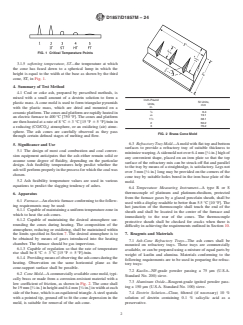
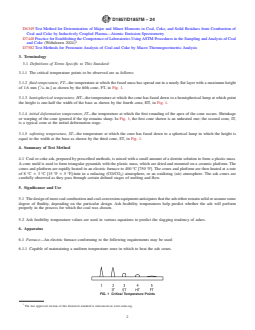
3.1.1 The critical temperature points to be observed are as
mine the applicability of regulatory limitations prior to use.
follows:
1.5 This international standard was developed in accor-
3.1.2 fluid temperature, FT—the temperature at which the
dance with internationally recognized principles on standard-
fused mass has spread out in a nearly flat layer with a
ization established in the Decision on Principles for the
maximum height of 1.6 mm [ ⁄16 in.] as shown by the fifth
Development of International Standards, Guides and Recom-
cone, FT, in Fig. 1.
mendations issued by the World Trade Organization Technical
Barriers to Trade (TBT) Committee.
3.1.3 hemispherical temperature, HT—the temperature at
which the cone has fused down to a hemispherical lump at
2. Referenced Documents
which point the height is one-half the width of the base as
shown by the fourth cone, HT, in Fig. 1.
2.1 ASTM Standards:
3.1.4 initial deformation temperature, IT—the temperature
at which the first rounding of the apex of the cone occurs.
Shrinkage or warping of the cone ignored if the tip remains
This test method is under the jurisdiction of ASTM Committee D05 on Coal
and Coke and is the direct responsibility of D05.21 on Methods of Analysis.
sharp. In Fig. 1, the first cone shown is an unheated one; the
Current edition approved April 1, 2024. Published April 2024. Originally
second cone, IT, is a typical cone at the initial deformation
approved 1961. Last previous edition approved in 2018 as D1857/D1857M – 18.
stage.
DOI: 10.1520/D1857_D1857M-24.
For referenced ASTM standards, visit the ASTM website, www.astm.org, or
contact ASTM Customer Service at service@astm.org. For Annual Book of ASTM
Standards volume information, refer to the standard’s Document Summary page on The last approved version of this historical standard is referenced on
the ASTM website. www.astm.org.
*A Summary of Changes section appears at the end of this standard
Copyright © ASTM International, 100 Barr Harbor Drive, PO Box C700, West Conshohocken, PA 19428-2959. United States
D1857/D1857M − 24
FIG. 1 Critical Temperature Points
3.1.5 softening temperature, ST—the temperature at which
the cone has fused down to a spherical lump in which the
height is equal to the width at the base as shown by the third
cone, ST, in Fig. 1.
4. Summary of Test Method
4.1 Coal or coke ash, prepared by prescribed methods, is
mixed with a small amount of a dextrin solution to form a
Inch-Pound
SI Units,
plastic mass. A cone mold is used to form triangular pyramids
Units,
mm
in.
with the plastic mass, which are dried and mounted on a
⁄4 6.4
ceramic platform. The cones and platform are rapidly heated in
⁄4 19.1
an electric furnace to 400 °C [750 °F]. The cones and platform
1 ⁄2 38.1
are then heated at a rate of 8 °C 6 3 °C [15 °F 6 5 °F] ⁄min in
2 50.2
3 76.2
a reducing (CO/CO ) atmosphere, or an oxidizing (air) atmo-
sphere. The ash cones are carefully observed as they pass
FIG. 2 Brass Cone Mold
through certain defined stages of melting and flow.
6.3 Refractory Tray Mold—A mold with flat top and bottom
5. Significance and Use
surfaces to provide a refractory tray of suitable thickness to
5.1 The design of most coal combustion and coal conver-
minimize warping. A sidemold not over 6.4 mm [ ⁄4 in.] high of
sion equipment anticipates that the ash either remain solid or
any convenient shape, placed on an iron plate so that the top
assume some degree of fluidity, depending on the particular
surface of the refractory mix can be struck off flat and parallel
design. Ash fusibility temperatures help predict whether the
to the tray by means of a straightedge, is satisfactory. Legs not
ash will perform properly in the process for which the coal was
over 3 mm [ ⁄8 in.] long may be provided on the corners of the
chosen.
cone tray by suitable holes bored in the iron base plate of the
5.2 Ash fusibility temperature values are used in various
mold.
equations to predict the slagging tendency of ashes.
6.4 Temperature Measuring Instrument—A type R or S
thermocouple of platinum and platinum-rhodium, protected
6. Apparatus
from the furnace gases by a glazed porcelain sheath, shall be
6.1 Furnace—An electric furnace conforming to the follow-
used with a display readable to better than 5.5 °C [10 °F]. The
ing requirements may be used:
hot junction of the thermocouple shall touch the end of the
6.1.1 Capable of maintaining a uniform temperature zone in
sheath and shall be located in the center of the furnace and
which to heat the ash cones.
immediately to the rear of the cones. The thermocouple
6.1.2 Capable of maintaining the desired atmosphere sur-
protective sheath shall be checked for cracks when there is
rounding the cones during heating. The composition of the
difficulty in achieving the requirements outlined in Section 10.
atmosphere, reducing or oxidizing, shall be maintained within
the limits specified in Section 7. The desired atmosphere is to 7. Reagents and Materials
be obtained by means of gases introduced into the heating
7.1 Ash-Cone Refractory Trays—The ash cones shall be
chamber. The furnace should be gas impervious.
mounted on refractory trays. These trays are commercially
6.1.3 Capable of regulation so that the rate of temperature
available, or can be prepared using a mixture of equal parts by
rise shall be 8 °C 6 3 °C [15 °F 6 5 °F] ⁄min.
weight of kaolin and alumina. Materials conforming to the
6.1.4 Providing means of observing the ash cones during the
following requirements are to be used in preparing the refrac-
heating. Observation on the same horizontal plane as the
tory trays:
cone-support surface shall be possible.
7.2 Kaolin—NF-grade powder passing a 75 μm (U.S.A.
6.2 Cone Mold—A commercially available cone mold, typi-
Standard No. 200) sieve.
cally brass or made from a corrosion-resistant material with a
7.3 Aluminum Oxide—Reagent-grade ignited powder pass-
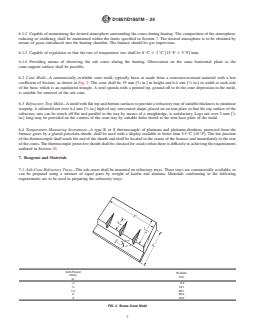
low coefficient of friction, as shown in Fig. 2. The cone shall
ing a 150 μm (U.S.A. Standard No. 100) sieve.
3 1
be 19 mm [ ⁄4 in.] in height and 6.4 mm [ ⁄4 in.] in width at each
side of the base, which is an equilateral triangle. A steel spatula 7.4 Dextrin Solution—Clear, filtered (if necessary) 10 %
with a pointed tip, ground off to fit the cone depression in the solution of dextrin containing 0.1 % salicylic acid as a
mold, is suitable for removal of the ash cone. preservative.
D1857/D1857M − 24
7.5 Mold Release Agent—Petroleum jelly, thinned with oxidation of the pyritic sulfur and, more importantly, to
kerosene (if necessary), or a non-silicon-based mold release efficiently remove the SO formed. Because of the possibility
agent. of SO product being absorbed by alkali and alkaline earth
metal oxides (especially CaO), it is advisable to not ash high
7.6 Gold Wire—0.51 mm diameter (twenty-four gage) or
pyritic sulfur coals with coals that have high alkali or alkaline
larger round wire of 99.98 % purity, but drawn from metal of
earth metal contents, or both.
99.99 % purity, and having a melting point of 1064 °C
[1948 °F].
NOTE 1—The D3174 and D7582 ashing procedures used in the
determination of ash from coal and/or coke samples and the D3682,
7.7 Nickel Wire—0.51 mm diameter (twenty-four gage) or
D4326, and D6349 ashing procedures used in preparing ash from coal or
larger round wire of CP nickel, 99.98 % pure, fully annealed,
coke samples, or both, for major and minor element analysis are
and having a melting point of 1455 °C [2651 °F].
acceptable procedures for preparing ash for the fusibility test.
NOTE 2—A mechanical agate mortar grinder will save time where many
determinations are made.
8. Test Atmospheres
9.3 Preparation of Cones—Thoroughly mix the ignited ash
8.1 Reducing Atmosphere Test—A regulated flow of gas of
the nominal composition, volume fraction 60 % carbon mon- in a mechanical mixer or on a sheet of glazed paper or oil cloth
by raising first one corner to roll the ash over and then raising
oxide and volume fraction 40 % 6 5 % carbon dioxide, shall
be maintained in the heating chamber throughout the test (Note each of the other corners in rotation in the same manner until
each corner has been raised five times or more.
1) in the furnace. The gas stream shall be regulated by any
convenient means to provide a measured flow of 1.3 to 1.5 9.3.1 Take sufficient ash for the number of cones desired
furnace volumes per minute. from various parts of the bulk ash. Moisten the ash with a few
drops of a dextrin solution
...
This document is not an ASTM standard and is intended only to provide the user of an ASTM standard an indication of what changes have been made to the previous version. Because
it may not be technically possible to adequately depict all changes accurately, ASTM recommends that users consult prior editions as appropriate. In all cases only the current version
of the standard as published by ASTM is to be considered the official document.
Designation: D1857/D1857M − 18 D1857/D1857M − 24
Standard Test Method for
Fusibility of Coal and Coke Ash
This standard is issued under the fixed designation D1857/D1857M; the number immediately following the designation indicates the
year of original adoption or, in the case of revision, the year of last revision. A number in parentheses indicates the year of last
reapproval. A superscript epsilon (´) indicates an editorial change since the last revision or reapproval.
This standard has been approved for use by agencies of the U.S. Department of Defense.
1. Scope Scope*
1.1 This test method covers the observation of the temperatures at which triangular pyramids (cones) prepared from coal and coke
ash attain and pass through certain defined stages of fusing and flow when heated at a specified rate in controlled, mildly reducing,
and where desired, oxidizing atmospheres.
1.2 The test method is empirical, and strict observance of the requirements and conditions is necessary to obtain reproducible
temperatures and enable different laboratories to obtain concordant results.
1.3 The values stated in either SI units or inch-pound units are to be regarded separately as standard. The values stated in each
system may not be exact equivalents; therefore, each system shall be used independently of the other. Combining values from the
two systems may result in non-conformance with the standard.
1.3.1 All percentages are percent mass fractions unless otherwise noted.
1.4 This standard does not purport to address all of the safety concerns, if any, associated with its use. It is the responsibility
of the user of this standard to establish appropriate safety, health, and environmental practices and determine the applicability of
regulatory limitations prior to use.
1.5 This international standard was developed in accordance with internationally recognized principles on standardization
established in the Decision on Principles for the Development of International Standards, Guides and Recommendations issued
by the World Trade Organization Technical Barriers to Trade (TBT) Committee.
2. Referenced Documents
2.1 ASTM Standards:
D346/D346M Practice for Collection and Preparation of Coke Samples for Laboratory Analysis
D2013/D2013M Practice for Preparing Coal Samples for Analysis
D3174 Test Method for Ash in the Analysis Sample of Coal and Coke from Coal
D3180 Practice for Calculating Coal and Coke Analyses from As-Determined to Different Bases
D3682 Test Method for Major and Minor Elements in Combustion Residues from Coal Utilization Processes by Atomic
Spectrometry
D4326 Test Method for Major and Minor Elements in Coal Ash By X-Ray Fluorescence
This test method is under the jurisdiction of ASTM Committee D05 on Coal and Coke and is the direct responsibility of D05.21 on Methods of Analysis.
Current edition approved Sept. 1, 2018April 1, 2024. Published September 2018April 2024. Originally approved 1961. Last previous edition approved in 20172018 as
D1857/D1857M – 17a.D1857/D1857M – 18. DOI: 10.1520/D1857_D1857M-18.10.1520/D1857_D1857M-24.
For referenced ASTM standards, visit the ASTM website, www.astm.org, or contact ASTM Customer Service at service@astm.org. For Annual Book of ASTM Standards
volume information, refer to the standard’s Document Summary page on the ASTM website.
*A Summary of Changes section appears at the end of this standard
Copyright © ASTM International, 100 Barr Harbor Drive, PO Box C700, West Conshohocken, PA 19428-2959. United States
D1857/D1857M − 24
D6349 Test Method for Determination of Major and Minor Elements in Coal, Coke, and Solid Residues from Combustion of
Coal and Coke by Inductively Coupled Plasma—Atomic Emission Spectrometry
D7448 Practice for Establishing the Competence of Laboratories Using ASTM Procedures in the Sampling and Analysis of Coal
and Coke (Withdrawn 2024)
D7582 Test Methods for Proximate Analysis of Coal and Coke by Macro Thermogravimetric Analysis
3. Terminology
3.1 Definitions of Terms Specific to This Standard:
3.1.1 The critical temperature points to be observed are as follows:
3.1.2 fluid temperature, FT—the temperature at which the fused mass has spread out in a nearly flat layer with a maximum height
of 1.6 mm [ ⁄16 in.] as shown by the fifth cone, FT, in Fig. 1.
3.1.3 hemispherical temperature, HT—the temperature at which the cone has fused down to a hemispherical lump at which point
the height is one-half the width of the base as shown by the fourth cone, HT, in Fig. 1.
3.1.4 initial deformation temperature, IT—the temperature at which the first rounding of the apex of the cone occurs. Shrinkage
or warping of the cone ignored if the tip remains sharp. In Fig. 1, the first cone shown is an unheated one; the second cone, IT,
is a typical cone at the initial deformation stage.
3.1.5 softening temperature, ST—the temperature at which the cone has fused down to a spherical lump in which the height is
equal to the width at the base as shown by the third cone, ST, in Fig. 1.
4. Summary of Test Method
4.1 Coal or coke ash, prepared by prescribed methods, is mixed with a small amount of a dextrin solution to form a plastic mass.
A cone mold is used to form triangular pyramids with the plastic mass, which are dried and mounted on a ceramic platform. The
cones and platform are rapidly heated in an electric furnace to 400 °C [750 °F]. The cones and platform are then heated at a rate
of 8 °C 6 3 °C [15 °F 6 5 °F] ⁄min in a reducing (CO/CO ) atmosphere, or an oxidizing (air) atmosphere. The ash cones are
carefully observed as they pass through certain defined stages of melting and flow.
5. Significance and Use
5.1 The design of most coal combustion and coal conversion equipment anticipates that the ash either remain solid or assume some
degree of fluidity, depending on the particular design. Ash fusibility temperatures help predict whether the ash will perform
properly in the process for which the coal was chosen.
5.2 Ash fusibility temperature values are used in various equations to predict the slagging tendency of ashes.
6. Apparatus
6.1 Furnace—An electric furnace conforming to the following requirements may be used:
6.1.1 Capable of maintaining a uniform temperature zone in which to heat the ash cones.
FIG. 1 Critical Temperature Points
The last approved version of this historical standard is referenced on www.astm.org.
D1857/D1857M − 24
6.1.2 Capable of maintaining the desired atmosphere surrounding the cones during heating. The composition of the atmosphere,
reducing or oxidizing, shall be maintained within the limits specified in Section 7. The desired atmosphere is to be obtained by
means of gases introduced into the heating chamber. The furnace should be gas impervious.
6.1.3 Capable of regulation so that the rate of temperature rise shall be 8 °C 6 3 °C [15 °F 6 5 °F] ⁄min.
6.1.4 Providing means of observing the ash cones during the heating. Observation on the same horizontal plane as the
cone-support surface shall be possible.
6.2 Cone Mold—A commercially available cone mold, typically brass or made from a corrosion-resistant material with a low
3 1
coefficient of friction, as shown in Fig. 2. The cone shall be 19 mm [ ⁄4 in.] in height and 6.4 mm [ ⁄4 in.] in width at each side
of the base, which is an equilateral triangle. A steel spatula with a pointed tip, ground off to fit the cone depression in the mold,
is suitable for removal of the ash cone.
6.3 Refractory Tray Mold—A mold with flat top and bottom surfaces to provide a refractory tray of suitable thickness to minimize
warping. A sidemold not over 6.4 mm [ ⁄4 in.] high of any convenient shape, placed on an iron plate so that the top surface of the
refractory mix can be struck off flat and parallel to the tray by means of a straightedge, is satisfactory. Legs not over 3 mm [ ⁄8
in.] long may be provided on the corners of the cone tray by suitable holes bored in the iron base plate of the mold.
6.4 Temperature Measuring Instrument—A type R or S thermocouple of platinum and platinum-rhodium, protected from the
furnace gases by a glazed porcelain sheath, shall be used with a display readable to better than 5.5 °C [10 °F]. The hot junction
of the thermocouple shall touch the end of the sheath and shall be located in the center of the furnace and immediately to the rear
of the cones. The thermocouple protective sheath shall be checked for cracks when there is difficulty in achieving the requirements
outlined in Section 10.
7. Reagents and Materials
7.1 Ash-Cone Refractory Trays—The ash cones shall be mounted on refractory trays. These trays are commercially available, or
can be prepared using a mixture of equal parts by weight of kaolin and alumina. Materials conforming to the following
requirements are to be used in preparing the refractory trays:
Inch-Pound
SI Units,
Units,
mm
in.
⁄4 6.4
⁄4 19.1
1 ⁄2 38.1
2 50.2
3 76.2
FIG. 2 Brass Cone Mold
D1857/D1857M − 24
7.2 Kaolin—NF-grade powder passing a 75 μm (U.S.A. Standard No. 200) sieve.
7.3 Aluminum Oxide—Reagent-grade ignited powder passing a 150 μm (U.S.A. Standard No. 100) sieve.
7.4 Dextrin Solution—Clear, filtered (if necessary) 10 % solution of dextrin containing 0.1 % salicylic acid as a preservative.
7.5 Mold Release Agent—Petroleum jelly, thinned with kerosene (if necessary), or a non-silicon-based mold release agent.
7.6 Gold Wire—0.51 mm diameter (twenty-four gage) or larger round wire of 99.98 % purity, but drawn from metal of 99.99 %
purity, and having a melting point of 1064 °C [1948 °F].
7.7 Nickel Wire—0.51 mm diameter (twenty-four gage) or larger round wire of CP nickel, 99.98 % pure, fully annealed, and
having a melting point of 1455 °C [2651 °F].
8. Test Atmospheres
8.1 Reducing Atmosphere Test—A regulated flow of gas of the nominal composition, volume fraction 60 % carbon monoxide and
volume fraction 40 % 6 5 % carbon dioxide, shall be maintained in the heating chamber throughout the test (Note 1) in the
furnace. The gas stream shall be regulated by any convenient means to provide a measured flow of 1.3 to 1.5 furnace volumes per
minute.
8.2 Cylinders of CO/CO Gas—To ensure that the CO/CO gas remains mixed, maintain the temperature of the cylinder above
2 2
the critical temperature at which CO can liquefy and separate.
8.3 Oxidizing Atmosphere Test—A regulated stream of air shall be maintained throughout the test in the furnace. The gas stream
shall be regulated by any convenient means to provide a measured flow of 1.3 to 1.5 furnace volumes per minute.
9. Sample and Test Specimen Preparation
9.1 Coal and Coke—Prepare the analysis sample in accordance with Practice D2013/D2013M for coal or Practice D346/D346M
for coke by pulverizing the material to pass a 250 μm (No. 60) U.S.A. standard sieve.
9.2 Laboratory Ashing of Coal or Coke Analysis Sample—Prepare the ash from a thoroughly mixed analysis sample of coal or
coke (see 9.1). To facilitate the ashing process, spread the coal or coke in a layer about 6 mm [ ⁄4 in.] in depth in a porcelain, quartz,
fused silica, or fireclay roasting dish. Place the dish in a muffle furnace at ambient temperature and heat gradually so that the
temperature reac
...
Questions, Comments and Discussion
Ask us and Technical Secretary will try to provide an answer. You can facilitate discussion about the standard in here.
Loading comments...