

ASTM F449-20
(Practice)Standard Practice for Subsurface Installation of Corrugated Polyethylene Pipe for Agricultural Drainage or Water Table Control
General Information
- Abstract
ABSTRACT
This practice covers the procedures for subsurface installation of corrugated polyethylene pipe, in accordance with the flexible conduit principles, intended for agricultural drainage or water table control. It is not however recommended for sanitary and storm sewer applications. General requirements for installation include: maximum and minimum burial depth; trench width; design of blinding, bedding, or envelope materials that are to be placed as the pipe is installed to ensure uniform continuous support; and granular or synthetic filters that are used to restrict the movement of particles into the pipe so as to maintain its hydraulic capacity. The pipe shall be aligned as smooth as possible with a curve radius larger than five times the pipe diameter while the backfill material shall be placed preferably on an angle to prevent pipe displacement or deflection. Stony trenches shall be avoided and any over-excavation or rock excavation shall be treated with proper bedding material. Factors that affect the proper handling of the pipe such as temperature; stretch caused by tension and bending forces; synthetic envelopes and filters that are subject to abrasion and tearing; and protection from fire hazards, livestock, heavy wheel traffic, and rodents or other animals shall also be considered during installation.
SCOPE
1.1 This practice is recommended for and limited to gravity flow subsurface drainage systems or water table control, but not recommended for sanitary or storm sewer applications. Procedures are outlined to minimize pipe deflection or structural damage during and after the installation process. These installation procedures are in accordance with “flexible conduit” principles.
1.2 This practice applies to all agricultural subsurface drainage or water table control installations using Specification F667, F2648, or other plastic pipe.
Note 1: Specific references to the appendix in the body of this practice are for informational purposes.
1.3 The values stated in inch-pound units are to be regarded as standard. The values given in parentheses are mathematical conversions to SI units that are provided for information only, may not be equivalents and are not considered standard.
1.4 This standard does not purport to address all of the safety concerns, if any, associated with its use. It is the responsibility of the user of this standard to establish appropriate safety, health, and environmental practices and determine the applicability of regulatory limitations prior to use.
1.5 This international standard was developed in accordance with internationally recognized principles on standardization established in the Decision on Principles for the Development of International Standards, Guides and Recommendations issued by the World Trade Organization Technical Barriers to Trade (TBT) Committee.
- Status
- Published
- Publication Date
- 31-Jan-2020
- Technical Committee
- F17 - Plastic Piping Systems
- Drafting Committee
- F17.65 - Land Drainage
Buy Documents
ASTM F449-20 - Standard Practice for Subsurface Installation of Corrugated Polyethylene Pipe for Agricultural Drainage or Water Table Control
REDLINE ASTM F449-20 - Standard Practice for Subsurface Installation of Corrugated Polyethylene Pipe for Agricultural Drainage or Water Table Control
Overview
ASTM F449-20: Standard Practice for Subsurface Installation of Corrugated Polyethylene Pipe for Agricultural Drainage or Water Table Control establishes essential guidelines for the correct subsurface installation of corrugated polyethylene (PE) pipe. This practice is specifically intended for gravity-flow systems utilized in agricultural drainage and water table management, ensuring the long-term performance and hydraulic capacity of subsurface drainage systems. Notably, it is not recommended for sanitary or storm sewer uses.
The standard supports the application of flexible conduit principles and addresses critical considerations such as burial depth, trench width, material selection, and protective measures. Ensuring proper handling and installation in different soil and environmental conditions maximizes the function and lifespan of corrugated PE drainage pipe.
Key Topics
- Scope and Applicability: Focused specifically on subsurface installations for agricultural drainage or water table regulation, not suitable for sanitary or storm sewers.
- Installation Procedures: Recommendations to minimize pipe deflection or structural damage, including proper trench width, burial depth, bedding, and blinding/envelope materials.
- Pipe Alignment and Curvature: Pipes should be aligned smoothly, maintaining curve radii larger than five times the pipe diameter to prevent stress and deflection.
- Soil and Bedding Requirements:
- Avoid stony, rocky, or unstable trenches unless appropriate bedding is used.
- Design and placement of granular or synthetic filters/envelopes are critical to restrict soil particle movement and maintain hydraulic capacity.
- Protection Measures: Guidance for handling pipe under varying temperature conditions, and protecting newly installed systems from livestock, vehicular traffic, rodents, and environmental hazards.
- Material Compatibility: Specifies the use of pipe and fittings in accordance with relevant ASTM specifications (e.g., ASTM F667, ASTM F2648).
Applications
Agricultural Drainage Systems:
Designers and installers use ASTM F449-20 procedures to ensure proper water removal from agricultural lands, preventing crop damage from excess water and improving soil health.
Water Table Management:
Systems installed per this standard are essential for controlling water tables, especially in farmlands with highly variable or poorly drained soils.
Land Improvement Projects:
Landowners, contractors, and engineers reference ASTM F449-20 when upgrading drainage infrastructure or converting land for production purposes.
Best Practices Enforcement:
Government agencies and consultants rely on this standard to ensure compliance, long-term reliability, and safety in subsurface drainage installations.
Related Standards
- ASTM F667: Specification for corrugated polyethylene pipe and fittings, applicable to sizes 3 through 24 inches for land drainage.
- ASTM F2648: Specification for annular corrugated profile wall polyethylene pipes, covering sizes 2 to 60 inches for land drainage.
- ASTM D2321: Practice for underground installation of thermoplastic pipe for sewers and other gravity-flow applications.
- ASTM D2487: Classification of soils for engineering purposes.
- ASTM F412 / ASTM D1600: Terminology and abbreviations related to plastic piping systems.
- ASTM D2412: Test method for external loading characteristics of plastic pipes.
Practical Value
Complying with ASTM F449-20 ensures proper installation and functioning of subsurface drainage systems, minimizes the risk of pipe failure, and optimizes hydraulic performance. Adherence to its requirements supports sustainable agriculture, reduces maintenance, and mitigates environmental impacts by directing excess water away from plant root zones efficiently.
For professionals in agricultural engineering, land management, and drainage installation, referencing ASTM F449-20 provides reliable, research-based criteria for durable and efficient drainage systems, confirming compatibility with supporting standards throughout the design and construction process.
Relations
- Effective Date
- 01-Feb-2020
- Effective Date
- 01-Apr-2020
- Effective Date
- 15-Mar-2020
- Effective Date
- 01-Jan-2019
- Effective Date
- 01-Mar-2018
- Refers
ASTM D1600-18 - Standard Terminology for Abbreviated Terms Relating to Plastics (Withdrawn 2024) - Effective Date
- 01-Jan-2018
- Effective Date
- 15-Dec-2017
- Effective Date
- 15-Dec-2017
- Effective Date
- 01-Aug-2017
- Effective Date
- 01-Feb-2017
- Effective Date
- 15-Nov-2016
- Effective Date
- 01-Aug-2016
- Effective Date
- 01-Jun-2015
- Effective Date
- 01-Aug-2014
- Effective Date
- 01-Aug-2014
Buy Documents
ASTM F449-20 - Standard Practice for Subsurface Installation of Corrugated Polyethylene Pipe for Agricultural Drainage or Water Table Control
REDLINE ASTM F449-20 - Standard Practice for Subsurface Installation of Corrugated Polyethylene Pipe for Agricultural Drainage or Water Table Control
Get Certified
Connect with accredited certification bodies for this standard

Institut za varilstvo d.o.o. (Welding Institute)
Slovenia's leading welding institute since 1952. ISO 3834, EN 1090, pressure equipment certification, NDT personnel, welder qualification. Only IIW Au
Sponsored listings
Frequently Asked Questions
ASTM F449-20 is a standard published by ASTM International. Its full title is "Standard Practice for Subsurface Installation of Corrugated Polyethylene Pipe for Agricultural Drainage or Water Table Control". This standard covers: ABSTRACT This practice covers the procedures for subsurface installation of corrugated polyethylene pipe, in accordance with the flexible conduit principles, intended for agricultural drainage or water table control. It is not however recommended for sanitary and storm sewer applications. General requirements for installation include: maximum and minimum burial depth; trench width; design of blinding, bedding, or envelope materials that are to be placed as the pipe is installed to ensure uniform continuous support; and granular or synthetic filters that are used to restrict the movement of particles into the pipe so as to maintain its hydraulic capacity. The pipe shall be aligned as smooth as possible with a curve radius larger than five times the pipe diameter while the backfill material shall be placed preferably on an angle to prevent pipe displacement or deflection. Stony trenches shall be avoided and any over-excavation or rock excavation shall be treated with proper bedding material. Factors that affect the proper handling of the pipe such as temperature; stretch caused by tension and bending forces; synthetic envelopes and filters that are subject to abrasion and tearing; and protection from fire hazards, livestock, heavy wheel traffic, and rodents or other animals shall also be considered during installation. SCOPE 1.1 This practice is recommended for and limited to gravity flow subsurface drainage systems or water table control, but not recommended for sanitary or storm sewer applications. Procedures are outlined to minimize pipe deflection or structural damage during and after the installation process. These installation procedures are in accordance with “flexible conduit” principles. 1.2 This practice applies to all agricultural subsurface drainage or water table control installations using Specification F667, F2648, or other plastic pipe. Note 1: Specific references to the appendix in the body of this practice are for informational purposes. 1.3 The values stated in inch-pound units are to be regarded as standard. The values given in parentheses are mathematical conversions to SI units that are provided for information only, may not be equivalents and are not considered standard. 1.4 This standard does not purport to address all of the safety concerns, if any, associated with its use. It is the responsibility of the user of this standard to establish appropriate safety, health, and environmental practices and determine the applicability of regulatory limitations prior to use. 1.5 This international standard was developed in accordance with internationally recognized principles on standardization established in the Decision on Principles for the Development of International Standards, Guides and Recommendations issued by the World Trade Organization Technical Barriers to Trade (TBT) Committee.
ABSTRACT This practice covers the procedures for subsurface installation of corrugated polyethylene pipe, in accordance with the flexible conduit principles, intended for agricultural drainage or water table control. It is not however recommended for sanitary and storm sewer applications. General requirements for installation include: maximum and minimum burial depth; trench width; design of blinding, bedding, or envelope materials that are to be placed as the pipe is installed to ensure uniform continuous support; and granular or synthetic filters that are used to restrict the movement of particles into the pipe so as to maintain its hydraulic capacity. The pipe shall be aligned as smooth as possible with a curve radius larger than five times the pipe diameter while the backfill material shall be placed preferably on an angle to prevent pipe displacement or deflection. Stony trenches shall be avoided and any over-excavation or rock excavation shall be treated with proper bedding material. Factors that affect the proper handling of the pipe such as temperature; stretch caused by tension and bending forces; synthetic envelopes and filters that are subject to abrasion and tearing; and protection from fire hazards, livestock, heavy wheel traffic, and rodents or other animals shall also be considered during installation. SCOPE 1.1 This practice is recommended for and limited to gravity flow subsurface drainage systems or water table control, but not recommended for sanitary or storm sewer applications. Procedures are outlined to minimize pipe deflection or structural damage during and after the installation process. These installation procedures are in accordance with “flexible conduit” principles. 1.2 This practice applies to all agricultural subsurface drainage or water table control installations using Specification F667, F2648, or other plastic pipe. Note 1: Specific references to the appendix in the body of this practice are for informational purposes. 1.3 The values stated in inch-pound units are to be regarded as standard. The values given in parentheses are mathematical conversions to SI units that are provided for information only, may not be equivalents and are not considered standard. 1.4 This standard does not purport to address all of the safety concerns, if any, associated with its use. It is the responsibility of the user of this standard to establish appropriate safety, health, and environmental practices and determine the applicability of regulatory limitations prior to use. 1.5 This international standard was developed in accordance with internationally recognized principles on standardization established in the Decision on Principles for the Development of International Standards, Guides and Recommendations issued by the World Trade Organization Technical Barriers to Trade (TBT) Committee.
ASTM F449-20 is classified under the following ICS (International Classification for Standards) categories: 23.040.20 - Plastics pipes. The ICS classification helps identify the subject area and facilitates finding related standards.
ASTM F449-20 has the following relationships with other standards: It is inter standard links to ASTM F449-16, ASTM F412-20, ASTM D2321-20, ASTM F412-19, ASTM D2321-18, ASTM D1600-18, ASTM D2487-17, ASTM D2487-17e1, ASTM F412-17a, ASTM F412-17, ASTM F412-16a, ASTM F412-16, ASTM F412-15, ASTM D2321-14e1, ASTM D2321-14. Understanding these relationships helps ensure you are using the most current and applicable version of the standard.
ASTM F449-20 is available in PDF format for immediate download after purchase. The document can be added to your cart and obtained through the secure checkout process. Digital delivery ensures instant access to the complete standard document.
Standards Content (Sample)
This international standard was developed in accordance with internationally recognized principles on standardization established in the Decision on Principles for the
Development of International Standards, Guides and Recommendations issued by the World Trade Organization Technical Barriers to Trade (TBT) Committee.
Designation: F449 − 20
Standard Practice for
Subsurface Installation of Corrugated Polyethylene Pipe for
Agricultural Drainage or Water Table Control
ThisstandardisissuedunderthefixeddesignationF449;thenumberimmediatelyfollowingthedesignationindicatestheyearoforiginal
adoption or, in the case of revision, the year of last revision.Anumber in parentheses indicates the year of last reapproval.Asuperscript
epsilon (´) indicates an editorial change since the last revision or reapproval.
1. Scope* D2321 PracticeforUndergroundInstallationofThermoplas-
tic Pipe for Sewers and Other Gravity-Flow Applications
1.1 This practice is recommended for and limited to gravity
D2412 Test Method for Determination of External Loading
flow subsurface drainage systems or water table control, but
Characteristics of Plastic Pipe by Parallel-Plate Loading
not recommended for sanitary or storm sewer applications.
D2487 Practice for Classification of Soils for Engineering
Procedures are outlined to minimize pipe deflection or struc-
Purposes (Unified Soil Classification System)
tural damage during and after the installation process. These
F412 Terminology Relating to Plastic Piping Systems
installation procedures are in accordance with “flexible con-
F667 Specification for 3 through 24 in. Corrugated Polyeth-
duit” principles.
ylene Pipe and Fittings
1.2 This practice applies to all agricultural subsurface drain-
F2648 Specification for 2 to 60 inch [50 to 1500 mm]
age or water table control installations using Specification
Annular Corrugated Profile Wall Polyethylene (PE) Pipe
F667, F2648, or other plastic pipe.
and Fittings for Land Drainage Applications
NOTE1—Specificreferencestotheappendixinthebodyofthispractice
are for informational purposes.
3. Terminology
1.3 The values stated in inch-pound units are to be regarded
3.1 Definitions are in accordance with Terminology F412
as standard. The values given in parentheses are mathematical
and abbreviations are in accordance with Terminology D1600,
conversions to SI units that are provided for information only,
unless otherwise specified.
may not be equivalents and are not considered standard.
3.2 backfill—materials used to fill the trench following
1.4 This standard does not purport to address all of the
installation of the pipe and bedding.
safety concerns, if any, associated with its use. It is the
responsibility of the user of this standard to establish appro-
3.3 bedding—material which provides bottom and side sup-
priate safety, health, and environmental practices and deter-
port for the pipe.
mine the applicability of regulatory limitations prior to use.
3.4 blinding—the placement of bedding material over and
1.5 This international standard was developed in accor-
on the sides of the pipe to ensure proper grade, alignment,
dance with internationally recognized principles on standard-
support, and protection of pipe during backfilling after instal-
ization established in the Decision on Principles for the
lation.
Development of International Standards, Guides and Recom-
3.5 boot (also shield)——the protecting apparatus linked to
mendations issued by the World Trade Organization Technical
the rear of the installation machine in a manner which allows
Barriers to Trade (TBT) Committee.
placement of the pipe on the trench bottom, protection of the
2. Referenced Documents
workman, or placement of envelope or filter material, or both.
2.1 ASTM Standards:
3.6 cradle—a structure designed to provide trench bottom
D1600 Terminology forAbbreviatedTerms Relating to Plas-
support for the pipe.
tics
3.7 envelope—porous material placed around the pipe to fill
the excavated space.
This practice is under the jurisdiction of ASTM Committee F17 on Plastic
3.8 filter—an envelope of natural or synthetic materials
Piping Systems and is the direct responsibility of Subcommittee F17.65 on Land
Drainage.
placed completely around the pipe to permit free water
Current edition approved Feb. 1, 2020. Published May 2020. Originally
movement into pipe perforations and restrict movement of silt
approved in 1976. Last previous edition approved in 2016 as F449 – 16. DOI:
and sand into the pipe.
10.1520/F0449-20.
For referenced ASTM standards, visit the ASTM website, www.astm.org, or
3.8.1 Discussion—When crushed stone is used as the filter
contact ASTM Customer Service at service@astm.org. For Annual Book of ASTM
medium it also provides stabilizing support for the pipe.
Standards volume information, refer to the standard’s Document Summary page on
the ASTM website. 3.9 grade—the slope of the pipe invert.
*A Summary of Changes section appears at the end of this standard
Copyright © ASTM International, 100 Barr Harbor Drive, PO Box C700, West Conshohocken, PA 19428-2959. United States
F449 − 20
3.10 groove support angle—angle between the radii of the 4. General Requirements
pipe at points of contact with the formed groove of undisturbed
4.1 Burial—The maximum and minimum burial depth are
soil or a cradle.
affected by the following factors, groove support angle or
3.11 in-situ—soil in the natural or original position, undis-
shape of the trench bottom, bedding, blinding backfill soil
turbed. Applied to a soil when occurring in the situation in
density, envelope density, envelope placement, pipe stiffness,
which it was originally formed or deposited.
the live load expected, desired water table depth, and width of
3.12 mineral soils—soil containing (1) less than 30 % or-
trench.
ganicmatterbyweightprovidedthemineralfractionis60 %or
4.1.1 Minimum Depth:
more clay, or (2) less than 20 % organic matter by weight
4.1.1.1 Mineral Soils—The minimum recommended cover
provided the mineral fraction has no clay, or (3) less than a
needed to protect the pipe from excessive deflection under live
proportional content of organic matter between 20 and 30 % if
loads beyond what is listed in 5.2 for maximum deflection is 2
the clay content of the mineral fraction is between 0 and 60 %.
ft (0.6 m). Granular bedding or special construction techniques
3.13 natural granular envelope—an envelope of granular
may be used to reduce the cover. The time for consolidation of
material, usually highly permeable well-graded sand and
backfill may be a factor (see 8.1). The minimum cover may
gravel.
havelimitingfactorsotherthandeflectionsuchasclearancefor
subsoiling and utility crossing.
3.14 organic soil—soil containing (1) 30 % or more organic
matter provided the mineral fraction is 60 % or more clay, or
4.1.1.2 Organic Soils—Subsurface drains should be in-
(2) 20 % or more organic matter provided the mineral fraction
stalled in these soils only after initial subsidence has occurred.
has no clay, or (3) a proportional content of organic matter
To produce initial subsidence open ditches should be con-
between 20 and 30 % if the clay content of mineral fraction is
structed in deep organic soils to carry off free water, and the
between 0 and 60 %. (It is a general rule that a soil is classed
area should be allowed to stand or be partially cultivated for a
as an organic soil (histosol) either if more than one half of
period of 3 to 5 years before installing pipe.The recommended
upper 32 in. (80 mm) of soil is organic or if organic soil
minimum cover for the pipe in organic soils is 2.5 ft (0.7 m).
material of any thickness rests on rock or on fragmental
If water level controls are not provided in the drainage system
material having voids filled with organic material.)
to hold subsidence to a minimum, the depth of cover should be
increased to 3 ft (0.9 m).
3.15 pipe stiffness—force per unit length, per unit deflection
as defined in Test Method D2412.
NOTE 2—These minimum depths are recommended to prevent exces-
3.16 power feeder—mechanism that applies force to the
sive deflection of the pipe by normal agricultural vehicle loads beyond
what is listed in 5.2 for maximum deflection. Other drainage factors such
pipe as it passes through the boot or shield to reduce stretch
as those encountered with salinity control in arid irrigated lands may
during installation.
require minimum depths of 6 ft (1.8 m)
3.17 pre-ripping—the practice of making a pass with the
4.1.2 Maximum Depth—The maximum burial depth is in-
plowwithoutinstallingpipetolocaterocksandtoreducedraft.
fluenced by such factors as degree of compaction, type of
3.18 semi-circular groove—a rounded trench bottom in
bedding, support from the trench bottom, trench width, size of
native in-situ soil that conforms to the outside diameter from
pipe, pipe stiffness, weight of backfill, and live loads imposed.
the invert to the springline of the pipe (180°).
Withoutanengineeringdesign,maximumburieddepthsshould
3.19 start hole—a trench sufficiently long and wide to allow
be limited to those listed in Table 1 or Table 2. For installation
working room for placing the boot or shield, blade or cutting
at depths greater than those listed in Table 1 or Table 2,
mechanism on grade to start the trench and to install connec-
specifications of an engineering design should be followed.
tions or pipe.
4.1.3 Trench Width—Increasing the trench width increases
3.19.1 Discussion—Start holes are usually dug with a back-
the soil load on the pipe. For Table 1 designs, the trench width
hoe or excavator with a flat-bottom trench.
must be at least 2 in. (50 mm) wider than the pipe on each side
3.20 springline—an imaginary horizontal reference line lo-
for plow installation and 3 to 6 in. (75 to 150 mm) on each side
cated at mid-height, or halfway point of a pipe.
for open trench installation to allow sufficient bedding to
support the pipe. If fine material cannot be placed alongside
3.21 stretch—the increase in length of the pipe caused by
and over the pipe, a wider trench should be considered or
tension forces during installation. It is expressed as a percent
special bedding material supplied. Side clearances of more
increase of the length prior to installation. Stretch differs from
than 6 in. (150 mm) on each side should only be used with an
elongation in that elongation is a material test and stretch is an
engineering design and special construction. For Table 2
installation test.
designs, a maximum and minimum trench width is specified to
3.22 synthetic envelope—an envelope made of synthetic
limit excessive deflection and allow a larger amount of soil
geotextiles, usually thin synthetic fabrics or thicker fibrous
arching to reduce the load on the pipe. The tile boot or trench
material, or both, often selected to function as a filter.
boxusedtoconstructthesemi-circulargrooveshallconformas
3.23 trench depth—the depth of the trench measured from
closely as possible to the pipe OD and shall be within 1 % or
the bottom of the pipe. 1
⁄2 in. (12 mm), whichever is greater, of the pipe OD. The
3.24 trench width—the width of the trench measured at the trench width requirements only pertain to the vertical distance
top of the pipe. from the springline to the top of the pipe. It is permissible for
F449 − 20
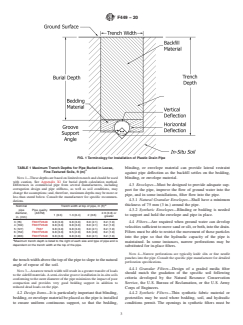
FIG. 1 Terminology for Installation of Plastic Drain Pipe
TABLE 1 Maximum Trench Depths for Pipe Buried in Loose,
blinding, or envelope material can provide lateral restraint
A
Fine-Textured Soils, ft (m)
against pipe deflection as the backfill settles on the bedding,
NOTE1—Thesedepthsarebasedonlimitedresearchandshouldbeused blinding, or envelope material.
with caution. See Appendix X1 for burial depth calculation method.
4.3 Envelopes—Must be designed to provide adequate sup-
Differences in commercial pipe from several manufacturers, including
corrugation design and pipe stiffness, as well as soil conditions, may
port for the pipe, improve the flow of ground water into the
change the assumptions; and, therefore, maximum depths may be more or
pipe, and in some installations, filter flow into the pipe.
less than stated below. Consult the manufacturer for specific recommen-
4.3.1 Natural Granular Envelopes—Shall have a minimum
dations.
thickness of 75 mm (3 in.) around the pipe.
A
Nominal Trench width at top of pipe, m (ft)
pipe Pipe quality
4.3.2 Synthetic Envelopes—Blinding or bedding is needed
2.6 (0.8) or
diameter, (ASTM)
1 (0.3) 1.3 (0.4) 2 (0.6)
to support and hold the envelope and pipe in place.
greater
in. (mm)
3 (76) F667/F2648 9.8 (3.0) 9.8 (3.0) 6.9 (2.1) 6.2 (1.9)
4.4 Filters—Are required when ground water can develop
4 (102) F667/F2648 9.8 (3.0) 9.8 (3.0) 6.9 (2.1) 6.2 (1.9)
velocities sufficient to move sand or silt, or both, into the drain.
5 (127) F667 9.8 (3.0) 9.8 (3.0) 6.9 (2.1) 6.2 (1.9)
Filters must be able to restrict the movement of these particles
6 (152) F667/F2648 9.8 (3.0) 9.5 (2.9) 6.6 (2.0) 6.2 (1.9)
8 (203) F667/F2648 9.8 (3.0) 9.8 (3.0) 6.9 (2.1) 6.2 (1.9)
into the pipe so that the hydraulic capacity of the pipe is
A
Maximum trench depth is listed to the right of each size and type of pipe and is
maintained. In some instances, narrow perforations may be
dependent on the trench width at the top of the pipe.
substituted for in-place filters.
NOTE 4—Narrow perforations are typically knife slits or fine needle
punches into the pipe. Consult the specific pipe manufacturer for detailed
thetrenchwidthabovethetopofthepipetoslopetothenatural
perforation specifications.
angle of repose of the soil.
4.4.1 Granular Filters—Design of a graded media filter
NOTE 3—Anarrow trench width will result in a greater transfer of loads
should match the gradation of the specific soil following
to the sidefill materials.Asemi-circular groove installation in in-situ soils
criteria developed by the Natural Resource Conservation
conforming to the outer diameter of the pipe minimizes the impact of poor
Service, the U.S. Bureau of Reclamation, or the U.S. Army
compaction and provides very good bedding support in addition to
reduced dead loads on the pipe.
Corps of Engineers.
4.2 Design Items—It is particularly important that blinding, 4.4.2 Synthetic Filters—Thin synthetic fabric material or
bedding, or envelope material be placed as the pipe is installed geotextiles may be used where bedding, soil, and hydraulic
to ensure uniform continuous support, so that the bedding, conditions permit. The openings in synthetic filters must be
F449 − 20
A
TABLE 2 Maximum Trench Depths for Pipe Buried with a Semi-Circular Groove, ft (m)
NOTE 1—These depths are based on limited research and should be used with caution. Differences in commercial pipe from several manufacturers,
including corrugation design and pipe stiffness and soil conditions, may change the assumptions; and, therefore, maximum depths may be more or less
than stated above.
Nominal Pipe Inside Typical Pipe Outside Pipe Quality Trench Width Tolerance on Trench Maximum Depth of
Diameter Diameter ASTM at Springline of Pipe Width at Springline Fill
in. (mm) in. (mm) Standard in. (mm) in. (mm) ft (m)
3 (76) 3.5 (90) F667 3.5 (90) + 8 (+ 203) 9.8 (3.0)
4 (102) 4.5 (115) F667 4.5 (115) + 8 (+ 203) 9.8 (3.0)
5 (127) 5.5 (140) F667 5.5 (140) + 8 (+ 203) 9.8 (3.0)
6 (152) 6.5 (165) F667 6.5 (165) + 8 (+ 203) 9.8 (3.0)
8 (203) 10 (254) F667 10 (254) + 8 (+ 203) 9.8 (3.0)
10 (254) 12 (305) F667 12 (305) + 10 (+ 254) 8 (2.4)
12 (305) 15 (381) F667 15 (381) + 12 (+ 305) 6 (1.8)
15 (381) 18 (457) F667 18 (457) + 12 (+ 305) 6 (1.8)
18 (457) 21 (533) F667 21 (533) + 12 (+ 305) 6 (1.8)
21 (533) 24 (600) F667 24 (610) + 12 (+ 305) 6 (1.8)
24 (610) 28 (711) F667 28 (711) + 12 (+ 305) 6 (1.8)
Nominal Pipe Inside Typical Pipe Outside Pipe Quality Trench Width Tolerance on Trench Maximum Depth of
Diameter Diameter ASTM at Springline of Pipe Width at Springline Fill
B
in. (mm) in. (mm) Standard in. (mm) in. (mm) ft (m)
4 (102) 4.5 (115) F2648 4.5 (115) + 8 (+ 203) 11 (3.4)
6 (152) 6.5 (165) F2648 6.5 (165) + 8 (+ 203) 11 (3.4)
8 (203) 10 (254) F2648 10 (250) + 8 (+ 203) 11 (3.4)
10 (254) 12 (305) F2648 12 (305) + 10 (+ 254) 11 (3.4)
12 (305) 15 (381) F2648 15 (381) + 12 (+ 305) 11 (3.4)
15 (381) 18 (457) F2648 18 (457) + 12 (+ 305) 10 (3.0)
18 (457) 21 (533) F2648 21 (533) + 12 (+ 305) 10 (3.0)
21 (533) 24 (610) F2648 24 (610) + 12 (+ 305) 10 (3.0)
24 (610) 28 (711) F2648 28 (711) + 12 (+ 305) 10 (3.0)
30 (762) 35 (889) F2648 35 (889) + 16 (+ 406) 10 (3.0)
36 (914) 41 (1041) F2648 41 (1041) + 18 (+ 457) 8 (2.4)
42 (1067) 48 (1219) F2648 48 (1219) + 20 (+ 508) 8 (2.4)
48 (1219) 54 (1372) F2648 54 (1372) + 20 (+ 508) 7 (2.1)
60 (1524) 67 (1702) F2648 67 (1702) + 25 (+ 635) 6 (1.8)
A
A small “V” notch or groove at the bottom of the shaped trench may be beneficial to accommodate any soil chunks or small clods that may fall into the plowed-in or
excavated trench in order to prevent localized stress points on the invert crown of the pipe,
B
The minimum trench width at the springline listed in the table are listed as the typical pipe OD in the industry. Pipe ODs vary and as such the minimum trench width should
always be at least the pipe OD.
compatible with the soil that surrounds the drain to prevent 5. Significant Factors in Pipe/Soil Interactions
excessive movement of soil that otherwise could plug the drain
5.1 Connections—In start holes and adjacent open trenches,
or filter (see 5.3).
the pipe shall be a
...
This document is not an ASTM standard and is intended only to provide the user of an ASTM standard an indication of what changes have been made to the previous version. Because
it may not be technically possible to adequately depict all changes accurately, ASTM recommends that users consult prior editions as appropriate. In all cases only the current version
of the standard as published by ASTM is to be considered the official document.
Designation: F449 − 16 F449 − 20
Standard Practice for
Subsurface Installation of Corrugated Polyethylene Pipe for
Agricultural Drainage or Water Table Control
This standard is issued under the fixed designation F449; the number immediately following the designation indicates the year of original
adoption or, in the case of revision, the year of last revision. A number in parentheses indicates the year of last reapproval. A superscript
epsilon (´) indicates an editorial change since the last revision or reapproval.
1. Scope*
1.1 This practice is recommended for and limited to gravity flow subsurface drainage systems or water table control, but not
recommended for sanitary or storm sewer applications. Procedures are outlined to minimize pipe deflection or structural damage
during and after the installation process. These installation procedures are in accordance with “flexible conduit” principles.
1.2 This practice applies to all agricultural subsurface drainage or water table control installations using Specification F667,
F2648, or other plastic pipe.
NOTE 1—Specific references to the appendix in the body of this practice are for informational purposes.
1.3 The values stated in inch-pound units are to be regarded as standard. The values given in parentheses are mathematical
conversions to SI units that are provided for information only only, may not be equivalents and are not considered standard.
1.4 This standard does not purport to address all of the safety concerns, if any, associated with its use. It is the responsibility
of the user of this standard to establish appropriate safety safety, health, and healthenvironmental practices and determine the
applicability of regulatory limitations prior to use.
1.5 This international standard was developed in accordance with internationally recognized principles on standardization
established in the Decision on Principles for the Development of International Standards, Guides and Recommendations issued
by the World Trade Organization Technical Barriers to Trade (TBT) Committee.
2. Referenced Documents
2.1 ASTM Standards:
D1600 Terminology for Abbreviated Terms Relating to Plastics
D2321 Practice for Underground Installation of Thermoplastic Pipe for Sewers and Other Gravity-Flow Applications
D2412 Test Method for Determination of External Loading Characteristics of Plastic Pipe by Parallel-Plate Loading
D2487 Practice for Classification of Soils for Engineering Purposes (Unified Soil Classification System)
F412 Terminology Relating to Plastic Piping Systems
F667 Specification for 3 through 24 in. Corrugated Polyethylene Pipe and Fittings
F2648 Specification for 2 to 60 inch [50 to 1500 mm] Annular Corrugated Profile Wall Polyethylene (PE) Pipe and Fittings for
Land Drainage Applications
3. Terminology
3.1 Definitions are in accordance with Terminology F412 and abbreviations are in accordance with Terminology D1600, unless
otherwise specified.
3.2 backfill—materials used to fill the trench following installation of the pipe and bedding.
3.3 bedding—material which provides stable bottom and side support for the pipe including the trench bottom groove support
angle or select material placed around the pipe, and envelope or filter materials where used during installation.pipe.
3.4 blinding—the placement of soil, bedding material over and on the sides of the pipe or envelope to ensure proper grade,
alignment, support, and protection of pipe during backfilling and after installation.
This practice is under the jurisdiction of ASTM Committee F17 on Plastic Piping Systems and is the direct responsibility of Subcommittee F17.65 on Land Drainage.
Current edition approved Feb. 15, 2016Feb. 1, 2020. Published March 2016May 2020. Originally approved in 1976. Last previous edition approved in 20142016 as
F449 – 02F449 – 16.(2014). DOI: 10.1520/F0449-16.10.1520/F0449-20.
For referenced ASTM standards, visit the ASTM website, www.astm.org, or contact ASTM Customer Service at service@astm.org. For Annual Book of ASTM Standards
volume information, refer to the standard’s Document Summary page on the ASTM website.
*A Summary of Changes section appears at the end of this standard
Copyright © ASTM International, 100 Barr Harbor Drive, PO Box C700, West Conshohocken, PA 19428-2959. United States
F449 − 20
3.5 boot (also shield)—the—the protecting apparatus linked to the rear of the installation machine in a manner which allows
placement of the pipe on the trench bottom, protection of the workman, or placement of envelope or filter material, or both.
3.6 cradle—a prefabricated rigid structure designed to provide trench bottom support for the pipe when soil support is
inadequate.pipe.
3.7 envelope—porous material placed around the pipe to provide bedding, improve the flow of ground water into the drain, or
function as a filter.fill the excavated space.
3.8 filter—an envelope of natural or synthetic materials placed completely around a drainthe pipe to permit free water movement
into the drain, provide stabilizing support at the soil-filter interface, pipe perforations and restrict movement of silt and sand into
the drain.pipe.
3.8.1 Discussion—
When crushed stone is used as the filter medium it also provides stabilizing support for the pipe.
3.9 grade—the slope of the pipe invert.
3.10 groove support angle—angle between the radii of the pipe at points of contact with the formed groove of undisturbed soil
or a cradle.
3.11 in-situ—soil in the natural or original position, undisturbed. Applied to a soil when occurring in the situation in which it
was originally formed or deposited.
3.12 mineral soils—soil containing (1) less than 30 % organic matter by weight provided the mineral fraction is 60 % or more
clay, or (2) less than 20 % organic matter by weight provided the mineral fraction has no clay, or (3) less than a proportional content
of organic matter between 20 and 30 % if the clay content of the mineral fraction is between 0 and 60 %.
3.13 natural granular envelope—an envelope of granular material, usually highly permeable well-graded sand and gravel.
3.14 organic soil—soil containing (1) 30 % or more organic matter provided the mineral fraction is 60 % or more clay, or (2)
20 % or more organic matter provided the mineral fraction has no clay, or (3) a proportional content of organic matter between
20 and 30 % if the clay content of mineral fraction is between 0 and 60 %. (It is a general rule that a soil is classed as an organic
soil (histosol) either if more than one half of upper 32 in. (80 mm) of soil is organic or if organic soil material of any thickness
rests on rock or on fragmental material having voids filled with organic material.)
3.15 pipe stiffness—force per unit length, per unit deflection as defined in Test Method D2412.
3.16 power feeder—mechanism that applies force to the pipe as it passes through the boot or shield to reduce stretch during
installation.
3.17 pre-ripping—the practice of making a pass with the plow without installing pipe to locate rocks and to reduce draft.
3.18 semi-circular groove—a rounded trench bottom in native insituin-situ soil that conforms to the outside diameter from the
invert to the springline of the pipe.pipe (180°).
3.19 start hole—a trench sufficiently long and wide to allow working room for placing the boot or shield, blade or cutting
mechanism on grade to start the trench and to install connections or pipe.
3.19.1 Discussion—
Start holes are usually dug with a backhoe or excavator with a flat-bottom trench.
3.20 springline—an imaginary horizontal reference line located at mid-height, or halfway point of a pipe.
3.21 stretch—the increase in length of the pipe caused by tension forces during installation. It is expressed as a percent increase
of the length prior to installation. Stretch differs from elongation in that elongation is a material test and stretch is an installation
test.
3.22 synthetic envelope—an envelope made of synthetic geotextiles, usually thin synthetic fabrics or thicker fibrous material,
or both, often selected to function as a filter.
3.23 trench depth—the depth of the trench measured from the bottom of the pipe.
3.24 trench width—the width of the trench measured at the top of the pipe.
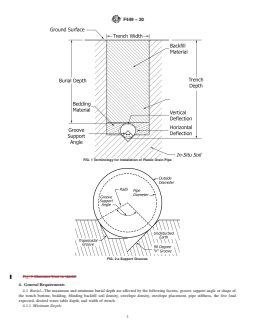
3.23 Fig. 1 illustrates the terms bedding, vertical deflection, backfill material, cover, groove support angle, horizontal deflection,
trench width, and trench depth.
Fig. 2a and b illustrates various support grooves or trench bottom shapes.
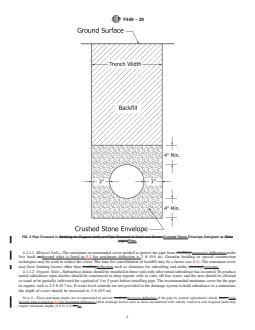
Fig. 3 illustrates envelope and filter.
Fig. 4 illustrates rodent protection devices.
F449 − 20
FIG. 1 Terminology for Installation of Plastic Drain Pipe
FIG. 2 a Support Grooves
Fig. 5 illustrates boot or shield.
4. General Requirements
4.1 Burial—The maximum and minimum burial depth are affected by the following factors, groove support angle or shape of
the trench bottom, bedding, blinding backfill soil density, envelope density, envelope placement, pipe stiffness, the live load
expected, desired water table depth, and width of trench.
4.1.1 Minimum Depth:
F449 − 20
FIG. 3 Pipe Encased in Bedding for Support (left) and Pipe Encased in Sand and Gravel Crushed Stone Envelope Designed as Filter
(right)Filter.
4.1.1.1 Mineral Soils—The minimum recommended cover needed to protect the pipe from crushing excessive deflection under
live loads is beyond what is listed in 5.2 for maximum deflection is 2 ft (0.6 m). Granular bedding or special construction
techniques may be used to reduce the cover. The time for consolidation of backfill may be a factor (see 8.1). The minimum cover
may have limiting factors other than crushingdeflection such as clearance for subsoiling and utility crossing crossing.
4.1.1.2 Organic Soils—Subsurface drains should be installed in these soils only after initial subsidence has occurred. To produce
initial subsidence open ditches should be constructed in deep organic soils to carry off free water, and the area should be allowed
to stand or be partially cultivated for a period of 3 to 5 years before installing pipe. The recommended minimum cover for the pipe
in organic soils is 2.5 ft (0.7 m). If water level controls are not provided in the drainage system to hold subsidence to a minimum,
the depth of cover should be increased to 3 ft (0.9 m).
NOTE 2—These minimum depths are recommended to prevent crushing excessive deflection of the pipe by normal agricultural vehicle loads. loads
beyond what is listed in 5.2 for maximum deflection. Other drainage factors such as those encountered with salinity control in arid irrigated lands may
require minimum depths of 6 ft (1.8 m).m)
F449 − 20
FIG. 4 Suggested Methods of Providing Rodent Protection for Outlet PipesTile Boot
FIG. 5 Example Boot DesignTile Plow
F449 − 20
4.1.2 Maximum Depth—The maximum burial depth is influenced by such factors as degree of compaction, type of bedding,
support from the trench bottom, trench width, size of pipe, pipe stiffness, weight of backfill, and live loads imposed. Without an
engineering design, maximum buried depths should be limited to those listed in Table 1 or Table 2. For installation at depths greater
than those listed in Table 1 or Table 2, specifications of andan engineering design should be followed.
4.1.3 Trench Width—Increasing the trench width increases the soil load on the pipe. Side clearances of more than 150 mm (6
in.) on each side should only be used with an engineering design and special construction (see Table 1). For Table 1 designs, the
trench width must be at least 50 mm (2 in.)2 in. (50 mm) wider than the pipe on each side for plow installation and 75 to 150 mm
(3 to 6 in.)3 to 6 in. (75 to 150 mm) on each side for open trench installation to allow sufficient bedding to support the pipe. If
fine material cannot be placed alongside and over the pipe, a wider trench should be considered or special bedding material
supplied. Side clearances of more than 6 in. (150 mm) on each side should only be used with an engineering design and special
construction. For Table 2 designs, a maximum and minimum trench width is specified to limit excessive deflection and allow a
larger amount of soil arching to reduce the load on the pipe. The tile boot or trench box used to construct the semi-circular groove
shall conform as closely as possible to the pipe OD and shall be within 1%1 % or ⁄2 in. in. (12 mm), whichever is greater, of the
pipe OD. The trench width requirements only pertain to the vertical distance from the springline to the top of the pipe. It is
permissible for the trench width above the top of the pipe to slope to the natural angle of repose of the soil.
TABLE 1 Maximum Trench Depths for Pipe Buried in Loose,
A
Fine-Textured Soils, ft (m)
NOTE 1—These depths are based on limited research and should be used
with caution. Differences in commercial pipe from several manufacturers,
including corrugation design and pipe stiffness and soil conditions, may
change the assumptions; and, therefore, maximum depths may be more or
less than stated above.
A
Nominal Trench width at top of pipe, m (ft)
pipe Pipe quality
0.8 (2.6) or
diameter, (ASTM)
0.3 (1) 0.4 (1.3) 0.6 (2)
greater
in. (mm)
B
4 (102) Standard 3.9 (12.8) 2.1 (6.9) 1.7 (5.6) 1.6 (5.2)
C D
Heavy-Duty 3.0 (9.8) 2.1 (6.9) 1.9 (6.2)
B
6 (152) Standard 3.1 (10.2) 2.1 (6.9) 1.7 (5.6) 1.6 (5.2)
C D
Heavy-Duty 2.9 (9.5) 2.0 (6.6) 1.9 (6.2)
B
8 (203) Standard 3.1 (10.2) 2.2 (7.2) 1.7 (5.6) 1.6 (5.2)
C D
Heavy-Duty 3.0 (9.8) 2.1 (6.9) 1.9 (6.2)
C
10 (254) . . . 2.8 (9.2) 2.0 (6.6) 1.9 (6.2)
C
12 (305) . . . 2.7 (8.9) 2.0 (6.6) 1.9 (6.2)
C
15 (381) . . . . . . 2.1 (6.9) 1.9 (6.2)
C
18 (457)
TABLE 1 Maximum Trench Depths for Pipe Buried in Loose,
A
Fine-Textured Soils, ft (m)
NOTE 1—These depths are based on limited research and should be used
with caution. See Appendix X1 for burial depth calculation method.
Differences in commercial pipe from several manufacturers, including
corrugation design and pipe stiffness, as well as soil conditions, may
change the assumptions; and, therefore, maximum depths may be more or
less than stated below. Consult the manufacturer for specific recommen-
dations.
A
Nominal Trench width at top of pipe, m (ft)
pipe Pipe quality
2.6 (0.8) or
diameter, (ASTM)
1 (0.3) 1.3 (0.4) 2 (0.6)
greater
in. (mm)
3 (76) F667/F2648 9.8 (3.0) 9.8 (3.0) 6.9 (2.1) 6.2 (1.9)
4 (102) F667/F2648 9.8 (3.0) 9.8 (3.0) 6.9 (2.1) 6.2 (1.9)
5 (127) F667 9.8 (3.0) 9.8 (3.0) 6.9 (2.1) 6.2 (1.9)
6 (152) F667/F2648 9.8 (3.0) 9.5 (2.9) 6.6 (2.0) 6.2 (1.9)
8 (203) F667/F2648 9.8 (3.0) 9.8 (3.0) 6.9 (2.1) 6.2 (1.9)
A 2
E' = 345 kN/m (50 psi)
D = 3.4
K = 0.096 (90° bedding angle)
3 3
w = 1750 kg/m (109 lb/ft )
Y = 1.1x (x = horizontal deflection)
B 2
Pipe stiffness 90 kN/m (13 psi) for 20 % deflection.
C 2
Pipe stiffness 124 kN/m (18 psi) for 20 % deflection.
A
Any depth is permissible for this or less width and for 0.2-m (0.67-ft) trench width
for all sizes.Maximum trench depth is listed to the right of each size and type of
pipe and is dependent on the trench width at the top of the pipe.
F449 − 20
A
TABLE 2 Maximum Trench Depths for Pipe Buried with a Semi-Circular Groove, ft (m)
NOTE 1—These depths are based on limited research and should be used with caution. Differences in commercial pipe from several manufacturers,
including corrugation design and pipe stiffness and soil conditions, may change the assumptions; and, therefore, maximum depths may be more or less
than stated above.
Nominal Pipe Inside Typical Pipe Outside Trench Width Tolerance on Trench Maximum Depth of
Diameter Diameter at Springline of Pipe Width at Springline Fill
in. (mm) in. (mm) in. (mm) in. (mm) ft (m)
10 [250] 12 [305] 16 [406] + 8 [+ 203] 11 [3.4]
12 [300] 15 [381] 19 [483] + 12 [+ 305] 11 [3.4]
15 [375] 18 [457] 22 [559] + 12 [+ 305] 10 [3.0]
18 [450] 21 [533] 25 [635] + 12 [+ 305] 10 [3.0]
24 [600] 28 [711] 32 [813] + 12 [+ 305] 10 [3.0]
30 [750] 35 [889] 39 [991] + 16 [+ 406] 10 [3.0]
36 [900] 41 [1041] 45 [1143] + 18 [+ 457] 8 [2.4]
42 [1050] 48 [1219] 52 [1321] + 20 [+ 508] 8 [2.4]
48 [1200] 54 [1371] 58 [1473] + 20 [+ 508] 7 [2.1]
60 [1500] 67 [1702] 71 [1803] + 25 [+ 635] 6[1.8]
A
TABLE 2 Maximum Trench Depths for Pipe Buried with a Semi-Circular Groove, ft (m)
NOTE 1—These depths are based on limited research and should be used with caution. Differences in commercial pipe from several manufacturers,
including corrugation design and pipe stiffness and soil conditions, may change the assumptions; and, therefore, maximum depths may be more or less
than stated above.
Nominal Pipe Inside Typical Pipe Outside Pipe Quality Trench Width Tolerance on Trench Maximum Depth of
Diameter Diameter ASTM at Springline of Pipe Width at Springline Fill
in. (mm) in. (mm) Standard in. (mm) in. (mm) ft (m)
3 (76) 3.5 (90) F667 3.5 (90) + 8 (+ 203) 9.8 (3.0)
4 (102) 4.5 (115) F667 4.5 (115) + 8 (+ 203) 9.8 (3.0)
5 (127) 5.5 (140) F667 5.5 (140) + 8 (+ 203) 9.8 (3.0)
6 (152) 6.5 (165) F667 6.5 (165) + 8 (+ 203) 9.8 (3.0)
8 (203) 10 (254) F667 10 (254) + 8 (+ 203) 9.8 (3.0)
10 (254) 12 (305) F667 12 (305) + 10 (+ 254) 8 (2.4)
12 (305) 15 (381) F667 15 (381) + 12 (+ 305) 6 (1.8)
15 (381) 18 (457) F667 18 (457) + 12 (+ 305) 6 (1.8)
18 (457) 21 (533) F667 21 (533) + 12 (+ 305) 6 (1.8)
21 (533) 24 (600) F667 24 (610) + 12 (+ 305) 6 (1.8)
24 (610) 28 (711) F667 28 (711) + 12 (+ 305) 6 (1.8)
Nominal Pipe Inside Typical Pipe Outside Pipe Quality Trench Width Tolerance on Trench Maximum Depth of
Diameter Diameter ASTM at Springline of Pipe Width at Springline Fill
B
in. (mm) in. (mm) Standard in. (mm) in. (mm) ft (m)
4 (102) 4.5 (115) F2648 4.5 (115) + 8 (+ 203) 11 (3.4)
6 (152) 6.5 (165) F2648 6.5 (165) + 8 (+ 203) 11 (3.4)
8 (203) 10 (254) F2648 10 (250) + 8 (+ 203) 11 (3.4)
10 (254) 12 (305) F2648 12 (305) + 10 (+ 254) 11 (3.4)
12 (305) 15 (381) F2648 15 (381) + 12 (+ 305) 11 (3.4)
15 (381) 18 (457) F2648 18 (457) + 12 (+ 305) 10 (3.0)
18 (457) 21 (533) F2648 21 (533) + 12 (+ 305) 10 (3.0)
21 (533) 24 (610) F2648 24 (610) + 12 (+ 305) 10 (3.0)
24 (610) 28 (711) F2648 28 (711) + 12 (+ 305) 10 (3.0)
30 (762) 35 (889) F2648 35 (889) + 16 (+ 406) 10 (3.0)
36 (914) 41 (1041) F2648 41 (1041) + 18 (+ 457) 8 (2.4)
42 (1067) 48 (1219) F2648 48 (1219) + 20 (+ 508) 8 (2.4)
48 (1219) 54 (1372) F2648 54 (1372) + 20 (+ 508) 7 (2.1)
60 (1524) 67 (1702) F2648 67 (1702) + 25 (+ 635) 6 (1.8)
A
A small “V” notch or groove at the bottom of the shaped trench may be beneficial to accommodate any soil chunks or small clods that may fall into the plowed-in or
excavated trench in order to prevent localized stress points on the invert crown of the pipe,
B
The minimum trench width at the springline listed in the table are listed as the typical pipe OD in the industry. Pipe ODs vary and as such the minimum trench width should
always be at least the pipe OD.
NOTE 3—A narrow trench width will result in a greater transfer of loads to the sidefill materials. A semi-circular groove installation in insituin-situ soils
conforming to the outer diameter of the pipe minimizes the impact of poor compaction or installation techniques and provides very good bedding support
in addition to reduced dead loads on the pipe.
4.2 Design Items—It is particularly important that blinding, bedding, or envelope material be placed as the pipe is
installed,installed to ensure uniform continuous support, so that the bedding, blinding, or envelope material can provide lateral
restraint against pipe deflection as the backfill settles on the bedding, blinding, or envelope material.
4.3 Envelopes—Must be designed to provide adequate support for the pipe, improve the flow of ground water into the pipe, and
in some installations, filter flow into the pipe.
4.3.1 Natural Granular Envelopes—Minimum Shall have a minimum thickness of 75 mm (3 in.) around the pipe.
4.3.2 Synthetic Envelopes—Blinding or bedding is needed to support and hold the envelope and pipe in place.
...