

ASTM C633-13(2021)
(Test Method)Standard Test Method for Adhesion or Cohesion Strength of Thermal Spray Coatings
General Information
- Abstract
SIGNIFICANCE AND USE
3.1 This test method is recommended for quality control, acceptance testing; or it may help to develop or qualify a thermal spray operator's equipment and procedure or to aid in developing thermal spray coatings with improved adhesion and integrity.
3.2 This test method is useful for comparing adhesion or cohesion strengths of coatings of similar types of thermal spray materials. The test should not be considered to provide an intrinsic value for direct use in making calculations, such as to determine if a coating will withstand specific environmental stresses. Because of residual stresses in thermal spray coatings, actual strength depends upon the shape of the particular coated part. Also, in use, a coating may be stressed in a more complex manner than is practical for a standard test.
SCOPE
1.1 This test method covers the determination of the degree of adhesion (bonding strength) of a coating to a substrate or the cohesion strength of the coating in a tension normal to the surface. The test consists of coating one face of a substrate fixture, bonding this coating to the face of a loading fixture, and subjecting this assembly of coating and fixtures to a tensile load normal to the plane of the coating. It is adapted particularly for testing coatings applied by thermal spray, which is defined to include the combustion flame, plasma arc, two-wire arc, high-velocity oxygen fuel, and detonation processes for spraying feedstock, which may be in the form of, wire, rod, or powder.
Note 1: Thermal spray coating materials include ceramics, such as metal oxides or carbides, and metals. In some cases, a coating is formed of different spray materials, such as an oxide layer sprayed onto a sprayed metal-bonding layer. The substrate generally is a metal, but may be a ceramic, such as an oxide or graphite.
1.2 Usually this test method is performed at ambient temperature. Higher temperature testing is restricted by the need for a suitable adhesive bonding agent. For certain fundamental investigations, it is suggested that very low (cryogenic) temperature be used.
1.3 This test method is limited to testing thermal spray coatings that can be applied in thickness greater than 0.015 in. (0.38 mm). The limitation is imposed because an adhesive bonding agent is used in the test. Those bonding agents established so far for this method tend to penetrate thermal spray coatings and may invalidate results unless the coatings are thick enough to prevent penetration through the coating. Further development may establish that thin layers of certain types of especially dense coatings may be tested satisfactorily. Alternatively, new adhesive bonding agents that would allow reduction of the minimum thickness limitation may become available.
1.4 The values stated in inch-pound units are to be regarded as standard. The values given in parentheses are mathematical conversions to SI units that are provided for information only and are not considered standard.
1.5 This standard does not purport to address all of the safety concerns, if any, associated with its use. It is the responsibility of the user of this standard to establish appropriate safety, health, and environmental practices and determine the applicability of regulatory limitations prior to use.
1.6 This international standard was developed in accordance with internationally recognized principles on standardization established in the Decision on Principles for the Development of International Standards, Guides and Recommendations issued by the World Trade Organization Technical Barriers to Trade (TBT) Committee.
- Status
- Published
- Publication Date
- 30-Sep-2021
- Technical Committee
- B08 - Metallic and Inorganic Coatings
- Drafting Committee
- B08.12 - Materials for Porcelain Enamel and Ceramic-Metal Systems
Overview
ASTM C633-13(2021) – Standard Test Method for Adhesion or Cohesion Strength of Thermal Spray Coatings specifies a standardized procedure to determine the adhesive (bonding) and cohesive strength of thermal spray coatings applied to a substrate. Developed by ASTM, this test method is essential for quality control, acceptance testing, operator qualification, and the development of improved thermal spray coatings in industrial and research settings. The method focuses on measuring tensile strength normal to the surface, which provides a reliable comparison between similar types of thermal spray coatings.
Thermal spray coatings, which include materials such as ceramics (metal oxides or carbides) and metals, are widely used to enhance surface properties like wear, corrosion, and heat resistance. This standard supports manufacturers and users in ensuring consistent coating performance and reliability.
Key Topics
Purpose and Use:
- Quality control of thermal spray coatings
- Acceptance testing for coated parts
- Qualification of operators and procedures
- Development and comparison of thermal spray materials
Test Method Summary:
- Involves coating a substrate fixture, bonding it to a loading fixture, and applying a tensile load perpendicular to the coated surface
- Measures where the failure occurs: coating-substrate interface (adhesion), within the coating (cohesion), or in the bonding agent
Applicable Coating Processes:
- Combustion flame spraying
- Plasma arc spraying
- Two-wire arc spraying
- High-velocity oxygen fuel spraying
- Detonation processes
Material Considerations:
- Coating materials: ceramics, metals, carbides, or composites
- Substrate materials: typically metals, occasionally ceramics such as oxides or graphite
Limitations and Conditions:
- Recommended for coatings at thicknesses above 0.015 in. (0.38 mm) to avoid adhesive penetration
- Normally performed at ambient temperature, with adaptability for special requirements such as cryogenic testing
- Not intended to directly predict service performance under operational or complex loading conditions
Applications
The ASTM C633-13(2021) test method is critical for a range of industries employing thermal spray coatings, including:
Aerospace and Turbine Manufacturing:
Ensures quality and durability of thermal barrier and wear-resistant coatings on engine components.Heavy Equipment and Automotive:
Evaluates surface protection for parts exposed to abrasion, corrosion, or high temperatures.Energy Generation:
Assesses performance of coatings for turbines, boilers, and other high-stress applications.Research and Development:
Facilitates the comparison of new coating compositions, application techniques, and process improvements.Quality Assurance and Certification:
Used for batch acceptance testing and validation of coating procedures and equipment, supporting compliance with industry standards.
By providing a consistent method to measure adhesion or cohesion strength, this standard helps reduce variability and enhances the reliability of coated products.
Related Standards
For comprehensive quality assurance and compatibility with other testing practices, the following ASTM standards are often referenced or used alongside ASTM C633:
ASTM E4 – Practices for Force Calibration and Verification of Testing Machines:
Ensures that the tensile testing machinery used meets specified accuracy and calibration requirements.Other Thermal Spray Coating Standards:
Consider referencing additional ASTM and ISO documents relating to thermal spray process qualification, coating characterization, and other mechanical property assessments.
Consult the ASTM catalog for the most up-to-date list of related standards and further guidance on testing and quality management for thermal spray coatings.
Keywords: ASTM C633-13(2021), thermal spray coatings, adhesion strength, cohesion strength, tensile test method, industrial coating quality control, ASTM standard, coating qualification, ceramic coatings, metal coatings
Relations
- Effective Date
- 01-Jun-2014
- Effective Date
- 01-Jun-2010
- Effective Date
- 01-Nov-2009
- Effective Date
- 01-Apr-2009
- Effective Date
- 01-Dec-2008
- Effective Date
- 01-Jan-2007
- Effective Date
- 10-Aug-2003
- Effective Date
- 10-Nov-2002
- Effective Date
- 10-Apr-2001
- Effective Date
- 10-Apr-2001
Get Certified
Connect with accredited certification bodies for this standard

DVS-ZERT GmbH
German welding certification society.
CARES (UK Certification Authority for Reinforcing Steels)
UK certification for reinforcing steels and construction.
EWF/IIW (European/International Welding Federation)
International welding personnel certification.
Sponsored listings
Frequently Asked Questions
ASTM C633-13(2021) is a standard published by ASTM International. Its full title is "Standard Test Method for Adhesion or Cohesion Strength of Thermal Spray Coatings". This standard covers: SIGNIFICANCE AND USE 3.1 This test method is recommended for quality control, acceptance testing; or it may help to develop or qualify a thermal spray operator's equipment and procedure or to aid in developing thermal spray coatings with improved adhesion and integrity. 3.2 This test method is useful for comparing adhesion or cohesion strengths of coatings of similar types of thermal spray materials. The test should not be considered to provide an intrinsic value for direct use in making calculations, such as to determine if a coating will withstand specific environmental stresses. Because of residual stresses in thermal spray coatings, actual strength depends upon the shape of the particular coated part. Also, in use, a coating may be stressed in a more complex manner than is practical for a standard test. SCOPE 1.1 This test method covers the determination of the degree of adhesion (bonding strength) of a coating to a substrate or the cohesion strength of the coating in a tension normal to the surface. The test consists of coating one face of a substrate fixture, bonding this coating to the face of a loading fixture, and subjecting this assembly of coating and fixtures to a tensile load normal to the plane of the coating. It is adapted particularly for testing coatings applied by thermal spray, which is defined to include the combustion flame, plasma arc, two-wire arc, high-velocity oxygen fuel, and detonation processes for spraying feedstock, which may be in the form of, wire, rod, or powder. Note 1: Thermal spray coating materials include ceramics, such as metal oxides or carbides, and metals. In some cases, a coating is formed of different spray materials, such as an oxide layer sprayed onto a sprayed metal-bonding layer. The substrate generally is a metal, but may be a ceramic, such as an oxide or graphite. 1.2 Usually this test method is performed at ambient temperature. Higher temperature testing is restricted by the need for a suitable adhesive bonding agent. For certain fundamental investigations, it is suggested that very low (cryogenic) temperature be used. 1.3 This test method is limited to testing thermal spray coatings that can be applied in thickness greater than 0.015 in. (0.38 mm). The limitation is imposed because an adhesive bonding agent is used in the test. Those bonding agents established so far for this method tend to penetrate thermal spray coatings and may invalidate results unless the coatings are thick enough to prevent penetration through the coating. Further development may establish that thin layers of certain types of especially dense coatings may be tested satisfactorily. Alternatively, new adhesive bonding agents that would allow reduction of the minimum thickness limitation may become available. 1.4 The values stated in inch-pound units are to be regarded as standard. The values given in parentheses are mathematical conversions to SI units that are provided for information only and are not considered standard. 1.5 This standard does not purport to address all of the safety concerns, if any, associated with its use. It is the responsibility of the user of this standard to establish appropriate safety, health, and environmental practices and determine the applicability of regulatory limitations prior to use. 1.6 This international standard was developed in accordance with internationally recognized principles on standardization established in the Decision on Principles for the Development of International Standards, Guides and Recommendations issued by the World Trade Organization Technical Barriers to Trade (TBT) Committee.
SIGNIFICANCE AND USE 3.1 This test method is recommended for quality control, acceptance testing; or it may help to develop or qualify a thermal spray operator's equipment and procedure or to aid in developing thermal spray coatings with improved adhesion and integrity. 3.2 This test method is useful for comparing adhesion or cohesion strengths of coatings of similar types of thermal spray materials. The test should not be considered to provide an intrinsic value for direct use in making calculations, such as to determine if a coating will withstand specific environmental stresses. Because of residual stresses in thermal spray coatings, actual strength depends upon the shape of the particular coated part. Also, in use, a coating may be stressed in a more complex manner than is practical for a standard test. SCOPE 1.1 This test method covers the determination of the degree of adhesion (bonding strength) of a coating to a substrate or the cohesion strength of the coating in a tension normal to the surface. The test consists of coating one face of a substrate fixture, bonding this coating to the face of a loading fixture, and subjecting this assembly of coating and fixtures to a tensile load normal to the plane of the coating. It is adapted particularly for testing coatings applied by thermal spray, which is defined to include the combustion flame, plasma arc, two-wire arc, high-velocity oxygen fuel, and detonation processes for spraying feedstock, which may be in the form of, wire, rod, or powder. Note 1: Thermal spray coating materials include ceramics, such as metal oxides or carbides, and metals. In some cases, a coating is formed of different spray materials, such as an oxide layer sprayed onto a sprayed metal-bonding layer. The substrate generally is a metal, but may be a ceramic, such as an oxide or graphite. 1.2 Usually this test method is performed at ambient temperature. Higher temperature testing is restricted by the need for a suitable adhesive bonding agent. For certain fundamental investigations, it is suggested that very low (cryogenic) temperature be used. 1.3 This test method is limited to testing thermal spray coatings that can be applied in thickness greater than 0.015 in. (0.38 mm). The limitation is imposed because an adhesive bonding agent is used in the test. Those bonding agents established so far for this method tend to penetrate thermal spray coatings and may invalidate results unless the coatings are thick enough to prevent penetration through the coating. Further development may establish that thin layers of certain types of especially dense coatings may be tested satisfactorily. Alternatively, new adhesive bonding agents that would allow reduction of the minimum thickness limitation may become available. 1.4 The values stated in inch-pound units are to be regarded as standard. The values given in parentheses are mathematical conversions to SI units that are provided for information only and are not considered standard. 1.5 This standard does not purport to address all of the safety concerns, if any, associated with its use. It is the responsibility of the user of this standard to establish appropriate safety, health, and environmental practices and determine the applicability of regulatory limitations prior to use. 1.6 This international standard was developed in accordance with internationally recognized principles on standardization established in the Decision on Principles for the Development of International Standards, Guides and Recommendations issued by the World Trade Organization Technical Barriers to Trade (TBT) Committee.
ASTM C633-13(2021) is classified under the following ICS (International Classification for Standards) categories: 25.220.40 - Metallic coatings. The ICS classification helps identify the subject area and facilitates finding related standards.
ASTM C633-13(2021) has the following relationships with other standards: It is inter standard links to ASTM E4-14, ASTM E4-10, ASTM E4-09a, ASTM E4-09, ASTM E4-08, ASTM E4-07, ASTM E4-03, ASTM E4-02, ASTM E4-01, ASTM E4-99. Understanding these relationships helps ensure you are using the most current and applicable version of the standard.
ASTM C633-13(2021) is available in PDF format for immediate download after purchase. The document can be added to your cart and obtained through the secure checkout process. Digital delivery ensures instant access to the complete standard document.
Standards Content (Sample)
This international standard was developed in accordance with internationally recognized principles on standardization established in the Decision on Principles for the
Development of International Standards, Guides and Recommendations issued by the World Trade Organization Technical Barriers to Trade (TBT) Committee.
Designation: C633 − 13 (Reapproved 2021)
Standard Test Method for
Adhesion or Cohesion Strength of Thermal Spray Coatings
This standard is issued under the fixed designation C633; the number immediately following the designation indicates the year of
original adoption or, in the case of revision, the year of last revision.Anumber in parentheses indicates the year of last reapproval.A
superscript epsilon (´) indicates an editorial change since the last revision or reapproval.
This standard has been approved for use by agencies of the U.S. Department of Defense.
1. Scope 1.4 Thevaluesstatedininch-poundunitsaretoberegarded
as standard. The values given in parentheses are mathematical
1.1 This test method covers the determination of the degree
conversions to SI units that are provided for information only
ofadhesion(bondingstrength)ofacoatingtoasubstrateorthe
and are not considered standard.
cohesion strength of the coating in a tension normal to the
1.5 This standard does not purport to address all of the
surface. The test consists of coating one face of a substrate
safety concerns, if any, associated with its use. It is the
fixture,bondingthiscoatingtothefaceofaloadingfixture,and
responsibility of the user of this standard to establish appro-
subjecting this assembly of coating and fixtures to a tensile
priate safety, health, and environmental practices and deter-
load normal to the plane of the coating. It is adapted particu-
mine the applicability of regulatory limitations prior to use.
larly for testing coatings applied by thermal spray, which is
1.6 This international standard was developed in accor-
defined to include the combustion flame, plasma arc, two-wire
dance with internationally recognized principles on standard-
arc, high-velocity oxygen fuel, and detonation processes for
ization established in the Decision on Principles for the
spraying feedstock, which may be in the form of, wire, rod, or
Development of International Standards, Guides and Recom-
powder.
mendations issued by the World Trade Organization Technical
NOTE 1—Thermal spray coating materials include ceramics, such as
Barriers to Trade (TBT) Committee.
metal oxides or carbides, and metals. In some cases, a coating is formed
ofdifferentspraymaterials,suchasanoxidelayersprayedontoasprayed
metal-bonding layer. The substrate generally is a metal, but may be a 2. Referenced Documents
ceramic, such as an oxide or graphite.
2.1 ASTM Standards:
1.2 Usually this test method is performed at ambient tem-
E4Practices for Force Calibration and Verification of Test-
perature. Higher temperature testing is restricted by the need
ing Machines
for a suitable adhesive bonding agent. For certain fundamental
investigations, it is suggested that very low (cryogenic) tem-
3. Significance and Use
perature be used.
3.1 This test method is recommended for quality control,
1.3 This test method is limited to testing thermal spray
acceptance testing; or it may help to develop or qualify a
coatings that can be applied in thickness greater than 0.015 in.
thermal spray operator’s equipment and procedure or to aid in
(0.38 mm). The limitation is imposed because an adhesive
developingthermalspraycoatingswithimprovedadhesionand
bonding agent is used in the test. Those bonding agents
integrity.
established so far for this method tend to penetrate thermal
3.2 This test method is useful for comparing adhesion or
spray coatings and may invalidate results unless the coatings
cohesionstrengthsofcoatingsofsimilartypesofthermalspray
are thick enough to prevent penetration through the coating.
materials. The test should not be considered to provide an
Further development may establish that thin layers of certain
intrinsic value for direct use in making calculations, such as to
types of especially dense coatings may be tested satisfactorily.
determine if a coating will withstand specific environmental
Alternatively, new adhesive bonding agents that would allow
stresses.Becauseofresidualstressesinthermalspraycoatings,
reduction of the minimum thickness limitation may become
actualstrengthdependsupontheshapeoftheparticularcoated
available.
part.Also,inuse,acoatingmaybestressedinamorecomplex
manner than is practical for a standard test.
ThistestmethodisunderthejurisdictionofASTMCommitteeB08onMetallic
and Inorganic Coatings and is the direct responsibility of Subcommittee B08.12 on
Materials for Porcelain Enamel and Ceramic-Metal Systems. For referenced ASTM standards, visit the ASTM website, www.astm.org, or
Current edition approved Oct. 1, 2021. Published November 2021. Originally contact ASTM Customer Service at service@astm.org. For Annual Book of ASTM
approvedin1969.Lastpreviouseditionapprovedin2017asC633–13(2017).DOI: Standards volume information, refer to the standard’s Document Summary page on
10.1520/C0633-13R21. the ASTM website.
Copyright © ASTM International, 100 Barr Harbor Drive, PO Box C700, West Conshohocken, PA 19428-2959. United States
C633 − 13 (2021)
4. Apparatus 5. Material
4.1 Atension testing machine shall conform to the require- 5.1 Adhesive Bonding Agent—A suitable adhesive bonding
ments of Practices E4. The loads used in determining the
agent shall be agreed between the purchaser and manufacturer
adhesionortensilestrengthshallbewithintheloadingrangeof of the coating and shall meet the following requirements.
the testing machine, as defined in Practices E4. Permissible
5.1.1 The bonding agent shall be capable of bonding the
variation shall be less than 1.0%. It shall be possible to apply
coating to the loading fixture with a tensile strength that is at
increasing tensile load at a constant rate of cross-head travel
least as great as the minimum required adhesion and cohesion
between 0.030 in./min (0.013 mm/s) and 0.050 in./min (0.021
strength of the coating.
mm/s).Themachineshallincludeaload-indicatingdevicethat
5.1.2 The bonding agent shall be sufficiently viscous not to
registers the maximum load applied before rupture occurs.
penetrate through a 0.015-in. (0.38-mm) thickness of the
coating. Certain commercial resins that cure or harden at room
4.2 Self-aligningdevices,forapplyingthetensileloadtothe
temperature by means of a curing agent have been proven
assembly of the coating and fixtures, shall not permit eccentric
satisfactory. If any other bonding agent is to be used, it shall
load or bending moment to the specimen. Self-alignment is
often provided by the manufacturer as an integral part of the
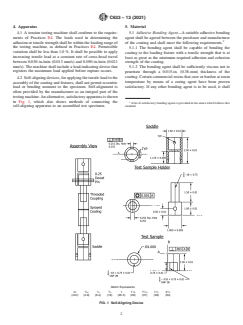
testingmachine.Analternative,satisfactoryapparatusisshown
in Fig. 1, which also shows methods of connecting the 3
Alistofsatisfactorybondingagentsisprovidedintheannexwhichfollowsthis
self-aligning apparatus to an assembled test specimen. standard.
Metric Equivalents
3 1 3 1 7 1 1
in. ⁄16 ⁄4 ⁄4 11 ⁄8 1 ⁄16 1 ⁄2 2 ⁄2
(mm) (4.8) (6.4) (19) (25.4) (29) (37) (38) (64)
FIG. 1 Self-Aligning Device
C633 − 13 (2021)
first be compared with a proven bonding agent using this test 6. Test Specimens
method with the desired thermal spray coating.
6.1 Substrate and Loading Fixtures— Each test specimen is
NOTE 2—Thermal spray coatings may have an inherent porosity. an assembly comprising a substrate fixture, to which the
Excessive penetration of the adhesive bonding agent into this porosity
coating is applied, and a loading fixture. The substrate and
may affect the results determined by this test method. Unless proved
loadingfixturesshalleachbecircular,solidcylindersofnoless
satisfactory by comparison testing, any agent requiring elevated tempera-
than 1.5 in. in length, or as agreed upon by the manufacturer
ture for curing should be avoided because viscosity may decrease at high
and customer.Asuggested detail for either fixture is shown in
temperature, allowing penetration.
NOTE 3—When liquid epoxy bonding agents are used, there should be Fig. 2. One end of each fixture shall be adapted for attachment
a procedure in place to ensure relatively consistent thickness on every
to the self-aligning loading devices of the tension testing
sample.
machine. Both ends of each fixture shall have faces parallel to
5.1.3 The adhesion strength of the bonding agent shall be
eachotherandnormaltotheloadingaxis.Thefacingdiameters
determined each time this test method is performed.This shall
shallbenotlessthan0.9in.(23mm),normorethan1.0in.(25
be done by using the bonding agent to attach a loading fixture
mm). The diameters of the two fixtures shall be the same and
to a second loading fixture, in accordance with 6.5, except that
shall be measured so that the error is no greater than 0.5%.
the coated substrate fixture of 6.5 is replaced with the second
NOTE 5—In Appendix X1, an alternative substrate and fixture arrange-
loading fixture.
ment is provided that has proved cost effective and simple.
NOTE4—Onereasonfortestingthebondingagenteachtimeistodetect
6.1.1 Material for Substrate Fixture— The substrate fixture
improper preparation of the agent if it is a two-part mix. Another reason
shallbeconstructedofmetal,preferablymetalintendedforuse
isthatadhesionstrengthgenerallydecreaseswithageoftheunusedagent.
as the substrate for the coating. If no such substrate material is
If strength is lower than required, more adhesive bonding agent shall be
prepared and tested, or the agent shall be discarded and replaced. specified,thesubstratefixtureshallbeSAE1018or1020steel.
1 31 1 5
U.S. 0.003 in. ⁄64 in. ⁄64 in. ⁄2 in. ⁄8 in.
Metric (0.08 mm) (0.39 mm) (12.3 mm) (12.7 mm) (15.9 mm)
U.S. ⁄4 in. 0.990 in. 1 in. 1.000 in. 1 ft. 24 in.
Metric (19 mm) (25.15 mm) (25.4 mm) (25.4 mm) (0.3 m) (610 mm)
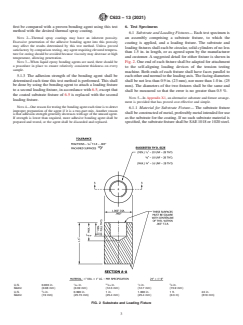
FIG. 2 Substrate and Loading Fixture
C633 − 13 (2021)
NOTE 6—If desired because of cost or ease of fabrication, it may be
shall be held together parallel and aligned until the bonding
suitable to attach or bond a layer of the specified substrate material to a
agentiscuredorhardened.Asuitableholdingdevicesuchasa
fixture formed ofanyconvenientmetal.Suchalayerofsubstrate material
“V-block” shall be used for the purpose, except such a device
need not be metal. The layer must be substantially thicker than the
is not necessary if the surface of the coating has been ground
possible depth of effects on the substrate, such as recrystallization or
or machined smooth.
diffusionzones,thatmayresultfromapplyingthecoating.Alayergreater
than 0.1 in. (2.5mm) thick should be sufficient.
6.6 Number of Test Specimens—The number of test speci-
6.1.2 Material for Loading Fixture—The loading fixture
mens chosen depends upon the purpose of the particular tests
shall be constructed of metal, but material is otherwise op-
under consideration. However, if specimens are to be used for
tional. It is usually convenient to make the loading fixture of
acceptancetests,notlessthanfivespecimensofatypeshallbe
thesamematerialasthesubstratefixture;thus,thefixturesmay
tested.
be interchangeable until a coating is applied to one.
7. Procedure
6.2 Coating Application—The front facing of the substrate
7.1 Prepare the chosen number of substrate fixtures, and
fixture shall be prepared in the manner required by the
apply a thermal spray coating to
...