

ASTM F1645/F1645M-22
(Test Method)Standard Test Method for Water Migration in Honeycomb Core Materials
General Information
- Abstract
SIGNIFICANCE AND USE
5.1 Water permeability is a fundamental physical property that can be used in conjunction with other properties to characterize honeycomb sandwich core materials. Migration testing can be used to characterize and compare the relative permeability of honeycomb core materials to water.
5.2 This test method provides a standard method of characterizing the rate of water migration within honeycomb sandwich core materials for design properties, material specifications, research and development applications, and quality assurance.
5.3 Factors that influence water migration rate characteristics of honeycomb sandwich core materials and shall therefore be reported include the following: core material, methods of material fabrication, core geometry (cell size), core thickness, core thickness uniformity, cell wall thickness, specimen geometry, specimen preparation, specimen conditioning, facing material, facing permeability, adhesive permeability, adhesive thickness, and methods of mass, volume, and water column height measurement.
SCOPE
1.1 This test method covers the determination of water migration in honeycomb core materials.
1.2 Units—The values stated in either SI units or inch-pound units are to be regarded separately as standard. The values stated in each system are not necessarily exact equivalents; therefore, to ensure conformance with the standard, each system shall be used independently of the other, and values from the two systems shall not be combined.
1.2.1 Within the text, the inch-pound units are shown in brackets.
1.3 This standard does not purport to address all of the safety concerns, if any, associated with its use. It is the responsibility of the user of this standard to establish appropriate safety, health, and environmental practices and determine the applicability of regulatory limitations prior to use.
1.4 This international standard was developed in accordance with internationally recognized principles on standardization established in the Decision on Principles for the Development of International Standards, Guides and Recommendations issued by the World Trade Organization Technical Barriers to Trade (TBT) Committee.
- Status
- Published
- Publication Date
- 30-Apr-2022
- Technical Committee
- D30 - Composite Materials
- Drafting Committee
- D30.09 - Sandwich Construction
Overview
ASTM F1645/F1645M-22 is the standard test method developed by ASTM International for determining water migration in honeycomb core materials. As water permeability directly impacts the integrity and durability of honeycomb sandwich constructions, this test method provides a reliable way to characterize and compare the water migration rates of various honeycomb core materials. Its systematic procedure helps engineers, manufacturers, and quality assurance professionals assess the suitability of such materials for demanding applications where moisture ingress can compromise performance or lifespan.
Key Topics
Water Migration in Honeycomb Cores
The standard establishes procedures for measuring how water migrates through the interior of sandwich core materials constructed with a honeycomb geometry. Migration can occur due to diffusion through cell walls, and its rate is a key indicator of material susceptibility to environmental conditions.Influencing Factors
Multiple factors are reported and considered in evaluating water migration, including:- Type of core material
- Fabrication methods
- Core geometry, such as cell size and thickness
- Uniformity and thickness of cell walls
- Facing and adhesive materials and their permeability
- Specimen conditioning and preparation methods
- Environmental conditions during testing
Methodology
The method involves bonding a honeycomb panel to transparent facings using water-resistant adhesive, preparing the specimen, introducing water into a specific cavity, maintaining a controlled hydrostatic head, and then measuring the volume or mass of water transfused over a 24-hour period.Reporting and Calibration
The standard details necessary reporting elements, including full traceability of specimen materials, fabrication steps, conditioning parameters, measurement accuracy, and statistical analysis such as average values and coefficient of variation. Calibration of measuring equipment is also addressed to uphold data integrity.
Applications
Material Selection and Qualification
This test method is essential for engineers and materials scientists tasked with selecting honeycomb core materials for aerospace, marine, transportation, and construction industries, where long-term exposure to moisture could lead to degradation or failure.Design and Engineering
Results from this water migration test guide the design of sandwich structures, influencing decisions on core type, adhesives, and facing materials to improve water resistance and structural stability.Research and Development
R&D teams use this standard to benchmark new honeycomb core materials or modifications in manufacturing processes, comparing their water permeability to established baselines or competing products.Quality Assurance
Manufacturers apply the ASTM F1645/F1645M-22 method for routine quality control, ensuring production lots match specified water migration performance criteria before delivery or use in critical applications.
Related Standards
ASTM C271/C271M - Test Method for Density of Sandwich Core Materials
Important for correlating water migration data with density and other physical properties.ASTM D5229/D5229M - Test Method for Moisture Absorption Properties of Polymer Matrix Composites
Provides procedures for specimen conditioning and assessing moisture equilibrium.ASTM D883 - Terminology Relating to Plastics
Useful for consistent terminology across standards involving honeycomb cores.ASTM D3878 - Terminology for Composite Materials
Defines terms critical to structural sandwich constructions.ASTM E122 & ASTM E177
Provide statistical methods for calculating sample size and using terms precision and bias in test methods.
Conclusion
Implementing ASTM F1645/F1645M-22 ensures repeatable, consistent assessment of water migration in honeycomb core materials, supporting informed decisions in material selection, structural design, R&D, and quality assurance. Adherence to this standard is vital for industries where composite sandwich panels are used in moisture-sensitive environments. For further reading, consult associated ASTM standards, which provide additional guidance on material characterization and statistical data analysis.
Keywords: honeycomb core, water migration, permeability, sandwich materials, ASTM F1645, composites, quality assurance, material testing
Relations
- Effective Date
- 01-Feb-2024
- Effective Date
- 01-Nov-2023
- Effective Date
- 01-Apr-2022
- Effective Date
- 01-Mar-2020
- Effective Date
- 01-Jan-2020
- Effective Date
- 15-Oct-2019
- Effective Date
- 01-Aug-2019
- Effective Date
- 15-Apr-2019
- Effective Date
- 15-Apr-2019
- Effective Date
- 01-Feb-2019
- Effective Date
- 01-Dec-2018
- Effective Date
- 01-Nov-2018
- Effective Date
- 01-Apr-2018
- Effective Date
- 01-Oct-2017
- Effective Date
- 01-Oct-2017
Get Certified
Connect with accredited certification bodies for this standard

DIBt (Deutsches Institut für Bautechnik)
German Institute for Building Technology.
DIN CERTCO
DIN Group product certification.

Aboma Certification B.V.
Specialized in construction, metal, and transport sectors.
Sponsored listings
Frequently Asked Questions
ASTM F1645/F1645M-22 is a standard published by ASTM International. Its full title is "Standard Test Method for Water Migration in Honeycomb Core Materials". This standard covers: SIGNIFICANCE AND USE 5.1 Water permeability is a fundamental physical property that can be used in conjunction with other properties to characterize honeycomb sandwich core materials. Migration testing can be used to characterize and compare the relative permeability of honeycomb core materials to water. 5.2 This test method provides a standard method of characterizing the rate of water migration within honeycomb sandwich core materials for design properties, material specifications, research and development applications, and quality assurance. 5.3 Factors that influence water migration rate characteristics of honeycomb sandwich core materials and shall therefore be reported include the following: core material, methods of material fabrication, core geometry (cell size), core thickness, core thickness uniformity, cell wall thickness, specimen geometry, specimen preparation, specimen conditioning, facing material, facing permeability, adhesive permeability, adhesive thickness, and methods of mass, volume, and water column height measurement. SCOPE 1.1 This test method covers the determination of water migration in honeycomb core materials. 1.2 Units—The values stated in either SI units or inch-pound units are to be regarded separately as standard. The values stated in each system are not necessarily exact equivalents; therefore, to ensure conformance with the standard, each system shall be used independently of the other, and values from the two systems shall not be combined. 1.2.1 Within the text, the inch-pound units are shown in brackets. 1.3 This standard does not purport to address all of the safety concerns, if any, associated with its use. It is the responsibility of the user of this standard to establish appropriate safety, health, and environmental practices and determine the applicability of regulatory limitations prior to use. 1.4 This international standard was developed in accordance with internationally recognized principles on standardization established in the Decision on Principles for the Development of International Standards, Guides and Recommendations issued by the World Trade Organization Technical Barriers to Trade (TBT) Committee.
SIGNIFICANCE AND USE 5.1 Water permeability is a fundamental physical property that can be used in conjunction with other properties to characterize honeycomb sandwich core materials. Migration testing can be used to characterize and compare the relative permeability of honeycomb core materials to water. 5.2 This test method provides a standard method of characterizing the rate of water migration within honeycomb sandwich core materials for design properties, material specifications, research and development applications, and quality assurance. 5.3 Factors that influence water migration rate characteristics of honeycomb sandwich core materials and shall therefore be reported include the following: core material, methods of material fabrication, core geometry (cell size), core thickness, core thickness uniformity, cell wall thickness, specimen geometry, specimen preparation, specimen conditioning, facing material, facing permeability, adhesive permeability, adhesive thickness, and methods of mass, volume, and water column height measurement. SCOPE 1.1 This test method covers the determination of water migration in honeycomb core materials. 1.2 Units—The values stated in either SI units or inch-pound units are to be regarded separately as standard. The values stated in each system are not necessarily exact equivalents; therefore, to ensure conformance with the standard, each system shall be used independently of the other, and values from the two systems shall not be combined. 1.2.1 Within the text, the inch-pound units are shown in brackets. 1.3 This standard does not purport to address all of the safety concerns, if any, associated with its use. It is the responsibility of the user of this standard to establish appropriate safety, health, and environmental practices and determine the applicability of regulatory limitations prior to use. 1.4 This international standard was developed in accordance with internationally recognized principles on standardization established in the Decision on Principles for the Development of International Standards, Guides and Recommendations issued by the World Trade Organization Technical Barriers to Trade (TBT) Committee.
ASTM F1645/F1645M-22 is classified under the following ICS (International Classification for Standards) categories: 91.100.99 - Other construction materials. The ICS classification helps identify the subject area and facilitates finding related standards.
ASTM F1645/F1645M-22 has the following relationships with other standards: It is inter standard links to ASTM D883-24, ASTM D883-23, ASTM E456-13a(2022)e1, ASTM D5229/D5229M-20, ASTM D883-20, ASTM D3878-19a, ASTM D883-19c, ASTM D3878-19, ASTM D883-19a, ASTM D883-19, ASTM D883-18a, ASTM D883-18, ASTM D3878-18, ASTM E456-13A(2017)e3, ASTM E456-13A(2017)e1. Understanding these relationships helps ensure you are using the most current and applicable version of the standard.
ASTM F1645/F1645M-22 is available in PDF format for immediate download after purchase. The document can be added to your cart and obtained through the secure checkout process. Digital delivery ensures instant access to the complete standard document.
Standards Content (Sample)
This international standard was developed in accordance with internationally recognized principles on standardization established in the Decision on Principles for the
Development of International Standards, Guides and Recommendations issued by the World Trade Organization Technical Barriers to Trade (TBT) Committee.
Designation: F1645/F1645M − 22
Standard Test Method for
Water Migration in Honeycomb Core Materials
ThisstandardisissuedunderthefixeddesignationF1645/F1645M;thenumberimmediatelyfollowingthedesignationindicatestheyear
of original adoption or, in the case of revision, the year of last revision. A number in parentheses indicates the year of last reapproval.
A superscript epsilon (´) indicates an editorial change since the last revision or reapproval.
1. Scope Specified Precision, the Average for a Characteristic of a
Lot or Process
1.1 This test method covers the determination of water
E177 Practice for Use of the Terms Precision and Bias in
migration in honeycomb core materials.
ASTM Test Methods
1.2 Units—The values stated in either SI units or inch-
E456 Terminology Relating to Quality and Statistics
pound units are to be regarded separately as standard. The
values stated in each system are not necessarily exact equiva-
3. Terminology
lents; therefore, to ensure conformance with the standard, each
system shall be used independently of the other, and values
3.1 Definitions—Terminology D3878 defines terms relating
from the two systems shall not be combined. to high-modulus fibers and their composites, as well as terms
1.2.1 Within the text, the inch-pound units are shown in
relating to structural sandwich constructions. Terminology
brackets.
D883 defines terms relating to plastics. Terminology E456 and
Practice E177 define terms relating to statistics. In the event of
1.3 This standard does not purport to address all of the
a conflict between terms, Terminology D3878 shall have
safety concerns, if any, associated with its use. It is the
precedence over the other terminologies.
responsibility of the user of this standard to establish appro-
priate safety, health, and environmental practices and deter-
3.2 Symbols:
mine the applicability of regulatory limitations prior to use.
1.4 This international standard was developed in accor-
CV = coefficientofvariationstatisticofasamplepopulation
dance with internationally recognized principles on standard-
for a given property (in percent),
ization established in the Decision on Principles for the S = standard deviation statistic of a sample population for
n-1
Development of International Standards, Guides and Recom-
a given property,
x = test result for an individual specimen from the sample
mendations issued by the World Trade Organization Technical
Barriers to Trade (TBT) Committee. population for a given property,
x¯ = mean or average (estimate of mean) of a sample
2. Referenced Documents population for a given property,
2 V = volume of water necessary to fill one core cell,
c
2.1 ASTM Standards:
V = volume of water transfused,
f
C271/C271M Test Method for Density of Sandwich Core
W = mass of specimen after filling the primary cell with
c
Materials
water,
D883 Terminology Relating to Plastics
W = mass of specimen after water transfusion, and
f
D3878 Terminology for Composite Materials
W = mass of specimen after conditioning, prior to water
i
D5229/D5229M TestMethodforMoistureAbsorptionProp-
introduction.
erties and Equilibrium Conditioning of Polymer Matrix
Composite Materials
4. Summary of Test Method
E122 Practice for Calculating Sample Size to Estimate,With
4.1 This test method consists of bonding a honeycomb core
material to transparent face sheets using a water-resistant
adhesive, drilling an access hole through one facing to an
This test method is under the jurisdiction of ASTM Committee D30 on
Composite Materials and is the direct responsibility of Subcommittee D30.09 on
individual core cell, filling the cell with water, subjecting the
Sandwich Construction.
filled cell to a constant hydrostatic pressure by maintaining a
Current edition approved May 1, 2022. Published May 2022. Originally
specified water column height, then measuring the amount of
approved in 1995. Last previous edition approved in 2016 as F1645/F1645M – 16.
DOI: 10.1520/F1645_F1645M-22.
watertransferredintothehoneycombcorespecimen(primarily
For referenced ASTM standards, visit the ASTM website, www.astm.org, or
due to diffusion through the cell walls) within a 24 h period.
contact ASTM Customer Service at service@astm.org. For Annual Book of ASTM
Theamountofwatertransferredispresentedasanapproximate
Standards volume information, refer to the standard’s Document Summary page on
the ASTM website. number of honeycomb core cells filled with water.
Copyright © ASTM International, 100 Barr Harbor Drive, PO Box C700, West Conshohocken, PA 19428-2959. United States
F1645/F1645M − 22
5. Significance and Use measurement, whereas an instrument with an accuracy of
6250 µm [60.010 in.] is acceptable for length and width
5.1 Water permeability is a fundamental physical property
measurement.
that can be used in conjunction with other properties to
characterize honeycomb sandwich core materials. Migration 7.2 Balance or Weighing Scale—If the amount of water
testing can be used to characterize and compare the relative transferred into the honeycomb core material specimen is to be
permeability of honeycomb core materials to water. measured by mass, an analytical balance or weighing scale is
required that is capable of measuring the initial mass of the
5.2 This test method provides a standard method of charac-
honeycomb core material specimen accurately to 60.5 %.
terizing the rate of water migration within honeycomb sand-
wich core materials for design properties, material 7.3 Syringe—If the amount of water transferred into the
specifications, research and development applications, and honeycomb core material specimen is to be measured
quality assurance. volumetrically, a graduated syringe is required that is capable
3 3
of measuring accurately to 610 mm [60.0005 in. ].
5.3 Factors that influence water migration rate characteris-
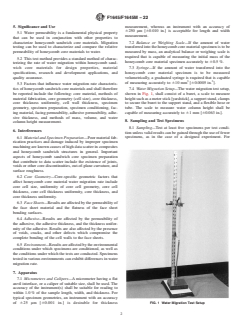
tics of honeycomb sandwich core materials and shall therefore 7.4 Water Migration Setup—The water migration test setup,
be reported include the following: core material, methods of shown in Fig. 1, shall consist of a buret, a scale to measure
material fabrication, core geometry (cell size), core thickness, heightsuchasameterstick[yardstick],asupportstand,clamps
core thickness uniformity, cell wall thickness, specimen to secure the buret to the support stand, and a flexible hose or
geometry, specimen preparation, specimen conditioning, fac- tube. The scale to measure water column height shall be
ing material, facing permeability, adhesive permeability, adhe- capable of measuring accurately to 61mm[60.063 in.].
sive thickness, and methods of mass, volume, and water
8. Sampling and Test Specimens
column height measurement.
8.1 Sampling—Test at least five specimens per test condi-
6. Interferences
tion unless valid results can be gained through the use of fewer
specimens, as in the case of a designed experiment. For
6.1 Material and Specimen Preparation—Poormaterialfab-
rication practices and damage induced by improper specimen
machining are known causes of high data scatter in composites
and honeycomb sandwich structures in general. Important
aspects of honeycomb sandwich core specimen preparation
that contribute to data scatter include the existence of joints,
voids or other core discontinuities, out-of-plane curvature, and
surface roughness.
6.2 Core Geometry—Core-specific geometric factors that
affect honeycomb core material water migration rate include
core cell size, uniformity of core cell geometry, core cell
thickness, core cell thickness uniformity, core thickness, and
core thickness uniformity.
6.3 Face Sheets—Resultsareaffectedbythepermeabilityof
the face sheet material and the flatness of the face sheet
bonding surfaces.
6.4 Adhesive—Results are affected by the permeability of
the adhesive, the adhesive thickness, and the thickness unifor-
mity of the adhesive. Results are also affected by the presence
of voids, cracks, and other defects which compromise the
complete bonding of the cell walls to the face sheets.
6.5 Environment—Resultsareaffectedbytheenvironmental
conditions under which specimens are conditioned, as well as
the conditions under which the tests are conducted. Specimens
tested in various environments can exhibit differences in water
migration rate.
7. Apparatus
7.1 Micrometers and Calipers—A micrometer having a flat
anvil interface, or a caliper of suitable size, shall be used. The
accuracy of the instrument(s) shall be suitable for reading to
within 1.0 % of the sample length, width, and thickness. For
typical specimen geometries, an instrument with an accuracy
of 625 µm [60.001 in.] is desirable for thickness FIG. 1 Water Migration Test Setup
F1645/F1645M − 22
statistically significant data, consult the procedures outlined in 8.2.5 Specimen Preparation for Water Introduction—Ahole
Practice E122. Report the method of sampling. shall be drilled through the upper facing over one centrally
located honeycomb core material cell. The hole shall permit
8.2 Test Specimens:
access of water into only one cell. A suitable connection, such
8.2.1 Core Geometry—Honeycomb core material test speci-
as a tube bonded over or into the hole, shall be provided for the
mens shall have a square or rectangular cross-section. The
application of hydrostatic pressure (see Fig. 2). If the amount
recommended minimum specimen size is 75 mm [3.0 in.] in
of water transferred is monitored by mass, an appropriate seal
length by 75 mm [3.0 in.] in width by 13 mm [0.5 in.] thick.
shall be used to cover the hole, to prevent water loss during
NOTE1—Thehoneycombcorespecimen’scross-sectionisdefinedtobe
weighings.
in the facing plane, in regard to the orientation that the core would be
8.2.6 If honeycomb core material density is to be reported,
placed in a structural sandwich construction. For a honeycomb core, the
then obtain these samples from the same sheet of honeycomb
cross-section is in the plane of the cells, which is perpendicular to the
core material being tested. Density may be evaluated in
orientation of the cell walls.
accordance with Test Method C271/C271M.
8.2.2 Core Preparation and Machining—Prepare the hon-
eycomb core material samples so that the facing plane surfaces 8.3 Labeling—Label the test specimens so that they will be
are parallel to each other and perpendicular to the sides of the distinct from each other and traceable back to the sheet of
core. Take precautions when cutting specimens from large origin, and will neither influence the test nor be affected by it.
sheets of core material to avoid notches, undercuts, rough or
9. Calibration
uneven surfaces due to inappropriate machining methods.
Obtain final dimensions by lubricated precision sawing,
9.1 The accuracy of all measuring equipment shall have
milling, or grinding. The use of diamond tooling has been
certified calibrations that are current at the time of use of the
found to be extremely effective for many material systems.
equipment.
Record and report the honeycomb core material specimen
10. Conditioning
cutting preparation method.
8.2.3 Face Sheets—The honeycomb core material shall be
10.1 The recommended pre-test condition is effective mois-
bonded to impermeable, transparent face sheets which permit
ture equilibrium at a specific relative humidity as established
visual observation into the honeycomb core cells by illumina-
byTest Me
...
This document is not an ASTM standard and is intended only to provide the user of an ASTM standard an indication of what changes have been made to the previous version. Because
it may not be technically possible to adequately depict all changes accurately, ASTM recommends that users consult prior editions as appropriate. In all cases only the current version
of the standard as published by ASTM is to be considered the official document.
Designation: F1645/F1645M − 16 F1645/F1645M − 22
Standard Test Method for
Water Migration in Honeycomb Core Materials
This standard is issued under the fixed designation F1645/F1645M; the number immediately following the designation indicates the year
of original adoption or, in the case of revision, the year of last revision. A number in parentheses indicates the year of last reapproval.
A superscript epsilon (´) indicates an editorial change since the last revision or reapproval.
1. Scope
1.1 This test method covers the determination of water migration in honeycomb core materials.
1.2 Units—The values stated in either SI units or inch-pound units are to be regarded separately as standard. The values stated in
each system mayare not benecessarily exact equivalents; therefore, to ensure conformance with the standard, each system shall be
used independently of the other. Combiningother, and values from the two systems may result in non-conformance with the
standard.shall not be combined.
1.2.1 Within the text, the inch-pound units are shown in brackets.
1.3 This standard does not purport to address all of the safety concerns, if any, associated with its use. It is the responsibility
of the user of this standard to establish appropriate safety safety, health, and healthenvironmental practices and determine the
applicability of regulatory limitations prior to use.
1.4 This international standard was developed in accordance with internationally recognized principles on standardization
established in the Decision on Principles for the Development of International Standards, Guides and Recommendations issued
by the World Trade Organization Technical Barriers to Trade (TBT) Committee.
2. Referenced Documents
2.1 ASTM Standards:
C271/C271M Test Method for Density of Sandwich Core Materials
D883 Terminology Relating to Plastics
D3878 Terminology for Composite Materials
D5229/D5229M Test Method for Moisture Absorption Properties and Equilibrium Conditioning of Polymer Matrix Composite
Materials
E122 Practice for Calculating Sample Size to Estimate, With Specified Precision, the Average for a Characteristic of a Lot or
Process
E177 Practice for Use of the Terms Precision and Bias in ASTM Test Methods
E456 Terminology Relating to Quality and Statistics
3. Terminology
3.1 Definitions—Terminology D3878 defines terms relating to high-modulus fibers and their composites, as well as terms relating
This test method is under the jurisdiction of ASTM Committee D30 on Composite Materials and is the direct responsibility of Subcommittee D30.09 on Sandwich
Construction.
Current edition approved April 1, 2016May 1, 2022. Published May 2016May 2022. Originally approved in 1995. Last previous edition approved in 20122016 as
F1645 – 12.F1645/F1645M – 16. DOI: 10.1520/F1645_F1645M-16. 10.1520/F1645_F1645M-22.
For referenced ASTM standards, visit the ASTM website, www.astm.org, or contact ASTM Customer Service at service@astm.org. For Annual Book of ASTM Standards
volume information, refer to the standard’s Document Summary page on the ASTM website.
Copyright © ASTM International, 100 Barr Harbor Drive, PO Box C700, West Conshohocken, PA 19428-2959. United States
F1645/F1645M − 22
to structural sandwich constructions. Terminology D883 defines terms relating to plastics. Terminology E456 and Practice E177
define terms relating to statistics. In the event of a conflict between terms, Terminology D3878 shall have precedence over the other
terminologies.
3.2 Symbols:
CV = coefficient of variation statistic of a sample population for a given property (in percent),
S = standard deviation statistic of a sample population for a given property,
n-1
x = test result for an individual specimen from the sample population for a given property,
x¯ = mean or average (estimate of mean) of a sample population for a given property,
V = volume of water necessary to fill one core cell,
c
V = volume of water transfused,
f
W = mass of specimen after filling the primary cell with water,
c
W = mass of specimen after water transfusion, and
f
W = mass of specimen after conditioning, prior to water introduction.
i
4. Summary of Test Method
4.1 This test method consists of bonding a honeycomb core material to transparent facings face sheets using a water-resistant
adhesive, drilling an access hole through one facing to an individual core cell, filling the cell with water, subjecting the filled cell
to a constant hydrostatic pressure by maintaining a specified water column height, then measuring the amount of water transferred
into the honeycomb core specimen (primarily due to diffusion through the cell walls) within a 24-h24 h period. The amount of
water transferred is presented as an approximate number of honeycomb core cells filled with water.
5. Significance and Use
5.1 Water permeability is a fundamental physical property that can be used in conjunction with other properties to characterize
honeycomb sandwich core materials. Migration testing can be used to characterize and compare the relative permeability of
honeycomb core materials to water.
5.2 This test method provides a standard method of characterizing the rate of water migration within honeycomb sandwich core
materials for design properties, material specifications, research and development applications, and quality assurance.
5.3 Factors that influence water migration rate characteristics of honeycomb sandwich core materials and shall therefore be
reported include the following: core material, methods of material fabrication, core geometry (cell size), core thickness, core
thickness uniformity, cell wall thickness, specimen geometry, specimen preparation, specimen conditioning, facing material, facing
permeability, adhesive permeability, adhesive thickness, and methods of mass, volume, and water column height measurement.
6. Interferences
6.1 Material and Specimen Preparation—Poor material fabrication practices and damage induced by improper specimen
machining are known causes of high data scatter in composites and honeycomb sandwich structures in general. Important aspects
of honeycomb sandwich core specimen preparation that contribute to data scatter include the existence of joints, voids or other core
discontinuities, out-of-plane curvature, and surface roughness.
6.2 Core Geometry—Core-specific geometric factors that affect honeycomb core material water migration rate include core cell
size, uniformity of core cell geometry, core cell thickness, core cell thickness uniformity, core thickness, and core thickness
uniformity.
6.3 Facings—Face Sheets—Results are affected by the permeability of the facing face sheet material and the flatness of the facing
face sheet bonding surfaces.
6.4 Adhesive—Results are affected by the permeability of the adhesive, the adhesive thickness, and the thickness uniformity of the
adhesive. Results are also affected by the presence of voids, cracks, and other defects which compromise the complete bonding
of the cell walls to the facings.face sheets.
F1645/F1645M − 22
6.5 Environment—Results are affected by the environmental conditions under which specimens are conditioned, as well as the
conditions under which the tests are conducted. Specimens tested in various environments can exhibit differences in water
migration rate.
7. Apparatus
7.1 Micrometers and Calipers—A micrometer having a flat anvil interface, or a caliper of suitable size, shall be used. The accuracy
of the instrument(s) shall be suitable for reading to within 1.0 % of the sample length, width, and thickness. For typical specimen
geometries, an instrument with an accuracy of 625 μm [60.001 in.] is desirable for thickness measurement, whereas an instrument
with an accuracy of 6250 μm [60.010 in.] is acceptable for length and width measurement.
7.2 Balance or Weighing Scale—If the amount of water transferred into the honeycomb core material specimen is to be measured
by mass, an analytical balance or weighing scale is required that is capable of measuring the initial mass of the honeycomb core
material specimen accurately to 60.5 %.
7.3 Syringe—If the amount of water transferred into the honeycomb core material specimen is to be measured volumetrically, a
3 3
graduated syringe is required that is capable of measuring accurately to 610 mm [60.0005 in. ].
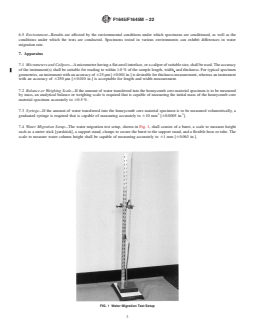
7.4 Water Migration Setup—The water migration test setup, shown in Fig. 1, shall consist of a buret, a scale to measure height
such as a meter stick [yardstick], a support stand, clamps to secure the buret to the support stand, and a flexible hose or tube. The
scale to measure water column height shall be capable of measuring accurately to 61 mm [60.063 in.].
FIG. 1 Water Migration Test Setup
F1645/F1645M − 22
8. Sampling and Test Specimens
8.1 Sampling—Test at least five specimens per test condition unless valid results can be gained through the use of fewer specimens,
as in the case of a designed experiment. For statistically significant data, consult the procedures outlined in Practice E122. Report
the method of sampling.
8.2 Test Specimens:
8.2.1 Core Geometry—Honeycomb core material test specimens shall have a square or rectangular cross-section. The
recommended minimum specimen size is 75 mm [3.0 in.] in length by 75 mm [3.0 in.] in width by 13 mm [0.5 in.] thick.
NOTE 1—The honeycomb core specimen’s cross-section is defined to be in the facing plane, in regard to the orientation that the core would be placed
in a structural sandwich construction. For a honeycomb core, the cross-section is in the plane of the cells, which is perpendicular to the orientation of
the cell walls.
8.2.2 Core Preparation and Machining—Prepare the honeycomb core material samples so that the facing plane surfaces are
parallel to each other and perpendicular to the sides of the core. Take precautions when cutting specimens from large sheets of core
material to avoid notches, undercuts, rough or uneven surfaces due to inappropriate machining methods. Obtain final dimensions
by lubricated precision sawing, milling, or grinding. The use of diamond tooling has been found to be extremely effective for many
material systems. Record and report the honeycomb core material specimen cutting preparation method.
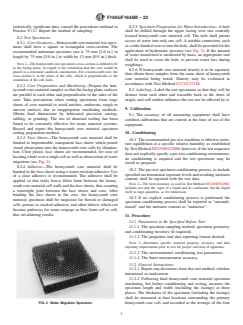
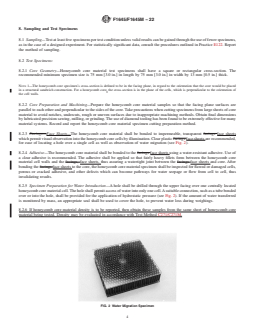
8.2.3 Facings—Face Sheets—The honeycomb core material shall be bonded to impermeable, transparent facings face sheets
which permit visual observation into the honeycomb core cells by illumination. Clear plastic facings face sheets are recommended,
for ease of locating a hole over a single cell as well as observation of water migration (see Fig. 2).
8.2.4 Adhesive—The honeycomb core material shall be bonded to the facings face sheets using a water-resistant adhesive. Use of
a clear adhesive is recommended. The adhesive shall be applied so that fairly heavy fillets form between the honeycomb core
material cell walls and the facings, face sheets, thus assuring a watertight joint between the facings face sheets and core. After
bonding the facings face sheets to the core, the honeycomb core material specimen shall be inspected for flawed or damaged cells,
porous or cracked adhesive, and other defects which can become pathways for water seepage or flow from cell to cell, thus
invalidating results.
8.2.5 Specimen Preparation for Water Introduction—A hole shall be drilled through the upper facing over one centrally located
honeycomb core material cell. The hole shall permit access of water into only one cell. A suitable connection, such as a tube bonded
over or into the hole, shall be provided for the application of hydrostatic pressure (see Fig. 2). If the amount of water transferred
is monitored by mass, a
...