

ASTM D8173-23
(Guide)Standard Guide for Site Preparation, Layout, Installation, and Hydration of Geosynthetic Cementitious Composite Mats
General Information
- Abstract
SIGNIFICANCE AND USE
4.1 This guide identifies proper layout, installation, and hydration procedures along with equipment for use by GCCM designers, inspectors, and installers.
4.2 Applications—Typical GCCM applications may include but are not limited to:
4.2.1 Hydraulic structure armoring or protection, including but not limited to: ditches, swales, canals, flumes, and other similar structures.
4.2.2 Slope protection.
4.2.3 Berm and bund lining and protection.
4.2.4 Culvert invert lining.
4.2.5 Scour protection at culvert inlets and outlets.
4.2.6 Remediation of existing concrete channels and structures.
4.2.7 Lining of outfalls and spillways.
4.2.8 Mow strips or weed suppression.
4.2.9 Lagoons and secondary containment berms (using GCCBs).
SCOPE
1.1 This guide covers directions for the installation of geosynthetic cementitious composite mat (GCCM) materials under field conditions typically present in erosion control, hydraulic structure armoring and protection, and protection applications. This guide also covers directions for the installation of a special category of GCCMs known as geosynthetic cementitious composite barrier (GCCB) materials, under field conditions typically present in geotechnical or civil engineering applications, with the purpose of reducing or preventing the flow of fluid through the construction.
1.2 The values in SI units are to be regarded as the standard. Values in inch-pound units are in parentheses for information.
1.3 This guide contains general guidelines. It is not intended to replace project-specific installation requirements. In the event of a conflict between the two, the requirements of the project specifications will supersede the requirements of this guide.
1.4 This is not an all-inclusive guide, and some projects will be beyond the scope of this guide.
1.5 This standard does not purport to address all of the safety concerns, if any, associated with its use. It is the responsibility of the user of this standard to establish appropriate safety, health, and environmental practices and determine the applicability of regulatory limitations prior to use.
1.6 This international standard was developed in accordance with internationally recognized principles on standardization established in the Decision on Principles for the Development of International Standards, Guides and Recommendations issued by the World Trade Organization Technical Barriers to Trade (TBT) Committee.
- Status
- Published
- Publication Date
- 14-Jul-2023
- Technical Committee
- D35 - Geosynthetics
- Drafting Committee
- D35.05 - Geosynthetic Erosion Control
Buy Documents
ASTM D8173-23 - Standard Guide for Site Preparation, Layout, Installation, and Hydration of Geosynthetic Cementitious Composite Mats
REDLINE ASTM D8173-23 - Standard Guide for Site Preparation, Layout, Installation, and Hydration of Geosynthetic Cementitious Composite Mats
Overview
ASTM D8173-23 is the Standard Guide for Site Preparation, Layout, Installation, and Hydration of Geosynthetic Cementitious Composite Mats (GCCMs). Published by ASTM International, this guide offers best practices for the installation of GCCMs and a special subset, geosynthetic cementitious composite barriers (GCCBs), in a range of civil and geotechnical applications. Its scope covers procedures for installing these versatile erosion control materials under field conditions, emphasizing key considerations for site preparation, deployment, jointing, hydration, and anchoring.
GCCMs provide effective armoring and lining for hydraulic structures and protect against erosion, making them highly valuable in demanding infrastructure projects. The guide is relevant for designers, installers, and inspectors, helping ensure that installation methods preserve the integrity and performance of these advanced composite materials.
Key Topics
Site and Subgrade Preparation: Proper grading, compaction, and cleaning of the subgrade are essential for a durable GCCM installation. The guide covers preparation for soil, concrete, asphalt, and corrugated metal pipe substrates, emphasizing the need for stable and clean surfaces free of debris, vegetation, and voids.
Material Storage and Handling: Recommendations for storing GCCMs in dry conditions and within manufacturer-sealed packaging minimize the risk of premature hydration and damage.
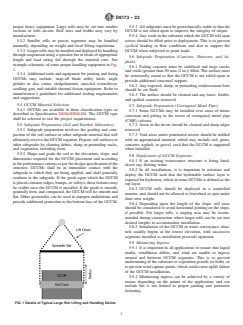
Equipment for Deployment: Guidance includes selection and use of heavy lifting equipment for large GCCM rolls, as well as appropriate manual handling techniques for smaller sections.
Installation Procedures: Details include the proper orientation and placement of GCCMs, methods for securing segments (such as shingled and butt joints), and minimizing the ingress of fluids, debris, or wind.
Jointing and Fastening: The guide explains mechanical and thermal fusion jointing techniques, use of adhesives and sealants, as well as anchoring details for both unjointed edges and rigid structures.
Hydration Practices: Thorough hydration is critical to the development of the GCCM's physical properties. The guide recommends following manufacturer-specific ratios and ensuring adequate saturation under varying site conditions.
Safety and Pre-Construction Coordination: Stresses the importance of safety protocols, pre-construction meetings to clarify responsibilities and procedures, and compliance with project-specific codes and requirements.
Applications
Geosynthetic cementitious composite mats, guided by ASTM D8173-23, are widely used in:
- Hydraulic Structure Armoring: Lining and protecting ditches, swales, canals, and flumes from erosion and fluid flow.
- Slope Protection: Stabilizing and protecting earthen and concrete slopes in infrastructure and landscaping applications.
- Berm and Bund Lining: Providing containment and erosion control for embankments and levees.
- Culvert Invert Lining: Restoring and extending the life of pipe inverts and other culvert structures.
- Scour Protection: Mitigating erosion and washout at inlets and outlets of drainage structures.
- Remediation Projects: Rehabilitating concrete channels, structures, and spillways.
- Weed Suppression and Mow Strips: Suppressing unwanted vegetation and creating durable landscape borders.
- Lagoons and Secondary Containment: Using GCCBs to line and protect fluid containment areas and berms, especially where leak prevention is critical.
These applications highlight the standard's value in civil engineering, public works, environmental protection, and infrastructure maintenance.
Related Standards
- ASTM D8364: Specification for Geosynthetic Cementitious Composite Mat (GCCM) Materials
- ASTM D4439: Terminology for Geosynthetics
- ASTM D4437/D4437M, D5641/D5641M, D5820, D7177/D7177M: Practices for testing and evaluating geomembrane seams
- ACI 306.1: Standard Specification for Cold Weather Concreting
Aligning with these referenced documents ensures installation quality and compatibility with broader geosynthetics practice.
Keywords: GCCM installation, erosion control, hydraulic structure armoring, geosynthetic installation guide, site preparation, jointing techniques, slope protection, ASTM D8173-23, hydration procedures, geosynthetic cementitious composite mats, GCCB, civil engineering standards.
Relations
- Effective Date
- 01-Feb-2024
- Effective Date
- 01-Nov-2023
- Effective Date
- 01-Nov-2023
- Effective Date
- 15-Apr-2018
- Effective Date
- 01-Feb-2018
- Effective Date
- 01-Feb-2018
- Effective Date
- 01-Aug-2017
- Effective Date
- 01-Jul-2016
- Effective Date
- 01-Jul-2016
- Effective Date
- 01-Sep-2015
- Effective Date
- 01-Jul-2015
- Effective Date
- 01-Mar-2014
- Effective Date
- 01-Oct-2011
- Effective Date
- 01-Jun-2011
- Effective Date
- 01-Jun-2006
Buy Documents
ASTM D8173-23 - Standard Guide for Site Preparation, Layout, Installation, and Hydration of Geosynthetic Cementitious Composite Mats
REDLINE ASTM D8173-23 - Standard Guide for Site Preparation, Layout, Installation, and Hydration of Geosynthetic Cementitious Composite Mats
Get Certified
Connect with accredited certification bodies for this standard

DIBt (Deutsches Institut für Bautechnik)
German Institute for Building Technology.
DIN CERTCO
DIN Group product certification.

Aboma Certification B.V.
Specialized in construction, metal, and transport sectors.
Sponsored listings
Frequently Asked Questions
ASTM D8173-23 is a guide published by ASTM International. Its full title is "Standard Guide for Site Preparation, Layout, Installation, and Hydration of Geosynthetic Cementitious Composite Mats". This standard covers: SIGNIFICANCE AND USE 4.1 This guide identifies proper layout, installation, and hydration procedures along with equipment for use by GCCM designers, inspectors, and installers. 4.2 Applications—Typical GCCM applications may include but are not limited to: 4.2.1 Hydraulic structure armoring or protection, including but not limited to: ditches, swales, canals, flumes, and other similar structures. 4.2.2 Slope protection. 4.2.3 Berm and bund lining and protection. 4.2.4 Culvert invert lining. 4.2.5 Scour protection at culvert inlets and outlets. 4.2.6 Remediation of existing concrete channels and structures. 4.2.7 Lining of outfalls and spillways. 4.2.8 Mow strips or weed suppression. 4.2.9 Lagoons and secondary containment berms (using GCCBs). SCOPE 1.1 This guide covers directions for the installation of geosynthetic cementitious composite mat (GCCM) materials under field conditions typically present in erosion control, hydraulic structure armoring and protection, and protection applications. This guide also covers directions for the installation of a special category of GCCMs known as geosynthetic cementitious composite barrier (GCCB) materials, under field conditions typically present in geotechnical or civil engineering applications, with the purpose of reducing or preventing the flow of fluid through the construction. 1.2 The values in SI units are to be regarded as the standard. Values in inch-pound units are in parentheses for information. 1.3 This guide contains general guidelines. It is not intended to replace project-specific installation requirements. In the event of a conflict between the two, the requirements of the project specifications will supersede the requirements of this guide. 1.4 This is not an all-inclusive guide, and some projects will be beyond the scope of this guide. 1.5 This standard does not purport to address all of the safety concerns, if any, associated with its use. It is the responsibility of the user of this standard to establish appropriate safety, health, and environmental practices and determine the applicability of regulatory limitations prior to use. 1.6 This international standard was developed in accordance with internationally recognized principles on standardization established in the Decision on Principles for the Development of International Standards, Guides and Recommendations issued by the World Trade Organization Technical Barriers to Trade (TBT) Committee.
SIGNIFICANCE AND USE 4.1 This guide identifies proper layout, installation, and hydration procedures along with equipment for use by GCCM designers, inspectors, and installers. 4.2 Applications—Typical GCCM applications may include but are not limited to: 4.2.1 Hydraulic structure armoring or protection, including but not limited to: ditches, swales, canals, flumes, and other similar structures. 4.2.2 Slope protection. 4.2.3 Berm and bund lining and protection. 4.2.4 Culvert invert lining. 4.2.5 Scour protection at culvert inlets and outlets. 4.2.6 Remediation of existing concrete channels and structures. 4.2.7 Lining of outfalls and spillways. 4.2.8 Mow strips or weed suppression. 4.2.9 Lagoons and secondary containment berms (using GCCBs). SCOPE 1.1 This guide covers directions for the installation of geosynthetic cementitious composite mat (GCCM) materials under field conditions typically present in erosion control, hydraulic structure armoring and protection, and protection applications. This guide also covers directions for the installation of a special category of GCCMs known as geosynthetic cementitious composite barrier (GCCB) materials, under field conditions typically present in geotechnical or civil engineering applications, with the purpose of reducing or preventing the flow of fluid through the construction. 1.2 The values in SI units are to be regarded as the standard. Values in inch-pound units are in parentheses for information. 1.3 This guide contains general guidelines. It is not intended to replace project-specific installation requirements. In the event of a conflict between the two, the requirements of the project specifications will supersede the requirements of this guide. 1.4 This is not an all-inclusive guide, and some projects will be beyond the scope of this guide. 1.5 This standard does not purport to address all of the safety concerns, if any, associated with its use. It is the responsibility of the user of this standard to establish appropriate safety, health, and environmental practices and determine the applicability of regulatory limitations prior to use. 1.6 This international standard was developed in accordance with internationally recognized principles on standardization established in the Decision on Principles for the Development of International Standards, Guides and Recommendations issued by the World Trade Organization Technical Barriers to Trade (TBT) Committee.
ASTM D8173-23 is classified under the following ICS (International Classification for Standards) categories: 91.100.99 - Other construction materials. The ICS classification helps identify the subject area and facilitates finding related standards.
ASTM D8173-23 has the following relationships with other standards: It is inter standard links to ASTM D4439-24, ASTM D5820-95(2023), ASTM D4437/D4437M-16(2023), ASTM D4439-18, ASTM D4437/D4437M-16(2018), ASTM D5820-95(2018), ASTM D4439-17, ASTM D4437/D4437M-16, ASTM D5641/D5641M-16, ASTM D4439-15a, ASTM D4439-15, ASTM D4439-14, ASTM D4439-11, ASTM D5820-95(2011), ASTM D5820-95(2006). Understanding these relationships helps ensure you are using the most current and applicable version of the standard.
ASTM D8173-23 is available in PDF format for immediate download after purchase. The document can be added to your cart and obtained through the secure checkout process. Digital delivery ensures instant access to the complete standard document.
Standards Content (Sample)
This international standard was developed in accordance with internationally recognized principles on standardization established in the Decision on Principles for the
Development of International Standards, Guides and Recommendations issued by the World Trade Organization Technical Barriers to Trade (TBT) Committee.
Designation: D8173 − 23
Standard Guide for
Site Preparation, Layout, Installation, and Hydration of
Geosynthetic Cementitious Composite Mats
This standard is issued under the fixed designation D8173; the number immediately following the designation indicates the year of
original adoption or, in the case of revision, the year of last revision. A number in parentheses indicates the year of last reapproval. A
superscript epsilon (´) indicates an editorial change since the last revision or reapproval.
1. Scope 2. Referenced Documents
1.1 This guide covers directions for the installation of 2.1 ASTM Standards:
geosynthetic cementitious composite mat (GCCM) materials D4437/D4437M Practice for Nondestructive Testing (NDT)
under field conditions typically present in erosion control, for Determining the Integrity of Seams Used in Joining
hydraulic structure armoring and protection, and protection Flexible Polymeric Sheet Geomembranes
applications. This guide also covers directions for the installa- D4439 Terminology for Geosynthetics
tion of a special category of GCCMs known as geosynthetic D5641/D5641M Practice for Geomembrane Seam Evalua-
cementitious composite barrier (GCCB) materials, under field tion by Vacuum Chamber
conditions typically present in geotechnical or civil engineer- D5820 Practice for Pressurized Air Channel Evaluation of
ing applications, with the purpose of reducing or preventing the Dual-Seamed Geomembranes
flow of fluid through the construction. D7177/D7177M Specification for Air Channel Evaluation of
Polyvinyl Chloride (PVC) Dual Track Seamed Geomem-
1.2 The values in SI units are to be regarded as the standard.
branes
Values in inch-pound units are in parentheses for information.
D8364/D8364M Specification for Geosynthetic Cementi-
1.3 This guide contains general guidelines. It is not intended
tious Composite Mat (GCCM) Materials
to replace project-specific installation requirements. In the
2.2 American Concrete Institute Standard:
event of a conflict between the two, the requirements of the
ACI 306.1 Standard Specification for Cold Weather Concret-
project specifications will supersede the requirements of this
ing
guide.
2.3 Further information is available on the various GCCMs
1.4 This is not an all-inclusive guide, and some projects will from their manufacturers. Individual GCCM manufacturer’s
recommendations may be more detailed with regards to spe-
be beyond the scope of this guide.
cific applications or details than the information found in this
1.5 This standard does not purport to address all of the
standard, and should be consulted prior to undertaking any
safety concerns, if any, associated with its use. It is the
installation.
responsibility of the user of this standard to establish appro-
priate safety, health, and environmental practices and deter-
3. Terminology
mine the applicability of regulatory limitations prior to use.
3.1 Definitions:
1.6 This international standard was developed in accor-
3.1.1 geosynthetic cementitious composite barrier (GCCB),
dance with internationally recognized principles on standard-
n—a composite material consisting of a geosynthetic barrier
ization established in the Decision on Principles for the
bonded to an integral GCCM protective cover layer. The
Development of International Standards, Guides and Recom-
geosynthetic barrier component of adjacent material must be
mendations issued by the World Trade Organization Technical
seamed to reduce or prevent the flow of fluid through the
Barriers to Trade (TBT) Committee.
construction.
1 2
This guide is under the jurisdiction of ASTM Committee D35 on Geosynthetics For referenced ASTM standards, visit the ASTM website, www.astm.org, or
and is the direct responsibility of Subcommittee D35.05 on Geosynthetic Erosion contact ASTM Customer Service at service@astm.org. For Annual Book of ASTM
Control. Standards volume information, refer to the standard’s Document Summary page on
Current edition approved July 15, 2023. Published July 2023. Originally the ASTM website.
approved in 2018. Last previous edition approved in 2018 as D8173 – 18. DOI: Available from American Concrete Institute (ACI), 38800 Country Club Dr.,
10.1520/D8173-23. Farmington Hills, MI 48331-3439, http://www.concrete.org.
Copyright © ASTM International, 100 Barr Harbor Drive, PO Box C700, West Conshohocken, PA 19428-2959. United States
D8173 − 23
3.1.1.1 Discussion—The terms geosynthetic barrier, 5. Procedure
GCCM, and seam are defined in Terminology D4439.
5.1 Pre-Construction Meeting and Safety:
3.1.2 hydration, n—in a GCCM installation, exposure of the
5.1.1 The methods and equipment used for the placement of
GCCM, in this case, to water in prescribed conditions for a
GCCMs can vary, but the primary objective of the process is to
prescribed time.
minimize damage and maximize performance. For optimum
performance, the GCCM must be installed in a manner that
3.1.3 layer, n—in a GCCM installation, the distinct material
does not negatively impact its physical, mechanical, or hydrau-
components of which a segment of GCCM material is com-
lic properties.
posed.
5.1.2 All applicable project safety requirements should be
3.1.4 longitudinal layup, n—in a GCCM installation, a
observed. Prior to handling any GCCM, the manufacturer’s
deployed position of the GCCM where the material is deployed
Safety Data Sheet (SDS) should be read and understood.
in line with the greater length of the structure being lined (that
5.1.3 With most projects, the construction means and meth-
is, along the length of a channel).
ods are the responsibility of the installation contractor.
3.1.5 segment, n—in a GCCM installation, an individual
However, pre-construction meetings between the owner or
strip or section of GCCM material.
their representative, the contractor, the GCCM manufacturing
3.1.6 shingled joint, n—in a GCCM, a connection method of representative, or other parties should be held prior to instal-
two separate segments of GCCM where a length of one lation of the GCCM material.
segment overlaps on top of an adjacent segment.
5.1.4 This meeting shall cover details of (at a minimum):
5.1.4.1 GCCM application purpose and objectives.
3.1.7 transverse layup, n—in a GCCM installation, a de-
5.1.4.2 Review of installation procedures.
ployed position of the GCCM where the material is deployed
transverse to the greater length of the structure being lined (that 5.1.4.3 Provisions for heavy lifting equipment needed for
is, across the width of a channel). handling and installing GCCM rolls that are too large for
manual lifting, based on local requirements for manual labor.
3.1.8 unjointed edge, n—in a GCCM installation, an edge of
5.1.4.4 Clear understanding of each party’s responsibilities
the segment of GCCM that is not secured within an anchor
and authority.
trench or sufficiently fixed to provide immediate contact
5.1.4.5 Availability of required ancillaries which can in-
between the segment and substrate and to minimize ingress.
clude screws, connectors, ground pegs, and adhesives to be
Sometimes referred to as “free ends.”
used.
3.1.9 welding strip, n—in a GCCB installation, an unpro-
5.1.4.6 Understanding the jointing of the GCCM segments
tected edge of the geosynthetic barrier to facilitate thermal
when connecting to appurtenant structures, concrete slabs,
fusion weld jointing of GCCB layers. The welding strip may be
curbs, soil surface, etc.
formed by separating the geosynthetic barrier and GCCM to
5.1.4.7 Agreed-upon time estimates for installing, then hy-
form an open edge; alternatively, the welding strip may extend
drating for each day.
beyond the protective GCCM layer.
5.1.4.8 Provisions for hydration water source, both required
3.2 For definitions of additional terms used in this standard,
volume and hydration procedure for determining if the GCCM
refer to Terminology D4439.
is completely hydrated.
5.1.5 Prior to deployment, the entire fabrication and instal-
4. Significance and Use
lation procedures shall be reviewed and accepted by all parties.
4.1 This guide identifies proper layout, installation, and
5.2 GCCM Storage at Installation Site:
hydration procedures along with equipment for use by GCCM
5.2.1 GCCMs harden when exposed to water, and therefore
designers, inspectors, and installers.
should be properly stored to prevent exposure to water and
4.2 Applications—Typical GCCM applications may include moisture prior to the desired installation.
but are not limited to:
5.2.2 GCCMs should be stored under cover in dry condi-
4.2.1 Hydraulic structure armoring or protection, including tions away from direct sunlight and, if possible, in the
but not limited to: ditches, swales, canals, flumes, and other manufacturer’s sealed packaging.
similar structures.
5.2.3 For some GCCMs, it is not recommended to store in
4.2.2 Slope protection. shipping containers in direct sunlight where temperatures may
exceed 40 °C (100 °F) for prolonged periods of time.
4.2.3 Berm and bund lining and protection.
5.2.4 Once the manufacturer’s original sealed packing is
4.2.4 Culvert invert lining.
opened, the material should be deployed shortly thereafter (that
4.2.5 Scour protection at culvert inlets and outlets.
is, within 24 h); if there is leftover material, the leftover
4.2.6 Remediation of existing concrete channels and struc-
material is returned to a sealed package daily or other airtight
tures.
packaging around the roll.
4.2.7 Lining of outfalls and spillways.
4.2.8 Mow strips or weed suppression. 5.3 Installation Equipment:
4.2.9 Lagoons and secondary containment berms (using 5.3.1 Several means of handling and deploying the GCCM
GCCBs). rolls are possible. Typically, large rolls may be deployed with
D8173 − 23
proper heavy equipment. Large rolls may be cut into smaller 5.5.3 All subgrades must be geotechnically stable so that the
sections or rolls on-site. Roll sizes and widths may vary by GCCM is not relied upon to improve the integrity of slopes.
manufacturer. 5.5.4 Any voids in the substrate which the GCCM will span
5.3.2 Smaller rolls or precut segments may be handled across should be filled prior to deployment. This is to prevent
manually, depending on weight and local lifting regulations. cyclical loading in flow conditions and also to support the
5.3.3 Larger rolls may be handled and deployed by handling GCCM when subjected to point loads.
through suspension using a spreader bar or beam of appropriate
5.6 Subgrade Preparation (Concrete, Shotcrete, and As-
length and load rating fed through the material core. See
phalt):
example schematic of some proper handling equipment in Fig.
5.6.1 Failing concrete must be stabilized and large cracks
1.
and voids (greater than 50 mm (2 in.)) filled. The surface must
5.3.4 Additional tools and equipment for jointing and fixing
be structurally sound so that the GCCM is not relied upon to
GCCMs may include: snap-off blade utility knife, angle
provide additional structural support.
grinder or disc cutter, sledgehammer, auto-fed screwdriver,
5.6.2 Any exposed, sharp, or protruding reinforcement bars
caulking gun, and suitable thermal fusion equipment. Refer to
should be cut flush.
manufacturer’s guidelines for additional tooling requirements
5.6.3 The surface should be cleaned and any loose, friable,
and suggestions.
and spalled concrete removed.
5.4 GCCM Material Selection:
5.7 Subgrade Preparation (Corrugated Metal Pipe):
5.4.1 GCCMs are available in three classification types as
5.7.1 Some GCCMs may be installed over areas of minor
described in Specification D8364/D8364M. The GCCM type
corrosion and pitting in the invert of corrugated metal pipe
shall be selected to suit the project requirements.
(CMP) culverts.
5.5 Subgrade Preparation (Soil and Earthen Substrates): 5.7.2 Areas in the invert should be cleaned and sharp edges
5.5.1 Subgrade preparation involves the grading and com- removed.
paction of the soil surface or other subgrade material that will 5.7.3 Void areas under penetrated inverts should be infilled
ultimately receive the GCCM segment. Prepare soil surfaces or with an appropriated material, which may include soil, grout,
other subgrades by clearing debris, sharp or protruding rocks, concrete, asphalt, or gravel, such that the GCCM is supported
and vegetation, including roots. when installed.
5.5.2 Shape and grade the soil to the elevations, slope, and
5.8 Deployment of GCCM Segments:
dimensions required for the GCCM placement and according
5.8.1 If an existing watercourse structure is being lined,
to the performance criteria as per the design specification of the
divert any flowing water.
structure. GCCMs shall be in immediate contact with the
5.8.2 In all installations, it is important to orientate and
subgrade to which they are being applied, and shall generally
deploy the GCCM such that the hydratable surface layer is
conform to the subgrade. If the grade upon which the GCCM
exposed for hydration, which in some GCCMs is defined as the
is placed contains ridges, bumps, or valleys, these features may
top layer.
be visible once the GCCM is installed. If the grade is smooth,
5.8.3 GCCM rolls should be deployed in a controlled
generally firm, and compacted, the GCCM will lie smooth and
manner, and should not be allowed to freewheel or spin under
flat. Other geotextiles can be used to dampen undulations and
their own weight.
provide additional protection to the bottom face of the GCCM.
5.8.4 Depending upon the length of the slope, roll sizes
should be considered to avoid horizontal jointing on the slope,
if possible. For larger rolls, a staging area may be recom-
mended during construction where larger rolls can be cut into
desired lengths to accommodate installation.
5.8.5 Installation of the GCCM in water conveyance chan-
nels usually begins at the lowest elevation, with successive
segments installed as installation proceeds upstream.
5.9 Minimizing Ingress:
5.9.1 It is important in all applications to ensure that liquid
media, windblown debris, and wind are unable to ingress
around and between GCCM segments. This is to prevent
undermining of the substrate or vegetation growth (or both), or
to prevent wind capture points, which could cause uplift failure
of the GCCM installations.
5.9.2 Minimizing ingress can be achieved by a variety of
means depending on the nature of the application, and can
include but is not limited to proper jointing and perimeter
fastening.
FIG. 1 Details of Typical Large Roll Lifting and Handling Device
D8173 − 23
5.10 Jointing:
5.10.1 Proper jointing effectively creates a continuous struc-
ture from the individual segments, which may aid in securing
the GCCM to the substrate. It is important to ensure that the
jointed GCCM is fixed sufficiently to ensure intimate contact
between the two GCCM segments.
5.10.2 Jointing of GCCMs:
5.10.2.1 Layers of GCCM materials sh
...
This document is not an ASTM standard and is intended only to provide the user of an ASTM standard an indication of what changes have been made to the previous version. Because
it may not be technically possible to adequately depict all changes accurately, ASTM recommends that users consult prior editions as appropriate. In all cases only the current version
of the standard as published by ASTM is to be considered the official document.
Designation: D8173 − 18 D8173 − 23
Standard Guide for
Site Preparation, Layout, Installation, and Hydration of
Geosynthetic Cementitious Composite Mats
This standard is issued under the fixed designation D8173; the number immediately following the designation indicates the year of
original adoption or, in the case of revision, the year of last revision. A number in parentheses indicates the year of last reapproval. A
superscript epsilon (´) indicates an editorial change since the last revision or reapproval.
1. Scope
1.1 This guide covers directions for the installation of a geosynthetic cementitious composite mat (GCCM) materials under field
conditions typically present in erosion control, hydraulic structure armoring and protection, and protection applications. This guide
also covers directions for the installation of a special category of GCCMs known as geosynthetic cementitious composite barrier
(GCCB) materials, under field conditions typically present in geotechnical or civil engineering applications, with the purpose of
reducing or preventing the flow of fluid through the construction.
1.2 The values in SI units are to be regarded as the standard. Values in inch-pound units are in parentheses for information.
1.3 This guide contains general guidelines. It is not intended to replace project-specific installation requirements. In the event of
a conflict between the two, the requirements of the project specifications will supersede the requirements of this guide.
1.4 This is not an all-inclusive guide, and some projects will be beyond the scope of this guide.
1.5 This standard does not purport to address all of the safety concerns, if any, associated with its use. It is the responsibility
of the user of this standard to establish appropriate safety, health, and environmental practices and determine the applicability of
regulatory limitations prior to use.
1.6 This international standard was developed in accordance with internationally recognized principles on standardization
established in the Decision on Principles for the Development of International Standards, Guides and Recommendations issued
by the World Trade Organization Technical Barriers to Trade (TBT) Committee.
2. Referenced Documents
2.1 ASTM Standards:
D4437/D4437M Practice for Nondestructive Testing (NDT) for Determining the Integrity of Seams Used in Joining Flexible
Polymeric Sheet Geomembranes
D4439 Terminology for Geosynthetics
D5641/D5641M Practice for Geomembrane Seam Evaluation by Vacuum Chamber
D5820 Practice for Pressurized Air Channel Evaluation of Dual-Seamed Geomembranes
D7177/D7177M Specification for Air Channel Evaluation of Polyvinyl Chloride (PVC) Dual Track Seamed Geomembranes
D8364/D8364M Specification for Geosynthetic Cementitious Composite Mat (GCCM) Materials
This guide is under the jurisdiction of ASTM Committee D35 on Geosynthetics and is the direct responsibility of Subcommittee D35.05 on Geosynthetic Erosion Control.
Current edition approved Feb. 1, 2018July 15, 2023. Published February 2018July 2023. Originally approved in 2018. Last previous edition approved in 2018 as
D8173 – 18. DOI: 10.1520/D8173-18.10.1520/D8173-23.
For referenced ASTM standards, visit the ASTM website, www.astm.org, or contact ASTM Customer Service at service@astm.org. For Annual Book of ASTM Standards
volume information, refer to the standard’s Document Summary page on the ASTM website.
Copyright © ASTM International, 100 Barr Harbor Drive, PO Box C700, West Conshohocken, PA 19428-2959. United States
D8173 − 23
2.2 American Concrete Institute Standard:
ACI 306.1 Standard Specification for Cold Weather Concreting
2.3 Further information is available on the various GCCMs from their manufacturers. Individual GCCM manufacturer’s
recommendations may be more detailed with regards to specific applications or details than the information found in this standard,
and should be consulted prior to undertaking any installation.
3. Terminology
3.1 Definitions:
3.1.1 bottom layer flap, geosynthetic cementitious composite barrier (GCCB), n—in a GCCM installation,a composite material
consisting of a geosynthetic barrier bonded to an integral GCCM protective a section of the bottom layer that extends beyond the
top layer.cover layer. The geosynthetic barrier component of adjacent material must be seamed to reduce or prevent the flow of
fluid through the construction.
3.1.1.1 Discussion—
The terms geosynthetic barrier,GCCM, and seam are defined in Terminology D4439.
3.1.2 butt joint, n—in a GCCM installation, a connection of two separate segments of GCCM where the edges of each segment
of GCCM are touching and generally in the same plane and may be sealed with a bottom layer flap.
3.1.2 hydration, n—in a GCCM installation, exposure of the GCCM, in this case, to water in prescribed conditions for a prescribed
time.
3.1.3 layer, n—in a GCCM installation, the distinct material components of which a segment of GCCM material is composed.
3.1.4 longitudinal layup, n—in a GCCM installation, a deployed position of the GCCM where the material is deployed in line with
the greater length of the structure being lined (that is, along the length of a channel).
3.1.5 segment, n—in a GCCM installation, an individual strip or section of GCCM material.
3.1.6 shingled joint, n—in a GCCM, a connection method of two separate segments of GCCM where a length of one segment
overlaps on top of an adjacent segment.
3.1.7 transverse layup, n—in a GCCM installation, a deployed position of the GCCM where the material is deployed transverse
to the greater length of the structure being lined (that is, across the width of a channel).
3.1.8 unjointed edge, n—in a GCCM installation, an edge of the segment of GCCM that is not secured within an anchor trench
or sufficiently fixed to provide immediate contact between the segment and substrate and to minimize ingress. Sometimes referred
to as “free ends.”
3.1.9 welding strip, n—in a GCCB installation, an unprotected edge of the geosynthetic barrier to facilitate thermal fusion weld
jointing of GCCB layers. The welding strip may be formed by separating the geosynthetic barrier and GCCM to form an open
edge; alternatively, the welding strip may extend beyond the protective GCCM layer.
3.2 For definitions of additional terms used in this standard, refer to Terminology D4439.
4. Significance and Use
4.1 This guide identifies proper layout, installation, and hydration procedures along with equipment for use by GCCM designers,
inspectors, and installers.
4.2 Applications—Typical GCCM applications may include but are not limited to:
Available from American Concrete Institute (ACI), 38800 Country Club Dr., Farmington Hills, MI 48331-3439, http://www.concrete.org.
D8173 − 23
4.2.1 Hydraulic structure armoring or protection, including but not limited to: ditches, swales, canals, flumes, and other similar
structures.
4.2.2 Slope protection.
4.2.3 Berm and bund lining and protection.
4.2.4 Culvert invert lining.
4.2.5 Scour protection at culvert inlets and outlets.
4.2.6 Remediation of existing concrete channels and structures.
4.2.7 Lining of outfalls and spillways.
4.2.8 Mow strips or weed suppression.
4.2.9 Lagoons and secondary containment berms (using GCCBs).
5. Procedure
5.1 Pre-Construction Meeting and Safety:
5.1.1 The methods and equipment used for the placement of GCCMs can vary, but the primary objective of the process is to
minimize damage and maximize performance. For optimum performance, the GCCM must be installed in a manner that does not
negatively impact its physical, mechanical, or hydraulic properties.
5.1.2 All applicable project safety requirements should be observed. Prior to handling any GCCM, the manufacturer’s Safety Data
Sheet (SDS) should be read and understood.
5.1.3 With most projects, the construction means and methods are the responsibility of the installation contractor. However,
pre-construction meetings between the owner or their representative, the contractor, the GCCM manufacturing representative, or
other parties should be held prior to installation of the GCCM material.
5.1.4 This meeting shall cover details of (at a minimum):
5.1.4.1 GCCM application purpose and objectives.
5.1.4.2 Review of installation procedures.
5.1.4.3 Provisions for heavy lifting equipment needed for handling and installing GCCM rolls that are too large for manual lifting,
based on local requirements for manual labor.
5.1.4.4 Clear understanding of each party’s responsibilities and authority.
5.1.4.5 Availability of required ancillaries which can include screws, connectors, ground pegs, and adhesives to be used.
5.1.4.6 Understanding the jointing of the GCCM segments when connecting to appurtenant structures, concrete slabs, curbs, soil
surface, etc.
5.1.4.7 Agreed-upon time estimates for installing, then hydrating for each day.
5.1.4.8 Provisions for hydration water source, both required volume and hydration procedure for determining if the GCCM is
completely hydrated.
5.1.5 Prior to deployment, the entire fabrication and installation procedures shall be reviewed and accepted by all parties.
D8173 − 23
5.2 GCCM Storage at Installation Site:
5.2.1 GCCMs harden when exposed to water, and therefore should be properly stored to prevent exposure to water and moisture
prior to the desired installation.
5.2.2 GCCMs should be stored under cover in dry conditions away from direct sunlight and, if possible, in the manufacturer’s
sealed packaging.
5.2.3 For some GCCMs, it is not recommended to store in shipping containers in direct sunlight where temperatures may exceed
40 °C (100 °F) for prolonged periods of time.
5.2.4 Once the manufacturer’s original sealed packing is opened, the material should be deployed shortly thereafter (that is, within
24 h); if there is leftover material, the leftover material is returned to a sealed package daily or other airtight packaging around the
roll.
5.3 Installation Equipment:
5.3.1 Several means of handling and deploying the GCCM rolls are possible. Typically, large rolls may be deployed with proper
heavy equipment. Large rolls may be cut into smaller sections or rolls on-site. Roll sizes and widths may vary by manufacturer.
5.3.2 Smaller rolls or precut segments may be handled manually, depending on weight and local lifting regulations.
5.3.3 Larger rolls may be handled and deployed by handling through suspension using a spreader bar or beam of appropriate length
and load rating fed through the material core. See example schematic of some proper handling equipment in Fig. 1.
5.3.4 Additional tools and equipment for jointing and fixing GCCMs may include: snap-off blade utility knife, angle grinder or
disc cutter, sledgehammer, power-actuated nail gun, auto-fed screw driver, and caulking gun. auto-fed screwdriver, caulking gun,
and suitable thermal fusion equipment. Refer to manufacturer’s guidelines for additional tooling requirements and suggestions.
FIG. 1 Details of Typical Large Roll Lifting and Handling Device
D8173 − 23
5.4 GCCM Material Selection:
5.4.1 GCCMs are available in different thicknesses and grades. Consult manufacturer’s recommendationsthree classification types
as described in Specification D8364/D8364Mon the shear and strength requirements of various applications and specify an
appropriate thickness for project requirements. Considerations include but are not limited to: flow rates, shear, traffic concerns,
subgrade, soil heaving, wind uplift, abrasion, and other factors including:. The GCCM type shall be selected to suit the project
requirements.
5.4.1.1 Thin GCCMs, typically less than 8 mm (0.32 in.) in thickness, may be adequate for noncritical erosion protection or
remediation and non-trafficked slope protection. Thicker GCCMs, typically larger than 8 mm (0.32 in.) in thickness, may be used
for more robust protection applications. GCCM rolls are available in various thicknesses, widths, lengths, and weights by
manufacturer. Proper handling equipment with proper load ratings should be used. Refer to GCCM manufacturer’s specifications
for details.
5.4.1.2 Typically, GCCMs have a proper orientation to allow for hydration; the proper surface should be placed face up to allow
for this hydration. With some GCCMs, the top layer dissolves on hydration.
5.4.1.3 GCCM materials may have a bottom layer flap or other attachment mechanism which is designed for improving attachment
and jointing.
5.5 Subgrade Preparation (Soil and Earthen Substrates):
5.5.1 Subgrade preparation involves the grading and compaction of the soil surface or other subgrade material that will ultimately
receive the GCCM segment. Prepare soil surfaces or other subgrades by clearing debris, sharp or protruding rocks, and vegetation,
including roots.
5.5.2 Shape and grade the soil to the elevations, slope, and dimensions required for the GCCM placement and according to the
performance criteria as per the design specification of the structure. GCCMs shall be in immediate contact with the subgrade to
which they are being applied, and shall generally conform to the subgrade. If the grade upon which the GCCM is placed contains
ridges, bumps, or valleys, these features may be visible once the GCCM is installed. If the grade is smooth, generally firm, and
compacted, the GCCM will lie smooth and flat. Other geotextiles can be used to dampen undulations and provide additional
protection to the bottom face of the GCCM.
5.5.3 All subgrades must be geotechnically stable so that the GCCM is not relied upon to improve the integrity of slopes.
5.5.4 Any voids in the substrate which the GCCM will span across should be filled prior to deployment. This is to prevent cyclical
loading in flow conditions and also to support the GCCM when subjected to point loads.
5.6 Unjointed Edge Treatments and Anchor Trenches:
5.6.1 It is important to install the GCCM in such a way that prevents or minimizes the potential for undermining of the subgrade.
This is especially true in channel armoring and protections applications, or where the GCCM is designed to transport/contain
liquids, or both.
5.6.2 All unjointed edges (leading, trailing, toe, and crest) should be properly installed with an anchor trench, or fixed
mechanically, or sealed in such a way that liquid, wind, or both cannot ingress. Consult Fig. 2 for examples of anchor trenches
used on GCCM deployment on a slope. Some slope applications require backfill compaction.
5.6.3 Anchor trenches may vary in depth depending upon project conditions including soils, hydraulics, subgrade strength,
differential settlement, installation techniques, and the recommendation of the design engineer.
5.6.4 Dig anchor trenches before deployment of the GCCM. This will facilitate the process of placing the GCCM quickly and
neatly, and provides a footprint of the total GCCM area to be covered. Following hydration of the GCCM within the anchor trench,
the trench should then be backfilled and compacted.
D8173 − 23
5.6.5 Any voids in the substrate which the GCCM will span across should be filled prior to deployment. This is to prevent cyclical
loading in flow conditions and also to support the GCCM when subjected to point loads.
5.6 Subgrade Preparation (Concrete, Shotcrete, and Asphalt):
5.6.1 Failing concrete must be stabilized and large cracks and voids filled.(greater than 50 mm (2 in.)) filled. The surface must
be structurally sound so that the GCCM is not relied upon to provide additional structural support.
5.6.2 Any exposed, sharp, or protruding reinforcement bars should be cut flush.
5.6.3 The surface should be cleaned and any loose, friable, and spalled concrete removed.
5.7 Subgrade Preparation (Corrugated Metal Pipe):
5.7.1 Some GCCMs may be installed over areas of minor corrosion and pitting in the invert of corrugated metal pipe (CMP)
culverts.
5.7.2 Areas in the invert should be cleaned and sharp edges removed.
5.7.3 Void areas under penetrated inverts should be infilled with an appropriated material, which may include soil, grout, concrete,
asphalt, or gravel, such that the GCCM is supported when installed.
5.8 Deployment of GCCM Segments:
5.8.1 If an existing watercourse structure is being lined, divert any flowing water.
5.8.2 In all installations, it is important to orientate and deploy the GCCM such that the proper hydratable surface layer is exposed
for hydration, which in some GCCMs is defined as the top layer.
5.8.3 GCCM rolls should be deployed in a controlled manner, and should not be allowed to freewheel or spin under their own
weight.
5.8.4 Depending upon the length of the slope, roll sizes should be considered to avoid horizontal jointing inon the slope, if
possible. For larger rolls, a staging area may be recommended during construction where larger rolls can be cut into desired lengths
to accommodate installation.
5.8.5 Installation of the GCCM in water conveyance channels usually begins at the lowest elevation, with successive segments
installed as installation proceeds upstream.
5.9 Minimizing Ingress:
5.9.1 It is important in all applications to ensure that liquid media, windblown debris, and wind are unable to ingress around and
between GCCM segments. This is to prevent undermining of the substrate or vegetation growth (or both), or to prevent wind
capture points, which could cause uplift failure of the GCCM installations.
5.9.2 Minimizing ingress can be achieved by a variety of means depending on the nature of the application, and can include but
is not limited to proper jointing and perimeter fastening.
D8173 − 23
5.10 Jointing:
5.10.1 Proper jointing effectively creates a continuous structure from the individual segments, which may aid in securing the
GCCM to the substrate. It is important to ensure that the jointed GCCM is fixed sufficiently to ensure intimate contact between
the two GCCM segments.
5.10.2 Layers of GCCM materials should be jointed (shingled or butted) to minimize ingress between adjacent layers.Jointing of
GCCMs:
5.10.2.1 Layers of GCCM materials shall be shingled to minimize ingress between adjacent layers.
5.10.2.2 Segments shall be placed in a shingled joint either longitudinal or transverse to the direction of the flow, depending on
project dimensions. Fig. 2 illustrates an example of proper shingling. Figs. 3 and 4 demonstrate longitudinal and transverse layups
of GCCM in a ditching application.
5.10.2.3 All shingled joints should be positioned from upstream to downstream end, and the angle of grading should be such to
avoid pooling of water or other liquids at the slightly raised overlap.
5.10.2.4 In many applications, a shingled joint is sufficient to minimize ingress of flow, but segments should be secured together
by fastening or thermal fusion to form continuous contact and to reduce the potential for vegetation growth.
5.10.3 Shingle Fastened GCCM Joints:
5.10.2.1 Segments may be placed in a shingled joint either longitudinal or transverse to the direction of the flow, depending on
project dimensions. Fig. 3 illustrates an example of proper shingling. Figs. 4 and 5 demonstrate longitudinal and transverse layups
of GCCM in a ditching application.
5.10.2.2 In many applications, a shingled joint is sufficient to minimize ingress of flow.
5.10.3.1 In addition, some shingled joints may use 25-mm (1-in.)Shingled joints can be fastened using stainless steel screws or
screws with a corrosion-resistant coating, or other corrosion-resistant fasteners acceptable to the project engineer as a mechanical
fastener, with spacing engineer, with a typical spacing of 100 to 200 mm (4 to 8 in.), or determined by the project engineer based
on project-specific conditions which may include hydraulic loadings, soil heaving, and wind uplift. Consult manufacturer’s
recommendations on minimum screw spacing and fixing specification.
5.10.2.4 All shingled joints should be positioned from upstream to downstream end, and the angle of grading should be such to
avoid pooling of water or other liquids at the slightly raised overlap.
5.10.2.5 Stainless steel screws or screws with a corrosion-resistant coating, or other corro
...