

ASTM D8172/D8172M-18(2023)e1
(Test Method)Standard Test Method for Shear and Peel Strength of Solvent-Welded Seams with Nonreinforced Geomembranes
General Information
- Abstract
SIGNIFICANCE AND USE
4.1 The use of nonreinforced geomembranes as barrier materials has created a need for a test method to evaluate the quality of chemical fusion seams produced by methods other than thermal fusion. This test method is used for quality control purposes and is intended to provide quality control and quality assurance personnel with a method to evaluate seam quality.
4.2 This test method utilizes two methods of sampling and specimen preparation for the purpose of providing a method of specimen preparation when overlapping of the seam does or does not produce a flap suitable for testing purposes.
SCOPE
1.1 This test method describes destructive quality control and quality assurance tests used to determine the integrity of geomembrane seams produced by adhesive and chemical fusion methods. These test procedures are intended for nonreinforced geomembranes only. This test method utilizes two sampling techniques; Method A is for seams produced without a testing flap, while Method B is for seams that produce a testing flap.
1.2 The rationale behind the two methods is that most seaming processes produce some type of flap on the back side or front side, or both, of the seam to perform peel testing. However, there are some processes in the industry that do not produce any type of flap to perform seam peel testing, and this is where the additional method is needed.
1.3 This method is intended for use with polyvinyl chloride (PVC)-based material seams, but is not limited to PVC.
1.4 Units—The values stated in either SI units or inch-pound units are to be regarded separately as standard. The values stated in each system may not be exact equivalents; therefore, each system shall be used independently of the other. Combining values from the two systems may result in nonconformance with the standard.
1.5 Hazardous Materials—Always consult the proper Material Safety Data Sheets for any hazardous materials used for proper ventilation and protection.
1.6 This standard does not purport to address all of the safety concerns, if any, associated with its use. It is the responsibility of the user of this standard to establish appropriate safety, health, and environmental practices and determine the applicability of regulatory limitations prior to use.
1.7 This international standard was developed in accordance with internationally recognized principles on standardization established in the Decision on Principles for the Development of International Standards, Guides and Recommendations issued by the World Trade Organization Technical Barriers to Trade (TBT) Committee.
- Status
- Published
- Publication Date
- 30-Apr-2023
- Technical Committee
- D35 - Geosynthetics
- Drafting Committee
- D35.10 - Geomembranes
Overview
ASTM D8172/D8172M-18(2023)e1 is an international standard developed by ASTM International under the jurisdiction of ASTM Committee D35 on Geosynthetics. This standard details a test method for evaluating the shear and peel strength of solvent-welded, nonreinforced geomembrane seams made by adhesive and chemical fusion processes. As nonreinforced geomembranes are widely used as barrier materials in environmental and civil engineering applications, this standard provides essential procedures for ensuring seam integrity through destructive testing, supporting robust quality control and assurance practices.
Key Topics
- Destructive Testing Methods: The standard specifies destructive seam tests to determine seam integrity for seams produced by adhesive and chemical fusion (excluding thermal fusion).
- Sampling and Specimen Preparation: Two sampling methods are outlined:
- Method A: For seams without a testing flap.
- Method B: For seams with a testing flap.
- Applicable Materials: It is primarily intended for polyvinyl chloride (PVC)-based geomembranes but is applicable to other nonreinforced geomembranes.
- Testing Procedures:
- Peel Strength: Testing the resistance to separation of seam layers.
- Shear Strength: Testing the resistance to sliding along the seam.
- Conditioning and Test Environment: Procedures require curing and standard laboratory conditioning to ensure consistency.
- Results and Reporting: Guidelines on reporting are provided, including required documentation such as sample identification, fabrication details, and test conditions.
- Safety and Units: Emphasis is placed on compliance with safety data sheets and the use of either SI or inch-pound units exclusively.
Applications
The ASTM D8172/D8172M-18(2023)e1 standard is crucial for industries relying on geomembrane barriers to prevent contamination, leakage, or fluid migration. Key practical applications include:
- Landfill Liners and Caps: Ensuring the integrity of seams in geomembranes used as landfill liners or covers to prevent leachate escape and environmental contamination.
- Reservoirs and Pond Liners: Verifying seam strength in water containment systems to support water leakage resistance and durability.
- Wastewater and Water Treatment Facilities: Assessing the quality of geomembrane installations in engineered ponds and tanks.
- Secondary Containment: Used in systems for chemical or fuel storage to maintain barrier reliability.
- General Civil and Environmental Engineering: Quality control in various infrastructure and environmental projects where nonreinforced geomembranes are used for containment.
By applying this test method, organizations can validate seam quality, improve installation procedures, and help ensure the long-term performance and safety of geomembrane systems.
Related Standards
Several ASTM standards and terminology documents are referenced in ASTM D8172/D8172M-18(2023)e1, underlining its integration within a broader framework for geosynthetics testing and specification:
- ASTM D4439: Standard Terminology for Geosynthetics
- ASTM D76/D76M: Specification for Tensile Testing Machines for Textiles
These related documents ensure consistent definitions and testing apparatus requirements across geosynthetics standards. Users are encouraged to consult these documents for comprehensive testing and terminology guidelines in geomembrane quality control.
Keywords: ASTM D8172, shear strength, peel strength, geomembrane seams, nonreinforced geomembranes, chemical fusion, adhesive seams, PVC geomembranes, landfill liners, pond liners, geosynthetics testing, quality control, water containment membranes, seam integrity.
Relations
- Effective Date
- 01-Feb-2024
- Effective Date
- 15-Apr-2018
- Effective Date
- 01-Aug-2017
- Effective Date
- 01-Sep-2015
- Effective Date
- 01-Jul-2015
- Effective Date
- 01-Mar-2014
- Effective Date
- 01-Dec-2011
- Effective Date
- 01-Oct-2011
- Effective Date
- 01-Jun-2004
- Effective Date
- 10-Aug-2002
- Effective Date
- 10-Sep-2001
- Effective Date
- 10-Sep-2001
Get Certified
Connect with accredited certification bodies for this standard

DIBt (Deutsches Institut für Bautechnik)
German Institute for Building Technology.
DIN CERTCO
DIN Group product certification.

Aboma Certification B.V.
Specialized in construction, metal, and transport sectors.
Sponsored listings
Frequently Asked Questions
ASTM D8172/D8172M-18(2023)e1 is a standard published by ASTM International. Its full title is "Standard Test Method for Shear and Peel Strength of Solvent-Welded Seams with Nonreinforced Geomembranes". This standard covers: SIGNIFICANCE AND USE 4.1 The use of nonreinforced geomembranes as barrier materials has created a need for a test method to evaluate the quality of chemical fusion seams produced by methods other than thermal fusion. This test method is used for quality control purposes and is intended to provide quality control and quality assurance personnel with a method to evaluate seam quality. 4.2 This test method utilizes two methods of sampling and specimen preparation for the purpose of providing a method of specimen preparation when overlapping of the seam does or does not produce a flap suitable for testing purposes. SCOPE 1.1 This test method describes destructive quality control and quality assurance tests used to determine the integrity of geomembrane seams produced by adhesive and chemical fusion methods. These test procedures are intended for nonreinforced geomembranes only. This test method utilizes two sampling techniques; Method A is for seams produced without a testing flap, while Method B is for seams that produce a testing flap. 1.2 The rationale behind the two methods is that most seaming processes produce some type of flap on the back side or front side, or both, of the seam to perform peel testing. However, there are some processes in the industry that do not produce any type of flap to perform seam peel testing, and this is where the additional method is needed. 1.3 This method is intended for use with polyvinyl chloride (PVC)-based material seams, but is not limited to PVC. 1.4 Units—The values stated in either SI units or inch-pound units are to be regarded separately as standard. The values stated in each system may not be exact equivalents; therefore, each system shall be used independently of the other. Combining values from the two systems may result in nonconformance with the standard. 1.5 Hazardous Materials—Always consult the proper Material Safety Data Sheets for any hazardous materials used for proper ventilation and protection. 1.6 This standard does not purport to address all of the safety concerns, if any, associated with its use. It is the responsibility of the user of this standard to establish appropriate safety, health, and environmental practices and determine the applicability of regulatory limitations prior to use. 1.7 This international standard was developed in accordance with internationally recognized principles on standardization established in the Decision on Principles for the Development of International Standards, Guides and Recommendations issued by the World Trade Organization Technical Barriers to Trade (TBT) Committee.
SIGNIFICANCE AND USE 4.1 The use of nonreinforced geomembranes as barrier materials has created a need for a test method to evaluate the quality of chemical fusion seams produced by methods other than thermal fusion. This test method is used for quality control purposes and is intended to provide quality control and quality assurance personnel with a method to evaluate seam quality. 4.2 This test method utilizes two methods of sampling and specimen preparation for the purpose of providing a method of specimen preparation when overlapping of the seam does or does not produce a flap suitable for testing purposes. SCOPE 1.1 This test method describes destructive quality control and quality assurance tests used to determine the integrity of geomembrane seams produced by adhesive and chemical fusion methods. These test procedures are intended for nonreinforced geomembranes only. This test method utilizes two sampling techniques; Method A is for seams produced without a testing flap, while Method B is for seams that produce a testing flap. 1.2 The rationale behind the two methods is that most seaming processes produce some type of flap on the back side or front side, or both, of the seam to perform peel testing. However, there are some processes in the industry that do not produce any type of flap to perform seam peel testing, and this is where the additional method is needed. 1.3 This method is intended for use with polyvinyl chloride (PVC)-based material seams, but is not limited to PVC. 1.4 Units—The values stated in either SI units or inch-pound units are to be regarded separately as standard. The values stated in each system may not be exact equivalents; therefore, each system shall be used independently of the other. Combining values from the two systems may result in nonconformance with the standard. 1.5 Hazardous Materials—Always consult the proper Material Safety Data Sheets for any hazardous materials used for proper ventilation and protection. 1.6 This standard does not purport to address all of the safety concerns, if any, associated with its use. It is the responsibility of the user of this standard to establish appropriate safety, health, and environmental practices and determine the applicability of regulatory limitations prior to use. 1.7 This international standard was developed in accordance with internationally recognized principles on standardization established in the Decision on Principles for the Development of International Standards, Guides and Recommendations issued by the World Trade Organization Technical Barriers to Trade (TBT) Committee.
ASTM D8172/D8172M-18(2023)e1 is classified under the following ICS (International Classification for Standards) categories: 91.100.99 - Other construction materials. The ICS classification helps identify the subject area and facilitates finding related standards.
ASTM D8172/D8172M-18(2023)e1 has the following relationships with other standards: It is inter standard links to ASTM D4439-24, ASTM D4439-18, ASTM D4439-17, ASTM D4439-15a, ASTM D4439-15, ASTM D4439-14, ASTM D76/D76M-11, ASTM D4439-11, ASTM D4439-04, ASTM D4439-02, ASTM D4439-00, ASTM D4439-01. Understanding these relationships helps ensure you are using the most current and applicable version of the standard.
ASTM D8172/D8172M-18(2023)e1 is available in PDF format for immediate download after purchase. The document can be added to your cart and obtained through the secure checkout process. Digital delivery ensures instant access to the complete standard document.
Standards Content (Sample)
This international standard was developed in accordance with internationally recognized principles on standardization established in the Decision on Principles for the
Development of International Standards, Guides and Recommendations issued by the World Trade Organization Technical Barriers to Trade (TBT) Committee.
´1
Designation: D8172/D8172M − 18 (Reapproved 2023)
Standard Test Method for
Shear and Peel Strength of Solvent-Welded Seams with
Nonreinforced Geomembranes
This standard is issued under the fixed designation D8172/D8172M; the number immediately following the designation indicates the
year of original adoption or, in the case of revision, the year of last revision. A number in parentheses indicates the year of last
reapproval. A superscript epsilon (´) indicates an editorial change since the last revision or reapproval.
ε NOTE—Editorially updated designation in May 2023.
1. Scope ization established in the Decision on Principles for the
Development of International Standards, Guides and Recom-
1.1 This test method describes destructive quality control
mendations issued by the World Trade Organization Technical
and quality assurance tests used to determine the integrity of
Barriers to Trade (TBT) Committee.
geomembrane seams produced by adhesive and chemical
fusion methods. These test procedures are intended for nonre-
2. Referenced Documents
inforced geomembranes only. This test method utilizes two
2.1 ASTM Standards:
sampling techniques; Method A is for seams produced without
D76/D76M Specification for Tensile Testing Machines for
a testing flap, while Method B is for seams that produce a
Textiles
testing flap.
D4439 Terminology for Geosynthetics
1.2 The rationale behind the two methods is that most
seaming processes produce some type of flap on the back side 3. Terminology
or front side, or both, of the seam to perform peel testing.
3.1 Refer to Terminology D4439 for definitions of terms
However, there are some processes in the industry that do not
applying to this test method.
produce any type of flap to perform seam peel testing, and this
3.2 Definitions:
is where the additional method is needed.
3.2.1 adhesive, n—seams are typically produced by apply-
1.3 This method is intended for use with polyvinyl chloride
ing an adhesive to both sides of the sheet to be bonded, and
(PVC)-based material seams, but is not limited to PVC.
then pressure is applied to the top sheet with the bottom sheet
1.4 Units—The values stated in either SI units or inch-
supported by a flat, firm surface.
pound units are to be regarded separately as standard. The
3.2.1.1 Discussion—Heat and pressure are commonly used
values stated in each system may not be exact equivalents; as part of the bodied chemical fusion process.
therefore, each system shall be used independently of the other.
3.2.2 bodied chemical agent, n—a chemical fluid containing
Combining values from the two systems may result in noncon-
a portion of the parent geomembrane polymer that dissolves
formance with the standard.
the surface of the geomembranes to be bonded.
1.5 Hazardous Materials—Always consult the proper Ma-
3.2.3 bodied chemical fusion seams, n—use of a bodied
terial Safety Data Sheets for any hazardous materials used for
chemical agent to dissolve the surfaces of the geomembranes
proper ventilation and protection.
for bonding.
1.6 This standard does not purport to address all of the
3.2.4 chemical agent, n—a chemical fluid that dissolves the
safety concerns, if any, associated with its use. It is the
surface of the geomembrane to be bonded.
responsibility of the user of this standard to establish appro-
3.2.5 chemical fusion seams, n—use of a chemical agent to
priate safety, health, and environmental practices and deter-
dissolve the surface of the geomembrane for bonding.
mine the applicability of regulatory limitations prior to use.
1.7 This international standard was developed in accor-
4. Significance and Use
dance with internationally recognized principles on standard-
4.1 The use of nonreinforced geomembranes as barrier
materials has created a need for a test method to evaluate the
This test method is under the jurisdiction of ASTM Committee D35 on
Geosynthetics and is the direct responsibility of Subcommittee D35.10 on Geomem-
branes. For referenced ASTM standards, visit the ASTM website, www.astm.org, or
Current edition approved May 1, 2023. Published May 2023. Originally contact ASTM Customer Service at service@astm.org. For Annual Book of ASTM
approved in 2018. Last previous edition approved in 2018 as D8172 – 18. DOI: Standards volume information, refer to the standard’s Document Summary page on
10.1520/D8172_D8172M-18R23E01. the ASTM website.
Copyright © ASTM International, 100 Barr Harbor Drive, PO Box C700, West Conshohocken, PA 19428-2959. United States
´1
D8172/D8172M − 18 (2023)
quality of chemical fusion seams produced by methods other
than thermal fusion. This test method is used for quality control
purposes and is intended to provide quality control and quality
assurance personnel with a method to evaluate seam quality.
4.2 This test method utilizes two methods of sampling and
specimen preparation for the purpose of providing a method of
specimen preparation when overlapping of the seam does or
does not produce a flap suitable for testing purposes.
5. Apparatus
5.1 Tensile Testing Machine—Constant rate of extension
(CRE) equipment meeting the requirements of Specification
D76/D76M. The load cell shall be accurate to within 1 % of the
applied force used. The drive mechanism shall be able to
control the rate of extension to within 1 % of the targeted rate.
The maximum allowable error in recorded grip displacement
shall be 1 % of the recorded values. The maximum allowable
variation in nominal gage length on repeated return of the
clamps to their starting position shall be less than 0.25 mm
[0.01 in.].
5.2 Grip Faces—The clamping force and the clamp surfaces
shall hold the specimen firmly without causing damage. One of
the grips shall be self aligning to compensate for uneven
distribution of force across the specimen.
5.3 Clamp faces shall be adequate to grip the specimen in
the dimension parallel to the direction of test and wide enough
to grip the full width of the specimen.
6. Sampling, Test Specimens, and Test Units
6.1 Method A—Use this method when overlapping of the
geomembrane material during the seaming process does not
produce a flap suitable for peel testing across the seam. Seams
tested using this procedure should have a minimum seam width
of 1 in. for testing. If the seams to be tested are less than 1 in.
in width, further calculations may be required as noted in 10.2.
FIG. 1 Specimen Cutout Diagram – Method A
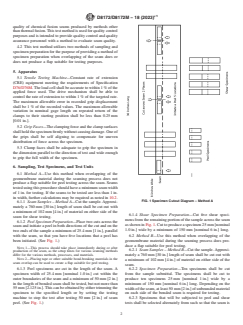
6.1.1 Seam Samples – Method A—Cut the sample. Approxi-
mately a 760 mm [30 in.] length of seam shall be cut out with
a minimum of 102 mm [4 in.] of material on either side of the
6.1.4 Shear Specimen Preparation—Cut five shear speci-
seam for shear testing.
mens from the remaining portion of the sample across the seam
6.1.2 Peel Specimen Preparation—Place two cuts across the
as shown in Fig. 1. Cut to produce a specimen 25 mm [nominal
seam and initiate a peel in both directions of the cut and on the
1.0 in.] wide by a minimum of 150 mm [nominal 6 in.] long.
two ends of the sam
...