

ASTM E526-22
(Test Method)Standard Test Method for Measuring Fast-Neutron Reaction Rates By Radioactivation of Titanium
General Information
- Abstract
SIGNIFICANCE AND USE
5.1 Refer to Guide E844 for the selection, irradiation, and quality control of neutron dosimeters.
5.2 Refer to Practice E261 for a general discussion of the determination of fast-neutron fluence rate with threshold detectors.
5.3 Titanium has good physical strength, is easily fabricated, has excellent corrosion resistance, has a melting temperature of 1668 °C, and can be obtained with satisfactory purity.
5.4 46Sc has a half-life of 83.787 (16)4 days (2). The 46Sc decay emits a 0.889271 (2) MeV gamma 99.98374 (35) % of the time and a second gamma with an energy of 1.120537 (3) MeV 99.97 (2) % of the time.
5.5 The recommended “representative isotopic abundances” for natural titanium (3) are:
8.25 (3) % 46Ti
7.44 (2) % 47Ti
73.72 (2) % 48Ti
5.41 (2) % 49Ti
5.18 (2) % 50Ti
5.6 The radioactive products of the neutron reactions 47Ti(n,p)47Sc (τ1/2 = 3.3485 (9) d) (2) and 48Ti(n,p)48Sc (τ1/2 = 43.67 h), (3) might interfere with the analysis of 46Sc.
5.7 Contaminant activities (for example, 65Zn and 182Ta) might interfere with the analysis of 46Sc. See 7.1.2 and 7.1.3 for more details on the 182Ta and 65Zn interference.
5.8 46Ti and 46Sc have cross sections for thermal neutrons of 0.59 ± 0.18 and 8.0 ± 1.0 barns, respectively (4); therefore, when an irradiation exceeds a thermal-neutron fluence greater than about 2 × 1021 cm–2, provisions should be made to either use a thermal-neutron shield to prevent burn-up of 46Sc or measure the thermal-neutron fluence rate and calculate the burn-up.
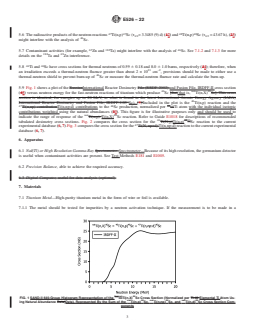
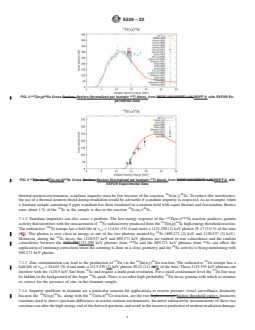
5.9 Fig. 1 shows a plot of the International Reactor Dosimetry and Fusion File, IRDFF-II cross section (5) versus neutron energy for the fast-neutron reactions of titanium which produce 46Sc (that is, natTi(n,X)46Sc). Included in the plot is the 46Ti(n,p) reaction and the 47Ti(n,np:d) contributions to the 46Sc production, normalized per natTi atom with the individual isotopic contributions weighted using the natural abundances (3). This figure ...
SCOPE
1.1 This test method covers procedures for measuring reaction rates by the activation reaction natTi(n,X)46Sc. The “X” designation represents any combination of light particles associated with the production of the residual 46Sc product. Within the applicable neutron energy range for fission reactor applications, this reaction is a properly normalized combination of three different reaction channels: 46Ti(n,p)46Sc; 47Ti(n, np)46Sc; and 47Ti(n,d)46Sc.
Note 1: The 47Ti(n,np)46Sc reaction, ENDF-6 format file/reaction identifier MF=3, MT=28, is distinguished from the 47Ti(n,d)46Sc reaction, ENDF-6 format file/reaction identifier MF=3/MT=104, even though it leads to the same residual product (1).2 The combined reaction, in the IRDFF-II library, has the file/reaction identifier MF=10/MT=5.
Note 2: The cross section for the combined 47Ti(n,np:d) reaction is relatively small for energies less than 12 MeV and, in fission reactor spectra, the production of the residual 46Sc is not easily distinguished from that due to the 46Ti(n,p) reaction.
1.2 The reaction is useful for measuring neutrons with energies above approximately 4.4 MeV and for irradiation times, under uniform power, up to about 250 days (for longer irradiations, or for varying power levels, see Practice E261).
1.3 With suitable techniques, fission-neutron fluence rates above 109 cm–2·s–1 can be determined. However, in the presence of a high thermal-neutron fluence rate, 46Sc depletion should be investigated.
1.4 Detailed procedures for other fast-neutron detectors are referenced in Practice E261.
1.5 The values stated in SI units are to be regarded as standard. No other units of measurement are included in this standard.
1.6 This standard does not purport to address all of the safety concerns, if any, associated with its use. It is the responsibility of the user of this standard to establish appropriate safety, health, and environmental practices an...
- Status
- Published
- Publication Date
- 30-Jun-2022
- Technical Committee
- E10 - Nuclear Technology and Applications
- Drafting Committee
- E10.05 - Nuclear Radiation Metrology
Buy Documents
ASTM E526-22 - Standard Test Method for Measuring Fast-Neutron Reaction Rates By Radioactivation of Titanium
REDLINE ASTM E526-22 - Standard Test Method for Measuring Fast-Neutron Reaction Rates By Radioactivation of Titanium
Overview
ASTM E526-22: Standard Test Method for Measuring Fast-Neutron Reaction Rates By Radioactivation of Titanium provides a systematic method for quantifying fast-neutron fluence rates through activation of titanium. Supported by ASTM Committee E10 on Nuclear Technology and Applications, this standard is widely utilized for dosimetry applications in reactor environments. The method leverages the natTi(n,X)46Sc reaction, where natural titanium is irradiated by fast neutrons, producing radioactive scandium-46. Measurement of the emitted gamma rays from scandium-46 decay enables precise calculation of neutron reaction rates.
This standard is relevant in nuclear metrology, reactor surveillance, and quality control scenarios where accurate measurement of fast-neutron exposure is critical for safety and performance evaluation. It prescribes SI units and requires conformity with safety, health, and environmental protocols.
Key Topics
- Principle of Measurement: The core methodology involves irradiating high-purity titanium in a fast-neutron field, resulting in the formation of 46Sc via activation reactions. The decay gamma emissions from 46Sc are measured to determine the neutron-induced reaction rate.
- Neutron Energy Range: The method is best suited for neutron energies above approximately 4.4 MeV, commonly found in fission reactor environments. It is valid for irradiation periods up to about 250 days under steady conditions.
- Sample Considerations: Titanium’s excellent physical properties, purity, and corrosion resistance make it ideal for neutron dosimetry. However, attention must be paid to possible contaminants (e.g., 65Zn, 182Ta) and their potential gamma-ray interferences.
- Data Analysis: The test method references gamma spectrometry techniques for counting, along with specific calculations for saturation activity and reaction rates. It addresses correction factors for sample geometry and coincident gamma emissions.
- Uncertainty and Quality Control: The standard discusses procedures for evaluating measurement precision and bias, referencing related practices for uncertainty quantification and result reporting.
- Safety and Compliance: Users are responsible for ensuring the safe handling of radioactive materials and compliance with appropriate regulatory requirements.
Applications
- Reactor Pressure Vessel Surveillance: Monitoring and assessing fast-neutron exposure in nuclear reactor pressure vessels, vital for structural integrity and lifespan prediction.
- Nuclear Facility Dosimetry: Implementation as a threshold dosimeter for characterizing neutron flux in research reactors, nuclear power plants, and fusion devices.
- Radiation Field Characterization: Used to validate computational dosimetry models by providing experimental benchmarks for neutron fluence and energy spectra.
- Material Testing: Evaluates neutron-induced changes in materials, supporting safety analyses and qualification of components exposed to reactors or neutron sources.
- Quality Assurance: Ensures consistent reactor operation and adherence to regulatory dose limits through reliable fast-neutron measurement.
Related Standards
For broader context and complementary procedures, reference the following ASTM standards:
- ASTM E844 - Guide for Sensor Set Design and Irradiation for Reactor Surveillance
- ASTM E261 - Practice for Determining Neutron Fluence, Fluence Rate, and Spectra by Radioactivation Techniques
- ASTM E181 - Test Methods for Detector Calibration and Analysis of Radionuclides
- ASTM E1005 - Test Method for Application and Analysis of Radiometric Monitors for Reactor Vessel Surveillance
- ASTM E1018 - Guide for Application of ASTM Evaluated Cross Section Data File
- ASTM E170 - Terminology Relating to Radiation Measurements and Dosimetry
These documents support the implementation of ASTM E526-22 and provide guidance on neutron dosimeter selection, detector calibration, dosimetry data analysis, and reporting practices.
Keywords: ASTM E526-22, fast-neutron reaction rates, titanium radioactivation, neutron dosimetry, nuclear metrology, neutron fluence measurement, reactor surveillance, gamma-ray spectrometry, titanium activation, radioactive scandium-46, standard test method
Relations
- Effective Date
- 01-Apr-2022
- Effective Date
- 01-Mar-2020
- Effective Date
- 01-Mar-2020
- Effective Date
- 01-Oct-2019
- Effective Date
- 01-Jun-2018
- Effective Date
- 01-Oct-2017
- Effective Date
- 01-Oct-2017
- Effective Date
- 01-Jun-2017
- Effective Date
- 01-Oct-2016
- Effective Date
- 15-Feb-2016
- Effective Date
- 01-Sep-2015
- Effective Date
- 01-Jul-2015
- Effective Date
- 01-Jun-2015
- Effective Date
- 15-Mar-2015
- Effective Date
- 15-Oct-2014
Buy Documents
ASTM E526-22 - Standard Test Method for Measuring Fast-Neutron Reaction Rates By Radioactivation of Titanium
REDLINE ASTM E526-22 - Standard Test Method for Measuring Fast-Neutron Reaction Rates By Radioactivation of Titanium
Get Certified
Connect with accredited certification bodies for this standard

DNV
DNV is an independent assurance and risk management provider.

Lloyd's Register
Lloyd's Register is a global professional services organisation specialising in engineering and technology.
DNV Energy Systems
Energy and renewable energy certification.
Sponsored listings
Frequently Asked Questions
ASTM E526-22 is a standard published by ASTM International. Its full title is "Standard Test Method for Measuring Fast-Neutron Reaction Rates By Radioactivation of Titanium". This standard covers: SIGNIFICANCE AND USE 5.1 Refer to Guide E844 for the selection, irradiation, and quality control of neutron dosimeters. 5.2 Refer to Practice E261 for a general discussion of the determination of fast-neutron fluence rate with threshold detectors. 5.3 Titanium has good physical strength, is easily fabricated, has excellent corrosion resistance, has a melting temperature of 1668 °C, and can be obtained with satisfactory purity. 5.4 46Sc has a half-life of 83.787 (16)4 days (2). The 46Sc decay emits a 0.889271 (2) MeV gamma 99.98374 (35) % of the time and a second gamma with an energy of 1.120537 (3) MeV 99.97 (2) % of the time. 5.5 The recommended “representative isotopic abundances” for natural titanium (3) are: 8.25 (3) % 46Ti 7.44 (2) % 47Ti 73.72 (2) % 48Ti 5.41 (2) % 49Ti 5.18 (2) % 50Ti 5.6 The radioactive products of the neutron reactions 47Ti(n,p)47Sc (τ1/2 = 3.3485 (9) d) (2) and 48Ti(n,p)48Sc (τ1/2 = 43.67 h), (3) might interfere with the analysis of 46Sc. 5.7 Contaminant activities (for example, 65Zn and 182Ta) might interfere with the analysis of 46Sc. See 7.1.2 and 7.1.3 for more details on the 182Ta and 65Zn interference. 5.8 46Ti and 46Sc have cross sections for thermal neutrons of 0.59 ± 0.18 and 8.0 ± 1.0 barns, respectively (4); therefore, when an irradiation exceeds a thermal-neutron fluence greater than about 2 × 1021 cm–2, provisions should be made to either use a thermal-neutron shield to prevent burn-up of 46Sc or measure the thermal-neutron fluence rate and calculate the burn-up. 5.9 Fig. 1 shows a plot of the International Reactor Dosimetry and Fusion File, IRDFF-II cross section (5) versus neutron energy for the fast-neutron reactions of titanium which produce 46Sc (that is, natTi(n,X)46Sc). Included in the plot is the 46Ti(n,p) reaction and the 47Ti(n,np:d) contributions to the 46Sc production, normalized per natTi atom with the individual isotopic contributions weighted using the natural abundances (3). This figure ... SCOPE 1.1 This test method covers procedures for measuring reaction rates by the activation reaction natTi(n,X)46Sc. The “X” designation represents any combination of light particles associated with the production of the residual 46Sc product. Within the applicable neutron energy range for fission reactor applications, this reaction is a properly normalized combination of three different reaction channels: 46Ti(n,p)46Sc; 47Ti(n, np)46Sc; and 47Ti(n,d)46Sc. Note 1: The 47Ti(n,np)46Sc reaction, ENDF-6 format file/reaction identifier MF=3, MT=28, is distinguished from the 47Ti(n,d)46Sc reaction, ENDF-6 format file/reaction identifier MF=3/MT=104, even though it leads to the same residual product (1).2 The combined reaction, in the IRDFF-II library, has the file/reaction identifier MF=10/MT=5. Note 2: The cross section for the combined 47Ti(n,np:d) reaction is relatively small for energies less than 12 MeV and, in fission reactor spectra, the production of the residual 46Sc is not easily distinguished from that due to the 46Ti(n,p) reaction. 1.2 The reaction is useful for measuring neutrons with energies above approximately 4.4 MeV and for irradiation times, under uniform power, up to about 250 days (for longer irradiations, or for varying power levels, see Practice E261). 1.3 With suitable techniques, fission-neutron fluence rates above 109 cm–2·s–1 can be determined. However, in the presence of a high thermal-neutron fluence rate, 46Sc depletion should be investigated. 1.4 Detailed procedures for other fast-neutron detectors are referenced in Practice E261. 1.5 The values stated in SI units are to be regarded as standard. No other units of measurement are included in this standard. 1.6 This standard does not purport to address all of the safety concerns, if any, associated with its use. It is the responsibility of the user of this standard to establish appropriate safety, health, and environmental practices an...
SIGNIFICANCE AND USE 5.1 Refer to Guide E844 for the selection, irradiation, and quality control of neutron dosimeters. 5.2 Refer to Practice E261 for a general discussion of the determination of fast-neutron fluence rate with threshold detectors. 5.3 Titanium has good physical strength, is easily fabricated, has excellent corrosion resistance, has a melting temperature of 1668 °C, and can be obtained with satisfactory purity. 5.4 46Sc has a half-life of 83.787 (16)4 days (2). The 46Sc decay emits a 0.889271 (2) MeV gamma 99.98374 (35) % of the time and a second gamma with an energy of 1.120537 (3) MeV 99.97 (2) % of the time. 5.5 The recommended “representative isotopic abundances” for natural titanium (3) are: 8.25 (3) % 46Ti 7.44 (2) % 47Ti 73.72 (2) % 48Ti 5.41 (2) % 49Ti 5.18 (2) % 50Ti 5.6 The radioactive products of the neutron reactions 47Ti(n,p)47Sc (τ1/2 = 3.3485 (9) d) (2) and 48Ti(n,p)48Sc (τ1/2 = 43.67 h), (3) might interfere with the analysis of 46Sc. 5.7 Contaminant activities (for example, 65Zn and 182Ta) might interfere with the analysis of 46Sc. See 7.1.2 and 7.1.3 for more details on the 182Ta and 65Zn interference. 5.8 46Ti and 46Sc have cross sections for thermal neutrons of 0.59 ± 0.18 and 8.0 ± 1.0 barns, respectively (4); therefore, when an irradiation exceeds a thermal-neutron fluence greater than about 2 × 1021 cm–2, provisions should be made to either use a thermal-neutron shield to prevent burn-up of 46Sc or measure the thermal-neutron fluence rate and calculate the burn-up. 5.9 Fig. 1 shows a plot of the International Reactor Dosimetry and Fusion File, IRDFF-II cross section (5) versus neutron energy for the fast-neutron reactions of titanium which produce 46Sc (that is, natTi(n,X)46Sc). Included in the plot is the 46Ti(n,p) reaction and the 47Ti(n,np:d) contributions to the 46Sc production, normalized per natTi atom with the individual isotopic contributions weighted using the natural abundances (3). This figure ... SCOPE 1.1 This test method covers procedures for measuring reaction rates by the activation reaction natTi(n,X)46Sc. The “X” designation represents any combination of light particles associated with the production of the residual 46Sc product. Within the applicable neutron energy range for fission reactor applications, this reaction is a properly normalized combination of three different reaction channels: 46Ti(n,p)46Sc; 47Ti(n, np)46Sc; and 47Ti(n,d)46Sc. Note 1: The 47Ti(n,np)46Sc reaction, ENDF-6 format file/reaction identifier MF=3, MT=28, is distinguished from the 47Ti(n,d)46Sc reaction, ENDF-6 format file/reaction identifier MF=3/MT=104, even though it leads to the same residual product (1).2 The combined reaction, in the IRDFF-II library, has the file/reaction identifier MF=10/MT=5. Note 2: The cross section for the combined 47Ti(n,np:d) reaction is relatively small for energies less than 12 MeV and, in fission reactor spectra, the production of the residual 46Sc is not easily distinguished from that due to the 46Ti(n,p) reaction. 1.2 The reaction is useful for measuring neutrons with energies above approximately 4.4 MeV and for irradiation times, under uniform power, up to about 250 days (for longer irradiations, or for varying power levels, see Practice E261). 1.3 With suitable techniques, fission-neutron fluence rates above 109 cm–2·s–1 can be determined. However, in the presence of a high thermal-neutron fluence rate, 46Sc depletion should be investigated. 1.4 Detailed procedures for other fast-neutron detectors are referenced in Practice E261. 1.5 The values stated in SI units are to be regarded as standard. No other units of measurement are included in this standard. 1.6 This standard does not purport to address all of the safety concerns, if any, associated with its use. It is the responsibility of the user of this standard to establish appropriate safety, health, and environmental practices an...
ASTM E526-22 is classified under the following ICS (International Classification for Standards) categories: 17.240 - Radiation measurements; 27.120.30 - Fissile materials and nuclear fuel technology. The ICS classification helps identify the subject area and facilitates finding related standards.
ASTM E526-22 has the following relationships with other standards: It is inter standard links to ASTM E456-13a(2022)e1, ASTM E1018-20, ASTM E1018-20e1, ASTM E944-19, ASTM E844-18, ASTM E456-13A(2017)e1, ASTM E456-13A(2017)e3, ASTM E170-17, ASTM E170-16a, ASTM E170-16, ASTM E170-15a, ASTM E1005-15, ASTM E261-15, ASTM E170-15, ASTM E170-14a. Understanding these relationships helps ensure you are using the most current and applicable version of the standard.
ASTM E526-22 is available in PDF format for immediate download after purchase. The document can be added to your cart and obtained through the secure checkout process. Digital delivery ensures instant access to the complete standard document.
Standards Content (Sample)
This international standard was developed in accordance with internationally recognized principles on standardization established in the Decision on Principles for the
Development of International Standards, Guides and Recommendations issued by the World Trade Organization Technical Barriers to Trade (TBT) Committee.
Designation: E526 − 22
Standard Test Method for
Measuring Fast-Neutron Reaction Rates By Radioactivation
of Titanium
This standard is issued under the fixed designation E526; the number immediately following the designation indicates the year of
original adoption or, in the case of revision, the year of last revision.Anumber in parentheses indicates the year of last reapproval.A
superscript epsilon (´) indicates an editorial change since the last revision or reapproval.
1. Scope priate safety, health, and environmental practices and deter-
mine the applicability of regulatory limitations prior to use.
1.1 This test method covers procedures for measuring reac-
nat 46 1.7 This international standard was developed in accor-
tion rates by the activation reaction Ti(n,X) Sc. The “X”
dance with internationally recognized principles on standard-
designation represents any combination of light particles asso-
46 ization established in the Decision on Principles for the
ciated with the production of the residual Sc product.Within
Development of International Standards, Guides and Recom-
the applicable neutron energy range for fission reactor
mendations issued by the World Trade Organization Technical
applications, this reaction is a properly normalized combina-
46 46 47 Barriers to Trade (TBT) Committee.
tion of three different reaction channels: Ti(n,p) Sc; Ti(n,
46 47 46
np) Sc; and Ti(n,d) Sc.
2. Referenced Documents
47 46
NOTE 1—The Ti(n,np) Sc reaction, ENDF-6 format file/reaction
2.1 ASTM Standards:
47 46
identifierMF=3,MT=28,isdistinguishedfromthe Ti(n,d) Screaction,
E170Terminology Relating to Radiation Measurements and
ENDF-6 format file/reaction identifier MF=3/MT=104, even though it
Dosimetry
leads to the same residual product (1). The combined reaction, in the
IRDFF-II library, has the file/reaction identifier MF=10/MT=5.
E177Practice for Use of the Terms Precision and Bias in
NOTE 2—The cross section for the combined Ti(n,np:d) reaction is
ASTM Test Methods
relatively small for energies less than 12 MeV and, in fission reactor
46 E181Test Methods for Detector Calibration andAnalysis of
spectra,theproductionoftheresidual Scisnoteasilydistinguishedfrom
Radionuclides
that due to the Ti(n,p) reaction.
E261Practice for Determining Neutron Fluence, Fluence
1.2 The reaction is useful for measuring neutrons with
Rate, and Spectra by Radioactivation Techniques
energies above approximately 4.4 MeV and for irradiation
E456Terminology Relating to Quality and Statistics
times, under uniform power, up to about 250 days (for longer
E844Guide for Sensor Set Design and Irradiation for
irradiations, or for varying power levels, see Practice E261).
Reactor Surveillance
1.3 With suitable techniques, fission-neutron fluence rates
E944Guide for Application of Neutron Spectrum Adjust-
9 –2 –1
above 10 cm ·s can be determined. However, in the
ment Methods in Reactor Surveillance
presence of a high thermal-neutron fluence rate, Sc depletion
E1005Test Method for Application and Analysis of Radio-
should be investigated.
metric Monitors for Reactor Vessel Surveillance
E1018Guide for Application of ASTM Evaluated Cross
1.4 Detailed procedures for other fast-neutron detectors are
Section Data File
referenced in Practice E261.
1.5 The values stated in SI units are to be regarded as
3. Terminology
standard. No other units of measurement are included in this
3.1 Definitions:
standard.
3.1.1 Refer to Terminologies E170 and E456.
1.6 This standard does not purport to address all of the
safety concerns, if any, associated with its use. It is the
4. Summary of Test Method
responsibility of the user of this standard to establish appro-
4.1 High-purity titanium is irradiated in a fast-neutron field,
46 46 46
thereby producing radioactive Sc from the Ti(n,p) Sc
47 46
ThistestmethodisunderthejurisdictionofASTMCommitteeE10onNuclear
reaction as well as the Ti(n,np:d) Sc activation reactions.
Technology and Applications and is the direct responsibility of Subcommittee
E10.05 on Nuclear Radiation Metrology.
Current edition approved July 1, 2022. Published August 2022. Originally
approved in 1976. Last previous edition approved in 2017 as E526–17. DOI: For referenced ASTM standards, visit the ASTM website, www.astm.org, or
10.1520/E0526-22. contact ASTM Customer Service at service@astm.org. For Annual Book of ASTM
The boldface numbers in parentheses refer to a list of references at the end of Standards volume information, refer to the standard’s Document Summary page on
this standard. the ASTM website.
Copyright © ASTM International, 100 Barr Harbor Drive, PO Box C700, West Conshohocken, PA 19428-2959. United States
E526 − 22
4.2 The gamma rays emitted by the radioactive decay of
Sc are counted in accordance with Test Methods E181 and
the reaction rate, as defined by Practice E261, is calculated
from the decay rate and the irradiation conditions.
4.3 The neutron fluence rate above about 4.4 MeVcan then
be calculated from the spectral-weighted neutron activation
cross section as defined by Practice E261.
5. Significance and Use
5.1 Refer to Guide E844 for the selection, irradiation, and
quality control of neutron dosimeters.
5.2 Refer to Practice E261 for a general discussion of the
determination of fast-neutron fluence rate with threshold de-
tectors.
5.3 Titanium has good physical strength, is easily
FIG. 1 SAND-II 640-Group Histogram Representation of the
fabricated, has excellent corrosion resistance, has a melting
nat 46
Ti(n,X) Sc Cross Section (Normalized per Elemental Ti Atom
temperature of 1668°C, and can be obtained with satisfactory
Using Natural Abundance Data), Represented By the Sum of the
purity. nat 46 nat 46 nat 46
Ti(n,p) Sc, Ti(n,np) Sc, and Ti(n,d) Sc Cross Section
46 4 46 Components
5.4 Sc has a half-life of 83.787 (16) days (2). The Sc
decay emits a 0.889271 (2) MeV gamma 99.98374 (35)% of
the time and a second gamma with an energy of 1.120537 (3)
MeV 99.97(2) % of the time.
5.5 Therecommended“representativeisotopicabundances”
for natural titanium (3) are:
8.25 (3) % Ti
7.44 (2) % Ti
73.72 (2) % Ti
5.41 (2) % Ti
5.18 (2) % Ti
5.6 Theradioactiveproductsoftheneutronreactions Ti(n,
47 48 48
p) Sc (τ = 3.3485 (9) d) (2) and Ti(n,p) Sc (τ = 43.67
1/2 1/2
h), (3) might interfere with the analysis of Sc.
65 182
5.7 Contaminant activities (for example, Zn and Ta)
might interfere with the analysis of Sc. See 7.1.2 and 7.1.3
182 65
46 46 46
for more details on the Ta and Zn interference.
FIG. 2 Ti(n,p) Sc Cross Section (Normalized per Isotopic Ti
46 46 Atom), from IRDFF-II, with EXFOR Experimental Data
5.8 Tiand Schavecrosssectionsforthermalneutronsof
0.59 6 0.18 and 8.0 6 1.0 barns, respectively (4); therefore,
46 46
when an irradiation exceeds a thermal-neutron fluence greater
the cross section for the Ti(n,p) Sc reaction to the current
21 –2
than about2×10 cm , provisions should be made to either
experimentaldatabase (6, 7).Fig.3comparesthecrosssection
use a thermal-neutron shield to prevent burn-up of Sc or
for the Ti(n,np:d) reaction to the current experimental data-
measure the thermal-neutron fluence rate and calculate the
base (6, 7).
burn-up.
6. Apparatus
5.9 Fig. 1 shows a plot of the International Reactor Dosim-
etryandFusionFile,IRDFF-IIcrosssection (5)versusneutron
6.1 NaI(Tl)orHighResolutionGamma-RaySpectrometer—
energy for the fast-neutron reactions of titanium which pro- Because of its high resolution, the germanium detector is
46 nat 46
duce Sc (that is, Ti(n,X) Sc). Included in the plot is the
useful when contaminant activities are present. See Test
46 47 46
Ti(n,p)reactionandthe Ti(n,np:d)contributionstothe Sc Methods E181 and E1005.
nat
production, normalized per Ti atom with the individual
6.2 Precision Balance, able to achieve the required accu-
isotopic contributions weighted using the natural abundances
racy.
(3). This figure is for illustrative purposes only and should be
nat 46
used to indicate the range of response of the Ti(n,X) Sc
7. Materials
reaction. Refer to Guide E1018 for descriptions of recom-
7.1 Titanium Metal—High-puritytitaniummetalintheform
mended tabulated dosimetry cross sections. Fig. 2 compares
of wire or foil is available.
7.1.1 Themetalshouldbetestedforimpuritiesbyaneutron
activation technique. If the measurement is to be made in a
The value of uncertainty, in parentheses, refers to the corresponding last digits,
thus 14.958(2) corresponds to 14.958 6 0.002. thermal-neutron environment, scandium impurity must be low
E526 − 22
7.2 Encapsulating Materials—Brass, stainless steel, copper,
aluminum, quartz, or vanadium have been used as primary
encapsulating materials. The container should be constructed
in such a manner that it will not create significant flux
perturbation and that it may be opened easily, especially if the
monitors must be removed remotely (see Guide E844).
8. Procedure
8.1 Decide on the size and shape of the titanium sample to
be irradiated, taking into consideration the size and shape of
the irradiation space. The mass and exposure time are param-
eters that can be varied to obtain a desired disintegration rate
for a given neutron-fluence rate level. (See Guide E844.)
8.2 Weigh the sample.
47 46
FIG. 3 Ti(n,np:d) Sc Cross Section (Normalized per Isotopic
47 8.3 Irradiate the sample for the predetermined time period.
Ti Atom), from IRDFF-II, with EXFOR Experimental Data
Record the power level and any changes in power during the
irradiation, the time at the beginning and end of each power
45 46
because of the reaction, Sc(n,γ) Sc. To reduce this
level,andtherelativepositionofthemonitorsintheirradiation
interference, the use of a thermal-neutron shield during irra- facility.
diation would be advisable if scandium impurity is suspected.
8.4 If the counting procedure available requires that the
As an example, when a titanium sample containing 6 ppm
activity be pure Sc, a waiting period of about 20 days is
scandium has been
...
This document is not an ASTM standard and is intended only to provide the user of an ASTM standard an indication of what changes have been made to the previous version. Because
it may not be technically possible to adequately depict all changes accurately, ASTM recommends that users consult prior editions as appropriate. In all cases only the current version
of the standard as published by ASTM is to be considered the official document.
´1
Designation: E526 − 17 E526 − 22
Standard Test Method for
Measuring Fast-Neutron Reaction Rates byBy
Radioactivation of Titanium
This standard is issued under the fixed designation E526; the number immediately following the designation indicates the year of
original adoption or, in the case of revision, the year of last revision. A number in parentheses indicates the year of last reapproval. A
superscript epsilon (´) indicates an editorial change since the last revision or reapproval.
ε NOTE—Editorial changes, such as removing extra spacing, correcting notation and a variable, were made in November
2017.
1. Scope
nat 46
1.1 This test method covers procedures for measuring reaction rates by the activation reactionsreaction Ti(n,X) Ti(n,p)Sc. The
“X” designation represents any combination of light particles associated with the production of the residual Sc + product. Within
the applicable neutron energy range for fission reactor applications, this reaction is a properly normalized combination of three
46 46 47 46 47 46
different reaction channels: Ti(n,p) Sc; Ti(n, np) Sc +Sc; and Ti(n,d) Sc.
47 46 47 46
NOTE 1—The Ti(n,np) Sc reaction, ENDF-6 format file/reaction identifier MF=3, MT=28, is distinguished from the Ti(n,d) Sc reaction, ENDF-6
format file/reaction identifier MF=3/MT=104, even though it leads to the same residual product (1). The combined reaction, in the IRDFF-II library, has
the file/reaction identifier MF=10/MT=5.
NOTE 2—The cross section for the combined Ti(n,np+d)Ti(n,np:d) reaction is relatively small for energies less than 12 MeV and and, in fission reactor
46 46
spectra, the production of the residual Sc is not easily distinguished from that of due to the Ti(n,p) reaction. This test method will apply to the
nat 46
composite Ti(n,X) Sc reaction that is typically used for dosimetry purposes.
1.2 The reaction is useful for measuring neutrons with energies above approximately 4.4 MeV and for irradiation times, under
uniform power, up to about 250 days (for longer irradiations, or for varying power levels, see Practice E261).
9 –2 –1
1.3 With suitable techniques, fission-neutron fluence rates above 10 cm ·s can be determined. However, in the presence of a
high thermal-neutron fluence rate, Sc depletion should be investigated.
1.4 Detailed procedures for other fast-neutron detectors are referenced in Practice E261.
1.5 The values stated in SI units are to be regarded as standard. No other units of measurement are included in this standard.
1.6 This standard does not purport to address all of the safety concerns, if any, associated with its use. It is the responsibility
of the user of this standard to establish appropriate safety, health, and environmental practices and determine the applicability of
regulatory limitations prior to use.
1.7 This international standard was developed in accordance with internationally recognized principles on standardization
established in the Decision on Principles for the Development of International Standards, Guides and Recommendations issued
by the World Trade Organization Technical Barriers to Trade (TBT) Committee.
This test method is under the jurisdiction of ASTM Committee E10 on Nuclear Technology and Applications and is the direct responsibility of Subcommittee E10.05
on Nuclear Radiation Metrology.
Current edition approved Aug. 1, 2017July 1, 2022. Published October 2017August 2022. Originally approved in 1976. Last previous edition approved in 20132017 as
E526 – 08E526 – 17.(2013). DOI: 10.1520/E0526-17E01.10.1520/E0526-22.
The boldface numbers in parentheses refer to a list of references at the end of this standard.
Copyright © ASTM International, 100 Barr Harbor Drive, PO Box C700, West Conshohocken, PA 19428-2959. United States
E526 − 22
2. Referenced Documents
2.1 ASTM Standards:
E170 Terminology Relating to Radiation Measurements and Dosimetry
E177 Practice for Use of the Terms Precision and Bias in ASTM Test Methods
E181 Test Methods for Detector Calibration and Analysis of Radionuclides
E261 Practice for Determining Neutron Fluence, Fluence Rate, and Spectra by Radioactivation Techniques
E456 Terminology Relating to Quality and Statistics
E844 Guide for Sensor Set Design and Irradiation for Reactor Surveillance
E944 Guide for Application of Neutron Spectrum Adjustment Methods in Reactor Surveillance
E1005 Test Method for Application and Analysis of Radiometric Monitors for Reactor Vessel Surveillance
E1018 Guide for Application of ASTM Evaluated Cross Section Data File
3. Terminology
3.1 Definitions:
3.1.1 Refer to Terminologies E170 and E456.
4. Summary of Test Method
46 46 46
4.1 High-purity titanium is irradiated in a fast-neutron field, thereby producing radioactive Sc from the Ti(n,p) Sc reaction
47 46
as well as the Ti(n,np:d) Sc activation reaction.reactions.
4.2 The gamma rays emitted by the radioactive decay of Sc are counted in accordance with Test Methods E181 and the reaction
rate, as defined by Test Method Practice E261, is calculated from the decay rate and the irradiation conditions.
4.3 The neutron fluence rate above about 4.4 MeV can then be calculated from the spectral-weighted neutron activation cross
section as defined by Test Method Practice E261.
5. Significance and Use
5.1 Refer to Guide E844 for the selection, irradiation, and quality control of neutron dosimeters.
5.2 Refer to Test Method Practice E261 for a general discussion of the determination of fast-neutron fluence rate with threshold
detectors.
5.3 Titanium has good physical strength, is easily fabricated, has excellent corrosion resistance, has a melting temperature of
1668°C,1668 °C, and can be obtained with satisfactory purity.
46 4 46
5.4 Sc has a half-life of 83.787 (16) days (12). The Sc decay emits a 0.889271 (2) MeV gamma 99.98374 (35) % of the time
and a second gamma with an energy of 1.120537 (3) MeV 99.97 (2) % of the time.
5.5 The isotopic content of natural titanium recommended for recommended “representative isotopic abundances” for natural
titanium Ti is 8.25 %. (23) are:
8.25 (3) % Ti
7.44 (2) % Ti
73.72 (2) % Ti
5.41 (2) % Ti
5.18 (2) % Ti
For referenced ASTM standards, visit the ASTM website, www.astm.org, or contact ASTM Customer Service at service@astm.org. For Annual Book of ASTM Standards
volume information, refer to the standard’s Document Summary page on the ASTM website.
The value of uncertainty, in parentheses, refers to the corresponding last digits, thus 14.958(2) corresponds to 14.958 6 0.002.
E526 − 22
47 47 48 48
5.6 The radioactive products of the neutron reactions Ti(n,p) Sc (τ = 3.3485 (9) d) (12) and Ti(n,p) Sc (τ = 43.67 h), (23)
1/2 1/2
might interfere with the analysis of Sc.
65 182 46
5.7 Contaminant activities (for example, Zn and Ta) might interfere with the analysis of Sc. See 7.1.2 and 7.1.3 for more
182 65
details on the Ta and Zn interference.
46 46
5.8 Ti and Sc have cross sections for thermal neutrons of 0.59 6 0.18 and 8.0 6 1.0 barns, respectively (34); therefore, when
21 –2
an irradiation exceeds a thermal-neutron fluence greater than about 2 × 10 cm , provisions should be made to either use a
thermal-neutron shield to prevent burn-up of Sc or measure the thermal-neutron fluence rate and calculate the burn-up.
5.9 Fig. 1 shows a plot of the RussianInternational Reactor Dosimetry File (RRDF-2002) and Fusion File, IRDFF-II cross section
46 nat 46
(45) versus neutron energy for the fast-neutron reactions of titanium which produce Sc [that(that is, Ti(n,X) Sc]. This cross
section is identical, for energies up to 20 MeV, to what is found in the latest International Atomic Energy Agency (IAEA)
International Reactor Dosimetry and Fusion File, IRDFF-1.05 Sc). (5).Included in the plot is the Ti(n,p) reaction and the
47 46 46nat
Ti(n,np) contributionTi(n,np:d) contributions to the Sc production, normalized per Ti atom with the individual isotopic
contributions weighted using the natural abundances (23). This figure is for illustrative purposes only and should be used to
nat 46
indicate the range of response of the Ti(n,p) Ti(n,X) Sc reaction. Refer to Guide E1018 for descriptions of recommended
46 4746
tabulated dosimetry cross sections. Fig. 2 compares the cross section for the Ti(N,p)Ti(n,p) Sc reaction to the current
experimental database (6, 7).Fig. 3 compares the cross section for the Ti(N, np+d) Ti(n,np:d) reaction to the current experimental
database (6, 7).
6. Apparatus
6.1 NaI(Tl) or High Resolution Gamma-Ray Spectrometer. Spectrometer—Because of its high resolution, the germanium detector
is useful when contaminant activities are present. See Test Methods E181 and E1005.
6.2 Precision Balance, able to achieve the required accuracy.
6.3 Digital Computer, useful for data analysis (optional).
7. Materials
7.1 Titanium Metal—High-purity titanium metal in the form of wire or foil is available.
7.1.1 The metal should be tested for impurities by a neutron activation technique. If the measurement is to be made in a
Natnat 46
FIG. 1 SAND-II 640-Group Histogram Representation of the Ti(n,X) Sc Cross Section (Normalized per Ti-46 Elemental Ti Atom Us-
nat 46 nat 46 nat 46
ing Natural Abundance Data)Data), Represented By the Sum of the Ti(n,p) Sc, Ti(n,np) Sc, and Ti(n,d) Sc Cross Section Com-
ponents
E526 − 22
46 46 46
FIG. 2 Ti(n,p) Sc Cross Section, Section (Normalized per Isotopic Ti Atom), from RRDF-2002/IRDFF-1.05,IRDFF-II, with EXFOR Ex-
perimental Data
47 46 47
FIG. 3 Ti(n,np+d)Ti(n,np:d) Sc Cross Section, Section (Normalized per Isotopic Ti Atom), from RRDF-2002/IRDFF-1.05,IRDFF-II, with
EXFOR Experimental Data
45 46
thermal-neutron environment, scandium impurity must be low because of the reaction, Sc(n,γ) Sc. To reduce this interference,
the use of a thermal-neutron shield during irradiation would be advisable if scandium impurity is suspected. As an example, when
a titanium sample containing 6 ppm scandium has been irradiated in a neutron field with equal thermal and fast-neutron fluence
46 45 46
rates about 1 % of the Sc in the sample is due to the reaction Sc(n,γ) Sc.
181 182
7.1.2 Tantalum impurities can also cause a problem. The low-energy response of the Ta(n,γ) Ta reaction produces gamma
46 46 46
activity that interferes with the measurement of Sc radioactivity produced from the Ti(n,p) Sc high-energy threshold reaction.
The radioactive Ta isotope has a half-life of τ = 114.61 (13) d and emits a 1121.290 (3) keV photon 35.17 (33) % of the time
1/2
(12). This photon is very close in energy to one of the two photons emitted by Sc (889.271 (2) keV and 1120.537 (3) keV).
Moreover, during the Sc decay, the 1120.537 keV and 889.271 keV photons are emitted in true coincidence and the random
182 46
coincidence between the 1121.3951121.290 keV photons from Ta and the 889.271 keV photons from Sc can affect the
application of summing corrections when the counting is done in a close geometry and the Sc activity is being monitoring with
889.271 keV photon.
65 64 65 65
7.1.3 Zinc contamination can lead to the production of Zn via the Zn(n,γ) Zn reaction. The radioactive Zn isotope has a
half-life of τ = 244.01 (9) d and emits a 1115.539 (2) keV photon 50.22 (11) %% of the time. These 1115.539 keV photons can
1/2
46 65
interfere with the 1120.5 keV line from Sc and require a multi-peak resolution. For a small contaminant lev
...