

ASTM E1018-20e1
(Guide)Standard Guide for Application of ASTM Evaluated Cross Section Data File
General Information
- Abstract
SIGNIFICANCE AND USE
4.1 The ENDF/B library in the United States and similar libraries elsewhere, such as JEFF (23), JENDL (21), and BROND (22), provide a compilation of neutron cross section and other nuclear data for use by the nuclear community. The availability of these excellent evaluations makes possible standardized usage, thereby allowing easy referencing and intercomparisons of calculations. However, as the first ENDF/B files were developed it became apparent that they were not adequate for all applications. This need resulted in the development of the specialized ENDF/B Dosimetry File (17, 25), consisting of activation cross sections important for dosimetry applications. This file was made available worldwide. Later, other “Special Purpose” files were introduced (26). In the ENDF/B-VI compilation (27), dosimetry files no longer appeared as separate evaluation files. The ENDF/B-VII.0 compilation (28) removed most of the reaction-specific covariance files used by the dosimetry community. It kept the covariance files for the “standard cross sections” in a special sub-library, but the covariance data in this sub-library are only provided over the energy range in which each reaction is considered to be a “standard”, and does not include the full energy range required for LWR PVS dosimetry applications. Later updates to the ENDF/B releases added covariance files for some reaction channels but these covariance files were often based solely on calculations and were not representative of the methodology used to derive the underlying ENDF/B cross section. In response to the need for a dosimetry-specific library, the International Atomic Energy Agency convened a Coordinated Research Project (CRP) that drew upon the set of international experts to provide a recommended set of dosimetry cross sections and to compile a set of validation evidence that supported the use of this recommended dataset. This file, the International Reactor Dosimetry and Fusion File (IRDFF) (19, 20), draws upon oth...
SCOPE
1.1 This guide covers the establishment and use of an ASTM evaluated nuclear data cross section and uncertainty file for analysis of single or multiple sensor measurements in neutron fields related to light water reactor LWR-Pressure Vessel Surveillance (PVS). These fields include in- and ex-vessel surveillance positions in operating power reactors, benchmark fields, and reactor test regions.
1.2 Requirements for establishment of ASTM-recommended cross section files address data format, evaluation requirements, validation in benchmark fields, evaluation of error estimates (covariance file), and documentation. A further requirement for components of the ASTM-recommended cross section file is their internal consistency when combined with sensor measurements and used to determine a neutron spectrum.
1.3 Specifications for use include energy region of applicability, data processing requirements, and application of uncertainties.
1.4 This guide is directly related to and should be used primarily in conjunction with Guides E482 and E944, and Practices E560, E185, and E693.
1.5 The ASTM cross section and uncertainty file represents a generally available data set for use in sensor set analysis. However, the availability of this data set does not preclude the use of other validated data, either proprietary or nonproprietary. When alternate cross section files that deviate from the requirements laid out in this standard are used, the deviations should be noted to the customer of the dosimetry application.
1.6 This standard does not purport to address all of the safety concerns, if any, associated with its use. It is the responsibility of the user of this standard to establish appropriate safety, health, and environmental practices and determine the applicability of regulatory limitations prior to use.
1.7 This international standard was developed in accordance with internationally recognized principles on standar...
- Status
- Published
- Publication Date
- 29-Feb-2020
- Technical Committee
- E10 - Nuclear Technology and Applications
- Drafting Committee
- E10.05 - Nuclear Radiation Metrology
Overview
ASTM E1018-20e1: Standard Guide for Application of ASTM Evaluated Cross Section Data File provides guidelines for the establishment and use of evaluated nuclear data cross section and uncertainty files in the field of neutron dosimetry. Developed by ASTM Committee E10, this standard is essential for analyzing sensor measurements in neutron fields, especially for Light Water Reactor - Pressure Vessel Surveillance (LWR-PVS). The standard supports consistency, traceability, and accuracy in using nuclear cross section data from internationally recognized databases such as ENDF/B, JEFF, JENDL, and BROND, facilitating widespread application in the nuclear industry.
Key Topics
- Evaluated Cross Section Files: Guidance on creating and using standardized nuclear data files for neutron dosimetry applications, ensuring compatibility and accuracy.
- Uncertainty and Covariance Data: Recommendations for including energy-dependent uncertainties and covariance matrices with all relevant cross section data.
- Benchmarking and Validation: Instructions on validating cross section data with experimental measurements from benchmark neutron fields.
- Data Formats: Support for recognized formats such as ENDF-6 and multigroup representations (e.g., 640-group SAND-II structure).
- Related Nuclear Data: Criteria for sourcing and documenting additional data such as isotopic abundances, gamma branching ratios, fission yields, half-lives, atomic weights, and Q-values.
- Consistency and Documentation: Emphasis on internal consistency of the data files, documentation of sources, and adherence to established evaluation methodologies.
Applications
- LWR Pressure Vessel Surveillance (PVS): The standard is specifically tailored for PVS dosimetry, enabling precise evaluation of neutron exposure and material damage in nuclear reactor environments.
- Sensor Set Analysis: The ASTM evaluated cross section and uncertainty file provides a unified dataset for analyzing results from single or multiple sensors exposed to neutron fields.
- Benchmark Testing: Useful for validation in well-characterized benchmark fields and reference environments, supporting regulatory compliance and operational excellence in nuclear facilities.
- Dosimetry Method Development: Facilitates development and validation of new dosimetry methods by ensuring access to high-quality, standardized nuclear data.
- Regulatory and Safety Analysis: Supports meeting safety, health, and environmental requirements by providing reliable data for assessment and reporting purposes in nuclear applications.
Related Standards
The usefulness and correct application of ASTM E1018-20e1 are enhanced when used in conjunction with several other international and ASTM standards:
- ASTM E482: Guide for Application of Neutron Transport Methods for Reactor Vessel Surveillance
- ASTM E944: Guide for Application of Neutron Spectrum Adjustment Methods in Reactor Surveillance
- ASTM E560: Practice for Extrapolating Reactor Vessel Surveillance Dosimetry Results
- ASTM E185: Practice for Design of Surveillance Programs for Light-Water Moderated Nuclear Power Reactor Vessels
- ASTM E693: Practice for Characterizing Neutron Exposures in Iron and Low Alloy Steels in Terms of Displacements Per Atom (DPA)
Referencing these documents ensures a comprehensive and integrated approach to nuclear dosimetry, maximizing data reliability and regulatory acceptance.
Practical Value
By utilizing ASTM E1018-20e1, nuclear professionals and dosimetry practitioners gain:
- Standardized Access: Ready access to validated, internationally recognized cross section data files and associated uncertainties.
- Improved Comparability: Enhanced ability to compare, interrelate, and interpret dosimetry results across projects and regions.
- Quality Assurance: Establishment of traceable methodologies, supporting consistent and transparent reporting.
- Regulatory Compliance: Conformance with global best practices and technical barriers to trade (TBT) principles.
Keywords
cross section data, neutron dosimetry, nuclear data, ENDF, IRDFF, LWR pressure vessel, ASTM E1018, covariance matrix, nuclear metrology, benchmark testing, uncertainty quantification, sensor analysis, neutron field evaluation, international standards, reactor surveillance
Relations
- Effective Date
- 01-Mar-2020
- Effective Date
- 01-Nov-2019
- Effective Date
- 01-Oct-2019
- Effective Date
- 01-Jun-2018
- Effective Date
- 01-Feb-2018
- Effective Date
- 01-Jun-2017
- Effective Date
- 01-Oct-2016
- Effective Date
- 15-Feb-2016
- Effective Date
- 01-Sep-2015
- Effective Date
- 01-Jul-2015
- Effective Date
- 01-Jun-2015
- Effective Date
- 01-Jun-2015
- Effective Date
- 15-Mar-2015
- Effective Date
- 15-Oct-2014
- Effective Date
- 01-Sep-2014
Get Certified
Connect with accredited certification bodies for this standard

BSI Group
BSI (British Standards Institution) is the business standards company that helps organizations make excellence a habit.

NYCE
Mexican standards and certification body.
Sponsored listings
Frequently Asked Questions
ASTM E1018-20e1 is a guide published by ASTM International. Its full title is "Standard Guide for Application of ASTM Evaluated Cross Section Data File". This standard covers: SIGNIFICANCE AND USE 4.1 The ENDF/B library in the United States and similar libraries elsewhere, such as JEFF (23), JENDL (21), and BROND (22), provide a compilation of neutron cross section and other nuclear data for use by the nuclear community. The availability of these excellent evaluations makes possible standardized usage, thereby allowing easy referencing and intercomparisons of calculations. However, as the first ENDF/B files were developed it became apparent that they were not adequate for all applications. This need resulted in the development of the specialized ENDF/B Dosimetry File (17, 25), consisting of activation cross sections important for dosimetry applications. This file was made available worldwide. Later, other “Special Purpose” files were introduced (26). In the ENDF/B-VI compilation (27), dosimetry files no longer appeared as separate evaluation files. The ENDF/B-VII.0 compilation (28) removed most of the reaction-specific covariance files used by the dosimetry community. It kept the covariance files for the “standard cross sections” in a special sub-library, but the covariance data in this sub-library are only provided over the energy range in which each reaction is considered to be a “standard”, and does not include the full energy range required for LWR PVS dosimetry applications. Later updates to the ENDF/B releases added covariance files for some reaction channels but these covariance files were often based solely on calculations and were not representative of the methodology used to derive the underlying ENDF/B cross section. In response to the need for a dosimetry-specific library, the International Atomic Energy Agency convened a Coordinated Research Project (CRP) that drew upon the set of international experts to provide a recommended set of dosimetry cross sections and to compile a set of validation evidence that supported the use of this recommended dataset. This file, the International Reactor Dosimetry and Fusion File (IRDFF) (19, 20), draws upon oth... SCOPE 1.1 This guide covers the establishment and use of an ASTM evaluated nuclear data cross section and uncertainty file for analysis of single or multiple sensor measurements in neutron fields related to light water reactor LWR-Pressure Vessel Surveillance (PVS). These fields include in- and ex-vessel surveillance positions in operating power reactors, benchmark fields, and reactor test regions. 1.2 Requirements for establishment of ASTM-recommended cross section files address data format, evaluation requirements, validation in benchmark fields, evaluation of error estimates (covariance file), and documentation. A further requirement for components of the ASTM-recommended cross section file is their internal consistency when combined with sensor measurements and used to determine a neutron spectrum. 1.3 Specifications for use include energy region of applicability, data processing requirements, and application of uncertainties. 1.4 This guide is directly related to and should be used primarily in conjunction with Guides E482 and E944, and Practices E560, E185, and E693. 1.5 The ASTM cross section and uncertainty file represents a generally available data set for use in sensor set analysis. However, the availability of this data set does not preclude the use of other validated data, either proprietary or nonproprietary. When alternate cross section files that deviate from the requirements laid out in this standard are used, the deviations should be noted to the customer of the dosimetry application. 1.6 This standard does not purport to address all of the safety concerns, if any, associated with its use. It is the responsibility of the user of this standard to establish appropriate safety, health, and environmental practices and determine the applicability of regulatory limitations prior to use. 1.7 This international standard was developed in accordance with internationally recognized principles on standar...
SIGNIFICANCE AND USE 4.1 The ENDF/B library in the United States and similar libraries elsewhere, such as JEFF (23), JENDL (21), and BROND (22), provide a compilation of neutron cross section and other nuclear data for use by the nuclear community. The availability of these excellent evaluations makes possible standardized usage, thereby allowing easy referencing and intercomparisons of calculations. However, as the first ENDF/B files were developed it became apparent that they were not adequate for all applications. This need resulted in the development of the specialized ENDF/B Dosimetry File (17, 25), consisting of activation cross sections important for dosimetry applications. This file was made available worldwide. Later, other “Special Purpose” files were introduced (26). In the ENDF/B-VI compilation (27), dosimetry files no longer appeared as separate evaluation files. The ENDF/B-VII.0 compilation (28) removed most of the reaction-specific covariance files used by the dosimetry community. It kept the covariance files for the “standard cross sections” in a special sub-library, but the covariance data in this sub-library are only provided over the energy range in which each reaction is considered to be a “standard”, and does not include the full energy range required for LWR PVS dosimetry applications. Later updates to the ENDF/B releases added covariance files for some reaction channels but these covariance files were often based solely on calculations and were not representative of the methodology used to derive the underlying ENDF/B cross section. In response to the need for a dosimetry-specific library, the International Atomic Energy Agency convened a Coordinated Research Project (CRP) that drew upon the set of international experts to provide a recommended set of dosimetry cross sections and to compile a set of validation evidence that supported the use of this recommended dataset. This file, the International Reactor Dosimetry and Fusion File (IRDFF) (19, 20), draws upon oth... SCOPE 1.1 This guide covers the establishment and use of an ASTM evaluated nuclear data cross section and uncertainty file for analysis of single or multiple sensor measurements in neutron fields related to light water reactor LWR-Pressure Vessel Surveillance (PVS). These fields include in- and ex-vessel surveillance positions in operating power reactors, benchmark fields, and reactor test regions. 1.2 Requirements for establishment of ASTM-recommended cross section files address data format, evaluation requirements, validation in benchmark fields, evaluation of error estimates (covariance file), and documentation. A further requirement for components of the ASTM-recommended cross section file is their internal consistency when combined with sensor measurements and used to determine a neutron spectrum. 1.3 Specifications for use include energy region of applicability, data processing requirements, and application of uncertainties. 1.4 This guide is directly related to and should be used primarily in conjunction with Guides E482 and E944, and Practices E560, E185, and E693. 1.5 The ASTM cross section and uncertainty file represents a generally available data set for use in sensor set analysis. However, the availability of this data set does not preclude the use of other validated data, either proprietary or nonproprietary. When alternate cross section files that deviate from the requirements laid out in this standard are used, the deviations should be noted to the customer of the dosimetry application. 1.6 This standard does not purport to address all of the safety concerns, if any, associated with its use. It is the responsibility of the user of this standard to establish appropriate safety, health, and environmental practices and determine the applicability of regulatory limitations prior to use. 1.7 This international standard was developed in accordance with internationally recognized principles on standar...
ASTM E1018-20e1 is classified under the following ICS (International Classification for Standards) categories: 35.240.50 - IT applications in industry. The ICS classification helps identify the subject area and facilitates finding related standards.
ASTM E1018-20e1 has the following relationships with other standards: It is inter standard links to ASTM E1018-20, ASTM E854-19, ASTM E944-19, ASTM E844-18, ASTM E910-18, ASTM E170-17, ASTM E170-16a, ASTM E170-16, ASTM E170-15a, ASTM E1005-15, ASTM E185-15, ASTM E185-15e1, ASTM E170-15, ASTM E170-14a, ASTM E170-14. Understanding these relationships helps ensure you are using the most current and applicable version of the standard.
ASTM E1018-20e1 is available in PDF format for immediate download after purchase. The document can be added to your cart and obtained through the secure checkout process. Digital delivery ensures instant access to the complete standard document.
Standards Content (Sample)
This international standard was developed in accordance with internationally recognized principles on standardization established in the Decision on Principles for the
Development of International Standards, Guides and Recommendations issued by the World Trade Organization Technical Barriers to Trade (TBT) Committee.
ϵ1
Designation: E1018 − 20
Standard Guide for
Application of ASTM Evaluated Cross Section Data File
This standard is issued under the fixed designation E1018; the number immediately following the designation indicates the year of
original adoption or, in the case of revision, the year of last revision.Anumber in parentheses indicates the year of last reapproval.A
superscript epsilon (´) indicates an editorial change since the last revision or reapproval.
ε NOTE—The URL for the E10 electronic files referenced in 8.3 was added editorially in July 2020.
1. Scope 1.7 This international standard was developed in accor-
dance with internationally recognized principles on standard-
1.1 This guide covers the establishment and use of an
ization established in the Decision on Principles for the
ASTMevaluatednucleardatacrosssectionanduncertaintyfile
Development of International Standards, Guides and Recom-
for analysis of single or multiple sensor measurements in
mendations issued by the World Trade Organization Technical
neutron fields related to light water reactor LWR-Pressure
Barriers to Trade (TBT) Committee.
Vessel Surveillance (PVS). These fields include in- and ex-
vessel surveillance positions in operating power reactors,
2. Referenced Documents
benchmark fields, and reactor test regions.
2.1 ASTM Standards:
1.2 Requirements for establishment of ASTM-
E170Terminology Relating to Radiation Measurements and
recommended cross section files address data format, evalua-
Dosimetry
tionrequirements,validationinbenchmarkfields,evaluationof
E185Practice for Design of Surveillance Programs for
error estimates (covariance file), and documentation.Afurther
Light-Water Moderated Nuclear Power Reactor Vessels
requirementforcomponentsoftheASTM-recommendedcross
E482Guide for Application of Neutron Transport Methods
section file is their internal consistency when combined with
for Reactor Vessel Surveillance
sensor measurements and used to determine a neutron spec-
E560Practice for Extrapolating Reactor Vessel Surveillance
trum.
Dosimetry Results, E 706(IC) (Withdrawn 2009)
1.3 Specifications for use include energy region of E693Practice for Characterizing Neutron Exposures in Iron
applicability, data processing requirements, and application of
and Low Alloy Steels in Terms of Displacements Per
uncertainties. Atom (DPA)
E844Guide for Sensor Set Design and Irradiation for
1.4 This guide is directly related to and should be used
Reactor Surveillance
primarily in conjunction with Guides E482 and E944, and
E853PracticeforAnalysisandInterpretationofLight-Water
Practices E560, E185, and E693.
Reactor Surveillance Neutron Exposure Results
1.5 TheASTM cross section and uncertainty file represents
E854Test Method for Application and Analysis of Solid
a generally available data set for use in sensor set analysis.
State Track Recorder (SSTR) Monitors for Reactor Sur-
However, the availability of this data set does not preclude the
veillance
use of other validated data, either proprietary or nonpropri-
E910Test Method for Application and Analysis of Helium
etary. When alternate cross section files that deviate from the
Accumulation Fluence Monitors for Reactor Vessel Sur-
requirements laid out in this standard are used, the deviations
veillance
should be noted to the customer of the dosimetry application.
E944Guide for Application of Neutron Spectrum Adjust-
1.6 This standard does not purport to address all of the
ment Methods in Reactor Surveillance
safety concerns, if any, associated with its use. It is the
E1005Test Method for Application and Analysis of Radio-
responsibility of the user of this standard to establish appro-
metric Monitors for Reactor Vessel Surveillance
priate safety, health, and environmental practices and deter-
E2005Guide for Benchmark Testing of Reactor Dosimetry
mine the applicability of regulatory limitations prior to use.
in Standard and Reference Neutron Fields
1 2
This guide is under the jurisdiction of ASTM Committee E10 on Nuclear For referenced ASTM standards, visit the ASTM website, www.astm.org, or
Technology and Applications and is the direct responsibility of Subcommittee contact ASTM Customer Service at service@astm.org. For Annual Book of ASTM
E10.05 on Nuclear Radiation Metrology. Standards volume information, refer to the standard’s Document Summary page on
Current edition approved March 1, 2020. Published April 2020. Originally the ASTM website.
published as E1018–84. Last previous edition approved in 2013 as E1018– 09 The last approved version of this historical standard is referenced on
ɛ1
(2013) . DOI: 10.1520/E1018-20E01. www.astm.org.
Copyright © ASTM International, 100 Barr Harbor Drive, PO Box C700, West Conshohocken, PA 19428-2959. United States
ϵ1
E1018 − 20
3. Terminology reproducible, less well characterized than a standard field, but
acceptable as a measurement reference by the community of
3.1 Definitions of Terms Specific to This Standard:
users.
3.1.1 benchmark field—a limited number of neutron fields
3.1.1.3 controlled environment—these environments are
have been identified as benchmark fields for the purpose of
dosimetry sensor calibration and dosimetry cross section data well-defined neutron fields with some spectral definitions,
employed for a restricted set of validation experiments over a
developmentandtesting (1, 2). SeeTerminologyE170.These
fields were permanent facilities in which experiments could be range of energies.
repeated. In addition, differential neutron spectrum measure-
3.1.2 dosimetry cross sections—cross sections used for do-
ments have been performed in many of the fields to provide,
simetry application and which provide the cross section for
togetherwithtransportcalculationsandintegralmeasurements,
production of particular (measurable) reaction products. These
the best state-of-the-art neutron spectrum evaluation. To
include fission cross sections for production of fission
supplement the data available from benchmark fields, most of
products, activation cross sections for the production of radio-
which are limited in fluence rate intensity, reactor test regions
active nuclei, and cross sections for production of measurable
for dosimetry method validation have also been defined,
stable products, such as helium.
including both in-reactor and ex-vessel dosimetry positions.
3.1.3 evaluated data—values of physical quantities repre-
Table 1 lists some of the neutron fields that have been used for
senting a current best estimate. Such estimates are developed
datadevelopment,testing,andevaluation.Manyofthesefields
by experts considering measurements or calculations of the
may not be available any longer, but new nuclear data files are
quantity of interest, or both. Cross section evaluations, for
still validated against the historical measurements made in
example, are conducted by teams of scientists such as the
these fields. Other benchmark fields used for testing LWR
ENDF/B Cross Section Evaluation Working Group (CSEWG)
calculations are described in Guide E2005.
(see also 3.1.5).
3.1.1.1 standard field—these fields are produced by facili-
3.1.4 Evaluated Nuclear Data File (ENDF)—consists of
ties and apparatus that are stable, permanent, and whose fields
neutron cross sections and other nuclear data evaluated from
are reproducible with neutron fluence rate intensity, energy
available experimental measurements (15) and calculations.
spectra, and angular fluence rate distributions characterized to
Two types of ENDF files exist.
state-of-the-art accuracy. Important standard field quantities
3.1.4.1 ENDF/B files—evaluatedfilesofficiallyapprovedby
mustbeverifiedbyinterlaboratorymeasurements.Thesefields
exist at the National Institute of Standards and Technology CSEWG [see format document ENDF-102 available at the
CSEWG website, (16) after suitable review and testing. The
(NIST) and other national laboratories.
latest version of the ENDF/B nuclear data evaluations is
3.1.1.2 reference field—these fields are produced by facili-
ENDF/B-VIII.0 (17).
ties and apparatus that are permanent and whose fields are
3.1.4.2 ENDF/A files—evaluated files including outdated
versions of ENDF/B, the International Reactor Dosimetry File
(IRDF-2002) (18), the International Reactor Dosimetry and
Fusion File (IRDFF) (19, 20), the Japanese Evaluated Nuclear
The boldfaced numbers in parentheses refer to the list of references at the end
of this guide.
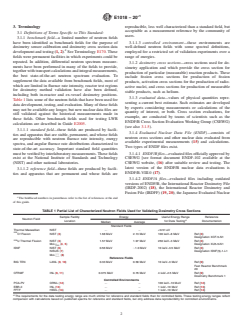
TABLE 1 Partial List of Characterized Neutron Fields Used for Validating Dosimetry Cross Sections
Energy
Sample Facility Useful Energy Range Reference
Neutron Field
A
Location for Data Testing Documentation
Median Average
Standard Fields
Thermal Maxwellian NIST . . <0.51 eV
Cf Fission NIST (3) 1.68 MeV 2.13 MeV 100 keV–8 MeV Ref (3)
Designation XCF-5-N1
U Thermal Fission NIST (3) 1.57 MeV 1.97 MeV 250 keV–3 MeV Ref (3)
Mol-χ (4, 5) Designation XU5-5-N1
ISNF NIST (6) 0.56 MeV ;1.0 MeV 10 keV–3.5 MeV Ref (3)
NISUS (7) Designation ISNF(5)-1-L1
Mol-^^ (8)
Reference Fields
BIG TEN LANL (9, 10) 0.33 MeV 0.58 MeV 10 keV–3 MeV Ref (9)
Fast Reactor Benchmark
CFRMF INL (9, 11) 0.375 MeV 0.76 MeV 4 keV–2.5 MeV Ref (9)
Dosimetry Benchmark 1
Controlled Environments
PCA-PV ORNL (12) . . 100 keV–10 MeV Ref (12)
EBR-II INL (13) . . 1 keV–10 MeV Ref (13)
FFTF HEDL (14) . . 1 keV–10 MeV Ref (14)
A
The requirements for the data testing energy range are much stricter for reference and standard fields than for controlled fields. These testing energy ranges reflect
comparison with calculations based on published spectra for reference and standard fields, but only address data reproducibility for controlled environments.
ϵ1
E1018 − 20
Data Library (JENDL) (21), BROND (USSR) (22), JEFF 23 dosimetry applications that go beyond the scope of this
and other evaluated cross section libraries. These files include standardand,aspartofitsdevelopmentprocess,itincorporates
partial as well as complete evaluations. validation data acquired in reference and standard benchmark
neutron fields. Some of the IRDFF supplemental reactions
3.1.5 integral data/differential data—integral data are data
represent material evaluations that are currently being exam-
points that represent an integrated sensor’s response over a
ined by the CSEWG for inclusion within updated ENDF/B
range of energy. Examples are measurements of reaction rates
evaluations.ThesupplementalIRDFFevaluationsonlyinclude
or fission rates in a fission neutron spectrum. Differential data
the specific reactions of interest to the dosimetry community
are measurements at single energy points or over a relatively
and not a full material evaluation. The ENDF community
smallenergyrange.Examplesaretime-of-flightmeasurements,
requires a complete evaluation before including it in the main
proton recoil spectrometry, etc. (24).
ENDF/B evaluated library.
3.1.6 uncertainty file—the uncertainty in cross section data
4.2 The application to LWR surveillance dosimetry intro-
hasbeenincludedwithevaluatedcrosssectionlibrariesthatare
duced new data needs that can best be satisfied by the creation
used for dosimetry applications. Because of the correlations
ofadedicatedcrosssectionfile.Thisfileshallbemaintainedin
between the data points or cross section parameters, these
a form designed for easy application by users (minimal
uncertainties, in general, cannot be expressed as variances, but
processing). The file shall continue to incorporate the follow-
rather a covariance matrix must be specified. Through the use
ing types of information or indicate the sources of the
of the covariance matrix, uncertainties in derived quantities,
following type of data that should be used to supplement the
such as average cross sections, can be calculated more accu-
file contents:
rately.
4.2.1 Dosimetry cross sections for fission, activation, he-
lium production sensor reactions in LWR environments in
4. Significance and Use
support of radiometric, solid state track recorder, helium
4.1 The ENDF/B library in the United States and similar
accumulation dosimetry methods (see Test Methods E853,
libraries elsewhere, such as JEFF (23), JENDL (21), and
E854, E910, and E1005).
BROND (22), provide a compilation of neutron cross section
4.2.2 Other cross sections or sensor response functions
and other nuclear data for use by the nuclear community. The
useful for active or passive dosimetry measurements, for
availability of these excellent evaluations makes possible
example, the use of neutron absorption cross sections to
standardized usage, thereby allowing easy referencing and
represent attenuation corrections due to covers or self-
intercomparisons of calculations. However, as the first
shielding.
ENDF/B files were developed it became apparent that they
4.2.3 Cross sections for damage evaluation, such as dis-
werenotadequateforallapplications.Thisneedresultedinthe
placements per atom (dpa) in iron.
development of the specialized ENDF/B Dosimetry File (17,
4.2.4 Related nuclear data needed for dosimetry, such as
25), consisting of activation cross sections important for
branching ratios, fission yields, and atomic abundances.
dosimetry applications. This file was made available world-
4.3 TheASTM-recommended cross sections and uncertain-
wide.Later,other“SpecialPurpose”fileswereintroduced (26).
ties are based mostly on the IRDFF (version 1.05) dosimetry
In the ENDF/B-VI compilation (27), dosimetry files no longer
files. Damage cross sections for materials such as iron have
appeared as separate evaluation files. The ENDF/B-VII.0
beenaddedinordertopromotestandardizationofreporteddpa
compilation (28) removed most of the reaction-specific cova-
measurements within the dosimetry community. Integral mea-
riance files used by the dosimetry community. It kept the
surements from benchmark fields and reactor test regions have
covariance files for the “standard cross sections” in a special
been considered in order to ensure self-consistency (29). The
sub-library, but the covariance data in this sub-library are only
total dosimetry file is intended to be as self-consistent as
provided over the energy range in which each reaction is
possible with respect to both differential and integral measure-
considered to be a “standard”, and does not include the full
ments as applied in LWR environments. This self-consistency
energy range required for LWR PVS dosimetry applications.
of the data file is mandatory for LWR-pressure vessel surveil-
Later updates to the ENDF/B releases added covariance files
lance applications, where only very limited dosimetry data are
for some reaction channels but these covariance files were
available. Where modifications to an existing evaluated cross
often based solely on calculations and were not representative
section have been made to obtain this self-consistence in LWR
of the methodology used to derive the underlying ENDF/B
environments, the modifications shall be detailed in the asso-
cross section. In response to the need for a dosimetry-specific
ciated documentation (see (19, 29)).
library, the International Atomic Energy Agency convened a
Coordinated Research Project (CRP) that drew upon the set of
5. Establishment of Cross Section File
international experts to provide a recommended set of dosim-
etry cross sections and to compile a set of validation evidence 5.1 Committee—The cross section and uncertainty file shall
that supported the use of this recommended dataset. This file, be established and maintained under a responsible task group
the International Reactor Dosimetry and Fusion File (IRDFF) appointed by Subcommittee E10.05 on Nuclear Radiation
(19, 20), draws upon other national nuclear evaluations and Metrology. The task group shall review, and approve all data
supplementstheseevaluationswithasetofreactionsevaluated before insertion of the file and ensure the adequate testing has
by expert international groups. The IRDFF library was devel- been performed on the file contents. The task group shall
opedtosupporttheLWRdosimetryapplicationaswellasother establish requirements, data formats, etc.
ϵ1
E1018 − 20
5.2 Formats—Formats shall generally conform to one of the related data shall be taken from sources specified in 5.5.2
two types. The first format type is that referred to as the – 5.5.7. These sources represent the latest dosimetry-quality
ENDF-6 format and is specified in ENDF-201 (30). The
community-evaluated databases.
second format type consists of multigroup data in the 640
5.5.2 isotopic abundances—The principal reference for iso-
group SAND-II (31, 32) energy structure (see Practice E693
topic abundance in dosimetry applications should be from the
for SAND-II energy group structure). The multigroup data
international collaboration Decay Data Evaluation Project
format is the preferred form since it is more compatible with
(DDEP) as documented in BIPM-5 (36). This is the principal
the forms typically used to represent facility neutron spectra.
source of isotopic abundance data used in the IRDFF cross
The spectrum weighting function used to collapse the point
sections. When the data is not available in the BIPM-5, Ref
cross section data onto the multigroup energy grid should be
(37) gives isotopic abundances suitable for use with this
generic in nature. Unless specified differently in associated file
standard.
documentation, the weighting function used in the collapse of
5.5.3 gamma branching ratios—The principal reference for
the point cross sections is assumed to be equivalent to the
branching ratios should be from the international collaboration
NJOY-2012 GROUPR module iwt=8 weight function option
Decay Data Evaluation Project (DDEP) as documented in
for “thermal—1/Ee—fast reactor—fission +_ fusion” weight
BIPM-5 (36) and released at the time of the cross section
function using the default energy breakpoints (32).
evaluation. This is the principal source of branching ratio data
5.3 Cross Section Evaluation—Thesource(s)fortherecom-
used in the IRDFF cross sections. When the data is not
mended cross section for each dosimetry reaction is/are iden-
available in the BIPM-5, the fallback community standard
tified in Table 2. Currently, the recommended cross section for
source of branching ratios is the ENSDF (38).
most dosimetry reactions are found in the IRDFF-1.05 library.
5.5.4 fission yields—The best data on fission yields are
For the dosimetry reactions of interest for LWR applications
reflected in the JEFF 3.3 library (23). The release date for the
and addressed in Table 2, users should use the IRDFF version
latest fission yield data was November 2016. This library was
1.05libraryastherecommendedsourceforcrosssectionsupto
based on the UKFY3.6A library. Note, a set of prototype
20MeV.Crosssectionsshallbeconsistentwithinerrorbounds
fission yields at a fine set of incident neutron energies can be
for selected benchmark fields (see 5.4 and Table 1) and this
found in the UKFY4.1 library (39). Empirical equations
consistencyhasbeendemonstratedfortheIRDFFversion1.05
representingthesystematicsoffission-productyields (40)were
library (29). Dosimetry cross sections presently not in IRDFF-
used to obtain this characterization. While this UKFY4.1
1.05 shall be obtained from the designated alternate sources or
library can be used to obtain an indication of the energy-
from new evaluations. Other cross sections may be obtained
dependent sensitivity in the fission yield data, it is not, at this
from other sources, for example, the dpa cross section for iron
time, recommended for use in dosimetry applications.
may be obtained from Practice E693.
5.5.5 half-life—Theprincipalreferenceforhalf-livesshould
NOTE 1—The IRDFF library includes several iron dpa cross sections
be from the international collaboration Decay Data Evaluation
thatareendorsedforusebytheinternationalreactordosimetrycommunity
for application to LWR pressure vessel surveillance. The iron dpa from Project (DDEP) as documented in BIPM-5 (36). The DDEP
Practice E693 is one of these IRDFF dpa damage functions and it
version at the time of the nuclear data evaluation is the
[MAT=2600, MF=3, MT=900] is the ASTM recommended response for
principal source of half-life data used in the IRDFF cross
this damage metric.
sections. When the data is not available in the BIPM-5, the
5.4 Cross Section Validation—The cross section file will be
most recent comprehensive alternate listing of half-lives is
validatedforLWRapplicationsusingdosimetrymeasurements
given in Ref (41) and the 2011 Nuclear Wallet Cards (42)
made in benchmark fields. Such validation may result in
distributed by the NNDC.
necessary modifications to cross sections to eliminate signifi-
5.5.6 atomic weights—The cross section evaluation shall
cant biases. Modification of IRDFF and ENDF/B files shall be
specify the atomic weight of the target atom. This quantity, in
doneinamannerconsistentwiththeuncertaintiesspecifiedfor
neutron mass units, is a required input in the ENDF-6 format
the differential data, using a least squares methodology.
specifications. In the ENDF-6 format specifications (30),1
neutron mass unit (m ) is equal to 1.00866491588 amu, where
5.5 Related Nuclear Data for Dosimetry Application—All
n
1 amu is taken to be equal to 931.4940954 MeV/c and the
necessaryrelateddatashouldbespecifiedinthedocumentation
speed of light (c) is 2.99792458E8 m/s. If the atomic weight is
associated with the specific dosimetry application. These data
notspecified,theatomicweightoftheproductnucleusshallbe
include isotopic abundances, gamma branching ratios, fission
determined from the AME2016 mass excess data (43).
yields, half-lives, etc., as appropriate. Updates of these data
shallrequire,ingeneral,arevalidationofthecrosssection(see
5.5.7 Q-value—The reaction Q-value is typically specified
5.4). In the ENDF-6 format this data can be specified as
in the cross section evaluation. For some dosimetry sensor
comment cards in the File 1 General Information section. The
responsefunctions,suchasdpa,aQ-valuemaynotberelevant.
evaluation file or associated documentation may cite a com-
InthiscaseazeroentryshallberecordedfortheQ-valueinthe
prehensivedosimetry-qualitysource,suchasthe Nuclear Data
cross section evaluation. If a Q-value is not given in the cross
Guide for Reactor Neutron Metrology (33) or the SNLRMI,
section evaluation for a dosimetry reaction, then the cross
(26, 34, 35), for the related nuclear data.
section documentation must provide a numerical recipe for
calculating the cross section down to a zero energy for the
5.5.1 If the related data is not explicitly provided in the
cross section evaluation itself or a reference is not cited, then incident particle.
ϵ1
E1018 − 20
TABLE 2 Recommended Sources for Several Useful Dosimetry Cross Sections
Original Source(s) for Library Material Consistent with Target Atom Residual Nuclei
I
ID # Reaction Label Recommended Cross ID IRDFF Natural Half-life Comment
H
Section Library(19, 20) Abundance (%)
6 4 A,B,C
1 Li(n,t) He ENDF/B-VII.1 325 Yes 7.589 (24) He, stable;
He, 12.312 (25) a
10 7 B,C,E,K
7 B(n,α) Li CENDL-3 525 No 19.82 (2) stable
23 24 F
22 Na(n,γ) Na JENDL-4.0/IRDFF 1125 No/Yes 100. 14.958 (2) h
24 24 G
23 Mg(n,p) Na RRDF 1225 Yes 78.951 (12) 14.958 (2) h
27 24 G
24 Al(n,α) Na RRDF 1325 Yes 100. 14.958 (2) h
27 27 G
25 Al(n,p) Mg RRDF 1325 Yes 100. 9.458 (12) m
32 32 G
30 S(n,p) P RRDF 1625 Yes 95.04074 (88) 14.284 (36) d
45 46 D,F
33 Sc(n,γ) Sc FENDL-D/IRDFF 2126 No 100. 83.787 (16) d
2125 Yes
46 46 I,G,J
34 Ti(n,p) Sc RRDF 2225 Yes 8.249 (21) 83.787 (16) d
47 47 I,G,J
36 Ti(n,p) Sc RRDF 2228 Yes 7.437 (14) 3.3485 (9) d
48 48 G
39 Ti(n,p) Sc RRDF 2231 Yes 73.720 (22) 43.67 (9) h
55 54 F
47 Mn(n,γ) Mn IRDFF 2525 Yes 100. 2.57878 (46) h
55 54 G
48 Mn(n,2n) Mn RRDF 2525 Yes 100. 2.57878 (46) h
54 54 D,G
51 Fe(n,p) Mn GLUCS-3/RRDF(44) 2625 No/Yes 5.8459 (230) 312.19 (3) d
56 56 G
52 Fe(n,p) Mn RRDF 2631 Yes 91.7540 (240) 2.57878 (46) h
58 59 D,F,L
54 Fe(n,γ) Fe JENDL/D99(45)/ 2637 No/Yes 0.282 (4) 44.495 (9) d
JEFF-3.1
nat M,N
55 Fe(n,X)dpa ENDF/B-VI.1 NA Yes NA stable
59 59 G
56 Co(n,p Fe RRDF 2725 Yes 100. 44.494 (12) d
59 60
57 Co(n,γ) Co JENDL 4.0/IRDFF 2725 No/Yes 100. 5.2711 (8) a
59 58 G
58 Co(n,2n) Co RRDF 2725 Yes 100. 70.85 (3) d
59 56 O G
59 Co(n,α) Mn RRDF 2712 Yes 100. 2.57878 (46) h
58 57
60 Ni(n,2n) Ni ENDF/B-VI 2825 Yes 68.0769 (59) 35.9 (3) h
58 58 G
61 Ni(n,p) Co RRDF 2825 Yes 68.0769 (59) 70.85 (3) d
60 60 G
63 Ni(n,p) Co RRDF 2831 Yes 26.2231 (51) 5.2711 (8) a
63 62 G
64 Cu(n,2n) Cu RRDF 2825 Yes 69.174 (20) 9.67 (3) m
63 64 O
65 Cu(n,γ) Cu ENDF/B-VI 2925 Yes 69.174 (20) 12.701 (2) h
63 60 G
66 Cu(n,α) Co RRDF 2925 Yes 69.174 (20) 5.2711 (8) a
65 64 G
67 Cu(n,2n) Cu RRDF 2931 Yes 30.826 (20) 12.7004 (20) h
64 64 G
68 Zn(n,p) Cu RRDF 3025 Yes 49.1704 (83) 12.7004 (20) h
64 89 G
73 Zr(n,2n) Zr RRDF 4025 Yes 51.452 (9) 78.42 (13) h
93 94[g+(m→g)]
77 Nb(n,γ) Nb ENDF/B-VI 4125 Yes 100. 2.03E4 (16)
93 92m G
78 Nb(n,2n) Nb RRDF 4112 Yes 100. 10.15 (2) d
93 93m N,G
79 Nb(n,n') Nb RRDF 4112 Yes 100. 16.12 (15) a
103 103m N,G
87 Rh(n,n') Rh RRDF 4525 Yes 100. 56.114 (20) m
109 110m G
88 Ag(n,γ) Ag CNDC 4731 Yes 48.1608 (51) 249.78 (2) d
115 116m O
92 In(n,γ) In ENDF/B-VI 4931 Yes 95.719 (17) 54.29 (17) m
115 115m N,G
93 In(n,n') In RRDF 4931 Yes 95.719 (17) 4.486 (4) h
197 198 C
110 Au(n,γ) Au IPPE 7925 Yes 100. 2.6943 (3) d
197 196 G
112 Au(n,2n) Au 7925 7925 Yes 100. 6.1669 (6) d
232 N
119 Th(n,f)FP JENDL 4.0/IRDFF 9040 No/Yes 100. stable
235 C,G
121 U(n,f)FP RRDF 9228 Yes 0.72041 (36) stable
238 C,N
122 U(n,f)FP IRDFF 9237 Yes 99.27417 (36) stable
237 N,G
123 Np(n,f)FP RRDF 9346 Yes NA stable
239 N
124 Pu(n,f)FP IRDFF 9437 Yes NA stable
A nat 4 6 6
The total Li He production is typically the desired metric. It is obtained by combining the Li(n,t) ENDF/B-Viii.0 cross sections (MT=105) with the Li(n,d) (MT=32) and
6 6 7 7 7
Li(n,2np) (MT=41) cross sections. If the sample is not isotopically pure Li, then the Li reactions need to be considered, for example, Li(n,2nα) (MT=24) and Li(n.3nα)
(MT=25) cross sections.
B
This cross section is a combination of several reaction components. The recommended covariance matrix is taken from the covariance of the predominant reaction
component, which is typically the (n,α) or (n,t) component.
C
Use of the ENDF/B-VII.0 standards sub-libr
...