

ASTM D5348-95(2019)
(Test Method)Standard Test Method for Determination of the Moisture Content of Sulfonated and Sulfated Oils by Distillation with Xylene
General Information
- Abstract
SIGNIFICANCE AND USE
3.1 This test method is intended to determine the moisture content of fats, oils, and fatliquors used in the softening and stuffing of leather. The moisture content is measured for the purpose of quality assurance.
SCOPE
1.1 This test method covers the determination of water existing in a sample of sulfonated or sulfated oil, or both, by distilling the sample with a volatile solvent. The test method is applicable only to sulfonated and sulfated oils that do not contain the following: mineral acids, free sulfonic acids, or free sulfuric acid esters; or alkali hydroxides, carbonates or acetates: or alcohol, glycerin, diethylene glycol, acetone, or other water-miscible volatile compounds. This test method was derived from Test Methods D500, Sections 4 through 9.
1.2 The values stated in SI units are to be regarded as the standard. The values given in parentheses are provided for information only.
1.3 This standard does not purport to address all of the safety concerns, if any, associated with its use. It is the responsibility of the user of this standard to establish appropriate safety, health, and environmental practices and determine the applicability of regulatory limitations prior to use.
1.4 This international standard was developed in accordance with internationally recognized principles on standardization established in the Decision on Principles for the Development of International Standards, Guides and Recommendations issued by the World Trade Organization Technical Barriers to Trade (TBT) Committee.
- Status
- Published
- Publication Date
- 31-Mar-2019
- Technical Committee
- D31 - Leather
- Drafting Committee
- D31.08 - Fats and Oils


Overview
ASTM D5348-95(2019) is an internationally recognized standard developed by ASTM International for the determination of moisture content in sulfonated and sulfated oils via distillation with xylene. This test method is specifically designed for fats, oils, and fatliquors, commonly used in the softening and stuffing of leather. The primary objective is to support quality assurance by accurately measuring water content, thereby helping manufacturers and laboratories ensure product consistency and performance.
This standard was established in accordance with World Trade Organization principles, emphasizing global harmonization and best practices for chemical analysis in the leather processing industry and related sectors.
Key Topics
Scope and Applicability:
- Focuses on moisture determination in sulfonated and sulfated oils that do not contain mineral acids, free sulfonic acids, free sulfuric acid esters, alkali hydroxides, carbonates, acetates, alcohol, glycerin, diethylene glycol, acetone, or other water-miscible volatile compounds.
- Derived from established chemical analysis procedures to ensure reliability and repeatability.
- Utilizes SI units as the primary measurement standard.
Significance of Moisture Analysis:
- Ensures the quality and consistency of leather treatment products.
- Provides critical data for quality control in production environments.
- Assists in evaluating and optimizing processes in the leather industry.
Testing Method Overview:
- Involves distillation of the sample with xylene in a controlled setup.
- Measurement of water is collected in a trap and quantified for precise results.
- Only reagent-grade chemicals conforming to industry specifications are utilized.
Safety and Compliance:
- Users must implement appropriate safety, health, and environmental practices.
- The standard highlights the need to consider regulatory limitations and compliance before use.
Applications
The ASTM D5348-95(2019) standard test method is valuable across several applications, prominently including:
Leather Processing:
- Used by leather manufacturers to determine the moisture content of fats and fatliquors during leather softening and stuffing operations.
- Helps in ensuring product uniformity and desired qualities in finished leather.
Quality Control Laboratories:
- Critical in commercial laboratories performing routine inspections for quality assurance of oils used in industrial processes.
Chemical Analysis of Oils:
- Applied in the analysis and specification of sulfonated and sulfated oils where accurate moisture content is a key quality parameter.
Product Development:
- Facilitates R&D teams in formulating and validating oil-based products for industrial applications.
Related Standards
Consideration of related documents helps ensure comprehensive compliance and optimal use:
- ASTM D500 – Chemical Analysis of Sulfonated and Sulfated Oils: The foundational method from which several procedures in ASTM D5348 are derived.
- Other Leather and Oil Quality Standards – Standards addressing the analysis, processing, and quality determination of chemicals used in leather manufacturing.
- International Guidelines – Includes adherence to WTO Technical Barriers to Trade (TBT) Committee recommendations for the development of international standards.
For more information, the ASTM website (www.astm.org) offers resources and related standards to supplement laboratory and industrial practices in chemical and materials testing.
Keywords: moisture determination, sulfonated oils, sulfated oils, xylene distillation, quality assurance, leather processing, ASTM standard, chemical analysis, fatliquors, industrial oils
Relations
- Effective Date
- 01-Apr-2019
- Refers
ASTM D500-95(2009) - Standard Test Methods of Chemical Analysis of Sulfonated and Sulfated Oils - Effective Date
- 01-Oct-2009
- Refers
ASTM D500-95(2003) - Standard Test Methods of Chemical Analysis of Sulfonated and Sulfated Oils - Effective Date
- 15-Apr-1995
- Effective Date
- 01-Jan-1995
Get Certified
Connect with accredited certification bodies for this standard

Element Materials Technology
Materials testing and product certification.

ABS Group Brazil
ABS Group certification services in Brazil.

ABS Quality Evaluations Inc.
American Bureau of Shipping quality certification.
Sponsored listings
Frequently Asked Questions
ASTM D5348-95(2019) is a standard published by ASTM International. Its full title is "Standard Test Method for Determination of the Moisture Content of Sulfonated and Sulfated Oils by Distillation with Xylene". This standard covers: SIGNIFICANCE AND USE 3.1 This test method is intended to determine the moisture content of fats, oils, and fatliquors used in the softening and stuffing of leather. The moisture content is measured for the purpose of quality assurance. SCOPE 1.1 This test method covers the determination of water existing in a sample of sulfonated or sulfated oil, or both, by distilling the sample with a volatile solvent. The test method is applicable only to sulfonated and sulfated oils that do not contain the following: mineral acids, free sulfonic acids, or free sulfuric acid esters; or alkali hydroxides, carbonates or acetates: or alcohol, glycerin, diethylene glycol, acetone, or other water-miscible volatile compounds. This test method was derived from Test Methods D500, Sections 4 through 9. 1.2 The values stated in SI units are to be regarded as the standard. The values given in parentheses are provided for information only. 1.3 This standard does not purport to address all of the safety concerns, if any, associated with its use. It is the responsibility of the user of this standard to establish appropriate safety, health, and environmental practices and determine the applicability of regulatory limitations prior to use. 1.4 This international standard was developed in accordance with internationally recognized principles on standardization established in the Decision on Principles for the Development of International Standards, Guides and Recommendations issued by the World Trade Organization Technical Barriers to Trade (TBT) Committee.
SIGNIFICANCE AND USE 3.1 This test method is intended to determine the moisture content of fats, oils, and fatliquors used in the softening and stuffing of leather. The moisture content is measured for the purpose of quality assurance. SCOPE 1.1 This test method covers the determination of water existing in a sample of sulfonated or sulfated oil, or both, by distilling the sample with a volatile solvent. The test method is applicable only to sulfonated and sulfated oils that do not contain the following: mineral acids, free sulfonic acids, or free sulfuric acid esters; or alkali hydroxides, carbonates or acetates: or alcohol, glycerin, diethylene glycol, acetone, or other water-miscible volatile compounds. This test method was derived from Test Methods D500, Sections 4 through 9. 1.2 The values stated in SI units are to be regarded as the standard. The values given in parentheses are provided for information only. 1.3 This standard does not purport to address all of the safety concerns, if any, associated with its use. It is the responsibility of the user of this standard to establish appropriate safety, health, and environmental practices and determine the applicability of regulatory limitations prior to use. 1.4 This international standard was developed in accordance with internationally recognized principles on standardization established in the Decision on Principles for the Development of International Standards, Guides and Recommendations issued by the World Trade Organization Technical Barriers to Trade (TBT) Committee.
ASTM D5348-95(2019) is classified under the following ICS (International Classification for Standards) categories: 75.080 - Petroleum products in general. The ICS classification helps identify the subject area and facilitates finding related standards.
ASTM D5348-95(2019) has the following relationships with other standards: It is inter standard links to ASTM D5348-95(2012), ASTM D500-95(2009), ASTM D500-95(2003), ASTM D500-95. Understanding these relationships helps ensure you are using the most current and applicable version of the standard.
ASTM D5348-95(2019) is available in PDF format for immediate download after purchase. The document can be added to your cart and obtained through the secure checkout process. Digital delivery ensures instant access to the complete standard document.
Standards Content (Sample)
This international standard was developed in accordance with internationally recognized principles on standardization established in the Decision on Principles for the
Development of International Standards, Guides and Recommendations issued by the World Trade Organization Technical Barriers to Trade (TBT) Committee.
Designation:D5348 −95 (Reapproved 2019)
Standard Test Method for
Determination of the Moisture Content of Sulfonated and
Sulfated Oils by Distillation with Xylene
This standard is issued under the fixed designation D5348; the number immediately following the designation indicates the year of
original adoption or, in the case of revision, the year of last revision. A number in parentheses indicates the year of last reapproval. A
superscript epsilon (´) indicates an editorial change since the last revision or reapproval.
1. Scope D500 Test Methods of ChemicalAnalysis of Sulfonated and
Sulfated Oils
1.1 This test method covers the determination of water
existing in a sample of sulfonated or sulfated oil, or both, by
3. Significance and Use
distilling the sample with a volatile solvent. The test method is
3.1 This test method is intended to determine the moisture
applicable only to sulfonated and sulfated oils that do not
content of fats, oils, and fatliquors used in the softening and
containthefollowing:mineralacids,freesulfonicacids,orfree
stuffing of leather. The moisture content is measured for the
sulfuric acid esters; or alkali hydroxides, carbonates or ac-
purpose of quality assurance.
etates: or alcohol, glycerin, diethylene glycol, acetone, or other
water-miscible volatile compounds. This test method was
4. Apparatus
derived from Test Methods D500, Sections 4 through 9.
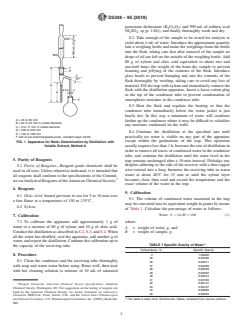
4.1 The apparatus required consists of a glass flask heated
1.2 The values stated in SI units are to be regarded as the
by suitable means and provided with a reflux condenser
standard. The values given in parentheses are provided for
discharging into a trap and connected to the flask. The
information only.
connections between the trap and the condenser and flask shall
1.3 This standard does not purport to address all of the
be interchangeable ground joints.The trap serves to collect and
safety concerns, if any, associated with its use. It is the
measure the condensed water and to return the solvent to the
responsibility of the user of this standard to establish appro-
flask.Asuitable assembly of the apparatus is illustrated in Fig.
priate safety, health, and environmental practices and deter-
1.
mine the applicability of regulatory limitations prior to use.
4.1.1 Flask, 500-mL, of either the short-neck, round-bottom
1.4 This international standard was developed in accor-
type or the Erlenmeyer type.
dance with internationally recognized principles on standard-
4.1.2 Heat Source—The source of heat may be either an oil
ization established in the Decision on Principles for the
bath (stearic acid, paraffin wax, etc.), or an electric heater
Development of International Standards, Guides and Recom-
provided with a sliding rheostat or other means of heat control.
mendations issued by the World Trade Organization Technical
4.1.3 Condenser,awater-cooledglassrefluxcondenser(Fig.
Barriers to Trade (TBT) Committee.
1), having a jacket approximately 400 mm (15 ⁄4 in.) in length
3 1
with an inner tube 9.5 to 12.7 mm ( ⁄8 to ⁄2 in.) in outside
2. Referenced Documents
diameter. The end of the condenser to be inserted in the trap
shall be ground off at an angle of 30° from the vertical axis of
2.1 ASTM Standards:
the condenser. When inserted into the trap, the tip of the
condenser shall be about 7 mm ( ⁄4 in.) above the surface of the
liquid in the trap after the distillation conditions have been
This test method is under the jurisdiction ofASTM Committee D31 on Leather
and is the direct responsibility of Subcommittee D31.08 on Fats and Oils. This test
established. Fig. 1 shows a conventional sealed-in type of
method was developed in cooperation with the American Leather Chemists Assn.
condenser, but any other condenser fulfilling the detailed
(Method H 40-1957).
requirements above may be used.
Current edition approved April 1, 2019. Published April 2019. Originally
4.1.4 Trap, a trap made of well-annealed glass constructed
approved in 1993. Last previous edition approved in 2012 as D5348 – 95(2012).
DOI: 10.1520/D5348-95R19.
in accordance with Fig. 1 and graduated as shown to contain 5
For referenced ASTM standards, visit the ASTM website, www.astm.org, or
mL at 20°C. It shall be subdivided into 0.1-mL divisions, with
contact ASTM Customer Service at service@astm.org. For Annual Book of ASTM
each 1-mL line numbered (5 mL at top). The error in any
Standards volume information, refer to the standard’s Document Summary page on
the ASTM website. indicated capacity may not be greater than 0.05 mL.
Copyright © ASTM International, 100 Barr Harbor Drive, PO Box C700, West Conshohocken, PA 19428-2959. United States
D5348−95 (2019)
potassium dichromate (K Cr O ) and 990 mL of sulfuric acid
2 2 7
(H SO , sp gr 1.84)), and finally thoroughly wash and dry.
2 4
8.2 Take enough of the sample to be tested for analysis to
yield about 4 mL of water. Introduce the approximate quantity
into a weighing bottle and make the weighings from the bottle
into the flask, taking care that after removal of the sample no
drops of oil are left on the outside of the weighing bottle. Add
80 g of xylene and
...