

ASTM D6186-19
(Test Method)Standard Test Method for Oxidation Induction Time of Lubricating Oils by Pressure Differential Scanning Calorimetry (PDSC)
General Information
- Abstract
SIGNIFICANCE AND USE
4.1 Oxidation induction time, as determined under the conditions of this test method, may be used as an indication of oxidation stability.2 This test method is faster than other oil oxidation tests and requires a very small amount of sample. It may be used for research and development, quality control, and specification purposes. However, no correlation has been established between the results of this test method and service performance.
SCOPE
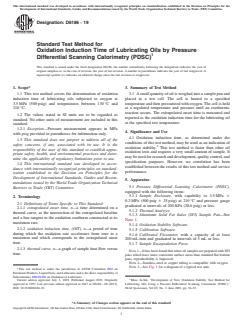
1.1 This test method covers the determination of oxidation induction time of lubricating oils subjected to oxygen at 3.5 MPa (500 psig) and temperatures between 130 °C and 210 °C.
1.2 The values stated in SI units are to be regarded as standard. No other units of measurement are included in this standard.
1.2.1 Exception—Pressure measurement appears in MPa with psig provided in parentheses for information only.
1.3 This standard does not purport to address all of the safety concerns, if any, associated with its use. It is the responsibility of the user of this standard to establish appropriate safety, health, and environmental practices and determine the applicability of regulatory limitations prior to use.
1.4 This international standard was developed in accordance with internationally recognized principles on standardization established in the Decision on Principles for the Development of International Standards, Guides and Recommendations issued by the World Trade Organization Technical Barriers to Trade (TBT) Committee.
- Status
- Published
- Publication Date
- 30-Jun-2019
- Technical Committee
- D02 - Petroleum Products, Liquid Fuels, and Lubricants
- Drafting Committee
- D02.09.0D - Oxidation of Lubricants
Buy Documents
ASTM D6186-19 - Standard Test Method for Oxidation Induction Time of Lubricating Oils by Pressure Differential Scanning Calorimetry (PDSC)
REDLINE ASTM D6186-19 - Standard Test Method for Oxidation Induction Time of Lubricating Oils by Pressure Differential Scanning Calorimetry (PDSC)
Overview
ASTM D6186-19 is the Standard Test Method for Oxidation Induction Time (OIT) of Lubricating Oils by Pressure Differential Scanning Calorimetry (PDSC). Developed by ASTM International, this method enables rapid determination of the oxidation stability of lubricating oils, providing a reliable way to assess their resistance to oxidative degradation. Unlike traditional oil oxidation tests, this method uses minimal sample quantities and delivers results more quickly, making it highly attractive for research, development, quality control, and specification purposes.
Key Topics
- Oxidation Induction Time (OIT): The primary parameter measured, representing the time taken for the oil’s oxidation rate to accelerate under controlled pressure and temperature.
- Pressure Differential Scanning Calorimetry (PDSC): The test employs a calorimeter where an oil sample is subjected to oxygen at 3.5 MPa (500 psig) and held at temperatures between 130 °C and 210 °C. The sample’s thermal response is monitored to identify the onset of oxidation.
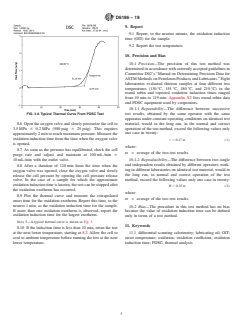
- Thermal Analysis: The method involves plotting a thermal curve of heat flow versus time. The extrapolated onset time from this curve designates the OIT.
- Repeatability and Reproducibility: The method is designed for consistent results both within and across laboratories, as established through round robin studies.
Applications
ASTM D6186-19 is widely used in the lubricants industry for several practical and commercial purposes:
- Research and Development: Assists formulators in comparing different base stocks, antioxidants, and additive packages based on oxidation stability profiles.
- Quality Control: Allows routine screening of finished lubricating oil products to ensure they meet specified oxidation resistance requirements before distribution.
- Specification Compliance: Supports oversight for contract requirements and industry specifications, particularly where oxidation stability is a key performance criterion.
- Process Improvement: Enables oil producers to rapidly evaluate batch consistency and refine manufacturing processes.
- Product Benchmarking: Facilitates competitive benchmarking and continuous improvement in finished lubricant formulations.
The test covers a comprehensive range of lubricants, including mineral oils, synthetic oils (such as PAO, polyol ester, and biodegradable fluids), vegetable-based hydraulic fluids, and gear and turbine oils.
Related Standards
Several standards are relevant or complementary to ASTM D6186-19, particularly within the field of oxidation stability testing and lubricating oil performance:
- ASTM D2272: Test Method for Oxidation Stability of Steam Turbine Oils by Rotating Pressure Vessel, a popular alternative for oxidation stability assessments.
- ASTM D7545: Test Method for Oxidation Stability of Middle Distillate Fuels and Biodiesel Blends by Rapid Small Scale Oxidation Test (RSSOT).
- ASTM D943: Standard Test Method for Oxidation Characteristics of Inhibited Mineral Oils.
- IEC 61125: Test Methods for Oxidation Stability of Insulating Liquids.
Practical Value
The ASTM D6186-19 test method delivers significant value to lubricant manufacturers, users, and formulators:
- Fast and Reliable: Highly efficient compared to conventional oxidation tests, with minimal sample volume required.
- Suitable for Broad Applications: Adaptable to mineral, synthetic, biodegradable, and hydraulic oil types.
- Supports Quality Assurance: Facilitates evidence-based decisions on batch release, product development, and troubleshooting.
- Enhances Product Performance: Enables comprehensive screening of formulations for enhanced oxidative stability, directly impacting equipment protection and oil service life.
By employing ASTM D6186-19, organizations can confidently evaluate the oxidation stability of lubricating oils, optimize product performance, and ensure compliance with industry standards.
Relations
- Effective Date
- 01-Jul-2019
- Effective Date
- 01-Jul-2019
- Effective Date
- 01-Jul-2019
- Effective Date
- 01-Jul-2019
- Effective Date
- 01-Jul-2019
- Effective Date
- 01-Jul-2019
Buy Documents
ASTM D6186-19 - Standard Test Method for Oxidation Induction Time of Lubricating Oils by Pressure Differential Scanning Calorimetry (PDSC)
REDLINE ASTM D6186-19 - Standard Test Method for Oxidation Induction Time of Lubricating Oils by Pressure Differential Scanning Calorimetry (PDSC)
Get Certified
Connect with accredited certification bodies for this standard

Element Materials Technology
Materials testing and product certification.

ABS Group Brazil
ABS Group certification services in Brazil.

ABS Quality Evaluations Inc.
American Bureau of Shipping quality certification.
Sponsored listings
Frequently Asked Questions
ASTM D6186-19 is a standard published by ASTM International. Its full title is "Standard Test Method for Oxidation Induction Time of Lubricating Oils by Pressure Differential Scanning Calorimetry (PDSC)". This standard covers: SIGNIFICANCE AND USE 4.1 Oxidation induction time, as determined under the conditions of this test method, may be used as an indication of oxidation stability.2 This test method is faster than other oil oxidation tests and requires a very small amount of sample. It may be used for research and development, quality control, and specification purposes. However, no correlation has been established between the results of this test method and service performance. SCOPE 1.1 This test method covers the determination of oxidation induction time of lubricating oils subjected to oxygen at 3.5 MPa (500 psig) and temperatures between 130 °C and 210 °C. 1.2 The values stated in SI units are to be regarded as standard. No other units of measurement are included in this standard. 1.2.1 Exception—Pressure measurement appears in MPa with psig provided in parentheses for information only. 1.3 This standard does not purport to address all of the safety concerns, if any, associated with its use. It is the responsibility of the user of this standard to establish appropriate safety, health, and environmental practices and determine the applicability of regulatory limitations prior to use. 1.4 This international standard was developed in accordance with internationally recognized principles on standardization established in the Decision on Principles for the Development of International Standards, Guides and Recommendations issued by the World Trade Organization Technical Barriers to Trade (TBT) Committee.
SIGNIFICANCE AND USE 4.1 Oxidation induction time, as determined under the conditions of this test method, may be used as an indication of oxidation stability.2 This test method is faster than other oil oxidation tests and requires a very small amount of sample. It may be used for research and development, quality control, and specification purposes. However, no correlation has been established between the results of this test method and service performance. SCOPE 1.1 This test method covers the determination of oxidation induction time of lubricating oils subjected to oxygen at 3.5 MPa (500 psig) and temperatures between 130 °C and 210 °C. 1.2 The values stated in SI units are to be regarded as standard. No other units of measurement are included in this standard. 1.2.1 Exception—Pressure measurement appears in MPa with psig provided in parentheses for information only. 1.3 This standard does not purport to address all of the safety concerns, if any, associated with its use. It is the responsibility of the user of this standard to establish appropriate safety, health, and environmental practices and determine the applicability of regulatory limitations prior to use. 1.4 This international standard was developed in accordance with internationally recognized principles on standardization established in the Decision on Principles for the Development of International Standards, Guides and Recommendations issued by the World Trade Organization Technical Barriers to Trade (TBT) Committee.
ASTM D6186-19 is classified under the following ICS (International Classification for Standards) categories: 75.100 - Lubricants, industrial oils and related products. The ICS classification helps identify the subject area and facilitates finding related standards.
ASTM D6186-19 has the following relationships with other standards: It is inter standard links to ASTM D6186-08(2013), ASTM E2744-21, ASTM E1858-23, ASTM E2046-19, ASTM E2070-13(2018), ASTM D7155-20. Understanding these relationships helps ensure you are using the most current and applicable version of the standard.
ASTM D6186-19 is available in PDF format for immediate download after purchase. The document can be added to your cart and obtained through the secure checkout process. Digital delivery ensures instant access to the complete standard document.
Standards Content (Sample)
This international standard was developed in accordance with internationally recognized principles on standardization established in the Decision on Principles for the
Development of International Standards, Guides and Recommendations issued by the World Trade Organization Technical Barriers to Trade (TBT) Committee.
Designation: D6186 − 19
Standard Test Method for
Oxidation Induction Time of Lubricating Oils by Pressure
Differential Scanning Calorimetry (PDSC)
This standard is issued under the fixed designation D6186; the number immediately following the designation indicates the year of
original adoption or, in the case of revision, the year of last revision. A number in parentheses indicates the year of last reapproval. A
superscript epsilon (´) indicates an editorial change since the last revision or reapproval.
1. Scope* 3. Summary of Test Method
1.1 This test method covers the determination of oxidation 3.1 Asmall quantity of oil is weighed into a sample pan and
induction time of lubricating oils subjected to oxygen at placed in a test cell. The cell is heated to a specified
3.5 MPa (500 psig) and temperatures between 130 °C and temperature and then pressurized with oxygen. The cell is held
210 °C. at a regulated temperature and pressure until an exothermic
reaction occurs. The extrapolated onset time is measured and
1.2 The values stated in SI units are to be regarded as
reported as the oxidation induction time for the lubricating oil
standard. No other units of measurement are included in this
at the specified test temperature.
standard.
1.2.1 Exception—Pressure measurement appears in MPa
4. Significance and Use
with psig provided in parentheses for information only.
4.1 Oxidation induction time, as determined under the
1.3 This standard does not purport to address all of the
conditions of this test method, may be used as an indication of
safety concerns, if any, associated with its use. It is the
oxidation stability. This test method is faster than other oil
responsibility of the user of this standard to establish appro-
oxidation tests and requires a very small amount of sample. It
priate safety, health, and environmental practices and deter-
maybeusedforresearchanddevelopment,qualitycontrol,and
mine the applicability of regulatory limitations prior to use.
specification purposes. However, no correlation has been
1.4 This international standard was developed in accor-
established between the results of this test method and service
dance with internationally recognized principles on standard-
performance.
ization established in the Decision on Principles for the
Development of International Standards, Guides and Recom-
5. Apparatus
mendations issued by the World Trade Organization Technical
5.1 Pressure Differential Scanning Calorimeter (PDSC),
Barriers to Trade (TBT) Committee.
equipped with the following items:
5.1.1 Sample Enclosure, with capability to 3.5 MPa 6
2. Terminology
0.2 MPa (500 psig 6 25 psig) at 210 °C and pressure gauge
2.1 Definitions of Terms Specific to This Standard:
graduated at intervals of 200 KPa (28.6 psig) or less.
2.1.1 extrapolated onset time, n—a time determined on a
5.1.2 Thermal Analyzer.
thermal curve, as the intersection of the extrapolated baseline
5.1.3 Aluminum Solid Fat Index (SFI) Sample Pan—See
and a line tangent to the oxidation exotherm constructed at its
Note 1.
maximum rate.
5.1.4 Oxidation Stability Software.
2.1.2 oxidation induction time, (OIT), n—a period of time
5.1.5 Calibration Software.
during which the oxidation rate accelerates from zero to a
5.1.6 Calibrated Flowmeter, with a capacity of at least
maximum and which corresponds to the extrapolated onset
200 mL⁄min and graduated in intervals of 5 mL or less.
time.
5.1.7 Sample Encapsulation Press.
2.1.3 thermal curve, n—a graph of sample heat flow versus
NOTE 1—It has been found that when oil samples are prepared with SFI
time.
pans which have more consistent surface areas than standard flat bottom
pans, reproducibility is improved.
NOTE 2—Stainless steel or copper tubing is compatible with oxygen.
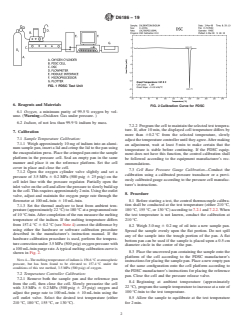
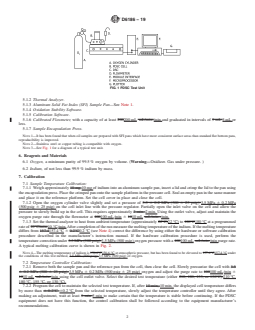
NOTE 3—See Fig. 1 for a diagram of a typical test unit.
This test method is under the jurisdiction of ASTM Committee D02 on
Petroleum Products, Liquid Fuels, and Lubricants and is the direct responsibility of
Subcommittee D02.09.0D on Oxidation of Lubricants.
Current edition approved July 1, 2019. Published August 2019. Originally Rhee, In-Sik, “Development of New Oxidation Stability Test Method for
approved in 1997. Last previous edition approved in 2013 as D6186 – 08 (2013). Lubricating Oils Using a Pressure Differential Scanning Calorimeter (PDSC),”
DOI: 10.1520/D6186-19. NLGI Spokesman, Vol 65, No. 3, June 2001, pp. 16–23.
*A Summary of Changes section appears at the end of this standard
Copyright © ASTM International, 100 Barr Harbor Drive, PO Box C700, West Conshohocken, PA 19428-2959. United States
D6186 − 19
FIG. 1 PDSC Test Unit
6. Reagents and Materials
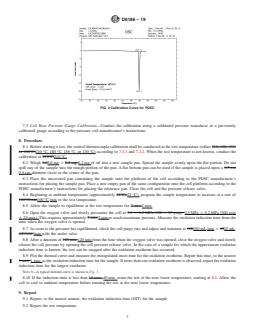
FIG. 2 Calibration Curve for PDSC
6.1 Oxygen, a minimum purity of 99.5 % oxygen by vol-
ume. (Warning—Oxidizer. Gas under pressure. )
6.2 Indium, of not less than 99.9 % indium by mass.
7.2.2 Program the cell to maintain the selected test tempera-
ture. If, after 10 min, the displayed cell temperature differs by
7. Calibration
more than 60.2 °C from the selected temperature, slowly
7.1 Sample Temperature Calibration:
adjust the temperature controller until they agree.After making
7.1.1 Weigh approximately 10 mg of indium into an alumi-
an adjustment, wait at least 5 min to make certain that the
num sample pan, insert a lid and crimp the lid to the pan using
temperature is stable before continuing. If the PDSC equip-
the encapsulation press. Place the crimped pan onto the sample
ment does not have this function, the control calibration shall
platform in the pressure cell. Seal an empty pan in the same
be followed according to the equipment manufacturer’s rec-
manner and place it on the reference platform. Set the cell
ommendations.
cover in place and close the cell.
7.3 Cell Base Pressure Gauge Calibration—Conduct the
7.1.2 Open the oxygen cylinder valve slightly and set a
calibration using a calibrated pressure transducer or a previ-
pressure of 3.5 MPa 6 0.2 MPa (500 psig 6 25 psig) on the
ously calibrated gauge according to the pressure cell manufac-
cell inlet line with the pressure regulator. Partially open the
turer’s instructions.
inlet valve on the cell and allow the pressure to slowly build up
in the cell. This requires approximately 2 min. Using the outlet
8. Procedure
valve, adjust and maintain the oxygen purge rate through the
flowmeter at 100 mL⁄min 6 10 mL⁄min. 8.1 Before starting a test, the control thermocouple calibra-
tion shall be conducted at the test temperature (either 210 °C,
7.1.3 Set the thermal analyzer to heat from ambient tem-
perature(approximately22 °C)to180 °Cataprogrammedrate 180 °C, 155 °C, or 130 °C) according to 7.2.1 and 7.2.2. When
the test temperature is not known, conduct the calibration at
of 10 °C⁄min.After completion of the run measure the melting
temperature of the indium. If the melting temperature differs 210 °C.
Note 4) correct the difference by
from 157.4 °C 6 0.2 °C (see
8.2 Weigh 3.0 mg 6 0.2 mg of oil into a new sample pan.
using either the hardware or software calibration procedure
Spread the sample evenly upon the flat portion. Do not spill
described in the manufacturer’s instruction manual. If the
any of the sample into the trough portion of the pan. A flat
hardware calibration procedure is used, perform the tempera-
bottom pan can be used if the sample is placed upon a 0.5 cm
ture correction under 3.5 MPa (500 psig) oxygen pressure with
diameter circle in the center of the pan.
a 100 mL⁄min purge rate.Atypical melting calibration curve is
8.3 Place the uncovered pan containing the sample onto the
shown in Fig. 2.
platform of the cell according to the PDSC manufacturer’s
NOTE4—Themeltingtemperatureofindiumis156.6 °Catatmospheric
instructions for placing the sample pan. Place a new empty pan
pressure, but has been found to be elevated to 157.4 °C under the
of the same configuration onto the cell platform according to
conditions of this test method, 3.5 MPa (500 psig) of oxygen.
the PDSC manufacturer’s instructions for placing the reference
7.2 Temperature Controller Calibration:
pan. Close the cell and the pr
...
This document is not an ASTM standard and is intended only to provide the user of an ASTM standard an indication of what changes have been made to the previous version. Because
it may not be technically possible to adequately depict all changes accurately, ASTM recommends that users consult prior editions as appropriate. In all cases only the current version
of the standard as published by ASTM is to be considered the official document.
Designation: D6186 − 08 (Reapproved 2013) D6186 − 19
Standard Test Method for
Oxidation Induction Time of Lubricating Oils by Pressure
Differential Scanning Calorimetry (PDSC)
This standard is issued under the fixed designation D6186; the number immediately following the designation indicates the year of
original adoption or, in the case of revision, the year of last revision. A number in parentheses indicates the year of last reapproval. A
superscript epsilon (´) indicates an editorial change since the last revision or reapproval.
1. Scope Scope*
1.1 This test method covers the determination of oxidation induction time of lubricating oils subjected to oxygen at 3.5 MPa
(500 psig) 3.5 MPa (500 psig) and temperatures between 130130 °C and 210°C.210 °C.
1.2 The values stated in SI units are to be regarded as standard. No other units of measurement are included in this standard.
1.2.1 Exception—Pressure measurement appears in MPa with psig provided in parentheses for information only.
1.3 This standard does not purport to address all of the safety concerns, if any, associated with its use. It is the responsibility
of the user of this standard to establish appropriate safety safety, health, and healthenvironmental practices and determine the
applicability of regulatory limitations prior to use.
1.4 This international standard was developed in accordance with internationally recognized principles on standardization
established in the Decision on Principles for the Development of International Standards, Guides and Recommendations issued
by the World Trade Organization Technical Barriers to Trade (TBT) Committee.
2. Terminology
2.1 Definitions of Terms Specific to This Standard:
2.1.1 extrapolated onset time, n—a time determined on a thermal curve, as the intersection of the extrapolated baseline and a
line tangent to the oxidation exotherm constructed at its maximum rate.
2.1.2 oxidation induction time, (OIT), n—a period of time during which the oxidation rate accelerates from zero to a maximum
and which corresponds to the extrapolated onset time.
2.1.3 thermal curve, n—a graph of sample heat flow versus time.
3. Summary of Test Method
3.1 A small quantity of oil is weighed into a sample pan and placed in a test cell. The cell is heated to a specified temperature
and then pressurized with oxygen. The cell is held at a regulated temperature and pressure until an exothermic reaction occurs. The
extrapolated onset time is measured and reported as the oxidation induction time for the lubricating oil at the specified test
temperature.
4. Significance and Use
4.1 Oxidation induction time, as determined under the conditions of this test method, may be used as an indication of oxidation
stability. This test method is faster than other oil oxidation tests and requires a very small amount of sample. It may be used for
research and development, quality control, and specification purposes. However, no correlation has been established between the
results of this test method and service performance.
5. Apparatus
5.1 Pressure Differential Scanning Calorimeter (PDSC), equipped with the following items:
5.1.1 Sample Enclosure, with capability to 3.5 6 0.2 MPa (500 6 25 psig) at 210°C3.5 MPa 6 0.2 MPa (500 psig 6 25 psig)
at 210 °C and pressure gauge graduated at intervals of 200 KPa (28.6 psig) 200 KPa (28.6 psig) or less.
This test method is under the jurisdiction of ASTM Committee D02 on Petroleum Products, Liquid Fuels, and Lubricants and is the direct responsibility of Subcommittee
D02.09.0D on Oxidation of Lubricants.
Current edition approved Dec. 1, 2013July 1, 2019. Published December 2013August 2019. Originally approved in 1997. Last previous edition approved in 20082013 as
D6186 – 08.D6186 – 08 (2013). DOI: 10.1520/D6186-08R13.10.1520/D6186-19.
Rhee, In-Sik, “Development of New Oxidation Stability Test Method for Lubricating Oils Using a Pressure Differential Scanning Calorimeter (PDSC),” NLGI
Spokesman, Vol 65, No. 3, June 2001, pp. 16–23.
*A Summary of Changes section appears at the end of this standard
Copyright © ASTM International, 100 Barr Harbor Drive, PO Box C700, West Conshohocken, PA 19428-2959. United States
D6186 − 19
FIG. 1 PDSC Test Unit
5.1.2 Thermal Analyzer.
5.1.3 Aluminum Solid Fat Index (SFI) Sample Pan—See Note 1.
5.1.4 Oxidation Stability Software.
5.1.5 Calibration Software.
5.1.6 Calibrated Flowmeter, with a capacity of at least 200200 mL mL/min ⁄min and graduated in intervals of 5 mL 5 mL or
less.
5.1.7 Sample Encapsulation Press.
NOTE 1—It has been found that when oil samples are prepared with SFI pans which have more consistent surface areas than standard flat bottom pans,
reproducibility is improved.
NOTE 2—Stainless steel or copper tubing is compatible with oxygen.
NOTE 3—See Fig. 1 for a diagram of a typical test unit.
6. Reagents and Materials
6.1 Oxygen, a minimum purity of 99.5 % oxygen by volume. (Warning—Oxidizer. Gas under pressure. )
6.2 Indium, of not less than 99.9 % indium by mass.
7. Calibration
7.1 Sample Temperature Calibration:
7.1.1 Weigh approximately 10 mg 10 mg of indium into an aluminum sample pan, insert a lid and crimp the lid to the pan using
the encapsulation press. Place the crimped pan onto the sample platform in the pressure cell. Seal an empty pan in the same manner
and place it on the reference platform. Set the cell cover in place and close the cell.
7.1.2 Open the oxygen cylinder valve slightly and set a pressure of 3.5 6 0.2 MPa (500 6 25 psig) 3.5 MPa 6 0.2 MPa
(500 psig 6 25 psig) on the cell inlet line with the pressure regulator. Partially open the inlet valve on the cell and allow the
pressure to slowly build up in the cell. This requires approximately 2 min. 2 min. Using the outlet valve, adjust and maintain the
oxygen purge rate through the flowmeter at 100100 mL ⁄min 6 1010 mL mL/min. ⁄min.
7.1.3 Set the thermal analyzer to heat from ambient temperature (approximately 22°C)22 °C) to 180°C180 °C at a programmed
rate of 10°C/min.10 °C ⁄min. After completion of the run measure the melting temperature of the indium. If the melting temperature
differs from 157.4157.4 °C 6 0.2°C0.2 °C (see Note 4) correct the difference by using either the hardware or software calibration
procedure described in the manufacturer’s instruction manual. If the hardware calibration procedure is used, perform the
temperature correction under 3.5 MPa (500 psig) 3.5 MPa (500 psig) oxygen pressure with a 100100 mL mL/min ⁄min purge rate.
A typical melting calibration curve is shown in Fig. 2.
NOTE 4—The melting temperature of indium is 156.6°C156.6 °C at atmospheric pressure, but has been found to be elevated to 157.4°C157.4 °C under
the conditions of this test method, 3.5 MPa (500 psig) 3.5 MPa (500 psig) of oxygen.
7.2 Temperature Controller Calibration:
7.2.1 Remove both the sample pan and the reference pan from the cell, then close the cell. Slowly pressurize the cell with 3.5
6 0.2 MPa (500 6 25 psig) 3.5 MPa 6 0.2 MPa (500 psig 6 25 psig) oxygen and adjust the purge rate to 100100 mL ⁄min 6
1010 mL mL/min ⁄min using the cell outlet valve. Select the desired test temperature (either 210, 180, 155, or 130°C).210 °C,
180 °C, 155 °C, or 130 °C).
7.2.2 Program the cell to maintain the selected test temperature. If, after 10 min, 10 min, the displayed cell temperature differs
by more than 6 0.2°C 60.2 °C from the selected temperature, slowly adjust the temperature controller until they agree. After
making an adjustment, wait at least 5 min 5 min to make certain that the temperature is stable before continuing. If the PDSC
equipment does not have this function, the control calibration shall be followed according to the equipment manufacturer’s
recommendations.
D6186 − 19
FIG. 2 Calibration Curve for PDSC
7.3 Cell Base Pressure Gauge Calibration—Conduct the calibration using a calibrated pressure transducer or a previously
calibrated gauge according to the pressure cell manufacturer’s instructions.
8. Procedure
8.1 Before starting a test, the control thermocouple calibration shall be conducted at the test temperature (either 210, 180, 155,
or 130°C)210 °C, 180 °C, 155 °C, or 130 °C) according to 7.2.1 and 7.2.2. When the test temperature is not known, conduct the
calibration at 210°C.210 °C.
8.2 Weigh 3.03.0 mg 6 0.2 mg 0.2 mg of
...