

ASTM E2744-21
(Test Method)Standard Test Method for Pressure Calibration of Thermal Analyzers
General Information
- Abstract
SIGNIFICANCE AND USE
5.1 Most thermal analysis experiments are conducted under ambient pressure conditions using isothermal or temperature time rate of change conditions where time or temperature is the independent parameter. Some experiments, however, are conducted under reduced or elevated pressure conditions where pressure is an independent experimental parameter (Test Method E537). Oxidation Induction Times (Test Methods D5483, D5885, D6186, and E1858), Oxidation Onset Temperature (Test Method E2009), and the Vapor Pressure (Test Method E1782) are other examples of experiments conducted under elevated or reduced pressure (vacuum) conditions. Since in these cases pressure is an independent variable, the measurement system for this parameter shall be calibrated to ensure interlaboratory reproducibility.
5.2 The dependence of experimental results on pressure is usually logarithmic rather than linear.
SCOPE
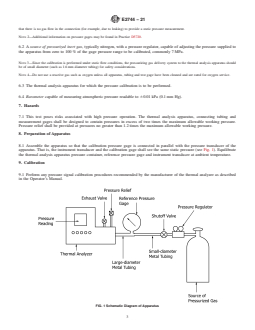
1.1 This test method describes the calibration or performance confirmation of the electronic pressure signals from thermal analysis apparatus.
1.2 The values stated in SI units are to be regarded as standard. No other units of measurement are included in this standard.
1.3 This standard does not purport to address all of the safety concerns, if any, associated with its use. It is the responsibility of the user of this standard to establish appropriate safety, health, and environmental practices and determine the applicability of regulatory limitations prior to use.
1.4 This international standard was developed in accordance with internationally recognized principles on standardization established in the Decision on Principles for the Development of International Standards, Guides and Recommendations issued by the World Trade Organization Technical Barriers to Trade (TBT) Committee.
- Status
- Published
- Publication Date
- 30-Sep-2021
- Technical Committee
- E37 - Thermal Measurements
- Drafting Committee
- E37.10 - Fundamental, Statistical and Mechanical Properties

Overview
ASTM E2744-21: Standard Test Method for Pressure Calibration of Thermal Analyzers establishes a reliable method for calibrating and confirming the performance of electronic pressure signals in thermal analysis equipment. Developed by ASTM International, this standard ensures precise and traceable pressure measurements, which are essential for accurately conducting thermal analysis experiments under ambient, reduced, or elevated pressure conditions. The method is crucial for laboratories conducting measurements where pressure is a key experimental variable, enabling consistent and comparable results across different setups and facilities.
Key Topics
- Pressure Calibration in Thermal Analysis: The standard outlines procedures for calibrating the pressure measurement system of thermal analyzers. Conformance is verified by comparing the instrument’s pressure signal against a reference gage traceable to a national metrology institute.
- Absolute vs. Gage Pressure: The method addresses the importance of both gage pressure (relative to atmospheric pressure) and absolute pressure (sum of gage and atmospheric pressure) in experiments and calibration.
- Interlaboratory Reproducibility: Recognizing that pressure is often a logarithmic variable in thermal analysis, the standard emphasizes the need for reproducibility between laboratories through proper calibration protocols.
- Reporting and Traceability: Detailed reporting guidelines are provided to document calibration constants, conformity values, and equipment details, supporting the traceability and validation of results.
Applications
- Thermal Analysis Experiments: Essential for methods where pressure is an independent experimental parameter, such as:
- Oxidation Induction Time (OIT) tests for lubricating greases, oils, hydrocarbons, and geosynthetics.
- Determining oxidation onset temperature and vapor pressure using differential scanning calorimetry (DSC) or related techniques.
- Quality Control and Research Laboratories: Laboratories utilizing thermal analyzers benefit from compliance with ASTM E2744-21 by ensuring data integrity, instrument comparability, and adherence to quality assurance requirements.
- Industrial and Academic Research: Used in materials science, petrochemical analysis, and geotechnical studies where accurate control and measurement of pressure during thermal events are critical.
- Instrument Maintenance: Manufacturers and operators employ this method for routine calibration, performance confirmation, and during instrument commissioning or after repairs.
Related Standards
ASTM E2744-21 references and aligns with several other key ASTM standards to enhance measurement accuracy and consistency, including:
- ASTM D5483, D5885, D6186, and E1858: Test methods involving Oxidation Induction Time under controlled pressures.
- ASTM E2009: Oxidation Onset Temperature of hydrocarbons.
- ASTM E1782: Determination of vapor pressure by thermal analysis.
- ASTM E537: Thermal stability of chemicals by differential scanning calorimetry.
- ASTM D5720: (Withdrawn) Practice for static calibration of electronic pressure measurement systems.
- ASTM E473, E1142, and E2161: Terminology relating to thermal analysis, thermophysical properties, and performance validation.
Adherence to ASTM E2744-21 helps laboratories operate in accordance with globally recognized standards, supporting efforts toward traceability, data validity, and regulatory compliance in thermal analysis and materials testing environments.
Keywords: ASTM E2744-21, pressure calibration, thermal analyzer, absolute pressure, gage pressure, calibration standard, thermal analysis, laboratory calibration, pressure measurement, reproducibility, traceability.
Relations
- Effective Date
- 01-Oct-2023
- Effective Date
- 01-Oct-2023
- Effective Date
- 01-Feb-2020
- Effective Date
- 01-Jul-2019
- Effective Date
- 01-Oct-2015
- Effective Date
- 01-Sep-2015
- Effective Date
- 01-May-2015
- Effective Date
- 15-Aug-2014
- Effective Date
- 15-Aug-2014
- Effective Date
- 01-Apr-2014
- Effective Date
- 15-Feb-2014
- Effective Date
- 01-Dec-2013
- Effective Date
- 01-Mar-2013
- Effective Date
- 01-Dec-2012
- Effective Date
- 01-Sep-2012
Get Certified
Connect with accredited certification bodies for this standard

BSMI (Bureau of Standards, Metrology and Inspection)
Taiwan's standards and inspection authority.
Sponsored listings
Frequently Asked Questions
ASTM E2744-21 is a standard published by ASTM International. Its full title is "Standard Test Method for Pressure Calibration of Thermal Analyzers". This standard covers: SIGNIFICANCE AND USE 5.1 Most thermal analysis experiments are conducted under ambient pressure conditions using isothermal or temperature time rate of change conditions where time or temperature is the independent parameter. Some experiments, however, are conducted under reduced or elevated pressure conditions where pressure is an independent experimental parameter (Test Method E537). Oxidation Induction Times (Test Methods D5483, D5885, D6186, and E1858), Oxidation Onset Temperature (Test Method E2009), and the Vapor Pressure (Test Method E1782) are other examples of experiments conducted under elevated or reduced pressure (vacuum) conditions. Since in these cases pressure is an independent variable, the measurement system for this parameter shall be calibrated to ensure interlaboratory reproducibility. 5.2 The dependence of experimental results on pressure is usually logarithmic rather than linear. SCOPE 1.1 This test method describes the calibration or performance confirmation of the electronic pressure signals from thermal analysis apparatus. 1.2 The values stated in SI units are to be regarded as standard. No other units of measurement are included in this standard. 1.3 This standard does not purport to address all of the safety concerns, if any, associated with its use. It is the responsibility of the user of this standard to establish appropriate safety, health, and environmental practices and determine the applicability of regulatory limitations prior to use. 1.4 This international standard was developed in accordance with internationally recognized principles on standardization established in the Decision on Principles for the Development of International Standards, Guides and Recommendations issued by the World Trade Organization Technical Barriers to Trade (TBT) Committee.
SIGNIFICANCE AND USE 5.1 Most thermal analysis experiments are conducted under ambient pressure conditions using isothermal or temperature time rate of change conditions where time or temperature is the independent parameter. Some experiments, however, are conducted under reduced or elevated pressure conditions where pressure is an independent experimental parameter (Test Method E537). Oxidation Induction Times (Test Methods D5483, D5885, D6186, and E1858), Oxidation Onset Temperature (Test Method E2009), and the Vapor Pressure (Test Method E1782) are other examples of experiments conducted under elevated or reduced pressure (vacuum) conditions. Since in these cases pressure is an independent variable, the measurement system for this parameter shall be calibrated to ensure interlaboratory reproducibility. 5.2 The dependence of experimental results on pressure is usually logarithmic rather than linear. SCOPE 1.1 This test method describes the calibration or performance confirmation of the electronic pressure signals from thermal analysis apparatus. 1.2 The values stated in SI units are to be regarded as standard. No other units of measurement are included in this standard. 1.3 This standard does not purport to address all of the safety concerns, if any, associated with its use. It is the responsibility of the user of this standard to establish appropriate safety, health, and environmental practices and determine the applicability of regulatory limitations prior to use. 1.4 This international standard was developed in accordance with internationally recognized principles on standardization established in the Decision on Principles for the Development of International Standards, Guides and Recommendations issued by the World Trade Organization Technical Barriers to Trade (TBT) Committee.
ASTM E2744-21 is classified under the following ICS (International Classification for Standards) categories: 17.200.20 - Temperature-measuring instruments. The ICS classification helps identify the subject area and facilitates finding related standards.
ASTM E2744-21 has the following relationships with other standards: It is inter standard links to ASTM E1142-23b, ASTM E473-23b, ASTM E537-20, ASTM D6186-19, ASTM D5483-05(2015), ASTM E2161-15, ASTM E1142-15, ASTM E1142-14b, ASTM E473-14, ASTM E1142-14a, ASTM E1142-14, ASTM D6186-08(2013), ASTM E2161-13, ASTM E537-12, ASTM E1142-12. Understanding these relationships helps ensure you are using the most current and applicable version of the standard.
ASTM E2744-21 is available in PDF format for immediate download after purchase. The document can be added to your cart and obtained through the secure checkout process. Digital delivery ensures instant access to the complete standard document.
Standards Content (Sample)
This international standard was developed in accordance with internationally recognized principles on standardization established in the Decision on Principles for the
Development of International Standards, Guides and Recommendations issued by the World Trade Organization Technical Barriers to Trade (TBT) Committee.
Designation: E2744 − 21
Standard Test Method for
Pressure Calibration of Thermal Analyzers
This standard is issued under the fixed designation E2744; the number immediately following the designation indicates the year of
original adoption or, in the case of revision, the year of last revision. A number in parentheses indicates the year of last reapproval. A
superscript epsilon (´) indicates an editorial change since the last revision or reapproval.
1. Scope* olefin Geosynthetics by High-Pressure Differential Scan-
ning Calorimetry
1.1 This test method describes the calibration or perfor-
E473 Terminology Relating to Thermal Analysis and Rhe-
mance confirmation of the electronic pressure signals from
ology
thermal analysis apparatus.
E537 Test Method for Thermal Stability of Chemicals by
1.2 The values stated in SI units are to be regarded as
Differential Scanning Calorimetry
standard. No other units of measurement are included in this
E1142 Terminology Relating to Thermophysical Properties
standard.
E1782 Test Method for Determining Vapor Pressure by
1.3 This standard does not purport to address all of the
Thermal Analysis
safety concerns, if any, associated with its use. It is the E1858 Test Methods for Determining Oxidation Induction
responsibility of the user of this standard to establish appro-
Time of Hydrocarbons by Differential Scanning Calorim-
priate safety, health, and environmental practices and deter- etry
mine the applicability of regulatory limitations prior to use.
E2009 Test Methods for Oxidation Onset Temperature of
1.4 This international standard was developed in accor- Hydrocarbons by Differential Scanning Calorimetry
dance with internationally recognized principles on standard-
E2161 Terminology Relating to Performance Validation in
ization established in the Decision on Principles for the Thermal Analysis and Rheology
Development of International Standards, Guides and Recom-
mendations issued by the World Trade Organization Technical
3. Terminology
Barriers to Trade (TBT) Committee.
3.1 Definitions:
3.1.1 The technical terms used in this test method are
2. Referenced Documents
defined in Terminologies E473, E1142, and E2161, including
2.1 ASTM Standards:
calibration, Celsius, differential scanning calorimetry, high
D5483 Test Method for Oxidation Induction Time of Lubri-
pressure, linearity, oxidative induction time, thermal analysis,
catingGreasesbyPressureDifferentialScanningCalorim-
and vapor pressure.
etry
3.2 Definitions of Terms Specific to This Standard:
D6186 Test Method for Oxidation Induction Time of Lubri-
3.2.1 absolute pressure, n—pressure measured relative to
cating Oils by Pressure Differential Scanning Calorimetry
zero pressure corresponding to empty space.
(PDSC)
3.2.1.1 Discussion—Absolute pressure is atmospheric pres-
D5720 Practice for Static Calibration of Electronic
sure plus gage pressure.
Transducer-Based Pressure Measurement Systems for
Geotechnical Purposes (Withdrawn 2018)
3.2.2 atmospheric pressure, n—the pressure due to the
D5885 Test Method for Oxidative Induction Time of Poly-
weight of the atmosphere.
3.2.2.1 Discussion—Atmospheric pressure varies with el-
evation above sea level, acceleration due to gravity and
1 weather conditions. Standard atmospheric pressure is
ThistestmethodisunderthejurisdictionofASTMCommitteeE37onThermal
Measurements and is the direct responsibility of Subcommittee E37.10 on
101.325 kPa.
Fundamental, Statistical and Mechanical Properties.
3.2.3 barometer, n—an instrument for measuring atmo-
Current edition approved Oct. 1, 2021. Published November 2021. Originally
ɛ1
approved in 2010. Last previous edition approved in 2016 as E2744 – 16 .
spheric pressure.
DOI:101520/E2744-21.
2 3.2.4 gage pressure, n—pressure measured relative to atmo-
For referenced ASTM standards, visit the ASTM website, www.astm.org, or
contact ASTM Customer Service at service@astm.org. For Annual Book of ASTM
spheric pressure.
Standards volume information, refer to the standard’s Document Summary page on
3.2.4.1 Discussion—Zero gage pressure is equal to atmo-
the ASTM website.
spheric pressure. Gage pressure is the difference between
The last approved version of this historical standard is referenced on
www.astm.org. absolute pressure and atmospheric pressure.
*A Summary of Changes section appears at the end of this standard
Copyright © ASTM International, 100 Barr Harbor Drive, PO Box C700, West Conshohocken, PA 19428-2959. United States
E2744 − 21
3.2.5 pressure, n—the force exerted to a surface per unit 6.4 Barometer capable of measuring atmospheric pressure
area. readable to 60.01 kPa (0.1 mm Hg).
3.2.6 vacuum, n—pressure less than atmospheric pressure.
7. Hazards
7.1 This test poses risks associated with high pressure
4. Summary of Test Method
operation. The thermal analysis apparatus, connecting tubing
4.1 The pressure (vacuum) signal generated by a thermal
and measurement gages shall be designed to contain pressures
analyzer is compared to a gage whose performance is known
in excess of two times the maximum allowable working
and traceable to a national metrology institute. The thermal
pressure. Pressure relief shall be provided at pressures no
analyzer may be said to be in conformance if the performance
greater than 1.2 times the maximum allowable working pres-
is within established limits. Alternately, the pressure signal
sure.
may be calibrated using a two-point calibration method.
8. Preparation of Apparatus
5. Significance and Use
8.1 Assemble the apparatus so that the calibration pressure
5.1 Most thermal analysis experiments are conducted under
gageisconnectedinparallelwiththepressuretransducerofthe
ambient pressure conditions using isothermal or temperature
apparatus.Thatis,theinstrumenttransducerandthecalibration
timerateofchangeconditionswheretimeortemperatureisthe
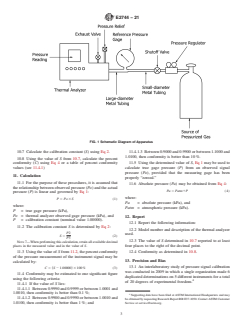
gage shall see the same static pressure (see Fig. 1). Equilibrate
independent parameter. Some experiments, however, are con-
the thermal analysis apparatus pressure container, reference
ducted under reduced or elevated pressure conditions where
pressure gage and instrument transducer at ambient tempera-
pressure is an independent experimental parameter (Test
ture.
Method E537). Oxidation Induction Times (Test Methods
D5483, D5885, D6186, and E1858), Oxidation Onset Tem-
9. Calibration
perature (Test Method E2009), and the Vapor Pressure (Test
9.1 Perform any pressure signal calibration procedures rec-
Method E1782) are other examples of experiments conducted
ommended by the manufacturer of the thermal analyzer as
under elevated or reduced pressure (vacuum) conditions. Since
described in the Operator’s Manual.
in these cases pressure is an independent variable, the mea-
surementsystemforthisparametershallbecalibratedtoensure
10. Procedure
interlaboratory reproducibility.
10.1 Electronic pressure signals associated with thermal
5.2 The dependence of experimental results on pressure is
analysis apparatus measure gage pressure relative to atmo-
usually logarithmic rather than linear.
spheric pressure. However, absolute pressure is most often
required for thermal analysis experiments.Absolute pressure is
6. Apparatus
the sum of gage pressure and atmospheric pressure. So
6.1 Reference pressure gage with a range 1.2 times the
knowledge of atmospheric pressure is required to obtain
maximumvaluetobecalibratedreadabletowithin0.1 %ofthe
absolute pressure.
full range and performance of which has been verified using
10.2 Using a laboratory barometer, measure and record the
standards and procedures traceable to a national metrology
atmospheric pressure (Patm) within one hour of the pressure
institute (such as the National Institute of Standards and
calibration in steps 10.4 – 10.6.
Technology (NIST)).
NOTE 5—Should a laboratory barometer be unavailable, local pressure
may often be obtained by contacting
...
This document is not an ASTM standard and is intended only to provide the user of an ASTM standard an indication of what changes have been made to the previous version. Because
it may not be technically possible to adequately depict all changes accurately, ASTM recommends that users consult prior editions as appropriate. In all cases only the current version
of the standard as published by ASTM is to be considered the official document.
´1
Designation: E2744 − 16 E2744 − 21
Standard Test Method for
Pressure Calibration of Thermal Analyzers
This standard is issued under the fixed designation E2744; the number immediately following the designation indicates the year of
original adoption or, in the case of revision, the year of last revision. A number in parentheses indicates the year of last reapproval. A
superscript epsilon (´) indicates an editorial change since the last revision or reapproval.
ε NOTE—Research report information was editorially added to 13.1 in January 2018.
1. Scope*
1.1 This test method describes the calibration or performance confirmation of the electronic pressure signals from thermal analysis
apparatus.
1.2 The values stated in SI units are to be regarded as standard. No other units of measurement are included in this standard.
1.3 There is no ISO standard equivalent to this test method.
1.3 This standard does not purport to address all of the safety concerns, if any, associated with its use. It is the responsibility
of the user of this standard to establish appropriate safety, health, and environmental practices and determine the applicability of
regulatory limitations prior to use.
1.4 This international standard was developed in accordance with internationally recognized principles on standardization
established in the Decision on Principles for the Development of International Standards, Guides and Recommendations issued
by the World Trade Organization Technical Barriers to Trade (TBT) Committee.
2. Referenced Documents
2.1 ASTM Standards:
D5483 Test Method for Oxidation Induction Time of Lubricating Greases by Pressure Differential Scanning Calorimetry
D6186 Test Method for Oxidation Induction Time of Lubricating Oils by Pressure Differential Scanning Calorimetry (PDSC)
D5720 Practice for Static Calibration of Electronic Transducer-Based Pressure Measurement Systems for Geotechnical Purposes
(Withdrawn 2018)
D5885 Test Method for Oxidative Induction Time of Polyolefin Geosynthetics by High-Pressure Differential Scanning
Calorimetry
E473 Terminology Relating to Thermal Analysis and Rheology
E537 Test Method for Thermal Stability of Chemicals by Differential Scanning Calorimetry
E1142 Terminology Relating to Thermophysical Properties
E1782 Test Method for Determining Vapor Pressure by Thermal Analysis
E1858 Test Methods for Determining Oxidation Induction Time of Hydrocarbons by Differential Scanning Calorimetry
E2009 Test Methods for Oxidation Onset Temperature of Hydrocarbons by Differential Scanning Calorimetry
This test method is under the jurisdiction of ASTM Committee E37 on Thermal Measurements and is the direct responsibility of Subcommittee E37.10 on Fundamental,
Statistical and Mechanical Properties.
Current edition approved Feb. 15, 2016Oct. 1, 2021. Published March 2016November 2021. Originally approved in 2010. Last previous edition approved in 20152016
ɛ1
as E2744 – 1016 (2015). DOI:101520/E2744-16E01. DOI:101520/E2744-21.
For referenced ASTM standards, visit the ASTM website, www.astm.org, or contact ASTM Customer Service at service@astm.org. For Annual Book of ASTM Standards
volume information, refer to the standard’s Document Summary page on the ASTM website.
The last approved version of this historical standard is referenced on www.astm.org.
*A Summary of Changes section appears at the end of this standard
Copyright © ASTM International, 100 Barr Harbor Drive, PO Box C700, West Conshohocken, PA 19428-2959. United States
E2744 − 21
E2161 Terminology Relating to Performance Validation in Thermal Analysis and Rheology
3. Terminology
3.1 Definitions:
3.1.1 The technical terms used in this test method are defined in Terminologies E473, E1142, and E2161, including calibration,
Celsius, differential scanning calorimetry, high pressure, linearity, oxidative induction time, thermal analysis, and vapor pressure.
3.2 Definitions of Terms Specific to This Standard:
3.2.1 absolute pressure, n—pressure measured relative to zero pressure corresponding to empty space.
3.2.1.1 Discussion—
Absolute pressure is atmospheric pressure plus gage pressure.
3.2.2 atmospheric pressure, n—the pressure due to the weight of the atmosphere.
3.2.2.1 Discussion—
Atmospheric pressure varies with elevation above sea level, acceleration due to gravity and weather conditions. Standard
atmospheric pressure is 101.325 kPa.
3.2.3 barometer, n—an instrument for measuring atmospheric pressure.
3.2.4 gage pressure, n—pressure measured relative to atmospheric pressure.
3.2.4.1 Discussion—
Zero gage pressure is equal to atmospheric pressure. Gage pressure is the difference between absolute pressure and atmospheric
pressure.
3.2.5 pressure, n—the force exerted to a surface per unit area.
3.2.6 vacuum, n—pressure less than atmospheric pressure.
4. Summary of Test Method
4.1 The pressure (vacuum) signal generated by a thermal analyzer is compared to a gage whose performance is known and
traceable to a national metrology institute. The thermal analyzer may be said to be in conformance if the performance is within
established limits. Alternately, the pressure signal may be calibrated using a two-point calibration method.
5. Significance and Use
5.1 Most thermal analysis experiments are conducted under ambient pressure conditions using isothermal or temperature time rate
of change conditions where time or temperature is the independent parameter. Some experiments, however, are conducted under
reduced or elevated pressure conditions where pressure is an independent experimental parameter (Test Method E537). Oxidation
Induction Times (Test Methods D5483, D5885, D6186, and E1858), Oxidation Onset Temperature (Test Method E2009), and the
Vapor Pressure (Test Method E1782) are other examples of experiments conducted under elevated or reduced pressure (vacuum)
conditions. Since in these cases pressure is an independent variable, the measurement system for this parameter shall be calibrated
to ensure interlaboratory reproducibility.
5.2 The dependence of experimental results on pressure is usually logarithmic rather than linear.
6. Apparatus
6.1 Reference pressure gage with a range 1.2 times the maximum value to be calibrated readable to within 0.1 % of the full range
and performance of which has been verified using standards and procedures traceable to a national metrology institute (such as the
National Institute of Standards and Technology (NIST)).
NOTE 1—To ensure an accurate pressure measurement, the reference pressure gage shall be placed as close as practical to the thermal analysis apparatus
to be calibrated and connected to the thermal analysis apparatus with large diameter tubing such as 6.3 mm or larger especially for vacuum testing. Ensure
E2744 − 21
that there is no gas flow in the connection (for example, due to leaking) to provide a static pressure measurement.
NOTE 2—Additional information on pressure gages may be found in Practice D5720.
6.2 A source of pressurized inert gas, typically nitrogen, with a pressure regulator, capable of adjusting the pressure supplied to
the apparatus from zero to 100 % of the gage pressure range to be calibrated, commonly 7 MPa.
NOTE 3—Since the calibration is performed under static flow conditions, the pressurizing gas delivery system to the thermal analysis apparatus should
be of small diameter (such as 1.6 mm diameter tubing) for safety considerations.
NOTE 4—Do not use a reactive gas such as oxygen unless all apparatus, tubing and test gage have been cleaned and are rated for oxygen service.
6.3 The thermal analysis apparatus for which the pressure calibration is to be performed.
6.4 Barometer capable of measuring atmospheric pressure readable to 60.01 kPa (0.1 mm Hg).
7. Hazards
7.1 This test poses risks associated with high pressure operation. The thermal analysis apparatus, connecting tubing and
measurement gages shall be designed to contain pressures in excess of two times the maximum allowable working press
...