

ASTM D4754-18
(Test Method)Standard Test Method for Two-Sided Liquid Extraction of Plastic Materials Using FDA Migration Cell
General Information
- Abstract
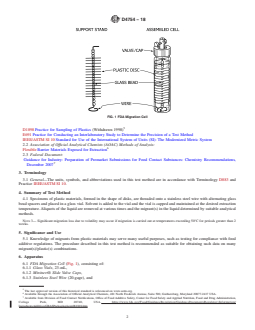
SIGNIFICANCE AND USE
5.1 Knowledge of migrants from plastic materials may serve many useful purposes, such as testing for compliance with food additive regulations. The procedure described in this test method is recommended as suitable for obtaining such data on many migrant(s)/plastic(s) combinations.
SCOPE
1.1 This test method covers the use of the FDA migration cell in the extraction of components and permits quantitation of individual migrants from plastic materials by suitable extracting liquids, including liquid foods and food-stimulating solvents.
1.2 This test method provides a two-sided, liquid extraction test for plastic materials that can be formed into film, sheet, or disks.
1.3 This test method has been applied to a variety of migrant/polymer systems in contact with numerous foods and food simulants.2 Though most of the migrants examined were radiolabeled, the use of the FDA cell has been validated for migration studies of unlabeled sytrene from polystyrene.3
1.4 This test method has been shown to yield reproducible results under the conditions for migration tests requested by the FDA. However, if the data is to be submitted to the FDA, it is suggested that their guidelines be consulted.
1.5 Because it employs two-sided extraction, this test method may not be suitable for multi-layered plastics intended for single-sided food contact use.
1.6 The size of the FDA migration cell as described may preclude its use in determining total nonvolatile extractives in some cases.
Note 1: For more information, see Practice D1898, the AOAC Methods of Analysis on Flexible Barrier Materials Exposed for Extraction, and the Guidance for Industry: Preparation of Premarket Submissions for Food Contact Substances: Chemistry Recommendations, December 2007.
1.7 Analytical procedures must be available to quantitate the migrant(s) generated by this test method.
1.8 The values stated in SI units are to be regarded as the standard.
1.9 This standard does not purport to address all of the safety concerns, if any, associated with its use. It is the responsibility of the user of this standard to establish appropriate safety, health, and environmental practices and determine the applicability of regulatory limitations prior to use. Specific hazards statements are given in Section 8.
Note 2: There is no known ISO equivalent to this test method.
1.10 This international standard was developed in accordance with internationally recognized principles on standardization established in the Decision on Principles for the Development of International Standards, Guides and Recommendations issued by the World Trade Organization Technical Barriers to Trade (TBT) Committee.
- Status
- Published
- Publication Date
- 30-Apr-2018
- Technical Committee
- D20 - Plastics
- Drafting Committee
- D20.70 - Analytical Methods
Buy Documents
ASTM D4754-18 - Standard Test Method for Two-Sided Liquid Extraction of Plastic Materials Using FDA Migration Cell
REDLINE ASTM D4754-18 - Standard Test Method for Two-Sided Liquid Extraction of Plastic Materials Using FDA Migration Cell
Overview
ASTM D4754-18: Standard Test Method for Two-Sided Liquid Extraction of Plastic Materials Using FDA Migration Cell, provides a systematic approach for assessing the migration of substances from plastic materials into liquids. The method uses the FDA migration cell to extract and quantify individual migrants from plastics using various extracting liquids, including liquid foods and food-simulating solvents. This standard is widely referenced for regulatory compliance, particularly in the context of food contact materials, helping manufacturers ensure their plastic products meet safety and quality requirements.
Key Topics
- Migration Testing for Plastics: This standard outlines the two-sided extraction procedure using the FDA migration cell, making it suitable for films, sheets, and disks formed from plastic materials.
- Quantification of Migrants: Users can determine the quantity of specific migrants leached from plastics under controlled conditions, including their concentration in extraction liquids.
- Regulatory Compliance: The method supports testing for compliance with food additive regulations and other legal requirements regarding indirect food additives and residues from plastic food packaging.
- Reproducibility: The method is validated to provide reproducible results for a broad range of plastic/migrant systems, even at conditions requested by the FDA.
- Analytical Flexibility: The standard accommodates a variety of analytical methods for quantifying migrants, which must be validated to ensure accuracy and reliability.
- Safety Considerations: Users are responsible for implementing appropriate safety measures, as the process may involve hazardous chemicals and conditions.
Applications
ASTM D4754-18 is a valuable tool in several practical contexts:
- Food Packaging Testing: Evaluate the safety of plastic packaging materials for direct and indirect food contact by identifying potential migrant substances.
- Research and Product Development: Screen new polymers or additives for migration behavior prior to commercial release or regulatory submission.
- Regulatory Submissions: Generate data required for premarket submissions to regulatory agencies, such as the FDA, concerning food contact substances.
- Quality Control: Monitor batch-to-batch consistency in plastic manufacturing by measuring migration levels and ensuring ongoing compliance with industry and government standards.
- Material Comparison: Compare the extraction characteristics of different plastic formulations or suppliers to select safer or more compliant materials.
Limitations:
- Not suitable for multi-layered plastics intended for single-sided food contact.
- May not reliably measure total nonvolatile extractives due to cell size restrictions.
- The standard lacks a direct ISO equivalent, though it references related practices and guidance for industry.
Related Standards
- ASTM D883: Terminology Relating to Plastics.
- ASTM E691: Practice for Conducting an Interlaboratory Study to Determine the Precision of a Test Method.
- AOAC Methods of Analysis: Procedures for testing flexible barrier materials exposed to extraction.
- Guidance for Industry: Preparation of Premarket Submissions for Food Contact Substances: Chemistry Recommendations (FDA, December 2007).
- ASTM D1898 (withdrawn): Practice for Sampling of Plastics.
For complete compliance and to enhance the reliability of migration testing, reference these standards and guidelines alongside ASTM D4754-18.
Keywords: ASTM D4754-18, FDA migration cell, plastic migration testing, two-sided extraction, polymer extraction, food packaging compliance, migration cell, food contact material, regulatory testing, ASTM standards.
Relations
- Effective Date
- 01-May-2018
- Effective Date
- 01-Feb-2024
- Effective Date
- 01-Nov-2023
- Effective Date
- 29-Sep-2023
- Effective Date
- 01-Jan-2020
- Effective Date
- 01-Aug-2019
- Effective Date
- 15-Apr-2019
- Effective Date
- 01-Feb-2019
- Effective Date
- 01-Dec-2018
- Effective Date
- 01-Nov-2018
- Effective Date
- 15-Aug-2017
- Effective Date
- 01-May-2013
- Effective Date
- 15-Nov-2012
- Effective Date
- 01-Nov-2011
- Effective Date
- 15-May-2011
Buy Documents
ASTM D4754-18 - Standard Test Method for Two-Sided Liquid Extraction of Plastic Materials Using FDA Migration Cell
REDLINE ASTM D4754-18 - Standard Test Method for Two-Sided Liquid Extraction of Plastic Materials Using FDA Migration Cell
Get Certified
Connect with accredited certification bodies for this standard

DIN CERTCO
DIN Group product certification.

Smithers Quality Assessments
US management systems and product certification.
Sponsored listings
Frequently Asked Questions
ASTM D4754-18 is a standard published by ASTM International. Its full title is "Standard Test Method for Two-Sided Liquid Extraction of Plastic Materials Using FDA Migration Cell". This standard covers: SIGNIFICANCE AND USE 5.1 Knowledge of migrants from plastic materials may serve many useful purposes, such as testing for compliance with food additive regulations. The procedure described in this test method is recommended as suitable for obtaining such data on many migrant(s)/plastic(s) combinations. SCOPE 1.1 This test method covers the use of the FDA migration cell in the extraction of components and permits quantitation of individual migrants from plastic materials by suitable extracting liquids, including liquid foods and food-stimulating solvents. 1.2 This test method provides a two-sided, liquid extraction test for plastic materials that can be formed into film, sheet, or disks. 1.3 This test method has been applied to a variety of migrant/polymer systems in contact with numerous foods and food simulants.2 Though most of the migrants examined were radiolabeled, the use of the FDA cell has been validated for migration studies of unlabeled sytrene from polystyrene.3 1.4 This test method has been shown to yield reproducible results under the conditions for migration tests requested by the FDA. However, if the data is to be submitted to the FDA, it is suggested that their guidelines be consulted. 1.5 Because it employs two-sided extraction, this test method may not be suitable for multi-layered plastics intended for single-sided food contact use. 1.6 The size of the FDA migration cell as described may preclude its use in determining total nonvolatile extractives in some cases. Note 1: For more information, see Practice D1898, the AOAC Methods of Analysis on Flexible Barrier Materials Exposed for Extraction, and the Guidance for Industry: Preparation of Premarket Submissions for Food Contact Substances: Chemistry Recommendations, December 2007. 1.7 Analytical procedures must be available to quantitate the migrant(s) generated by this test method. 1.8 The values stated in SI units are to be regarded as the standard. 1.9 This standard does not purport to address all of the safety concerns, if any, associated with its use. It is the responsibility of the user of this standard to establish appropriate safety, health, and environmental practices and determine the applicability of regulatory limitations prior to use. Specific hazards statements are given in Section 8. Note 2: There is no known ISO equivalent to this test method. 1.10 This international standard was developed in accordance with internationally recognized principles on standardization established in the Decision on Principles for the Development of International Standards, Guides and Recommendations issued by the World Trade Organization Technical Barriers to Trade (TBT) Committee.
SIGNIFICANCE AND USE 5.1 Knowledge of migrants from plastic materials may serve many useful purposes, such as testing for compliance with food additive regulations. The procedure described in this test method is recommended as suitable for obtaining such data on many migrant(s)/plastic(s) combinations. SCOPE 1.1 This test method covers the use of the FDA migration cell in the extraction of components and permits quantitation of individual migrants from plastic materials by suitable extracting liquids, including liquid foods and food-stimulating solvents. 1.2 This test method provides a two-sided, liquid extraction test for plastic materials that can be formed into film, sheet, or disks. 1.3 This test method has been applied to a variety of migrant/polymer systems in contact with numerous foods and food simulants.2 Though most of the migrants examined were radiolabeled, the use of the FDA cell has been validated for migration studies of unlabeled sytrene from polystyrene.3 1.4 This test method has been shown to yield reproducible results under the conditions for migration tests requested by the FDA. However, if the data is to be submitted to the FDA, it is suggested that their guidelines be consulted. 1.5 Because it employs two-sided extraction, this test method may not be suitable for multi-layered plastics intended for single-sided food contact use. 1.6 The size of the FDA migration cell as described may preclude its use in determining total nonvolatile extractives in some cases. Note 1: For more information, see Practice D1898, the AOAC Methods of Analysis on Flexible Barrier Materials Exposed for Extraction, and the Guidance for Industry: Preparation of Premarket Submissions for Food Contact Substances: Chemistry Recommendations, December 2007. 1.7 Analytical procedures must be available to quantitate the migrant(s) generated by this test method. 1.8 The values stated in SI units are to be regarded as the standard. 1.9 This standard does not purport to address all of the safety concerns, if any, associated with its use. It is the responsibility of the user of this standard to establish appropriate safety, health, and environmental practices and determine the applicability of regulatory limitations prior to use. Specific hazards statements are given in Section 8. Note 2: There is no known ISO equivalent to this test method. 1.10 This international standard was developed in accordance with internationally recognized principles on standardization established in the Decision on Principles for the Development of International Standards, Guides and Recommendations issued by the World Trade Organization Technical Barriers to Trade (TBT) Committee.
ASTM D4754-18 is classified under the following ICS (International Classification for Standards) categories: 83.080.01 - Plastics in general. The ICS classification helps identify the subject area and facilitates finding related standards.
ASTM D4754-18 has the following relationships with other standards: It is inter standard links to ASTM D4754-11, ASTM D883-24, ASTM D883-23, ASTM D1898-68(1989), ASTM D883-20, ASTM D883-19c, ASTM D883-19a, ASTM D883-19, ASTM D883-18a, ASTM D883-18, ASTM D883-17, ASTM E691-13, ASTM D883-12e1, ASTM E691-11, ASTM D883-11. Understanding these relationships helps ensure you are using the most current and applicable version of the standard.
ASTM D4754-18 is available in PDF format for immediate download after purchase. The document can be added to your cart and obtained through the secure checkout process. Digital delivery ensures instant access to the complete standard document.
Standards Content (Sample)
This international standard was developed in accordance with internationally recognized principles on standardization established in the Decision on Principles for the
Development of International Standards, Guides and Recommendations issued by the World Trade Organization Technical Barriers to Trade (TBT) Committee.
Designation: D4754 − 18
Standard Test Method for
Two-Sided Liquid Extraction of Plastic Materials Using FDA
Migration Cell
This standard is issued under the fixed designation D4754; the number immediately following the designation indicates the year of
original adoption or, in the case of revision, the year of last revision. A number in parentheses indicates the year of last reapproval. A
superscript epsilon (´) indicates an editorial change since the last revision or reapproval.
1. Scope* 1.7 Analytical procedures must be available to quantitate
the migrant(s) generated by this test method.
1.1 This test method covers the use of the FDA migration
cellintheextractionofcomponentsandpermitsquantitationof 1.8 The values stated in SI units are to be regarded as the
individual migrants from plastic materials by suitable extract- standard.
ing liquids, including liquid foods and food-stimulating sol-
1.9 This standard does not purport to address all of the
vents.
safety concerns, if any, associated with its use. It is the
responsibility of the user of this standard to establish appro-
1.2 This test method provides a two-sided, liquid extraction
priate safety, health, and environmental practices and deter-
test for plastic materials that can be formed into film, sheet, or
mine the applicability of regulatory limitations prior to use.
disks.
Specific hazards statements are given in Section 8.
1.3 This test method has been applied to a variety of
migrant/polymer systems in contact with numerous foods and NOTE 2—There is no known ISO equivalent to this test method.
food simulants. Though most of the migrants examined were
1.10 This international standard was developed in accor-
radiolabeled, the use of the FDA cell has been validated for
dance with internationally recognized principles on standard-
migration studies of unlabeled sytrene from polystyrene.
ization established in the Decision on Principles for the
Development of International Standards, Guides and Recom-
1.4 This test method has been shown to yield reproducible
mendations issued by the World Trade Organization Technical
resultsundertheconditionsformigrationtestsrequestedbythe
Barriers to Trade (TBT) Committee.
FDA. However, if the data is to be submitted to the FDA, it is
suggested that their guidelines be consulted.
2. Referenced Documents
1.5 Because it employs two-sided extraction, this test
2.1 ASTM Standards:
method may not be suitable for multi-layered plastics intended
D883 Terminology Relating to Plastics
for single-sided food contact use.
D1898 Practice for Sampling of Plastics (Withdrawn 1998)
1.6 The size of the FDA migration cell as described may
E691 Practice for Conducting an Interlaboratory Study to
preclude its use in determining total nonvolatile extractives in
Determine the Precision of a Test Method
some cases.
IEEE/ASTM SI 10 Standard for Use of the International
NOTE 1—For more information, see Practice D1898, the AOAC System of Units (SI): The Modernized Metric System
Methods of Analysis on Flexible Barrier Materials Exposed for
2.2 Association of Offıcial Analytical Chemists (AOAC)
Extraction, and the Guidance for Industry: Preparation of Premarket
Methods of Analysis:
Submissions for Food Contact Substances: Chemistry Recommendations,
December 2007. Flexible Barrier Materials Exposed for Extraction
This test method is under the jurisdiction ofASTM Committee D20 on Plastics
and is the direct responsibility of Subcommittee D20.70 on Analytical Methods. For referenced ASTM standards, visit the ASTM website, www.astm.org, or
Current edition approved May 1, 2018. Published May 2018. Originally contact ASTM Customer Service at service@astm.org. For Annual Book of ASTM
approved in 1987. Last previous edition approved in 2011 as D4754 – 11. DOI: Standards volume information, refer to the standard’s Document Summary page on
10.1520/D4754-18. the ASTM website.
2 5
“A Study of Indirect Food Additive Migration,” Arthur D. Little, Inc., FDA The last approved version of this historical standard is referenced on
Contract No. 223-77-2360. www.astm.org.
3 6
Supporting data have been filed at ASTM International Headquarters and may Available through the Association of Official Analytical Chemists, 481 North
be obtained by requesting Research Report RR:D20-1141. Frederick Avenue, Suite 500, Gaithersburg, Maryland 20877-2417 USA.
*A Summary of Changes section appears at the end of this standard
Copyright © ASTM International, 100 Barr Harbor Drive, PO Box C700, West Conshohocken, PA 19428-2959. United States
D4754 − 18
6.1.1 Glass Vials, 23-mL,
6.1.2 Mininert® Slide Valve Caps,
6.1.3 Stainless Steel Wire (20-gage), and
6.1.4 Glass Bead (5-mm diameter), containing hole slightly
larger than diameter of stainless steel wire. (Available at local
hobby shops.)
NOTE 4—The apparatus, disk size, and number of disks are described
for the 23-mLvial.Alternative vial sizes and corresponding test specimen
sizes may be substituted. (The volume-to-surface area ideally should be
between 155 and 0.31 mL/cm .) Note that validation tests have only been
conducted using the 23-mL vials.
NOTE 5—Recommend one-time use of mininert valve (that is, discard-
ing it at completion of study).
6.2 Hot-Air Oven or Static Thermostatted Water Bath, with
suitable safety provisions and capable of maintaining the
desired extraction temperature within 61°C.
6.3 Thermostatted Shaker Water Bath—Some migrant/
plastic/liquid combinations may involve significant partition-
ing and would benefit by having the cells shaken throughout
FIG. 1 FDA Migration Cell
the migration study.
6.4 Liquid Syringes, for removing liquid aliquots from the
2.3 Federal Document: cells and transferring them to the analytical instrumentation.
Guidance for Industry: Preparation of Premarket Submis-
6.5 Analytical Instrumentation, as required by the method
sions for Food Contact Substances: Chemistry
chosen to determine the migrant(s).
Recommendations, December 2007
7. Reagents and Materials
3. Terminology
7.1 Purity of Reagents—All solvents shall be HPLC or
3.1 General—The units, symbols, and abbreviations used in
chromatographicgradeandshowntobefreeofinterferencesin
this test method are in accordance withTerminology D883 and
the detection region of the migrant(s).
Practice IEEE/ASTM SI 10.
8. Hazards
4. Summary of Test Method
8.1 The usual safety precautions for handling flammable
4.1 Specimens of plastic materials, formed in the shape of
solvents are recommended when such solvents are used for
disks, are threaded onto a stainless steel wire with alternating
extraction.
glass bead spacers and placed in a glass vial. Solvent is added
to the vial and the vial is capped and maintained at the desired
9. Sampling
extraction temperature. Aliquots of the liquid are removed at
9.1 Sample the plastic in accordance with Practice D1898.
various times and the migrant(s) in the liquid determined by
suitable analytical methods. 9.2 Select representative samples of the plastic to be tested
from available stock on hand. Film, pellets, powders, sheet,
NOTE 3— Significant migration loss due to volatility may occur if
and, in some cases, actual end-use articles are suitable. Protect
migration is carried out at temperatures exceeding 50°C for periods
the samples from exposure to liquids or contamination by
greater than 2 weeks.
migration from contact with other materials.
5. Significance and Use
NOTE 6—See RR:D20-1141 for details regarding sample test speci-
5.1 Knowledge of migrants from plastic materials may
mens.
serve many useful purposes, such as testing for compliance
10. Test Specimen
with food additive regulations. The procedure described in this
testmethodisrecommendedassuitableforobtainingsuchdata
10.1 Test specimens in the form of round disks (11 by 1
on many migrant(s)/plastic(s) combinations.
mm) are prepared from the plastic to be tested. Disks can be
stamped out of sheets of actual end-use articles of non-brittle
6. Apparatus
plastic by means of the appropriate sized cork borer.
6.1 FDA Migration Cell (Fig. 1), consisting of: Alternatively, disks can be formed by using a heated press and
an appropriate shim or mold containing holes the size of the
disk. Holes can be put in the center of the disk by means of a
AvailablefromDivisionofFoodContactNotifications,OfficeofFoodAdditive
drill or a heated wire.
Safety, Center for Food Safety and Applied Nutrition, Food and Drug
Administration, College Park, MD 20740, USA. https://www.fda.gov/Food/
GuidanceRegulation/GuidanceDocumentsRegulatoryInformation/
IngredientsAdditivesGRASPackaging/ucm081818.htm Glass beads sold at hobby shops have been found satisfactory for this purpose.
D4754 − 18
NOTE 7—Whenever possible, plastic from actual end-use articles TABLE 1 Precision for Migration of Residual Styrene from
Polystyrene
should be tested.
NOTE 8—When actual end-use articles are tested, the cut edges of the
Values in ppm
Time, h
disks may have a different structure than the surfaces, and henceforth the
A B C D
Avg S S r R
r R
migration rates may be altered. Because the area of the surfaces is much
4 0.222 0.022 0.11 0.062 0.31
greater than that of the cut edges, the effect of the edges would be limited.
24 0.979 0.080 0.12 0.226 0.34
If a
...
This document is not an ASTM standard and is intended only to provide the user of an ASTM standard an indication of what changes have been made to the previous version. Because
it may not be technically possible to adequately depict all changes accurately, ASTM recommends that users consult prior editions as appropriate. In all cases only the current version
of the standard as published by ASTM is to be considered the official document.
Designation: D4754 − 11 D4754 − 18
Standard Test Method for
Two-Sided Liquid Extraction of Plastic Materials Using FDA
Migration Cell
This standard is issued under the fixed designation D4754; the number immediately following the designation indicates the year of
original adoption or, in the case of revision, the year of last revision. A number in parentheses indicates the year of last reapproval. A
superscript epsilon (´) indicates an editorial change since the last revision or reapproval.
1. Scope*
1.1 This test method covers the use of the FDA migration cell in the extraction of components and permits quantitation of
individual migrants from plastic materials by suitable extracting liquids, including liquid foods and food-stimulating solvents.
1.2 This test method provides a two-sided, liquid extraction test for plastic materials that can be formed into film, sheet, or disks.
1.3 This test method has been applied to a variety of migrant/polymer systems in contact with numerous foods and food
simulants. Though most of the migrants examined were radiolabeled, the use of the FDA cell has been validated for migration
studies of unlabeled sytrene from polystyrene.
1.4 This test method has been shown to yield reproducible results under the conditions for migration tests requested by the FDA.
However, if the data is to be submitted to the FDA, it is suggested that their guidelines be consulted.
1.5 Because it employs two-sided extraction, this test method may not be suitable for multi-layered plastics intended for
single-sided food contact use.
1.6 The size of the FDA migration cell as described may preclude its use in determining total nonvolatile extractives in some
cases.
NOTE 1—For more information, see Practice D1898, the AOAC Methods of Analysis on Flexible Barrier Materials Exposed for Extraction, and the
Guidance for Industry: Preparation of Premarket Submissions for Food Contact Substances: Chemistry Recommendations, December 2007.
1.7 Analytical procedures must be available to quantitate the migrant(s) generated by this test method.
1.8 The values stated in SI units are to be regarded as the standard.
1.9 This standard does not purport to address all of the safety concerns, if any, associated with its use. It is the responsibility
of the user of this standard to establish appropriate safety and health practices and determine the applicability of regulatory
limitations prior to use. Specific hazards statements are given in Section 8.
NOTE 2—There is no known ISO equivalent to this test method.
1.9 This standard does not purport to address all of the safety concerns, if any, associated with its use. It is the responsibility
of the user of this standard to establish appropriate safety, health, and environmental practices and determine the applicability of
regulatory limitations prior to use. Specific hazards statements are given in Section 8.
NOTE 2—There is no known ISO equivalent to this test method.
1.10 This international standard was developed in accordance with internationally recognized principles on standardization
established in the Decision on Principles for the Development of International Standards, Guides and Recommendations issued
by the World Trade Organization Technical Barriers to Trade (TBT) Committee.
2. Referenced Documents
2.1 ASTM Standards:
D883 Terminology Relating to Plastics
This test method is under the jurisdiction of ASTM Committee D20 on Plastics and is the direct responsibility of Subcommittee D20.70 on Analytical Methods.
Current edition approved Dec. 1, 2011May 1, 2018. Published December 2011May 2018. Originally approved in 1987. Last previous edition approved in 20032011 as
D4754 – 98D4754 – 11.(2003). DOI: 10.1520/D4754-11.10.1520/D4754-18.
“A Study of Indirect Food Additive Migration,” Arthur D. Little, Inc., FDA Contract No. 223-77-2360.
Supporting data have been filed at ASTM International Headquarters and may be obtained by requesting Research Report RR:D20-1141.
For referenced ASTM standards, visit the ASTM website, www.astm.org, or contact ASTM Customer Service at service@astm.org. For Annual Book of ASTM Standards
volume information, refer to the standard’s Document Summary page on the ASTM website.
*A Summary of Changes section appears at the end of this standard
Copyright © ASTM International, 100 Barr Harbor Drive, PO Box C700, West Conshohocken, PA 19428-2959. United States
D4754 − 18
FIG. 1 FDA Migration Cell
D1898 Practice for Sampling of Plastics (Withdrawn 1998)
E691 Practice for Conducting an Interlaboratory Study to Determine the Precision of a Test Method
IEEE/ASTM SI 10 Standard for Use of the International System of Units (SI): The Modernized Metric System
2.2 Association of Offıcial Analytical Chemists (AOAC) Methods of Analysis:
Flexible Barrier Materials Exposed for Extraction
2.3 Federal Document:
Guidance for Industry: Preparation of Premarket Submissions for Food Contact Substances: Chemistry Recommendations,
December 2007
3. Terminology
3.1 General—The units, symbols, and abbreviations used in this test method are in accordance with Terminology D883 and
Practice IEEE/ASTM SI 10.
4. Summary of Test Method
4.1 Specimens of plastic materials, formed in the shape of disks, are threaded onto a stainless steel wire with alternating glass
bead spacers and placed in a glass vial. Solvent is added to the vial and the vial is capped and maintained at the desired extraction
temperature. Aliquots of the liquid are removed at various times and the migrant(s) in the liquid determined by suitable analytical
methods.
NOTE 3— Significant migration loss due to volatility may occur if migration is carried out at temperatures exceeding 50°C for periods greater than 2
weeks.
5. Significance and Use
5.1 Knowledge of migrants from plastic materials may serve many useful purposes, such as testing for compliance with food
additive regulations. The procedure described in this test method is recommended as suitable for obtaining such data on many
migrant(s)/plastic(s) combinations.
6. Apparatus
6.1 FDA Migration Cell (Fig. 1), consisting of:
6.1.1 Glass Vials, 23-mL,
6.1.2 Mininert® Slide Valve Caps,
6.1.3 Stainless Steel Wire (20-gage), and
The last approved version of this historical standard is referenced on www.astm.org.
Available through the Association of Official Analytical Chemists, 481 North Frederick Avenue, Suite 500, Gaithersburg, Maryland 20877-2417 USA.
Available from Division of Food Contact Notifications, Office of Food Additive Safety, Center for Food Safety and Applied Nutrition, Food and Drug Administration,
College Park, MD 20740, USA. https://www.fda.gov/Food/GuidanceRegulation/GuidanceDocumentsRegulatoryInformation/
IngredientsAdditivesGRASPackaging/ucm081818.htm
D4754 − 18
6.1.4 Glass Bead (5-mm diameter), containing hole slightly larger than diameter of stainless steel wire. (Available at local
hobby shops.)
NOTE 4—The apparatus, disk size, and number of disks are described for the 23-mL vial. Alternative vial sizes and corresponding test specimen sizes
may be substituted. (The volume-to-surface area ideally should be between 155 and 0.31 mL/cm .) Note that validation tests have only been conducted
using the 23-mL vials.
NOTE 5—Recommend one-time use of mininert valve (that is, discarding it at completion of study).
6.2 Hot-Air Oven or Static Thermostatted Water Bath, with suitable safety provisions and capable of maintaining the desired
extraction temperature within 61°C.
,
6.3 Thermostatted Shaker Water Bath —Some migrant/plastic/liquid combinations may involve significant partitioning and
would benefit by having the cells shaken throughout the migration study.
6.4 Liquid Syringes, for removing liquid aliquots from the cells and transferring them to the analytical instrumentation.
6.5 Analytical Instrumentation, as required by the method chosen to determine the migrant(s).
7. Reagents and Materials
7.1 Purity of Reagents—All solvents shall be HPLC or chromatographic grade and shown to be free of interferences in the
detection region of the migrant(s).
8. Hazards
8.1 The usual safety precautions for handling flammable solvents are recommended when such solvents are used for extraction.
9. Sampling
9.1 Sample the plastic in accordance with Practice D1898.
9.2 Select representative samples of the plastic to be tested from available stock on hand. Film, pellets, powders, sheet, and, in
some cases, actual end-use articles are suitable. Protect the samples from exposure to liquids or contamination by migration from
contact with other materials.
NOTE 6—See RR:D20-1141 for details regarding sample test specimens.
10. Test Specimen
10.1 Test specimens in the form of round disks (11 by 1 mm) are prepared from the plastic to be tested. Disks can be stamped
out of sheets of actual end-use articles of non-brittle plastic by means of the appropriate sized cork borer. Alternatively, disks can
be formed by using a heated press and an appropriate shim or mold containing holes the size of the disk. Holes can be put in the
center of the disk by means of a drill or a heated wire.
NOTE 7—Whenever possible, plastic from actual end-use articles should be tested.
NOTE 8—When actual end-use articles are tested, the cut edges of the disks may have a different structure than the surfaces, and henceforth the
migration rates may be altered. Because the area of the surfaces is much greater than that of the cut edges, the effect of the edges would be limited. If
a significant edge effect is suspected, however, tests can be run comparing disks formed by using a heated press with disks cut from a sheet formed under
similar conditions.
11. Preparation of Apparatus
11.1 Alternately thread glass beads and 14 plastic disks onto the stainless steel wire (see Fig. 1). Prepare at least 4 sets for each
liquid extractant used. Place resulting stacks of disks into 23 mL glass vials. Add 22 mL of extraction liquid and screw Mininert®
caps tightly onto the vials.
11.2 Use the above prepared vials to determine the total amount of migrant(s).
11.3 To calculate migration rates, the samples should be washed to remove any surface bloom of the migrant(s). Maintain the
above prep
...