

ASTM F793/F793M-20
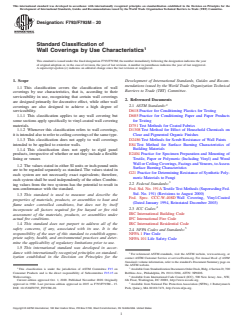
(Classification)Standard Classification of Wall Coverings by Use Characteristics
General Information
- Abstract
SIGNIFICANCE AND USE
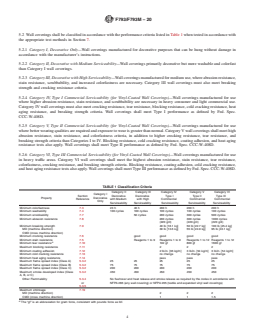
4.1 This classification provides criteria by which wall coverings of appropriate use characteristics can be chosen for particular residential and commercial decorating applications.
SCOPE
1.1 This classification covers the classification of wall coverings by use characteristics, that is, according to their serviceability in use, recognizing that certain wall coverings are designed primarily for decorative effect, while other wall coverings are also designed to achieve a high degree of serviceability.
1.1.1 This classification applies to any wall covering but some sections apply specifically to vinyl-coated wall covering materials.
1.1.2 Whenever this classification refers to wall coverings, it is intended also to refer to ceiling coverings of the same type.
1.1.3 This classification does not apply to wall coverings intended to be applied to exterior walls.
1.1.4 This classification does not apply to rigid panel products, irrespective of whether or not they include a flexible lining or veneer.
1.2 The values stated in either SI units or inch-pound units are to be regarded separately as standard. The values stated in each system are not necessarily exact equivalents; therefore, each system shall be used independently of the other. Combining values from the two systems has the potential to result in non-conformance with the standard.
1.3 This standard is used to measure and describe the properties of materials, products, or assemblies to heat and flame under controlled conditions, but does not by itself incorporate all factors required for fire hazard or fire risk assessment of the materials, products, or assemblies under actual fire conditions.
1.4 This standard does not purport to address all of the safety concerns, if any, associated with its use. It is the responsibility of the user of this standard to establish appropriate safety, health, and environmental practices and determine the applicability of regulatory limitations prior to use.
1.5 This international standard was developed in accordance with internationally recognized principles on standardization established in the Decision on Principles for the Development of International Standards, Guides and Recommendations issued by the World Trade Organization Technical Barriers to Trade (TBT) Committee.
- Status
- Published
- Publication Date
- 30-Sep-2020
- Technical Committee
- F15 - Consumer Products
- Drafting Committee
- F15.15 - Wallcoverings
Overview
ASTM F793/F793M-20: Standard Classification of Wall Coverings by Use Characteristics establishes a systematic approach for classifying wall coverings based on their use characteristics, including durability, serviceability, and decorative qualities. Issued by ASTM International, this standard provides essential criteria that help manufacturers, designers, specifiers, and end-users select suitable wall coverings for different residential and commercial interior applications.
Key Topics
Classification Categories: The standard organizes wall and ceiling coverings into six primary categories, ranging from purely decorative uses to heavy-duty commercial applications.
- Category I: Decorative Only
- Category II: Decorative with Medium Serviceability
- Category III: Decorative with High Serviceability
- Category IV: Type I Commercial Serviceability (vinyl-coated)
- Category V: Type II Commercial Serviceability (vinyl-coated)
- Category VI: Type III Commercial Serviceability (vinyl-coated)
Performance Properties: Wall coverings are classified according to their performance in tests such as:
- Abrasion resistance
- Scrubbability and washability
- Colorfastness and stain resistance
- Breaking and tear strength
- Blocking resistance, coating adhesion, and cold cracking resistance
- Smoke developed and flame spread index
- Mildew resistance and shrinkage
Test Methods: The classification references a breadth of standard test methods and specifications to ensure consistent evaluation, including ASTM E84 for fire characteristics, Fed. Spec. CCC-W-408D for vinyl coatings, and G21 for mildew resistance.
Scope Limitations: This standard does not apply to exterior wall coverings, rigid panel products, or ceiling systems not classified as wall covering types.
Applications
ASTM F793/F793M-20 is invaluable for a broad spectrum of residential and commercial interior design and construction projects. Its detailed classification system enables:
- Product Selection: Facility managers, architects, and designers can confidently specify wall coverings tailored to the expected level of use, durability, and regulatory requirements for homes, offices, hotels, hospitals, and public buildings.
- Compliance and Safety: Building code officials and inspectors use this standard as a benchmark for flammability, surface burning, and smoke development, supporting fire safety and statutory code compliance.
- Manufacturer Guidance: Producers of wall coverings can utilize this classification to design, test, label, and certify their products accurately for the intended end-use, streamlining communication in the supply chain.
- Procurement and Labeling: The standard prescribes recommended labeling statements that enhance transparency during the procurement process and ensure end-users receive products meeting proven performance benchmarks.
Related Standards
Wall coverings tested and classified according to ASTM F793/F793M-20 often reference or comply with additional national and international standards, such as:
- ASTM E84: Standard Test Method for Surface Burning Characteristics of Building Materials
- Fed. Spec. CCC-W-408D: Vinyl-Coated Wall Covering Specification
- ASTM D685/D618: Conditioning of Paper and Plastics for Testing
- ASTM D751: Test Methods for Coated Fabrics
- NFPA 101, 265, 286: Life Safety, Fire Test Methods, and Room Fire Growth Evaluation
- UL 723: Surface Burning Characteristics of Building Materials
- International Building, Fire, and Residential Codes (IBC, IFC, IRC): Referenced for flammability class designation and code compliance
By following ASTM F793/F793M-20, stakeholders in the design, specification, and use of wall coverings ensure product suitability, safety, and conformance to key industry standards. This standard is critical for anyone involved in interior finishes, flooring, and wall coverings for residential and commercial environments.
Relations
- Effective Date
- 01-Dec-2023
- Effective Date
- 01-Sep-2023
- Effective Date
- 01-Jul-2019
- Effective Date
- 15-Apr-2019
- Effective Date
- 01-Mar-2019
- Effective Date
- 01-Oct-2018
- Effective Date
- 01-Jul-2018
- Effective Date
- 01-Mar-2018
- Effective Date
- 01-Nov-2017
- Effective Date
- 01-Aug-2017
- Effective Date
- 01-Jun-2017
- Effective Date
- 01-Dec-2016
- Effective Date
- 01-Jul-2016
- Effective Date
- 15-Dec-2015
- Effective Date
- 01-Jun-2015
Get Certified
Connect with accredited certification bodies for this standard

DIBt (Deutsches Institut für Bautechnik)
German Institute for Building Technology.
DIN CERTCO
DIN Group product certification.

Aboma Certification B.V.
Specialized in construction, metal, and transport sectors.
Sponsored listings
Frequently Asked Questions
ASTM F793/F793M-20 is a standard published by ASTM International. Its full title is "Standard Classification of Wall Coverings by Use Characteristics". This standard covers: SIGNIFICANCE AND USE 4.1 This classification provides criteria by which wall coverings of appropriate use characteristics can be chosen for particular residential and commercial decorating applications. SCOPE 1.1 This classification covers the classification of wall coverings by use characteristics, that is, according to their serviceability in use, recognizing that certain wall coverings are designed primarily for decorative effect, while other wall coverings are also designed to achieve a high degree of serviceability. 1.1.1 This classification applies to any wall covering but some sections apply specifically to vinyl-coated wall covering materials. 1.1.2 Whenever this classification refers to wall coverings, it is intended also to refer to ceiling coverings of the same type. 1.1.3 This classification does not apply to wall coverings intended to be applied to exterior walls. 1.1.4 This classification does not apply to rigid panel products, irrespective of whether or not they include a flexible lining or veneer. 1.2 The values stated in either SI units or inch-pound units are to be regarded separately as standard. The values stated in each system are not necessarily exact equivalents; therefore, each system shall be used independently of the other. Combining values from the two systems has the potential to result in non-conformance with the standard. 1.3 This standard is used to measure and describe the properties of materials, products, or assemblies to heat and flame under controlled conditions, but does not by itself incorporate all factors required for fire hazard or fire risk assessment of the materials, products, or assemblies under actual fire conditions. 1.4 This standard does not purport to address all of the safety concerns, if any, associated with its use. It is the responsibility of the user of this standard to establish appropriate safety, health, and environmental practices and determine the applicability of regulatory limitations prior to use. 1.5 This international standard was developed in accordance with internationally recognized principles on standardization established in the Decision on Principles for the Development of International Standards, Guides and Recommendations issued by the World Trade Organization Technical Barriers to Trade (TBT) Committee.
SIGNIFICANCE AND USE 4.1 This classification provides criteria by which wall coverings of appropriate use characteristics can be chosen for particular residential and commercial decorating applications. SCOPE 1.1 This classification covers the classification of wall coverings by use characteristics, that is, according to their serviceability in use, recognizing that certain wall coverings are designed primarily for decorative effect, while other wall coverings are also designed to achieve a high degree of serviceability. 1.1.1 This classification applies to any wall covering but some sections apply specifically to vinyl-coated wall covering materials. 1.1.2 Whenever this classification refers to wall coverings, it is intended also to refer to ceiling coverings of the same type. 1.1.3 This classification does not apply to wall coverings intended to be applied to exterior walls. 1.1.4 This classification does not apply to rigid panel products, irrespective of whether or not they include a flexible lining or veneer. 1.2 The values stated in either SI units or inch-pound units are to be regarded separately as standard. The values stated in each system are not necessarily exact equivalents; therefore, each system shall be used independently of the other. Combining values from the two systems has the potential to result in non-conformance with the standard. 1.3 This standard is used to measure and describe the properties of materials, products, or assemblies to heat and flame under controlled conditions, but does not by itself incorporate all factors required for fire hazard or fire risk assessment of the materials, products, or assemblies under actual fire conditions. 1.4 This standard does not purport to address all of the safety concerns, if any, associated with its use. It is the responsibility of the user of this standard to establish appropriate safety, health, and environmental practices and determine the applicability of regulatory limitations prior to use. 1.5 This international standard was developed in accordance with internationally recognized principles on standardization established in the Decision on Principles for the Development of International Standards, Guides and Recommendations issued by the World Trade Organization Technical Barriers to Trade (TBT) Committee.
ASTM F793/F793M-20 is classified under the following ICS (International Classification for Standards) categories: 91.180 - Interior finishing. The ICS classification helps identify the subject area and facilitates finding related standards.
ASTM F793/F793M-20 has the following relationships with other standards: It is inter standard links to ASTM E84-23d, ASTM E84-23c, ASTM E84-19b, ASTM E84-19a, ASTM E84-19, ASTM E84-18b, ASTM E84-18a, ASTM E84-18, ASTM E84-17a, ASTM E84-17, ASTM D2486-17, ASTM D2486-06(2016), ASTM E84-16, ASTM E84-15b, ASTM E2404-15a. Understanding these relationships helps ensure you are using the most current and applicable version of the standard.
ASTM F793/F793M-20 is available in PDF format for immediate download after purchase. The document can be added to your cart and obtained through the secure checkout process. Digital delivery ensures instant access to the complete standard document.
Standards Content (Sample)
This international standard was developed in accordance with internationally recognized principles on standardization established in the Decision on Principles for the
Development of International Standards, Guides and Recommendations issued by the World Trade Organization Technical Barriers to Trade (TBT) Committee.
Designation:F793/F793M −20
Standard Classification of
Wall Coverings by Use Characteristics
This standard is issued under the fixed designation F793/F793M; the number immediately following the designation indicates the year
of original adoption or, in the case of revision, the year of last revision.Anumber in parentheses indicates the year of last reapproval.
A superscript epsilon (´) indicates an editorial change since the last revision or reapproval.
1. Scope Development of International Standards, Guides and Recom-
mendations issued by the World Trade Organization Technical
1.1 This classification covers the classification of wall
Barriers to Trade (TBT) Committee.
coverings by use characteristics, that is, according to their
serviceability in use, recognizing that certain wall coverings
2. Referenced Documents
are designed primarily for decorative effect, while other wall
coverings are also designed to achieve a high degree of 2.1 ASTM Standards:
D618Practice for Conditioning Plastics for Testing
serviceability.
1.1.1 This classification applies to any wall covering but D685Practice for Conditioning Paper and Paper Products
for Testing
some sections apply specifically to vinyl-coated wall covering
materials. D751Test Methods for Coated Fabrics
D1308Test Method for Effect of Household Chemicals on
1.1.2 Whenever this classification refers to wall coverings,
itisintendedalsotorefertoceilingcoveringsofthesametype. Clear and Pigmented Organic Finishes
D2486Test Methods for Scrub Resistance of Wall Paints
1.1.3 This classification does not apply to wall coverings
intended to be applied to exterior walls. E84Test Method for Surface Burning Characteristics of
Building Materials
1.1.4 This classification does not apply to rigid panel
products, irrespective of whether or not they include a flexible E2404Practice for Specimen Preparation and Mounting of
Textile, Paper or Polymeric (Including Vinyl) and Wood
lining or veneer.
WallorCeilingCoverings,FacingsandVeneers,toAssess
1.2 The values stated in either SI units or inch-pound units
Surface Burning Characteristics
are to be regarded separately as standard. The values stated in
G21Practice for Determining Resistance of Synthetic Poly-
each system are not necessarily exact equivalents; therefore,
meric Materials to Fungi
each system shall be used independently of the other. Combin-
2.2 Federal Standards:
ing values from the two systems has the potential to result in
Fed. Std. No. 191ATextile Test Methods (Superseding Fed.
non-conformance with the standard.
Std. No. 191) (Revisions to August 2000)
1.3 This standard is used to measure and describe the
Fed. Spec. CCC-W-408D Wall Covering, Vinyl-Coated
properties of materials, products, or assemblies to heat and
(Dated January 1994, Reinstated December 2003)
flame under controlled conditions, but does not by itself
2.3 ICC Codes:
incorporate all factors required for fire hazard or fire risk
IBC International Building Code
assessment of the materials, products, or assemblies under
IFC International Fire Code
actual fire conditions.
IRC International Residential Code
1.4 This standard does not purport to address all of the
safety concerns, if any, associated with its use. It is the
2.4 NFPA Codes and Standards:
responsibility of the user of this standard to establish appro-
NFPA 1Fire Code
priate safety, health, and environmental practices and deter-
NFPA 101Life Safety Code
mine the applicability of regulatory limitations prior to use.
1.5 This international standard was developed in accor-
dance with internationally recognized principles on standard-
For referenced ASTM standards, visit the ASTM website, www.astm.org, or
ization established in the Decision on Principles for the
contact ASTM Customer Service at service@astm.org. For Annual Book of ASTM
Standards volume information, refer to the standard’s Document Summary page on
the ASTM website.
1 3
This classification is under the jurisdiction of ASTM Committee F15 on AvailablefromStandardizationDocumentsOrderDesk,Bldg.4SectionD,700
Consumer Products and is the direct responsibility of Subcommittee F15.15 on Robbins Ave., Philadelphia, PA 19111-5094, ATTN: NPODS.
Wallcoverings. Available from International Code Council (ICC), 500 New Jersey Ave., NW,
Current edition approved Oct. 1, 2020. Published November 2020. Originally 6th Floor, Washington, DC 20001, http://www.iccsafe.org.
approved in 1982. Last previous edition approved in 2015 as F793/F793M–15. Available from National Fire Protection Association (NFPA), 1 Batterymarch
DOI: 10.1520/F0793_F0793M-20. Park, Quincy, MA 02169-7471, http://www.nfpa.org.
Copyright © ASTM International, 100 Barr Harbor Drive, PO Box C700, West Conshohocken, PA 19428-2959. United States
F793/F793M−20
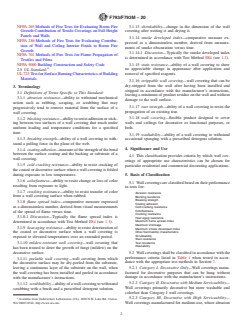
NFPA 265Methods of Fire Tests for Evaluating Room Fire 3.1.13 shrinkability—change in the dimension of the wall
Growth Contribution of Textile Coverings on Full Height covering after wetting it and drying it.
Panels and Walls
3.1.14 smoke developed index—comparative measure ex-
NFPA 286Methods of Fire Tests for Evaluating Contribu-
pressed as a dimensionless number, derived from measure-
tion of Wall and Ceiling Interior Finish to Room Fire
ments of smoke obscuration versus time.
Growth
3.1.14.1 Discussion—Typically the smoke developed index
NFPA 701Methods of Fire Tests for Flame Propagation of
is determined in accordance with Test Method E84 (see 1.3).
Textiles and Films
NFPA 5000Building Construction and Safety Code 3.1.15 stain resistance—ability of a wall covering to show
no appreciable change in appearance after application and
2.5 UL Standard:
UL723TestforSurfaceBurningCharacteristicsofBuilding removal of specified reagents.
Materials
3.1.16 strippable wall covering—wall covering that can be
dry-stripped from the wall after having been installed and
3. Terminology
stripped in accordance with the manufacturer’s instructions,
3.1 Definitions of Terms Specific to This Standard:
leaving a minimum of product residue on the wall and without
3.1.1 abrasion resistance—ability to withstand mechanical
damage to the wall surface.
action such as rubbing, scraping, or scrubbing that may
3.1.17 tear strength—ability of a wall covering to resist the
progressively tend to remove material from the surface of a
propagation of an existing tear.
wall covering.
3.1.18 wall covering—flexible product designed to cover
3.1.2 blockingresistance—abilitytoresistadhesionorstick-
walls and ceilings for decorative or functional purposes, or
ing between two surfaces of a wall covering that touch under
both.
uniform loading and temperature conditions for a specified
time.
3.1.19 washability—ability of a wall covering to withstand
3.1.3 breaking strength—ability of a wall covering to with-
occasional sponging with a prescribed detergent solution.
stand a pulling force in the plane of the web.
4. Significance and Use
3.1.4 coatingadhesion—measureofthestrengthofthebond
between the surface coating and the backing or substrate of a
4.1 This classification provides criteria by which wall cov-
wall covering.
erings of appropriate use characteristics can be chosen for
3.1.5 cold cracking resistance—ability to resist cracking of
particular residential and commercial decorating applications.
thecoatedordecorativesurfacewhenawallcoveringisfolded
during exposure to low temperatures.
5. Basis of Classification
3.1.6 colorfastness—ability to resist change or loss of color
5.1 Wallcoveringsareclassifiedbasedontheirperformance
resulting from exposure to light.
in tests for:
3.1.7 crocking resistance—ability to resist transfer of color
Abrasion resistance
from a wall covering surface when rubbed.
Blocking resistance
Breaking strength
3.1.8 flame spread index—comparative measure expressed
Coating adhesion
as a dimensionless number, derived from visual measurements Cold cracking resistance
Colorfastness
of the spread of flame versus time.
Crocking resistance
3.1.8.1 Discussion—Typically the flame spread index is
Heat aging resistance
determined in accordance with Test Method E84 (see 1.3). Maximum flame spread index
Maximum shrinkage
3.1.9 heat aging resistance—abilitytoresistdeteriorationof
Maximum smoke developed index
Other flammability characteristics
the coated or decorative surface when a wall covering is
Scrubbability
exposed to elevated temperatures over an extended period.
Stain resistance
3.1.10 mildew-resistant wall covering—wall covering that Tear resistance
Washability
has been treated to deter the growth of fungi (mildew) on the
decorative surface.
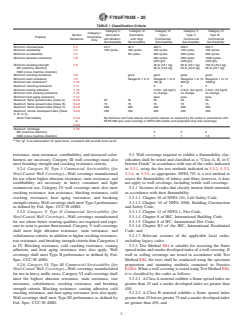
5.2 Wallcoveringsshallbeclassifiedinaccordancewiththe
performance criteria listed in Table 1 when tested in accor-
3.1.11 peelable wall covering—wall covering from which
dance with the appropriate test methods in Section 7.
the decorative surface may be dry-peeled from the substrate,
5.2.1 Category I, Decorative Only—Wall coverings manu-
leaving a continuous layer of the substrate on the wall, when
the wall covering has been installed and peeled in accordance factured for decorative purposes that can be hung without
damage in accordance with the manufacturer’s instructions.
with the manufacturer’s instructions.
5.2.2 Category II, Decorative with Medium Serviceability—
3.1.12 scrubbability—abilityofawallcoveringtowithstand
Wall coverings primarily decorative but more washable and
scrubbing with a brush and a prescribed detergent solution.
colorfast than Category I wall coverings.
5.2.3 Category III, Decorative with High Serviceability—
Available from Underwriters Laboratories (UL), 2600 N.W. Lake Rd., Camas,
WA 98607-8542, http://www.ul.com. Wall coverings manufactured for medium use, where abrasion
F793/F793M−20
TABLE 1 Classification Criteria
Category II Category III Category IV Category V Category VI
Category I
Section Decorative Decorative Type I Type II Type III
Property Decorative
Reference with Medium with High Commercial Commercial Commercial
Only
Serviceability Serviceability Serviceability Serviceability Serviceability
Minimum colorfastness 7.3 23 h 46 h 200 h 200 h 200 h
Minimum washability 7.4 100 cycles 100 cycles 100 cycles 100 cycles 100 cycles
Minimum scrubbability 7.7 50 cycles 200 cycles 300 cycles 500 cycles
Minimum abrasion resistance 7.8 200 cycles 300 cycles 1000 cycles
(220 grit) (220 grit) (220 grit)
Minimum breaking strength 7.9 40 lb [18.1 kg] 50 lb [22.7 kg] 100 lb [45.4 kg]
MD (machine direction) 30 lb [13.6 kg] 55 lb [24.9 kg] 95 lb [43.1 kg]
CMD (cross machine direction)
Minimum crocking resistance 7.6 good good good good
Minimum stain resistance 7.5 Reagents 1 to 9 Reagents 1 to 9 Reagents 1 to 12 Reagents 1 to 12
A
Minimum tear resistance 7.10 192 gf 800 gf 1600 gf
Maximum blocking resistance 7.11 22 2
Minimum coating adhesion 7.12 2 lb/in. [36 kg/m] 3 lb/in. [54 kg/m] 3 lb/in. [54 kg/m]
Minimum cold cracking resistance 7.13 no change no change no change
Minimum heat aging resistance 7.14 pass pass pass
Maximum flame spread index (Class A) 5.3.2 25 25 25 25 25
Maximum flame spread index (Class B) 5.3.2 75 75 75 75 75
Maximum flame spread index (Class C) 5.3.2 200 200 200 200 200
Maximum smoke developed index (Class 5.3.2 450 450 450 450 450
A, B, or C)
Other Flammability 5.3.4 No flashover and heat release and smoke release as required by the codes in accordance with
or NFPA 286 (any wall covering) or NFPA 265 (textile and expanded vinyl wall coverings)
5.3.5
Maximum shrinkage 7.19
MD (machine direction) 2 2 2
CMD (cross machine direction) 1 1 1.5
A
The “gf” is an abbreviation for gram force, consistent with pounds force as lbf.
resistance, stain resistance, scrubbability, and increased color- 5.3 Wall coverings required to exhibit a flammability clas-
fastness are necessary. Category III wall coverings must also sification shall be tested and classified as a “Class A, B, or C
meet breaking strength and crocking resistance criteria. Interior Finish” in accordance with one of the codes indicated
5.2.4 Category IV, Type I Commercial Serviceability (for in 5.3.1, using the fire test methods indicated in 5.3.2, 5.3.3,
Vinyl-Coated Wall Coverings)—Wall coverings manufactured 5.3.4,or 5.3.5, as appropriate. NFPA 701 is a test method to
for use where higher abrasion resistance, stain resistance, and assess the flammability of fabrics and films; however, it does
scrubbability are necessary in heavy consumer and light not apply to wall coverings, including textile wall coverings.
commercial use. Category IV wall coverings must also meet 5.3.1 Sections of codes that classify interior finish materials
crocking resistance, tear resistance, blocking resistance, cold in accordance with their flammability.
cracking resistance, heat aging resistance, and breaking 5.3.1.1 Chapter 10 of NFPA 101, Life Safety Code,
strengthcriteria.WallcoveringsshallmeetTypeIperformance 5.3.1.2 Chapter 10 of NFPA 5000, Building Construction
as defined by Fed. Spec. CCC-W-408D. and Safety Code,
5.2.5 Category V, Type II Commercial Serviceability (for 5.3.1.3 Chapter 12 of NFPA 1, Fire Code,
Vinyl-Coated Wall Coverings)—Wall coverings manufactured 5.3.1.4 Chapter 8 of IBC, International Building Code,
for use where better wearing qualities are required and expo- 5.3.1.5 Chapter 8 of IFC, International Fire Code,
sure to wear is greater than normal. CategoryVwall coverings 5.3.1.6 Chapter R3 of the IRC, International Residential
shall meet high abrasion resistance, stain resistance, and Code, and
colorfastness criteria, in addition to higher crocking resistance, 5.3.1.7 Relevant sections of the applicable local codes,
tear resistance, and breaking strength criteria than Categories I including legacy codes.
to IV. Blocking resistance, cold cracking resistance, coating 5.3.2 Test Method E84 is suitable for assessing the flame
adhesion, and heat aging resistance tests also apply. Wall spread index and smoke developed index of a wall covering. If
coverings shall meet Type II performance as defined by Fed. wall or ceiling coverings are tested in accordance with Test
Spec. CCC-W-408D. Method E84, the tests shall be conducted using the specimen
5.2.6 Category VI, Type III Commercial Serviceability (for preparation and mounting methods contained in Practice
Vinyl-Coated Wall Coverings)—Wall coverings manufactured E2404.WhenawallcoveringistestedusingTestMethodE84,
for use in heavy traffic areas. CategoryVI wall coverings shall it is classified by the codes as follows:
meet the highest abrasion resistance, stain resistance, tear 5.3.2.1 AClassAmaterial exhibits a flame spread index no
resistance, colorfastness, crocking resistance, and breaking greater than 25 and a smoke developed index no greater than
strength criteria. Blocking resistance, coating adhesion, cold 450,
cracking resistance, and heat aging resistance tests also apply. 5.3.2.2 A Class B material exhibits a flame spread index
Wall coverings shall meet Type III performance as defined by greater than 25 but no greater 75 and a smoke developed index
Fed. Spec. CCC-W-408D. no greater than 450, and
F793/F793M−20
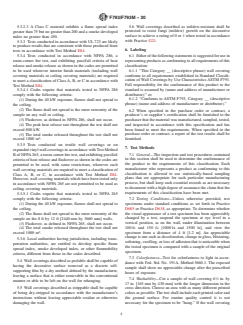
5.3.2.3 A Class C material exhibits a flame spread index 5.6 Wall coverings described as mildew-resistant shall be
greater than 75 but no greater than 200 and a smoke developed protected to resist fungi (mildew) growth on the decorative
surface to achieve a rating of 0 or 1 when tested in accordance
index no greater than 450.
with Practice G21.
5.3.3 Tests conducted in accordance with UL723 are likely
to produce results that are consistent with those produced from
6. Labeling
tests in accordance with Test Method E84.
5.3.4 Tests conducted in accordance with NFPA 286, a
6.1 Eitherofthefollowingstatementsissuggestedforusein
room-corner fire test, and exhibiting pass/fail criteria of heat representingproductsasconformingtoallrequirementsofthis
release and smoke release as shown in the codes are permitted classification:
6.1.1 “This Category __ (descriptive phrase) wall covering
to be used wherever interior finish materials (including wall
covering materials or ceiling covering materials) are required conforms to all requirements established in Standard Classifi-
cation of Wall Coverings by Use CharacteristicsASTM F793.
to meet a classification of ClassA, B, or C in accordance with
Full responsibility for the conformance of this product to the
Test Method E84.
standard is assumed by (name and address of manufacturer or
5.3.4.1 Codes require that materials tested to NFPA 286
distributor);” or
comply with the following criteria:
6.1.2 “Conforms to ASTM F793, Category __ (descriptive
(1)During the 40 kW exposure, flames shall not spread to
phrase) (name and address of manufacturer or distributor).”
the ceiling.
(2)The flame shall not spread to the outer extremity of the
6.2 When specified in the purchase order or contract, a
sample on any wall or ceiling. producer’s or supplier’s certification shall be furnished to the
(3)Flashover, as defined in NFPA 286, shall not occur.
purchaser that the material was manufactured, sampled, tested,
(4)The peak heat release rate throughout the test shall not and inspected in accordance with this specification and has
exceed 800 kW. been found to meet the requirements. When specified in the
purchase order or contract, a report of the test results shall be
(5)The total smoke released throughout the test shall not
exceed 1000 m . furnished.
5.3.5 Tests conducted on textile wall coverings or on
7. Test Methods
expandedvinylwallcoveringsinaccordancewithTestMethod
7.1
...
This document is not an ASTM standard and is intended only to provide the user of an ASTM standard an indication of what changes have been made to the previous version. Because
it may not be technically possible to adequately depict all changes accurately, ASTM recommends that users consult prior editions as appropriate. In all cases only the current version
of the standard as published by ASTM is to be considered the official document.
Designation: F793/F793M − 15 F793/F793M − 20
Standard Classification of
Wall Coverings by Use Characteristics
This standard is issued under the fixed designation F793/F793M; the number immediately following the designation indicates the year
of original adoption or, in the case of revision, the year of last revision. A number in parentheses indicates the year of last reapproval.
A superscript epsilon (´) indicates an editorial change since the last revision or reapproval.
1. Scope
1.1 This classification covers the classification of wall coverings by use characteristics, that is, according to their serviceability
in use, recognizing that certain wall coverings are designed primarily for decorative effect, while other wall coverings are also
designed to achieve a high degree of serviceability.
1.1.1 This classification applies to allany wall coveringscovering but some sections apply specifically to vinyl-coated wall
covering materials.
1.1.2 Whenever this classification refers to wall coverings, it is intended also to refer to ceiling coverings of the same type.
1.1.3 This classification does not apply to wall coverings intended to be applied to exterior walls.
1.1.4 This classification does not apply to rigid panel products, irrespective of whether or not they include a flexible lining or
veneer.
1.2 The values stated in either SI units or inch-pound units are to be regarded separately as standard. The values stated in each
system are not necessarily exact equivalents; therefore, each system shall be used independently of the other. Combining values
from the two systems has the potential to result in non-conformance with the standard.
1.3 This standard is used to measure and describe the properties of materials, products, or assemblies to heat and flame under
controlled conditions, but does not by itself incorporate all factors required for fire hazard or fire risk assessment of the materials,
products, or assemblies under actual fire conditions.
1.4 This standard does not purport to address all of the safety problems,concerns, if any, associated with its use. It is the
responsibility of the user of this standard to establish appropriate safety safety, health, and healthenvironmental practices and
determine the applicability of regulatory limitations prior to use.
1.5 This international standard was developed in accordance with internationally recognized principles on standardization
established in the Decision on Principles for the Development of International Standards, Guides and Recommendations issued
by the World Trade Organization Technical Barriers to Trade (TBT) Committee.
2. Referenced Documents
2.1 ASTM Standards:
D618 Practice for Conditioning Plastics for Testing
D685 Practice for Conditioning Paper and Paper Products for Testing
D751 Test Methods for Coated Fabrics
This classification is under the jurisdiction of ASTM Committee F15 on Consumer Products and is the direct responsibility of Subcommittee F15.15 on Wallcoverings.
Current edition approved Dec. 15, 2015Oct. 1, 2020. Published January 2016November 2020. Originally approved in 1982. Last previous edition approved in 20102015
as F793 – 10a.F793/F793M – 15. DOI: 10.1520/F0793_F0793M-15.10.1520/F0793_F0793M-20.
For referenced ASTM standards, visit the ASTM website, www.astm.org, or contact ASTM Customer Service at service@astm.org. For Annual Book of ASTM Standards
volume information, refer to the standard’s Document Summary page on the ASTM website.
Copyright © ASTM International, 100 Barr Harbor Drive, PO Box C700, West Conshohocken, PA 19428-2959. United States
F793/F793M − 20
D1308 Test Method for Effect of Household Chemicals on Clear and Pigmented Organic Finishes
D2486 Test Methods for Scrub Resistance of Wall Paints
E84 Test Method for Surface Burning Characteristics of Building Materials
E2404 Practice for Specimen Preparation and Mounting of Textile, Paper or Polymeric (Including Vinyl) and Wood Wall or
Ceiling Coverings, Facings and Veneers, to Assess Surface Burning Characteristics
G21 Practice for Determining Resistance of Synthetic Polymeric Materials to Fungi
2.2 Federal Standards:
Fed. Std. No. 191A Textile Test Methods (Superseding Fed. Std. No. 191) (Revisions to August 2000)
Fed. Spec. CCC-W-408D Wall Covering, Vinyl-Coated (Dated January 1994, Reinstated December 2003)
2.3 ICC Codes:
IBC International Building Code
IFC International Fire Code
IRC International Residential Code
2.4 NFPA Codes and Standards:
NFPA 1 Fire Code
NFPA 101 Life Safety Code
NFPA 265 Methods of Fire Tests for Evaluating Room Fire Growth Contribution of Textile Coverings on Full Height Panels and
Walls
NFPA 286 Methods of Fire Tests for Evaluating Contribution of Wall and Ceiling Interior Finish to Room Fire Growth
NFPA 701 Methods of Fire Tests for Flame Propagation of Textiles and Films
NFPA 5000 Building Construction and Safety Code
2.5 UL Standard:
UL 723 Test for Surface Burning Characteristics of Building Materials
3. Terminology
3.1 Definitions of Terms Specific to This Standard:
3.1.1 abrasion resistance—ability to withstand mechanical action such as rubbing, scraping, or scrubbing that may progressively
tend to remove material from the surface of a wall covering.
3.1.2 blocking resistance—ability to resist adhesion or sticking between two surfaces of a wall covering that touch under uniform
loading and temperature conditions for a specified time.
3.1.3 breaking strength—ability of a wall covering to withstand a pulling force in the plane of the web.
3.1.4 coating adhesion—measure of the strength of the bond between the surface coating and the backing or substrate of a wall
covering.
3.1.5 cold cracking resistance—ability to resist cracking of the coated or decorative surface when a wall covering is folded during
exposure to low temperatures.
3.1.6 colorfastness—ability to resist change or loss of color resulting from exposure to light.
3.1.7 crocking resistance—ability to resist transfer of color from a wall covering surface when rubbed.
3.1.8 flame spread index—comparative measure expressed as a dimensionless number, derived from visual measurements of the
spread of flame versus time.
3.1.8.1 Discussion—
Typically the flame spread index is determined in accordance with Test Method E84 (see 1.3).
Available from Standardization Documents Order Desk, Bldg. 4 Section D, 700 Robbins Ave., Philadelphia, PA 19111-5094, ATTN: NPODS.
Available from International Code Council (ICC), 5203 Leesburg Pike, Suite 600, Falls Church, VA 22041.500 New Jersey Ave., NW, 6th Floor, Washington, DC 20001,
http://www.iccsafe.org.
Available from National Fire Protection Association (NFPA), 1 Batterymarch Park, Quincy, MA 02269-9101.02169-7471, http://www.nfpa.org.
Available from Underwriters Laboratories (UL), Corporate Progress, 333 Pfingsten Rd., Northbrook, IL 60062.2600 N.W. Lake Rd., Camas, WA 98607-8542,
http://www.ul.com.
F793/F793M − 20
3.1.9 heat aging resistance—ability to resist deterioration of the coated or decorative surface when a wall covering is exposed to
elevated temperatures over an extended period.
3.1.10 mildew-resistant wall covering—wall covering that has been treated to deter the growth of fungi (mildew) on the decorative
surface.
3.1.11 peelable wall covering—wall covering from which the decorative surface may be dry-peeled from the substrate, leaving a
continuous layer of the substrate on the wall, when the wall covering has been installed and peeled in accordance with the
manufacturer’s instructions.
3.1.12 scrubbability—ability of a wall covering to withstand scrubbing with a brush and a prescribed detergent solution.
3.1.13 shrinkability—change in the dimension of the wall covering after wetting it and drying it.
3.1.14 smoke developed index—comparative measure expressed as a dimensionless number, derived from measurements of smoke
obscuration versus time.
3.1.14.1 Discussion—
Typically the smoke developed index is determined in accordance with Test Method E84 (see 1.3).
3.1.15 stain resistance—ability of a wall covering to show no appreciable change in appearance after application and removal of
specified reagents.
3.1.16 strippable wall covering—wall covering that can be dry-stripped from the wall after having been installed and stripped in
accordance with the manufacturer’s instructions, leaving a minimum of product residue on the wall and without damage to the wall
surface.
3.1.17 tear strength—ability of a wall covering to resist the propagation of an existing tear.
3.1.18 wall covering—flexible product designed to cover walls and ceilings for decorative or functional purposes, or both.
3.1.19 washability—ability of a wall covering to withstand occasional sponging with a prescribed detergent solution.
4. Significance and Use
4.1 This classification provides criteria by which wall coverings of appropriate use characteristics can be chosen for particular
residential and commercial decorating applications.
5. Basis of Classification
5.1 Wall coverings are classified based on their performance in tests for:
Abrasion resistance
Blocking resistance
Breaking strength
Coating adhesion
Cold cracking resistance
Colorfastness
Crocking resistance
Heat aging resistance
Maximum flame spread index
Maximum shrinkage
Maximum smoke developed index
Other flammability characteristics
Scrubbability
Stain resistance
Tear resistance
Washability
F793/F793M − 20
5.2 Wall coverings shall be classified in accordance with the performance criteria listed in Table 1 when tested in accordance with
the appropriate test methods in Section 7.
5.2.1 Category I, Decorative Only—Wall coverings manufactured for decorative purposes that can be hung without damage in
accordance with the manufacturer’s instructions.
5.2.2 Category II, Decorative with Medium Serviceability—Wall coverings primarily decorative but more washable and colorfast
than Category I wall coverings.
5.2.3 Category III, Decorative with High Serviceability—Wall coverings manufactured for medium use, where abrasion resistance,
stain resistance, scrubbability, and increased colorfastness are necessary. Category III wall coverings must also meet breaking
strength and crocking resistance criteria.
5.2.4 Category IV, Type I Commercial Serviceability (for Vinyl-Coated Wall Coverings)—Wall coverings manufactured for use
where higher abrasion resistance, stain resistance, and scrubbability are necessary in heavy consumer and light commercial use.
Category IV wall coverings must also meet crocking resistance, tear resistance, blocking resistance, cold cracking resistance, heat
aging resistance, and breaking strength criteria. Wall coverings shall meet Type I performance as defined by Fed. Spec.
CCC-W-408D.
5.2.5 Category V, Type II Commercial Serviceability (for Vinyl-Coated Wall Coverings)—Wall coverings manufactured for use
where better wearing qualities are required and exposure to wear is greater than normal. Category V wall coverings shall meet high
abrasion resistance, stain resistance, and colorfastness criteria, in addition to higher crocking resistance, tear resistance, and
breaking strength criteria than Categories I to IV. Blocking resistance, cold cracking resistance, coating adhesion, and heat aging
resistance tests also apply. Wall coverings shall meet Type II performance as defined by Fed. Spec. CCC-W-408D.
5.2.6 Category VI, Type III Commercial Serviceability (for Vinyl-Coated Wall Coverings)—Wall coverings manufactured for use
in heavy traffic areas. Category VI wall coverings shall meet the highest abrasion resistance, stain resistance, tear resistance,
colorfastness, crocking resistance, and breaking strength criteria. Blocking resistance, coating adhesion, cold cracking resistance,
and heat aging resistance tests also apply. Wall coverings shall meet Type III performance as defined by Fed. Spec. CCC-W-408D.
TABLE 1 Classification Criteria
Category II Category III Category IV Category V Category VI
Category I
Section Decorative Decorative Type I Type II Type III
Property Decorative
Reference with Medium with High Commercial Commercial Commercial
Only
Serviceability Serviceability Serviceability Serviceability Serviceability
Minimum colorfastness 7.3 23 h 46 h 200 h 200 h 200 h
Minimum washability 7.4 100 cycles 100 cycles 100 cycles 100 cycles 100 cycles
Minimum scrubbability 7.7 50 cycles 200 cycles 300 cycles 500 cycles
Minimum abrasion resistance 7.8 200 cycles 300 cycles 1000 cycles
(220 grit) (220 grit) (220 grit)
Minimum breaking strength 7.9 40 lb [18.1 kg] 50 lb [22.7 kg] 100 lb [45.4 kg]
MD (machine direction) 30 lb [13.6 kg] 55 lb [24.9 kg] 95 lb [43.1 kg]
CMD (cross machine direction)
Minimum crocking resistance 7.6 good good good good
Minimum stain resistance 7.5 Reagents 1 to 9 Reagents 1 to 9 Reagents 1 to 12 Reagents 1 to 12
A
Minimum tear resistance 7.10 192 gf 800 gf 1600 gf
Maximum blocking resistance 7.11 2 2 2
Minimum coating adhesion 7.12 2 lb/in. [36 kg/m] 3 lb/in. [54 kg/m] 3 lb/in. [54 kg/m]
Minimum cold cracking resistance 7.13 no change no change no change
Minimum heat aging resistance 7.14 pass pass pass
Maximum flame spread index (Class A) 5.3.2 25 25 25 25 25
Maximum flame spread index (Class B) 5.3.2 75 75 75 75 75
Maximum flame spread index (Class C) 5.3.2 200 200 200 200 200
Maximum smoke developed index (Class 5.3.2 450 450 450 450 450
A, B, or C)
Other Flammability 5.3.4 No flashover and heat release and smoke release as required by the codes in accordance with
or NFPA 286 (any wall covering) or NFPA 265 (textile and expanded vinyl wall coverings)
5.3.5
Maximum shrinkage 7.19
MD (machine direction) 2 2 2
CMD (cross machine direction) 1 1 1.5
A
The “gf” is an abbreviation for gram force, consistent with pounds force as lbf.
F793/F793M − 20
5.3 Wall coverings required to exhibit a flammability classification shall be tested and classified as a “Class A, B, or C Interior
Finish” in accordance with one of the codes indicated in 5.3.1, using the fire test methods indicated in 5.3.2, 5.3.3, 5.3.4, or 5.3.5,
as appropriate. NFPA 701 is a test method to assess the flammability of fabrics and films; however, it does not apply to wall
coverings, including textile wall coverings.
5.3.1 Sections of codes that classify interior finish materials in accordance with their flammability.
5.3.1.1 Chapter 10 of NFPA 101, Life Safety Code,
5.3.1.2 Chapter 10 of NFPA 5000, Building Construction and Safety Code,
5.3.1.3 Chapter 12 of NFPA 1, Fire Code,
5.3.1.4 Chapter 8 of IBC, International Building Code,
5.3.1.5 Chapter 8 of IFC, International Fire Code,
5.3.1.6 Chapter R3 of the IRC, International Residential Code, and
5.3.1.7 Relevant sections of the applicable local codes, including legacy codes.
5.3.2 Test Method E84 is suitable for assessing the flame spread index and smoke developed index of a wall covering. If wall or
ceiling coverings are tested in accordance with Test Method E84, the tests shall be conducted using the specimen preparation and
mounting methods contained in Practice E2404. When a wall covering is tested using Test Method E84, it is classified by the codes
as follows:
5.3.2.1 A Class A material exhibits a flame spread index no greater than 25 and a smoke developed index no greater than 450,
5.3.2.2 A Class B material exhibits a flame spread index greater than 25 but no greater 75 and a smoke developed index no greater
than 450, and
5.3.2.3 A Class C material exhibits a flame spread index greater than 75 but no greater than 200 and a smoke developed index
no greater than 450.
5.3.3 Tests conducted in accordance with UL 723 are likely to produce results that are consistent with those produced from tests
in accordance with Test Method E84.
5.3.4 Tests conducted in accordance with NFPA 286, a room-corner fire test, and exhibiting pass/fail criteria of heat release and
smoke release as shown in the codes are permitted to be used wherever interior finish materials (including wall covering materials
or ceiling covering materials) are required to meet a classification of Class A, B, or C in accordance with Test Method E84.
5.3.4.1 Codes require that materials tested to NFPA 286 comply with the following criteria:
(1) During the 40 kW exposure, flames shall not spread to the ceiling.
(2) The flame shall not spread to the outer extremity of the sample on any wall or ceiling.
(3) Flashover, as defined in NFPA 286, shall not occur.
(4) The peak heat release rate throughout the test shall not exceed 800 kW.
(5) The total smoke released throughout the test shall not exceed 1000 m .
5.3.5 Tests conducted on textile wall coverings or on expanded vinyl wall coverings in accordance with Test Method B of NFPA
265, a room-corner fire test, and exhibiting pass/fail criteria of heat release and flashover as shown in the codes are permitted to
be used, with some restrictions, wherever such wall covering materials are required to meet a classification of Class A, B, or C,
in accordance with Test Method E84. However, wall covering materials which have been tested only in accordance with NFPA
265 are not permitted to be used as ceiling covering materials.
5.3.5.1 Codes require that materials tested to NFPA 265 comply with the following criteria:
(1) During the 40 kW exposure, flames shall not spread to the ceiling.
(2) The flame shall not spread to the outer extremity of the sample on the 88 ft by 12 ft. [2440ft [2440 mm by 3660 mm] walls.
F793/F793M − 20
(3) Flashover, as defined in NFPA 265, shall not occur.
(4) The total smoke released throughout the test shall not exceed 1000 m .
5.3.6 Local authorities having jurisdiction, including transportation authorities, are entitled to develop specific flame spread index,
smoke developed index, or other flammability criteria, different from those in the codes described.
5.4 Wall coverings described as peelable shall be capable of having t
...