

ASTM F3030-13(2019)
(Test Method)Standard Test Method for Snowboards with a Channel-Mounting System and Removable Inserts
General Information
- Abstract
SIGNIFICANCE AND USE
4.1 This test method is intended for use in evaluating the binding to snowboard insert retention strength resulting from use. This test method may also be used to compare the durability of different materials and designs. This test method references ISO 10958-2, which is considered satisfactory for acceptance testing insert retention for snowboards.
SCOPE
1.1 This test method covers the requirements and test method for snowboards with channel-mounting systems on which bindings are attached to the board by means of a removable insert and screws.
1.2 This test method does not apply to snowboards for children with a mass less than 25 kg. It contains data for the manufacturer of snowboards, bindings, and retention devices concerning dimensions, tests, and other specifications for the binding mounting area.
1.3 For snowboards with fixed inserts, see ISO 10958-2.
1.4 The values stated in SI units are to be regarded as standard. No other units of measurement are included in this standard.
1.5 This standard does not purport to address all of the safety concerns, if any, associated with its use. It is the responsibility of the user of this standard to establish appropriate safety, health, and environmental practices and determine the applicability of regulatory limitations prior to use.
1.6 This international standard was developed in accordance with internationally recognized principles on standardization established in the Decision on Principles for the Development of International Standards, Guides and Recommendations issued by the World Trade Organization Technical Barriers to Trade (TBT) Committee.
- Status
- Published
- Publication Date
- 31-Oct-2019
- Technical Committee
- F27 - Snow and Water Sports
- Drafting Committee
- F27.30 - Skiing and Snowboarding Equipment


Overview
ASTM F3030-13(2019), Standard Test Method for Snowboards with a Channel-Mounting System and Removable Inserts, is an international standard developed by ASTM International. This standard specifies the test method and requirements for evaluating the retention strength of snowboard bindings attached to boards using channel-mounting systems and removable inserts. It aims to provide clarity for manufacturers, quality controllers, and designers focusing on snowboard safety, durability, and performance.
The scope of ASTM F3030-13(2019) is limited to snowboards equipped with channel-mounting systems where bindings are attached via removable inserts and screws. It also provides guidance for manufacturers on dimensions and testing for the binding mounting area. The standard aligns with internationally recognized standardization principles and cross-references pertinent ISO standards for related products.
Key Topics
- Binding Retention Strength: Establishes methods to test and determine the axial pull-out force, referred to as retention strength, of removable inserts in channel-mounting snowboard systems.
- Applicability: Applies to snowboards designed for users with a mass of 25 kg or more; excludes snowboards for children under this weight threshold.
- Dimensional and Material Specifications: Recommends the use of specific thread standards (M6 × 1.0, Class 6H internal; M6 × 1.0, Class 6g external) and ensures a minimum thread engagement for secure binding attachment.
- Testing Methodology: Outlines the use of a universal test machine (UTM) to measure retention strength, including specimen conditioning and detailed pullout procedures.
- Performance Criteria: Defines minimum retention strength levels based on rider mass, such as 4500 N for boards intended for riders of 45 kg or more, and 3500 N for boards in the 25-45 kg range.
- Reporting and Precision: Details requirements for documenting test results, including compliance status, test conditions, and equipment used. Discusses precision and repeatability in test results.
Applications
The ASTM F3030-13(2019) standard is particularly valuable for:
- Snowboard Manufacturers: Ensuring product reliability and optimizing the safety of channel-mounting systems for snowboards with removable inserts.
- Component Suppliers: Specifying insert and screw designs that meet international requirements for mechanical strength and compatibility.
- Quality Assurance and Testing Labs: Providing a reproducible and objective methodology for evaluating the retention strength of bindings, supporting product certification and compliance.
- Product Designers: Assisting in the development of innovative snowboard mounting solutions while maintaining adherence to internationally recognized safety and performance standards.
- Regulatory Authorities: Supporting the harmonization of safety requirements within the sporting goods industry and facilitating trade by referencing accepted test methods.
Related Standards
- ISO 10958-2: For snowboards with fixed inserts, providing complementary test methods and requirements for binding retention.
- ISO 68-1: Specifies the use of metric screw threads relevant to inserts and fasteners used in snowboard channel-mounting systems.
- ASTM E177: Guidance on the use of terms precision and bias in ASTM test methods, important for ensuring consistency in reporting.
- ASTM E691: Procedures for conducting interlaboratory studies, which underpin the repeatability and reproducibility assessments included in ASTM F3030-13(2019).
By following ASTM F3030-13(2019), industry stakeholders can help ensure the functional safety, performance, and international marketability of snowboards utilizing channel-mounting systems and removable inserts, while aligning with current best practices in testing and standardization.
Keywords: snowboard bindings, channel-mounting systems, removable inserts, ASTM F3030-13, retention strength test, snowboard manufacturing standards, international snowboard standards, binding safety, mechanical testing, sporting equipment standards.
Relations
- Effective Date
- 01-Nov-2019
- Effective Date
- 01-May-2014
- Effective Date
- 01-May-2013
- Effective Date
- 01-May-2013
- Effective Date
- 01-Nov-2011
- Effective Date
- 01-Oct-2010
- Effective Date
- 01-Oct-2008
- Effective Date
- 01-Oct-2008
- Refers
ASTM E177-06b - Standard Practice for Use of the Terms Precision and Bias in ASTM Test Methods - Effective Date
- 15-Nov-2006
- Refers
ASTM E177-06a - Standard Practice for Use of the Terms Precision and Bias in ASTM Test Methods - Effective Date
- 01-Nov-2006
- Effective Date
- 01-Nov-2005
- Effective Date
- 01-Nov-2004
- Effective Date
- 01-Nov-2004
- Refers
ASTM E177-04e1 - Standard Practice for Use of the Terms Precision and Bias in ASTM Test Methods - Effective Date
- 01-Nov-2004
- Refers
ASTM E177-90a(2002) - Standard Practice for Use of the Terms Precision and Bias in ASTM Test Methods - Effective Date
- 10-Jan-2002
Frequently Asked Questions
ASTM F3030-13(2019) is a standard published by ASTM International. Its full title is "Standard Test Method for Snowboards with a Channel-Mounting System and Removable Inserts". This standard covers: SIGNIFICANCE AND USE 4.1 This test method is intended for use in evaluating the binding to snowboard insert retention strength resulting from use. This test method may also be used to compare the durability of different materials and designs. This test method references ISO 10958-2, which is considered satisfactory for acceptance testing insert retention for snowboards. SCOPE 1.1 This test method covers the requirements and test method for snowboards with channel-mounting systems on which bindings are attached to the board by means of a removable insert and screws. 1.2 This test method does not apply to snowboards for children with a mass less than 25 kg. It contains data for the manufacturer of snowboards, bindings, and retention devices concerning dimensions, tests, and other specifications for the binding mounting area. 1.3 For snowboards with fixed inserts, see ISO 10958-2. 1.4 The values stated in SI units are to be regarded as standard. No other units of measurement are included in this standard. 1.5 This standard does not purport to address all of the safety concerns, if any, associated with its use. It is the responsibility of the user of this standard to establish appropriate safety, health, and environmental practices and determine the applicability of regulatory limitations prior to use. 1.6 This international standard was developed in accordance with internationally recognized principles on standardization established in the Decision on Principles for the Development of International Standards, Guides and Recommendations issued by the World Trade Organization Technical Barriers to Trade (TBT) Committee.
SIGNIFICANCE AND USE 4.1 This test method is intended for use in evaluating the binding to snowboard insert retention strength resulting from use. This test method may also be used to compare the durability of different materials and designs. This test method references ISO 10958-2, which is considered satisfactory for acceptance testing insert retention for snowboards. SCOPE 1.1 This test method covers the requirements and test method for snowboards with channel-mounting systems on which bindings are attached to the board by means of a removable insert and screws. 1.2 This test method does not apply to snowboards for children with a mass less than 25 kg. It contains data for the manufacturer of snowboards, bindings, and retention devices concerning dimensions, tests, and other specifications for the binding mounting area. 1.3 For snowboards with fixed inserts, see ISO 10958-2. 1.4 The values stated in SI units are to be regarded as standard. No other units of measurement are included in this standard. 1.5 This standard does not purport to address all of the safety concerns, if any, associated with its use. It is the responsibility of the user of this standard to establish appropriate safety, health, and environmental practices and determine the applicability of regulatory limitations prior to use. 1.6 This international standard was developed in accordance with internationally recognized principles on standardization established in the Decision on Principles for the Development of International Standards, Guides and Recommendations issued by the World Trade Organization Technical Barriers to Trade (TBT) Committee.
ASTM F3030-13(2019) is classified under the following ICS (International Classification for Standards) categories: 97.220.20 - Winter sports equipment. The ICS classification helps identify the subject area and facilitates finding related standards.
ASTM F3030-13(2019) has the following relationships with other standards: It is inter standard links to ASTM F3030-13, ASTM E177-14, ASTM E691-13, ASTM E177-13, ASTM E691-11, ASTM E177-10, ASTM E691-08, ASTM E177-08, ASTM E177-06b, ASTM E177-06a, ASTM E691-05, ASTM E177-06, ASTM E177-04, ASTM E177-04e1, ASTM E177-90a(2002). Understanding these relationships helps ensure you are using the most current and applicable version of the standard.
ASTM F3030-13(2019) is available in PDF format for immediate download after purchase. The document can be added to your cart and obtained through the secure checkout process. Digital delivery ensures instant access to the complete standard document.
Standards Content (Sample)
This international standard was developed in accordance with internationally recognized principles on standardization established in the Decision on Principles for the
Development of International Standards, Guides and Recommendations issued by the World Trade Organization Technical Barriers to Trade (TBT) Committee.
Designation: F3030 − 13 (Reapproved 2019)
Standard Test Method for
Snowboards with a Channel-Mounting System and
Removable Inserts
This standard is issued under the fixed designation F3030; the number immediately following the designation indicates the year of
original adoption or, in the case of revision, the year of last revision.Anumber in parentheses indicates the year of last reapproval.A
superscript epsilon (´) indicates an editorial change since the last revision or reapproval.
1. Scope Determine the Precision of a Test Method
2.2 ISO Standards:
1.1 This test method covers the requirements and test
ISO 68-1ISO general purpose screw threads-Basic profile-
method for snowboards with channel-mounting systems on
Part 1: Metric screw threads
which bindings are attached to the board by means of a
ISO10958-2Requirementsandtestmethodsforsnowboards
removable insert and screws.
with fixed inserts
1.2 This test method does not apply to snowboards for
children with a mass less than 25 kg. It contains data for the
3. Terminology
manufacturer of snowboards, bindings, and retention devices
3.1 Definitions:
concerning dimensions, tests, and other specifications for the
3.1.1 channel, n—reusable metal attachment slot perma-
binding mounting area.
nently fixed in the snowboard at the time of manufacture used
1.3 For snowboards with fixed inserts, see ISO 10958-2.
to mount the bindings to the snowboard via removable
threaded inserts.
1.4 The values stated in SI units are to be regarded as
standard. No other units of measurement are included in this 3.1.2 insert, n—reusable commonly threaded attachment
standard.
point, removable from the channel in the snowboard, used to
mount the bindings to the snowboard.
1.5 This standard does not purport to address all of the
safety concerns, if any, associated with its use. It is the
3.1.3 retention strength, n—axial pull-out force of an insert
responsibility of the user of this standard to establish appro- in a snowboard tested in accordance with 5.1 and 8.1.
priate safety, health, and environmental practices and deter-
3.1.4 screw thread engagement, n—number of threads en-
mine the applicability of regulatory limitations prior to use.
gaged by a standard screw in an insert.
1.6 This international standard was developed in accor-
dance with internationally recognized principles on standard-
4. Significance and Use
ization established in the Decision on Principles for the
4.1 This test method is intended for use in evaluating the
Development of International Standards, Guides and Recom-
binding to snowboard insert retention strength resulting from
mendations issued by the World Trade Organization Technical
use. This test method may also be used to compare the
Barriers to Trade (TBT) Committee.
durability of different materials and designs. This test method
references ISO 10958-2, which is considered satisfactory for
2. Referenced Documents
acceptance testing insert retention for snowboards.
2.1 ASTM Standards:
E177Practice for Use of the Terms Precision and Bias in 5. Apparatus
ASTM Test Methods
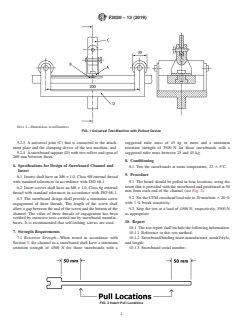
5.1 Retention Strength Test Apparatus—Universal test ma-
E691Practice for Conducting an Interlaboratory Study to
chine (UTM), with a pull-out device according to Fig. 1,
having a minimum load range of 10 kN.
5.2 The pullout device should consist of:
This test method is under the jurisdiction of ASTM Committee F27 on Snow
5.2.1 A rigid steel attachment plate (A) with one hole of
andWater Sports and is the direct responsibility of Subcommittee F27.30 on Skiing
and Snowboarding Equipment.
6.5-mm diameter,
Current edition approved Nov. 1, 2019. Published December 2019. Originally
5.2.2 An insert (B) located in the snowboard channel and
approved in 2013. Last previous edition approved in 2013 as F3030–13. DOI:
bolted through the hole of (A),
10.1520/F3030-13R19.
For referenced ASTM standards, visit the ASTM website, www.astm.org, or
contact ASTM Customer Service at service@astm.org. For Annual Book of ASTM
Standards volume information, refer to the standard’s Document Summary page on Available from International Organization for Standardization (ISO), 1, ch. de
the ASTM website. la Voie-Creuse, CP 56, CH-1211 Geneva 20, Switzerland, http://www.iso.org.
Copyright © ASTM International, 100 Barr Harbor Drive, PO Box C700, West Conshohocken, PA 19428-2959. United States
F3030 − 13 (2019)
NOTE 1—Dimensions in millimetres.
FIG. 1 Universal Test Machine with Pullout Device
5.2.3 A universal joint (C) that is connected to the attach- suggested rider mass of 45 kg or more and a minimum
ment plate and the clamping device of the test machine, and retention strength of 3500 N for those snowboards with a
5.2.4 Asnowboard support (D) with two rollers and span of suggested rider mass between 25 and 45 kg.
200 mm between them.
8. Conditioning
6. Specifications for Design of Snowboard Channel and
8.1 Test the snowboards at room temperature, 23 6 5°C.
Insert
9. Procedure
6.1 Inserts shall have an M6 × 1.0, Class 6H internal thread
with standard tolerances in accordance with ISO 68-1. 9.1 The board should be pulled in four locations, using the
insertthatisprovidedwiththesnowboardandpositionedat50
6.2 Insert screws shall have an M6 × 1.0, Class 6g external
mm from each end of the channel (see Fig. 2).
thread with standard tolerances in accordance with IS
...