

ASTM D3884-22
(Guide)Standard Guide for Abrasion Resistance of Textile Fabrics (Rotary Platform Abrader Method)
General Information
- Abstract
SIGNIFICANCE AND USE
5.1 The measurement of the resistance to abrasion of textile and other materials is very complex and may be affected by a number of factors, including:
5.1.1 The inherent mechanical properties of the fibers; the dimensions of the fibers; the structure of the yarns; the construction of the fabrics; and the type, kind, and amount of finishing material added to the fibers, yarns, or fabric.
5.1.2 The conditions of the tests, such as the nature of abradant, variable action of the abradant over the area of specimen abraded, the tension of the specimen, the pressure between the specimen and abradant, and the dimensional changes in the specimens.
5.1.3 Changes in the abradant during specific tests.
Note 2: The abradant must accordingly be discarded at frequent intervals or checked periodically against a standard. With disposable abradants, the abradant is used only once or discarded after limited use. With permanent abradants that use hardened metal or equivalent surfaces, it is assumed that the abradant will not change appreciably in a specific series of tests. Similar abradants used in different laboratories will not change at the same rate, due to differences in usage. Permanent abradants may also change due to pick up of finishing or other material from test fabrics and must accordingly be cleaned at frequent intervals.
5.1.4 The method of evaluation, which may be influenced by the judgment of the operator.
5.2 The resistance of textile materials to abrasion as measured on a testing machine in the laboratory is generally only one of several factors contributing to wear performance or durability as experienced in the actual use of the material. While “abrasion resistance” (often stated in terms of the number of cycles on a specified machine, using a specified technique to produce a specified degree or amount of abrasion) and “durability” (defined as the ability to withstand deterioration or wearing out in use, including the effects of abrasion) are freq...
SCOPE
1.1 This guide covers the determination of the abrasion resistance of textile fabrics using the rotary platform abrader.
Note 1: Other procedures for measuring the abrasion resistance of textile fabrics are given in Test Methods D3389, D3885, D3886, D4157, D4158, D4685, D4966, and AATCC 93. To determine the abrasion resistance of leather, refer to Test Method D7255.
1.2 The values stated in SI units are to be regarded as standard. No other units of measurement are included in this standard.
1.2.1 Exception—English units are used when referencing rotational speed.
1.3 This standard does not purport to address all of the safety concerns, if any, associated with its use. It is the responsibility of the user of this standard to establish appropriate safety, health, and environmental practices and determine the applicability of regulatory limitations prior to use.
1.4 This international standard was developed in accordance with internationally recognized principles on standardization established in the Decision on Principles for the Development of International Standards, Guides and Recommendations issued by the World Trade Organization Technical Barriers to Trade (TBT) Committee.
- Status
- Published
- Publication Date
- 31-May-2022
- Technical Committee
- D13 - Textiles
- Drafting Committee
- D13.60 - Fabric Physical Test Methods B
Buy Documents
ASTM D3884-22 - Standard Guide for Abrasion Resistance of Textile Fabrics (Rotary Platform Abrader Method)
REDLINE ASTM D3884-22 - Standard Guide for Abrasion Resistance of Textile Fabrics (Rotary Platform Abrader Method)
Overview
ASTM D3884-22: Standard Guide for Abrasion Resistance of Textile Fabrics (Rotary Platform Abrader Method) provides a comprehensive procedure for determining the abrasion resistance of textile fabrics using a rotary platform, double-head abrader. Abrasion resistance is a critical property for textiles used in garments, upholstery, industrial applications, and floor coverings. This ASTM standard is widely referenced to evaluate how well textile materials withstand surface wear and deterioration from rubbing actions. It outlines guidelines for both equipment setup and test procedures, supporting consistent and repeatable laboratory testing for manufacturers, quality control professionals, and product developers.
Key Topics
- Abrasion Resistance Testing: The guide describes testing textile specimens on a rotary platform, where two opposing abrasive wheels apply controlled, repeated rubbing under specific loads and environmental conditions.
- Factors Affecting Results: Test outcomes may vary based on fiber properties, yarn structure, fabric construction, finishing materials, and the choice of abradant wheels. Calibration, platform speed, specimen tension, and vacuum suction settings also influence results.
- Wheel and Load Selection: The standard lists several types of abrasive wheels (e.g., resilient, vitrified) and offers a wheel selection guide to match fabric types and testing requirements. Loads can be adjusted based on fabric delicacy or robustness.
- Test Methods and Endpoints: Evaluation criteria can include loss in breaking strength, mass loss, cycles to rupture, or visual changes such as color loss or pilling, using industry-accepted rating scales.
- Sampling and Specimen Preparation: Clear guidance is provided for sampling textiles from production lots or garments, specimen cutting, mounting, and conditioning to ensure reliable and comparable data.
- Reporting Requirements: Results should specify wheel type, loads, suction, test atmosphere, evaluation methods, and interpretation of abrasion data, supporting transparency and traceability.
Applications
- Product Development and Quality Control: Fabric and apparel producers use this standard to benchmark new materials and verify product durability before market release.
- Specification Compliance: Buyers and suppliers reference ASTM D3884-22 in contracts and technical specifications to ensure textile materials meet abrasion resistance requirements for their intended use.
- Research and Comparative Evaluation: Laboratories and research institutions utilize the method for comparative studies of textile performance, process optimization, or materials innovation.
- Industry Sectors: The guide is applicable to woven, nonwoven, and knit fabrics used in apparel, furniture upholstery, automotive interiors, industrial textiles, and floor coverings.
Related Standards
For broader context or alternative abrasion testing methods, the following standards are referenced or related to ASTM D3884-22:
- ASTM D3389: Coated Fabrics Abrasion Resistance (Rotary Platform Abrader)
- ASTM D3885: Abrasion Resistance (Flexing and Abrasion Method)
- ASTM D3886: Abrasion Resistance (Inflated Diaphragm Apparatus)
- ASTM D4157/D4158: Oscillatory Cylinder Method / Uniform Abrasion
- ASTM D4685: Pile Fabric Abrasion Resistance
- ASTM D4966: Martindale Abrasion Tester Method
- AATCC 93: Accelerator Method for abrasion resistance
- ASTM D7255: Abrasion Resistance of Leather
These standards support holistic textile testing programs and satisfy a diverse range of durability assessment needs across industries.
Keywords: abrasion resistance, textile testing, rotary platform abrader, ASTM D3884-22, fabric durability, textile standards, wear resistance, laboratory testing, textile quality control, industrial fabrics
Relations
- Refers
ASTM D4158-08(2020) - Standard Guide for Abrasion Resistance of Textile Fabrics (Uniform Abrasion) - Effective Date
- 01-Jul-2020
- Effective Date
- 01-Jul-2019
- Effective Date
- 01-Sep-2018
- Effective Date
- 15-Jul-2017
- Effective Date
- 01-Mar-2017
- Refers
ASTM D4158-08(2016) - Standard Guide for Abrasion Resistance of Textile Fabrics (Uniform Abrasion) - Effective Date
- 01-Jul-2016
- Effective Date
- 15-Sep-2015
- Effective Date
- 01-Sep-2015
- Effective Date
- 01-Jul-2015
- Effective Date
- 01-Apr-2015
- Effective Date
- 01-Nov-2013
- Effective Date
- 01-Jul-2013
- Effective Date
- 01-Jul-2013
- Effective Date
- 01-Jul-2013
- Effective Date
- 01-Jul-2013
Buy Documents
ASTM D3884-22 - Standard Guide for Abrasion Resistance of Textile Fabrics (Rotary Platform Abrader Method)
REDLINE ASTM D3884-22 - Standard Guide for Abrasion Resistance of Textile Fabrics (Rotary Platform Abrader Method)
Get Certified
Connect with accredited certification bodies for this standard

Control Union Certifications
Global certification for agriculture and sustainability.

Hohenstein Institut
Textile testing and certification.

Bureau Veritas Bangladesh
Bureau Veritas certification services in Bangladesh.
Sponsored listings
Frequently Asked Questions
ASTM D3884-22 is a guide published by ASTM International. Its full title is "Standard Guide for Abrasion Resistance of Textile Fabrics (Rotary Platform Abrader Method)". This standard covers: SIGNIFICANCE AND USE 5.1 The measurement of the resistance to abrasion of textile and other materials is very complex and may be affected by a number of factors, including: 5.1.1 The inherent mechanical properties of the fibers; the dimensions of the fibers; the structure of the yarns; the construction of the fabrics; and the type, kind, and amount of finishing material added to the fibers, yarns, or fabric. 5.1.2 The conditions of the tests, such as the nature of abradant, variable action of the abradant over the area of specimen abraded, the tension of the specimen, the pressure between the specimen and abradant, and the dimensional changes in the specimens. 5.1.3 Changes in the abradant during specific tests. Note 2: The abradant must accordingly be discarded at frequent intervals or checked periodically against a standard. With disposable abradants, the abradant is used only once or discarded after limited use. With permanent abradants that use hardened metal or equivalent surfaces, it is assumed that the abradant will not change appreciably in a specific series of tests. Similar abradants used in different laboratories will not change at the same rate, due to differences in usage. Permanent abradants may also change due to pick up of finishing or other material from test fabrics and must accordingly be cleaned at frequent intervals. 5.1.4 The method of evaluation, which may be influenced by the judgment of the operator. 5.2 The resistance of textile materials to abrasion as measured on a testing machine in the laboratory is generally only one of several factors contributing to wear performance or durability as experienced in the actual use of the material. While “abrasion resistance” (often stated in terms of the number of cycles on a specified machine, using a specified technique to produce a specified degree or amount of abrasion) and “durability” (defined as the ability to withstand deterioration or wearing out in use, including the effects of abrasion) are freq... SCOPE 1.1 This guide covers the determination of the abrasion resistance of textile fabrics using the rotary platform abrader. Note 1: Other procedures for measuring the abrasion resistance of textile fabrics are given in Test Methods D3389, D3885, D3886, D4157, D4158, D4685, D4966, and AATCC 93. To determine the abrasion resistance of leather, refer to Test Method D7255. 1.2 The values stated in SI units are to be regarded as standard. No other units of measurement are included in this standard. 1.2.1 Exception—English units are used when referencing rotational speed. 1.3 This standard does not purport to address all of the safety concerns, if any, associated with its use. It is the responsibility of the user of this standard to establish appropriate safety, health, and environmental practices and determine the applicability of regulatory limitations prior to use. 1.4 This international standard was developed in accordance with internationally recognized principles on standardization established in the Decision on Principles for the Development of International Standards, Guides and Recommendations issued by the World Trade Organization Technical Barriers to Trade (TBT) Committee.
SIGNIFICANCE AND USE 5.1 The measurement of the resistance to abrasion of textile and other materials is very complex and may be affected by a number of factors, including: 5.1.1 The inherent mechanical properties of the fibers; the dimensions of the fibers; the structure of the yarns; the construction of the fabrics; and the type, kind, and amount of finishing material added to the fibers, yarns, or fabric. 5.1.2 The conditions of the tests, such as the nature of abradant, variable action of the abradant over the area of specimen abraded, the tension of the specimen, the pressure between the specimen and abradant, and the dimensional changes in the specimens. 5.1.3 Changes in the abradant during specific tests. Note 2: The abradant must accordingly be discarded at frequent intervals or checked periodically against a standard. With disposable abradants, the abradant is used only once or discarded after limited use. With permanent abradants that use hardened metal or equivalent surfaces, it is assumed that the abradant will not change appreciably in a specific series of tests. Similar abradants used in different laboratories will not change at the same rate, due to differences in usage. Permanent abradants may also change due to pick up of finishing or other material from test fabrics and must accordingly be cleaned at frequent intervals. 5.1.4 The method of evaluation, which may be influenced by the judgment of the operator. 5.2 The resistance of textile materials to abrasion as measured on a testing machine in the laboratory is generally only one of several factors contributing to wear performance or durability as experienced in the actual use of the material. While “abrasion resistance” (often stated in terms of the number of cycles on a specified machine, using a specified technique to produce a specified degree or amount of abrasion) and “durability” (defined as the ability to withstand deterioration or wearing out in use, including the effects of abrasion) are freq... SCOPE 1.1 This guide covers the determination of the abrasion resistance of textile fabrics using the rotary platform abrader. Note 1: Other procedures for measuring the abrasion resistance of textile fabrics are given in Test Methods D3389, D3885, D3886, D4157, D4158, D4685, D4966, and AATCC 93. To determine the abrasion resistance of leather, refer to Test Method D7255. 1.2 The values stated in SI units are to be regarded as standard. No other units of measurement are included in this standard. 1.2.1 Exception—English units are used when referencing rotational speed. 1.3 This standard does not purport to address all of the safety concerns, if any, associated with its use. It is the responsibility of the user of this standard to establish appropriate safety, health, and environmental practices and determine the applicability of regulatory limitations prior to use. 1.4 This international standard was developed in accordance with internationally recognized principles on standardization established in the Decision on Principles for the Development of International Standards, Guides and Recommendations issued by the World Trade Organization Technical Barriers to Trade (TBT) Committee.
ASTM D3884-22 is classified under the following ICS (International Classification for Standards) categories: 59.080.30 - Textile fabrics. The ICS classification helps identify the subject area and facilitates finding related standards.
ASTM D3884-22 has the following relationships with other standards: It is inter standard links to ASTM D4158-08(2020), ASTM D5035-11(2019), ASTM D4848-98(2018), ASTM D4850-13(2017), ASTM D123-17, ASTM D4158-08(2016), ASTM D123-15b, ASTM D123-15a, ASTM D3885-07a(2015), ASTM D123-15, ASTM G195-13a, ASTM D4157-13, ASTM G195-13, ASTM D4850-13, ASTM D4850-13e1. Understanding these relationships helps ensure you are using the most current and applicable version of the standard.
ASTM D3884-22 is available in PDF format for immediate download after purchase. The document can be added to your cart and obtained through the secure checkout process. Digital delivery ensures instant access to the complete standard document.
Standards Content (Sample)
This international standard was developed in accordance with internationally recognized principles on standardization established in the Decision on Principles for the
Development of International Standards, Guides and Recommendations issued by the World Trade Organization Technical Barriers to Trade (TBT) Committee.
Designation: D3884 − 22
Standard Guide for
Abrasion Resistance of Textile Fabrics (Rotary Platform
Abrader Method)
This standard is issued under the fixed designation D3884; the number immediately following the designation indicates the year of
original adoption or, in the case of revision, the year of last revision. A number in parentheses indicates the year of last reapproval. A
superscript epsilon (´) indicates an editorial change since the last revision or reapproval.
1. Scope D3886 Test Method for Abrasion Resistance of Textile
Fabrics (Inflated Diaphragm Apparatus)
1.1 This guide covers the determination of the abrasion
D4157 Test Method for Abrasion Resistance of Textile
resistance of textile fabrics using the rotary platform abrader.
Fabrics (Oscillatory Cylinder Method)
NOTE 1—Other procedures for measuring the abrasion resistance of
D4158 Guide for Abrasion Resistance of Textile Fabrics
textile fabrics are given in Test Methods D3389, D3885, D3886, D4157,
(Uniform Abrasion)
D4158, D4685, D4966, and AATCC 93. To determine the abrasion
D4685 Test Method for Pile Fabric Abrasion
resistance of leather, refer to Test Method D7255.
D4850 Terminology Relating to Fabrics and Fabric Test
1.2 The values stated in SI units are to be regarded as
Methods
standard. No other units of measurement are included in this
D4848 Terminology Related to Force, Deformation and
standard.
Related Properties of Textiles
1.2.1 Exception—English units are used when referencing
D4966 Test Method for Abrasion Resistance of Textile
rotational speed.
Fabrics (Martindale Abrasion Tester Method)
1.3 This standard does not purport to address all of the
D5034 TestMethodforBreakingStrengthandElongationof
safety concerns, if any, associated with its use. It is the
Textile Fabrics (Grab Test)
responsibility of the user of this standard to establish appro-
D5035 Test Method for Breaking Force and Elongation of
priate safety, health, and environmental practices and deter-
Textile Fabrics (Strip Method)
mine the applicability of regulatory limitations prior to use.
D7255 Test Method for Abrasion Resistance of Leather
1.4 This international standard was developed in accor-
(Rotary Platform, Abraser Method)
dance with internationally recognized principles on standard-
G195 Guide for Conducting Wear Tests Using a Rotary
ization established in the Decision on Principles for the
Platform Abraser
Development of International Standards, Guides and Recom-
2.2 Other Documents:
mendations issued by the World Trade Organization Technical
AATCC 93 Abrasion Resistance of Fabrics: Accelerotor
Barriers to Trade (TBT) Committee.
Method
2. Referenced Documents
3. Terminology
2.1 ASTM Standards:
3.1 For all terminology relating to D13.60, Fabric Test
D123 Terminology Relating to Textiles
Methods, Specific, refer to Terminology D4850. For the
D1776 Practice for Conditioning and Testing Textiles
definition of breaking force, refer to Terminology D4848.
D3389 Test Method for Coated FabricsAbrasion Resistance
3.2 Definitions:
(Rotary Platform Abrader)
3.2.1 The following terms are relevant to this standard:
D3885 Test Method for Abrasion Resistance of Textile
abrasion, abrasion cycle, breaking force.
Fabrics (Flexing and Abrasion Method)
3.2.2 resurface, v—procedure of cleaning and refreshing the
running surface of an abrasive wheel prior to use or during
This guide is under the jurisdiction of ASTM Committee D13 on Textiles and testing.
is the direct responsibility of Subcommittee D13.60 on Fabric Physical Test
3.3 For all other terminology related to textiles, refer to
Methods B.
CurrenteditionapprovedJune1,2022.PublishedJuly2022.Originallyapproved Terminology D123.
in 1980. Last previous edition approved in 2017 as D3884 – 09(2017). DOI:
10.1520/D3884-22.
For referenced ASTM standards, visit the ASTM website, www.astm.org, or
contact ASTM Customer Service at service@astm.org. For Annual Book of ASTM Available from American Association of Textile Chemists and Colorists
Standards volume information, refer to the standard’s Document Summary page on (AATCC), P.O. Box 12215, Research Triangle Park, NC 27709, http://
theASTM website. www.aatcc.org.
Copyright © ASTM International, 100 Barr Harbor Drive, PO Box C700, West Conshohocken, PA 19428-2959. United States
D3884 − 22
3.4 Acronyms: general, they should not be relied upon for prediction of actual
3.4.1 CAMI—Coated Abrasives Manufacturers Institute wear-life in specific end uses unless there are data showing the
specific relationship between laboratory abrasion tests and
4. Summary of Test Method
actual wear in the intended end-use.
4.1 Aspecimenisabradedusingrotaryrubbingactionunder
5.3 Before definite predictions of fabric usefulness can be
controlled conditions of pressure and abrasive action. The test
drawn from an abrasion test as made on the rotary platform
specimen, mounted on a turntable platform, turns on a vertical
abrader (Fig. 1), actual end-use trials should be conducted and
axis, against the sliding rotation of two abrading wheels. The
related to the abrasion test. Different types of wear (for
wheels shall be mounted in such a way that when they are in
example, wear on men’s clothing at cuffs, crotch, etc.) may
contact with the rotating test specimen, they rotate in opposing
correspond to different ratings of the rotary platform abrader
directions. One abrading wheel rubs the specimen outward
test.
toward the periphery and the other, inward toward the center
5.3.1 In making a comparison of different fabrics (that is, of
while a vacuum system removes wear debris generated during
different fibers, weights, etc.) the rotary platform abrader test
the test.The resulting abrasion marks form a pattern of crossed
will not always reveal a difference known to exist when the
arcs over an area of approximately 30 cm . Resistance to
fabrics are actually used. Therefore, end-use trials should be
abrasion is evaluated by various means which are described in
conducted in conjunction with the abrasion test, at least as a
Section 13.
guide for future testing of these fabrics.
5.3.2 Uncontrolled manufacturing or finishing variations
5. Significance and Use
occurring within a fabric or within lots of the same style of
5.1 The measurement of the resistance to abrasion of textile
fabric can, however, be detected satisfactorily with the rotary
and other materials is very complex and may be affected by a
platform abrader tester.
number of factors, including:
5.4 These general observations apply to all types of fabrics,
5.1.1 The inherent mechanical properties of the fibers; the
including woven, nonwoven, and knit apparel fabrics, house-
dimensions of the fibers; the structure of the yarns; the
hold fabrics, industrial fabrics, and floor coverings.
construction of the fabrics; and the type, kind, and amount of
finishing material added to the fibers, yarns, or fabric.
6. Apparatus
5.1.2 The conditions of the tests, such as the nature of
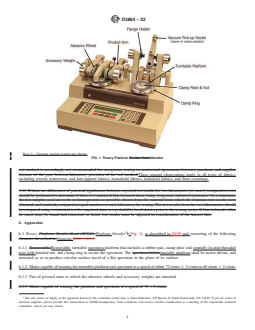
6.1 Rotary Platform Abrader (Fig.1),asdescribedinG195
abradant, variable action of the abradant over the area of
and consisting of the following elements:
specimen abraded, the tension of the specimen, the pressure
6.1.1 Removable, turntable specimen platform that includes
between the specimen and abradant, and the dimensional
a rubber pad, clamp plate and centrally located threaded post
changes in the specimens.
with knurled nut, and clamp ring to secure the specimen. The
5.1.3 Changes in the abradant during specific tests.
turntable platform shall be motor driven, and mounted so as to
NOTE 2—The abradant must accordingly be discarded at frequent
produce circular surface travel of a flat specimen in the plane
intervals or checked periodically against a standard. With disposable
of its surface.
abradants, the abradant is used only once or discarded after limited use.
6.1.2 Motor capable of rotating the turntable platform and
With permanent abradants that use hardened metal or equivalent surfaces,
specimen at a speed of either 72 r/min 6 2 r⁄min or 60
it is assumed that the abradant will not change appreciably in a specific
series of tests. Similar abradants used in different laboratories will not
r/min 6 2 r/min.
change at the same rate, due to differences in usage. Permanent abradants
6.1.3 Pair of pivoted arms to which the abrasive wheels and
may also change due to pick up of finishing or other material from test
accessory weights are attached.
fabrics and must accordingly be cleaned at frequent intervals.
6.1.4 Vacuum suction system and vacuum pick-up nozzle
5.1.4 The method of evaluation, which may be influenced
for removal of lint and debris generated during testing. The
by the judgment of the operator.
height of the vacuum nozzle shall be adjustable and the nozzle
5.2 The resistance of textile materials to abrasion as mea- will have two 8 mm openings – one opening positioned
sured on a testing machine in the laboratory is generally only between the two wheels and over the wear path and the other
placed diametrically opposite. The distance between the axes
one of several factors contributing to wear performance or
durability as experienced in the actual use of the material. of the two openings shall be 76.0 mm 6 1.0 mm.
6.1.5 Counter for indicating the number of abrasion cycles
While “abrasion resistance” (often stated in terms of the
number of cycles on a specified machine, using a specified (revolutions of the turntable platform).
technique to produce a specified degree or amount of abrasion)
6.2 Abrasive wheels , which are attached to the free end of
and “durability” (defined as the ability to withstand deteriora-
the pivoted arms and rotate freely about horizontal spindles.
tionorwearingoutinuse,includingtheeffectsofabrasion)are
6.2.1 The wheels shall be cylindrical shaped; have an
frequently related, the relationship varies with different end
external diameter between 51.9 mm and 44.4 mm; a width of
uses, and different factors may be necessary in any calculation
of predicted durability from specific abrasion data. Laboratory
The sole source of supply of the apparatus known to the committee at this time
tests may be reliable as an indication of relative end-use
is Taber Industries, 455 Bryant St. North Tonawanda, NY 14120. If you are aware
performance in cases where the difference in abrasion resis-
of alternate suppliers, please provide this information to ASTM headquarters. Your
tanceofvariousmaterialsislarge,buttheyshouldnotberelied
comments will receive careful consideration at a meeting of the responsible
upon where differences in laboratory test findings are small. In technical committee, which you may attend.
D3884 − 22
NOTE 1—Vacuum suction system not shown.
FIG. 1 Rotary Platform Abrader
12.7 mm 6 0.3 mm; and include an axial hole 16.0 mm 6 0.1 6.4.1 Resurfacing discs (S-11), for resurfacing resilient
mm to allow the wheel to be mounted to the flanged holder on wheels. The resurfacing disc shall be silicon carbide coated
the pivoted arm. The running surface of the wheel shall be 90° abrasive paper with an average particle size of 92 µm (150 grit
to the side. The wheels are either resilient or vitrified-based CAMI grade), approximately 102 mm in diameter witha7mm
with both types of wheels consisting of hard particles embed- center hole.
ded in a binder material and are manufactured in different 6.4.2 Wheel refacer, with a diamond tool for resurfacing
grades of abrasive quality. Other types of wheels, which do not vitrified based wheels or for correcting uneven wheel wear.
include hard particles embedded in a binder material, may also 6.4.3 Mounting card (optional), approximately 108 mm
be used (see Appendix X1). round witha7mm center hole and one side coated with
6.2.2 When resting on the specimen, the wheels will have a pressure sensitive adhesive to secure the specimen.
peripheral engagement with the surface of the specimen, the 6.4.4 Soft bristle brush, to remove loose fibers and debris
direction of travel of the periphery of the wheels and of the from the surface of the abrading wheels.
specimen at the contacting portions being at acute angles, and 6.4.5 AATCC Gray Scale for Color Change.
the angles of travel of one wheel periphery being opposite to
that of the other. Motion of the abrasive wheels, in opposite 7. Sampling
directions, is provided by rotation of the specimen and the
7.1 Take a lot sample as directed in the applicable material
associated friction therefrom.
specification, or as agreed upon by the interested parties. In the
6.3 Accessory Weights, attached to the pivoted arms to absence of such a specification or other agreement, take a
increase or decrease the force at which the wheel is pressed laboratory sample as directed in 7.1.1. Consider rolls or pieces
against the specimen, exclusive of the mass of the wheel itself. of fabric to be the primary sampling unit.
The pivoted abrader arms without auxiliary weights or counter 7.1.1 Take a laboratory sample that is the full width of the
weights apply a load against the specimen of 250 g per wheel
fabric and at least 50 cm long, from each roll or piece of fabric
and additional weights can be used to increase the load to 500 in the lot sample. The laboratory sample should be taken no
gor1000gperwheel.Acounterweightattachmentcanbeused
closer than 1 m from the end of each roll or piece of fabric.
to reduce the load on the specimen.
7.2 Sample shipments of garments as agreed upon by the
6.4 Auxiliary Apparatus: interested parties.
D3884 − 22
TABLE 1 Preparation of Resilient Abrasive Wheels
8. Number and Preparation of Test Specimens
Wheel Status Resurfacing Cycles
8.1 If the number of specimens to be tested is not specified
New 2 resurfacings of 50 cycles
by a material specification or an agreement between the
Used 25 or 50 cycles
interested parties, test five specimens.
During Test 50 cycles
8.1.1 If the number of specimens to be tested exceeds the
number of laboratory samples, randomly select those labora-
tory samples from which more than one test specimen will be
10.1.5 If the vacuum system does not turn on automatically
taken. If not, test one specimen per laboratory sample.
at the start of the test, start the vacuum suction and then the
turntable. Resurface the wheels by running them for the
8.2 In lieu of laboratory samples, specimens may be taken
appropriate number of cycles against the resurfacing disc as
from garment samples as agreed upon by all interested parties.
shown in Table 1. Each resurfacing disc is good for one 25 or
8.3 Cut specimens approximately 15 cm square. For the
50 cycle resurfacing operation, after which it must be dis-
specimens to be abraded, cut or punch a 6.5 mm diameter hole
carded.
in the center of the specimen. When determining residual or
NOTE 3—New Set of Wheels (break-in procedure)—Before placing in
average breaking strength, cut an additional five specimens to
service a new set of resilient wheels perform two (2) resurfacings of 50
be reserved for controls.
cycles to ensure perfect contact of the abrading faces with the specimen
8.3.1 For fabric widths 125 mm or more, take no specimen surface. The resurfacing disc is used only once (maximum of 50 cycles),
therefore this initial resurfacing of new wheels will require two (2)
closer than 25 mm from the selvage edge. Fabric widths less
resurfacing discs.
than 125 mm are not recommended.
NOTE 4—Starting a test with previously used wheels—Before testing a
8.3.2 Cut specimens representing a broad distribution di-
specimen with previously used wheels, resurface 25 or 50 cycles on a new
agonally across the width of the laboratory sampling unit.Take
resurfacing disc. When the previous test was short in duration (<1,000
cycles), resurfacing of 25 cycles is sufficient. When the previous test was
lengthwise specimens from different positions across the width
1,000 cycles or more, a resurfacing of 50 cycles is recommended. Wheels
of the fabric. Take widthwise specimens from different posi-
that have not been used for an extended period of time may require a
tions along the length of the fabric.
break-in resurfacing like a new set of wheels.
8.3.3 When b
...
This document is not an ASTM standard and is intended only to provide the user of an ASTM standard an indication of what changes have been made to the previous version. Because
it may not be technically possible to adequately depict all changes accurately, ASTM recommends that users consult prior editions as appropriate. In all cases only the current version
of the standard as published by ASTM is to be considered the official document.
Designation: D3884 − 09 (Reapproved 2017) D3884 − 22
Standard Guide for
Abrasion Resistance of Textile Fabrics (Rotary Platform,
Double-HeadPlatform Abrader Method)
This standard is issued under the fixed designation D3884; the number immediately following the designation indicates the year of
original adoption or, in the case of revision, the year of last revision. A number in parentheses indicates the year of last reapproval. A
superscript epsilon (´) indicates an editorial change since the last revision or reapproval.
1. Scope
1.1 This guide covers the determination of the abrasion resistance of textile fabrics using the rotary platform, double-head tester
(RPDH). platform abrader.
NOTE 1—Other procedures for measuring the abrasion resistance of textile fabrics are given in Test Methods D3389, D3885, D3886, D4157, D4158,
D4685, D4966, and AATCC 93. To determine the abrasion resistance of leather, refer to Test Method D7255.
1.2 The values stated in SI units are to be regarded as standard: the values in English units are provided as information only and
are not exact equivalents.standard. No other units of measurement are included in this standard.
1.2.1 Exception—English units are used when referencing rotational speed.
1.3 This standard does not purport to address all of the safety problems,concerns, if any, associated with its use. It is the
responsibility of the user of this standard to establish appropriate safety safety, health, and healthenvironmental practices and
determine the applicability of regulatory limitations prior to use.
1.4 This international standard was developed in accordance with internationally recognized principles on standardization
established in the Decision on Principles for the Development of International Standards, Guides and Recommendations issued
by the World Trade Organization Technical Barriers to Trade (TBT) Committee.
2. Referenced Documents
2.1 ASTM Standards:
D123 Terminology Relating to Textiles
D1776 Practice for Conditioning and Testing Textiles
D3389 Test Method for Coated Fabrics Abrasion Resistance (Rotary Platform Abrader)
D3885 Test Method for Abrasion Resistance of Textile Fabrics (Flexing and Abrasion Method)
D3886 Test Method for Abrasion Resistance of Textile Fabrics (Inflated Diaphragm Apparatus)
D4157 Test Method for Abrasion Resistance of Textile Fabrics (Oscillatory Cylinder Method)
D4158 Guide for Abrasion Resistance of Textile Fabrics (Uniform Abrasion)
D4685 Test Method for Pile Fabric Abrasion
D4850 Terminology Relating to Fabrics and Fabric Test Methods
D4848 Terminology Related to Force, Deformation and Related Properties of Textiles
This guide is under the jurisdiction of ASTM Committee D13 on Textiles and is the direct responsibility of Subcommittee D13.60 on Fabric Physical Test Methods,
SpecificMethods B.
Current edition approved July 15, 2017June 1, 2022. Published August 2017July 2022. Originally approved in 1980. Last previous edition approved in 20132017 as
ɛ1
D3884 – 09(2013)(2017). . DOI: 10.1520/D3884-09R17.10.1520/D3884-22.
For referenced ASTM standards, visit the ASTM website, www.astm.org, or contact ASTM Customer Service at service@astm.org. For Annual Book of ASTM Standards
volume information, refer to the standard’s Document Summary page on the ASTM website.
Copyright © ASTM International, 100 Barr Harbor Drive, PO Box C700, West Conshohocken, PA 19428-2959. United States
D3884 − 22
D4966 Test Method for Abrasion Resistance of Textile Fabrics (Martindale Abrasion Tester Method)
D5034 Test Method for Breaking Strength and Elongation of Textile Fabrics (Grab Test)
D5035 Test Method for Breaking Force and Elongation of Textile Fabrics (Strip Method)
D7255 Test Method for Abrasion Resistance of Leather (Rotary Platform, Abraser Method)
G195 Guide for Conducting Wear Tests Using a Rotary Platform Abraser
2.2 Other Documents:
AATCC 93 Abrasion Resistance of Fabrics: AcceleratorAccelerotor Method
3. Terminology
3.1 For all terminology relating to D13.60, Fabric Test Methods, Specific, refer to Terminology D4850. For the definition of
breaking force, refer to Terminology D4848.
3.1.1 The following terms are relevant to this standard: abrasion, abrasion cycle, breaking force.
3.2 Definitions:
3.2.1 The following terms are relevant to this standard: abrasion, abrasion cycle, breaking force.
3.2.2 resurface, v—procedure of cleaning and refreshing the running surface of an abrasive wheel prior to use or during testing.
3.3 For all other terminology related to textiles, refer to Terminology D123.
3.4 Acronyms:
3.4.1 CAMI—Coated Abrasives Manufacturers Institute
4. Summary of Test Method
4.1 A specimen is abraded using rotary rubbing action under controlled conditions of pressure and abrasive action. The test
specimen, mounted on a turntable platform, turns on a vertical axis, against the sliding rotation of two abrading wheels. The wheels
shall be mounted in such a way that when they are in contact with the rotating test specimen, they rotate in opposing directions.
One abrading wheel rubs the specimen outward toward the periphery and the other, inward toward the center. center while a
vacuum system removes wear debris generated during the test. The resulting abrasion marks form a pattern of crossed arcs over
an area of approximately 30 cm . Resistance to abrasion is evaluated by various means which are described in Section 13.
5. Significance and Use
5.1 The measurement of the resistance to abrasion of textile and other materials is very complex. The resistance to abrasion is
affected by many factors, such as the inherent mechanical properties of the fibers; the dimensions of the fibers; the structure of the
yarns; the construction of the fabrics; and the type, kind, and amount of finishing material added to the fibers, yarns, or fabric.
5.2 The resistance to abrasion is also greatly affected by the conditions of the tests, such as the nature of abradant, variable action
of the abradant over the area of specimen abraded, the tension of the specimen, the pressure between the specimen and abradant,
and the dimensional changes in the specimens.
5.1 Abrasion tests are all subject to variation due to changes in the abradant during specific tests. The abradant must accordingly
be discarded at frequent intervals or checked periodically against a standard. With disposable abradants, the abradant is used only
once or discarded after limited use. With permanent abradants that use hardened metal or equivalent surfaces, it is assumed that
the abradant will not change appreciably in a specific series of tests. Similar abradants used in different laboratories will not change
at the same rate, due to differences in usage. Permanent abradants may also change due to pick up of finishing or other material
from test fabrics and must accordingly be cleaned at frequent intervals. The The measurement of the relative amount of abrasion
may also resistance to abrasion of textile and other materials is very complex and may be affected by the method of evaluation
and may be influenced by the judgment of the operator.a number of factors, including:
5.1.1 The inherent mechanical properties of the fibers; the dimensions of the fibers; the structure of the yarns; the construction of
the fabrics; and the type, kind, and amount of finishing material added to the fibers, yarns, or fabric.
Available from American Association of Textile Chemists and Colorists (AATCC), P.O. Box 12215, Research Triangle Park, NC 27709, http://www.aatcc.org.
D3884 − 22
5.1.2 The conditions of the tests, such as the nature of abradant, variable action of the abradant over the area of specimen abraded,
the tension of the specimen, the pressure between the specimen and abradant, and the dimensional changes in the specimens.
5.1.3 Changes in the abradant during specific tests.
NOTE 2—The abradant must accordingly be discarded at frequent intervals or checked periodically against a standard. With disposable abradants, the
abradant is used only once or discarded after limited use. With permanent abradants that use hardened metal or equivalent surfaces, it is assumed that
the abradant will not change appreciably in a specific series of tests. Similar abradants used in different laboratories will not change at the same rate, due
to differences in usage. Permanent abradants may also change due to pick up of finishing or other material from test fabrics and must accordingly be
cleaned at frequent intervals.
5.1.4 The method of evaluation, which may be influenced by the judgment of the operator.
5.2 The resistance of textile materials to abrasion as measured on a testing machine in the laboratory is generally only one of
several factors contributing to wear performance or durability as experienced in the actual use of the material. While “abrasion
resistance” (often stated in terms of the number of cycles on a specified machine, using a specified technique to produce a specified
degree or amount of abrasion) and “durability” (defined as the ability to withstand deterioration or wearing out in use, including
the effects of abrasion) are frequently related, the relationship varies with different end uses, and different factors may be necessary
in any calculation of predicted durability from specific abrasion data. Laboratory tests may be reliable as an indication of relative
end-use performance in cases where the difference in abrasion resistance of various materials is large, but they should not be relied
upon where differences in laboratory test findings are small. In general, they should not be relied upon for prediction of actual
wear-life in specific end uses unless there are data showing the specific relationship between laboratory abrasion tests and actual
wear in the intended end-use.
5.5 These general observations apply to all types of fabrics, including woven, nonwoven, and knit apparel fabrics, household
fabrics, industrial fabrics, and floor coverings. It is not surprising, therefore, to find that there are many different types of abrasion
testing machines, abradants, testing conditions, testing procedures, methods of evaluation of abrasion resistance and interpretation
of results.
5.6 All the test procedures and instruments that have been developed for abrasion resistance of fabrics may show a high degree
of variability in results obtained by different operators and in different laboratories, however, they represent the procedures most
widely used in the industry. Because there is a definite need for measuring the relative resistance to abrasion, this is one of the
several procedures that is useful to help minimize the inherent variation in results that may occur.
5.3 Before definite predictions of fabric usefulness can be drawn from an abrasion test as made on the rotary platform, double-head
(RPDH) platform abrader (Fig. 1), actual end-use trials should be conducted and related to the abrasion test. Different types of wear
(for example, wear on men’s clothing at cuffs, crotch, etc.) may correspond to different ratings of the RPDH rotary platform abrader
test.
5.3.1 In making a comparison of different fabrics (that is, of different fibers, weights, etc.) the rotary platform abrader test will
not always reveal a difference known to exist when the fabrics are actually used. Therefore, end-use trials should be conducted
in conjunction with the abrasion test, at least as a guide for future testing of these fabrics.
5.3.2 Uncontrolled manufacturing or finishing variations occurring within a fabric or within lots of the same style of fabric can,
however, be detected satisfactorily with the rotary platform abrader tester.
5.8 In making a comparison of different fabrics (that is, of different fibers, weights, etc.) the RPDH test will not always reveal a
difference known to exist when the fabrics are actually used. Therefore, end-use trials should be conducted in conjunction with
the RPDH abrasion test, at least as a guide for future testing of these fabrics.
5.9 Uncontrolled manufacturing or finishing variations occurring within a fabric or within lots of the same style of fabric can,
however, be detected satisfactorily with the RPDH tester.
5.4 Because of the conditions mentioned above, technicians frequently fail to get good agreement between results obtained on the
same type of testing instrument both within and between laboratories, and the precision of these test methods is uncertain. This
D3884 − 22
NOTE 1—Vacuum suction system not shown.
FIG. 1 Rotary Platform Double Head Abrader
test method is accordingly not recommended for acceptance testing in contractual agreements between purchaser and supplier
because of the poor between-laboratory precision of the test method.These general observations apply to all types of fabrics,
including woven, nonwoven, and knit apparel fabrics, household fabrics, industrial fabrics, and floor coverings.
5.11 If there are differences of practical significance between reported test results for two laboratories (or more), comparative tests
should be performed to determine if there is a statistical bias between them, using competent statistical assistance. As a minimum,
the test samples used are to be as homogeneous as possible, drawn from the material from which the disparate test results were
obtained, and randomly assigned in equal numbers to each laboratory for testing. The test results from the two laboratories should
be compared using a statistical test for unpaired data, at a probability level chosen prior to the testing series. If bias is found, either
its cause must be found and corrected, or future test results must be adjusted in consideration of the known bias.
6. Apparatus
6.1 Rotary Platform, Double-Head (RPDH) Platform Abrader ( (Fig. 1), as described in G195 and consisting of the following
elements described in elements:6.1.1 – 6.1.5
6.1.1 Removeable,Removable, turntable specimen platform that includes a rubber pad, clamp plate and centrally located threaded
post with knurled nut, and clamp ring to secure the specimen. The specimen holderturntable platform shall be motor driven, and
mounted so as to produce circular surface travel of a flat specimen in the plane of its surface.
6.1.2 Motor capable of rotating the turntable platform and specimen at a speed of either 72 r/min 6 2 r ⁄min or 60 r/min 6 2 r/min.
6.1.3 Pair of pivoted arms to which the abrasive wheels and accessory weights are attached.
6.1.3 Motor capable of rotating the platform and specimen at a speed of 72 62 r/min.
The sole source of supply of the apparatus known to the committee at this time is Taber Industries, 455 Bryant St. North Tonawanda, NY 14120. If you are aware of
alternate suppliers, please provide this information to ASTM headquarters. Your comments will receive careful consideration at a meeting of the responsible technical
committee, which you may attend.
D3884 − 22
6.1.4 Vacuum nozzle suction system and vacuum cleaner pick-up nozzle for removal of lint and debris from specimen. generated
during testing. The height of the vacuum nozzle shall be adjustable and the nozzle will have two 8 mm openings – one opening
positioned between the two wheels and over the wear path and the other placed diametrically opposite. The distance between the
axes of the two openings shall be 76.0 61.0 mm 6 1.0 mm.
6.1.5 Counter for indicating the revolutions of the specimen holder. number of abrasion cycles (revolutions of the turntable
platform).
6.2 Abrasive wheels,wheels , which are attached to the free end of the pivoted arms and rotate freely about horizontal spindles.
6.2.1 The wheels shall be cylindrical shaped; have an external diameter between 51.9 mm and 44.4 mm; a width of 12.7 mm 6
0.3 mm; and include an axial hole 16.0 mm 6 0.1 mm to allow the wheel to be mounted to the flanged holder on the pivoted arm.
The running surface of the wheel shall be 90° to the side. The wheels are either resilient or vitrified-based with both types of wheels
consisting of hard particles embedded in a binder material and are manufactured in different grades of abrasive quality. Other types
of wheels, which do not include hard particles embedded in a binder material, may also be used (see Appendix X1).
6.2.2 Their internal faces shall be 52.4 61.0 mm apart and the hypothetical line through the two spindles shall be 19.05 60.3 mm
away from the central axis of the turntable (see Fig. 2). When resting on the specimen, the wheels will have a peripheral
engagement with the surface of the specimen, the direction of travel of the periphery of the wheels and of the specimen at the
contacting portions being at acute angles, and the angles of travel of one wheel periphery being opposite to that of the other. Motion
of the abrasive wheels, in opposite directions, is provided by rotation of the specimen and the associated friction therefrom.
6.2.2 The abrasive wheels are either resilient or vitrified-based. Both types of wheels consist of hard particles embedded in a
binder material and are manufactured in different grades of abrasive quality. The wheels shall be 12.7 60.3 mm thick and have
an external diameter of 51.9 60.5 mm when new, and in no case less than 44.4 mm.
6.3 Accessory Loads,Weights, The RPDH abrader is provided with a load adjustment for varying the load of the abrader wheels
on the specimen. attached to the pivoted arms to increase or decrease the force at which the wheel is pressed against the specimen,
exclusive of the mass of the wheel itself. The pivoted abrader arms without auxiliary weights or counter weights apply a load
against the specimen of 250 g per wheel (exclusive of the mass of the wheel itself). The manufacturer provides additional weights
that and additional weights can be used to increase the load to 500 g or 1000 g per wheel, and a wheel. A counterweight attachment
that can be used to reduce the load on the specimen to 125 g per wheel.specimen.
6.4 Auxiliary Apparatus—Resurfacing discs (S-11), of carborundum-coated paper, are used to resurface the resilient wheels.
6.4 Abrasion Wheel Resurfacing Device, Auxiliary Apparatus: for resurfacing vitrified based wheels or for correcting uneven
wheel wear.
6.4.1 Resurfacing discs (S-11), for resurfacing resilient wheels. The resurfacing disc shall be silicon carbide coated abrasive paper
with an average particle size of 92 μm (150 grit CAMI grade), approximately 102 mm in diameter with a 7 mm center hole.
6.4.2 Wheel refacer, with a diamond tool for resurfacing vitrified based wheels or for correcting uneven wheel wear.
6.4.3 Mounting card (optional), approximately 108 mm round with a 7 mm center hole and one side coated with pressure sensitive
adhesive to secure the specimen.
6.4.4 Soft bristle brush, to remove loose fibers and debris from the surface of the abrading wheels.
6.4.5 AATCC Gray Scale for Color Change.
7. Sampling
7.1 Take a lot sample as directed in the applicable material specification, or as agreed upon by the purchaser and seller. interested
parties. In the absence of such a specification or other agreement, take a laboratory sample as directed in 7.1.1. Consider rolls or
pieces of fabric to be the primary sampling unit.
D3884 − 22
7.1.1 Take a laboratory sample that is the full width of the fabric and at least 50 cm (approximately 20 in.) long, from each roll
or piece of fabric in the lot sample. The laboratory sample should be taken no closer than 1 m (1 yd) from the end of each roll
or piece of fabric.
7.2 Sample shipments of garments as agreed upon by purchaser and seller.the interested parties.
8. Number and Preparation of Test Specimens
8.1 If the number of specimens to be tested is not specified by a material specification or an agreement between purchaser and
seller,the interested parties, test five specimens.
8.1.1 If the number of specimens to be tested exceeds the number of laboratory samples, randomly select those laboratory samples
from which more than one test specimen will be taken. If not, test one specimen per laboratory sample.
8.2 Take specimens In lieu of laboratory samples, specimens may be taken from garment samples as agreed upon by all interested
parties.
8.3 Cut ten specimens approximately 15 cm (6 in.) square, five for abrasion tests and five reserved for controls. For the five square.
For the specimens to be abraded, cut a 6-mm (or punch a 6.5 mm ⁄4-in.) diameter hole in the center of the specimen. When
determining residual or average breaking strength, cut an additional five specimens to be reserved for controls.
8.3.1 For fabric widths 125 mm (5 in.) or more, take no specimen closer than 25 mm (1 in.) from the selvage edge. Fabric widths
less than 125 mm are not recommended.
8.3.2 For fabric widths less than 125 mm (5 in.), use the entire width for specimens.
8.3.2 Cut specimens representing a broad distribution diagonally across the width of the laboratory sampling unit. Take lengthwise
specimens from different positions across the width of the fabric. Take widthwise specimens from different positions along the
length of the fabric.
8.3.3 When breaking force or strength are to be measured, specimens must be appropriately marked to indicate which is the
lengthwise or widthwise direction.
8.3.4 Ensure specimens are free of folds, creases, or wrinkles. Avoid getting oil, water, grease, etc. on the specimens when
...