

ASTM F2845-22
(Test Method)Standard Test Method for Measuring the Dynamic Stiffness (DS) and Cylindrical Coefficient of Restitution (CCOR) of Baseballs and Softballs
General Information
- Abstract
SIGNIFICANCE AND USE
5.1 1 The ball dynamic stiffness is a measure of a ball’s hardness. Its measurement is conducted to represent bat-ball impact forces. It is normalized by the ball weight and speed to minimize the influence of manufacturing and test variations from the measure.
5.2 The cylindrical coefficient of restitution is a ball property of relative velocity change caused by impact with a cylindrical surface.
5.3 This test method compares the performance of baseballs and softballs after impact with a cylindrical test surface.
5.4 Sports associations can use DS and CCOR measurements in specifications for official baseballs and softballs.
SCOPE
1.1 This procedure describes a method of measuring the dynamic stiffness (DS) and cylindrical coefficient of restitution (CCOR) of baseballs and softballs providing similar impact forces and ball deformation as are observed in a bat-ball collision.
1.2 This procedure is for a ball that is intended for the game of baseball or softball.
1.3 The test method is based on ball speed measurements before and after impact with a cylindrical test surface and the impact force between the ball and impacted surface.
1.4 The values stated in inch-pound units are to be regarded as standard. The values given in parentheses are mathematical conversions to SI units that are provided for information only and are not considered standard.
1.5 This standard does not purport to address all of the safety concerns, if any, associated with its use. It is the responsibility of the user of this standard to establish appropriate safety, health, and environmental practices and determine the applicability of regulatory limitations prior to use.
1.6 This international standard was developed in accordance with internationally recognized principles on standardization established in the Decision on Principles for the Development of International Standards, Guides and Recommendations issued by the World Trade Organization Technical Barriers to Trade (TBT) Committee.
- Status
- Published
- Publication Date
- 30-Apr-2022
- Technical Committee
- F08 - Sports Equipment, Playing Surfaces, and Facilities
- Drafting Committee
- F08.26 - Baseball and Softball Equipment
Buy Documents
ASTM F2845-22 - Standard Test Method for Measuring the Dynamic Stiffness (DS) and Cylindrical Coefficient of Restitution (CCOR) of Baseballs and Softballs
REDLINE ASTM F2845-22 - Standard Test Method for Measuring the Dynamic Stiffness (DS) and Cylindrical Coefficient of Restitution (CCOR) of Baseballs and Softballs
Overview
ASTM F2845-22 is a standardized test method developed by ASTM International for measuring the dynamic stiffness (DS) and cylindrical coefficient of restitution (CCOR) of baseballs and softballs. These two measurements are crucial indicators of a ball's performance, especially in simulating the real-world forces and deformations that occur during actual bat-ball collisions in game scenarios. This method is widely recognized and employed by sports associations, manufacturers, and laboratories to ensure and compare the quality and compliance of baseball and softball equipment.
Key Topics
- Dynamic Stiffness (DS): This property evaluates the "hardness" or rigidity of a ball by measuring the force required to deform it under dynamic (impact) conditions. DS is normalized by ball weight and speed to minimize the impact of variations in manufacturing and testing. This makes it a robust metric for comparing different balls.
- Cylindrical Coefficient of Restitution (CCOR): CCOR quantifies how much velocity a ball retains after bouncing off a cylindrical surface, which is indicative of the ball’s energy return capabilities following an impact similar to a bat-ball collision.
- Test Methodology: The method involves propelling the ball at controlled speeds toward a cylindrical steel surface, measuring both the incoming and rebound speeds, as well as the impact force throughout the collision. State-of-the-art equipment such as load cells, speed monitors, and precise data acquisition systems are used.
- Environmental Conditioning: To ensure consistent results, balls must be conditioned in a controlled environment for temperature and humidity prior to testing.
- Precision and Repeatability: The standard establishes clear criteria for repeatability and reproducibility to ensure that test results are consistent across different laboratories and operators.
Applications
- Product Development and Quality Control: Ball manufacturers use ASTM F2845-22 to evaluate and improve the design and material consistency of baseballs and softballs, ensuring reliable in-game performance.
- Compliance with Sports Association Standards: Sports governing bodies reference DS and CCOR results to set and enforce specifications for official game balls, supporting fair play and safety.
- Comparative Performance Analysis: Organizations and labs use these tests to compare balls from different batches, suppliers, or brands, leading to higher transparency and better purchasing decisions.
- Research and Innovation: Academic and industry researchers apply this standard to analyze the effects of new materials, construction techniques, and environmental conditions on ball performance.
Related Standards
- ASTM E177 - Practice for Use of the Terms Precision and Bias in ASTM Test Methods: Provides guidance on terminology and interpretation of statistical data associated with test precision.
- ASTM E691 - Practice for Conducting an Interlaboratory Study to Determine the Precision of a Test Method: Supports the design and analysis of collaborative studies to assess test repeatability.
- Associated Sports Equipment Standards: Other ASTM F08 standards cover testing methods for sports equipment, ensuring comprehensive safety and performance criteria across the industry.
Keywords: ball elasticity, dynamic stiffness, CCOR, baseball, softball, impact testing, ball hardness, sports equipment testing, ASTM standards, quality control, sports equipment compliance.
Relations
- Effective Date
- 01-May-2014
- Effective Date
- 01-May-2013
- Effective Date
- 01-May-2013
- Effective Date
- 01-Nov-2011
- Effective Date
- 01-Oct-2010
- Effective Date
- 01-Oct-2008
- Effective Date
- 01-Oct-2008
- Refers
ASTM E177-06b - Standard Practice for Use of the Terms Precision and Bias in ASTM Test Methods - Effective Date
- 15-Nov-2006
- Refers
ASTM E177-06a - Standard Practice for Use of the Terms Precision and Bias in ASTM Test Methods - Effective Date
- 01-Nov-2006
- Effective Date
- 01-Nov-2005
- Refers
ASTM E177-04e1 - Standard Practice for Use of the Terms Precision and Bias in ASTM Test Methods - Effective Date
- 01-Nov-2004
- Effective Date
- 01-Nov-2004
- Effective Date
- 01-Nov-2004
- Refers
ASTM E177-90a(2002) - Standard Practice for Use of the Terms Precision and Bias in ASTM Test Methods - Effective Date
- 10-Jan-2002
- Effective Date
- 10-May-1999
Buy Documents
ASTM F2845-22 - Standard Test Method for Measuring the Dynamic Stiffness (DS) and Cylindrical Coefficient of Restitution (CCOR) of Baseballs and Softballs
REDLINE ASTM F2845-22 - Standard Test Method for Measuring the Dynamic Stiffness (DS) and Cylindrical Coefficient of Restitution (CCOR) of Baseballs and Softballs
Frequently Asked Questions
ASTM F2845-22 is a standard published by ASTM International. Its full title is "Standard Test Method for Measuring the Dynamic Stiffness (DS) and Cylindrical Coefficient of Restitution (CCOR) of Baseballs and Softballs". This standard covers: SIGNIFICANCE AND USE 5.1 1 The ball dynamic stiffness is a measure of a ball’s hardness. Its measurement is conducted to represent bat-ball impact forces. It is normalized by the ball weight and speed to minimize the influence of manufacturing and test variations from the measure. 5.2 The cylindrical coefficient of restitution is a ball property of relative velocity change caused by impact with a cylindrical surface. 5.3 This test method compares the performance of baseballs and softballs after impact with a cylindrical test surface. 5.4 Sports associations can use DS and CCOR measurements in specifications for official baseballs and softballs. SCOPE 1.1 This procedure describes a method of measuring the dynamic stiffness (DS) and cylindrical coefficient of restitution (CCOR) of baseballs and softballs providing similar impact forces and ball deformation as are observed in a bat-ball collision. 1.2 This procedure is for a ball that is intended for the game of baseball or softball. 1.3 The test method is based on ball speed measurements before and after impact with a cylindrical test surface and the impact force between the ball and impacted surface. 1.4 The values stated in inch-pound units are to be regarded as standard. The values given in parentheses are mathematical conversions to SI units that are provided for information only and are not considered standard. 1.5 This standard does not purport to address all of the safety concerns, if any, associated with its use. It is the responsibility of the user of this standard to establish appropriate safety, health, and environmental practices and determine the applicability of regulatory limitations prior to use. 1.6 This international standard was developed in accordance with internationally recognized principles on standardization established in the Decision on Principles for the Development of International Standards, Guides and Recommendations issued by the World Trade Organization Technical Barriers to Trade (TBT) Committee.
SIGNIFICANCE AND USE 5.1 1 The ball dynamic stiffness is a measure of a ball’s hardness. Its measurement is conducted to represent bat-ball impact forces. It is normalized by the ball weight and speed to minimize the influence of manufacturing and test variations from the measure. 5.2 The cylindrical coefficient of restitution is a ball property of relative velocity change caused by impact with a cylindrical surface. 5.3 This test method compares the performance of baseballs and softballs after impact with a cylindrical test surface. 5.4 Sports associations can use DS and CCOR measurements in specifications for official baseballs and softballs. SCOPE 1.1 This procedure describes a method of measuring the dynamic stiffness (DS) and cylindrical coefficient of restitution (CCOR) of baseballs and softballs providing similar impact forces and ball deformation as are observed in a bat-ball collision. 1.2 This procedure is for a ball that is intended for the game of baseball or softball. 1.3 The test method is based on ball speed measurements before and after impact with a cylindrical test surface and the impact force between the ball and impacted surface. 1.4 The values stated in inch-pound units are to be regarded as standard. The values given in parentheses are mathematical conversions to SI units that are provided for information only and are not considered standard. 1.5 This standard does not purport to address all of the safety concerns, if any, associated with its use. It is the responsibility of the user of this standard to establish appropriate safety, health, and environmental practices and determine the applicability of regulatory limitations prior to use. 1.6 This international standard was developed in accordance with internationally recognized principles on standardization established in the Decision on Principles for the Development of International Standards, Guides and Recommendations issued by the World Trade Organization Technical Barriers to Trade (TBT) Committee.
ASTM F2845-22 is classified under the following ICS (International Classification for Standards) categories: 97.220.40 - Outdoor and water sports equipment. The ICS classification helps identify the subject area and facilitates finding related standards.
ASTM F2845-22 has the following relationships with other standards: It is inter standard links to ASTM E177-14, ASTM E691-13, ASTM E177-13, ASTM E691-11, ASTM E177-10, ASTM E691-08, ASTM E177-08, ASTM E177-06b, ASTM E177-06a, ASTM E691-05, ASTM E177-04e1, ASTM E177-04, ASTM E177-06, ASTM E177-90a(2002), ASTM E691-99. Understanding these relationships helps ensure you are using the most current and applicable version of the standard.
ASTM F2845-22 is available in PDF format for immediate download after purchase. The document can be added to your cart and obtained through the secure checkout process. Digital delivery ensures instant access to the complete standard document.
Standards Content (Sample)
This international standard was developed in accordance with internationally recognized principles on standardization established in the Decision on Principles for the
Development of International Standards, Guides and Recommendations issued by the World Trade Organization Technical Barriers to Trade (TBT) Committee.
Designation: F2845 − 22
Standard Test Method for
Measuring the Dynamic Stiffness (DS) and Cylindrical
Coefficient of Restitution (CCOR) of Baseballs and
Softballs
This standard is issued under the fixed designation F2845; the number immediately following the designation indicates the year of
original adoption or, in the case of revision, the year of last revision. A number in parentheses indicates the year of last reapproval. A
superscript epsilon (´) indicates an editorial change since the last revision or reapproval.
1. Scope ASTM Test Methods
E691 Practice for Conducting an Interlaboratory Study to
1.1 This procedure describes a method of measuring the
Determine the Precision of a Test Method
dynamic stiffness (DS) and cylindrical coefficient of restitution
(CCOR) of baseballs and softballs providing similar impact
3. Terminology
forces and ball deformation as are observed in a bat-ball
3.1 Definitions of Terms Specific to This Standard:
collision.
3.1.1 baseball or softball, n—any ball defined by the rules
1.2 This procedure is for a ball that is intended for the game
for the game of baseball or softball, respectively.
of baseball or softball.
3.1.2 cylindrical coeffıcient of restitution (CCOR), n—the
1.3 The test method is based on ball speed measurements
ratio of the rebound to incoming speed of a ball impacting a
before and after impact with a cylindrical test surface and the
solid rigid cylinder.
impact force between the ball and impacted surface.
3.1.3 dynamic stiffness (DS), n—a normalized measure of
1.4 The values stated in inch-pound units are to be regarded
the ball impact force having units of stiffness (lb/in. or kN/m).
as standard. The values given in parentheses are mathematical
It is obtained by dividing the square of the peak force between
conversions to SI units that are provided for information only
the ball and impact surface by the ball mass and the square of
and are not considered standard.
the incoming ball speed.
1.5 This standard does not purport to address all of the
safety concerns, if any, associated with its use. It is the 4. Summary of Test Method
responsibility of the user of this standard to establish appro-
4.1 A load cell or array of load cells is mounted between a
priate safety, health, and environmental practices and deter-
cylindrical solid steel impact surface and a rigid wall. The ball
mine the applicability of regulatory limitations prior to use.
speed is measured before and after impact with the impact
1.6 This international standard was developed in accor-
surface and the force is measured throughout the impact event.
dance with internationally recognized principles on standard-
ization established in the Decision on Principles for the
5. Significance and Use
Development of International Standards, Guides and Recom-
5.1 1 The ball dynamic stiffness is a measure of a ball’s
mendations issued by the World Trade Organization Technical
hardness. Its measurement is conducted to represent bat-ball
Barriers to Trade (TBT) Committee.
impact forces. It is normalized by the ball weight and speed to
minimize the influence of manufacturing and test variations
2. Referenced Documents
from the measure.
2.1 ASTM Standards:
5.2 The cylindrical coefficient of restitution is a ball prop-
E177 Practice for Use of the Terms Precision and Bias in
erty of relative velocity change caused by impact with a
cylindrical surface.
This test method is under the jurisdiction of ASTM Committee F08 on Sports
5.3 This test method compares the performance of baseballs
Equipment, Playing Surfaces, and Facilities and is the direct responsibility of
and softballs after impact with a cylindrical test surface.
Subcommittee F08.26 on Baseball and Softball Equipment.
Current edition approved May 1, 2022. Published June 2022. Originally
5.4 Sports associations can use DS and CCOR measure-
approved in 2010. Last previous edition approved in 2014 as F2845 – 14. DOI:
ments in specifications for official baseballs and softballs.
10.1520/F2845-22.
For referenced ASTM standards, visit the ASTM website, www.astm.org, or
contact ASTM Customer Service at service@astm.org. For Annual Book of ASTM
6. Apparatus
Standards volume information, refer to the standard’s Document Summary page on
the ASTM website. 6.1 Strike Plate:
Copyright © ASTM International, 100 Barr Harbor Drive, PO Box C700, West Conshohocken, PA 19428-2959. United States
F2845 − 22
FIG. 1 Test Apparatus
6.1.1 Load Cell—Adevice capable of measuring force up to 7.2 Position the speed monitors so that the first speed
10 kip (45 kN) within 61 %. The peak load-cell reading after monitor (light screen) is 12 6 0.1 in. (305 6 3 mm) from the
ball impact due to oscillation shall not exceed 5 % of the strike plate (see Fig. 1).
measured peak impact force.
8. Calibration and Standardization
6.1.2 Impact Surface—A4 6 0.1-in. (102 6 2-mm) long
8.1 Ball Speed Gate—The distance between the sensors of
solid steel half cylinder. For softballs, the diameter of the half
the speed gates should be measured and recorded. The timers
cylinder is 2.25 6 0.01 in. (57.2 6 0.3 mm). For baseballs the
used for speed measurements should be calibrated on at least a
diameter of the half cylinder is 2.62 6 0.01 in. (66.7 6 0.3
yearly basis.
mm).
6.1.3 Mounting—The load cell and impact surface shall be
8.2 Load Cells—The load cells used to measure the impact
secured to a massive rigid wall and fastened sufficiently secure
force should be calibrated on at least a yearly basis.
to prevent movement during ball impact. Thread-locking
9. Conditioning
liquids help prevent fasteners from coming loose and reduce
load-cell oscillations.
9.1 Ball Conditioning and Test-Room Conditioning:
9.1.1 Test balls shall be stored in an environmentally
6.2 Ball Throwing Device—A ball throwing device capable
controlled space for at least 14 days immediately before
of delivering the ball through the electronic speed monitor
testing.
within 61 mph (60.5 m/s) of the desired speed. Balls shall be
9.1.2 Temperature is to be maintained at 72 6 4°F (22 6
oriented to impact the strike surface between the stitches.
2°C).
6.3 Electronic Speed Monitors —An electronic ball-speed
9.1.3 Relative humidity (RH) is to be maintained between
measuring system consisting of two vertical light screens
40 and 60 %.
mounted 12 6 0.03 in. (305 6 0.8 mm) apart, and a
9.1.4 Temperature and relative humidity are to be measured
photoelectric sensor located at each screen that triggers a
and recorded hourly within 0.5°F (0.3°C) and 2 % RH over
timing device on ball passage to measure the time for the ball
conditioning and test durations.
to traverse the distance between the two vertical planes before
10. Procedure
and after impact with the strike plate. Accuracy shall be 60.1
mph (60.05 m/s).
10.1 Set the ball throwing device to 95 mph (42.5 m/s) for
softballs and 115 mph (51.4 m/s) for baseballs. Results from
6.4 Data Acquisition—The signal from the load cell shall be
inbound speeds exceeding 61 mph (60.5 m/s) of the target
sampledatafrequencyofatleast100kHzwhileitisincontact
speed will not be used.
with the ball.
10.2 Record the inbound speed, rebound speed, force-time
7. Preparation of Apparatus
data and peak impact force.
7.1 Mount the cylindrical impact surface and load cell on a
10.3 Aminimum 1-min rest period is required between each
rigid wall. Verify all fasteners are tightened according to
shot.
laboratory procedure to minimize load-cell oscillation.
10.4 The ball shall be rotated after each impact among its
four ears or surfaces with maximum spacing between the
stitches.
Thesolesourceofsupplyoftheapparatus(IBeamSensororequivalent)known
to the committee at this time is Automated Design Corporation, 1404 Joliet Road,
10.5 Verify proper alignment by observing the rebound path
Suite B, Romeoville, IL60446, http://www.automateddesign.com/. If you are aware
of the ball after impact. The ball rebound angle after impact
of alternative suppliers, please provide this information to ASTM International
with the impact surface should be within 65° of the inbound
Headquarters.Your comments will receive careful consideration at a meeting of the
responsible technical committee, which you may attend. ball path.
F2845 − 22
th
10.6 Compare the impulse from the ball speed and impact
F = peak impact force of the i test, lb (N),
i
force.
m = ball mass, oz (g), and
10.6.1 Calculate the impulse from the impact force by:
c = unit conversion factor - 19.943 US (1 SI).
S
t
11. Report
L 5 F t dt (1)
* ~ !
F
t
11.1 Report the following information:
where:
11.1.1 Name of test facility and test operator,
L = force impulse (area under the force-time curve), lb-s
F
11.1.2 Test date,
(N-s),
11.1.3 Hourly measurements of test conditions including:
F(t) = force measurement during impact, lb (N),
11.1.3.1 Relative humidity and temperature of the ball-
t = time when F(t) exceeds 20 lb (89 N) (s), and
conditioning and test-room environments,
t = time after the peak force is reached when F(t) is
...
This document is not an ASTM standard and is intended only to provide the user of an ASTM standard an indication of what changes have been made to the previous version. Because
it may not be technically possible to adequately depict all changes accurately, ASTM recommends that users consult prior editions as appropriate. In all cases only the current version
of the standard as published by ASTM is to be considered the official document.
Designation: F2845 − 14 F2845 − 22
Standard Test Method for
Measuring the Dynamic Stiffness (DS) and Cylindrical
Coefficient of Restitution (CCOR) of Baseballs and
Softballs
This standard is issued under the fixed designation F2845; the number immediately following the designation indicates the year of
original adoption or, in the case of revision, the year of last revision. A number in parentheses indicates the year of last reapproval. A
superscript epsilon (´) indicates an editorial change since the last revision or reapproval.
1. Scope
1.1 This procedure describes a method of measuring the dynamic stiffness (DS) and cylindrical coefficient of restitution (CCOR)
of baseballs and softballs providing similar impact forces and ball deformation as are observed in a bat-ball collision.
1.2 This procedure is for a ball that is intended for the game of baseball or softball.
1.3 The test method is based on ball speed measurements before and after impact with a cylindrical test surface and the impact
force between the ball and impacted surface.
1.4 The values stated in inch-pound units are to be regarded as standard. The values given in parentheses are mathematical
conversions to SI units that are provided for information only and are not considered standard.
1.5 This standard does not purport to address all of the safety concerns, if any, associated with its use. It is the responsibility
of the user of this standard to establish appropriate safety safety, health, and healthenvironmental practices and determine the
applicability of regulatory limitations prior to use.
1.6 This international standard was developed in accordance with internationally recognized principles on standardization
established in the Decision on Principles for the Development of International Standards, Guides and Recommendations issued
by the World Trade Organization Technical Barriers to Trade (TBT) Committee.
2. Referenced Documents
2.1 ASTM Standards:
E177 Practice for Use of the Terms Precision and Bias in ASTM Test Methods
E691 Practice for Conducting an Interlaboratory Study to Determine the Precision of a Test Method
3. Terminology
3.1 Definitions of Terms Specific to This Standard:
3.1.1 baseball or softball, n—any ball defined by the rules for the game of baseball or softball, respectively.
This test method is under the jurisdiction of ASTM Committee F08 on Sports Equipment, Playing Surfaces, and Facilities and is the direct responsibility of Subcommittee
F08.26 on Baseball and Softball Equipment.
Current edition approved March 1, 2014May 1, 2022. Published March 2014June 2022. Originally approved in 2010. Last previous edition approved in 20112014 as
F2845 – 11.F2845 – 14. DOI: 10.1520/F2845-14.10.1520/F2845-22.
For referenced ASTM standards, visit the ASTM website, www.astm.org, or contact ASTM Customer Service at service@astm.org. For Annual Book of ASTM Standards
volume information, refer to the standard’s Document Summary page on the ASTM website.
Copyright © ASTM International, 100 Barr Harbor Drive, PO Box C700, West Conshohocken, PA 19428-2959. United States
F2845 − 22
3.1.2 cylindrical coeffıcient of restitution (CCOR), n—the ratio of the rebound to incoming speed of a ball impacting a solid rigid
cylinder.
3.1.3 dynamic stiffness (DS), n—a normalized measure of the ball impact force having units of stiffness (lb/in. or kN/m). It is
obtained by dividing the square of the peak force between the ball and impact surface by the ball mass and the square of the
incoming ball speed.
4. Summary of Test Method
4.1 A load cell or array of load cells is mounted between a cylindrical solid steel impact surface and a rigid wall. The ball speed
is measured before and after impact with the impact surface and the force is measured throughout the impact event.
5. Significance and Use
5.1 1 The ball dynamic stiffness is a measure of a ball’s hardness. Its measurement is conducted to represent bat-ball impact forces.
It is normalized by the ball weight and speed to minimize the influence of manufacturing and test variations from the measure.
5.2 The cylindrical coefficient of restitution is a ball property of relative velocity change caused by impact with a cylindrical
surface.
5.3 This test method compares the performance of baseballs and softballs after impact with a cylindrical test surface.
5.4 Sports associations can use DS and CCOR measurements in specifications for official baseballs and softballs.
6. Apparatus
6.1 Strike Plate:
6.1.1 Load Cell—A device capable of measuring force up to 10 kip (45 kN) within 61 %. The peak load-cell reading after ball
impact due to oscillation shall not exceed 5 % of the measured peak impact force.
6.1.2 Impact Surface—A 4 6 0.1-in. (102 6 2-mm) long solid steel half cylinder. For softballs, the diameter of the half cylinder
is 2.25 6 0.01 in. (57.2 6 0.3 mm). For baseballs the diameter of the half cylinder is 2.62 6 0.01 in. (66.7 6 0.3 mm).
6.1.3 Mounting—The load cell and impact surface shall be secured to a massive rigid wall and fastened sufficiently secure to
prevent movement during ball impact. Thread-locking liquids help prevent fasteners from coming loose and reduce load-cell
oscillations.
6.2 Ball Throwing Device—A ball throwing device capable of delivering the ball through the electronic speed monitor within 61
mph (60.5 m/s) of the desired speed. Balls shall be oriented to impact the strike surface between the stitches.
6.3 Electronic Speed Monitors —An electronic ball-speed measuring system consisting of two vertical light screens mounted 12
6 0.03 in. (305 6 0.8 mm) apart, and a photoelectric sensor located at each screen that triggers a timing device on ball passage
to measure the time for the ball to traverse the distance between the two vertical planes before and after impact with the strike plate.
Accuracy shall be 60.1 mph (60.05 m/s).
6.4 Data Acquisition—The signal from the load cell shall be sampled at a frequency of at least 100 kHz while it is in contact with
the ball.
The sole source of supply of the apparatus (IBeam Sensor or equivalent) known to the committee at this time is Automated Design Corporation, 1404 Joliet Road, Suite
B, Romeoville, IL 60446, http://www.automateddesign.com/. If you are aware of alternative suppliers, please provide this information to ASTM International Headquarters.
Your comments will receive careful consideration at a meeting of the responsible technical committee, which you may attend.
F2845 − 22
FIG. 1 Test Apparatus
7. Preparation of Apparatus
7.1 Mount the cylindrical impact surface and load cell on a rigid wall. Verify all fasteners are tightened according to laboratory
procedure to minimize load-cell oscillation.
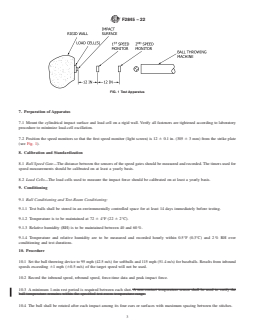
7.2 Position the speed monitors so that the first speed monitor (light screen) is 12 6 0.1 in. (305 6 3 mm) from the strike plate
(see Fig. 1).
8. Calibration and Standardization
8.1 Ball Speed Gate—The distance between the sensors of the speed gates should be measured and recorded. The timers used for
speed measurements should be calibrated on at least a yearly basis.
8.2 Load Cells—The load cells used to measure the impact force should be calibrated on at least a yearly basis.
9. Conditioning
9.1 Ball Conditioning and Test-Room Conditioning:
9.1.1 Test balls shall be stored in an environmentally controlled space for at least 14 days immediately before testing.
9.1.2 Temperature is to be maintained at 72 6 4°F (22 6 2°C).
9.1.3 Relative humidity (RH) is to be maintained between 40 and 60 %.
9.1.4 Temperature and relative humidity are to be measured and recorded hourly within 0.5°F (0.3°C) and 2 % RH over
conditioning and test durations.
10. Procedure
10.1 Set the ball throwing device to 95 mph (42.5 m/s) for softballs and 115 mph (51.4 m/s) for baseballs. Results from inbound
speeds exceeding 61 mph (60.5 m/s) of the target speed will not be used.
10.2 Record the inbound speed, rebound speed, force-time data and peak impact force.
10.3 A minimum 1-min rest period is required between each shot. A non-contact temperature sensor shall be used to verify the
ball temperature remains within the specified test-room temperature range.
10.4 The ball shall be rotated after each impact among its four ears or surfaces with maximum spacing between the stitches.
F2845 − 22
10.5 Verify proper alignment by observing the rebound path of the ball after impact. The ball rebound angle after impact with the
impact surface should be within 65° of the inbound ball path.
10.6 Compare the impulse from the ball speed and impact force.
10.6.1 Calculate the impulse from the impact force by:
t
L 5 F t dt (1)
* ~ !
F
t
where:
L = force impulse (area under the force-time curve), lb-s (N-s),
F
F(t) = force measurement during impact, lb (N),
t = time when F(t) exceeds 20 lb (89 N) (s), and
t = time after the peak force is reached when F(t) is less than 20 lb (89 N) (s).
10.6.2 Calculate the impulse from the ball speeds by:
m
L 5 ~V1S! (2)
S
c
L
where:
L = speed impulse, lb-s (N-s),
S
m = ball mass, oz (g),
V = incoming speed, mph (m/s),
S = outgoing ball speed, mph (m/s), and
c = u
...