

ASTM D2670-20
(Test Method)Standard Test Method for Measuring Wear Properties of Fluid Lubricants (Falex Pin and Vee Block Method)
General Information
- Abstract
SIGNIFICANCE AND USE
5.1 This test method may be used to determine wear obtained with fluid lubricants under the prescribed test conditions. The user of this test method should determine to his or her own satisfaction whether results of this test procedure correlate with field performance or other bench test machines. If the test conditions are changed, wear values may change and relative ratings of fluids may be different.
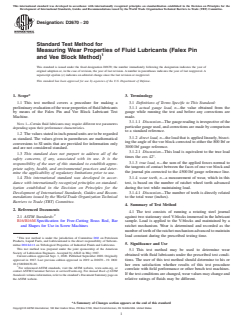
SCOPE
1.1 This test method covers a procedure for making a preliminary evaluation of the wear properties of fluid lubricants by means of the Falex Pin and Vee Block Lubricant Test Machine.
Note 1: Certain fluid lubricants may require different test parameters depending upon their performance characteristics.
1.2 The values stated in inch-pound units are to be regarded as standard. The values given in parentheses are mathematical conversions to SI units that are provided for information only and are not considered standard.
1.3 This standard does not purport to address all of the safety concerns, if any, associated with its use. It is the responsibility of the user of this standard to establish appropriate safety, health, and environmental practices and determine the applicability of regulatory limitations prior to use.
1.4 This international standard was developed in accordance with internationally recognized principles on standardization established in the Decision on Principles for the Development of International Standards, Guides and Recommendations issued by the World Trade Organization Technical Barriers to Trade (TBT) Committee.
- Status
- Published
- Publication Date
- 31-Aug-2020
- Technical Committee
- D02 - Petroleum Products, Liquid Fuels, and Lubricants
- Drafting Committee
- D02.L0.11 - Tribological Properties of Industrial Fluids and Lubricates
Buy Documents
ASTM D2670-20 - Standard Test Method for Measuring Wear Properties of Fluid Lubricants (Falex Pin and Vee Block Method)
REDLINE ASTM D2670-20 - Standard Test Method for Measuring Wear Properties of Fluid Lubricants (Falex Pin and Vee Block Method)
Overview
ASTM D2670-20, titled Standard Test Method for Measuring Wear Properties of Fluid Lubricants (Falex Pin and Vee Block Method), provides a widely recognized procedure for the preliminary evaluation of the wear resistance of fluid lubricants. Developed by ASTM International, this standard utilizes the Falex Pin and Vee Block Lubricant Test Machine to determine how lubricants perform under controlled wear conditions. Organizations and laboratories worldwide employ this test method to assess lubricants during research, development, and quality control, ensuring reliable tribological performance in field applications.
Key Topics
- Objective: Establishes a method to measure the wear properties of fluid lubricants under specified laboratory conditions using a rotating steel journal and stationary V-blocks immersed in the lubricant sample.
- Apparatus: Specifies the use of the Falex Pin and Vee Block Lubricant Test Machine, calibrated to recognized standards and traceable to NIST.
- Test Procedure:
- The rotating pin and stationary vee blocks are immersed in the lubricant.
- Load is incrementally applied and maintained using a ratchet mechanism.
- Wear is quantified by recording the advancement of ratchet wheel teeth during the test.
- Results: Wear is reported as the "teeth count" required to maintain the applied load. If excessive wear or component seizure occurs, this is also reported.
- Units: Inch-pound units are standard; SI conversions are provided for informational purposes.
Applications
- Lubricant Research & Development: Engineers and chemists use this method to compare the relative wear protection offered by new and existing lubricant formulations.
- Quality Control: Manufacturers employ ASTM D2670-20 to ensure batches of lubricants meet required wear-resistance specifications before product release.
- Benchmark Testing: Enables comparison against reference fluids to validate apparatus condition and testing accuracy.
- Industrial Lubricant Evaluation: Widely applicable to automotive, machinery, and heavy equipment lubricants, supporting product claims for durability and life extension.
- Regulatory and Compliance Testing: Meets requirements set by industry organizations, and may be referenced by agencies such as the U.S. Department of Defense.
Related Standards
- ASTM B16/B16M - Specification for Free-Cutting Brass Rod, Bar, and Shapes for Use in Screw Machines (referenced for apparatus components).
- Other Lubricant Wear Test Standards:
- ASTM D4172 - Standard Test Method for Wear Preventive Characteristics of Lubricating Fluid (Four-Ball Method).
- ASTM D2266 - Standard Test Method for Wear Prevention Characteristics of Lubricating Grease (Four-Ball Method).
- ISO 7148 - Plain Bearings-Testing of Lubricants in Tribological Systems.
- International Principles: This standard aligns with WTO TBT Committee principles for standardization, supporting global industry acceptance.
Practical Value
Implementing ASTM D2670-20 provides:
- Consistent Comparative Data: Allows lubricant suppliers and users to generate uniform, repeatable data on wear performance, supporting product development and procurement decisions.
- Field Correlation Guidance: Users are cautioned to determine correlation with real-world performance or results from other bench test machines for best applicability.
- Quality Assurance: Offers a standardized approach for ongoing verification of lubricant performance attributes, thus enhancing reliability and customer confidence.
- Global Recognition: As an internationally developed test method, it supports multinational coordination, procurement, and regulatory compliance in the fluid lubricant sector.
By adhering to the ASTM D2670-20 standard, organizations can ensure that their lubricant products are rigorously and fairly evaluated for wear properties, promoting higher standards of safety, efficiency, and equipment longevity in diverse industrial applications.
Relations
- Effective Date
- 01-Oct-2019
- Effective Date
- 01-May-2015
- Effective Date
- 01-Oct-2010
- Effective Date
- 01-Mar-2005
- Effective Date
- 10-Jan-2000
Buy Documents
ASTM D2670-20 - Standard Test Method for Measuring Wear Properties of Fluid Lubricants (Falex Pin and Vee Block Method)
REDLINE ASTM D2670-20 - Standard Test Method for Measuring Wear Properties of Fluid Lubricants (Falex Pin and Vee Block Method)
Get Certified
Connect with accredited certification bodies for this standard

Element Materials Technology
Materials testing and product certification.

ABS Group Brazil
ABS Group certification services in Brazil.

ABS Quality Evaluations Inc.
American Bureau of Shipping quality certification.
Sponsored listings
Frequently Asked Questions
ASTM D2670-20 is a standard published by ASTM International. Its full title is "Standard Test Method for Measuring Wear Properties of Fluid Lubricants (Falex Pin and Vee Block Method)". This standard covers: SIGNIFICANCE AND USE 5.1 This test method may be used to determine wear obtained with fluid lubricants under the prescribed test conditions. The user of this test method should determine to his or her own satisfaction whether results of this test procedure correlate with field performance or other bench test machines. If the test conditions are changed, wear values may change and relative ratings of fluids may be different. SCOPE 1.1 This test method covers a procedure for making a preliminary evaluation of the wear properties of fluid lubricants by means of the Falex Pin and Vee Block Lubricant Test Machine. Note 1: Certain fluid lubricants may require different test parameters depending upon their performance characteristics. 1.2 The values stated in inch-pound units are to be regarded as standard. The values given in parentheses are mathematical conversions to SI units that are provided for information only and are not considered standard. 1.3 This standard does not purport to address all of the safety concerns, if any, associated with its use. It is the responsibility of the user of this standard to establish appropriate safety, health, and environmental practices and determine the applicability of regulatory limitations prior to use. 1.4 This international standard was developed in accordance with internationally recognized principles on standardization established in the Decision on Principles for the Development of International Standards, Guides and Recommendations issued by the World Trade Organization Technical Barriers to Trade (TBT) Committee.
SIGNIFICANCE AND USE 5.1 This test method may be used to determine wear obtained with fluid lubricants under the prescribed test conditions. The user of this test method should determine to his or her own satisfaction whether results of this test procedure correlate with field performance or other bench test machines. If the test conditions are changed, wear values may change and relative ratings of fluids may be different. SCOPE 1.1 This test method covers a procedure for making a preliminary evaluation of the wear properties of fluid lubricants by means of the Falex Pin and Vee Block Lubricant Test Machine. Note 1: Certain fluid lubricants may require different test parameters depending upon their performance characteristics. 1.2 The values stated in inch-pound units are to be regarded as standard. The values given in parentheses are mathematical conversions to SI units that are provided for information only and are not considered standard. 1.3 This standard does not purport to address all of the safety concerns, if any, associated with its use. It is the responsibility of the user of this standard to establish appropriate safety, health, and environmental practices and determine the applicability of regulatory limitations prior to use. 1.4 This international standard was developed in accordance with internationally recognized principles on standardization established in the Decision on Principles for the Development of International Standards, Guides and Recommendations issued by the World Trade Organization Technical Barriers to Trade (TBT) Committee.
ASTM D2670-20 is classified under the following ICS (International Classification for Standards) categories: 75.100 - Lubricants, industrial oils and related products. The ICS classification helps identify the subject area and facilitates finding related standards.
ASTM D2670-20 has the following relationships with other standards: It is inter standard links to ASTM B16/B16M-19, ASTM B16/B16M-10(2015), ASTM B16/B16M-10, ASTM B16/B16M-05, ASTM B16/B16M-00. Understanding these relationships helps ensure you are using the most current and applicable version of the standard.
ASTM D2670-20 is available in PDF format for immediate download after purchase. The document can be added to your cart and obtained through the secure checkout process. Digital delivery ensures instant access to the complete standard document.
Standards Content (Sample)
This international standard was developed in accordance with internationally recognized principles on standardization established in the Decision on Principles for the
Development of International Standards, Guides and Recommendations issued by the World Trade Organization Technical Barriers to Trade (TBT) Committee.
Designation: D2670 − 20
Standard Test Method for
Measuring Wear Properties of Fluid Lubricants (Falex Pin
and Vee Block Method)
This standard is issued under the fixed designation D2670; the number immediately following the designation indicates the year of
original adoption or, in the case of revision, the year of last revision.Anumber in parentheses indicates the year of last reapproval.A
superscript epsilon (´) indicates an editorial change since the last revision or reapproval.
This standard has been approved for use by agencies of the U.S. Department of Defense.
1. Scope* 3. Terminology
1.1 This test method covers a procedure for making a 3.1 Definitions of Terms Specific to This Standard:
preliminaryevaluationofthewearpropertiesoffluidlubricants 3.1.1 actual gauge load, n—the value obtained from the
by means of the Falex Pin and Vee Block Lubricant Test gauge while running the test and before any corrections are
Machine. made.
3.1.1.1 Discussion—Thegaugereadingisirrespectiveofthe
NOTE 1—Certain fluid lubricants may require different test parameters
particulargaugeused,andcorrectionsaremadebycomparison
depending upon their performance characteristics.
to a standard reference.
1.2 Thevaluesstatedininch-poundunitsaretoberegarded
3.1.2 direct load, n—theloadthatisappliedlinearly,bisect-
as standard. The values given in parentheses are mathematical
ing the angle of the vee block corrected to either the 800lbf or
conversions to SI units that are provided for information only
3000lbf gauge reference.
and are not considered standard.
3.1.2.1 Discussion—This load is equivalent to the true load
1.3 This standard does not purport to address all of the
times the cos 42°.
safety concerns, if any, associated with its use. It is the
3.1.3 true load, n—the sum of the applied forces normal to
responsibility of the user of this standard to establish appro-
the tangents of contact between the faces of one vee block and
priate safety, health, and environmental practices and deter-
the journal pin corrected to the 4500lbf gauge reference line.
mine the applicability of regulatory limitations prior to use.
1.4 This international standard was developed in accor- 3.1.4 wear teeth, n—a measurement of wear, which in this
dance with internationally recognized principles on standard- test, is based on the number of ratchet wheel teeth advanced
ization established in the Decision on Principles for the during the test while maintaining load.
Development of International Standards, Guides and Recom- 3.1.4.1 Discussion—The number of teeth is directly related
mendations issued by the World Trade Organization Technical to the total wear (inches).
Barriers to Trade (TBT) Committee.
4. Summary of Test Method
2. Referenced Documents
4.1 The test consists of running a rotating steel journal
2.1 ASTM Standards: againsttwostationarysteelV-blocksimmersedinthelubricant
B16/B16MSpecification for Free-Cutting Brass Rod, Bar sample. Load is applied to the V-blocks and maintained by a
and Shapes for Use in Screw Machines ratchet mechanism. Wear is determined and recorded as the
numberofteethoftheratchetmechanismadvancedtomaintain
load constant during the prescribed testing time.
This test method is under the jurisdiction of Committee D02 on Petroleum
Products, Liquid Fuels, and Lubricantsand is the direct responsibility of Subcom-
5. Significance and Use
mittee D02.L0.11 on Tribological Properties of Industrial Fluids and Lubricates.
This test method was prepared under the joint sponsorship of the American
5.1 This test method may be used to determine wear
Society of Lubrication Engineers. Accepted by ASLE in May 1967.
obtained with fluid lubricants under the prescribed test condi-
Current edition approved Sept. 1, 2020. Published September 2020. Originally
tions. The user of this test method should determine to his or
approved in 1967. Last previous edition approved in 2019 as D2670–19. DOI:
10.1520/D2670-20.
her own satisfaction whether results of this test procedure
For referenced ASTM standards, visit the ASTM website, www.astm.org, or
correlate with field performance or other bench test machines.
contact ASTM Customer Service at service@astm.org. For Annual Book of ASTM
Ifthetestconditionsarechanged,wearvaluesmaychangeand
Standards volume information, refer to the standard’s Document Summary page on
the ASTM website. relative ratings of fluids may be different.
*A Summary of Changes section appears at the end of this standard
Copyright © ASTM International, 100 Barr Harbor Drive, PO Box C700, West Conshohocken, PA 19428-2959. United States
D2670 − 20
6. Apparatus
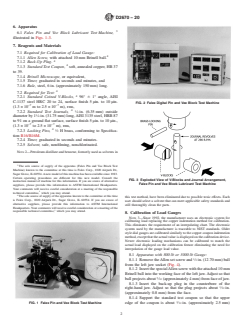
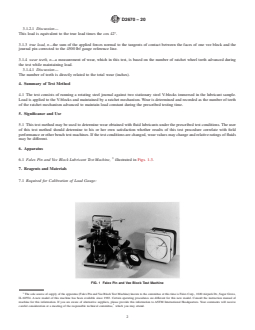
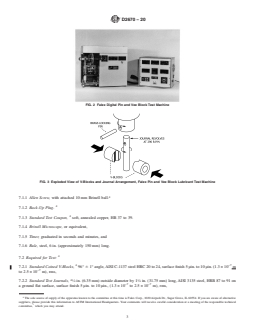
6.1 Falex Pin and Vee Block Lubricant Test Machine,
illustrated in Figs. 1-3.
7. Reagents and Materials
7.1 Required for Calibration of Load Gauge:
7.1.1 Allen Screw, with attached 10mm Brinell ball.
7.1.2 Back-Up Plug.
7.1.3 Standard Test Coupon, soft, annealed copper, HB 37
to 39.
7.1.4 Brinell Microscope, or equivalent,
7.1.5 Timer, graduated in seconds and minutes, and
7.1.6 Rule, steel, 6in. (approximately 150mm) long.
7.2 Required for Test:
7.2.1 Standard Coined V-Blocks, 96° 6 1° angle, AISI
C-1137 steel HRC 20 to 24, surface finish 5µin. to 10µin.
FIG. 2 Falex Digital Pin and Vee Block Test Machine
−7 −7
(1.3×10 mto2.5×10 m), rms,
7.2.2 Standard Test Journals, ⁄4in. (6.35mm) outside
diameterby1 ⁄4in.(31.75mm)long,AISI3135steel,HRB87
to 91 on a ground flat surface, surface finish 5µin. to 10µin.,
−7 −7
(1.3×10 to 2.5×10 m), rms,
7.2.3 Locking Pins, ⁄2 H brass, conforming to Specifica-
tion B16/B16M.
7.2.4 Timer, graduated in seconds and minutes.
7.2.5 Solvent, safe, nonfilming, nonchlorinated.
NOTE2—Petroleumdistillateandbenzene,formerlyusedassolventsin
The sole source of supply of the apparatus (Falex Pin and Vee Block Test
Machine) known to the committee at this time is Falex Corp., 1020 Airpark Dr.,
SugarGrove,IL60554.Anewmodelofthismachinehasbeenavailablesince1983.
Certain operating procedures are different for this new model. Consult the
FIG. 3 Exploded View of V-Blocks and Journal Arrangement,
instruction manual of machine for this information. If you are aware of alternative
Falex Pin and Vee Block Lubricant Test Machine
suppliers, please provide this information to ASTM International Headquarters.
Your comments will receive careful consideration at a meeting of the responsible
technical committee, which you may attend.
The sole source of supply of the apparatus known to the committee at this time
this test method, have been eliminated due to possible toxic effects. Each
is Falex Corp., 1020 Airpark Dr., Sugar Grove, IL 60554. If you are aware of
user should select a solvent that can meet applicable safety standards and
alternative suppliers, please provide this information to ASTM International
still thoroughly clean the parts.
Headquarters.Your comments will receive careful consideration at a meeting of the
responsible technical committee, which you may attend.
8. Calibration of Load Gauges
NOTE 3—Since 1992, the manufacturer uses an electronic system for
calibrating load replacing the copper indentation method for calibration.
This eliminates the requirement of an interpolating chart. The electronic
system used by the manufacturer is traceable to NIST standards. Older
styledialgaugesarecalibratedsimilarlytothecoppercouponindentation
method,exceptthattheactualvalueisdisplayedonthecalibrationdevice.
Newer electronic loading mechanisms can be calibrated to match the
actual load displayed on the calibration fixture eliminating the need for
interpolation of the gauge load value.
8.1 Apparatus with 800 lb or 3000 lb Gauge:
8.1.1 RemovetheAllensetscrewand ⁄2in.(12.70mm)ball
from the left jaw socket (Fig. 4).
8.1.2 InsertthespecialAllenscrewwiththeattached10mm
Brinellballintotheworkingfaceoftheleftjaw.Adjustsothat
ballprojectsabout ⁄32(approximately4mm)fromfaceofjaw.
8.1.3 Insert the back-up plug in the counterbore of the
right-hand jaw. Adjust so that the plug projects about ⁄32in.
(approximately 0.8 mm) from the face.
8.1.4 Support the standard test coupon so that the upper
FIG. 1 Falex Pin and Vee Block Test Machine edge of the coupon is about ⁄32in. (approximately 2.5mm)
D2670 − 20
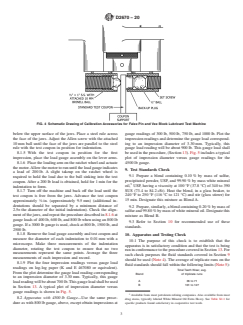
FIG. 4 Schematic Drawing of Calibration Accessories for Falex Pin and Vee Block Lubricant Test Machine
below the upper surface of the jaws. Place a steel rule across gauge readings of 300lb, 500lb, 750lb, and 1000lb. Plot the
the face of the jaws. Adjust the Allen screw with the attached impression readings and determine the gauge load correspond-
10mm ball until the face of the jaws are parallel to the steel ing to an impression diameter of 3.30mm. Typically, this
rule with the test coupon in position for indentation. gauge load reading will be about 900lb. This gauge load shall
8.1.5 With the test coupon in position for the first beusedintheprocedure,(Section13).Fig.5includesatypical
impression, place the load gauge assembly on the lever arms. plot of impression diameter versus gauge readings for the
8.1.6 Placetheloadingarmontheratchetwheelandactuate 4500lb gauge.
themotor.Allowthemotortorununtiltheloadgaugeindicates
9. Test Standards Check
a load of 200lb. A slight takeup on the ratchet wheel is
9.1 Prepare a blend containing 0.10% by mass of sulfur,
required to hold the load due to the ball sinking into the test
precipitated powder, USP, and 99.90% by mass white mineral
coupon.After a 200lb load is obtained, hold for 1min for the
oil, USP, having a viscosity at 100°F (37.8°C) of 340 to 390
indentation to form.
SUS (73.4 to 84.2cSt). Heat the blend, in a glass beaker, to
8.1.7 Turn off the machine and back off the load until the
240°F to 250°F (116°C to 121°C) and stir (glass stirrer) for
test coupon is free from the jaws. Advance the test coupon
15min. Designate this mixture as Blend A.
approximately ⁄8in. (approximately 9.5mm) (additional in-
dentations should be separated by a minimum distance of
9.2 Prepare,similarly,ablendcontaining0.20%bymassof
2.5×the diameter of the initial indentation). Check the align-
sulfurand99.80%bymassofwhitemineraloil.Designatethis
mentofthejaws,andrepeattheproceduredescribedin8.1.6at
mixture as Blend B.
gaugeloadsof400lb,600lb,and800lbwhenusingan800lb
9.3 Refer to Section 10 for recommended use of these
gauge.Ifa3000lbgaugeisused,checkat800lb,1500lb,and
standards.
2500lb.
8.1.8 Remove the load gauge assembly and test coupon and 10. Apparatus and Testing Check
measure the diameter of each indentation to 0.01mm with a
10.1 The purpose of this check is to establish that the
microscope. Make three measurements of the indentation
apparatus is in satisfactory condition and that the test is being
diameter, rotating the test coupon to ensure that no two
runinconformancetotheprocedurecoveredinSection13.For
measurements represent the same points. Average the three
such check purposes the fluid standards covered in Section 9
measurements of each impression and record.
should be used (Note 4). The average of triplicate runs on the
8.1.9 Plot the four impression readings versus gauge load
fluidstandardsshouldfallwithinthefollowinglimits(Note5):
readings on log-log paper (K and E 467080 or equivalent).
Total Teeth Wear, avg.
From the plot determine the gauge load reading corresponding
Blend of triplicate runs
to an impression diameter of 3.30mm. Typically, this gauge
A 36to71
loadreadingwillbeabout700lb.Thisgaugeloadshallbeused
B 101 to 127
in Section 13. A typical plot of impression diameter versus
gauge readings is shown in Fig. 5.
Available from most petroleum refining companies. Also available from most
8.2 Apparatus with 4500 lb Gauge—Use the same proce-
drug stores, typically labeled White Mineral Oil Extra Heavy. See Table X1.1 for
dure as with 800lb gauge, above, except obtain impressions at specific products found satisfactory in cooperative test work.
D2670 − 20
FIG. 5
...
This document is not an ASTM standard and is intended only to provide the user of an ASTM standard an indication of what changes have been made to the previous version. Because
it may not be technically possible to adequately depict all changes accurately, ASTM recommends that users consult prior editions as appropriate. In all cases only the current version
of the standard as published by ASTM is to be considered the official document.
Designation: D2670 − 19 D2670 − 20
Standard Test Method for
Measuring Wear Properties of Fluid Lubricants (Falex Pin
and Vee Block Method)
This standard is issued under the fixed designation D2670; the number immediately following the designation indicates the year of
original adoption or, in the case of revision, the year of last revision. A number in parentheses indicates the year of last reapproval. A
superscript epsilon (´) indicates an editorial change since the last revision or reapproval.
This standard has been approved for use by agencies of the U.S. Department of Defense.
1. Scope*
1.1 This test method covers a procedure for making a preliminary evaluation of the wear properties of fluid lubricants by means
of the Falex Pin and Vee Block Lubricant Test Machine.
NOTE 1—Certain fluid lubricants may require different test parameters depending upon their performance characteristics.
1.2 The values stated in inch-pound units are to be regarded as standard. The values given in parentheses are mathematical
conversions to SI units that are provided for information only and are not considered standard.
1.3 This standard does not purport to address all of the safety concerns, if any, associated with its use. It is the responsibility
of the user of this standard to establish appropriate safety, health, and environmental practices and determine the applicability of
regulatory limitations prior to use.
1.4 This international standard was developed in accordance with internationally recognized principles on standardization
established in the Decision on Principles for the Development of International Standards, Guides and Recommendations issued
by the World Trade Organization Technical Barriers to Trade (TBT) Committee.
2. Referenced Documents
2.1 ASTM Standards:
B16/B16M Specification for Free-Cutting Brass Rod, Bar and Shapes for Use in Screw Machines
3. Terminology
3.1 Definitions of Terms Specific to This Standard:
3.1.1 actual gauge load, n—the value obtained from the gauge while running the test and before any corrections are made.
3.1.1.1 Discussion—
The gauge reading is irrespective of the particular gauge used, and corrections are made by comparison to a standard reference.
3.1.2 direct load, n—the load that is applied linearly, bisecting the angle of the vee block corrected to either the 800 lbf or 3000 lbf
gauge reference.
This test method is under the jurisdiction of Committee D02 on Petroleum Products, Liquid Fuels, and Lubricantsand is the direct responsibility of Subcommittee
D02.L0.11 on Tribological Properties of Industrial Fluids and Lubricates.
This test method was prepared under the joint sponsorship of the American Society of Lubrication Engineers. Accepted by ASLE in May 1967.
Current edition approved May 1, 2019Sept. 1, 2020. Published August 2019September 2020. Originally approved in 1967. Last previous edition approved in 20162019
as D2670 – 95 (2016).D2670 – 19. DOI: 10.1520/D2670-19.10.1520/D2670-20.
For referenced ASTM standards, visit the ASTM website, www.astm.org, or contact ASTM Customer Service at service@astm.org. For Annual Book of ASTM Standards
volume information, refer to the standard’s Document Summary page on the ASTM website.
*A Summary of Changes section appears at the end of this standard
Copyright © ASTM International, 100 Barr Harbor Drive, PO Box C700, West Conshohocken, PA 19428-2959. United States
D2670 − 20
3.1.2.1 Discussion—
This load is equivalent to the true load times the cos 42°.
3.1.3 true load, n—the sum of the applied forces normal to the tangents of contact between the faces of one vee block and the
journal pin corrected to the 4500 lbf gauge reference line.
3.1.4 wear teeth, n—a measurement of wear, which in this test, is based on the number of ratchet wheel teeth advanced during
the test while maintaining load.
3.1.4.1 Discussion—
The number of teeth is directly related to the total wear (inches).
4. Summary of Test Method
4.1 The test consists of running a rotating steel journal against two stationary steel V-blocks immersed in the lubricant sample.
Load is applied to the V-blocks and maintained by a ratchet mechanism. Wear is determined and recorded as the number of teeth
of the ratchet mechanism advanced to maintain load constant during the prescribed testing time.
5. Significance and Use
5.1 This test method may be used to determine wear obtained with fluid lubricants under the prescribed test conditions. The user
of this test method should determine to his or her own satisfaction whether results of this test procedure correlate with field
performance or other bench test machines. If the test conditions are changed, wear values may change and relative ratings of fluids
may be different.
6. Apparatus
6.1 Falex Pin and Vee Block Lubricant Test Machine, illustrated in Figs. 1-3.
7. Reagents and Materials
7.1 Required for Calibration of Load Gauge:
FIG. 1 Falex Pin and Vee Block Test Machine
The sole source of supply of the apparatus (Falex Pin and Vee Block Test Machine) known to the committee at this time is Falex Corp., 1020 Airpark Dr., Sugar Grove,
IL 60554. A new model of this machine has been available since 1983. Certain operating procedures are different for this new model. Consult the instruction manual of
machine for this information. If you are aware of alternative suppliers, please provide this information to ASTM International Headquarters. Your comments will receive
careful consideration at a meeting of the responsible technical committee, which you may attend.
D2670 − 20
FIG. 2 Falex Digital Pin and Vee Block Test Machine
FIG. 3 Exploded View of V-Blocks and Journal Arrangement, Falex Pin and Vee Block Lubricant Test Machine
7.1.1 Allen Screw, with attached 10 mm Brinell ball.
7.1.2 Back-Up Plug.
7.1.3 Standard Test Coupon, soft, annealed copper, HB 37 to 39.
7.1.4 Brinell Microscope, or equivalent,
7.1.5 Timer, graduated in seconds and minutes, and
7.1.6 Rule, steel, 6 in. (approximately 150 mm) long.
7.2 Required for Test:
4 −7
7.2.1 Standard Coined V-Blocks, 96° 6 1° angle, AISI C-1137 steel HRC 20 to 24, surface finish 5 μin. to 10 μin. (1.3 × 10 m
−7
to 2.5 × 10 m), rms,
1 1
7.2.2 Standard Test Journals, ⁄4 in. (6.35 mm) outside diameter by 1 ⁄4 in. (31.75 mm) long, AISI 3135 steel, HRB 87 to 91 on
−7 −7
a ground flat surface, surface finish 5 μin. to 10 μin., (1.3 × 10 to 2.5 × 10 m), rms,
The sole source of supply of the apparatus known to the committee at this time is Falex Corp., 1020 Airpark Dr., Sugar Grove, IL 60554. If you are aware of alternative
suppliers, please provide this information to ASTM International Headquarters. Your comments will receive careful consideration at a meeting of the responsible technical
committee, which you may attend.
D2670 − 20
7.2.3 Locking Pins, ⁄2 H brass, conforming to Specification B16/B16M.
7.2.4 Timer, graduated in seconds and minutes.
7.2.5 Solvent, safe, nonfilming, nonchlorinated.
NOTE 2—Petroleum distillate and benzene, formerly used as solvents in this test method, have been eliminated due to possible toxic effects. Each user
should select a solvent that can meet applicable safety standards and still thoroughly clean the parts.
8. Calibration of Load Gauges
NOTE 3—Since 1992, the manufacturer uses an electronic system for calibrating load replacing the copper indentation method for calibration. This
eliminates the requirement of an interpolating chart. The electronic system used by the manufacturer is traceable to NIST standards. Older style dial
gauges are calibrated similarly to the copper coupon indentation method, except that the actual value is displayed on the calibration device. Newer
electronic loading mechanisms can be calibrated to match the actual load displayed on the calibration fixture eliminating the need for interpolation of
the gauge load value.
8.1 Apparatus with 800 lb or 3000 lb Gauge:
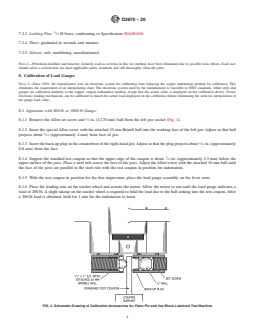
8.1.1 Remove the Allen set screw and ⁄2 in. (12.70 mm) ball from the left jaw socket (Fig. 4).
8.1.2 Insert the special Allen screw with the attached 10 mm Brinell ball into the working face of the left jaw. Adjust so that ball
projects about ⁄32 (approximately 4 mm) from face of jaw.
8.1.3 Insert the back-up plug in the counterbore of the right-hand jaw. Adjust so that the plug projects about ⁄32 in. (approximately
0.8 mm) from the face.
8.1.4 Support the standard test coupon so that the upper edge of the coupon is about ⁄32 in. (approximately 2.5 mm) below the
upper surface of the jaws. Place a steel rule across the face of the jaws. Adjust the Allen screw with the attached 10 mm ball until
the face of the jaws are parallel to the steel rule with the test coupon in position for indentation.
8.1.5 With the test coupon in position for the first impression, place the load gauge assembly on the lever arms.
8.1.6 Place the loading arm on the ratchet wheel and actuate the motor. Allow the motor to run until the load gauge indicates a
load of 200 lb. A slight takeup on the ratchet wheel is required to hold the load due to the ball sinking into the test coupon. After
a 200 lb load is obtained, hold for 1 min for the indentation to form.
FIG. 4 Schematic Drawing of Calibration Accessories for Falex Pin and Vee Block Lubricant Test Machine
D2670 − 20
8.1.7 Turn off the machine and back off the load until the test coupon is free from the jaws. Advance the test coupon approximately
⁄8 in. (approximately 9.5 mm) (additional indentations should be separated by a minimum distance of 2.5× the diameter of the
initial indentation). Check the alignment of the jaws, and repeat the procedure described in 8.1.6 at gauge loads of 400 lb, 600 lb,
and 800 lb when using an 800 lb gauge. If a 3000 lb gauge is used, check at 800 lb, 1500 lb, and 2500 lb.
8.1.8 Remove the load gauge assembly and test coupon and measure the diameter of each indentation to 0.01 mm with a
microscope. Make three measurements of the indentation diameter, rotating the test coupon to ensure that no two measurements
represent the same points. Average the three measurements of each impression and record.
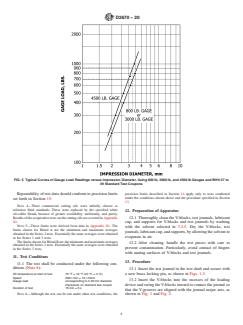
8.1.9 Plot the four impression readings versus gauge load readings on log-log paper (K and E 467080 or equivalent). From the
plot determine the gauge load reading corresponding to an impression diameter of 3.30 mm. Typically, this gauge load reading will
be about 700 lb. This gauge load shall be used in Section 1213. A typical plot of impression diameter versus gauge readings is
shown in Fig. 5.
8.2 Apparatus with 4500 lb Gauge—Use the same procedure as with 800 lb gauge, above, except obtain impressions at gauge
readings of 300 lb, 500 lb, 750 lb, and 1000 lb. Plot the impression readings and determine the gauge load corresponding to an
impression diameter of 3.30 mm. Typically, this gauge load reading will be about 900 lb. This gauge load shall be used in the
procedure, (Section 13). Fig. 45 includes a typical plot of impression diameter versus gauge readings for the 4500 lb gauge.
9. Test Standards Check
9.1 Prepare a blend containing 0.10 weight % 0.10 % by mass of sulfur, precipitated powder, USP, and 99.90 weight
FIG. 5 Typical Curves of Gauge Load Readings versus Impression Diameter, Using 800 lb, 3000 lb, and 4500 lb Gauges and BHN 37 to
39 Standard Test Coupons
D2670 − 20
percent99.90 % by mass white mineral oil, USP, having a viscosity at 100 °F (37.8 °C) of 340 to 390 SUS (73.4 to 84.2 cSt). Heat
the blend, in a glass beaker, to 240 °F to 250 °F (116 °C to 121 °C) and stir (glass stirrer) for 15 min. Designate this mixture as
Blend A.
9.2 Prepare, similarly, a blend containing 0.20 weight % 0.20 % by mass of sulfur and 99.80 weight % 99.80 % by mass of white
mineral oil. Designate this mixture as Blend B.
9.3 Refer to Section 810 for recommended use of these standards.
10. Apparatus and Testing Check
10.1 The purpose of this check is to establish that the apparatus is in satisfactory condition and that the test is being run in
conformance to the procedure covered in Section 13. For such check purposes the fluid standards covered in Section 9 should be
used (Note 4). The average of triplicate runs on the fluid standards should fall within the following limits (Note 5):
Total Teeth Wear, avg.
Blend of triplicate runs
A 36 to 71
B 101 to 127
Repeatability of test
...