

ASTM F1882-15
(Specification)Standard Specification for Residential Basketball Systems
General Information
- Abstract
ABSTRACT
This specification covers the performance and safety requirements intended to reduce the potential hazards associated with the manufacture, assembly, maintenance, and use of complete residential basketball systems. This specification is not intended to address the following: equipment intended to be used in places of public assembly (schools, parks, public and private recreational facilities, and the likes); individual components, such as rim, backboard, pole, portable base system, net, or other components not sold as a complete residential basketball system as defined here; any residential basketball system that is mounted to any structure or surface (roof mounting, wall mounting, or any locally or self-manufactured components) other than that which is purchased as part of a complete residential basketball system; any basketball equipment that does not use a full size rim, 18-in. (45.72-cm) diameter, or is designed for operational heights of less then 6 ft 6 in. (1.98 m) from the playing surface to the bottom of the backboard; and accessories and add-ons.
SCOPE
1.1 This specification covers the manufacture, assembly, recommended maintenance and use of complete residential basketball systems.
1.2 This specification is intended to reduce the potential hazards associated with the installation and use of residential basketball systems.
1.3 This specification is not intended to apply to the following:
1.3.1 Equipment intended to be used in places of public assembly, such as, but not limited to, schools, parks, public and private recreational facilities.
1.3.2 Individual components, such as rim, backboard, pole, portable base system, net, or other component when that component is not sold as a complete residential basketball system as defined in this specification.
1.3.3 Any residential basketball system that is mounted to any structure or surface other than that which is purchased as part of a complete residential basketball system. Examples include, but are not limited to, roof mounting, wall mounting, or any locally or self-manufactured components.
1.3.4 Any basketball equipment that does not use a full size rim, 18-in. (45.72-cm) diameter, or is designed for operational heights of less then 6 ft 6 in. (1.98 m) from the playing surface to the bottom of the backboard.
1.3.5 Accessories and add-ons.
1.4 This specification shall apply only to products manufactured after twelve months from the date this specification is published.
1.5 This specification does not cover product performance or quality, except as related to safety.
1.6 The rationale for provisions in this specification are given in Appendix X1 and Appendix X2.
1.7 The values stated in inch-pound units are to be regarded as standard. The values given in parentheses are mathematical conversions to SI units that are provided for information only and are not considered standard.
1.8 This standard does not purport to address all of the safety concerns, if any, associated with its use. It is the responsibility of the user of this standard to establish appropriate safety and health practices and determine the applicability of regulatory limitations prior to use.
- Status
- Published
- Publication Date
- 31-May-2015
- Technical Committee
- F08 - Sports Equipment, Playing Surfaces, and Facilities
- Drafting Committee
- F08.25 - Recreational Basketball Equipment
Overview
ASTM F1882-15: Standard Specification for Residential Basketball Systems sets forth comprehensive performance and safety requirements for the manufacture, assembly, maintenance, and use of complete residential basketball systems. Developed by ASTM International, this standard aims to minimize hazard risks associated with home basketball equipment by providing clear guidelines that manufacturers and consumers can follow for safer installation and play.
Key objectives of ASTM F1882-15 include:
- Reducing potential injury hazards through design and assembly requirements
- Defining the scope and limits of applicability to residential, not public, basketball systems
- Ensuring consistent safety practices for system setup, labeling, and maintenance
Key Topics
1. Scope and Applicability
- Covers only complete residential basketball systems, not individual components sold separately (e.g., just rims or backboards)
- Excludes systems intended for public spaces, roof or wall-mounted setups, non-regulation rim sizes, and accessories/add-ons
2. Safety and Performance Requirements
- Paints/finishes must comply with lead content regulations (16 CFR 1303)
- Assembled systems must have no exposed sharp edges, points, or surfaces per CPSC 16 CFR standards
- Design must prevent pinch, crush, or shear points, especially in the player’s normal access area
- Moving/adjustable components outside the main access area require clear warning labels
3. Structural Integrity and Stability
- Requirements for both portable and ground base systems include resistance to tipping, sliding, and deformation
- Rims must remain secured if the backboard breaks
- Glass backboards must be fully tempered to meet safety glazing standards (referencing ANSI Z97.1 and BSI 6206:1981)
4. Instructions and Labeling
- Mandatory permanent warning labels, complying with ANSI Z535 labeling standards, must be affixed in visible locations
- Clear, comprehensive assembly and maintenance instructions, including safety precautions, must accompany each system
- Manufacturer contact and model information must be included
5. Packaging
- Packaging must prevent exposure of sharp edges during shipping and storage, reducing risk of initial handling injury
Applications
Residential basketball systems produced according to ASTM F1882-15 are designed for private home use, providing guidelines for both manufacturers and consumers to ensure safer play environments. Key practical applications include:
- Manufacturers: Guidance for design, assembly, packaging, and documentation to meet industry-accepted safety standards for home basketball systems, enhancing product safety and consumer trust
- Homeowners/End Users: Assurance of safer play through compliant equipment, thorough instructions, and visible warnings to reduce accident risks during assembly, use, and maintenance
- Retailers: Clear criteria for selecting and marketing basketball systems that meet rigorous safety and stability benchmarks
Related Standards
Understanding ASTM F1882-15 is aided by familiarity with related standards, including:
- ASTM F1148: Consumer Safety Performance Specification for Home Playground Equipment
- ASTM C1048: Specification for Heat-Strengthened and Fully Tempered Flat Glass
- ANSI Z535: Standards for Warning Labels (design, placement, color, and text)
- ANSI Z97.1: Safety glazing materials in buildings - impact and breakage criteria
- BSI 6206: Impact performance of flat safety glass
- CPSC 16 CFR 1500.48 & 1500.49: Sharp point and edge requirements for children’s products
By adhering to ASTM F1882-15 and these referenced documents, manufacturers and consumers ensure higher safety, stability, and reliability for residential basketball systems, contributing to safer home recreation and injury prevention.
Relations
- Effective Date
- 01-Oct-2018
- Refers
ASTM F1148-18 - Standard Consumer Safety Performance Specification for Home Playground Equipment - Effective Date
- 15-Aug-2018
- Refers
ASTM F1148-17 - Standard Consumer Safety Performance Specification for Home Playground Equipment - Effective Date
- 01-Mar-2017
- Effective Date
- 15-Mar-2012
- Effective Date
- 15-Mar-2012
- Refers
ASTM F1148-12 - Standard Consumer Safety Performance Specification for Home Playground Equipment - Effective Date
- 01-Jan-2012
- Refers
ASTM F1148-11 - Standard Consumer Safety Performance Specification for Home Playground Equipment - Effective Date
- 01-Dec-2011
- Refers
ASTM F1148-09 - Standard Consumer Safety Performance Specification for Home Playground Equipment - Effective Date
- 01-Jun-2009
- Refers
ASTM F1148-08 - Standard Consumer Safety Performance Specification for Home Playground Equipment - Effective Date
- 15-Oct-2008
- Refers
ASTM F1148-05 - Standard Consumer Safety Performance Specification for Home Playground Equipment - Effective Date
- 01-Oct-2005
- Effective Date
- 01-Jan-2004
- Refers
ASTM F1148-03 - Standard Consumer Safety Performance Specification for Home Playground Equipment - Effective Date
- 01-Nov-2003
- Effective Date
- 01-Jan-1997
Frequently Asked Questions
ASTM F1882-15 is a technical specification published by ASTM International. Its full title is "Standard Specification for Residential Basketball Systems". This standard covers: ABSTRACT This specification covers the performance and safety requirements intended to reduce the potential hazards associated with the manufacture, assembly, maintenance, and use of complete residential basketball systems. This specification is not intended to address the following: equipment intended to be used in places of public assembly (schools, parks, public and private recreational facilities, and the likes); individual components, such as rim, backboard, pole, portable base system, net, or other components not sold as a complete residential basketball system as defined here; any residential basketball system that is mounted to any structure or surface (roof mounting, wall mounting, or any locally or self-manufactured components) other than that which is purchased as part of a complete residential basketball system; any basketball equipment that does not use a full size rim, 18-in. (45.72-cm) diameter, or is designed for operational heights of less then 6 ft 6 in. (1.98 m) from the playing surface to the bottom of the backboard; and accessories and add-ons. SCOPE 1.1 This specification covers the manufacture, assembly, recommended maintenance and use of complete residential basketball systems. 1.2 This specification is intended to reduce the potential hazards associated with the installation and use of residential basketball systems. 1.3 This specification is not intended to apply to the following: 1.3.1 Equipment intended to be used in places of public assembly, such as, but not limited to, schools, parks, public and private recreational facilities. 1.3.2 Individual components, such as rim, backboard, pole, portable base system, net, or other component when that component is not sold as a complete residential basketball system as defined in this specification. 1.3.3 Any residential basketball system that is mounted to any structure or surface other than that which is purchased as part of a complete residential basketball system. Examples include, but are not limited to, roof mounting, wall mounting, or any locally or self-manufactured components. 1.3.4 Any basketball equipment that does not use a full size rim, 18-in. (45.72-cm) diameter, or is designed for operational heights of less then 6 ft 6 in. (1.98 m) from the playing surface to the bottom of the backboard. 1.3.5 Accessories and add-ons. 1.4 This specification shall apply only to products manufactured after twelve months from the date this specification is published. 1.5 This specification does not cover product performance or quality, except as related to safety. 1.6 The rationale for provisions in this specification are given in Appendix X1 and Appendix X2. 1.7 The values stated in inch-pound units are to be regarded as standard. The values given in parentheses are mathematical conversions to SI units that are provided for information only and are not considered standard. 1.8 This standard does not purport to address all of the safety concerns, if any, associated with its use. It is the responsibility of the user of this standard to establish appropriate safety and health practices and determine the applicability of regulatory limitations prior to use.
ABSTRACT This specification covers the performance and safety requirements intended to reduce the potential hazards associated with the manufacture, assembly, maintenance, and use of complete residential basketball systems. This specification is not intended to address the following: equipment intended to be used in places of public assembly (schools, parks, public and private recreational facilities, and the likes); individual components, such as rim, backboard, pole, portable base system, net, or other components not sold as a complete residential basketball system as defined here; any residential basketball system that is mounted to any structure or surface (roof mounting, wall mounting, or any locally or self-manufactured components) other than that which is purchased as part of a complete residential basketball system; any basketball equipment that does not use a full size rim, 18-in. (45.72-cm) diameter, or is designed for operational heights of less then 6 ft 6 in. (1.98 m) from the playing surface to the bottom of the backboard; and accessories and add-ons. SCOPE 1.1 This specification covers the manufacture, assembly, recommended maintenance and use of complete residential basketball systems. 1.2 This specification is intended to reduce the potential hazards associated with the installation and use of residential basketball systems. 1.3 This specification is not intended to apply to the following: 1.3.1 Equipment intended to be used in places of public assembly, such as, but not limited to, schools, parks, public and private recreational facilities. 1.3.2 Individual components, such as rim, backboard, pole, portable base system, net, or other component when that component is not sold as a complete residential basketball system as defined in this specification. 1.3.3 Any residential basketball system that is mounted to any structure or surface other than that which is purchased as part of a complete residential basketball system. Examples include, but are not limited to, roof mounting, wall mounting, or any locally or self-manufactured components. 1.3.4 Any basketball equipment that does not use a full size rim, 18-in. (45.72-cm) diameter, or is designed for operational heights of less then 6 ft 6 in. (1.98 m) from the playing surface to the bottom of the backboard. 1.3.5 Accessories and add-ons. 1.4 This specification shall apply only to products manufactured after twelve months from the date this specification is published. 1.5 This specification does not cover product performance or quality, except as related to safety. 1.6 The rationale for provisions in this specification are given in Appendix X1 and Appendix X2. 1.7 The values stated in inch-pound units are to be regarded as standard. The values given in parentheses are mathematical conversions to SI units that are provided for information only and are not considered standard. 1.8 This standard does not purport to address all of the safety concerns, if any, associated with its use. It is the responsibility of the user of this standard to establish appropriate safety and health practices and determine the applicability of regulatory limitations prior to use.
ASTM F1882-15 is classified under the following ICS (International Classification for Standards) categories: 97.220.10 - Sports facilities. The ICS classification helps identify the subject area and facilitates finding related standards.
ASTM F1882-15 has the following relationships with other standards: It is inter standard links to ASTM C1048-18, ASTM F1148-18, ASTM F1148-17, ASTM C1048-12, ASTM C1048-12e1, ASTM F1148-12, ASTM F1148-11, ASTM F1148-09, ASTM F1148-08, ASTM F1148-05, ASTM C1048-04, ASTM F1148-03, ASTM C1048-97b. Understanding these relationships helps ensure you are using the most current and applicable version of the standard.
ASTM F1882-15 is available in PDF format for immediate download after purchase. The document can be added to your cart and obtained through the secure checkout process. Digital delivery ensures instant access to the complete standard document.
Standards Content (Sample)
This international standard was developed in accordance with internationally recognized principles on standardization established in the Decision on Principles for the
Development of International Standards, Guides and Recommendations issued by the World Trade Organization Technical Barriers to Trade (TBT) Committee.
Designation: F1882 − 15 An American National Standard
Standard Specification for
Residential Basketball Systems
This standard is issued under the fixed designation F1882; the number immediately following the designation indicates the year of
original adoption or, in the case of revision, the year of last revision. A number in parentheses indicates the year of last reapproval. A
superscript epsilon (´) indicates an editorial change since the last revision or reapproval.
1. Scope conversions to SI units that are provided for information only
and are not considered standard.
1.1 This specification covers the manufacture, assembly,
1.8 This standard does not purport to address all of the
recommended maintenance and use of complete residential
safety concerns, if any, associated with its use. It is the
basketball systems.
responsibility of the user of this standard to establish appro-
1.2 This specification is intended to reduce the potential
priate safety, health, and environmental practices and deter-
hazards associated with the installation and use of residential
mine the applicability of regulatory limitations prior to use.
basketball systems.
1.9 This international standard was developed in accor-
1.3 This specification is not intended to apply to the
dance with internationally recognized principles on standard-
following:
ization established in the Decision on Principles for the
1.3.1 Equipment intended to be used in places of public
Development of International Standards, Guides and Recom-
assembly, such as, but not limited to, schools, parks, public and
mendations issued by the World Trade Organization Technical
private recreational facilities.
Barriers to Trade (TBT) Committee.
1.3.2 Individual components, such as rim, backboard, pole,
portable base system, net, or other component when that
2. Referenced Documents
component is not sold as a complete residential basketball
2.1 ASTM Standards:
system as defined in this specification.
D2240 Test Method for Rubber Property—Durometer Hard-
1.3.3 Any residential basketball system that is mounted to
ness
any structure or surface other than that which is purchased as
C1048 Specification for Heat-Strengthened and Fully Tem-
part of a complete residential basketball system. Examples
pered Flat Glass
include, but are not limited to, roof mounting, wall mounting,
F1148 Consumer Safety Performance Specification for
or any locally or self-manufactured components.
Home Playground Equipment
1.3.4 Any basketball equipment that does not use a full size
2.2 ANSI Standards:
rim, 18-in. (45.72-cm) diameter, or is designed for operational
ANSI Z535 Warning Labels
heights of less then 6 ft 6 in. (1.98 m) from the playing surface
ANSI Z97.1–2004 American National Standard for Safety
to the bottom of the backboard.
Glazing Materials Used in Buildings—Safety Perfor-
1.3.5 Accessories and add-ons.
mance Specification and Methods of Test
1.4 This specification shall apply only to products manufac-
2.3 BSI Standard:
tured after twelve months from the date this specification is
BSI 6206: 1981 Impact Performance Requirements for Flat
published.
Safety Glass and Safety Plastics for Use in Buildings
1.5 This specification does not cover product performance
2.4 Federal Standards:Available from the Consumer Prod-
or quality, except as related to safety.
uct Safety Commission, Washington, DC 20207.
1.6 The rationale for provisions in this specification are
16 CFR 1303 Ban of Lead-Containing Paint and Certain
given in Appendix X1 and Appendix X2.
Consumer Products Bearing Lead-Containing Paint
1.7 The values stated in inch-pound units are to be regarded
as standard. The values given in parentheses are mathematical
For referenced ASTM standards, visit the ASTM website, www.astm.org, or
contact ASTM Customer Service at service@astm.org. For Annual Book of ASTM
This specification is under the jurisdiction of ASTM Committee F08 on Sports Standards volume information, refer to the standard’s Document Summary page on
Equipment, Playing Surfaces, and Facilities and is the direct responsibility of the ASTM website.
F08.25 on Recreational Basketball Equipment. Available from National Electrical Manufacturers Association (NEMA), 1300
Current edition approved June 1, 2015. Published August 2015. Originally N. 17th St., Suite 1847, Rosslyn, VA 22209.
approved in 1998. Last previous edition approved in 2014 as F1882 – 06 (2014). Available from British Standards Institute (BSI), 389 Chiswick High Rd.,
DOI: 10.1520/F1882-15. London W4 4AL, U.K.
Copyright © ASTM International, 100 Barr Harbor Drive, PO Box C700, West Conshohocken, PA 19428-2959. United States
F1882 − 15
16 CFR 1500.48 Technical Requirements for Determining a 3.1.16 residential basketball equipment, n—equipment that
Sharp Point in Toys and Other Articles Intended for Use is intended for the normal use and play in residential basketball
by Children Under 8-Years of Age that includes the components given in 3.1.3, 3.1.6, 3.1.10, and
16 CFR 1500.49 Technical Requirements for Determining a 3.1.18.
Sharp Metal or Glass Edge in Toys and Other Articles
3.1.17 supplemental restraint systems, n—additional meth-
Intended for Use by Children Under 8-Years of Age
ods of adding stability over and above recommended ballast to
portable base systems, that is ground stakes and additional
3. Terminology
weight.
3.1 Definitions of Terms Specific to This Standard:
3.1.18 support system, n—structure provided to support rim
and backboard in playing position. Could include pole, por-
3.1.1 accessories and add-ons (items not covered in 3.1.2,
table base, or mounting brackets.
3.1.3, 3.1.5, 3.1.6, 3.1.10, and 3.1.15–3.1.18), n—including but
not limited to, such things as pole pads, ball returns, scoring
4. General Requirements
and training devices, and including items attached to the
system not intended for use in basketball. 4.1 A complete residential basketball system, represented as
complying with this performance specification, shall meet all
3.1.2 adjusting mechanism, n—moveable components that
applicable requirements specified herein.
lock structural components in the desired position to facilitate
changes in rim height.
5. Performance Requirements
3.1.3 backboard, n—rigid, flat surface to provide rebound
5.1 General—The standards listed in 5.3 – 5.6 apply only to
surface for a basketball.
the normal access area as described in 3.1.11 and Fig. 1.
3.1.4 complete residential basketball system, n—any com- 5.2 Paint Toxicity—All paints and finishes used on basket-
bination of rim, net, backboard, portable or non-portable
ball equipment shall be in accordance with 16 CFR Part 1303.
pole-type support system not specifically excluded in 1.3.1 –
5.3 Edges, Points, and Surfaces—Following assembly of
1.3.5 that is designed and marketed by the original manufac-
the system, in accordance with the instructions to be provided
turer to be used together, whether packaged together as a
to the consumer, there shall be no exposed sharp edges, points,
system, or separately as individual components.
or surfaces on any portion of the residential basketball equip-
ment according to CPSC 16 CFR 1500.48 and 1500.49.
3.1.5 footing, n—the method for securing the placement of
the system into the ground.
5.4 There shall be no pinch, crush, or shear points as defined
in 3.1.13.
3.1.6 full-size rim, n—moveable or fixed-type rim with an
18-in. (45.72-cm) inside diameter.
5.5 Moving parts or height adjustment mechanisms outside
the normal access area, which could pose a finger entrapment
3.1.7 ground base systems, n—systems that have a main
problem, shall be noted clearly in the warning label on the
support pole attached in ground by a footing.
system and the safety instructions for proper use to reduce the
3.1.8 hanging, v—when a player briefly suspends their full
risk of injury.
weight from any point on the rim.
5.6 Hardware—Hardware must comply with the section on
3.1.9 maximum offset, n—distance from the front of the base
Hardware, Nuts, and Bolts of Performance Specification
or pole, whichever extends furthest from the system, to the
F1148.
front face of the backboard.
5.6.1 An projections and protrusions must comply with
CPSC Handbook for Playground Safety Publication 325 and
3.1.10 net, n—a device that hangs below the rim that
Performance Specification F1148.
restricts the downward movement of the ball.
5.6.2 Lock washers, self-locking nuts, or other locking
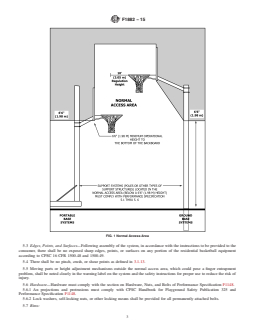
3.1.11 normal access area, n—as described in Fig. 1.
means shall be provided for all permanently attached bolts.
3.1.12 normal use, n—those safe-play modes that conform
5.7 Rims:
to the instructions that accompany the equipment. Misuse,
5.7.1 Rims—Each rim shall be attached to a support struc-
alteration, or modification are not considered normal use.
ture in such a way that ensures the rim and all structural
components stay attached should the backboard break.
3.1.13 pinch, crush, shear points, n—any point that entraps
5.7.2 Backboards Made of Glass—All glass backboards
at one or more positions a ⁄2-in. (13-mm) diameter neoprene
shall be made of fully tempered glass. As specified in Speci-
rod. Entrapment shall mean that force of more than 2 lb (0.90
fication C1048, “Fully tempered glass is approximately four
kg) is required to pull out the rod. The neoprene rods shall have
times as strong as annealed glass of the same thickness and
a hardness reading between 50 and 60 as determined by a Type
configuration. When broken, by impact, fully tempered glass
A Durometer as given in Test Method D2240.
fractures into relatively small pieces meeting safety glazing
3.1.14 pole joint, n—mechanical method for connecting a
requirements thereby greatly reducing the likelihood of serious
multiple segment pole.
cutting or piercing injuries in comparison with ordinary an-
3.1.15 portable base systems, n—systems that have a ballast nealed glass. Fully tempered glass is intended for used in
type support system that allows the system to be moved. applications where its strength or safety characteristics may be
F1882 − 15
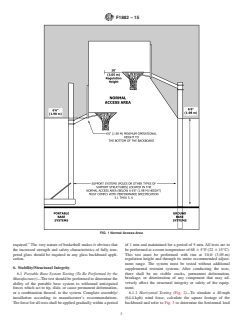
FIG. 1 Normal Access Area
required.” The very nature of basketball makes it obvious that of 1 min and maintained for a period of 5 min. All tests are to
the increased strength and safety characteristics of fully tem- be performed at a room temperature of 68 6 5°F (22 6 15°C).
pered glass should be required in any glass backboard appli- This test must be performed with rim at 10-ft (3.05-m)
cation. regulation height and through its entire recommended adjust-
ment range. The system must be tested without additional
6. Stability/Structural Integrity
supplemental restraint systems. After conducting the tests,
there shall be no visible cracks, permanent deformation,
6.1 Portable Base System Testing (To Be Performed by the
breakage, or deterioration of any component that may ad-
Manufacturer)—The test should be performed to determine the
versely affect the structural integrity or safety of the equip-
ability of the portable base system to withstand anticipated
ment.
forces which act to tip, slide, or cause permanent deformation,
or a combination thereof, to the system. Complete assembly/ 6.1.1 Horizontal Testing (Fig. 2)—To simulate a 40-mph
installation according to manufacturer’s recommendations. (64.4-kph) wind force, calculate the square footage of the
The force for all tests shall be applied gradually within a period backboard and refer to Fig. 3 to determine the horizontal load
F1882 − 15
deformation, breakage or deterioration of any component that
may adversely affect the structural integrity or safety of the
equipment.
6.2.1 Horizontal Testing (Fig. 8)—To simulate a 80-mph
(128.8-kph) wind force, calculate the square footage of back-
board and refer to Fig. 3 to determine the horizontal load
required to replicate the wind force. For Test No. 1, apply this
horizontal load in accordance with Fig. 8. If the rim height
drops more than 6 in. (15.24 cm) stop test and reposition
pulley. Proceed to Test No. 2. For Test No. 2, if required, with
the pulley realigned 6 in. (15.24 cm) lower, reapply horizontal
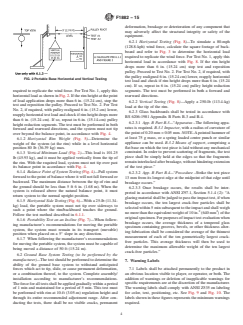
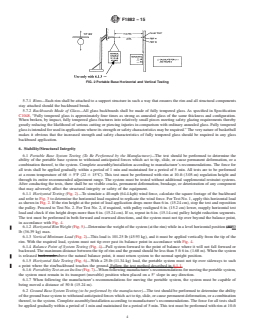
FIG. 2 Portable Base Horizontal and Vertical Testing
test load and check if rim height drops more than 6 in. (15.24
cm). If so, repeat in 6 in. (15.24 cm) pulley height reduction
required to replicate the wind force. For Test No. 1, apply this segments. The test must be performed in both a forward and
horizontal load as shown in Fig. 2. If the rim height at the point rearward directions.
of load application drops more than 6 in. (15.24 cm), stop the
6.2.2 Verti
...
This document is not an ASTM standard and is intended only to provide the user of an ASTM standard an indication of what changes have been made to the previous version. Because
it may not be technically possible to adequately depict all changes accurately, ASTM recommends that users consult prior editions as appropriate. In all cases only the current version
of the standard as published by ASTM is to be considered the official document.
Designation: F1882 − 06 (Reapproved 2014) F1882 − 15 An American National Standard
Standard Specification for
Residential Basketball Systems
This standard is issued under the fixed designation F1882; the number immediately following the designation indicates the year of
original adoption or, in the case of revision, the year of last revision. A number in parentheses indicates the year of last reapproval. A
superscript epsilon (´) indicates an editorial change since the last revision or reapproval.
1. Scope
1.1 This specification covers the manufacture, assembly, recommended maintenance and use of complete residential basketball
systems.
1.2 This specification is intended to reduce the potential hazards associated with the installation and use of residential basketball
systems.
1.3 This specification is not intended to apply to the following:
1.3.1 Equipment intended to be used in places of public assembly, such as, but not limited to, schools, parks, public and private
recreational facilities.
1.3.2 Individual components, such as rim, backboard, pole, portable base system, net, or other component when that component
is not sold as a complete residential basketball system as defined in this specification.
1.3.3 Any residential basketball system that is mounted to any structure or surface other than that which is purchased as part
of a complete residential basketball system. Examples include, but are not limited to, roof mounting, wall mounting, or any locally
or self-manufactured components.
1.3.4 Any basketball equipment that does not use a full size rim, 18-in. (45.72-cm) diameter, or is designed for operational
heights of less then 6 ft 6 in. (1.98 m) from the playing surface to the bottom of the backboard.
1.3.5 Accessories and add-ons.
1.4 This specification shall apply only to products manufactured after sixtwelve months from the date this specification is
published.
1.5 This specification does not cover product performance or quality, except as related to safety.
1.6 The tests are intended to uncover hazards, rather than to demonstrate the reliability of the system. The fact that a mechanism
or material of a system fails during testing only is relevant if the failure creates a potential hazard.
1.6 The rationale for provisions in this specification are given in Appendix X1 and Appendix X2.
1.7 The values stated in inch-pound units are to be regarded as standard. The values given in parentheses are mathematical
conversions to SI units that are provided for information only and are not considered standard.
1.8 This standard does not purport to address all of the safety concerns, if any, associated with its use. It is the responsibility
of the user of this standard to establish appropriate safety and health practices and determine the applicability of regulatory
limitations prior to use.
2. Referenced Documents
2.1 ASTM Standards:
D2240 Test Method for Rubber Property—Durometer Hardness
C1048 Specification for Heat-Strengthened and Fully Tempered Flat Glass
F1148 Consumer Safety Performance Specification for Home Playground Equipment
2.2 ANSI Standards:
ANSI Z535 Warning Labels
This specification is under the jurisdiction of ASTM Committee F08 on Sports Equipment, Playing Surfaces, and Facilities and is the direct responsibility of F08.25 on
Recreational Basketball Equipment.
Current edition approved Nov. 1, 2014June 1, 2015. Published December 2014August 2015. Originally approved in 1998. Last previous edition approved in 20062014
as F1882 – 06.F1882 – 06 (2014). DOI: 10.1520/F1882-06R14.10.1520/F1882-15.
For referenced ASTM standards, visit the ASTM website, www.astm.org, or contact ASTM Customer Service at service@astm.org. For Annual Book of ASTM Standards
volume information, refer to the standard’s Document Summary page on the ASTM website.
Available from National Electrical Manufacturers Association (NEMA), 1300 N. 17th St., Suite 1847, Rosslyn, VA 22209.
Copyright © ASTM International, 100 Barr Harbor Drive, PO Box C700, West Conshohocken, PA 19428-2959. United States
F1882 − 15
ANSI Z97.1–2004 American National Standard for Safety Glazing Materials Used in Buildings—Safety Performance
Specification and Methods of Test
2.3 BSI Standard:
BSI 6206: 1981 Impact Performance Requirements for Flat Safety Glass and Safety Plastics for Use in Buildings
2.4 Federal Standards:Available from the Consumer Product Safety Commission, Washington, DC 20207.
16 CFR 1303 Ban of Lead-Containing Paint and Certain Consumer Products Bearing Lead-Containing Paint
16 CFR 1500.48 Technical Requirements for Determining a Sharp Point in Toys and Other Articles Intended for Use by Children
Under 8-Years of Age
16 CFR 1500.49 Technical Requirements for Determining a Sharp Metal or Glass Edge in Toys and Other Articles Intended for
Use by Children Under 8-Years of Age
3. Terminology
3.1 Definitions of Terms Specific to This Standard:
3.1.1 accessories and add-ons (items not covered in 3.1.2, 3.1.3, 3.1.5, 3.1.6, 3.1.10, and 3.1.163.1.15–3.1.173.1.18),
n—including but not limited to, such things as pole pads, ball returns, scoring and training devices, and including items attached
to the system not intended for use in basketball.
3.1.2 adjusting mechanism, n—moveable components that lock structural components in the desired position to facilitate
changes in rim height.
3.1.3 backboard, n—rigid, flat surface to provide rebound surface for a basketball.
3.1.4 complete residential basketball system, n—any combination of rim, net, backboard, portable or non-portable pole-type
support system not specifically excluded in 1.3.1 – 1.3.5 that is designed and marketed by the original manufacturer to be used
together, whether packaged together as a system, or separately as individual components.
3.1.5 footing, n—the method for securing the placement of the system into the ground.
3.1.6 full-size rim, n—moveable or fixed-type rim with an 18-in. (45.72-cm) inside diameter.
3.1.7 ground base systems, n—systems that have a main support pole attached in ground by a footing.
3.1.8 hanging, v—when a player briefly suspends their full weight from any point on the rim.
3.1.9 maximum offset, n—distance from the front of the base or pole, whichever extends furthest from the system, to the front
face of the backboard.
3.1.10 net, n—a device that hangs below the rim that restricts the downward movement of the ball.
3.1.11 normal access area, n—as described in Fig. 1.
3.1.12 normal use, n—those safe-play modes that conform to the instructions that accompany the equipment. Misuse, alteration,
or modification are not considered normal use.
3.1.13 pinch, crush, shear points, n—any point that entraps at one or more positions a ⁄2-in. (13-mm) diameter neoprene rod.
Entrapment shall mean that force of more than 2 lb (0.90 kg) is required to pull out the rod. The neoprene rods shall have a hardness
reading between 50 and 60 as determined by a Type A Durometer as given in Test Method D2240.
3.1.14 pole joint, n—mechanical method for connecting a multiple segment pole.
3.1.15 portable base systems, n—systems that have a ballast type support system that allows the system to be moved.
3.1.16 residential basketball equipment, n—equipment that is intended for the normal use and play in residential basketball that
includes the components given in 3.1.3, 3.1.6, 3.1.10, and 3.1.173.1.18.
3.1.17 supplemental restraint systems, n—additional methods of adding stability over and above recommended ballast to
portable base systems, that is ground stakes and additional weight.
3.1.18 support system, n—structure provided to support rim and backboard in playing position. Could include pole, portable
base, or mounting brackets.
4. General Requirements
4.1 A complete residential basketball system, represented as complying with this performance specification, shall meet all
applicable requirements specified herein.
5. Performance Requirements
5.1 General—The standards listed in 5.3 – 5.6 apply only to the normal access area as described in 3.1.11 and Fig. 1.
5.2 Paint Toxicity—All paints and finishes used on basketball equipment shall be in accordance with 16 CFR Part 1303.
Available from British Standards Institute (BSI), 389 Chiswick High Rd., London W4 4AL, U.K.
F1882 − 15
FIG. 1 Normal Access Area
5.3 Edges, Points, and Surfaces—Following assembly of the system, in accordance with the instructions to be provided to the
consumer, there shall be no exposed sharp edges, points, or surfaces on any portion of the residential basketball equipment
according to CPSC 16 CFR 1500.48 and 1500.49.
5.4 There shall be no pinch, crush, or shear points as defined in 3.1.13.
5.5 Moving parts or height adjustment mechanisms outside the normal access area, which could pose a finger entrapment
problem, shall be noted clearly in the warning label on the system and the safety instructions for proper use to reduce the risk of
injury.
5.6 Hardware—Hardware must comply with the section on Hardware, Nuts, and Bolts of Performance Specification F1148.
5.6.1 An projections and protrusions must comply with CPSC Handbook for Playground Safety Publication 325 and
Performance Specification F1148.
5.6.2 Lock washers, self-locking nuts, or other locking means shall be provided for all permanently attached bolts.
5.7 Rims:
F1882 − 15
FIG. 2 Portable Base Horizontal and Vertical Testing
5.7.1 Rims—Each rim shall be attached to a support structure in such a way that ensures the rim and all structural components
stay attached should the backboard break.
5.7.2 Backboards Made of Glass—All glass backboards shall be made of fully tempered glass. As specified in Specification
C1048, “Fully tempered glass is approximately four times as strong as annealed glass of the same thickness and configuration.
When broken, by impact, fully tempered glass fractures into relatively small pieces meeting safety glazing requirements thereby
greatly reducing the likelihood of serious cutting or piercing injuries in comparison with ordinary annealed glass. Fully tempered
glass is intended for used in applications where its strength or safety characteristics may be required.” The very nature of basketball
makes it obvious that the increased strength and safety characteristics of fully tempered glass should be required in any glass
backboard application.
6. Stability/Structural Integrity
6.1 Portable Base System Testing (To Be Performed by the Manufacturer)—The test should be performed to determine the
ability of the portable base system to withstand anticipated forces which act to tip, slide, or cause permanent deformation, or a
combination thereof, to the system. Complete assembly/installation according to manufacturer’s recommendations. The force for
all tests shall be applied gradually within a period of 1 min and maintained for a period of 5 min. All tests are to be performed
at a room temperature of 68 6 5°F (22 6 15°C). This test must be performed with rim at 10-ft (3.05-m) regulation height and
through its entire recommended adjustment range. The system must be tested without additional supplemental restraint systems.
After conducting the tests, there shall be no visible cracks, permanent deformation, breakage, or deterioration of any component
that may adversely affect the structural integrity or safety of the equipment.
6.1.1 Horizontal Testing (Fig. 2)—To simulate a 40-mph (64.4-kph) wind force, calculate the square footage of the backboard
and refer to Fig. 3 to determine the horizontal load required to replicate the wind force. For Test No. 1, apply this horizontal load
as shown in Fig. 2. If the rim height at the point of load application drops more than 6 in. (15.24 cm), stop the test and reposition
the pulley. Proceed to Test No. 2. For Test No. 2, if required, with pulley realigned 6 in. (15.2 cm) lower, reapply horizontal test
load and check if rim height drops more than 6 in. (15.24 cm). If so, repeat in 6-in. (15.14-cm) pulley height reduction segments.
The test must be performed in both forward and rearward directions, and the system must not tip over beyond the balance point,
in accordance with Fig. 4.
6.1.2 Horizontal Rim Weight (Fig. 5)—Determine the weight of the system (at the rim) while in a level horizontal position (8080
lb (36.39 kg) max.
6.1.3 Vertical Minimum Load (Fig. 2)—This load is 101.25 lb (45.93 kg), and it must be applied vertically from the tip of the
rim. With the required load, system must not tip over past its balance point in accordance with Fig. 4.
6.1.4 Balance Point of System Testing (Fig. 4)—Pull syst
...