


ASTM D1508-12(2017)
(Test Method)Standard Test Method for Carbon Black, Pelleted Fines and Attrition
Standard Test Method for Carbon Black, Pelleted Fines and Attrition
SIGNIFICANCE AND USE
4.1 Method A, Fines—The fines content of carbon black is related to the bulk flowability, dustiness, and, in some instances, the level of dispersion. Due to the many other variables that influence dispersion and handling, the significance of fines content must be determined by the user.
4.2 Method B, Attrition—By comparing the percent fines and attrition, an indication can be obtained of pellet stability and the amount of fines that may be created by pellet degradation in conveying, handling or transit.
SCOPE
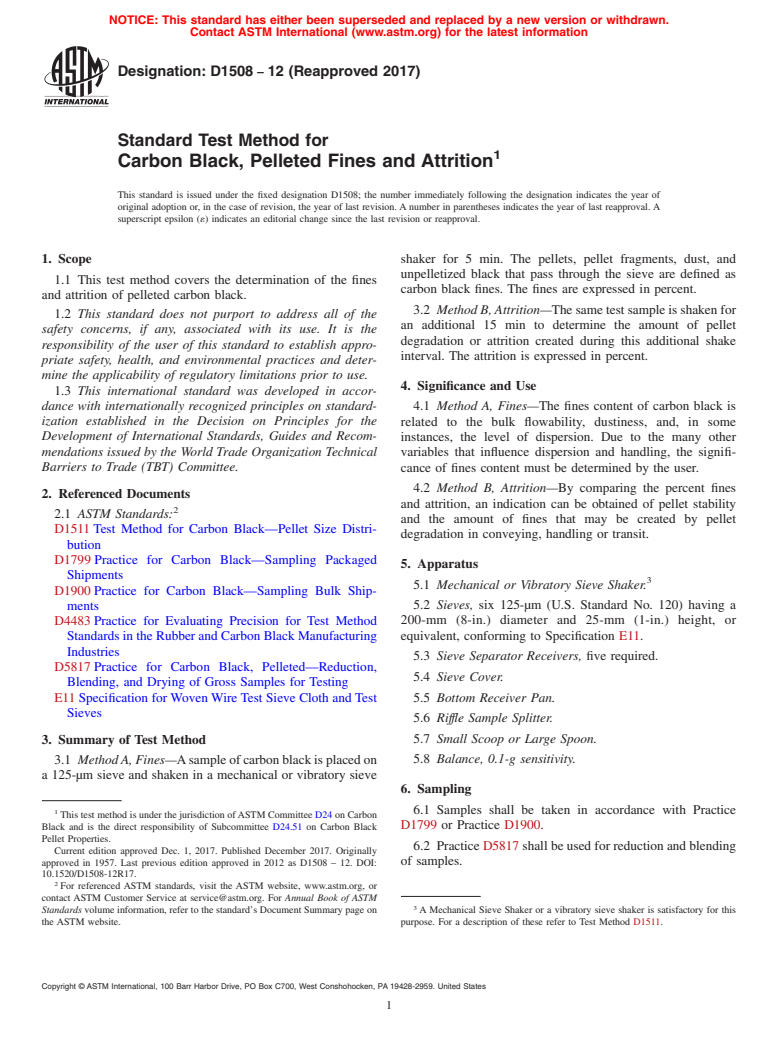
1.1 This test method covers the determination of the fines and attrition of pelleted carbon black.
1.2 This standard does not purport to address all of the safety concerns, if any, associated with its use. It is the responsibility of the user of this standard to establish appropriate safety, health, and environmental practices and determine the applicability of regulatory limitations prior to use.
1.3 This international standard was developed in accordance with internationally recognized principles on standardization established in the Decision on Principles for the Development of International Standards, Guides and Recommendations issued by the World Trade Organization Technical Barriers to Trade (TBT) Committee.
General Information
Buy Standard
Standards Content (Sample)
NOTICE: This standard has either been superseded and replaced by a new version or withdrawn.
Contact ASTM International (www.astm.org) for the latest information
Designation: D1508 − 12 (Reapproved 2017)
Standard Test Method for
Carbon Black, Pelleted Fines and Attrition
This standard is issued under the fixed designation D1508; the number immediately following the designation indicates the year of
original adoption or, in the case of revision, the year of last revision. A number in parentheses indicates the year of last reapproval. A
superscript epsilon (´) indicates an editorial change since the last revision or reapproval.
1. Scope shaker for 5 min. The pellets, pellet fragments, dust, and
unpelletized black that pass through the sieve are defined as
1.1 This test method covers the determination of the fines
carbon black fines. The fines are expressed in percent.
and attrition of pelleted carbon black.
3.2 Method B, Attrition—The same test sample is shaken for
1.2 This standard does not purport to address all of the
an additional 15 min to determine the amount of pellet
safety concerns, if any, associated with its use. It is the
degradation or attrition created during this additional shake
responsibility of the user of this standard to establish appro-
interval. The attrition is expressed in percent.
priate safety, health, and environmental practices and deter-
mine the applicability of regulatory limitations prior to use.
4. Significance and Use
1.3 This international standard was developed in accor-
dance with internationally recognized principles on standard- 4.1 Method A, Fines—The fines content of carbon black is
ization established in the Decision on Principles for the
related to the bulk flowability, dustiness, and, in some
Development of International Standards, Guides and Recom- instances, the level of dispersion. Due to the many other
mendations issued by the World Trade Organization Technical
variables that influence dispersion and handling, the signifi-
Barriers to Trade (TBT) Committee. cance of fines content must be determined by the user.
4.2 Method B, Attrition—By comparing the percent fines
2. Referenced Documents
and attrition, an indication can be obtained of pellet stability
2.1 ASTM Standards:
and the amount of fines that may be created by pellet
D1511 Test Method for Carbon Black—Pellet Size Distri-
degradation in conveying, handling or transit.
bution
D1799 Practice for Carbon Black—Sampling Packaged
5. Apparatus
Shipments
5.1 Mechanical or Vibratory Sieve Shaker.
D1900 Practice for Carbon Black—Sampling Bulk Ship-
5.2 Sieves, six 125-µm (U.S. Standard No. 120) having a
ments
D4483 Practice for Evaluating Precision for Test Method 200-mm (8-in.) diameter and 25-mm (1-in.) height, or
equivalent, conforming to Specification E11.
Standards in the Rubber and Carbon Black Manufacturing
Industries
5.3 Sieve Separator Receivers, five required.
D5817 Practice for Carbon Black, Pelleted—Reduction,
5.4 Sieve Cover.
Blending, and Drying of Gross Samples for Testing
E11 Specification for Woven Wire Test Sieve Cloth and Test 5.5 Bottom Receiver Pan.
Sieves
5.6 Riffle Sample Splitter.
3. Summary of Test Method 5.7 Small Scoop or Large Spoon.
5.8 Balance, 0.1-g sensitivity.
3.1 Method A, Fines—A sample of carbon black is placed on
a 125-µm sieve and shaken in a mechanical or vibratory sieve
6. Sampling
1 6.1 Samples shall be taken in accordance with Practice
This test method is under the jurisdiction of ASTM Committee D24 on Carbon
Black and is the direct responsibility of Subcommittee D24.51 on Carbon Black D1799 or Practice D1900.
Pellet Properties.
6.2 Practice D5817 shall be used for reduction and blending
Current edition approved Dec. 1, 2017. Published December 2017. Originally
of samples.
approved in 1957. Last previous edition approved in 2012 as D1508 – 12. DOI:
10.1520/D1508-12R17.
For referenced ASTM standards, visit the ASTM website, www.astm.org, or
contact ASTM Customer Service at service@astm.org. For Annual Book of ASTM
Standards volume information, refer to the standard’s Document Summary page on A Mechanical Sieve Shaker or a vibratory sieve shaker is satisfactory for this
the ASTM website. purpose. For a description of these refer to Test Method D1511.
Copyright © ASTM International, 100 Barr Harbor Drive, PO Box C700, West Conshohocken, PA 19428-2959. United States
D1508 − 12 (2017)
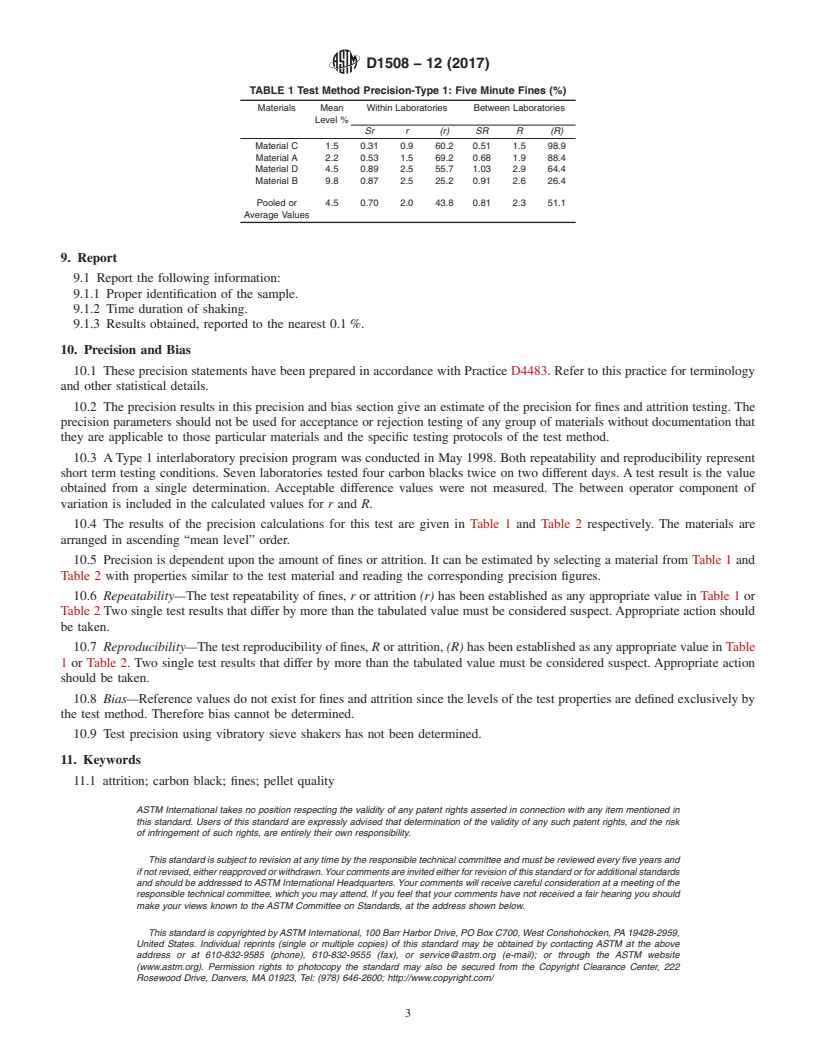
TABLE 1 Test Method Precision-Type 1: Five Minute Fines (%)
7. Procedure
Materials Mean Within Laboratories Between Laboratories
7.1 Method A, Fines and Method B, Attrition:
Level %
7.1.1 Stack up to six sets of sieves and receivers with a
Sr r (r) SR R (R)
receiver beneath each sieve.
Material C 1.5 0.31 0.9 60.2 0.51 1.5 98.9
Material A 2.2 0.53 1.5 69.2 0.68 1.9 88.4
7.1.2 Weigh 25.0 g portions, being careful to dip approxi-
Material D 4.5 0.89 2.5 55.7 1.03 2.9 64.4
mately 25 g of black from the riffle splitter.
Material B 9.8 0.87 2.5 25.2 0.91 2.6 26.4
NOTE 1—It is not good practice to weigh the sample by pouring it
Pooled or 4.5 0.70 2.0 43.8 0.81 2.3 51.1
directly out of the black container since the fines and smaller pellets will
Average Values
tend to remain in the container while the larger pellets pour out first.
Dipping the black from the container is the preferred technique.
7.1.3 Transfer each sample to an individual 125-µm sieve.
NOTE 2—Six different materials or samples may be tested when all six
WF = mass of carbon black in receiver after 5 min shake, g,
sets of sieves are used. In some labs the position of the sieve may affect
WA = mass of carbon black in receiver after additional 15
results with the higher sieves yielding higher fines data. For this reason the
min shake, total 20 min g, and
center position, sieves 3 and 4, should be used for referee testing.
S = mass of black tested, g.
7.1.4 Assemble up to six sets of sieves and receivers into a
stack. Place a cover on top and transfer to the shaker. Tighten
9. Report
the shaker to eliminate any looseness. Refer to the user manual
9.1 Report the following information:
for operation of the vibratory sieve shaker. A vibratory ampli-
9.1.1 Proper identification of the sample.
tude
...
This document is not an ASTM standard and is intended only to provide the user of an ASTM standard an indication of what changes have been made to the previous version. Because
it may not be technically possible to adequately depict all changes accurately, ASTM recommends that users consult prior editions as appropriate. In all cases only the current version
of the standard as published by ASTM is to be considered the official document.
Designation: D1508 − 12 D1508 − 12 (Reapproved 2017)
Standard Test Method for
Carbon Black, Pelleted Fines and Attrition
This standard is issued under the fixed designation D1508; the number immediately following the designation indicates the year of
original adoption or, in the case of revision, the year of last revision. A number in parentheses indicates the year of last reapproval. A
superscript epsilon (´) indicates an editorial change since the last revision or reapproval.
1. Scope
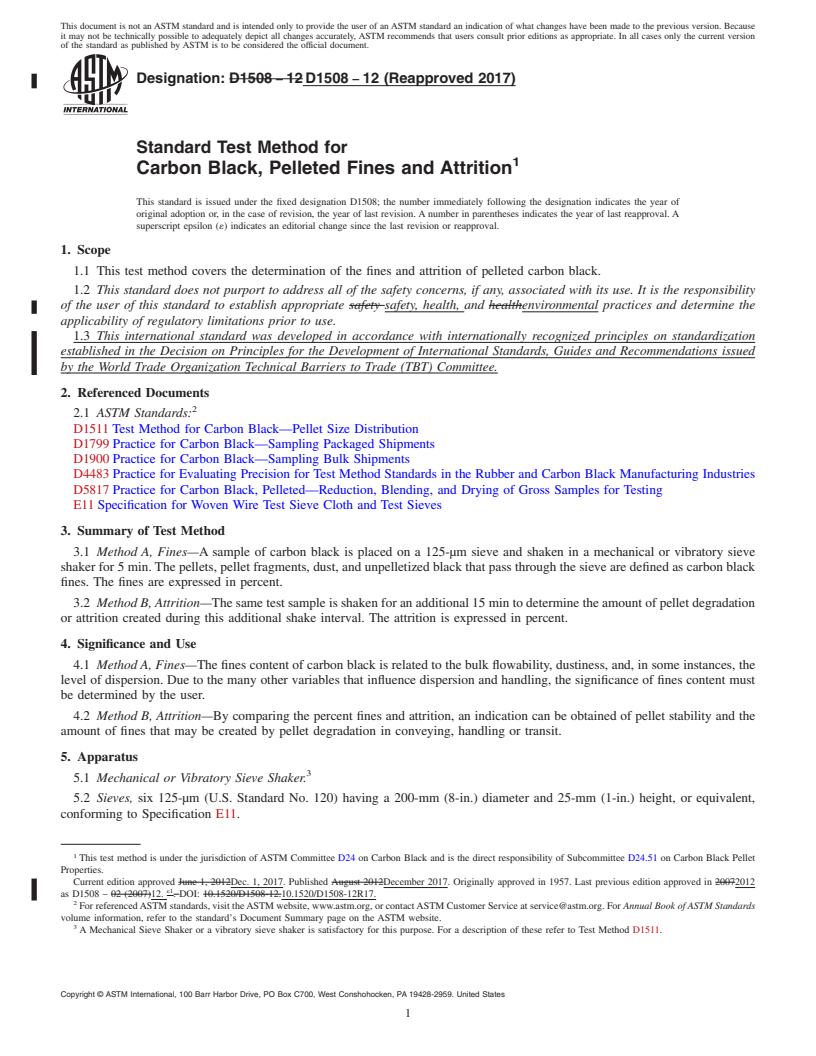
1.1 This test method covers the determination of the fines and attrition of pelleted carbon black.
1.2 This standard does not purport to address all of the safety concerns, if any, associated with its use. It is the responsibility
of the user of this standard to establish appropriate safety safety, health, and healthenvironmental practices and determine the
applicability of regulatory limitations prior to use.
1.3 This international standard was developed in accordance with internationally recognized principles on standardization
established in the Decision on Principles for the Development of International Standards, Guides and Recommendations issued
by the World Trade Organization Technical Barriers to Trade (TBT) Committee.
2. Referenced Documents
2.1 ASTM Standards:
D1511 Test Method for Carbon Black—Pellet Size Distribution
D1799 Practice for Carbon Black—Sampling Packaged Shipments
D1900 Practice for Carbon Black—Sampling Bulk Shipments
D4483 Practice for Evaluating Precision for Test Method Standards in the Rubber and Carbon Black Manufacturing Industries
D5817 Practice for Carbon Black, Pelleted—Reduction, Blending, and Drying of Gross Samples for Testing
E11 Specification for Woven Wire Test Sieve Cloth and Test Sieves
3. Summary of Test Method
3.1 Method A, Fines—A sample of carbon black is placed on a 125-μm sieve and shaken in a mechanical or vibratory sieve
shaker for 5 min. The pellets, pellet fragments, dust, and unpelletized black that pass through the sieve are defined as carbon black
fines. The fines are expressed in percent.
3.2 Method B, Attrition—The same test sample is shaken for an additional 15 min to determine the amount of pellet degradation
or attrition created during this additional shake interval. The attrition is expressed in percent.
4. Significance and Use
4.1 Method A, Fines—The fines content of carbon black is related to the bulk flowability, dustiness, and, in some instances, the
level of dispersion. Due to the many other variables that influence dispersion and handling, the significance of fines content must
be determined by the user.
4.2 Method B, Attrition—By comparing the percent fines and attrition, an indication can be obtained of pellet stability and the
amount of fines that may be created by pellet degradation in conveying, handling or transit.
5. Apparatus
5.1 Mechanical or Vibratory Sieve Shaker.
5.2 Sieves, six 125-μm (U.S. Standard No. 120) having a 200-mm (8-in.) diameter and 25-mm (1-in.) height, or equivalent,
conforming to Specification E11.
This test method is under the jurisdiction of ASTM Committee D24 on Carbon Black and is the direct responsibility of Subcommittee D24.51 on Carbon Black Pellet
Properties.
Current edition approved June 1, 2012Dec. 1, 2017. Published August 2012December 2017. Originally approved in 1957. Last previous edition approved in 20072012
ε1
as D1508 – 02 (2007)12. . DOI: 10.1520/D1508-12.10.1520/D1508-12R17.
For referenced ASTM standards, visit the ASTM website, www.astm.org, or contact ASTM Customer Service at service@astm.org. For Annual Book of ASTM Standards
volume information, refer to the standard’s Document Summary page on the ASTM website.
A Mechanical Sieve Shaker or a vibratory sieve shaker is satisfactory for this purpose. For a description of these refer to Test Method D1511.
Copyright © ASTM International, 100 Barr Harbor Drive, PO Box C700, West Conshohocken, PA 19428-2959. United States
D1508 − 12 (2017)
5.3 Sieve Separator Receivers, five required.
5.4 Sieve Cover.
5.5 Bottom Receiver Pan.
5.6 Riffle Sample Splitter.
5.7 Small Scoop or Large Spoon.
5.8 Balance, 0.1-g sensitivity.
6. Sampling
6.1 Samples shall be taken in accordance with Practice D1799 or Practice D1900.
6.2 Practice D5817 shall be used for reduction and blending of samples.
7. Procedure
7.1 Method A, Fines and Method B, Attrition:
7.1.1 Stack up to six sets of sieves and receivers with a receiver beneath each sieve.
7.1.2 Weigh 25.0 g portions, being careful to dip approximately 25 g of black from the riffle splitter.
NOTE 1—It is not good practice to weigh the sample by pouring it directly out of the black container since the fines and smaller pellets will tend to
remain in the container while the larger pellets pour out first. Dipping the black from the container is the preferred technique.
7.1.3 Transfer each sample to an individual 125-μm sieve.
NOTE 2—Six different materials or samples may be tested when all six sets of sieves are used. In some labs the position of the sieve may affect results
with the higher sieves yielding higher fines data. For this reason the center position, sieves 3 and 4, should be used for referee testing.
7.1.4 Assemble up to six sets of sieves and receivers into a stack. Place a cover on top and transfer to the shaker. Tighten the
shaker to eliminate any looseness. Refer to the user manual for operation of the vibratory sieve shaker. A vibratory amplitude of
1.3 mm should be selected with the vibratory sieve shakers operating at 3600 vpm. However, products that contain little or no
binder may experience excessive attrition at the specified amplitude of 1.3 mm. It is the responsibility of the user to determine the
appropriate amplitude for these products in order to match the Mechanical Sieve Shaker values. It should be noted that changing
the amplitude for standard products is not recommended and may result in erroneous values.
7.1.5 Start the shaker and allow to shake for 5 min with the hammer operating.
7.1.6 Remove the sieve assembly from the shaker and weigh the carb
...
Questions, Comments and Discussion
Ask us and Technical Secretary will try to provide an answer. You can facilitate discussion about the standard in here.