

ASTM D7138-16
(Test Method)Standard Test Method to Determine Melting Temperature of Synthetic Fibers
General Information
- Abstract
SIGNIFICANCE AND USE
5.1 Either of these two test methods is used to determine the temperature at which a synthetic fiber specimen changes from a solid to a liquid-like state.
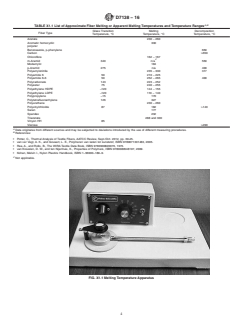
5.1.1 Synthetic fibers may be either amorphous or semi-crystalline thermoplastics or thermosets. Synthetic fibers may change from the solid to a liquid-like state on heating because of the glass transition of amorphous polymers, the melting of crystalline regions of semi-crystalline polymers, or at the onset of degradation. Thermoplastic fibers consist of crystalline and amorphous regions and may be manufactured with a range of molecular weights. The amorphous and crystalline fiber structure and variable molecular weight can lead to a melting temperature range instead of a discreet melting point (see Table X1.1).
5.2 This test method is considered satisfactory for acceptance testing of commercial shipments.
5.2.1 If there are differences of practical significance between reported test results for two or more laboratories, perform comparative testing to determine if there is a statistical bias between them, using competent statistical assistance. As a minimum, use the samples for such a comparative test that are as homogeneous as possible, drawn from the same lot of material as the samples that resulted in disparate results during initial testing and randomly assigned in equal numbers to each laboratory. Compare the test results from the laboratories involved using a statistical test for unpaired data, at a probability level chosen prior to the testing series. If bias is found, either its cause must be found and corrected, or future test results for that material must be adjusted in consideration of the known bias.
5.3 This test method is suitable for quality control testing of synthetic fibers and product comparisons of different fibers by manufacturers, retailers, and users.
5.4 If the test method is used to identify fiber material type, it is important to test a known reference material at the s...
SCOPE
1.1 Either of two test methods are used to determine the melting temperature of thermoplastic fibers, yarns, or threads.
1.2 Method 1 can be used to determine melting temperatures for blends of multiple fiber material types. Method 2 can only be used to determine the melting temperature of a single fiber material type.
1.2.1 Method 1, Differential Scanning Calorimetry (DSC), measures changes in heat capacity and will detect the glass transition, the crystalline melting and endothermic thermal degradation.
1.2.2 Method 2, a visual determination of melting, determines any change that visually appears as a transition from a solid to a liquid state.
1.2.3 Due to the differences in what each test method measures, the results from Method 1 and Method 2 cannot be compared.
1.3 The values stated in either SI units or other units are to be regarded separately. The values stated in each system are not exact equivalents; therefore, each system shall be used independently without combining values.
1.4 This standard does not purport to address all of the safety concerns, if any, associated with its use. It is the responsibility of the user of this standard to establish appropriate safety and health practices and determine the applicability of regulatory limitations prior to use.
- Status
- Published
- Publication Date
- 31-Dec-2015
- Technical Committee
- D13 - Textiles
- Drafting Committee
- D13.51 - Conditioning, Chemical and Thermal Properties
Overview
ASTM D7138-16: Standard Test Method to Determine Melting Temperature of Synthetic Fibers establishes procedures for determining the melting temperature of thermoplastic fibers, yarns, and threads. Developed by ASTM International, this standard supports stakeholders in the textile and synthetic fiber industries by providing clear, repeatable methodologies for identifying the point at which synthetic fibers transition from solid to liquid-like states. Accurate determination of melting temperatures is essential for quality control, product development, material identification, and acceptance testing in commercial supply chains.
Key Topics
- Dual Test Methods:
- Method 1 - Differential Scanning Calorimetry (DSC): Measures changes in heat capacity of the fiber, detecting transitions such as the glass transition and crystalline melting, and can be used for blends of multiple fiber types.
- Method 2 - Visual Determination: Relies on visually observing the point at which a fiber sample transitions to a liquid state. This method applies only to single material types.
- Precision and Bias:
- Method 1 and Method 2 measure different phenomena; their results cannot be directly compared.
- The standard outlines procedures for comparative testing and bias mitigation when discrepancies arise between laboratories.
- Sample Handling and Apparatus:
- Details are provided for sample preparation, apparatus calibration, and the handling of both reference and test specimens.
- Includes recommendations for handling amorphous and semi-crystalline thermoplastics, as well as for using appropriate reference materials.
- Safety and Compliance:
- Users must establish appropriate safety and health practices due to the use of high temperatures and, potentially, organic solvents.
Applications
- Quality Control in Manufacturing:
The melting temperature determination is a critical quality attribute for synthetic fibers used in textiles, composites, industrial fabrics, and technical applications. Regular testing ensures batch-to-batch consistency and reliable product performance. - Material Identification:
Manufacturers, retailers, and analysts use this standard to confirm fiber types in finished goods and raw material shipments. This can support compliance with regulatory, warranty, and specification requirements. - Product Comparison and Development:
The ability to differentiate between fiber types and assess their thermal properties assists R&D and commercial teams when evaluating competing products or developing new fiber formulations. - Acceptance Testing and Dispute Resolution:
Consistent methods make it possible to compare results across laboratories and resolve disputes in commercial transactions or quality assurance workflows.
Related Standards
The following standards are referenced or relevant to applications of ASTM D7138-16:
- ASTM D123: Terminology Relating to Textiles
- ASTM D1776: Practice for Conditioning and Testing Textiles
- ASTM D2257: Test Method for Extractable Matter in Textiles
- ASTM D2258: Practice for Sampling Yarn for Testing
- ASTM D276: Test Methods for Identification of Fibers in Textiles
- ASTM D3333: Practice for Sampling Manufactured Staple Fibers, Sliver, or Tow for Testing
These complementary standards support precise sampling, terminology, and fiber identification protocols, further strengthening the integrity of melting temperature measurements.
Key search terms: ASTM D7138-16, melting temperature of synthetic fibers, Differential Scanning Calorimetry (DSC), visual melting test, textile quality control, synthetic fiber identification, fiber melting point testing, ASTM textile standards
By adhering to ASTM D7138-16, organizations enhance reliability in manufacturing, distribution, and laboratory evaluation of synthetic fiber products.
Relations
- Effective Date
- 01-Jan-2016
- Effective Date
- 01-Jul-2018
- Effective Date
- 01-Mar-2017
- Effective Date
- 15-Sep-2015
- Effective Date
- 01-Sep-2015
- Effective Date
- 01-Apr-2015
- Effective Date
- 15-Jun-2013
- Effective Date
- 15-Jun-2013
- Effective Date
- 15-May-2013
- Effective Date
- 01-Jul-2012
- Effective Date
- 01-Mar-2012
- Effective Date
- 01-Feb-2012
- Effective Date
- 01-Feb-2012
- Effective Date
- 01-Feb-2012
- Effective Date
- 15-Jan-2009
Get Certified
Connect with accredited certification bodies for this standard

Control Union Certifications
Global certification for agriculture and sustainability.

Hohenstein Institut
Textile testing and certification.

Bureau Veritas Bangladesh
Bureau Veritas certification services in Bangladesh.
Sponsored listings
Frequently Asked Questions
ASTM D7138-16 is a standard published by ASTM International. Its full title is "Standard Test Method to Determine Melting Temperature of Synthetic Fibers". This standard covers: SIGNIFICANCE AND USE 5.1 Either of these two test methods is used to determine the temperature at which a synthetic fiber specimen changes from a solid to a liquid-like state. 5.1.1 Synthetic fibers may be either amorphous or semi-crystalline thermoplastics or thermosets. Synthetic fibers may change from the solid to a liquid-like state on heating because of the glass transition of amorphous polymers, the melting of crystalline regions of semi-crystalline polymers, or at the onset of degradation. Thermoplastic fibers consist of crystalline and amorphous regions and may be manufactured with a range of molecular weights. The amorphous and crystalline fiber structure and variable molecular weight can lead to a melting temperature range instead of a discreet melting point (see Table X1.1). 5.2 This test method is considered satisfactory for acceptance testing of commercial shipments. 5.2.1 If there are differences of practical significance between reported test results for two or more laboratories, perform comparative testing to determine if there is a statistical bias between them, using competent statistical assistance. As a minimum, use the samples for such a comparative test that are as homogeneous as possible, drawn from the same lot of material as the samples that resulted in disparate results during initial testing and randomly assigned in equal numbers to each laboratory. Compare the test results from the laboratories involved using a statistical test for unpaired data, at a probability level chosen prior to the testing series. If bias is found, either its cause must be found and corrected, or future test results for that material must be adjusted in consideration of the known bias. 5.3 This test method is suitable for quality control testing of synthetic fibers and product comparisons of different fibers by manufacturers, retailers, and users. 5.4 If the test method is used to identify fiber material type, it is important to test a known reference material at the s... SCOPE 1.1 Either of two test methods are used to determine the melting temperature of thermoplastic fibers, yarns, or threads. 1.2 Method 1 can be used to determine melting temperatures for blends of multiple fiber material types. Method 2 can only be used to determine the melting temperature of a single fiber material type. 1.2.1 Method 1, Differential Scanning Calorimetry (DSC), measures changes in heat capacity and will detect the glass transition, the crystalline melting and endothermic thermal degradation. 1.2.2 Method 2, a visual determination of melting, determines any change that visually appears as a transition from a solid to a liquid state. 1.2.3 Due to the differences in what each test method measures, the results from Method 1 and Method 2 cannot be compared. 1.3 The values stated in either SI units or other units are to be regarded separately. The values stated in each system are not exact equivalents; therefore, each system shall be used independently without combining values. 1.4 This standard does not purport to address all of the safety concerns, if any, associated with its use. It is the responsibility of the user of this standard to establish appropriate safety and health practices and determine the applicability of regulatory limitations prior to use.
SIGNIFICANCE AND USE 5.1 Either of these two test methods is used to determine the temperature at which a synthetic fiber specimen changes from a solid to a liquid-like state. 5.1.1 Synthetic fibers may be either amorphous or semi-crystalline thermoplastics or thermosets. Synthetic fibers may change from the solid to a liquid-like state on heating because of the glass transition of amorphous polymers, the melting of crystalline regions of semi-crystalline polymers, or at the onset of degradation. Thermoplastic fibers consist of crystalline and amorphous regions and may be manufactured with a range of molecular weights. The amorphous and crystalline fiber structure and variable molecular weight can lead to a melting temperature range instead of a discreet melting point (see Table X1.1). 5.2 This test method is considered satisfactory for acceptance testing of commercial shipments. 5.2.1 If there are differences of practical significance between reported test results for two or more laboratories, perform comparative testing to determine if there is a statistical bias between them, using competent statistical assistance. As a minimum, use the samples for such a comparative test that are as homogeneous as possible, drawn from the same lot of material as the samples that resulted in disparate results during initial testing and randomly assigned in equal numbers to each laboratory. Compare the test results from the laboratories involved using a statistical test for unpaired data, at a probability level chosen prior to the testing series. If bias is found, either its cause must be found and corrected, or future test results for that material must be adjusted in consideration of the known bias. 5.3 This test method is suitable for quality control testing of synthetic fibers and product comparisons of different fibers by manufacturers, retailers, and users. 5.4 If the test method is used to identify fiber material type, it is important to test a known reference material at the s... SCOPE 1.1 Either of two test methods are used to determine the melting temperature of thermoplastic fibers, yarns, or threads. 1.2 Method 1 can be used to determine melting temperatures for blends of multiple fiber material types. Method 2 can only be used to determine the melting temperature of a single fiber material type. 1.2.1 Method 1, Differential Scanning Calorimetry (DSC), measures changes in heat capacity and will detect the glass transition, the crystalline melting and endothermic thermal degradation. 1.2.2 Method 2, a visual determination of melting, determines any change that visually appears as a transition from a solid to a liquid state. 1.2.3 Due to the differences in what each test method measures, the results from Method 1 and Method 2 cannot be compared. 1.3 The values stated in either SI units or other units are to be regarded separately. The values stated in each system are not exact equivalents; therefore, each system shall be used independently without combining values. 1.4 This standard does not purport to address all of the safety concerns, if any, associated with its use. It is the responsibility of the user of this standard to establish appropriate safety and health practices and determine the applicability of regulatory limitations prior to use.
ASTM D7138-16 is classified under the following ICS (International Classification for Standards) categories: 59.060.20 - Man-made fibres. The ICS classification helps identify the subject area and facilitates finding related standards.
ASTM D7138-16 has the following relationships with other standards: It is inter standard links to ASTM D7138-08, ASTM D3333-07(2018), ASTM D123-17, ASTM D123-15b, ASTM D123-15a, ASTM D123-15, ASTM D123-13ae1, ASTM D123-13a, ASTM D123-13, ASTM D3333-07(2012), ASTM D2258-99(2012), ASTM D2257-98(2012), ASTM D123-12e1, ASTM D123-12, ASTM D123-09e2. Understanding these relationships helps ensure you are using the most current and applicable version of the standard.
ASTM D7138-16 is available in PDF format for immediate download after purchase. The document can be added to your cart and obtained through the secure checkout process. Digital delivery ensures instant access to the complete standard document.
Standards Content (Sample)
This international standard was developed in accordance with internationally recognized principles on standardization established in the Decision on Principles for the
Development of International Standards, Guides and Recommendations issued by the World Trade Organization Technical Barriers to Trade (TBT) Committee.
Designation: D7138 − 16
Standard Test Method to
Determine Melting Temperature of Synthetic Fibers
This standard is issued under the fixed designation D7138; the number immediately following the designation indicates the year of
original adoption or, in the case of revision, the year of last revision. A number in parentheses indicates the year of last reapproval. A
superscript epsilon (´) indicates an editorial change since the last revision or reapproval.
1. Scope D2258 Practice for Sampling Yarn for Testing
D3333 Practice for Sampling Manufactured Staple Fibers,
1.1 Either of two test methods are used to determine the
Sliver, or Tow for Testing
melting temperature of thermoplastic fibers, yarns, or threads.
1.2 Method 1 can be used to determine melting tempera-
3. Terminology
tures for blends of multiple fiber material types. Method 2 can
3.1 Definitions of Terms Specific to This Standard:
only be used to determine the melting temperature of a single
3.1.1 melting temperature, n—the temperature or range of
fiber material type.
temperatures at which a substance is observed to transition to
1.2.1 Method 1, Differential Scanning Calorimetry (DSC),
a liquid-like state.
measures changes in heat capacity and will detect the glass
3.1.2 For all other terminology related to textiles, see
transition, the crystalline melting and endothermic thermal
Terminology D123.
degradation.
1.2.2 Method 2, a visual determination of melting, deter-
4. Summary of Test Method
mines any change that visually appears as a transition from a
4.1 Method 1:
solid to a liquid state.
4.1.1 A specimen of fiber and a reference sample are
1.2.3 Due to the differences in what each test method
positioned into the designated heating blocks of a Differential
measures, the results from Method 1 and Method 2 cannot be
Scanning Calorimetry (DSC) instrument.
compared.
4.1.2 Use the DSC data to determine the fiber specimen
1.3 The values stated in either SI units or other units are to
melting temperature.
beregardedseparately.Thevaluesstatedineachsystemarenot
4.2 Method 2:
exact equivalents; therefore, each system shall be used inde-
4.2.1 A specimen of fiber is positioned in a melting tem-
pendently without combining values.
perature device.
1.4 This standard does not purport to address all of the
4.2.2 The temperature of the device is raised until the fiber
safety concerns, if any, associated with its use. It is the
specimen reaches its melting temperature as determined by
responsibility of the user of this standard to establish appro-
visual observation.
priate safety and health practices and determine the applica-
bility of regulatory limitations prior to use.
5. Significance and Use
5.1 Either of these two test methods is used to determine the
2. Referenced Documents
temperature at which a synthetic fiber specimen changes from
2.1 ASTM Standards:
a solid to a liquid-like state.
D123 Terminology Relating to Textiles
5.1.1 Synthetic fibers may be either amorphous or semi-
D276 Test Methods for Identification of Fibers in Textiles
crystalline thermoplastics or thermosets. Synthetic fibers may
D1776 Practice for Conditioning and Testing Textiles
change from the solid to a liquid-like state on heating because
D2257 Test Method for Extractable Matter in Textiles
of the glass transition of amorphous polymers, the melting of
crystalline regions of semi-crystalline polymers, or at the onset
of degradation. Thermoplastic fibers consist of crystalline and
This test method is under the jurisdiction ofASTM Committee D13 on Textiles
amorphous regions and may be manufactured with a range of
and is the direct responsibility of Subcommittee D13.51 on Conditioning, Chemical
and Thermal Properties.
molecular weights. The amorphous and crystalline fiber struc-
Current edition approved Jan. 1, 2016. Published February 2016. Originally
ture and variable molecular weight can lead to a melting
approved in 2007. Last previous edition approved in 2008 as D7138 - 08. DOI:
temperaturerangeinsteadofadiscreetmeltingpoint(seeTable
10.1520/D7138-16.
For referenced ASTM standards, visit the ASTM website, www.astm.org, or X1.1).
contact ASTM Customer Service at service@astm.org. For Annual Book of ASTM
5.2 This test method is considered satisfactory for accep-
Standards volume information, refer to the standard’s Document Summary page on
the ASTM website. tance testing of commercial shipments.
Copyright © ASTM International, 100 Barr Harbor Drive, PO Box C700, West Conshohocken, PA 19428-2959. United States
D7138 − 16
5.2.1 If there are differences of practical significance be- cleaning using a Soxhlet extractor proceed to 7.2.1. If cleaning
tween reported test results for two or more laboratories, using a Soxhlet extractor is not required proceed to 7.3.
performcomparativetestingtodetermineifthereisastatistical 7.2.1 Place sample in a Soxhlet extractor (see Fig. X1.2)
bias between them, using competent statistical assistance.As a and perform twenty extractions using a chloroform, USP
minimum, use the samples for such a comparative test that are reagent. Follow extraction procedure in D2257. Other solvents
as homogeneous as possible, drawn from the same lot of such as methanol, ethanol or isopropyl alcohol may be used if
material as the samples that resulted in disparate results during they are found to be effective in removing fiber finishes and
initial testing and randomly assigned in equal numbers to each coatings.
laboratory. Compare the test results from the laboratories 7.2.2 Dry samples and return to equilibrium in accordance
involved using a statistical test for unpaired data, at a prob- with D1776.
ability level chosen prior to the testing series. If bias is found,
7.3 Test Specimens:
either its cause must be found and corrected, or future test
7.3.1 Method 1:
resultsforthatmaterialmustbeadjustedinconsiderationofthe
7.3.1.1 DSC Sample Preparation—Cut the samples into
known bias.
very small pieces with scissors and puta5to7mg specimen
5.3 Thistestmethodissuitableforqualitycontroltestingof into the aluminum pan. Make a small hole on the lid with a
synthetic fibers and product comparisons of different fibers by needle and close the pan with the help of a sample crimper.
manufacturers, retailers, and users. Make another sample, which will be used as the reference
sample by closing an empty pan with lid.
5.4 If the test method is used to identify fiber material type,
7.3.1.2 Prepare five specimens and five references to per-
it is important to test a known reference material at the same
form five replicates.
laboratory with the same test method to confirm the fiber
7.3.2 Method 2:
identification. In addition, since some fiber types have similar
7.3.2.1 From each laboratory sampling unit, cut five fiber
melting temperatures or overlapping melting temperature
samples into specimens having a length of approximately 2
ranges as show in Table X1.1, secondary methods for fiber
mm (.0625 in).
identification as described in Test Methods D276 will be
7.3.2.2 Prepare the five specimens to perform five repli-
required to make fiber identifications.
cates.
6. Apparatus
8. Calibration
6.1 Apparatus for Method 1, using a DSC instrument:
8.1 Follow the manufacturer’s instructions to calibrate the
6.2 Apparatus for Method 2:
melting temperature apparatus (see Appendix X1).
6.2.1 Test Unit Configuration—Apparatus used consists of
8.2 Verify the melting temperature apparatus performance
anelectricallyheatedstagewhichhasatemperaturerangefrom
by using fiber of a known melting temperature (see Table
20ºC (68ºF) to 300ºC (572ºF) or at least 10ºC (18ºF) above the
X1.1).
highest melting temperature to be measured. See Fig. X1.1 for
a typical apparatus.
NOTE 1— Use a fiber having a melting temperature similar to the
6.2.1.1 The adjustment mechanism shall be able to control specimen to be te
...
This document is not an ASTM standard and is intended only to provide the user of an ASTM standard an indication of what changes have been made to the previous version. Because
it may not be technically possible to adequately depict all changes accurately, ASTM recommends that users consult prior editions as appropriate. In all cases only the current version
of the standard as published by ASTM is to be considered the official document.
Designation: D7138 − 08 D7138 − 16 An American National Standard
Standard Test Method to
Determine Melting Temperature of Synthetic Fibers
This standard is issued under the fixed designation D7138; the number immediately following the designation indicates the year of
original adoption or, in the case of revision, the year of last revision. A number in parentheses indicates the year of last reapproval. A
superscript epsilon (´) indicates an editorial change since the last revision or reapproval.
1. Scope
1.1 Either of two test methods are used to determine the melting temperature of thermoplastic fibers, yarns, or threads.
1.2 Method 1 can be used to determine melting temperatures for blends of multiple fiber material types. Method 2 can only be
used to determine the melting temperature of a single fiber material type.
1.2.1 Method 1, Differential Scanning Calorimetry (DSC), measures changes in heat capacity and will detect the glass transition,
the crystalline melting and endothermic thermal degradation.
1.2.2 Method 2, a visual determination of melting, determines any change that visually appears as a transition from a solid to
a liquid state.
1.2.3 Due to the differences in what each test method measures, the results from Method 1 and Method 2 cannot be compared.
1.3 The values stated in either SI units or other units are to be regarded separately. The values stated in each system are not exact
equivalents; therefore, each system shall be used independently without combining values.
1.4 This standard does not purport to address all of the safety concerns, if any, associated with its use. It is the responsibility
of the user of this standard to establish appropriate safety and health practices and determine the applicability of regulatory
limitations prior to use.
2. Referenced Documents
2.1 ASTM Standard:
D123 Terminology Relating to Textiles
D1776 Practice for Conditioning and Testing Textiles
D2257 Test Method for Extractable Matter in Textiles
D3333 Practice for Sampling Manufactured Staple Fibers, Sliver, or Tow for Testing
2.1 ASTM Standards:
D123 Terminology Relating to Textiles
D276 Test Methods for Identification of Fibers in Textiles
D1776 Practice for Conditioning and Testing Textiles
D2257 Test Method for Extractable Matter in Textiles
D2258 Practice for Sampling Yarn for Testing
D3333 Practice for Sampling Manufactured Staple Fibers, Sliver, or Tow for Testing
3. Terminology
3.1 Definitions of Terms Specific to This Standard:
3.1.1 melting temperature, n—the temperature or range of temperatures at which a substance is observed to transition to a
liquid-like state.
3.1.2 For all other terminology related to textiles, see Terminology D123.
4. Summary of Test Method
4.1 Method 1:
This test method is under the jurisdiction of ASTM Committee D13 on Textiles and is the direct responsibility of Subcommittee D13.51 on Conditioning and,
Conditioning, Chemical and Thermal Properties.
Current edition approved July 1, 2008Jan. 1, 2016. Published August 2008February 2016. Originally approved in 2007. Last previous edition approved in 20072008 as
D7138 - 07. - 08. DOI: 10.1520/D7138-08.10.1520/D7138-16.
For referenced ASTM standards, visit the ASTM website, www.astm.org, or contact ASTM Customer Service at service@astm.org. For Annual Book of ASTM Standards
volume information, refer to the standard’s Document Summary page on the ASTM website.
Copyright © ASTM International, 100 Barr Harbor Drive, PO Box C700, West Conshohocken, PA 19428-2959. United States
D7138 − 16
4.1.1 A specimen of fiber and a reference sample are positioned into the designated heating blocks of a Differential Scanning
Calorimetry (DSC) instrument.
4.1.2 Use the DSC data to determine the fiber specimen melting temperature.
4.2 Method 2:
4.2.1 A specimen of fiber is positioned in a melting temperature device.
4.2.2 The temperature of the device is raised until the fiber specimen reaches its melting temperature as determined by visual
observation.
5. Significance and Use
5.1 Either of these two test methods is used to determine the temperature at which a synthetic fiber specimen changes from a
solid to a liquid-like state.
5.1.1 Synthetic fibers may be either amorphous or semi-crystalline thermoplastics or thermosets. Synthetic fibers may change
from the solid to a liquid-like state on heating because of the glass transition of amorphous polymers, the melting of crystalline
regions of semi-crystalline polymers, or at the onset of degradation. Thermoplastic fibers consist of crystalline and amorphous
regions and may be manufactured with a range of molecular weights. The amorphous and crystalline fiber structure and variable
molecular weight can lead to a melting temperature range instead of a discreet melting point (see Table X1.1).
5.2 This test method is considered satisfactory for acceptance testing of commercial shipments.
5.2.1 If there are differences of practical significance between reported test results for two or more laboratories, perform
comparative testing to determine if there is a statistical bias between them, using competent statistical assistance. As a minimum,
use the samples for such a comparative test that are as homogeneous as possible, drawn from the same lot of material as the
samples that resulted in disparate results during initial testing and randomly assigned in equal numbers to each laboratory. Compare
the test results from the laboratories involved using a statistical test for unpaired data, at a probability level chosen prior to the
testing series. If bias is found, either its cause must be found and corrected, or future test results for that material must be adjusted
in consideration of the known bias.
5.3 This test method is suitable for quality control testing of synthetic fibers and product comparisons of different fibers by
manufacturers, retailers, and users.
5.4 If the test method is used to identify fiber material type, it is important to test a known reference material at the same
laboratory with the same test method to confirm the fiber identification. In addition, since some fiber types have similar melting
temperatures or overlapping melting temperature ranges as show in Table X1.1, secondary methods for fiber identification as
described in Test Methods D276 will be required to make fiber identifications.
6. Apparatus
6.1 Apparatus for Method 1, using a DSC instrument:
6.2 Apparatus for Method 2:
6.2.1 Test Unit Configuration—Apparatus used consists of an electrically heated stage which has a temperature range from 20ºC
(68ºF) to 300ºC (572ºF) or at least 10ºC (18ºF) above the highest melting temperature to be measured. See Fig. X1.1 for a typical
apparatus.
6.2.1.1 The adjustment mechanism shall be able to control the heat input into the stage.
6.2.1.2 Thermometer for measuring temperature shall be accurate to +0.5ºC (+1ºF).
6.2.1.3 The device shall have a low powered magnifying glass to permit visual examination.
6.2.1.4 The device shall have a top and bottom microcover glass. The top glass shall fit directly over the bottom glass so that
the fiber specimen rests between the microcovers.
6.2.2 Soxhlet extraction device. See Fig. X1.2.
7. Preparation of Apparatus
7.1 Lot Sample: As a lot sample for acceptance testing, take at random the number of laboratory sampling units as directed in
an applicable material specification or other agreement between the purchaser and the supplier. In the absence of a material
specification or other agreement, use Practice D2258 or Practice D3333, as applicable. Consider containers, such as cartons, bales
or other shipping containers to be the primary sampling units.
7.2 Laboratory Sample Unit: As a laboratory sampling unit for acceptance testing, take as directed in Practice D2258 or Practice
D3333, as applicable. If the fiber sample requires cleaning using a Soxhlet extractor proceed to 7.2.1. If cleaning using a Soxhlet
extractor is not required proceed to 7.3.
7.2.1 Place sample in a Soxhlet extractor (see Fig. X1.2) and perform twenty extractions using a chloroform, USP reagent.
Follow extraction procedure in D2257. Other solvents such as methanol, ethanol or isopropyl alcohol may be used if they are found
to be effective in removing fiber finishes and coatings.
7.2.2 Dry samples and return to equilibrium in accordance with D1776.
D7138 − 16
7.3 Test Specimens:
7.3.1 Method 1:
7.3.1.1 DSC S
...