


ASTM C92-95(2015)
(Test Method)Standard Test Methods for Sieve Analysis and Water Content of Refractory Materials
Standard Test Methods for Sieve Analysis and Water Content of Refractory Materials
SIGNIFICANCE AND USE
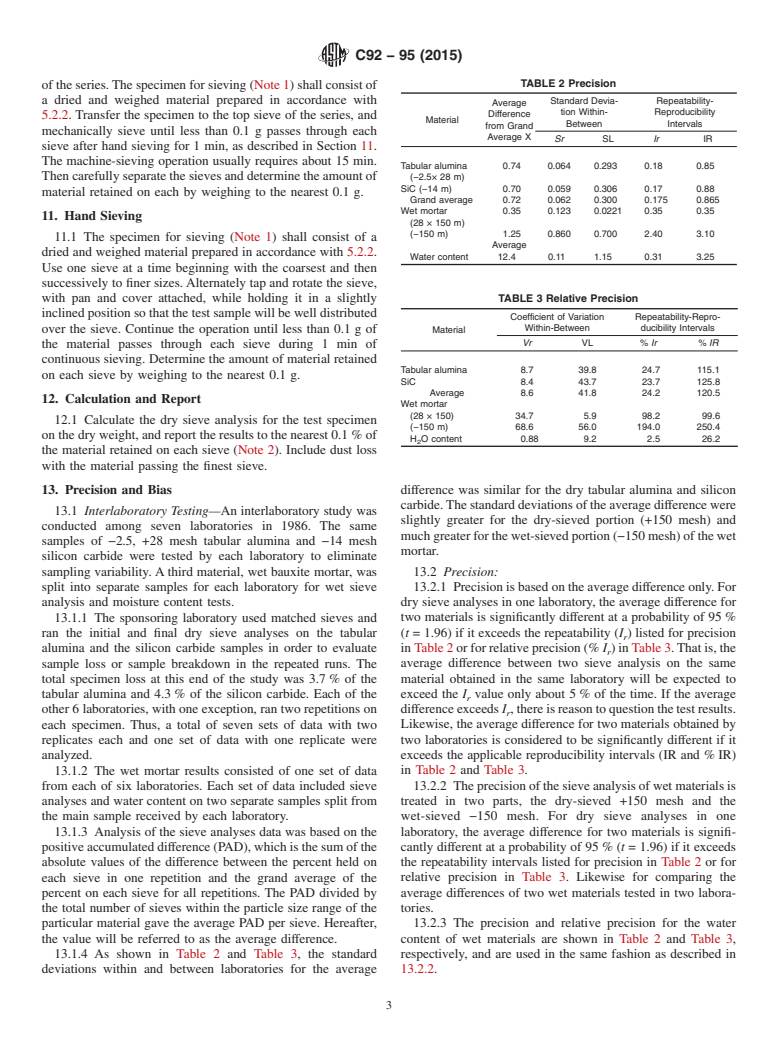
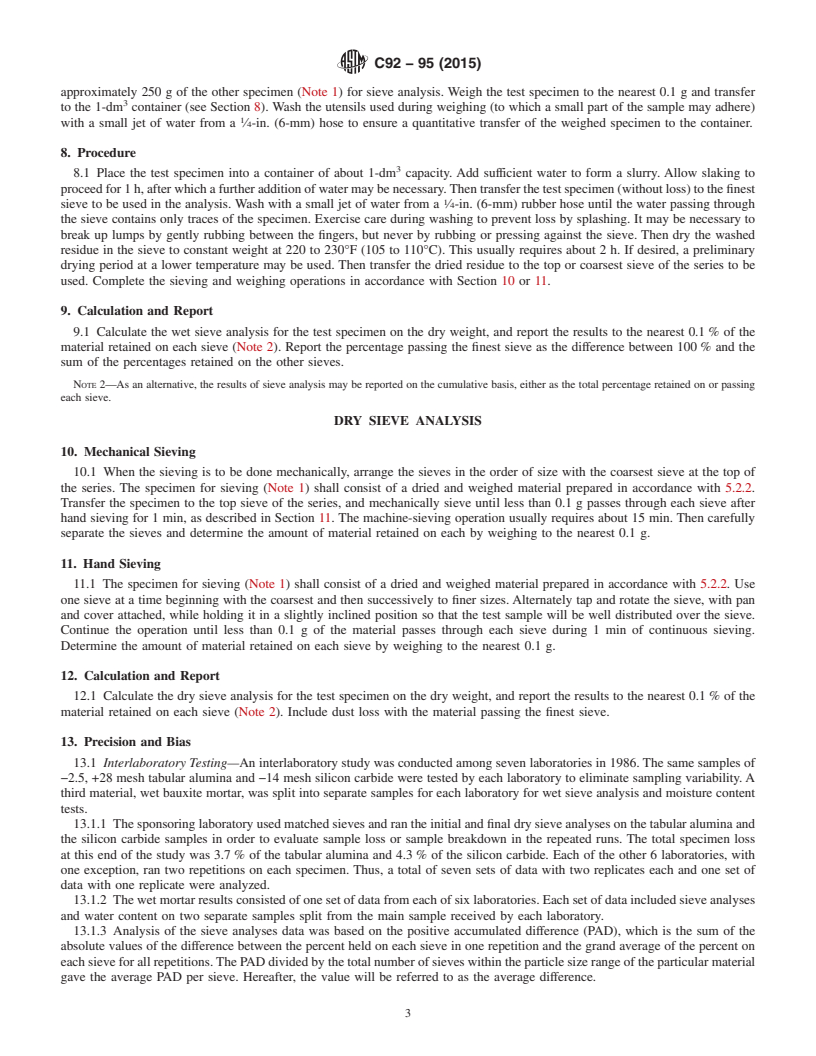
3.1 Particle size distribution has a major affect upon most of the refractory properties. These test methods provide a means of measuring the distribution for the purpose of comparison to the desired distribution.
3.2 These test methods also cover determination of the water content of refractory materials in the wet condition and of air-dried samples received, so that the sieve analysis can be calculated on the dry basis.
3.3 These methods can produce data for specification acceptance, design purposes, manufacturing control, and research and development.
3.4 A reference set of standard matched or calibrated sieves4 shall be provided for use in checking the set of sieves used in the actual sieve analysis of samples. The sieves for use in sieve analysis may also be standard matched sieves or may be unmatched sieves conforming to the Specification Table in Specification E11, provided that such sieves will give results that differ by no more than 5 % from those obtained with the reference set when the two sets are compared in accordance with the section of Test Method C429 on testing of sieves and samples splitters.
SCOPE
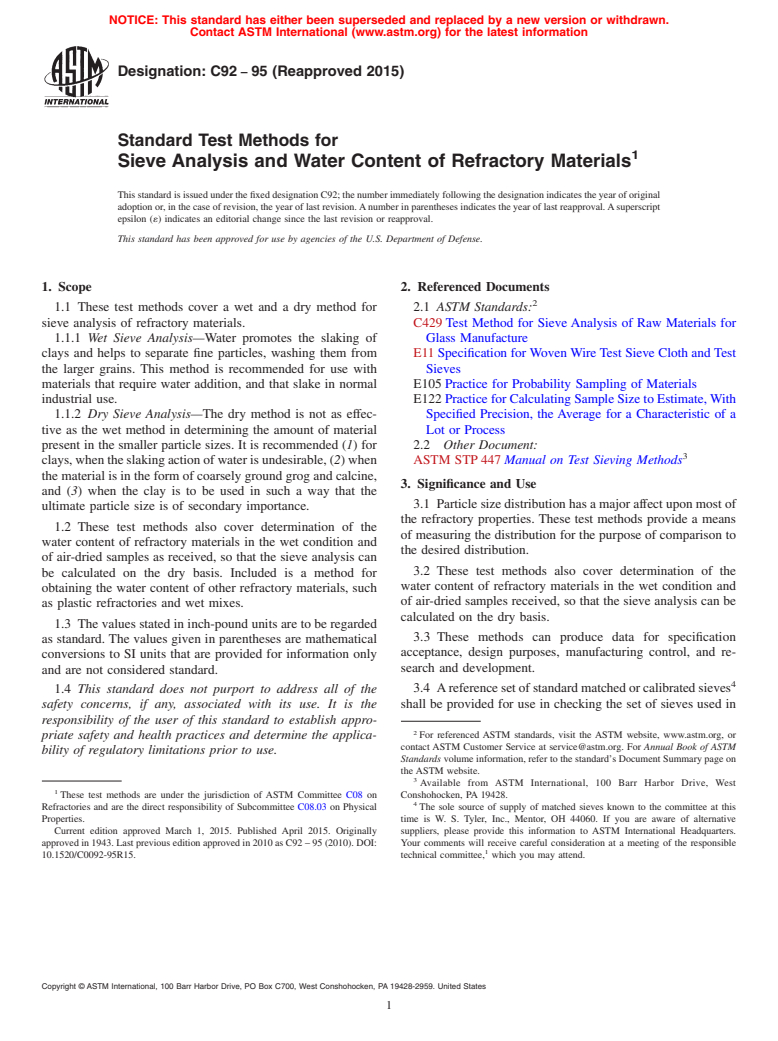
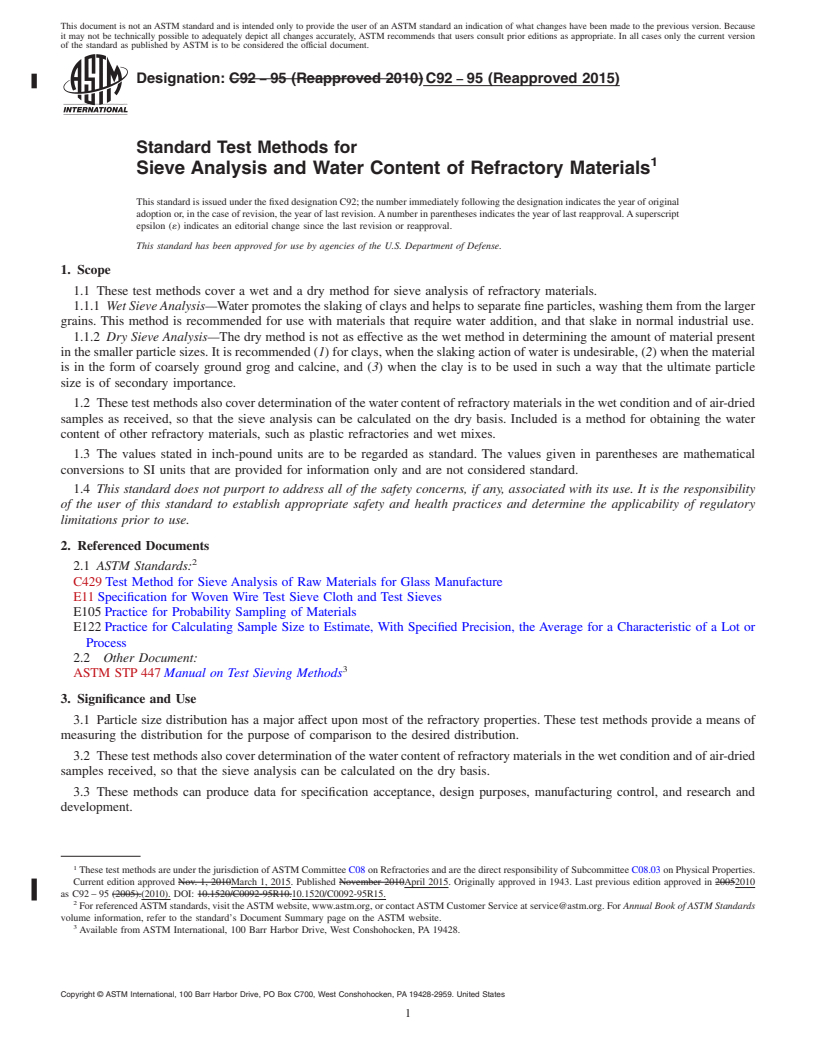
1.1 These test methods cover a wet and a dry method for sieve analysis of refractory materials.
1.1.1 Wet Sieve Analysis—Water promotes the slaking of clays and helps to separate fine particles, washing them from the larger grains. This method is recommended for use with materials that require water addition, and that slake in normal industrial use.
1.1.2 Dry Sieve Analysis—The dry method is not as effective as the wet method in determining the amount of material present in the smaller particle sizes. It is recommended (1) for clays, when the slaking action of water is undesirable, (2) when the material is in the form of coarsely ground grog and calcine, and (3) when the clay is to be used in such a way that the ultimate particle size is of secondary importance.
1.2 These test methods also cover determination of the water content of refractory materials in the wet condition and of air-dried samples as received, so that the sieve analysis can be calculated on the dry basis. Included is a method for obtaining the water content of other refractory materials, such as plastic refractories and wet mixes.
1.3 The values stated in inch-pound units are to be regarded as standard. The values given in parentheses are mathematical conversions to SI units that are provided for information only and are not considered standard.
1.4 This standard does not purport to address all of the safety concerns, if any, associated with its use. It is the responsibility of the user of this standard to establish appropriate safety and health practices and determine the applicability of regulatory limitations prior to use.
General Information
Buy Standard
Standards Content (Sample)
NOTICE: This standard has either been superseded and replaced by a new version or withdrawn.
Contact ASTM International (www.astm.org) for the latest information
Designation: C92 − 95 (Reapproved 2015)
Standard Test Methods for
Sieve Analysis and Water Content of Refractory Materials
ThisstandardisissuedunderthefixeddesignationC92;thenumberimmediatelyfollowingthedesignationindicatestheyearoforiginal
adoptionor,inthecaseofrevision,theyearoflastrevision.Anumberinparenthesesindicatestheyearoflastreapproval.Asuperscript
epsilon (´) indicates an editorial change since the last revision or reapproval.
This standard has been approved for use by agencies of the U.S. Department of Defense.
1. Scope 2. Referenced Documents
1.1 These test methods cover a wet and a dry method for 2.1 ASTM Standards:
sieve analysis of refractory materials. C429Test Method for Sieve Analysis of Raw Materials for
1.1.1 Wet Sieve Analysis—Water promotes the slaking of Glass Manufacture
clays and helps to separate fine particles, washing them from E11Specification forWovenWireTest Sieve Cloth andTest
the larger grains. This method is recommended for use with Sieves
materials that require water addition, and that slake in normal E105Practice for Probability Sampling of Materials
industrial use. E122PracticeforCalculatingSampleSizetoEstimate,With
1.1.2 Dry Sieve Analysis—The dry method is not as effec- Specified Precision, the Average for a Characteristic of a
tive as the wet method in determining the amount of material Lot or Process
present in the smaller particle sizes. It is recommended (1) for 2.2 Other Document:
clays,whentheslakingactionofwaterisundesirable,(2)when ASTM STP447Manual on Test Sieving Methods
thematerialisintheformofcoarselygroundgrogandcalcine,
3. Significance and Use
and (3) when the clay is to be used in such a way that the
3.1 Particlesizedistributionhasamajoraffectuponmostof
ultimate particle size is of secondary importance.
the refractory properties. These test methods provide a means
1.2 These test methods also cover determination of the
of measuring the distribution for the purpose of comparison to
water content of refractory materials in the wet condition and
the desired distribution.
of air-dried samples as received, so that the sieve analysis can
3.2 These test methods also cover determination of the
be calculated on the dry basis. Included is a method for
water content of refractory materials in the wet condition and
obtaining the water content of other refractory materials, such
of air-dried samples received, so that the sieve analysis can be
as plastic refractories and wet mixes.
calculated on the dry basis.
1.3 The values stated in inch-pound units are to be regarded
3.3 These methods can produce data for specification
as standard. The values given in parentheses are mathematical
acceptance, design purposes, manufacturing control, and re-
conversions to SI units that are provided for information only
search and development.
and are not considered standard.
3.4 Areferencesetofstandardmatchedorcalibratedsieves
1.4 This standard does not purport to address all of the
safety concerns, if any, associated with its use. It is the shall be provided for use in checking the set of sieves used in
responsibility of the user of this standard to establish appro-
priate safety and health practices and determine the applica- For referenced ASTM standards, visit the ASTM website, www.astm.org, or
contact ASTM Customer Service at service@astm.org. For Annual Book of ASTM
bility of regulatory limitations prior to use.
Standards volume information, refer to the standard’s Document Summary page on
the ASTM website.
Available from ASTM International, 100 Barr Harbor Drive, West
These test methods are under the jurisdiction of ASTM Committee C08 on Conshohocken, PA 19428.
Refractories and are the direct responsibility of Subcommittee C08.03 on Physical The sole source of supply of matched sieves known to the committee at this
Properties. time is W. S. Tyler, Inc., Mentor, OH 44060. If you are aware of alternative
Current edition approved March 1, 2015. Published April 2015. Originally suppliers, please provide this information to ASTM International Headquarters.
approvedin1943.Lastpreviouseditionapprovedin2010asC92–95(2010).DOI: Your comments will receive careful consideration at a meeting of the responsible
10.1520/C0092-95R15. technical committee, which you may attend.
Copyright © ASTM International, 100 Barr Harbor Drive, PO Box C700, West Conshohocken, PA 19428-2959. United States
C92 − 95 (2015)
theactualsieveanalysisofsamples.Thesievesforuseinsieve WET SIEVE ANALYSIS
analysis may also be standard matched sieves or may be
6. Dry Materials
unmatched sieves conforming to the Specification Table in
6.1 If the material is received in the dry condition, the test
Specification E11, provided that such sieves will give results
specimen (Note 1) shall consist of the dried and weighed test
that differ by no more than 5% from those obtained with the
specimen prepared in accordance with 5.2.2.
reference set when the two sets are compared in accordance
with the section of Test Method C429 on testing of sieves and
NOTE1—Thesizeofthetestspecimenmaybechangedbyreasonofthe
samples splitters.
nature of the material. For example, some clays tend to pack or cake on
the sieves when ground to exceedingly fine particle size, in which case a
4. Apparatus 100-g sample may be used. For plastic refractories or coarsely ground
mixes, the weight of the specimen could be increased to 500 g.
4.1 ASTM sieves, or the equivalent Tyler Series listed in
7. Wet Materials
Table 1, shall be used. The wire cloth for the sieves, described
inSpecificationE11,shallbewoven(nottwilled)andmounted
7.1 Materials prepared with water (plastic refractories, wet-
without distortion or looseness in 8-in. (200-mm) diameter
type high-temperature bonding mortars, etc.) shall be tested as
circular frames. Pans and covers shall be provided for the
received. Take two test specimens immediately after opening
sieves.
theoriginalcontainerand,inthecaseofmortars,aftercarefully
mixing the contents. Use one specimen for determining the
5. Sampling, Test Specimens, and Test Units
water content in accordance with either 5.2.1 or 5.2.2. Obtain
5.1 Arepresentativesampleofthematerialtobetestedshall approximately 250 g of the other specimen (Note 1) for sieve
weigh at least four to five times the required weight of the
analysis. Weigh the test specimen to the nearest 0.1 g and
actual test specimen. Material on which the water content is to transfer to the 1-dm container (see Section 8). Wash the
be determined shall be packed in a watertight container.
utensils used during weighing (to which a small part of the
sample may adhere) with a small jet of water from a ⁄4-in.
5.2 Water Content:
(6-mm) hose to ensure a quantitative transfer of the weighed
5.2.1 Wet-Type Air-Setting Refractory Mortars—Remove
specimen to the container.
approximately 50 g of the material immediately after opening
the original container and after carefully mixing the contents.
8. Procedure
To facilitate handling the specimen, place it on a tared piece of
8.1 Place the test specimen into a container of about 1-dm
waxed paper or aluminum weighing dish. Weigh the test
capacity.Addsufficientwatertoformaslurry.Allowslakingto
specimen to the nearest 0.1 g both before and after drying for
proceed for 1 h, after which a further addition of water may be
24 h at 220 to 230°F (105 to 110°C). Calculate the percentage
necessary.Then transfer the test specimen (without loss) to the
of water to the nearest 0.1% on the as-received basis.
finest sieve to be used in the analysis.Wash with a small jet of
5.2.2 MaterialsOtherThanWet-TypeAir-SettingRefractory
water froma ⁄4-in. (6-mm) rubber hose until the water passing
Mortars (ground fire clays, fireclay mortars, dry-type air-
through the sieve contains only traces of the specimen.
setting mortars, plastic refractories, and similar materials)—If
Exercise care during washing to prevent loss by splashing. It
the material is shipped in the wet condition, prevent loss of
maybenecessarytobreakuplumpsbygentlyrubbingbetween
waterbeforeobtainingatestspecimenofapproximately250g.
the fingers, but never by rubbing or pressing against the sieve.
Weigh the test specimen to the nearest 0.1 g both before and
Then dry the washed residue in the sieve to constant weight at
after drying for3hat220to 230°F (105 to 110°C). Calculate
220 to 230°F (105 to 110°C). This usually requires about 2 h.
the percentage of water to the nearest 0.1% on the as-received
If desired, a preliminary drying period at a lower temper
...
This document is not an ASTM standard and is intended only to provide the user of an ASTM standard an indication of what changes have been made to the previous version. Because
it may not be technically possible to adequately depict all changes accurately, ASTM recommends that users consult prior editions as appropriate. In all cases only the current version
of the standard as published by ASTM is to be considered the official document.
Designation: C92 − 95 (Reapproved 2010) C92 − 95 (Reapproved 2015)
Standard Test Methods for
Sieve Analysis and Water Content of Refractory Materials
This standard is issued under the fixed designation C92; the number immediately following the designation indicates the year of original
adoption or, in the case of revision, the year of last revision. A number in parentheses indicates the year of last reapproval. A superscript
epsilon (´) indicates an editorial change since the last revision or reapproval.
This standard has been approved for use by agencies of the U.S. Department of Defense.
1. Scope
1.1 These test methods cover a wet and a dry method for sieve analysis of refractory materials.
1.1.1 Wet Sieve Analysis—Water promotes the slaking of clays and helps to separate fine particles, washing them from the larger
grains. This method is recommended for use with materials that require water addition, and that slake in normal industrial use.
1.1.2 Dry Sieve Analysis—The dry method is not as effective as the wet method in determining the amount of material present
in the smaller particle sizes. It is recommended (1) for clays, when the slaking action of water is undesirable, (2) when the material
is in the form of coarsely ground grog and calcine, and (3) when the clay is to be used in such a way that the ultimate particle
size is of secondary importance.
1.2 These test methods also cover determination of the water content of refractory materials in the wet condition and of air-dried
samples as received, so that the sieve analysis can be calculated on the dry basis. Included is a method for obtaining the water
content of other refractory materials, such as plastic refractories and wet mixes.
1.3 The values stated in inch-pound units are to be regarded as standard. The values given in parentheses are mathematical
conversions to SI units that are provided for information only and are not considered standard.
1.4 This standard does not purport to address all of the safety concerns, if any, associated with its use. It is the responsibility
of the user of this standard to establish appropriate safety and health practices and determine the applicability of regulatory
limitations prior to use.
2. Referenced Documents
2.1 ASTM Standards:
C429 Test Method for Sieve Analysis of Raw Materials for Glass Manufacture
E11 Specification for Woven Wire Test Sieve Cloth and Test Sieves
E105 Practice for Probability Sampling of Materials
E122 Practice for Calculating Sample Size to Estimate, With Specified Precision, the Average for a Characteristic of a Lot or
Process
2.2 Other Document:
ASTM STP 447 Manual on Test Sieving Methods
3. Significance and Use
3.1 Particle size distribution has a major affect upon most of the refractory properties. These test methods provide a means of
measuring the distribution for the purpose of comparison to the desired distribution.
3.2 These test methods also cover determination of the water content of refractory materials in the wet condition and of air-dried
samples received, so that the sieve analysis can be calculated on the dry basis.
3.3 These methods can produce data for specification acceptance, design purposes, manufacturing control, and research and
development.
These test methods are under the jurisdiction of ASTM Committee C08 on Refractories and are the direct responsibility of Subcommittee C08.03 on Physical Properties.
Current edition approved Nov. 1, 2010March 1, 2015. Published November 2010April 2015. Originally approved in 1943. Last previous edition approved in 20052010
as C92 – 95 (2005).(2010). DOI: 10.1520/C0092-95R10.10.1520/C0092-95R15.
For referenced ASTM standards, visit the ASTM website, www.astm.org, or contact ASTM Customer Service at service@astm.org. For Annual Book of ASTM Standards
volume information, refer to the standard’s Document Summary page on the ASTM website.
Available from ASTM International, 100 Barr Harbor Drive, West Conshohocken, PA 19428.
Copyright © ASTM International, 100 Barr Harbor Drive, PO Box C700, West Conshohocken, PA 19428-2959. United States
C92 − 95 (2015)
3.4 A reference set of standard matched or calibrated sieves shall be provided for use in checking the set of sieves used in the
actual sieve analysis of samples. The sieves for use in sieve analysis may also be standard matched sieves or may be unmatched
sieves conforming to the Specification Table in Specification E11, provided that such sieves will give results that differ by no more
than 5 % from those obtained with the reference set when the two sets are compared in accordance with the section of Test Method
C429 on testing of sieves and samples splitters.
4. Apparatus
4.1 ASTM sieves, or the equivalent Tyler Series listed in Table 1, shall be used. The wire cloth for the sieves, described in
Specification E11, shall be woven (not twilled) and mounted without distortion or looseness in 8-in. (200-mm) diameter circular
frames. Pans and covers shall be provided for the sieves.
5. Sampling, Test Specimens, and Test Units
5.1 A representative sample of the material to be tested shall weigh at least four to five times the required weight of the actual
test specimen. Material on which the water content is to be determined shall be packed in a watertight container.
5.2 Water Content:
5.2.1 Wet-Type Air-Setting Refractory Mortars—Remove approximately 50 g of the material immediately after opening the
original container and after carefully mixing the contents. To facilitate handling the specimen, place it on a tared piece of waxed
paper or aluminum weighing dish. Weigh the test specimen to the nearest 0.1 g both before and after drying for 24 h at 220 to 230°F
(105 to 110°C). Calculate the percentage of water to the nearest 0.1 % on the as-received basis.
5.2.2 Materials Other Than Wet-Type Air-Setting Refractory Mortars (ground fire clays, fireclay mortars, dry-type air-setting
mortars, plastic refractories, and similar materials)—If the material is shipped in the wet condition, prevent loss of water before
obtaining a test specimen of approximately 250 g. Weigh the test specimen to the nearest 0.1 g both before and after drying for
3 h at 220 to 230°F (105 to 110°C). Calculate the percentage of water to the nearest 0.1 % on the as-received basis. The dried
specimen may be required for further tests (see Sections 6 and 7).
WET SIEVE ANALYSIS
6. Dry Materials
6.1 If the material is received in the dry condition, the test specimen (Note 1) shall consist of the dried and weighed test
specimen prepared in accordance with 5.2.2.
NOTE 1—The size of the test specimen may be changed by reason of the nature of the material. For example, some clays tend to pack or cake on the
sieves when ground to exceedingly fine particle size, in which case a 100-g sample may be used. For plastic refractories or coarsely ground mixes, the
weight of the specimen could be increased to 500 g.
7. Wet Materials
7.1 Materials prepared with water (plastic refractories, wet-type high-temperature bonding mortars, etc.) shall be tested as
received. Take two test specimens immediately after opening the original container and, in the case of mortars, after carefully
mixing the contents. Use one specimen for determining the water content in accordance with either 5.2.1 or 5.2.2. Obtain
The sole source of supply of matched sieves known to the committee at this time is W. S. Tyler, Inc., Mentor, OH 44060. If you are aware of alternative suppliers, please
provide this information to ASTM International Headquarters. Your comments will receive careful consideration at a meeting of the responsible technical committee, which
you may attend.
TABLE 1 ASTM Sieves and the Equivalent Tyler Standard Series
Tyler Standard Series
Sieve Opening
(Mesh Designation)
0.265 in. 3 6.7 mm
4 4 4.75 mm
6 6 3.35 mm
8 8 2.36 mm
12 10 1.70 mm
16 14 1.18 mm
20 20 850 μm
30 28 600 μm
40 35 425 μm
50 48 300 μm
70 65 212 μm
100 100 150 μm
140 150 106 μm
200 200 75 μm
C92 − 95 (2015)
approximately 250 g of the other specimen (Note 1) for sieve analysis. Weigh the test specimen to the nearest 0.1 g and transfer
to the 1-dm container (see Section 8). Wash the utensils used during weighing (to which a small part of the sample may adhere)
with a small jet of water from a ⁄4-in. (6-mm) hose to ensure a quantitative transfer of the weighed specimen to the container.
8. Procedure
8.1 Place the test specimen into a container of about 1-dm capacity. Add sufficient water to form a slurry. Allow slaking to
proceed for 1 h, after which a further addition of water may be necessary
...
Questions, Comments and Discussion
Ask us and Technical Secretary will try to provide an answer. You can facilitate discussion about the standard in here.