

ASTM D8303-20
(Test Method)Standard Test Method for Determining Thermal Cracking Properties of Asphalt Mixtures Through Measurement of Thermally Induced Stress and Strain
General Information
- Abstract
SIGNIFICANCE AND USE
5.1 The thermal strain measurements allow for the calculation of the coefficient of axial thermal contraction, which can be directly used in the mechanistic-empirical pavement design methods.
5.2 The thermal stress and strain measurements allow calculations of the modulus of asphalt mixture in the temperature domain.
5.3 From modulus versus temperature and thermal stress versus temperature relationships the thermal viscoelastic and fracture properties are determined for asphalt mixtures.
5.4 The derived modulus, thermal viscoelastic, and fracture properties may be used in evaluating the low-temperature cracking resistance of asphalt mixtures.
Note 1: The quality of the results produced by this standard are dependent on the competence of the personnel performing the procedure and the capability, calibration, and maintenance of the equipment used. Agencies that meet the criteria of Specification D3666 are generally considered capable of competent and objective testing, sampling, inspection, etc. Users of this standard are cautioned that compliance with Specification D3666 alone does not completely ensure reliable results. Reliable results depend on many factors; following the suggestions of Specification D3666 or some similar acceptable guideline provides a means of evaluating and controlling some of those factors.
SCOPE
1.1 This method of test is used to determine the thermal viscoelastic and thermal volumetric properties of field-cored or laboratory-compacted asphalt mixture specimens by measuring the thermally induced stress and strain while being cooled at a constant rate from an initial equilibrium temperature. The thermal stress and strain shall be measured using the uniaxial thermal stress and strain tester (UTSST).
1.2 This standard test method covers procedures for preparing and testing asphalt mixtures to measure thermal stress and strain and directly calculate: (1) the coefficient of axial thermal contraction, and (2) the modulus of asphalt mixture over a range of temperatures.
1.3 The procedure described in this standard provides required information for estimation of thermal cracking susceptibility of asphalt mixtures. The procedure applies to test specimens having a maximum aggregate size of 19 mm or less.
1.4 This standard can be used for conventional and nonconventional asphalt mixtures including but not limited to: hot asphalt mixtures, asphalt mixture with recycled materials, cold asphalt mixtures, warm asphalt mixtures, and neat or modified asphalt mixtures (for example, polymer or rubber-modified).
1.5 This standard can be used to determine the following:
1.5.1 Thermal stress buildup in asphalt mixture during a single cooling event.
1.5.2 Thermal strain in asphalt mixtures as a function of temperature.
1.5.3 Coefficient of axial thermal contraction.
1.5.4 Modulus of asphalt mixture as a function of temperature.
1.5.5 Thermal viscoelastic properties of asphalt mixture: viscous softening, viscous-glassy transition, glassy hardening, crack initiation, fracture temperature, and fracture stress.
1.5.6 UTSST cracking resistance index (CRI).
1.5.7 UTSST CRI adjusted for environmental condition (CRIEnv).
1.6 Units—The values stated in SI units are to be regarded as standard. No other units of measurement are included in this standard.
1.7 The text of this standard references notes and footnotes which provide explanatory material. These notes and footnotes (excluding those in tables and figures) shall not be considered as requirements of the standard.
1.8 This standard does not purport to address all of the safety concerns, if any, associated with its use. It is the responsibility of the user of this standard to establish appropriate safety, health, and environmental practices and determine the applicability of regulatory limitations prior to use.
1.9 This international standard was developed in accordance with internationally ...
- Status
- Published
- Publication Date
- 30-Jun-2020
- Technical Committee
- D04 - Road and Paving Materials
- Drafting Committee
- D04.26 - Fundamental/Mechanistic Tests
Overview
ASTM D8303-20: Standard Test Method for Determining Thermal Cracking Properties of Asphalt Mixtures Through Measurement of Thermally Induced Stress and Strain outlines a comprehensive procedure for evaluating the resistance of asphalt mixtures to thermal cracking. Developed by ASTM International, this test method addresses thermal viscoelastic and volumetric properties of both field-cored and laboratory-compacted asphalt specimens. Through controlled cooling and precise measurement of stress and strain, engineers and researchers can gain critical insights into how asphalt materials perform under low-temperature conditions, directly supporting mechanistic-empirical pavement design.
Key Topics
- Thermal Strain and Contraction: By measuring axial thermal strain, users can calculate the coefficient of axial thermal contraction, a key input for pavement design methods.
- Thermal Stress Development: Tracking thermal stress and strain enables calculation of the temperature-dependent modulus of asphalt mixtures.
- Thermal Viscoelastic Properties: The test identifies the stages of viscous softening, viscous-glassy transition, glassy hardening, as well as crack initiation and fracture behavior in asphalt.
- Modulus as a Function of Temperature: The procedure allows determination of asphalt mixture modulus across a spectrum of temperatures, vital for predicting performance and durability.
- Cracking Resistance Indices: ASTM D8303-20 enables calculation of the UTSST Cracking Resistance Index (CRI) and its adjustment for environmental conditions (CRIEnv).
- Specimen Flexibility: This standard accommodates various asphalt mixtures, including traditional hot mixes, cold mixes, recycled materials, polymer and rubber-modified asphalts, and others with a maximum aggregate size of 19 mm.
Applications
ASTM D8303-20 is primarily used to assess the low-temperature cracking resistance of asphalt pavement materials, making it highly relevant for:
- Pavement and Roadway Engineering: Integrates into mechanistic-empirical pavement design to predict performance and adjust mix designs for cold climates.
- Quality Control and Material Selection: Enables highway agencies, contractors, and material suppliers to evaluate and compare the thermal cracking susceptibility of different asphalt mixtures before placement.
- Forensic Analysis: Useful in post-construction evaluation of pavement distress related to thermal contraction and cracking.
- Research and Development: Supports the advancement of new asphalt technologies by providing quantitative measures of viscoelastic and fracture properties over a relevant temperature range.
- Sustainability Initiatives: Assesses performance of recycled or modified mixtures, helping to balance environmental considerations with durability.
Related Standards
The effectiveness and reliability of the ASTM D8303-20 method are closely linked with other essential standards in asphalt materials testing:
- ASTM D6925: Preparation and determination of relative density using the Superpave Gyratory Compactor.
- AASHTO R30: Procedures for mixture conditioning of hot mix asphalt.
- ASTM D2041/D2726: Methods for determining maximum theoretical and bulk specific gravity of asphalt mixtures.
- ASTM D979/D5361: Standards for sampling bituminous paving mixtures and compacted asphalt for laboratory testing.
- ASTM D3203: Test method for measuring air voids in compacted asphalt mixtures.
- ASTM D3549: Determining thickness and height of compacted mixture specimens.
- ASTM D3666: Minimum requirements for agencies testing and inspecting road paving materials - important for ensuring quality and competence in testing.
Summary
ASTM D8303-20 delivers a robust, standardized approach for measuring thermally induced stress and strain in asphalt mixtures, enabling better prediction and minimization of thermal cracking in pavements. Its implementation empowers engineers to make informed decisions on asphalt mix selection and design, enhancing pavement longevity and performance, especially in regions prone to low-temperature distress. Adherence to this and related standards ensures data reliability and supports advancements in sustainable, high-performing pavement materials.
Keywords: ASTM D8303-20, thermal cracking, asphalt mixture, pavement design, viscoelastic properties, modulus, low-temperature performance, UTSST, CRI, material testing standard.
Relations
- Effective Date
- 01-Dec-2023
- Effective Date
- 01-Nov-2023
- Effective Date
- 01-Nov-2023
- Effective Date
- 01-Nov-2023
- Effective Date
- 15-Mar-2020
- Effective Date
- 01-Aug-2019
- Effective Date
- 01-Jun-2019
- Effective Date
- 15-Dec-2018
- Effective Date
- 15-Aug-2018
- Effective Date
- 15-Aug-2018
- Effective Date
- 15-Aug-2018
- Effective Date
- 01-Jul-2018
- Effective Date
- 01-Feb-2018
- Effective Date
- 01-Oct-2017
- Effective Date
- 15-Jul-2017
Get Certified
Connect with accredited certification bodies for this standard

Zavod za gradbeništvo Slovenije (ZAG) - Inšpekcija
ZAG inspection body for construction products, structures, and materials.
Sponsored listings
Frequently Asked Questions
ASTM D8303-20 is a standard published by ASTM International. Its full title is "Standard Test Method for Determining Thermal Cracking Properties of Asphalt Mixtures Through Measurement of Thermally Induced Stress and Strain". This standard covers: SIGNIFICANCE AND USE 5.1 The thermal strain measurements allow for the calculation of the coefficient of axial thermal contraction, which can be directly used in the mechanistic-empirical pavement design methods. 5.2 The thermal stress and strain measurements allow calculations of the modulus of asphalt mixture in the temperature domain. 5.3 From modulus versus temperature and thermal stress versus temperature relationships the thermal viscoelastic and fracture properties are determined for asphalt mixtures. 5.4 The derived modulus, thermal viscoelastic, and fracture properties may be used in evaluating the low-temperature cracking resistance of asphalt mixtures. Note 1: The quality of the results produced by this standard are dependent on the competence of the personnel performing the procedure and the capability, calibration, and maintenance of the equipment used. Agencies that meet the criteria of Specification D3666 are generally considered capable of competent and objective testing, sampling, inspection, etc. Users of this standard are cautioned that compliance with Specification D3666 alone does not completely ensure reliable results. Reliable results depend on many factors; following the suggestions of Specification D3666 or some similar acceptable guideline provides a means of evaluating and controlling some of those factors. SCOPE 1.1 This method of test is used to determine the thermal viscoelastic and thermal volumetric properties of field-cored or laboratory-compacted asphalt mixture specimens by measuring the thermally induced stress and strain while being cooled at a constant rate from an initial equilibrium temperature. The thermal stress and strain shall be measured using the uniaxial thermal stress and strain tester (UTSST). 1.2 This standard test method covers procedures for preparing and testing asphalt mixtures to measure thermal stress and strain and directly calculate: (1) the coefficient of axial thermal contraction, and (2) the modulus of asphalt mixture over a range of temperatures. 1.3 The procedure described in this standard provides required information for estimation of thermal cracking susceptibility of asphalt mixtures. The procedure applies to test specimens having a maximum aggregate size of 19 mm or less. 1.4 This standard can be used for conventional and nonconventional asphalt mixtures including but not limited to: hot asphalt mixtures, asphalt mixture with recycled materials, cold asphalt mixtures, warm asphalt mixtures, and neat or modified asphalt mixtures (for example, polymer or rubber-modified). 1.5 This standard can be used to determine the following: 1.5.1 Thermal stress buildup in asphalt mixture during a single cooling event. 1.5.2 Thermal strain in asphalt mixtures as a function of temperature. 1.5.3 Coefficient of axial thermal contraction. 1.5.4 Modulus of asphalt mixture as a function of temperature. 1.5.5 Thermal viscoelastic properties of asphalt mixture: viscous softening, viscous-glassy transition, glassy hardening, crack initiation, fracture temperature, and fracture stress. 1.5.6 UTSST cracking resistance index (CRI). 1.5.7 UTSST CRI adjusted for environmental condition (CRIEnv). 1.6 Units—The values stated in SI units are to be regarded as standard. No other units of measurement are included in this standard. 1.7 The text of this standard references notes and footnotes which provide explanatory material. These notes and footnotes (excluding those in tables and figures) shall not be considered as requirements of the standard. 1.8 This standard does not purport to address all of the safety concerns, if any, associated with its use. It is the responsibility of the user of this standard to establish appropriate safety, health, and environmental practices and determine the applicability of regulatory limitations prior to use. 1.9 This international standard was developed in accordance with internationally ...
SIGNIFICANCE AND USE 5.1 The thermal strain measurements allow for the calculation of the coefficient of axial thermal contraction, which can be directly used in the mechanistic-empirical pavement design methods. 5.2 The thermal stress and strain measurements allow calculations of the modulus of asphalt mixture in the temperature domain. 5.3 From modulus versus temperature and thermal stress versus temperature relationships the thermal viscoelastic and fracture properties are determined for asphalt mixtures. 5.4 The derived modulus, thermal viscoelastic, and fracture properties may be used in evaluating the low-temperature cracking resistance of asphalt mixtures. Note 1: The quality of the results produced by this standard are dependent on the competence of the personnel performing the procedure and the capability, calibration, and maintenance of the equipment used. Agencies that meet the criteria of Specification D3666 are generally considered capable of competent and objective testing, sampling, inspection, etc. Users of this standard are cautioned that compliance with Specification D3666 alone does not completely ensure reliable results. Reliable results depend on many factors; following the suggestions of Specification D3666 or some similar acceptable guideline provides a means of evaluating and controlling some of those factors. SCOPE 1.1 This method of test is used to determine the thermal viscoelastic and thermal volumetric properties of field-cored or laboratory-compacted asphalt mixture specimens by measuring the thermally induced stress and strain while being cooled at a constant rate from an initial equilibrium temperature. The thermal stress and strain shall be measured using the uniaxial thermal stress and strain tester (UTSST). 1.2 This standard test method covers procedures for preparing and testing asphalt mixtures to measure thermal stress and strain and directly calculate: (1) the coefficient of axial thermal contraction, and (2) the modulus of asphalt mixture over a range of temperatures. 1.3 The procedure described in this standard provides required information for estimation of thermal cracking susceptibility of asphalt mixtures. The procedure applies to test specimens having a maximum aggregate size of 19 mm or less. 1.4 This standard can be used for conventional and nonconventional asphalt mixtures including but not limited to: hot asphalt mixtures, asphalt mixture with recycled materials, cold asphalt mixtures, warm asphalt mixtures, and neat or modified asphalt mixtures (for example, polymer or rubber-modified). 1.5 This standard can be used to determine the following: 1.5.1 Thermal stress buildup in asphalt mixture during a single cooling event. 1.5.2 Thermal strain in asphalt mixtures as a function of temperature. 1.5.3 Coefficient of axial thermal contraction. 1.5.4 Modulus of asphalt mixture as a function of temperature. 1.5.5 Thermal viscoelastic properties of asphalt mixture: viscous softening, viscous-glassy transition, glassy hardening, crack initiation, fracture temperature, and fracture stress. 1.5.6 UTSST cracking resistance index (CRI). 1.5.7 UTSST CRI adjusted for environmental condition (CRIEnv). 1.6 Units—The values stated in SI units are to be regarded as standard. No other units of measurement are included in this standard. 1.7 The text of this standard references notes and footnotes which provide explanatory material. These notes and footnotes (excluding those in tables and figures) shall not be considered as requirements of the standard. 1.8 This standard does not purport to address all of the safety concerns, if any, associated with its use. It is the responsibility of the user of this standard to establish appropriate safety, health, and environmental practices and determine the applicability of regulatory limitations prior to use. 1.9 This international standard was developed in accordance with internationally ...
ASTM D8303-20 is classified under the following ICS (International Classification for Standards) categories: 93.080.20 - Road construction materials. The ICS classification helps identify the subject area and facilitates finding related standards.
ASTM D8303-20 has the following relationships with other standards: It is inter standard links to ASTM D6925-23, ASTM D6752/D6752M-23, ASTM D8079-23, ASTM D6857/D6857M-23, ASTM D7981-20, ASTM D8-19, ASTM D2041/D2041M-19, ASTM D8-18c, ASTM D6752/D6752M-18, ASTM D6857/D6857M-18, ASTM D8-18b, ASTM D8-18a, ASTM D8-18, ASTM D3549/D3549M-17, ASTM D8-17c. Understanding these relationships helps ensure you are using the most current and applicable version of the standard.
ASTM D8303-20 is available in PDF format for immediate download after purchase. The document can be added to your cart and obtained through the secure checkout process. Digital delivery ensures instant access to the complete standard document.
Standards Content (Sample)
This international standard was developed in accordance with internationally recognized principles on standardization established in the Decision on Principles for the
Development of International Standards, Guides and Recommendations issued by the World Trade Organization Technical Barriers to Trade (TBT) Committee.
Designation: D8303 − 20
Standard Test Method for
Determining Thermal Cracking Properties of Asphalt
Mixtures Through Measurement of Thermally Induced
Stress and Strain
This standard is issued under the fixed designation D8303; the number immediately following the designation indicates the year of
original adoption or, in the case of revision, the year of last revision. A number in parentheses indicates the year of last reapproval. A
superscript epsilon (´) indicates an editorial change since the last revision or reapproval.
1. Scope 1.5.7 UTSST CRI adjusted for environmental condition
(CRI ).
Env
1.1 This method of test is used to determine the thermal
viscoelastic and thermal volumetric properties of field-cored or 1.6 Units—The values stated in SI units are to be regarded
laboratory-compactedasphaltmixturespecimensbymeasuring as standard. No other units of measurement are included in this
the thermally induced stress and strain while being cooled at a standard.
constant rate from an initial equilibrium temperature. The
1.7 The text of this standard references notes and footnotes
thermal stress and strain shall be measured using the uniaxial
which provide explanatory material.These notes and footnotes
thermal stress and strain tester (UTSST).
(excluding those in tables and figures) shall not be considered
1.2 This standard test method covers procedures for prepar- as requirements of the standard.
ing and testing asphalt mixtures to measure thermal stress and
1.8 This standard does not purport to address all of the
strain and directly calculate: (1) the coefficient of axial thermal
safety concerns, if any, associated with its use. It is the
contraction, and (2) the modulus of asphalt mixture over a
responsibility of the user of this standard to establish appro-
range of temperatures.
priate safety, health, and environmental practices and deter-
mine the applicability of regulatory limitations prior to use.
1.3 The procedure described in this standard provides re-
1.9 This international standard was developed in accor-
quired information for estimation of thermal cracking suscep-
dance with internationally recognized principles on standard-
tibility of asphalt mixtures. The procedure applies to test
ization established in the Decision on Principles for the
specimenshavingamaximumaggregatesizeof19 mmorless.
Development of International Standards, Guides and Recom-
1.4 This standard can be used for conventional and noncon-
mendations issued by the World Trade Organization Technical
ventional asphalt mixtures including but not limited to: hot
Barriers to Trade (TBT) Committee.
asphalt mixtures, asphalt mixture with recycled materials, cold
asphalt mixtures, warm asphalt mixtures, and neat or modified
2. Referenced Documents
asphalt mixtures (for example, polymer or rubber-modified).
2.1 ASTM Standards:
1.5 This standard can be used to determine the following:
A36/A36M Specification for Carbon Structural Steel
1.5.1 Thermal stress buildup in asphalt mixture during a
D8 Terminology Relating to Materials for Roads and Pave-
single cooling event.
ments
1.5.2 Thermal strain in asphalt mixtures as a function of
D979/D979M Practice for Sampling Bituminous Paving
temperature.
Mixtures
1.5.3 Coefficient of axial thermal contraction.
D2041/D2041M Test Method for Theoretical Maximum
1.5.4 Modulus of asphalt mixture as a function of tempera-
Specific Gravity and Density of Asphalt Mixtures
ture.
D2726/D2726M Test Method for Bulk Specific Gravity and
1.5.5 Thermal viscoelastic properties of asphalt mixture:
Density of Non-Absorptive Compacted Asphalt Mixtures
viscous softening, viscous-glassy transition, glassy hardening,
D3203/D3203M Test Method for PercentAir Voids in Com-
crack initiation, fracture temperature, and fracture stress.
pacted Asphalt Mixtures
1.5.6 UTSST cracking resistance index (CRI).
D3549/D3549M Test Method for Thickness or Height of
This test method is under the jurisdiction of ASTM Committee D04 on Road
and Paving Materials and is the direct responsibility of Subcommittee D04.26 on For referenced ASTM standards, visit the ASTM website, www.astm.org, or
Fundamental/Mechanistic Tests. contact ASTM Customer Service at service@astm.org. For Annual Book of ASTM
Current edition approved July 1, 2020. Published July 2020. DOI: 10.1520/ Standards volume information, refer to the standard’s Document Summary page on
D8303-20. the ASTM website.
Copyright © ASTM International, 100 Barr Harbor Drive, PO Box C700, West Conshohocken, PA 19428-2959. United States
D8303 − 20
Compacted Asphalt Mixture Specimens 3.2.9 initial starting temperature (°C), T ,
initial
D3665 Practice for Random Sampling of Construction Ma- n—temperature from which the test starts cooling the speci-
terials mens at a constant rate.
D3666 Specification for Minimum Requirements for Agen- 3.2.9.1 Discussion—The asphalt mixture specimens have to
cies Testing and Inspecting Road and Paving Materials be at thermal equilibrium at the initial starting temperature
D5361/D5361M Practice for Sampling Compacted Asphalt prior to the starting of the test.
Mixtures for Laboratory Testing
3.2.10 micro-crack, n—microscopic damage initiated at a
D6752/D6752M Test Method for Bulk Specific Gravity and
certain temperature in the restrained specimen while cooling,
Density of CompactedAsphalt Mixtures UsingAutomatic
which leads to macro-cracking and eventually the fracture of
Vacuum Sealing Method
the specimen.
D6857/D6857M Test Method for Maximum Specific Grav-
3.2.11 thermal viscoelastic properties, n—viscoelastic prop-
ity and Density of Asphalt Mixtures Using Automatic
erties of the asphalt mixture determined from the thermal
Vacuum Sealing Method
loadinghistory,includingtheviscoussoftening,viscous-glassy
D6925 Test Method for Preparation and Determination of
transition, glassy hardening, and crack initiation properties.
the Relative Density ofAsphalt Mix Specimens by Means
3.2.12 uniaxial thermal strain (mm/mm), ε(T ),
of the Superpave Gyratory Compactor
u
n—accumulated axial contraction strain induced in the unre-
D7981 Practice for Compaction of Prismatic Asphalt Speci-
strained specimen by decreasing the temperature from T
mens by Means of the Shear Box Compactor
initial
when the sample is free to contract axially.
D8079 Practice for Preparation of Compacted Slab Asphalt
Mix Samples Using a Segmented Rolling Compactor
3.2.13 uniaxial thermal stress (MPa), σ(T ),
r
F1684 Specification for Iron-Nickel and Iron-Nickel-Cobalt
n—accumulated axial tensile stress induced in the specimen by
Alloys for Low Thermal Expansion Applications
decreasing the temperature from T at a constant rate while
initial
2.2 AASHTO Standard:
maintaining the length of restrained specimen at the initial
R30 Practice for Mixture Conditioning of Hot Mix Asphalt
starting temperature length.
(HMA)
3.2.14 UTSST modulus (MPa), E (t, T), n—thetimeand
UTSST
temperature-dependent modulus of the asphalt mixture.
3. Terminology
3.2.14.1 Discussion—The modulus is determined using si-
3.1 Definitions—Fordefinitionsofgeneraltermsusedinthis
multaneous measures of thermal stress and strain resulting
standard, refer to Terminology D8.
from the same change in temperature.
3.2 Definitions of Terms Specific to This Standard:
3.2.15 viscous-glassy transition stage, n—at this stage the
3.2.1 coeffıcient of axial thermal contraction, α(T), n—the
glassy properties of the asphalt mixture overcome its viscous
fractional change in size in the axial direction associated with
properties.
a temperature change (/°C).
3.2.16 viscous softening stage, n—from this stage the relax-
3.2.2 cooling rate (°C/hour), n—constant rate at which the
ation modulus of the asphalt mixture increases rapidly, mostly
temperature of the asphalt mixture specimen decreases with
in a linear fashion, with decreases in temperature.
time during the test.
3.2.3 crack initiation stage, n—in this stage micro-cracks
4. Summary of Test Method
occurinthespecimenduetotheinducedthermalstresseswhen
4.1 This standard describes the procedure for determining
the asphalt mixture is characterized as glassy.
the thermal stress and thermal strain measurements from the
3.2.4 critical temperature (°C), T ,n—critical low
critical
axial restrained and axial unrestrained asphalt mixture
pavement temperature for a given project location.
specimens, respectively. The thermal stress and strain shall be
3.2.5 fracture stage, n—at this stage the asphalt mixture
determined using the uniaxial thermal stress and strain tester
specimen breaks due to the propagation of micro-cracks by the
(UTSST).
induced thermal stress.
4.2 Two cylindrical asphalt mixture specimens are cored or
3.2.5.1 Discussion—Identificationoffractureisindicatedby
cut (or both) from Superpave gyratory or shear box compacted
a significant reduction in the sustained load (25 % of the
specimens, or from field cores of specific dimensions.
maximum load or greater) or global fracture of the specimen.
4.2.1 The restrained specimen is restricted from axial con-
3.2.6 fracture stress (kPa), n—thermal tensile stress at
traction by fixing to platens of a test system and is enclosed
fracture stage of the restrained specimen.
within an environmental chamber.Asmall initial tensile load is
3.2.7 fracture temperature (°C), T ,n—temperature at applied to the specimen and the specimen is cooled at a given
fracture
temperature rate. The thermal contraction along the long axis
fracture stage of the restrained specimen.
of the specimen is monitored using linear variable displace-
3.2.8 glassy hardening stage, n—at this stage the behavior
menttransformers(LVDTs)orotheracceptabletransducer,and
of the asphalt mixture is considered glassy.
the initial length of the specimen is maintained by automatic
adjustment of the platens by the test system. The cooling
Available from American Association of State Highway and Transportation
process continues until tensile fracture of the restrained speci-
Officials (AASHTO), 444 N. Capitol St., NW, Suite 249, Washington, DC 20001,
http://www.transportation.org. men occurs.
D8303 − 20
4.2.2 Concurrently, an unrestrained specimen is set on a 5.2 The thermal stress and strain measurements allow cal-
nearly frictionless roller stand or oriented vertically while culations of the modulus of asphalt mixture in the temperature
maintaining zero load and contraction along the long axis of domain.
the specimen is recorded while cooling using LVDTs. The
5.3 From modulus versus temperature and thermal stress
unrestrained sample is made by gluing two cylindrical speci-
versus temperature relationships the thermal viscoelastic and
mens cored or cut (or both) from Superpave gyratory or shear
fracture properties are determined for asphalt mixtures.
box compacted specimens or field core specimens.
5.4 The derived modulus, thermal viscoelastic, and fracture
4.3 The induced strain measured data are used to determine
properties may be used in evaluating the low-temperature
the coefficient of axial thermal contraction.
cracking resistance of asphalt mixtures.
4.4 The induced thermal stress and strain measured data are
NOTE 1—The quality of the results produced by this standard are
combined to determine the modulus of asphalt mixture, and to
dependent on the competence of the personnel performing the procedure
characterize the thermal viscoelastic properties of the asphalt
and the capability, calibration, and maintenance of the equipment used.
Agencies that meet the criteria of Specification D3666 are generally
mixture at different stages of the material behavior.
considered capable of competent and objective testing, sampling,
4.5 The thermal strain is determined by measuring the
inspection, etc. Users of this standard are cautioned that compliance with
uniaxial deformation from an asphalt mixture specimen during
Specification D3666 alone does not completely ensure reliable results.
Reliable results depend on many factors; following the suggestions of
cooling from an initial equilibrium temperature while it is free
Specification D3666 or some similar acceptable guideline provides a
to contract without any restraint in a nearly frictionless
means of evaluating and controlling some of those factors.
apparatus.
4.6 The modulus is determined from the concurrent mea-
6. Apparatus
sured data of thermal stress and strain data from restrained and
6.1 Uniaxial Thermal Stress and Strain Tester (UTSST)—A
unrestrained asphalt mixture specimens, respectively.
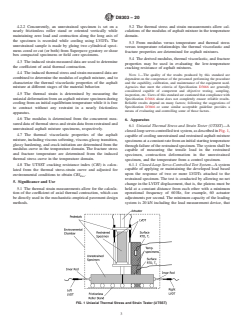
closed-loopservo-controlledtestsystem,asdescribedinFig.1,
4.7 The thermal viscoelastic properties of the asphalt
capable of cooling unrestrained and restrained asphalt mixture
mixture, including viscous softening, viscous-glassy transition,
specimensataconstantratefromaninitialstartingtemperature
glassy hardening, and crack initiation are determined from the
through failure of the restrained specimen.The system shall be
modulus curve in the temperature domain. The fracture stress
capable of measuring the tensile load in the restrained
and fracture temperature are determined from the induced
specimen, contraction deformation in the unrestrained
thermal stress curve in the temperature domain.
specimen, and the temperature from a control specimen.
6.1.1 Closed-Loop Servo-Controlled Test System—Asystem
4.8 The UTSST cracking resistance index (CRI) is calcu-
capable of applying or maintaining the developed load based
lated from the thermal stress-strain curve and adjusted for
upon the response of two or more LVDTs attached to the
environmental conditions to obtain CRI .
Env
restrained specimen. The test is conducted by allowing no net
5. Significance and Use
change in the LVDT displacement, that is, the platens must be
held at a constant distance from each other with a minimum
5.1 The thermal strain measurements allow for the calcula-
tion of the coefficient of axial thermal contraction, which can operational frequency of 60 Hz, for example, 60 actuator
adjustments per second. The minimum capacity of the loading
be directly used in the mechanistic-empirical pavement design
methods. system is 20 kN including the load measurement device, that
FIG. 1 Uniaxial Thermal Stress and Strain Tester (UTSST)
D8303 − 20
is,loadcellandanyattachmentandconnectionfixturessuchas 6.5.2 Each platen shall also have a pedestal approximately
described in 6.1. The measurements of the LVDTs within the 5 mminheightandthesamediameterasthespecimenoriented
environmental chamber must be corrected to remove the along the central axis of the platen that will be used as a
influence of the temperature change, whether electrical, physical aid in aligning the restrained specimen during the
mechanical, or a combination of both. This correction can be gluing operations. The pedestal shall be machined along with
waived if the thermal influence has been verified and recorded the platen and not be a separate component.
to remain within the accuracy limits of 6.3.
6.6 Environmental Chamber—The environmental chamber
NOTE 2—It has been found beneficial to include a safety mechanism shall be large enough to include the testing fixture described in
within the control system to limit the movement of actuator following
the test method and equipped with temperature conditioners
global failure of the restrained specimen to prevent damage of the
andcontrolscapableofmaintainingatesttemperaturebetween
restrained LVDTs. This mechanism may operate by any number of
30 °C and at least –50 °C inside the chamber with a predefined
processes, but the intent is to prevent undesired movement of the actuator
constant rate for cooling.
if the restrained specimen exhibits global fracture and moves far enough
for the control LVDTs to lose contact with the connecting rods. Examples
6.7 Cooling/Heating System—A cooling/heating system ca-
of such features may include limit switches on the magnitude of the
pable of applying temperatures as high as 30 °C and as low as
restrained LVDTs, actuator movement, substantial drop in tensile loads
(for example, 75 %), or development of compressive loads in the –50 °C at a constant rate up to 20 °C⁄h is required. Air flow
restrained specimen.
cooling systems may be utilized for this purpose.
6.2 Load Measurement—Load levels are to be measured
6.8 Thermally Stable Rods—Rods made of invar (conform-
using a load cell with a resolution of 0.01 kN and an accuracy
ing to Specification F1684) or other equivalent material (for
of 0.02 kN or smaller, or equivalent load measurement device.
example, certain ceramics) with similarly low coefficient of
6.3 Deformation Measurements—The deformation of the thermal expansion and contraction of sufficient geometry to
restrained and unrestrained samples can be measured by linear permit the necessary measurement and subsequent restraint of
variable displacement transducers (LVDTs) or other suitable the asphalt mixture specimen.
devices with a minimum range of 0.5 mm. The resolution and
6.8.1 For the restrained specimen, each LVDT requires one
accuracy of the LVDTs or other device must be at least
rod of sufficient length to span the distance between the two
0.01 mm and 0.02 mm, respectively.
restrained specimen platens with a specimen glued in place,
less a space of 20 mm 6 5 mm to permit room for the control
6.4 Temperature Measurement—The temperature measure-
LVDTs.
ment and control is done using surface-mounted resistance
6.8.2 The unrestrained specimen requires one rod for each
temperature detectors (RTDs) or other suitable devices with a
of the two LVDTs of sufficient geometry to permit physical
calibrated range of at least 30 °C to –50 °C with resolution of
connection between the unrestrained specimen and the unre-
0.1 °Candaccuracyof0.2 °Cwhichhavebeeninstalledonthe
strained LVDTs, which may depend upon the test configura-
temperature or dummy specimens in accordance with the
tion.
manufacturer’s recommendations.
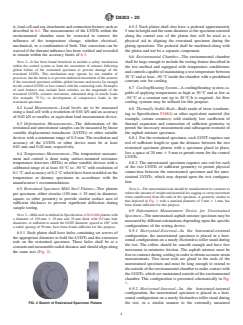
6.5 Restrained Specimen Mild Steel Platens—Two platens NOTE 4—The unrestrained rods should be manufactured in a manner to
reduce the amount of weight and potential for sagging or creep movement
per specimen, either circular (150 mm 6 25 mm) in diameter,
when cantilevered from the ends of the specimen. A geometry similar to
square, or other geometry to provide similar surface area of
that depicted in Fig. 1, with a nominal diameter of 5 mm 6 1 mm, has
sufficient thickness to prevent significant deflection during
been found sufficient for this purpose.
sample testing.
6.9 Deformation Measurement Device for Unrestrained
NOTE 3—Mild steel as defined in Specification A36/A36M platens with
Specimen—The unrestrained asphalt mixture specimen may be
a diameter of 150 mm 6 25 mm and 25 mm thick with 9.5 mm hole
measured by different orientations depending upon the specific
diameters, or sufficient to match the LVDT diameter, spaced at 120° with
configurations of the testing device.
a radial spacing of 50 mm, have been found sufficient for this purpose.
6.9.1 Horizontal-External—In the horizontal-external
6.5.1 Each platen shall have holes containing set screws of
configuration, the unrestrained specimen is placed in a hori-
the appropriate diameter to hold the LVDTs and the extension
zontal configuration on a nearly frictionless roller stand during
rods on the restrained specimen. These holes shall be at a
the test. The rollers should be smooth enough and have free
constant and measurable radial distance and should align along
movement to minimize friction. The asphalt mixture must be
the same axis (Fig. 2).
freetocontractduringcoolinginordertoobtainaccuratestrain
measurements. Two invar rods are glued to the ends of the
unrestrained specimen and must be long enough to extend to
the outside of the environmental chamber to make contact with
the LVDTs, which are maintained outside of the environmental
chamber. This configuration is presented schematically in Fig.
1.
6.9.2 Horizontal-Internal—In the horizontal-internal
configuration, the unrestrained specimen is placed in a hori-
zontal configuration on a nearly frictionless roller stand during
FIG. 2 Sketch of Restrained Specimen Platens the test, in a similar manner to the externally measured
D8303 − 20
specimen. However, the measurement LVDTs and correspond-
ing attachment configurations may vary with equipment geom-
etry. The inclusion of the measurement LVDTs within the
environmentalchamberrequiresthesamethermalcorrectionof
the LVDTs as in 6.1.1.
6.9.3 Vertical-Internal—In the vertical-internal
configuration, a single unrestrained specimen is oriented in a
vertical configuration, but is still unrestrained from thermal
contraction and should be permitted to move without restric-
tion. Although specific connections and configurations may
varybydevice,anexampleoftheorientationisdepictedbythe
restrained specimen presented in Fig. 1. However, the actuator
may not restrict the thermal contraction of the CTC specimen,
but such displacement shall be measured between the end
plates and the LVDT extension rods as depicted in 11.2. With
FIG. 3 Schematic Diagram of a Specimen Alignment Stand for the
the LVDTs contained within the environmental chamber, the
Restrained Specimen
same correction in 6.1.1 applies.
NOTE 5—In addition to the LVDT thermal correction in 6.1.1,a
physical correction may be required to ensure that any fixtures are not
6.12 Square—Precision square with a minimum 100 mm
applying a force to the top end of the unrestrained specimen. Given the
beam and 150 mm blade.
potential for varied configurations and designs, no specific corrections can
be specified.
NOTE 10—McMaster Carr, High Accuracy Square, Catalog Number
NOTE 6—Additional corrections should be included to account for the
2278A14 (www.mcmaster.com/#layout-squares/=15s569r) or equivalent
influence of gravitational forces adding to the thermal contraction of the
has been found satisfactory for this purpose.
vertically oriented specimen.
NOTE7—Certaintestingdevicesmaynothavesufficientspacetopermit
6.13 Carbon Steel Wires—Two carbon steel wires, 1.0 mm
the usage of two end-to-end samples for the unrestrained specimens.Thus
and 0.5 mm diameters, with a nominal length of 50 mm or
a single sample may be used, provided the configuration includes
longer.
sufficient accuracy in the displacement measurement and has been
determined to not influence the final CTC determination compared to
NOTE 11—McMaster Carr, Catalog Numbers 8907K42 and 8907K21 or
either of the horizontal unrestrained orientations.
equivalent, respectively, have been found satisfactory for this purpose.
6.10 Data Acquisition System—The data acquisition system
6.14 Scale or Balance—Scale or balance as necessary for
shall be used to record the developed load in the restrained
Test Method D2041/D2041M, D2726/D2726M, D3203/
specimen, contraction deformation of unrestrained specimen,
D3203M, D6752/D6752M,or D6857/D6857M, which shall
and the temperature of a control specimen over the duration of
also be used to measure out epoxy proportions.
the test.
6.15 Miscellaneous Apparatus—Spatula (for proportioning
6.11 Specimen Alignment Stand—A device capable of pro-
and mixing epoxy components), metals pans, masking tape,
viding concentric and perpendicular alignment of the platens/
and gloves.
screw holes and restraining the specimen within axial align-
ment of the platen while the epoxy cures.
7. Reagents and Materials
6.11.1 The alignment stand for the restrained specimen
7.1 Epoxy—An epoxy with similar thermal properties (co-
should rigidly affix the platens parallel and concentric to each
efficient of thermal contraction) to asphalt mixtures and ad-
other and permit the distance between the platens to be readily
equate adhesive properties at a temperature range of 30 °C to
adjusted. The stand should also provide adjustable support to
–50 °C is needed in several portions of the specimen prepara-
retain the specimen once it is concentrically aligned with the
tion.
platens. It should also be capable of applying a small load or
NOTE 12—Devcon Plastic Steel Putty (A) 10110 has been found
weight to the top platen to ensure complete contact and aid in
satisfactory for this purpose, but is covered by a patent. Interested parties
bonding of the epoxy.
are invited to submit information regarding the identification of an
alternative(s) to this patented item to ASTM International Headquarters.
NOTE 8—Fig. 3 presents an example of a device that has been found
Your comments will receive careful consideration at a meeting of the
satisfactory for gluing the restrained specimen.
responsible technical committee, which you may attend.
6.11.2 The alignment stand for the unrestrained specimen
7.2 Miscellaneous Materials—240 grit sandpaper, masking
shallbecapableofrestrainingthespecimensandtheinvarrods
or painter’s tape, and acetone or other degreaser.
in axial alignment with each other. While being restrained, the
specimens and the invar rods shall be compressed under a
8. Hazards
small load or weight to permit the adequate bonding of all
epoxied surfaces, but not so large as to deform or damage the 8.1 Follow the safety requirements listed in the manufactur-
er’s safety information sheet when using epoxy and acetone.
specimens.
8.2 Portions of this test method include temperatures well
NOTE 9—Fig. 4 presents an example of a device that has been found
satisfactory for gluing the unrestrained specimen. below freezing. Exposure to low temperatures, whether in
D8303 − 20
FIG. 4 Schematic Specimen Alignment Stand for the Unrestrained Specimen
direct contact or not, may cause burns or other health risks. 9.4 Coring of Test Specimens—Obtain the test specimens by
Appropriate personal protective equipment (PPE) is recom- laying the sample, either SGC sample or field core, on its side
mended. and core the test specimen 90° from the axis of compaction
with a suitable coring operation to produce test specimens
9. Test Specimens
meeting the geometry requirements outlined in this section.
Depending on the nominal maximum aggregate size (NMAS)
9.1 Laboratory Mixed Laboratory Compacted Asphalt Mix-
of the mixture, the cored specimens, after side-coring, shall be
ture Specimens—Mix and compact the asphalt mixture speci-
57 mm 6 5 mm in diameter for 19 mm NMAS mixtures and
mens according to Test Method D6925 using the 150 mm
45 mm 6 5 mm in diameter for 12.5 mm or smaller NMAS
diameter molds or other means of compaction described in
mixtures, respectively. However, the 57 mm samples may be
Practices D7981 and D8079 to obtain test specimens. Follow
used for 12.5 mm or smaller NMAS mixtures as well.
the short-term and long-term aging recommendations of
9.4.1 Trim the length of the side-cut cores using a suitable
AASHTO Practice R 30 for mixture mechanical testing.
trimming device so that the ends of the sample are as
Specimens should be compacted to obtain a target air void
perpendicular as possible to the sides. The length of the
level 60.5 % after trimming to the final dimensions as deter-
specimens shall be as long as possible, but sufficient to remove
mined by Test Method D3549/D3549M.
the curvature from the original sample geometry, as applicable
9.2 Plant Mixed Laboratory Compacted Asphalt Mixture
to cores or Superpave gyratory samples.The final length of the
Specimens—Obtain the asphalt mixture samples in accordance
test specimens should be no shorter than 132 mm.
with Practice D979/D979M. Reduce the sample to the appro-
9.4.2 Using the blade of the precision square as a
priate specimen sizes according to Practice D5361/D5361M.
straightedge, check the flatness of each end at three locations
Follow the applicable section of Test Method D6925 to
approximately 120° apart. At each location, place the blade of
compact the specimens using the 150 mm diameter molds or
the precision square across the diameter of the specimen and
other means of compaction described in Practices D7981 and
check the maximum departure of the specimen from the blade
D8079 to obtain test specimens. Follow long-term aging
using the 0.5 mm diameter carbon steel wire. Reject specimens
recommendations of AASHTO Practice R 30 for mixture
if the 0.5 mm diameter carbon steel wire fits between the blade
mechanical testing. Specimens should be compacted to obtain
and the specimen at any location.
a target air void level 60.5 % after trimming to the final
9.4.3 Check the perpendicularity of each end of the speci-
dimensions as determined by Test Method D3549/D3549M.
men using the precision square and the 1.0 mm carbon steel
9.3 Plant Mixed Field Compacted Asphalt Mixture wire at two locations approximately 90° apart. Place the
Specimens—Obtain field cores in accordance with Practice precision square on a table with the beam in contact with the
D979/D979M, to obtain core samples nominally 150 mm in table and the blade extending vertically. Place the long axis of
diameter and thick enough to core UTSST specimen from the the specimen on the beam such that the blade is in contact with
layer of interest. Take care to prevent deformation or other the end of the specimen. Check the maximum departure of the
disturbance of the samples during storage and transport to the specimen from the blade using the 1.0 mm diameter carbon
testing location. When the samples are taken from existing steel wire. Reject specimens if the 1.0 mm diameter carbon
pavement, obtain them in accordance with Practice D3665, steel wire fits between the blade and the specimen at any
unless specific locations are under investigation. location.
D8303 − 20
9.5 Bulk Specific Gravity—Determine the bulk specific straight line of epoxy on the sample after gluing. It is
gravity according to Test Method D2726/D2726M or D6752/ recommended to leave a small tab of the tape wrapped back
D6752M and the corresponding air voids in accordance with upon itself to aid in removal of the tape with minimal
Test Method D3203/D3203M, making use of Test Method disturbance of the sample prior the epoxy setting.
D2041/D2041M or D6857/D6857M.
10.2 Epoxy Preparation—Follow the mixing,
9.6 Drying of the Specimens—Ensure the specimens are dry
proportioning, applying, and curing instructions supplied by
from appreciable moisture after the specific gravity determina-
the manufacturer for the epoxy being used.
tionseitherbyairdryinginfrontofhigh-outputfansforseveral
NOTE 13—If Devcon Pla
...