

ASTM E2309/E2309M-20
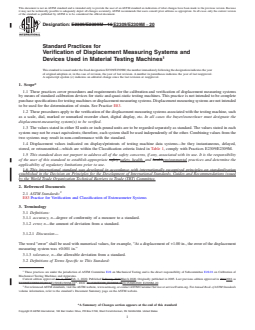
(Practice)Standard Practices for Verification of Displacement Measuring Systems and Devices Used in Material Testing Machines
General Information
- Abstract
SIGNIFICANCE AND USE
4.1 Testing machines that apply and measure displacement are used in many industries. They may be used in research laboratories to determine material properties, and in production lines to qualify products for shipment. The displacement measuring devices integral to the testing machines may be used for measurement of crosshead or actuator displacement over a defined range of operation. The accuracy of the displacement value shall be traceable to the National Institute of Standards and Technology (NIST) or another recognized National Laboratory. Practices E2309 provides a procedure to verify these machines and systems, in order that the measured displacement values may be traceable. A key element to having traceability is that the devices used in the verification produce known displacement characteristics, and have been calibrated in accordance with adequate calibration standards.
SCOPE
1.1 These practices cover procedures and requirements for the calibration and verification of displacement measuring systems by means of standard calibration devices for static and quasi-static testing machines. This practice is not intended to be complete purchase specifications for testing machines or displacement measuring systems. Displacement measuring systems are not intended to be used for the determination of strain. See Practice E83.
1.2 These procedures apply to the verification of the displacement measuring systems associated with the testing machine, such as a scale, dial, marked or unmarked recorder chart, digital display, etc. In all cases the buyer/owner/user must designate the displacement-measuring system(s) to be verified.
1.3 The values stated in either SI units or inch-pound units are to be regarded separately as standard. The values stated in each system may not be exact equivalents; therefore, each system shall be used independently of the other. Combining values from the two systems may result in non-conformance with the standard.
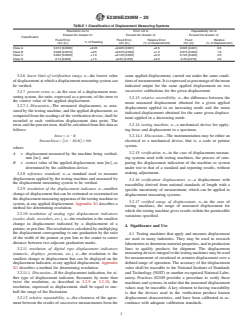
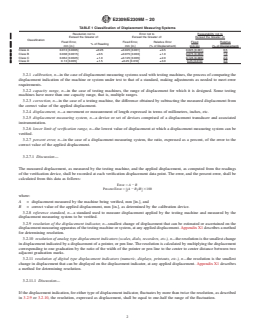
1.4 Displacement values indicated on displays/printouts of testing machine data systems—be they instantaneous, delayed, stored, or retransmitted—which are within the Classification criteria listed in Table 1, comply with Practices E2309/E2309M.
1.5 This standard does not purport to address all of the safety concerns, if any, associated with its use. It is the responsibility of the user of this standard to establish appropriate safety, health, and environmental practices and determine the applicability of regulatory limitations prior to use.
1.6 This international standard was developed in accordance with internationally recognized principles on standardization established in the Decision on Principles for the Development of International Standards, Guides and Recommendations issued by the World Trade Organization Technical Barriers to Trade (TBT) Committee.
- Status
- Published
- Publication Date
- 31-Jan-2020
- Technical Committee
- E28 - Mechanical Testing
- Drafting Committee
- E28.01 - Calibration of Mechanical Testing Machines and Apparatus
Buy Documents
ASTM E2309/E2309M-20 - Standard Practices for Verification of Displacement Measuring Systems and Devices Used in Material Testing Machines
REDLINE ASTM E2309/E2309M-20 - Standard Practices for Verification of Displacement Measuring Systems and Devices Used in Material Testing Machines
Overview
ASTM E2309/E2309M-20: Standard Practices for Verification of Displacement Measuring Systems and Devices Used in Material Testing Machines is an international standard developed by ASTM International. This standard specifies procedures and requirements for calibrating and verifying displacement measuring systems-integral components in material testing machines-using standard calibration devices. It ensures that measured displacement values are traceable to national standards, such as those provided by the National Institute of Standards and Technology (NIST), supporting precision in both research and industrial settings.
Displacement measurement is vital for the determination of mechanical properties and for quality control in manufacturing processes. This standard provides a framework for consistent, reliable verification, helping maintain quality assurance and regulatory compliance in material testing operations.
Key Topics
- Calibration and Verification Procedures: The standard outlines methods for calibrating and verifying displacement measuring systems, including preparation, alignment, and temperature stabilization steps.
- Traceability Requirements: Displacement measurements must be traceable to recognized national laboratories, ensuring international measurement consistency.
- Classification Criteria: The standard defines classification levels (A, B, C, D) for displacement measuring systems based on accuracy, repeatability, and error limits.
- System Verification: Full-system verification is required, rather than testing components separately. Verification procedures must be documented and reported clearly.
- Measurement Uncertainty: The standard addresses the assessment of measurement uncertainty, including components from calibration laboratories, repeatability, and indicator resolution.
- Reporting Requirements: Specifies the minimum information required in verification reports, including device details, verification methods, temperature, and error analysis.
Applications
ASTM E2309/E2309M-20 is widely used in industries where material testing machines play a critical role, such as:
- Manufacturing and Quality Control: Ensures displacement measurements used for product qualification on production lines are accurate and traceable.
- Research Laboratories: Supports experimental testing where precise determination of material properties, such as deformation and displacement, is essential.
- Calibration Laboratories: Provides guidelines for verifying displacement measuring devices and systems, maintaining compliance with industry standards.
- Regulatory Compliance: Assists organizations in meeting national and international quality standards for displacement measurement in testing machines.
The standard applies to various types of displacement measuring readouts, including scales, dials, recorder charts (marked or unmarked), and digital displays. It is crucial for static and quasi-static testing machines but does not cover displacement measurements used specifically for strain determination (see ASTM E83 instead).
Related Standards
- ASTM E83 – Practice for Verification and Classification of Extensometer Systems: Focused on systems used to determine strain, referenced for clarification by E2309/E2309M.
- ASTM E4 – Practices for Force Verification of Testing Machines: Addresses force measurement, complementing the displacement focus of E2309/E2309M.
- ISO/IEC 17025 – General requirements for the competence of testing and calibration laboratories: Relevant for laboratories performing verifications in line with E2309/E2309M.
By following ASTM E2309/E2309M-20, organizations ensure the reliability and traceability of displacement measurements in material testing, supporting both quality assurance and compliance with rigorous industry standards.
Keywords: displacement measuring systems, material testing machines, verification, calibration, ASTM E2309, traceability, resolution, measurement accuracy, repeatability, quality control.
Relations
- Effective Date
- 01-Feb-2020
- Effective Date
- 01-Jun-2010
- Effective Date
- 01-Jan-2010
- Effective Date
- 01-May-2006
- Effective Date
- 10-Jun-2002
- Effective Date
- 10-Dec-2000
- Referred By
ASTM E2969-18 - Standard Test Methods for Transverse Load Tests on Panels Used in Wall Construction - Effective Date
- 01-Feb-2020
- Referred By
ASTM D5652-21 - Standard Test Methods for Single-Bolt Connections in Wood and Wood-Based Products - Effective Date
- 01-Feb-2020
- Effective Date
- 01-Feb-2020
- Effective Date
- 01-Feb-2020
- Referred By
ASTM E72-22 - Standard Test Methods of Conducting Strength Tests of Panels for Building Construction - Effective Date
- 01-Feb-2020
- Referred By
ASTM F3437-23 - Standard Test Methods for Metallic Bone Plates Used in Small Bone Fracture Fixation - Effective Date
- 01-Feb-2020
- Effective Date
- 01-Feb-2020
- Effective Date
- 01-Feb-2020
- Effective Date
- 01-Feb-2020
Buy Documents
ASTM E2309/E2309M-20 - Standard Practices for Verification of Displacement Measuring Systems and Devices Used in Material Testing Machines
REDLINE ASTM E2309/E2309M-20 - Standard Practices for Verification of Displacement Measuring Systems and Devices Used in Material Testing Machines
Get Certified
Connect with accredited certification bodies for this standard

CIS Institut d.o.o.
Personal Protective Equipment (PPE) certification body. Notified Body NB-2890 for EU Regulation 2016/425 PPE.

Kiwa BDA Testing
Building and construction product certification.
Kmetijski inštitut Slovenije
Agricultural Institute of Slovenia. Soil testing, plant health, agricultural product analysis.
Sponsored listings
Frequently Asked Questions
ASTM E2309/E2309M-20 is a standard published by ASTM International. Its full title is "Standard Practices for Verification of Displacement Measuring Systems and Devices Used in Material Testing Machines". This standard covers: SIGNIFICANCE AND USE 4.1 Testing machines that apply and measure displacement are used in many industries. They may be used in research laboratories to determine material properties, and in production lines to qualify products for shipment. The displacement measuring devices integral to the testing machines may be used for measurement of crosshead or actuator displacement over a defined range of operation. The accuracy of the displacement value shall be traceable to the National Institute of Standards and Technology (NIST) or another recognized National Laboratory. Practices E2309 provides a procedure to verify these machines and systems, in order that the measured displacement values may be traceable. A key element to having traceability is that the devices used in the verification produce known displacement characteristics, and have been calibrated in accordance with adequate calibration standards. SCOPE 1.1 These practices cover procedures and requirements for the calibration and verification of displacement measuring systems by means of standard calibration devices for static and quasi-static testing machines. This practice is not intended to be complete purchase specifications for testing machines or displacement measuring systems. Displacement measuring systems are not intended to be used for the determination of strain. See Practice E83. 1.2 These procedures apply to the verification of the displacement measuring systems associated with the testing machine, such as a scale, dial, marked or unmarked recorder chart, digital display, etc. In all cases the buyer/owner/user must designate the displacement-measuring system(s) to be verified. 1.3 The values stated in either SI units or inch-pound units are to be regarded separately as standard. The values stated in each system may not be exact equivalents; therefore, each system shall be used independently of the other. Combining values from the two systems may result in non-conformance with the standard. 1.4 Displacement values indicated on displays/printouts of testing machine data systems—be they instantaneous, delayed, stored, or retransmitted—which are within the Classification criteria listed in Table 1, comply with Practices E2309/E2309M. 1.5 This standard does not purport to address all of the safety concerns, if any, associated with its use. It is the responsibility of the user of this standard to establish appropriate safety, health, and environmental practices and determine the applicability of regulatory limitations prior to use. 1.6 This international standard was developed in accordance with internationally recognized principles on standardization established in the Decision on Principles for the Development of International Standards, Guides and Recommendations issued by the World Trade Organization Technical Barriers to Trade (TBT) Committee.
SIGNIFICANCE AND USE 4.1 Testing machines that apply and measure displacement are used in many industries. They may be used in research laboratories to determine material properties, and in production lines to qualify products for shipment. The displacement measuring devices integral to the testing machines may be used for measurement of crosshead or actuator displacement over a defined range of operation. The accuracy of the displacement value shall be traceable to the National Institute of Standards and Technology (NIST) or another recognized National Laboratory. Practices E2309 provides a procedure to verify these machines and systems, in order that the measured displacement values may be traceable. A key element to having traceability is that the devices used in the verification produce known displacement characteristics, and have been calibrated in accordance with adequate calibration standards. SCOPE 1.1 These practices cover procedures and requirements for the calibration and verification of displacement measuring systems by means of standard calibration devices for static and quasi-static testing machines. This practice is not intended to be complete purchase specifications for testing machines or displacement measuring systems. Displacement measuring systems are not intended to be used for the determination of strain. See Practice E83. 1.2 These procedures apply to the verification of the displacement measuring systems associated with the testing machine, such as a scale, dial, marked or unmarked recorder chart, digital display, etc. In all cases the buyer/owner/user must designate the displacement-measuring system(s) to be verified. 1.3 The values stated in either SI units or inch-pound units are to be regarded separately as standard. The values stated in each system may not be exact equivalents; therefore, each system shall be used independently of the other. Combining values from the two systems may result in non-conformance with the standard. 1.4 Displacement values indicated on displays/printouts of testing machine data systems—be they instantaneous, delayed, stored, or retransmitted—which are within the Classification criteria listed in Table 1, comply with Practices E2309/E2309M. 1.5 This standard does not purport to address all of the safety concerns, if any, associated with its use. It is the responsibility of the user of this standard to establish appropriate safety, health, and environmental practices and determine the applicability of regulatory limitations prior to use. 1.6 This international standard was developed in accordance with internationally recognized principles on standardization established in the Decision on Principles for the Development of International Standards, Guides and Recommendations issued by the World Trade Organization Technical Barriers to Trade (TBT) Committee.
ASTM E2309/E2309M-20 is classified under the following ICS (International Classification for Standards) categories: 13.220.01 - Protection against fire in general. The ICS classification helps identify the subject area and facilitates finding related standards.
ASTM E2309/E2309M-20 has the following relationships with other standards: It is inter standard links to ASTM E2309/E2309M-16, ASTM E83-10a, ASTM E83-10, ASTM E83-06, ASTM E83-02, ASTM E83-00, ASTM E2969-18, ASTM D5652-21, ASTM D8069-17a, ASTM D8237-21, ASTM E72-22, ASTM F3437-23, ASTM D8044-23, ASTM F3574-22, ASTM C1802-23. Understanding these relationships helps ensure you are using the most current and applicable version of the standard.
ASTM E2309/E2309M-20 is available in PDF format for immediate download after purchase. The document can be added to your cart and obtained through the secure checkout process. Digital delivery ensures instant access to the complete standard document.
Standards Content (Sample)
This international standard was developed in accordance with internationally recognized principles on standardization established in the Decision on Principles for the
Development of International Standards, Guides and Recommendations issued by the World Trade Organization Technical Barriers to Trade (TBT) Committee.
Designation:E2309/E2309M −20
Standard Practices for
Verification of Displacement Measuring Systems and
Devices Used in Material Testing Machines
ThisstandardisissuedunderthefixeddesignationE2309/E2309M;thenumberimmediatelyfollowingthedesignationindicatestheyear
of original adoption or, in the case of revision, the year of last revision.Anumber in parentheses indicates the year of last reapproval.
A superscript epsilon (´) indicates an editorial change since the last revision or reapproval.
1. Scope* mendations issued by the World Trade Organization Technical
Barriers to Trade (TBT) Committee.
1.1 These practices cover procedures and requirements for
the calibration and verification of displacement measuring
2. Referenced Documents
systemsbymeansofstandardcalibrationdevicesforstaticand
2.1 ASTM Standards:
quasi-static testing machines. This practice is not intended to
E83Practice for Verification and Classification of Exten-
be complete purchase specifications for testing machines or
someter Systems
displacement measuring systems. Displacement measuring
systems are not intended to be used for the determination of
3. Terminology
strain. See Practice E83.
3.1 Definitions:
1.2 These procedures apply to the verification of the dis-
3.1.1 accuracy, n—degree of conformity of a measure to a
placement measuring systems associated with the testing
standard.
machine, such as a scale, dial, marked or unmarked recorder
3.1.2 error, n—the amount of deviation from a standard.
chart, digital display, etc. In all cases the buyer/owner/user
3.1.2.1 Discussion—The word “error” shall be used with
must designate the displacement-measuring system(s) to be
numericalvalues,forexample,“Atadisplacementof+1.00in.,
verified.
the error of the displacement measuring system was +0.001
1.3 The values stated in either SI units or inch-pound units
in.”
are to be regarded separately as standard. The values stated in
3.1.3 tolerance, n—theallowabledeviationfromastandard.
each system may not be exact equivalents; therefore, each
system shall be used independently of the other. Combining 3.2 Definitions of Terms Specific to This Standard:
values from the two systems may result in non-conformance 3.2.1 calibration, n—in the case of displacement measuring
with the standard. systems used with testing machines, the process of comparing
thedisplacementindicationofthemachineorsystemundertest
1.4 Displacement values indicated on displays/printouts of
to that of a standard, making adjustments as needed to meet
testing machine data systems—be they instantaneous, delayed,
error requirements.
stored, or retransmitted—which are within the Classification
3.2.2 capacity range, n—inthecaseoftestingmachines,the
criteria listed in Table 1, comply with Practices E2309/
range of displacement for which it is designed. Some testing
E2309M.
machines have more than one capacity range, that is, multiple
1.5 This standard does not purport to address all of the
ranges.
safety concerns, if any, associated with its use. It is the
3.2.3 correction, n—in the case of a testing machine, the
responsibility of the user of this standard to establish appro-
difference obtained by subtracting the measured displacement
priate safety, health, and environmental practices and deter-
from the correct value of the applied displacement.
mine the applicability of regulatory limitations prior to use.
1.6 This international standard was developed in accor-
3.2.4 displacement, n—a movement or measurement of
dance with internationally recognized principles on standard-
length expressed in terms of millimeters, inches, etc.
ization established in the Decision on Principles for the
3.2.5 displacement measuring system, n—a device or set of
Development of International Standards, Guides and Recom-
devicescomprisedofadisplacementtransducerandassociated
instrumentation.
These practices are under the jurisdiction of ASTM Committee E28 on
Mechanical Testing and is the direct responsibility of Subcommittee E28.01 on
Calibration of Mechanical Testing Machines and Apparatus. For referenced ASTM standards, visit the ASTM website, www.astm.org, or
Current edition approved Feb. 1, 2020. Published March 2020. Originally contact ASTM Customer Service at service@astm.org. For Annual Book of ASTM
ɛ1
published in 2005. Last previous edition approved in 2016 as E2309/E2309M-16 . Standards volume information, refer to the standard’s Document Summary page on
DOI: 10.1520/E2309_E2309M-20 the ASTM website.
*A Summary of Changes section appears at the end of this standard
Copyright © ASTM International, 100 Barr Harbor Drive, PO Box C700, West Conshohocken, PA 19428-2959. United States
E2309/E2309M−20
TABLE 1 Classification of Displacement Measuring Systems
Resolution not to Error not to Repeatability not to
Exceed the Greater of: Exceed the Greater of: Exceed the Greater of:
Classification
Fixed Error, Fixed Error, Relative Error Fixed Relative
% of Reading
mm [in.] mm [in.] (% of Displacement) mm [in] (% of Displacement)
Class A 0.013 [0.0005] ±0.25 ±0.025 [0.001] ±0.5 0.025 [0.001] 0.5
Class B 0.038 [0.0015] ±0.5 ±0.075 [0.003] ±1.0 0.075 [0.003] 1.0
Class C 0.064 [0.0025] ±1.0 ±0.125 [0.005] ±2.0 0.125 [0.005] 2.0
Class D 0.13 [0.005] ±1.5 ±0.25 [0.010] ±3.0 0.25 [0.010] 3.0
3.2.6 lower limit of verification range, n—the lowest value same applied displacement, carried out under the same condi-
ofdisplacementatwhichadisplacementmeasuringsystemcan
tionsofmeasurement.Itisexpressedaspercentageofthemean
be verified.
indicated output for the same applied displacement on two
successive calibrations for the given displacement.
3.2.7 percent error, n—in the case of a displacement mea-
suring system, the ratio, expressed as a percent, of the error to
3.2.13 relative reversibility, n—the difference between the
the correct value of the applied displacement.
mean measured displacement obtained for a given applied
3.2.7.1 Discussion—The measured displacement, as mea-
displacement applied in an increasing mode and the mean
sured by the testing machine, and the applied displacement, as
indicated displacement obtained for the same given displace-
computed from the readings of the verification device, shall be
ment applied in a decreasing mode.
recorded at each verification displacement data point. The
error,andthepercenterror,shallbecalculatedfromthisdataas 3.2.14 testing machine, n—a mechanical device for apply-
follows: ing force and displacement to a specimen.
3.2.14.1 Discussion—The instrumentation may be either an
Error 5 A 2 B
PercentError 5 @~A 2 B!/B# 3100 electrical or a mechanical device, that is, a scale or pointer
system.
where:
3.2.15 verification, n—in the case of displacement measur-
A = displacement measured by the machine being verified,
ing systems used with testing machines, the process of com-
mm [in.], and
B = correct value of the applied displacement, mm [in.], as paring the displacement indication of the machine or system
determined by the calibration device. under test to that of a standard and reporting results, without
making adjustments.
3.2.8 reference standard, n—a standard used to measure
displacement applied by the testing machine and measured by
3.2.16 verification displacement, n—a displacement with
the displacement measuring system to be verified.
traceability derived from national standards of length with a
3.2.9 resolution of the displacement indicator, n—smallest
specific uncertainty of measurement, which can be applied to
changeofdisplacementthatcanbeestimatedorascertainedon
displacement measuring systems.
thedisplacementmeasuringapparatusofthetestingmachineor
3.2.17 verified range of displacement, n—in the case of
system, at any applied displacement. Appendix X1 describes a
testing machines, the range of measured displacement for
method for determining resolution.
which the testing machine gives results within the permissible
3.2.10 resolution of analog type displacement indicators
variations specified.
(scales, dials, recorders, etc.), n—the resolution is the smallest
change in displacement indicated by a displacement of a
4. Significance and Use
pointer,orpenline.Theresolutioniscalculatedbymultiplying
the displacement corresponding to one graduation by the ratio
4.1 Testing machines that apply and measure displacement
of the width of the pointer or pen line to the center to center
are used in many industries. They may be used in research
distance between two adjacent graduation marks.
laboratoriestodeterminematerialproperties,andinproduction
lines to qualify products for shipment. The displacement
3.2.11 resolution of digital type displacement indicators
measuringdevicesintegraltothetestingmachinesmaybeused
(numeric, displays, printouts, etc.), n—the resolution is the
for measurement of crosshead or actuator displacement over a
smallest change in displacement that can be displayed on the
displacement indicator, at any applied displacement. Appendix defined range of operation. The accuracy of the displacement
X1 describes a method for determining resolution. value shall be traceable to the National Institute of Standards
3.2.11.1 Discussion—If the displacement indication, for ei-
and Technology (NIST) or another recognized National Labo-
ther type of displacement indicator, fluctuates by more than
ratory. Practices E2309 provides a procedure to verify these
twice the resolution, as described in 3.2.9 or 3.2.10, the
machinesandsystems,inorderthatthemeasureddisplacement
resolution, expressed as displacement, shall be equal to one-
values may be traceable. A key element to having traceability
half the range of the fluctuation.
is that the devices used in the verification produce known
displacement characteristics, and have been calibrated in ac-
3.2.12 relative repeatability, n—the closeness of the agree-
ment between the results of successive measurements from the cordance with adequate calibration standards.
E2309/E2309M−20
5. Calibration Devices and minimum test displacement values. Applied displacement
values on the second run are to be approximately the same as
5.1 Reference standards used for calibration and or verifi-
those on the first run. Report all values.
cationofdisplacementmeasuringsystemsshallhaveestimated
measurement uncertainties. The reported uncertainty of refer-
8.2 The low limit of displacement measurement must be
ence standards must be equal to or less than ⁄3 the allowable
equal to or greater than:
errorforthemeasuringsystemClassificationasshowninTable
400 times the resolution for Class A
1. The estimated measurement uncertainty of the reference 200 times the resolution for Class B
100 times the resolution for Class C
standard should have a confidence level of 95% (k = 2).
67 times the resolution for Class D
6. System Verification 8.2.1 Where the resolution of the displacement measuring
system is sufficient to allow for verification below 10% of
6.1 Displacement measuring systems shall be verified as a
displacement capacity or range, verify the displacement range
system with the displacement sensing and measuring devices
by applying at least two successive series of displacement
(see 1.2 and 1.4) in place and operating as in actual use.
values, arranged in overlapping decade groups, such that the
6.2 System verification is invalid if the displacement sens-
maximum displacement value in one decade is the minimum
ing devices are removed and checked independently of the
displacementvalueinthenexthigherdecade.Startingwiththe
testing machine.
selected minimal displacement value in each decade, there are
to be at least five displacement applications, in an approximate
6.3 A Practices E2309/E2309M verification consists of at
ratio of 1:1, 2.5:1, 5:1, 7.5:1, and 10:1, unless the maximum
least two verification runs of displacement contained in the
displacement value is reached prior to completing all displace-
displacement range(s) selected. See 8.1 and 8.2.
ment application ratios. Report all displacement values and
6.3.1 If the initial verification run produces values within
the Practices E2309/E2309M requirements of Section 15, the their percent errors.
NOTE 1—Example: If full scale is 200 mm [8 in.] and the minimal
datamaybeused“asfound”forrunoneofthetworequiredfor
resolution is 0.025 mm [0.001 mm], the minimum verified displacement
the new verification report.
would be 5 mm (0.025 × 200). Two decades of 20 and 200 mm could be
6.3.2 If the initial verification run produces any values
selected to cover the displacement application range. Suitable verification
which are outside of the Practices E2309/E2309M
test displacement values would then be approximately 5, 10, 15, 20, 50,
requirements, the “as found” data may be reported and may be
100, 150, 200 mm. The largest reported error of the two sets of the test
runs is the maximum error for the displacement range.
used in accordance with applicable quality control programs.
6.3.3 Calibration adjustments may be made to improve the
9. Preliminary Procedure
accuracy of the system. They shall be followed by the two
required verification runs, and issuance of a new verification
9.1 Alignment:
report.
9.1.1 When fixturing the calibration device, it is important
to minimize any misalignment. Significant errors can be
7. Application of Displacement
inducedduetomisalignment.Gaugeblocksorasquaremaybe
7.1 In the verification of the displacement measuring
used to ensure that the calibration device operates parallel to
system, approach the displacement test value by applying the
the actuator in hydraulic testing machines or perpendicular to
test displacement from a lower value of displacement. To
the crosshead in electro-mechanical testing machines.
reduce the error in displacement measurement due to internal
9.2 Temperature Considerations:
backlash of the testing machine, associated fixtures and or
9.2.1 Where the displacement measuring systems are
apparatus, make sure to approach the starting zero position of
electrical, connect the displacement transducer, indicator,
the testing machine from a point less than zero and in the
interface, etc. using the appropriate cabling used in the actual
direction for which the resultant verification data will be
machine setup. Turn on power and allow the components to
acquired. This procedure shall be followed when acquiring
warm up for a period of time recommended by the manufac-
descending verification data as well. When acquiring descend-
turer.Intheabsenceofanyrecommendations,allowatleast15
ing verification data apply a displacement greater than the
min for the components to be energized.
starting point and adjust the testing machine to re-establish a
9.2.2 Position a temperature measuring device in close
starting zero position in the direction for which verification
proximity to the machine being verified. Allow the displace-
data is to be acquired.
mentmeasuringdeviceandallrelevantpartsoftheverification
7.2 Displacement measuring systems that are used to ac-
equipment to reach thermal stability.
quire test data in both ascending and descending directions,
9.2.3 Include any bias due to temperature effects in the
shall be verified in both directions.
expandeduncertaintystatementassociatedwiththeverification
displacement values if required.
8. Selection of Verification Displacement Values
8.1 For any displacement range, verify the displacement
10. Procedure
measuring system by applying at least five test displacement
10.1 General:
values, at least two times, with the difference between any two
successive displacement value applications being no larger 10.1.1 After completing the preliminary procedure given in
than one-third the difference between the selected maximum Section 9 and before commencing with the verification
E2309/E2309M−20
the minimum percent error is –1.0%, the maximum percent error could
procedure, adjust the testing machine to the maximum verifi-
not exceed 0.0% to meet the repeatability requirement. Similarly, if the
cation displacement to ensure that the maximum displacement
minimum error percent is 0.0%, the maximum error percent could not
can be achieved, and the machine has adequate space for the
exceed +1.0 %. Reference Table 1.
calibration device.
11.2 In no case shall the verified displacement range be
NOTE 2—Care should be given to the way a testing machine is used in
statedasincludingdisplacementvaluesbelowthevalueslisted
determining the appropriate procedure for verifying a given machine. If a
in 8.2.
testing machine used to measure both positive and negative displacement
values during normal testing, the system must be verified through zero,
11.3 Displacement measuring systems may be more or less
and both positive and negative verification values must be obtained.
accurate or repeatable than the allowable Classification criteria
10.1.2 During the verification, measure the ambient tem- listed in Table 1, which is the Practices E2309/E2309M
perature by placing a calibrated thermometer as close to the verificationbasis.Buyers/owners/usersorproductspecification
calibration device as possible. The calibrated thermometer groups may require or allow larger or smaller error systems.
should have an accuracy of 61°C or better. Systems with accuracy and repeatability errors larger than the
allowable criteria for Class D as listed in Table 1,donot
10.2 Procedure:
comply with Practices E2309/E2309M.
10.2.1 Placethecalibrationdeviceinthetestingmachineso
that its center line coincides as closely as feasible with the
12. Corrections
center line of the testing machine’s application of force.
10.2.2 There are two methods for using displacement cali- 12.1 The measured displacement of a testing machine that
bration devices: exceeds the tolerance shall not be corrected either by calcula-
10.2.2.1 Follow-the-Displacement Method—The displace- tion or by the use of a calibration diagram in order to obtain
ment reading on the calibration device is followed until the displacement values within the required permissible variation.
testing machine reaches a nominal graduation on the
displacement-readout scale of the displacement measuring 13. Time Interval Between Verifications
system. Record the displacement from the calibration device.
13.1 Calibration intervals should be discussed and agreed
10.2.2.2 Set-the-Displacement Method—The nominal dis-
uponwiththeclient/customer.Itisrecommendedthatdisplace-
placement is preset by adjusting the testing machine to the
ment measuring systems be verified annually or more fre-
reading displayed by the calibration device, and the displace-
quently if required.
ment measuring system readout is recorded when the nominal
13.2 Displacement measuring systems shall be verified
displacement displayed by the calibration device is achieved.
immediately after repairs (this includes new or replacement
10.2.3 Aft
...
This document is not an ASTM standard and is intended only to provide the user of an ASTM standard an indication of what changes have been made to the previous version. Because
it may not be technically possible to adequately depict all changes accurately, ASTM recommends that users consult prior editions as appropriate. In all cases only the current version
of the standard as published by ASTM is to be considered the official document.
Designation: E2309/E2309M − 16 E2309/E2309M − 20
Standard Practices for
Verification of Displacement Measuring Systems and
Devices Used in Material Testing Machines
This standard is issued under the fixed designation E2309/E2309M; the number immediately following the designation indicates the year
of original adoption or, in the case of revision, the year of last revision. A number in parentheses indicates the year of last reapproval.
A superscript epsilon (´) indicates an editorial change since the last revision or reapproval.
1. Scope*
1.1 These practices cover procedures and requirements for the calibration and verification of displacement measuring systems
by means of standard calibration devices for static and quasi-static testing machines. This practice is not intended to be complete
purchase specifications for testing machines or displacement measuring systems. Displacement measuring systems are not intended
to be used for the determination of strain. See Practice E83.
1.2 These procedures apply to the verification of the displacement measuring systems associated with the testing machine, such
as a scale, dial, marked or unmarked recorder chart, digital display, etc. In all cases the buyer/owner/user must designate the
displacement-measuring system(s) to be verified.
1.3 The values stated in either SI units or inch-pound units are to be regarded separately as standard. The values stated in each
system may not be exact equivalents; therefore, each system shall be used independently of the other. Combining values from the
two systems may result in non-conformance with the standard.
1.4 Displacement values indicated on displays/printouts of testing machine data systems—be they instantaneous, delayed,
stored, or retransmitted—which are within the Classification criteria listed in Table 1, comply with Practices E2309/E2309M.
1.5 This standard does not purport to address all of the safety concerns, if any, associated with its use. It is the responsibility
of the user of this standard to establish appropriate safety safety, health, and healthenvironmental practices and determine the
applicability of regulatory limitations prior to use.
1.6 This international standard was developed in accordance with internationally recognized principles on standardization
established in the Decision on Principles for the Development of International Standards, Guides and Recommendations issued
by the World Trade Organization Technical Barriers to Trade (TBT) Committee.
2. Referenced Documents
2.1 ASTM Standards:
E83 Practice for Verification and Classification of Extensometer Systems
3. Terminology
3.1 Definitions:
3.1.1 accuracy, n—degree of conformity of a measure to a standard.
3.1.2 error, n—the amount of deviation from a standard.
3.1.2.1 Discussion—
The word “error” shall be used with numerical values, for example, “At a displacement of +1.00 in., the error of the displacement
measuring system was +0.001 in.”
3.1.3 tolerance, n—the allowable deviation from a standard.
3.2 Definitions of Terms Specific to This Standard:
These practices are under the jurisdiction of ASTM Committee E28 on Mechanical Testing and is the direct responsibility of Subcommittee E28.01 on Calibration of
Mechanical Testing Machines and Apparatus.
Current edition approved Jan. 1, 2016Feb. 1, 2020. Published February 2016March 2020. Originally published in 2005. Last previous edition approved in 20112016 as
ɛ1
E2309/E2309M-05(2011)E2309/E2309M-16 . DOI: 10.1520/E2309_E2309M-1610.1520/E2309_E2309M-20
For referenced ASTM standards, visit the ASTM website, www.astm.org, or contact ASTM Customer Service at service@astm.org. For Annual Book of ASTM Standards
volume information, refer to the standard’s Document Summary page on the ASTM website.
*A Summary of Changes section appears at the end of this standard
Copyright © ASTM International, 100 Barr Harbor Drive, PO Box C700, West Conshohocken, PA 19428-2959. United States
E2309/E2309M − 20
TABLE 1 Classification of Displacement Measuring Systems
Resolution not to Error not to Repeatability not to
Exceed the Greater of: Exceed the Greater of: Exceed the Greater of:
Classification
Fixed Error, Fixed Error, Relative Error Fixed Relative
% of Reading
mm [in.] mm [in.] (% of Displacement) mm [in] (% of Displacement)
Class A 0.013 [0.0005] ±0.25 ±0.025 [0.001] ±0.5 0.025 [0.001] 0.5
Class B 0.038 [0.0015] ±0.5 ±0.075 [0.003] ±1.0 0.075 [0.003] 1.0
Class C 0.064 [0.0025] ±1.0 ±0.125 [0.005] ±2.0 0.125 [0.005] 2.0
Class D 0.13 [0.005] ±1.5 ±0.25 [0.010] ±3.0 0.25 [0.010] 3.0
3.2.1 calibration, n—in the case of displacement measuring systems used with testing machines, the process of comparing the
displacement indication of the machine or system under test to that of a standard, making adjustments as needed to meet error
requirements.
3.2.2 capacity range, n—in the case of testing machines, the range of displacement for which it is designed. Some testing
machines have more than one capacity range, that is, multiple ranges.
3.2.3 correction, n—in the case of a testing machine, the difference obtained by subtracting the measured displacement from
the correct value of the applied displacement.
3.2.4 displacement, n—a movement or measurement of length expressed in terms of millimeters, inches, etc.
3.2.5 displacement measuring system, n—a device or set of devices comprised of a displacement transducer and associated
instrumentation.
3.2.6 lower limit of verification range, n—the lowest value of displacement at which a displacement measuring system can be
verified.
3.2.7 percent error, n—in the case of a displacement measuring system, the ratio, expressed as a percent, of the error to the
correct value of the applied displacement.
3.2.7.1 Discussion—
The measured displacement, as measured by the testing machine, and the applied displacement, as computed from the readings
of the verification device, shall be recorded at each verification displacement data point. The error, and the percent error, shall be
calculated from this data as follows:
Error 5 A 2 B
Percent Error 5 A 2 B /B 3100
@~ ! #
where:
A = displacement measured by the machine being verified, mm [in.], and
B = correct value of the applied displacement, mm [in.], as determined by the calibration device.
3.2.8 reference standard, n—a standard used to measure displacement applied by the testing machine and measured by the
displacement measuring system to be verified.
3.2.9 resolution of the displacement indicator, n—smallest change of displacement that can be estimated or ascertained on the
displacement measuring apparatus of the testing machine or system, at any applied displacement. Appendix X1 describes a method
for determining resolution.
3.2.10 resolution of analog type displacement indicators (scales, dials, recorders, etc.), n—the resolution is the smallest change
in displacement indicated by a displacement of a pointer, or pen line. The resolution is calculated by multiplying the displacement
corresponding to one graduation by the ratio of the width of the pointer or pen line to the center to center distance between two
adjacent graduation marks.
3.2.11 resolution of digital type displacement indicators (numeric, displays, printouts, etc.), n—the resolution is the smallest
change in displacement that can be displayed on the displacement indicator, at any applied displacement. Appendix X1 describes
a method for determining resolution.
3.2.11.1 Discussion—
If the displacement indication, for either type of displacement indicator, fluctuates by more than twice the resolution, as described
in 3.2.9 or 3.2.10, the resolution, expressed as displacement, shall be equal to one-half the range of the fluctuation.
E2309/E2309M − 20
3.2.12 relative repeatability, n—the closeness of the agreement between the results of successive measurements from the same
applied displacement, carried out under the same conditions of measurement. It is expressed as percentage of the mean indicated
output for the same applied displacement on two successive calibrations for the given displacement.
3.2.13 relative reversibility, n—the difference between the mean measured displacement obtained for a given applied
displacement applied in an increasing mode and the mean indicated displacement obtained for the same given displacement applied
in a decreasing mode.
3.2.14 testing machine, n—a mechanical device for applying force and displacement to a specimen.
3.2.14.1 Discussion—
The instrumentation may be either an electrical or a mechanical device, that is, a scale or pointer system.
3.2.15 verification, n—in the case of displacement measuring systems used with testing machines, the process of comparing the
displacement indication of the machine or system under test to that of a standard and reporting results, without making adjustments.
3.2.16 verification displacement, n—a displacement with traceability derived from national standards of length with a specific
uncertainty of measurement, which can be applied to displacement measuring systems.
3.2.17 verified range of displacement, n—in the case of testing machines, the range of measured displacement for which the
testing machine gives results within the permissible variations specified.
4. Significance and Use
4.1 Testing machines that apply and measure displacement are used in many industries. They may be used in research
laboratories to determine material properties, and in production lines to qualify products for shipment. The displacement measuring
devices integral to the testing machines may be used for measurement of crosshead or actuator displacement over a defined range
of operation. The accuracy of the displacement value shall be traceable to the National Institute of Standards and Technology
(NIST) or another recognized National Laboratory. Practices E2309 provides a procedure to verify these machines and systems,
in order that the measured displacement values may be traceable. A key element to having traceability is that the devices used in
the verification produce known displacement characteristics, and have been calibrated in accordance with adequate calibration
standards.
5. Calibration Devices
5.1 Reference standards used for calibration and or verification of displacement measuring systems shall have estimated
measurement uncertainties. The reported uncertainty of reference standards must be equal to or less than ⁄3 the allowable error for
the measuring system Classification as shown in Table 1. The estimated measurement uncertainty of the reference standard should
have a confidence level of 95 % (k = 2).
6. System Verification
6.1 Displacement measuring systems shall be verified as a system with the displacement sensing and measuring devices (see
1.2 and 1.4) in place and operating as in actual use.
6.2 System verification is invalid if the displacement sensing devices are removed and checked independently of the testing
machine.
6.3 A Practices E2309E2309/E2309M verification consists of at least two verification runs of displacement contained in the
displacement range(s) selected. See 8.1 and 8.2.
6.3.1 If the initial verification run produces values within the Practices E2309E2309/E2309M requirements of Section 15, the
data may be used “as found” for run one of the two required for the new verification report.
6.3.2 If the initial verification run produces any values which are outside of the Practices E2309E2309/E2309M requirements,
the “as found” data may be reported and may be used in accordance with applicable quality control programs.
6.3.3 Calibration adjustments may be made to improve the accuracy of the system. They shall be followed by the two required
verification runs, and issuance of a new verification report.
7. Application of Displacement
7.1 In the verification of the displacement measuring system, approach the displacement test value by applying the test
displacement from a lower value of displacement. To reduce the error in displacement measurement due to internal backlash of
the testing machine, associated fixtures and or apparatus, make sure to approach the starting zero position of the testing machine
from a point less than zero and in the direction for which the resultant verification data will be acquired. This procedure shall be
followed when acquiring descending verification data as well. When acquiring descending verification data apply a displacement
greater than the starting point and adjust the testing machine to re-establish a starting zero position in the direction for which
verification data is to be acquired.
E2309/E2309M − 20
7.2 Displacement measuring systems that are used to acquire test data in both ascending and descending directions, shall be
verified in both directions.
8. Selection of Verification Displacement Values
8.1 For any displacement range, verify the displacement measuring system by applying at least five test displacement values,
at least two times, with the difference between any two successive displacement value applications being no larger than one-third
the difference between the selected maximum and minimum test displacement values. Applied displacement values on the second
run are to be approximately the same as those on the first run. Report all values.
8.2 The low limit of displacement measurement must be equal to or greater than:
400 times the resolution for Class A
200 times the resolution for Class B
100 times the resolution for Class C
67 times the resolution for Class D
8.2.1 Where the resolution of the displacement measuring system is sufficient to allow for verification below 10 % of
displacement capacity or range, verify the displacement range by applying at least two successive series of displacement values,
arranged in overlapping decade groups, such that the maximum displacement value in one decade is the minimum displacement
value in the next higher decade. Starting with the selected minimal displacement value in each decade, there are to be at least five
displacement applications, in an approximate ratio of 1:1, 2.5:1, 5:1, 7.5:1, and 10:1, unless the maximum displacement value is
reached prior to completing all displacement application ratios. Report all displacement values and their percent errors.
NOTE 1—Example: If full scale is 200 mm [8 in.] and the minimal resolution is 0.025 mm [0.001 mm], the minimum verified displacement would be
5 mm (0.025 × 200). Two decades of 20 and 200 mm could be selected to cover the displacement application range. Suitable verification test displacement
values would then be approximately 5, 10, 15, 20, 50, 100, 150, 200 mm. The largest reported error of the two sets of the test runs is the maximum error
for the displacement range.
9. Preliminary Procedure
9.1 Alignment:
9.1.1 When fixturing the calibration device, it is important to minimize any misalignment. Significant errors can be induced due
to misalignment. Gauge blocks or a square may be used to ensure that the calibration device operates parallel to the actuator in
hydraulic testing machines or perpendicular to the crosshead in electro-mechanical testing machines.
9.2 Temperature Considerations:
9.2.1 Where the displacement measuring systems are electrical, connect the displacement transducer, indicator, interface, etc.
using the appropriate cabling used in the actual machine setup. Turn on power and allow the components to warm up for a period
of time recommended by the manufacturer. In the absence of any recommendations, allow at least 15 min for the components to
be energized.
9.2.2 Position a temperature measuring device in close proximity to the machine being verified. Allow the displacement
measuring device and all relevant parts of the verification equipment to reach thermal stability.
9.2.3 Include any bias due to temperature effects in the expanded uncertainty statement associated with the verification
displacement values if required.
10. Procedure
10.1 General:
10.1.1 After completing the preliminary procedure given in Section 9 and before commencing with the verification procedure,
adjust the testing machine to the maximum verification displacement to ensure that the maximum displacement can be achieved,
and the machine has adequate space for the calibration device.
NOTE 2—Care should be given to the way a testing machine is used in determining the appropriate procedure for verifying a given machine. If a testing
machine used to measure both positive and negative displacement values during normal testing, the system must be verified through zero, and both
positive and negative verification values must be obtained.
10.1.2 During the verification, measure the ambient temperature by placing a calibrated thermometer as close to the calibration
device as possible. The calibrated thermometer should have an accuracy of 61°C or better.
10.2 Procedure:
10.2.1 Place the calibration device in the testing machine so that its center line coincides as closely as feasible with the center
line of the testing machine’s application of force.
10.2.2 There are two methods for using displacement calibration devices:
10.2.2.1 Follow-the-Displacement Method—The displacement reading on the calibration device is followed until the testing
machine reaches a nominal graduation on the displacement-readout scale of the displacement measuring system. Record the
displacement from the calibration device.
E2309/E2309M − 20
10.2.2.2 Set-the-Displacement Method—The nominal displacement is preset by adjusting the testing machine to the reading
displayed by the calibration device, and the displacement measuring system readout is recorded when the nominal displacement
displayed by the calibration device is achieved.
10.2.3 After selecting suitable displacement increments, obtain zero readings for both the machine and the calibration device,
and adjust the testing machine slowly and smoothly for all verification measurements (see 7.1).
10.2.4 Ensure that the use of the maximum displacement indicators, recorders, or other accessory devices do not cause errors
which exceed the Classification criteria listed in Table 1.
10.2.5 Record the measured displacement of the displacement measuring system and the applied displacement from the
calibration device, as well as the error and percentage of error calculated from the readings.
11. Basis of Verification
11.1 The percent error for displacement values within the verified range of the displacement measuring system shall not exceed
the required Classification criteria as listed in Table 1. The algebraic difference between errors of two applications of same
displacement (repeatability) shall not exceed the required Classification criteria listed in Table 1 (see .8.1 and 8.2).
NOTE 3—This means that the report of the verification of a displacement measuring system will state within what verified range of displacement values
it may be used, rather than reporting a blanket acceptance or rejection of the machine. In testing machines that possess multiple-capacity ranges, the
verified range of displacement values of each range must be stated.
11.2 In establishing the lower limit of a verified displacement application range, the algebraic difference between the highest
and lowest percent error at displacement test values shall not exceed the required Classification criteria listed in Table 1.
NOTE 4—This means that to est
...