

ASTM E3312-21
(Guide)Standard Guide for Mitigation of Wildfire Impact to Source Water Protection Areas and Risk to Water Utilities
General Information
- Abstract
SIGNIFICANCE AND USE
4.1 This guide addresses issues related solely to strategies and the development of a plan to address wildfire-related physical and chemical changes to water resources in Source Water Protection Areas. This guide does not include specific advice on risk assessment. Mitigation strategies and planning may consist of a wide variety of actions by individuals, communities, or organizations to prepare for the impacts of wildfires on water quality and quantity in Source Water Protection Areas (see Guide E3136).
4.2 Source water protection activities not only help the utility identify risk, but they are also necessary to educate regulatory agencies, permitting authorities, and the community about the impacts that their actions can have on source water quality or quantity of the drinking water.
4.3 Example Users:
4.3.1 Federal, tribal, state, or municipal facility staff and regulators, including departments of health, water, sewer, and fire;
4.3.2 Financial and insurance institutions;
4.3.3 Federal, tribal, state, or local land managers;
4.3.4 Public works staff, including water systems, groundwater supplies, surface water supplies, stormwater systems, wastewater systems, publicly owned treatment works, and agriculture water management agencies;
4.3.5 Consultants, auditors, state, municipal and private inspectors, and compliance assistance personnel;
4.3.6 Educational facilities such as experimental forests and nature preserves;
4.3.7 Non-regulatory government agencies, such as the military;
4.3.8 Wildlife management entities including government, tribal, and non-governmental organizations (NGOs);
4.3.9 Cities, towns, and counties, especially in developing climate vulnerability strategies and plans;
4.3.10 Commercial and residential real estate property developers, including redevelopers;
4.3.11 Non-profits, community groups, and land owners.
4.4 Coordination and cooperation must fit into the process for improving community prepared...
SCOPE
1.1 Overview—Wildfires pose a significant risk to water utilities as they can cause contaminants of concern to be released into surface water and groundwater supplies (1).2 This can endanger human health if systems were not designed to manage these contaminant loads.
1.2 Purpose—Mitigation measures of wildfire effects on sediment loads, trace minerals, and contaminants of concern on runoff in a Source Water Protection Area (2) is an expanding area of study that does not have a full set of regulations at the federal or state level. This guide provides public-sector and private-sector land managers and water utility operators details on how to assess the potential impacts of wildfires on watersheds and measures that can be employed to minimize or abate those impacts prior to a wildfire occurring or after it occurs.
1.2.1 This guide supplements existing watershed and Source Water Protection Area guidance.
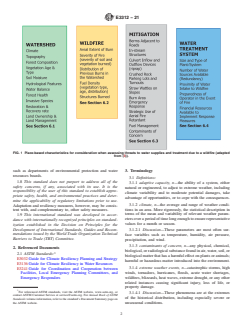
1.2.2 This guide will recommend fuel management prior to a wildfire, suppression strategies during a wildfire, and mitigation opportunities for both forests and water treatment systems after the wildfire. It will also support collaboration between involved stakeholders (see Fig. 1 below).
FIG. 1 Place-based characteristics for consideration when assessing threats to water supplies and treatment due to a wildfire (adapted from (3)).
1.2.3 The purpose of this guide is to provide a series of options that water utilities, landowners, and land managers can implement to limit the chance of a wildfire, specifically in a drinking water watershed, and mitigation opportunities to protect drinking water after a wildfire occurs. This guide encourages consistent management of forests to limit wildfire risks to water resources. The guide presents practices and recommendations based on the best available science to provide institutional and engineering actions to reduce the likelihood of a wildfire and the potentially disas...
- Status
- Published
- Publication Date
- 31-Aug-2021
- Technical Committee
- E50 - Environmental Assessment, Risk Management and Corrective Action
- Drafting Committee
- E50.05 - Environmental Risk Management
Overview
ASTM E3312-21: Standard Guide for Mitigation of Wildfire Impact to Source Water Protection Areas and Risk to Water Utilities provides vital guidance on developing strategies and plans to minimize the adverse effects of wildfires on crucial water resources. Wildfires can introduce contaminants into surface water and groundwater systems, posing a substantial threat to drinking water quality and the operations of water utilities. This ASTM standard focuses on actionable mitigation solutions-prior to, during, and after a wildfire-with the goal of preserving water quality and availability in Source Water Protection Areas. Emphasizing stakeholder cooperation, the guide is essential for communities, public and private land managers, utilities, and regulators seeking climate-resilient water resource management.
Key Topics
- Wildfire Impact on Water Resources: Overview of physical and chemical changes in watersheds following wildfires, including increased sediment, trace minerals, and contaminants.
- Mitigation Strategies: Guidance on fuel management before a wildfire, suppression actions during an event, and post-fire rehabilitation for both forests and water treatment infrastructure.
- Community Coordination: Importance of cooperation among utility operators, government agencies, fire departments, land managers, and local stakeholders to ensure effective preparedness and response.
- Risk and Vulnerability Assessment: Framework for evaluating source water vulnerability to wildfire threats, prioritizing actions, and identifying critical assets at risk.
- Stakeholder Involvement: Recommendations for engaging a broad spectrum of stakeholders-including tribal, state, and federal agencies; public works; financial institutions; developers; NGOs; and landowners-in preparedness and mitigation planning.
Applications
This standard is widely applicable to:
- Water Utilities and Public Works: Helps utilities develop wildfire emergency preparedness and mitigation plans to protect both groundwater and surface water supplies.
- Land and Resource Managers: Provides practical direction for forest management practices that reduce wildfire risk and protect drinking water sources.
- Urban and Regional Planners: Assists local governments in integrating wildfire risk mitigation into climate resilience and land use planning.
- Emergency Management: Guides emergency managers and response teams in developing comprehensive, community-based wildfire response plans.
- Educational and Conservation Entities: Supports nature preserves, experimental forests, and conservation groups in safeguarding ecological and water resources from wildfire damage.
- Financial and Insurance Sectors: Offers background to support risk analysis and strategic planning for properties and assets in wildfire-prone regions.
The standard emphasizes broad awareness, education, stakeholder engagement, and the use of both institutional and engineering controls, such as vegetative fuel breaks, upgraded filtration systems, and integrated watershed management.
Related Standards
- ASTM E3136 – Guide for Climate Resiliency in Water Resources: Provides additional guidance for water utilities as they address climate-driven risks.
- ASTM E3032 – Guide for Climate Resiliency Planning and Strategy: Addresses broader organizational climate adaptation strategies.
- ASTM E3241 – Guide for Coordination and Cooperation between Facilities, Local Emergency Planning Committees, and Emergency Responders: Supports collaborative community preparedness efforts.
This guide complements existing source water protection frameworks and fills a gap in regulatory guidance, particularly for planning and mitigation efforts related to wildfire impacts. Its value extends to settings with variable legal requirements, offering a flexible but structured approach to safeguarding drinking water resources.
ASTM E3312-21 is an essential resource for building climate resilience, protecting public health, and ensuring sustainable water resource management in fire-prone landscapes. By promoting best practices, cross-sector collaboration, and informed planning, it empowers a wide array of stakeholders to reduce the risks wildfires pose to source water and water utilities.
Relations
- Effective Date
- 01-Feb-2020
- Effective Date
- 01-Dec-2015
Get Certified
Connect with accredited certification bodies for this standard

CIS Institut d.o.o.
Personal Protective Equipment (PPE) certification body. Notified Body NB-2890 for EU Regulation 2016/425 PPE.

Kiwa BDA Testing
Building and construction product certification.
Kmetijski inštitut Slovenije
Agricultural Institute of Slovenia. Soil testing, plant health, agricultural product analysis.
Sponsored listings
Frequently Asked Questions
ASTM E3312-21 is a guide published by ASTM International. Its full title is "Standard Guide for Mitigation of Wildfire Impact to Source Water Protection Areas and Risk to Water Utilities". This standard covers: SIGNIFICANCE AND USE 4.1 This guide addresses issues related solely to strategies and the development of a plan to address wildfire-related physical and chemical changes to water resources in Source Water Protection Areas. This guide does not include specific advice on risk assessment. Mitigation strategies and planning may consist of a wide variety of actions by individuals, communities, or organizations to prepare for the impacts of wildfires on water quality and quantity in Source Water Protection Areas (see Guide E3136). 4.2 Source water protection activities not only help the utility identify risk, but they are also necessary to educate regulatory agencies, permitting authorities, and the community about the impacts that their actions can have on source water quality or quantity of the drinking water. 4.3 Example Users: 4.3.1 Federal, tribal, state, or municipal facility staff and regulators, including departments of health, water, sewer, and fire; 4.3.2 Financial and insurance institutions; 4.3.3 Federal, tribal, state, or local land managers; 4.3.4 Public works staff, including water systems, groundwater supplies, surface water supplies, stormwater systems, wastewater systems, publicly owned treatment works, and agriculture water management agencies; 4.3.5 Consultants, auditors, state, municipal and private inspectors, and compliance assistance personnel; 4.3.6 Educational facilities such as experimental forests and nature preserves; 4.3.7 Non-regulatory government agencies, such as the military; 4.3.8 Wildlife management entities including government, tribal, and non-governmental organizations (NGOs); 4.3.9 Cities, towns, and counties, especially in developing climate vulnerability strategies and plans; 4.3.10 Commercial and residential real estate property developers, including redevelopers; 4.3.11 Non-profits, community groups, and land owners. 4.4 Coordination and cooperation must fit into the process for improving community prepared... SCOPE 1.1 Overview—Wildfires pose a significant risk to water utilities as they can cause contaminants of concern to be released into surface water and groundwater supplies (1).2 This can endanger human health if systems were not designed to manage these contaminant loads. 1.2 Purpose—Mitigation measures of wildfire effects on sediment loads, trace minerals, and contaminants of concern on runoff in a Source Water Protection Area (2) is an expanding area of study that does not have a full set of regulations at the federal or state level. This guide provides public-sector and private-sector land managers and water utility operators details on how to assess the potential impacts of wildfires on watersheds and measures that can be employed to minimize or abate those impacts prior to a wildfire occurring or after it occurs. 1.2.1 This guide supplements existing watershed and Source Water Protection Area guidance. 1.2.2 This guide will recommend fuel management prior to a wildfire, suppression strategies during a wildfire, and mitigation opportunities for both forests and water treatment systems after the wildfire. It will also support collaboration between involved stakeholders (see Fig. 1 below). FIG. 1 Place-based characteristics for consideration when assessing threats to water supplies and treatment due to a wildfire (adapted from (3)). 1.2.3 The purpose of this guide is to provide a series of options that water utilities, landowners, and land managers can implement to limit the chance of a wildfire, specifically in a drinking water watershed, and mitigation opportunities to protect drinking water after a wildfire occurs. This guide encourages consistent management of forests to limit wildfire risks to water resources. The guide presents practices and recommendations based on the best available science to provide institutional and engineering actions to reduce the likelihood of a wildfire and the potentially disas...
SIGNIFICANCE AND USE 4.1 This guide addresses issues related solely to strategies and the development of a plan to address wildfire-related physical and chemical changes to water resources in Source Water Protection Areas. This guide does not include specific advice on risk assessment. Mitigation strategies and planning may consist of a wide variety of actions by individuals, communities, or organizations to prepare for the impacts of wildfires on water quality and quantity in Source Water Protection Areas (see Guide E3136). 4.2 Source water protection activities not only help the utility identify risk, but they are also necessary to educate regulatory agencies, permitting authorities, and the community about the impacts that their actions can have on source water quality or quantity of the drinking water. 4.3 Example Users: 4.3.1 Federal, tribal, state, or municipal facility staff and regulators, including departments of health, water, sewer, and fire; 4.3.2 Financial and insurance institutions; 4.3.3 Federal, tribal, state, or local land managers; 4.3.4 Public works staff, including water systems, groundwater supplies, surface water supplies, stormwater systems, wastewater systems, publicly owned treatment works, and agriculture water management agencies; 4.3.5 Consultants, auditors, state, municipal and private inspectors, and compliance assistance personnel; 4.3.6 Educational facilities such as experimental forests and nature preserves; 4.3.7 Non-regulatory government agencies, such as the military; 4.3.8 Wildlife management entities including government, tribal, and non-governmental organizations (NGOs); 4.3.9 Cities, towns, and counties, especially in developing climate vulnerability strategies and plans; 4.3.10 Commercial and residential real estate property developers, including redevelopers; 4.3.11 Non-profits, community groups, and land owners. 4.4 Coordination and cooperation must fit into the process for improving community prepared... SCOPE 1.1 Overview—Wildfires pose a significant risk to water utilities as they can cause contaminants of concern to be released into surface water and groundwater supplies (1).2 This can endanger human health if systems were not designed to manage these contaminant loads. 1.2 Purpose—Mitigation measures of wildfire effects on sediment loads, trace minerals, and contaminants of concern on runoff in a Source Water Protection Area (2) is an expanding area of study that does not have a full set of regulations at the federal or state level. This guide provides public-sector and private-sector land managers and water utility operators details on how to assess the potential impacts of wildfires on watersheds and measures that can be employed to minimize or abate those impacts prior to a wildfire occurring or after it occurs. 1.2.1 This guide supplements existing watershed and Source Water Protection Area guidance. 1.2.2 This guide will recommend fuel management prior to a wildfire, suppression strategies during a wildfire, and mitigation opportunities for both forests and water treatment systems after the wildfire. It will also support collaboration between involved stakeholders (see Fig. 1 below). FIG. 1 Place-based characteristics for consideration when assessing threats to water supplies and treatment due to a wildfire (adapted from (3)). 1.2.3 The purpose of this guide is to provide a series of options that water utilities, landowners, and land managers can implement to limit the chance of a wildfire, specifically in a drinking water watershed, and mitigation opportunities to protect drinking water after a wildfire occurs. This guide encourages consistent management of forests to limit wildfire risks to water resources. The guide presents practices and recommendations based on the best available science to provide institutional and engineering actions to reduce the likelihood of a wildfire and the potentially disas...
ASTM E3312-21 is classified under the following ICS (International Classification for Standards) categories: 13.060.01 - Water quality in general; 13.220.01 - Protection against fire in general. The ICS classification helps identify the subject area and facilitates finding related standards.
ASTM E3312-21 has the following relationships with other standards: It is inter standard links to ASTM E3241-20, ASTM E3032-15. Understanding these relationships helps ensure you are using the most current and applicable version of the standard.
ASTM E3312-21 is available in PDF format for immediate download after purchase. The document can be added to your cart and obtained through the secure checkout process. Digital delivery ensures instant access to the complete standard document.
Standards Content (Sample)
This international standard was developed in accordance with internationally recognized principles on standardization established in the Decision on Principles for the
Development of International Standards, Guides and Recommendations issued by the World Trade Organization Technical Barriers to Trade (TBT) Committee.
Designation:E3312 −21
Standard Guide for
Mitigation of Wildfire Impact to Source Water Protection
Areas and Risk to Water Utilities
This standard is issued under the fixed designation E3312; the number immediately following the designation indicates the year of
original adoption or, in the case of revision, the year of last revision. A number in parentheses indicates the year of last reapproval. A
superscript epsilon (´) indicates an editorial change since the last revision or reapproval.
1. Scope controls, and engineering controls that can be implemented by
utilities,landowners,andlandmanagersseekingtomitigatethe
1.1 Overview—Wildfires pose a significant risk to water
risk of wildfire in a source watershed. With climate change
utilities as they can cause contaminants of concern to be
2 wildfiresareanincreasinghazardthatcanaffectdrinkingwater
released into surface water and groundwater supplies (1). This
supplies. Often water utilities are not prepared for this risk and
can endanger human health if systems were not designed to
this guide seeks to support advanced planning.
manage these contaminant loads.
1.2.4 This guide ties into the ASTM E50 standards series
1.2 Purpose—Mitigation measures of wildfire effects on
related to environmental risk assessment and management.
sedimentloads,traceminerals,andcontaminantsofconcernon
1.2.5 The guide does not provide risk assessment, per se,
runoff in a Source Water Protection Area (2) is an expanding
but may help set priorities for creating a wildfire resilient
area of study that does not have a full set of regulations at the
watershed.
federal or state level. This guide provides public-sector and
1.3 Objectives—The objectives of this guide are to identify
private-sector land managers and water utility operators details
the risks of a source watershed o forest to wildfire and identify
on how to assess the potential impacts of wildfires on water-
actions that can be taken to manage those risks. The guide
sheds and measures that can be employed to minimize or abate
encourages users to set priorities based upon their associated
those impacts prior to a wildfire occurring or after it occurs.
risk. The guide encourages the us to develop long-term
1.2.1 This guide supplements existing watershed and
solutions for future wildfire risks.
Source Water Protection Area guidance.
1.2.2 This guide will recommend fuel management prior to 1.4 Limitations of this Guide—Given the different types of
a wildfire, suppression strategies during a wildfire, and miti- organizations that may wish to use this guide, as well as
gation opportunities for both forests and water treatment variations in state and local regulations, it is not possible to
systems after the wildfire. It will also support collaboration address all the relevant circumstances that might apply to a
between involved stakeholders (see Fig. 1 below). particular area. This guide uses generalized language and
1.2.3 The purpose of this guide is to provide a series of examples for the user. If it is not clear to the user how to apply
options that water utilities, landowners, and land managers can standards to their specific circumstances, users should seek
implement to limit the chance of a wildfire, specifically in a assistance from qualified professionals. Risks may vary de-
drinking water watershed, and mitigation opportunities to pending on the entity evaluating the risk. This guide does not
protect drinking water after a wildfire occurs. This guide take a position on the causes or science of extreme weather,
encourages consistent management of forests to limit wildfire natural disasters, or changing environmental conditions.
risks to water resources. The guide presents practices and
1.5 The guide uses references and information from many
recommendations based on the best available science to
cited sources on the control, management, and reduction of
provide institutional and engineering actions to reduce the
pre- and post-fire impacts.
likelihood of a wildfire and the potentially disastrous conse-
1.6 Several national and international agencies served as
quences. It presents available technologies, institutional
sources of information on existing and anticipated levels and
management of wildfire risks to drinking water supplies
This test method is under the jurisdiction of ASTM Committee E50 on
including:theWaterServicesAssociationofAustralia;theU.S.
Environmental Assessment, Risk Management and Corrective Action and is the
Department ofAgriculture; the U.S. Environmental Protection
direct responsibility of Subcommittee E50.05 on Environmental Risk Management.
Current edition approved Sept. 1, 2021. Published September 2021. DOI: Agency.
10.1520/E3312–21
2 1.7 This guide recommends reference to current regulatory
The boldface numbers in parentheses refer to a list of references at the end of
this standard. information about risks gathered from various state agencies,
Copyright © ASTM International, 100 Barr Harbor Drive, PO Box C700, West Conshohocken, PA 19428-2959. United States
E3312−21
FIG. 1 Place-based characteristics for consideration when assessing threats to water supplies and treatment due to a wildfire (adapted
from (3)).
such as departments of environmental protection and water 3. Terminology
resources boards.
3.1 Definitions:
1.8 This standard does not purport to address all of the
3.1.1 adaptive capacity, n—the ability of a system, either
safety concerns, if any, associated with its use. It is the
natural or engineered, to adjust to extreme weather, including
responsibility of the user of this standard to establish appro-
climate variability and to moderate potential damages, take
priate safety, health, and environmental practices and deter-
advantage of opportunities, or to cope with the consequences.
mine the applicability of regulatory limitations prior to use.
3.1.2 climate, n—the average and range of weather condi-
Adaptation and resiliency measures, however, may be consis-
tions in an area. More rigorously, the statistical description in
tent with, and complementary to, other safety measures.
terms of the mean and variability of relevant weather param-
1.9 This international standard was developed in accor-
etersoveraperiodoftimelongenoughtoensurerepresentative
dance with internationally recognized principles on standard-
values for a month or season.
ization established in the Decision on Principles for the
Development of International Standards, Guides and Recom-
3.1.2.1 Discussion—These parameters are most often sur-
mendations issued by the World Trade Organization Technical face variables such as temperature, humidity, air pressure,
Barriers to Trade (TBT) Committee.
precipitation, and wind.
3.1.3 contaminants of concern, n—any physical, chemical,
2. Referenced Documents
biological,orradiologicalsubstancefoundinair,water,soil,or
2.1 ASTM Standards:
biologicalmatterthathasaharmfuleffectonplantsoranimals;
E3032 Guide for Climate Resiliency Planning and Strategy
harmful or hazardous matter introduced into the environment.
E3136 Guide for Climate Resiliency in Water Resources
3.1.4 extreme weather events, n—catastrophic storms, high
E3241 Guide for Coordination and Cooperation between
winds, tornadoes, hurricanes, floods, acute water shortages,
Facilities, Local Emergency Planning Committees, and
wildfires, blizzards, heat waves, extreme drought, or any other
Emergency Responders
related instances causing significant injury, loss of life, or
property damage.
For referenced ASTM standards, visit the ASTM website, www.astm.org, or
3.1.4.1 Discussion—These phenomena are at the extremes
contact ASTM Customer Service at service@astm.org. For Annual Book of ASTM
of the historical distribution, including especially severe or
Standards volume information, refer to the standard’s Document Summary page on
the ASTM website. unseasonal conditions.
E3312−21
3.1.5 fire risk, n—various rating systems to determine the wastewater systems, publicly owned treatment works, and
likelihood of a fire, given weather and wind conditions. agriculture water management agencies;
3.1.5.1 Discussion—The National Fire Protection Associa- 4.3.5 Consultants, auditors, state, municipal and private
tion has a rating system (4). The USDA developed a Wildfire inspectors, and compliance assistance personnel;
RiskAssessment Framework for Land and Resources Manage- 4.3.6 Educational facilities such as experimental forests
ment (5) that stakeholders may find useful. and nature preserves;
4.3.7 Non-regulatory government agencies, such as the
3.1.6 mitigation, n—attempts to lower or compensate for
military;
risks from weather/climate related events including flood, fire,
4.3.8 Wildlife management entities including government,
drought, extreme temperature, sea level rise, and storms.
tribal, and non-governmental organizations (NGOs);
3.1.7 source water protection area, n—watershed area that
4.3.9 Cities, towns, and counties, especially in developing
is safeguarded to preserve and improve water quality for
climate vulnerability strategies and plans;
consumers.
4.3.10 Commercial and residential real estate property
3.1.7.1 Discussion—U.S. Environmental ProtectionAgency
developers, including redevelopers;
is the organization that originally defined this term (6).
4.3.11 Non-profits, community groups, and land owners.
3.2 Acronyms:
4.4 Coordination and cooperation must fit into the process
3.2.1 BAER – Burned Area Emergency Response
for improving community preparedness.
3.2.2 DWMAPS – Drinking Water Mapping Application to
4.4.1 Preparedness is based first on the community devel-
Protect Source Waters
opingabroadawarenessandunderstandingoftherisksthatare
3.2.3 ENVI – Environment for Visualizing Images
present locally. Next comes a community-wide evaluation of
3.2.4 GRASS – Geographical Resources Analysis Support
which community members or assets are most vulnerable to
System
risks, the mechanisms or pathways of risks, and the existing
3.2.5 gS-SURGO – Gridded Soil Survey Geographic data-
capabilities to address those risks should a wildfire occur (see
base
Guide E3241). The capabilities being evaluated include more
3.2.6 HRU – Hydrologic Response Unit
thantheabilityofthefirstrespondersorwildlandfirefightersto
3.2.7 NGO – Non-Governmental Organization
take actions. It includes the capabilities of all community
3.2.8 MFI – Mean Fire Interval
members to take appropriate actions.
3.2.9 NRCS – Natural Resources Conservation Service
4.4.2 All communities have capability gaps when evaluated
3.2.10 SAR – Synthetic Aperture Radar
against the risks present in the community. Strategic planning
3.2.11 SBS – Soil Burn Severity
aims to fill those capability gaps with prioritization for efforts
3.2.12 SWAT – Soil and Water Assessment Tool
developed by the community members. Again, improved
3.2.13 USDA – U.S. Department of Agriculture
preparedness is the goal, not simply focusing on response
3.2.14 USEPA – U.S. Environmental Protection Agency
capacity. A wildfire preparedness plan is a good first step.
3.2.15 USGS – U.S. Geological Survey
4.4.3 Filling capability gaps requires the use of all the
regulatory and social tools available to the community and its
4. Significance and Use
partners. All community members have a stake in accident
4.1 This guide addresses issues related solely to strategies
prevention, consequence reduction, and improved collective
and the development of a plan to address wildfire-related
ability to communicate and respond. Improvements are made
physical and chemical changes to water resources in Source
through increased awareness, education, training, cooperative
Water Protection Areas. This guide does not include specific
programs, and practice. Addressing the identified capability
advice on risk assessment. Mitigation strategies and planning
gaps can include a broad range of options such as accident
may consist of a wide variety of actions by individuals,
prevention to creation of expectations for the actions of
communities, or organizations to prepare for the impacts of
community members to be able to shelter, evacuate, and
wildfires on water quality and quantity in Source Water
provide aid to others. Stakeholder engagement is critical to
Protection Areas (see Guide E3136).
successfully closing capability gaps. This could include forest
4.2 Source water protection activities not only help the management,clearingfuelfromaroundstructures,andupgrad-
ing water filtration systems.
utility identify risk, but they are also necessary to educate
regulatory agencies, permitting authorities, and the community 4.4.4 Accomplishing these tasks is a community-level ac-
tivity. While it might be led by an emergency manager or local
about the impacts that their actions can have on source water
quality or quantity of the drinking water. emergency planning committee, the key to successful pre-
paredness planning is broad coordination and cooperation
4.3 Example Users:
involving all community members (see Guide E3241).
4.3.1 Federal, tribal, state, or municipal facility staff and
regulators, including departments of health, water, sewer, and
5. Risk and Vulnerability Assessment
fire;
4.3.2 Financial and insurance institutions; 5.1 This guide establishes a framework of wildfire risk and
4.3.3 Federal, tribal, state, or local land managers; vulnerability assessment approaches for water resources in
4.3.4 Public works staff, including water systems, ground- NorthAmerica. It may have value when applied to other areas.
water supplies, surface water supplies, stormwater systems, The user is advised to review Handbook for Developing
E3312−21
Watershed Plans to Restore and Protect our Waters (7), and 5.3.4 Establish the wildfire-related water utility parameters
Developing a Watershed Vulnerability Index (8). of concern. Decide on a time frame for the risk and vulner-
ability assessment.
5.2 Introduction to the Concept of a Risk and Vulnerability
5.3.5 Conduct the Risk and Vulnerability Assessment:
Assessment:
5.3.5.1 Assess the wildfire risk based on the consequence of
5.2.1 Wildfire may pose both direct and indirect risks or
an impact and the probability and likelihood of occurrence.
threats to businesses and properties including water utilities
5.3.5.2 Understand the level of risk perception and risk
and water users. Wildfire may cause economic damages in the
tolerance for the source water protection area, the
form of flood damage, water supply disruptions, critical water
landowner(s), land managers, water utility, with consideration
supply infrastructure outages, increased insurance rates, de-
of the contaminants of concern.
creased property values, and reduction of water quality. This
5.3.5.3 Contaminants of concern can be sediment that is
guide addresses wildfire preparedness strategies and plans,
mobilized after a wildfire or other chemicals or substances that
taking a measured approach to promote effective risk manage-
are located in said soil. The contaminants could be a result of
mentstrategiesforthehighestpriorityvulnerabilitiesidentified
heavy industry operating in the area or naturally occurring.
by the user.
5.3.6 Assess the wildfire vulnerability of the water resource
5.2.2 Risk Communication and Stakeholder Engagement—
and water utility infrastructure based on 5.3.1 – 5.3.5.3 above.
The user should seek the input of the public and conduct
outreach activities and community engagement in identifying
6. Procedure
themostvulnerableSourceWaterProtectionAreaintheregion
ofconcern.Table1identifiespotentialsignificantstakeholders. 6.1 Thissectionfollowsthefourbroadcategoriesillustrated
The user should involve all relevant stakeholders based upon in Fig. 1; watershed, wildfire, mitigation, and water treatment
the characteristics of land ownership as well as public and system.
private infrastructure within the Source Water ProtectionArea.
6.2 Steps to Assess Vulnerability in a Source Watershed:
5.3 Communicate vulnerability to the public; ensure stake- 6.2.1 The land managers and water utility should confirm
holders are aware of actual risk and address risk perception the boundaries of the watershed and its subbasins in accor-
barriers. This includes addressing non-support for key adapta- dance with federal or state regulations. The U.S. EPA’s
tion measures because the risk is perceived as low. Drinking Water MappingApplication to Protect Source Waters
5.3.1 Identify stakeholders and integrate stakeholder needs (DWMAPS) is a useful tool and is available at https:/
into wildfire response plans. (See Table 1.) geopub.epa.gov/DWWidgetApp.Thedatasetsarecurrentasof
5.3.2 Plan, prioritize, prepare, implement, and review plan March 2021 (9).
over time. (See Fig. 2 from the U.S. EPA.) 6.2.1.1 The DWMAPS will show the approximate location
5.3.3 Identify the water resource, its current conditions, of known potential sources of contaminants within the water-
beneficial uses, and vulnerabilities. This includes the lifespan shed.These potential sources of contamination include, but are
not limited to, mines and quarries, serpentine outcrops, and
of any critical equipment and structures used to manage the
resource. current and abandoned railroad rights-of-way.
TABLE 1 Stakeholder Identification
Users Potential Stakeholders
Small businesses Business and neighborhood associations.
Service industries Customers, industry associations, and consumer groups.
Government facilities Federal, military, tribal, state, or municipal employees and citizen concern groups including departments of health, water
and regulators customers, sewer customers, and fire departments.
Financial institutions Bank and insurance staff and customers.
Public works Staff and customers of water systems, groundwater supplies, surface water supplies, stormwater systems, wastewater
managers systems, publicly owned treatment works, and agriculture water management agencies.
Consultants Contractors, auditors, state, municipal, and private inspectors, and compliance assistance personnel.
Non-profit community Conservation associations, land trusts, community action groups, historic preservation groups.
organizations and groups
Non-regulatory Military base groups, neighborhood associations, and planning agencies.
government
Wildlife management Government and tribal forest and conservation services, park users, and non-governmental conservation organizations.
Local government Cities, towns, and counties, especially in developing wildfire vulnerability strategies and plans, and associated citizen
and the public groups.
Real estate agencies Commercial forestland, property, real estate professionals and managers.
E3312−21
FIG. 2Source Water Protection Flow Chart from US EPA Source Water Protection (6).
6.2.2 The land managers and water utility and other stake- the latest models and online training from the Texas A&M
holders should also consider applying U.S. Department of
University at https://swat.tamu.edu/ (12).
Agriculture’s Soil and Water Assessment Tool (SWAT) (10).
6.2.2.2 Each sub-basin contains a reach of the stream that
TheSoil&WaterAssessmentToolisasmallwatershedtoriver
will transfer its loadings at its outlet to the inlet of the next
basin scale model used to simulate the quality and quantity of
downstream sub-basin, therefore creating a stream network.
surfaceandgroundwaterandpredicttheenvironmentalimpact
Within each sub-basin, hydrologic response units (HRUs)
of land use, land management practices, and climate change.
define unique combinations of land use, soil, and slope
SWAT is widely used in assessing soil erosion prevention and
categories. These HRUs are not spatially connected but rather
control, non-point source pollution control, and regional man-
represent a percentage of each sub-basin (11). HRUs and their
agement in watersheds.
unique combination of parameters are used to calculate sub-
6.2.2.1 Developed in the 1990s by the United States De-
basin outlet loadings (11). SWAT is also a continuous time
partment ofAgriculture (USDA), the public domain SWAThas
model allowing for investigation of long-term implications of
been widely accepted as a useful modeling tool for watershed
changes in land management practices, land use, or climate.
analysis and management (11). Primary reasons for develop-
Further advantages of SWAT include the readily available land
ment of SWAT were to predict the long-term effects of land
use, soil, and climate input data and its ability to model very
management practices in large, complex watersheds (10).
large watersheds (10).
SWAT is a physically-based model that uses topography,
climate, soil, land cover, land use, and management data to 6.2.3 Earth observation remote sensing tools such as Land-
calculate a wide range of hydrologic outputs through physical
sat 8 Operational Land Imager and Finland’s ICEYE synthetic
equations and laws (10). This is different from empirically
aperture radar can be used to identify the vegetation species
based models that utilize regression equations to calculate
and density of each sub-basin (13).
output variables. SWAToperates at the basin scale, making it a
NOTE 1—ICEYE operates small SAR satellites that can provide data on
semi-distributed model. Sub-basins are defined by topography
wildfire location and intensity in real time.
and a user-specified stream definition threshold. Users can find
E3312−21
6.2.3.1 The Landsat Operational Land Imager data, coupled roots of overstory species because of prolonged high tempera-
with Environment for Visualizing Images (ENVI) and the tures in the rooting zone.
Geographic Resources Analysis Support System (GRASS)
6.3.1.2 Surface fire—Fires that burn only the lowest vegeta-
software can be used to process satellite images to estimate the tion layer, which may be composed of grasses, herbs, low
level of forest fire danger of the source water area by
shrubs, mosses, or lichens.
vegetation types (13).
NOTE 2—In forests, woodlands, or savannas. surface fires are generally
6.2.3.2 The European Space Agency’s Sentinel-1 satellite
low to moderate severity and do not cause extensive mortality to the
mission provides a spatially and temporally complete global overstory vegetation.
SAR dataset. Operational usage of optical earth observation
6.3.1.3 Understory or sub-canopy fire—A fire that burns
datasets available at multiple times each day can produce fire
trees or tall shrubs under the main canopy. Depending on
hotspot detection point data (and in some instances, fire-
structure, this may also be called a surface fire.
affected area products). These datasets have enhanced fire
6.3.1.4 Crown fire—Afire that burns through the upper tree
management activities, with information available on web
or shrub canopy.
interfaces hosted by state and federal government (14).
NOTE 3—In most cases the understory vegetation is also burned.
6.2.4 The National Aeronautics and Space Administration
Depending on species, a crown fire may or may not be lethal to all
(NASA) has additional remote sensing platforms and datasets
dominant vegetation. An example of this would be many shrub and
available such as soil moisture data, evapotranspiration data,
broadleaf tree species that sprout from roots, root crowns, or stem bases
after their tops are killed. A crown fire may be continuous or may occur
water balance data, elevation, and terrain data. See https://
in patches within a lower severity burn.
earthdata.nasa.gov/learn/pathfinders/wildfire-data-pathfinder
(15).
6.3.1.5 Stand replacement fire—A fire that is lethal to most
of the dominant above ground vegetation and substantially
6.2.5 The stakeholders should apply local resources to
augment knowledge of potential sources of contamination. For changes the vegetation structure.
example, local agencies may have information on previous
NOTE 4—Stand replacement fires may occur in forests, woodlands, and
land uses, and they may have generated predictions of in-
savannas, annual grasslands, and shrublands. They may be crown fires or
creased turbidity, sediment, and water quality impairment that
high-severity surface fires or ground fires.
wouldbeexpectedfollowingprecipitationinthewatershedand
6.3.1.6 Mixed-severity fire—The severity of fires varies
sub- basins that have been burned by wildfire.
between nonlethal understory and lethal stand replacement fire
6.2.6 Invasive insects, such as western bark beetle, Asian
with the variation occurring in space or time.
Long-horned beetle, and Emerald ash borer damage and
NOTE 5—In some vegetation types the stage of succession, the
weaken trees, increasing the fuel load in the watershed. Feral
understory vegetation structure, the fuel condition or the weather, or a
swine damage tree bark and root systems. In addition, feral
combination thereof, may determine whether a low- or high-severity (or
swine damage the A1 and A2 soil horizons, which can lead to
surface or crown) fire occurs. In this case individual fires vary over time
increased erosion (16). between low-intensity surface fires and longer-interval stand replacement
fires. In others, the severity may vary spatially as a function of landscape
6.2.7 Remote sensing data from earth orbiting satellites can
complexity or vegetation pattern. The result may be a mosaic of young,
be used to quantify restoration and recovery rates for specific
older, and multiple-aged vegetation patches.
subbasins (17). Fuel treatment options (see 6.3) significantly
6.3.1.7 Fire Intensity—Theamountofenergyorheatrelease
affect vegetation restoration and recovery rates following fires
per unit time or area during the consumption of organic matter
(18). The user should collaborate with landowners and land
(20). The term has also been defined as “the rate of energy or
managers within the source water area to determine basin-
heat release per unit time, per unit length of fire front,
specific restoration and recovery rates. The user should con-
regardless of its depth.” Other measures of fire intensity
sider the effects of drought on watershed growth.
include fire line intensity, reaction intensity, and total fire flux,
6.2.8 Soils:
all of which refer to the actual burning event. Fire intensity is
6.2.8.1 The Natural Resources Conservation Service
a real-time burning measurement and does not directly indicate
(NRCS) provides a Gridded Soil Survey Geographic (gS-
theeffectsofthefireonthevegetationorsoilorthesubsequent
SURGO) database on soil type distribution that includes
ecosystemresponse (21).Forexample,ahighintensityfirethat
certain parameters used by the SWAT model (19). Soil types
exhibits extreme fire behavior (such as high flame length, rapid
are grouped into map units based on their productivity,
rateofs
...