


ASTM D1351-20
(Specification)Standard Specification for Thermoplastic Polyethylene Insulation for Electrical Wire and Cable
Standard Specification for Thermoplastic Polyethylene Insulation for Electrical Wire and Cable
ABSTRACT
This specification covers thermoplastic polymer insulation consisting substantially of polyethylene considered suitable for use on electrical wire or cable with specified maximum conductor sizes that will be used for continuous operation at specified conductor temperatures and maximum voltage ratings for power application or series lighting. Since the insulation material cannot be tested unless it has been formed around a conductor, tests shall then be done on insulated wire or cable in this specification are solely to determine the relevant property of the insulation material and not to test the insulated conductor or completed cable. Materials shall conform to physical properties as to unaged tensile strength and elongation at rupture, tensile strength and elongation at rupture after air oven aging, absorption coefficient, and insulation thickness. Insulations shall also be tested for their electrical performance in terms of AC and DC voltage, partial discharge, and insulation resistance.
SCOPE
1.1 This specification covers a thermoplastic insulation which consists substantially of polyethylene.
1.2 This type of insulation is considered suitable for use on wire or cable that will be used for continuous operation at conductor temperatures up to 75 °C with a maximum conductor size of 1000 kcmil (507 mm2). The maximum voltage rating shall not exceed 35 000 V for power application or 9 000 V for series lighting.
1.3 In many instances the insulation material cannot be tested unless it has been formed around a conductor. Therefore, tests done on insulated wire or cable in this specification are solely to determine the relevant property of the insulation material and not to test the insulated conductor or completed cable.
1.4 Whenever two sets of values are stated, in different units, the values in the first set are regarded as standard, while the values in parentheses are provided for information only and are not considered standard.
1.5 This international standard was developed in accordance with internationally recognized principles on standardization established in the Decision on Principles for the Development of International Standards, Guides and Recommendations issued by the World Trade Organization Technical Barriers to Trade (TBT) Committee.
General Information
- Status
- Published
- Publication Date
- 30-Sep-2020
- Technical Committee
- D09 - Electrical and Electronic Insulating Materials
- Drafting Committee
- D09.07 - Electrical Insulating Materials
Relations
- Effective Date
- 01-Mar-2024
- Effective Date
- 15-Nov-2016
- Effective Date
- 01-Nov-2015
- Effective Date
- 01-Nov-2014
- Effective Date
- 01-May-2014
- Effective Date
- 01-Nov-2013
- Effective Date
- 01-Apr-2012
- Effective Date
- 01-Jan-2012
- Effective Date
- 01-Aug-2011
- Effective Date
- 01-May-2008
- Effective Date
- 01-May-2007
- Effective Date
- 01-Apr-2006
- Effective Date
- 01-Mar-2005
- Effective Date
- 01-Mar-2004
- Effective Date
- 10-Apr-2002
Overview
ASTM D1351-20 is a widely recognized standard specification established by ASTM International for thermoplastic polyethylene insulation intended for electrical wire and cable. This specification covers the requirements for polyethylene-based insulation materials used on electrical conductors in applications up to specific voltage and temperature ratings. Designed primarily for power applications and series lighting, the standard ensures that polyethylene insulation provides reliable electrical and physical performance in demanding environments.
The scope of ASTM D1351-20 includes polyethylene insulation suitable for continuous operation at conductor temperatures up to 75°C, with allowable conductor sizes up to 1000 kcmil (507 mm²). Voltage ratings under this standard do not exceed 35,000 V for power applications and 9,000 V for series lighting circuits. Importantly, the tests specified focus on the insulation material’s properties once applied to the wire or cable, not on the finished cable itself.
Key Topics
- Material Composition: The standard specifies insulation must be substantially thermoplastic polyethylene, with different grades and classes depending on exposure to sunlight or weather.
- Performance Characteristics: Key physical requirements include:
- Minimum tensile strength and elongation at rupture (both before and after aging)
- Resistance to air oven aging (retention of tensile strength and elongation)
- Absorption coefficient
- Specified insulation thickness according to voltage rating and cable type
- Electrical Properties:
- AC and DC voltage withstand capability
- Insulation resistance
- Partial discharge performance for shielded cables
- Testing Protocols: Methods for physical property testing require insulation to be tested as formed on conductors. Electrical testing order is defined for consistency and accuracy.
- Safety Considerations: Includes comprehensive procedures for high-voltage testing, grounding, and the safe operation of test apparatus to prevent hazards.
- Application Scope: Guidance for both shielded and non-shielded cables, as well as specific requirements for series lighting cables.
Applications
ASTM D1351-20 is essential for manufacturers, engineers, and quality assurance professionals in the wire and cable industry. Key application areas include:
- Power Distribution: Ensures reliable insulation for cables used in various voltage-rated electrical distribution systems.
- Series Lighting Circuits: Specifies insulation suitable for high-voltage lighting applications, such as airport runways or roadway lighting.
- Industrial Installations: Used when durable, consistent electrical insulation is required for equipment wiring and power cables exposed to demanding operational environments.
- Utility and Infrastructure Projects: Guides the production of cable products that meet safety and performance expectations for commercial and municipal power systems.
By following ASTM D1351-20, users can ensure that polyethylene insulation for wire and cable delivers consistent electrical performance, mechanical integrity, and longevity in field applications.
Related Standards
For comprehensive compliance and testing, ASTM D1351-20 references several other standards, including:
- ASTM D1248: Specification for Polyethylene Plastics Extrusion Materials for Wire and Cable
- ASTM D1711: Terminology Relating to Electrical Insulation
- ASTM D2308: Specification for Thermoplastic Polyethylene Jacket for Electrical Wire and Cable
- ASTM D2633: Test Methods for Thermoplastic Insulations and Jackets for Wire and Cable
- ASTM D3349: Test Method for Absorption Coefficient of Ethylene Polymer Material Pigmented with Carbon Black
- ICEA T-24-380: Guide for Partial-Discharge Procedure
Compliance with these related standards ensures adherence to best practices for material selection, testing methodologies, and product consistency in electrical insulation systems.
Keywords: ASTM D1351-20, thermoplastic polyethylene insulation, electrical wire and cable, power cable insulation, insulation testing, electrical standards, cable manufacturing, insulation performance, series lighting insulation, polyethylene cables.
Buy Documents

ASTM D1351-20 - Standard Specification for Thermoplastic Polyethylene Insulation for Electrical Wire and Cable
REDLINE ASTM D1351-20 - Standard Specification for Thermoplastic Polyethylene Insulation for Electrical Wire and Cable
Get Certified
Connect with accredited certification bodies for this standard

Intertek Testing Services NA Inc.
Intertek certification services in North America.

UL Solutions
Global safety science company with testing, inspection and certification.

ANCE
Mexican certification and testing association.
Sponsored listings
Frequently Asked Questions
ASTM D1351-20 is a technical specification published by ASTM International. Its full title is "Standard Specification for Thermoplastic Polyethylene Insulation for Electrical Wire and Cable". This standard covers: ABSTRACT This specification covers thermoplastic polymer insulation consisting substantially of polyethylene considered suitable for use on electrical wire or cable with specified maximum conductor sizes that will be used for continuous operation at specified conductor temperatures and maximum voltage ratings for power application or series lighting. Since the insulation material cannot be tested unless it has been formed around a conductor, tests shall then be done on insulated wire or cable in this specification are solely to determine the relevant property of the insulation material and not to test the insulated conductor or completed cable. Materials shall conform to physical properties as to unaged tensile strength and elongation at rupture, tensile strength and elongation at rupture after air oven aging, absorption coefficient, and insulation thickness. Insulations shall also be tested for their electrical performance in terms of AC and DC voltage, partial discharge, and insulation resistance. SCOPE 1.1 This specification covers a thermoplastic insulation which consists substantially of polyethylene. 1.2 This type of insulation is considered suitable for use on wire or cable that will be used for continuous operation at conductor temperatures up to 75 °C with a maximum conductor size of 1000 kcmil (507 mm2). The maximum voltage rating shall not exceed 35 000 V for power application or 9 000 V for series lighting. 1.3 In many instances the insulation material cannot be tested unless it has been formed around a conductor. Therefore, tests done on insulated wire or cable in this specification are solely to determine the relevant property of the insulation material and not to test the insulated conductor or completed cable. 1.4 Whenever two sets of values are stated, in different units, the values in the first set are regarded as standard, while the values in parentheses are provided for information only and are not considered standard. 1.5 This international standard was developed in accordance with internationally recognized principles on standardization established in the Decision on Principles for the Development of International Standards, Guides and Recommendations issued by the World Trade Organization Technical Barriers to Trade (TBT) Committee.
ABSTRACT This specification covers thermoplastic polymer insulation consisting substantially of polyethylene considered suitable for use on electrical wire or cable with specified maximum conductor sizes that will be used for continuous operation at specified conductor temperatures and maximum voltage ratings for power application or series lighting. Since the insulation material cannot be tested unless it has been formed around a conductor, tests shall then be done on insulated wire or cable in this specification are solely to determine the relevant property of the insulation material and not to test the insulated conductor or completed cable. Materials shall conform to physical properties as to unaged tensile strength and elongation at rupture, tensile strength and elongation at rupture after air oven aging, absorption coefficient, and insulation thickness. Insulations shall also be tested for their electrical performance in terms of AC and DC voltage, partial discharge, and insulation resistance. SCOPE 1.1 This specification covers a thermoplastic insulation which consists substantially of polyethylene. 1.2 This type of insulation is considered suitable for use on wire or cable that will be used for continuous operation at conductor temperatures up to 75 °C with a maximum conductor size of 1000 kcmil (507 mm2). The maximum voltage rating shall not exceed 35 000 V for power application or 9 000 V for series lighting. 1.3 In many instances the insulation material cannot be tested unless it has been formed around a conductor. Therefore, tests done on insulated wire or cable in this specification are solely to determine the relevant property of the insulation material and not to test the insulated conductor or completed cable. 1.4 Whenever two sets of values are stated, in different units, the values in the first set are regarded as standard, while the values in parentheses are provided for information only and are not considered standard. 1.5 This international standard was developed in accordance with internationally recognized principles on standardization established in the Decision on Principles for the Development of International Standards, Guides and Recommendations issued by the World Trade Organization Technical Barriers to Trade (TBT) Committee.
ASTM D1351-20 is classified under the following ICS (International Classification for Standards) categories: 29.035.20 - Plastics and rubber insulating materials. The ICS classification helps identify the subject area and facilitates finding related standards.
ASTM D1351-20 has the following relationships with other standards: It is inter standard links to ASTM D1711-24, ASTM D1248-16, ASTM D1711-15, ASTM D1711-14a, ASTM D1711-14, ASTM D1711-13, ASTM D1248-12, ASTM D3349-12, ASTM D1711-11a, ASTM D1711-08, ASTM D2308-07, ASTM D3349-06, ASTM D1248-05, ASTM D1248-04, ASTM D1248-00a. Understanding these relationships helps ensure you are using the most current and applicable version of the standard.
ASTM D1351-20 is available in PDF format for immediate download after purchase. The document can be added to your cart and obtained through the secure checkout process. Digital delivery ensures instant access to the complete standard document.
Standards Content (Sample)
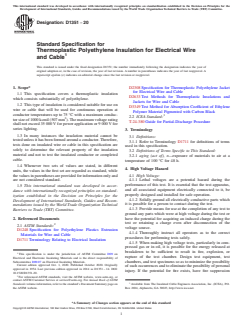
This international standard was developed in accordance with internationally recognized principles on standardization established in the Decision on Principles for the
Development of International Standards, Guides and Recommendations issued by the World Trade Organization Technical Barriers to Trade (TBT) Committee.
Designation:D1351 −20
Standard Specification for
Thermoplastic Polyethylene Insulation for Electrical Wire
and Cable
This standard is issued under the fixed designation D1351; the number immediately following the designation indicates the year of
original adoption or, in the case of revision, the year of last revision. A number in parentheses indicates the year of last reapproval. A
superscript epsilon (´) indicates an editorial change since the last revision or reapproval.
1. Scope* D2308 Specification for Thermoplastic Polyethylene Jacket
for Electrical Wire and Cable
1.1 This specification covers a thermoplastic insulation
D2633 Test Methods for Thermoplastic Insulations and
which consists substantially of polyethylene.
Jackets for Wire and Cable
1.2 This type of insulation is considered suitable for use on
D3349 Test Method for Absorption Coefficient of Ethylene
wire or cable that will be used for continuous operation at
Polymer Material Pigmented with Carbon Black
conductor temperatures up to 75 °C with a maximum conduc-
2.2 ICEA Standard:
torsizeof1000kcmil(507mm ).Themaximumvoltagerating
T-24-380 Guide for Partial-Discharge Procedure
shall not exceed 35 000Vfor power application or 9 000Vfor
series lighting.
3. Terminology
1.3 In many instances the insulation material cannot be
3.1 Definitions:
testedunlessithasbeenformedaroundaconductor.Therefore,
3.1.1 Refer to Terminology D1711 for definitions of terms
tests done on insulated wire or cable in this specification are
used in this specification.
solely to determine the relevant property of the insulation
3.2 Definitions of Terms Specific to This Standard:
material and not to test the insulated conductor or completed
3.2.1 aging (act of), n—exposure of materials to air at a
cable.
temperature of 100 °C for 48 h.
1.4 Whenever two sets of values are stated, in different
4. High Voltage Hazard
units, the values in the first set are regarded as standard, while
thevaluesinparenthesesareprovidedforinformationonlyand
4.1 High Voltage:
are not considered standard. 4.1.1 Lethal voltages are a potential hazard during the
performance of this test. It is essential that the test apparatus,
1.5 This international standard was developed in accor-
and all associated equipment electrically connected to it, be
dance with internationally recognized principles on standard-
properly designed and installed for safe operation.
ization established in the Decision on Principles for the
4.1.2 Solidly ground all electrically conductive parts which
Development of International Standards, Guides and Recom-
it is possible for a person to contact during the test.
mendations issued by the World Trade Organization Technical
4.1.3 Provide means for use at the completion of any test to
Barriers to Trade (TBT) Committee.
ground any parts which were at high voltage during the test or
have the potential for acquiring an induced charge during the
2. Referenced Documents
test or retaining a charge even after disconnection of the
2.1 ASTM Standards:
voltage source.
D1248 Specification for Polyethylene Plastics Extrusion
4.1.4 Thoroughly instruct all operators as to the correct
Materials for Wire and Cable
procedures for performing tests safely.
D1711 Terminology Relating to Electrical Insulation
4.1.5 When making high voltage tests, particularly in com-
pressed gas or in oil, it is possible for the energy released at
breakdown to be sufficient to result in fire, explosion, or
This specification is under the jurisdiction of ASTM Committee D09 on
rupture of the test chamber. Design test equipment, test
Electrical and Electronic Insulating Materials and is the direct responsibility of
Subcommittee D09.07 on Electrical Insulating Materials. chambers, and test specimens so as to minimize the possibility
Current edition approved Oct. 1, 2020. Published October 2020. Originally
of such occurrences and to eliminate the possibility of personal
approved in 1954. Last previous edition approved in 2014 as D1351 – 14. DOI:
injury. If the potential for fire exists, have fire suppression
10.1520/D1351-20.
For referenced ASTM standards, visit the ASTM website, www.astm.org, or
contact ASTM Customer Service at service@astm.org. For Annual Book of ASTM
Standards volume information, refer to the standard’s Document Summary page on Available from The Insulated Cable Engineers Association, Inc. (ICEA), P.O.
the ASTM website. Box 2694, Alpharetta, GA 30023, http://www.icea.net.
*A Summary of Changes section appears at the end of this standard
Copyright © ASTM International, 100 Barr Harbor Drive, PO Box C700, West Conshohocken, PA 19428-2959. United States
D1351−20
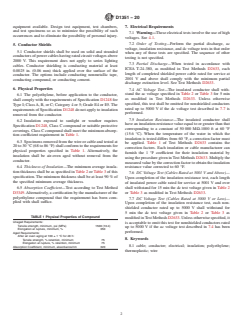
equipment available. Design test equipment, test chambers, 7. Electrical Requirements
and test specimens so as to minimize the possibility of such
7.1 Warning—These electrical tests involve the use of high
occurrences and to eliminate the possibility of personal injury.
voltages. See 4.1.
7.2 Order of Testing—Perform the partial discharge, ac
5. Conductor Shields
voltage, insulation resistance, and dc voltage tests in that order
5.1 Conductor shields shall be used on solid and stranded
when any of these tests are specified. The sequence of other
conductors of power cables having rated circuit voltages above
testing is not specified.
2000 V. This requirement does not apply to series lighting
7.3 Partial Discharge—When tested in accordance with
cables. Conductor shielding is conducting material at least
ICEA T-24-380, as modified in Test Methods D2633, each
0.0025 in. (0.06 mm) thick applied over the surface of the
length of completed shielded power cable rated for service at
conductor. The options include conducting nonmetallic tape,
2001 V and above shall comply with the minimum partial
conducting compound, or conducting cement.
discharge extinction level. See Test Methods D2633.
6. Physical Properties
7.4 AC Voltage Test—The insulated conductor shall with-
stand the ac voltage specified in Table 2 or Table 3 for 5 min
6.1 The polyethylene, before application to the conductor,
as modified in Test Methods D2633. Unless otherwise
shall comply with the requirements of Specification D1248 for
specified, this test shall be omitted for nonshielded conductors
Type I; ClassA, B, or C; Category 4 or 5; Grade E4 or E5.The
rated up to 5000 V if the dc voltage test described in 7.7 is
requirements of Specification D1248 do not apply to insulation
performed.
removed from the conductor.
7.5 Insulation Resistance—The insulated conductor shall
6.2 Insulation exposed to sunlight or weather requires
have an insulation-resistance value equal to or greater than that
Specification D1248, Class C compound or suitable protective
corresponding to a constant of 50 000 MΩ-1000 ft at 60 °F
coverings. Class C compound shall meet the minimum absorp-
(15.6 °C). When the temperature of the water in which the
tion coefficient requirement in Table 1.
insulation is tested differs from 60 °F, a correction factor must
6.3 Specimens removed from the wire or cable and tested at
be applied. Table 1 of Test Methods D2633 contains the
20 to 30 °C (68 to 86 °F) shall conform to the requirements for
correction factors. Each insulation or cable manufacturer can
physical properties specified in Table 1. Alternatively, the
furnish the 1 °F coefficient for their insulation material by
insulation shall be air-oven aged without removal from the
usingtheproceduregiveninTestMethodsD2633.Multiplythe
conductor.
measured value by the correction factor to obtain the insulation
6.4 Thickness of Insulation—The minimum average insula- resistance value corrected to 60 °F.
tion thickness shall be as specified in Table 2 or Table 3 of this
7.6 DC Voltage Test (Cables Rated at 5001 V and Above)—
specification. The minimum thickness shall be at least 90 % of
Upon completion of the insulation resistance test, each length
the specified minimum average thickness.
of insulated power cable rated for service at 5001 V and over
6.5 Absorption Coeffıcient—Test according to Test Method shall withstand for 15 min the dc test voltage given in Table 2
or Table 3 as modified in Test Methods D2633.
D3349.Alternatively, a certification by the manufacturer of the
polyethylene compound that the requirement has been com-
7.7 DC Voltage Test (Cables Rated at 5000 V or Less)—
plied with shall suffice.
Upon completion of the insulation resistance test, each non-
shielded conductor rated up to 5000 V shall withstand for
5 min the dc test voltage given in Table 2 or Table 3 as
TABLE 1 Physical Properties of Compound
modifiedinTestMethodsD2633.Unlessotherwisespecified,it
Unaged Requirements:
is acceptable to omit this test for nonshielded conductors rated
Tensile strength, minimum, psi (MPa) 1500 (10.4)
up to 5000 V if the ac voltage test described in 7.4 has been
Elongation at rupture, minimum, % 350
performed.
Aged Require
...
This document is not an ASTM standard and is intended only to provide the user of an ASTM standard an indication of what changes have been made to the previous version. Because
it may not be technically possible to adequately depict all changes accurately, ASTM recommends that users consult prior editions as appropriate. In all cases only the current version
of the standard as published by ASTM is to be considered the official document.
Designation: D1351 − 14 D1351 − 20
Standard Specification for
Thermoplastic Polyethylene Insulation for Electrical Wire
and Cable
This standard is issued under the fixed designation D1351; the number immediately following the designation indicates the year of
original adoption or, in the case of revision, the year of last revision. A number in parentheses indicates the year of last reapproval. A
superscript epsilon (´) indicates an editorial change since the last revision or reapproval.
1. Scope*
1.1 This specification covers a thermoplastic insulation which consists substantially of polyethylene.
1.2 This type of insulation is considered suitable for use on wire or cable that will be used for continuous operation at conductor
temperatures up to 75°C 75 °C with a maximum conductor size of 1000 kcmil (507 mm ). The maximum voltage rating shall not
exceed 35 000 V for power application or 9 000 V for series lighting.
1.3 In many instances the insulation material cannot be tested unless it has been formed around a conductor. Therefore, tests done
on insulated wire or cable in this specification are solely to determine the relevant property of the insulation material and not to
test the insulated conductor or completed cable.
1.4 Whenever two sets of values are presented,stated, in different units, the values in the firstfirst set are the regarded as standard,
while those the values in parentheses are provided for information only. only and are not considered standard.
1.5 This international standard was developed in accordance with internationally recognized principles on standardization
established in the Decision on Principles for the Development of International Standards, Guides and Recommendations issued
by the World Trade Organization Technical Barriers to Trade (TBT) Committee.
2. Referenced Documents
2.1 ASTM Standards:
D1248 Specification for Polyethylene Plastics Extrusion Materials for Wire and Cable
D1711 Terminology Relating to Electrical Insulation
D2308 Specification for Thermoplastic Polyethylene Jacket for Electrical Wire and Cable
D2633 Test Methods for Thermoplastic Insulations and Jackets for Wire and Cable
D3349 Test Method for Absorption Coefficient of Ethylene Polymer Material Pigmented with Carbon Black
2.2 ICEA Standard:
T-24-380 Guide for Partial-Discharge Procedure
3. Terminology
3.1 Definitions:
This specification is under the jurisdiction of ASTM Committee D09 on Electrical and Electronic Insulating Materials and is the direct responsibility of Subcommittee
D09.07 on Electrical Insulating Materials.
Current edition approved March 1, 2014Oct. 1, 2020. Published April 2014October 2020. Originally approved in 1954. Last previous edition approved in 20082014 as
D1351 – 08.D1351 – 14. DOI: 10.1520/D1351-14.10.1520/D1351-20.
For referenced ASTM standards, visit the ASTM website, www.astm.org, or contact ASTM Customer Service at service@astm.org. For Annual Book of ASTM Standards
volume information, refer to the standard’s Document Summary page on the ASTM website.
Available from The Insulated Cable Engineers Association, Inc. (ICEA), P.O. Box 1568, Carrollton,2694, Alpharetta, GA 30112,30023, http://www.icea.net.
*A Summary of Changes section appears at the end of this standard
Copyright © ASTM International, 100 Barr Harbor Drive, PO Box C700, West Conshohocken, PA 19428-2959. United States
D1351 − 20
3.1.1 Refer to Terminology D1711 for definitions of terms used in this specification.
3.2 Definitions of Terms Specific to This Standard:
3.2.1 aging (act of), n—exposure of materials to air at a temperature of 100°C 100 °C for 48 h.
4. High Voltage Hazard
4.1 High Voltage:
4.1.1 Lethal voltages are a potential hazard during the performance of this test. It is essential that the test apparatus, and all
associated equipment electrically connected to it, be properly designed and installed for safe operation.
4.1.2 Solidly ground all electrically conductive parts which it is possible for a person to contact during the test.
4.1.3 Provide means for use at the completion of any test to ground any parts which were at high voltage during the test or have
the potential for acquiring an induced charge during the test or retaining a charge even after disconnection of the voltage source.
4.1.4 Thoroughly instruct all operators as to the correct procedures for performing tests safely.
4.1.5 When making high voltage tests, particularly in compressed gas or in oil, it is possible for the energy released at breakdown
to be sufficient to result in fire, explosion, or rupture of the test chamber. Design test equipment, test chambers, and test specimens
so as to minimize the possibility of such occurrences and to eliminate the possibility of personal injury. If the potential for fire
exists, have fire suppression equipment available. Design test equipment, test chambers, and test specimens so as to minimize the
possibility of such occurrences and to eliminate the possibility of personal injury.
5. Conductor Shields
5.1 Conductor shields shall be used on solid and stranded conductors of power cables having rated circuit voltages above 2000
V. This requirement does not apply to series lighting cables. Conductor shielding is conducting material at least 0.0025 in. (0.06
mm) thick applied over the surface of the conductor. The options include conducting nonmetallic tape, conducting compound, or
conducting cement.
6. Physical Properties
6.1 The polyethylene, before application to the conductor, shall comply with the requirements of Specification D1248 for Type
I; Class A, B, or C; Category 4 or 5; Grade E4 or E5. The requirements of Specification D1248 do not apply to insulation removed
from the conductor.
6.2 Insulation exposed to sunlight or weather requires Specification D1248, Class C compound or suitable protective coverings.
Class C compound shall meet the minimum absorption coefficient requirement in Table 1.
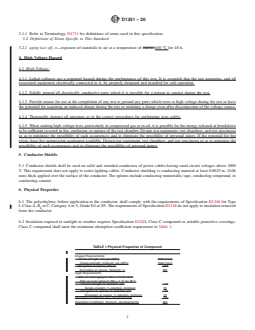
TABLE 1 Physical Properties of Compound
Unaged Requirements:
Tensile strength, min, psi (MPa) 1500 (10.4)
Tensile strength, minimum, psi (MPa) 1500 (10.4)
Elongation at rupture, min, % 350
Elongation at rupture, minimum, % 350
Aged Requirements:
After air oven aging at 100 ± 1°C for 48 h:
After air oven aging at 100 ± 1 °C for 48 h:
Tensile strength, % retention, min 75
Tensile strength, % retention, minimum 75
Elongation at rupture, % retention, min 75
Elongation at rupture, % retention, minimum 75
Absorption Coefficient, min, absorbance/nm 320
Absorption Coefficient, minimum, absorbance/nm 320
D1351 − 20
6.3 Specimens removed from the wire or cable and tested at 20 to 30°C30 °C (68 to 86°F)86 °F) shall conform to the requirements
for physical properties specified in Table 1. Alternatively, the insulation shall be air-oven aged without removal from the conductor.
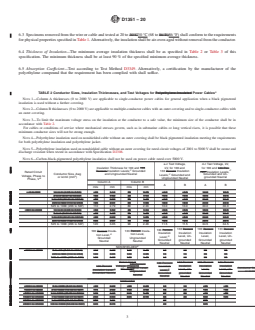
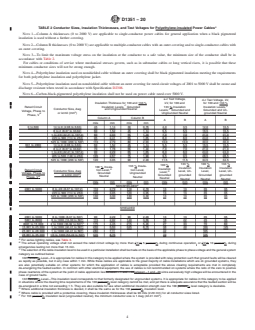
6.4 Thickness of Insulation—The minimum average insulation thickness shall be as specified in Table 2 or Table 3 of this
specification. The minimum thickness shall be at least 90 % of the specified minimum average thickness.
6.5 Absorption Coeffıcient—Test according to Test Method D3349. Alternatively, a certification by the manufacturer of the
polyethylene compound that the requirement has been complied with shall suffice.
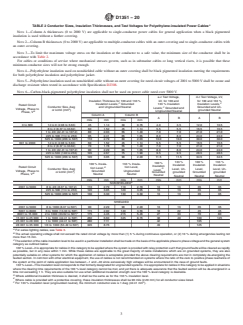
A
TABLE 2 Conductor Sizes, Insulation Thicknesses, and Test Voltages for Polyethylene-Insulated Power Cables
NOTE 1—Column A thicknesses (0 to 2000 V) are applicable to single-conductor power cables for general application when a black pigmented
insulation is used without a further covering.
NOTE 2—Column B thicknesses (0 to 2000 V) are applicable to multiple-conductor cables with an outer covering and to single-conductor cables with
an outer covering.
NOTE 3—To limit the maximum voltage stress on the insulation at the conductor to a safe value, the minimum size of the conductor shall be in
accordance with Table 2.
For cables or conditions of service where mechanical stresses govern, such as in submarine cables or long vertical risers, it is possible that these
minimum conductor sizes will not be strong enough.
NOTE 4—Polyethylene insulation used on nonshielded cable without an outer covering shall be black pigmented insulation meeting the requirements
for both polyethylene insulation and polyethylene jacket.
NOTE 5—Polyethylene insulation used on nonshielded cable without an outer covering for rated circuit voltages of 2001 to 5000 V shall be ozone and
discharge resistant when tested in accordance with Specification D2308.
NOTE 6—Carbon-black-pigmented polyethylene insulation shall not be used on power cable rated over 5000 V.
a-c Test Voltage,
d-c Test Voltage, kV,
Insulation Thickness for 100 and 133 kV, for 100 and
for 100 and 133 Per-
C
C
Percent Insulation Levels, Grounded 133 Percent Insulation
cent Insulation Levels,
Rated Circuit
Conductor Size, Awg C
and Ungrounded Neutral
Levels, Grounded and Grounded and Un-
Voltage, Phase to
or kcmil (mm ) Ungrounded Neutral grounded Neutral
B
Phase, V
Column A Column B
A B A B
mils mm mils mm
0 to 600 14 to 9 (2.08 to 6.63) 45 1.14 30 0.76 4.0 3.5 12.0 10.5
8 to 2 (8.37 to 33.62) 60 1.52 45 1.14 5.5 5.5 16.5 16.5
1 to 4/0 (42.41 to 107.2) 80 2.03 55 1.40 7.0 7.0 21.0 21.0
225 to 500 (114 to 253) 95 2.41 65 1.65 8.0 8.0 24.0 24.0
525 to 1000 (266 to 507) 110 2.79 80 2.03 10.0 10.0 30.0 30.0
601 to 2000 14 to 9 (2.08 to 6.63) 60 1.52 45 1.14 5.5 5.5 16.5 16.5
8 to 2 (8.37 to 33.62) 70 1.78 55 1.40 7.0 7.0 21.0 21.0
1 to 4/0 (42.41 to 107.2) 90 2.29 65 1.65 8.0 8.0 24.0 24.0
225 to 500 (140 to 253) 105 2.67 75 1.90 9.5 9.5 28.5 28.5
525 to 1000 (266 to 507) 120 3.05 90 2.29 11.5 11.5 34.5 34.5
133 Percent 100 Percent 133 Percent
100 Percent
133 Percent Insula-
100 Percent Insula-
Insulation Insulation Insulation
Insulation
D
tion Level,
tion Level,
D
Level, Un- Level, Level, Un-
Level,
Grounded Ungrounded
Grounded grounded Grounded grounded
Neutral
Neutral
Neutral
Neutral Neutral Neutral
E
NONSHIELDED
2001 to 5000 8 to 4/0 (8.37 to 107.2) 110 2.79 110 2.79 13 13 35 35
225 to 500 (114 to 253) 120 3.05 120 3.05 13 13 35 35
525 to 1000 (266 to 507) 130 3.30 130 3.30 13 13 35 35
Rated Circuit 133 Percent 100 Percent 133 Percent
100 Percent
133 Percent
Voltage, Phase to Insulation Insulation Insulation
100 Percent Insulation
Insulation Level, Conductor Size,
D B
D
Phase, V Level, Un- Level, Level, Un-
Insulation Level,
Level,
Ungrounded or kcmil
Grounded Neutral
Grounded grounded Grounded Grounded
Neutral
Neutral
Neutral Neutral Neutral
SHIELDED
2001 to 5000 8 to 1000 (8.37 to 507) 90 2.29 90 2.29 13 13 35 35
5001 to 8000 6 to 1000 (13.30 to 507) 115 2.92 140 3.56 18 22 45 45
F
8001 to 15000 2 to 1000 (33.62 to 507) 175 4.45 215 5.46 27 33 70 80
15001 to 25000 1 to 1000 (42.41 to 507) 260 6.60 345 8.76 38 49 100 125
25001 to 28000 1 to 1000 (42.41 to 507) 280 7.11 42 105
28001 to 35000 1/0 to 1000 (53.49 to 507) 345 8.76 49 125
D1351 − 20
A
TABLE 2 Conductor Sizes, Insulation Thicknesses, and Test Voltages for Polyethylene-insulated Power Cables
NOTE 1—Column A thicknesses (0 to 2000 V) are applicable to single-conductor power cables for general application when a black pigmented
insulation is used without a further covering.
NOTE 2—Column B thicknesses (0 to 2000 V) are applicable to multiple-conductor cables with an outer covering and to single-conductor cables with
an outer covering.
NOTE 3—To limit the maximum voltage stress on the insulation at the conductor to a safe value, the
...
Questions, Comments and Discussion
Ask us and Technical Secretary will try to provide an answer. You can facilitate discussion about the standard in here.
Loading comments...